7 Reports
7.1
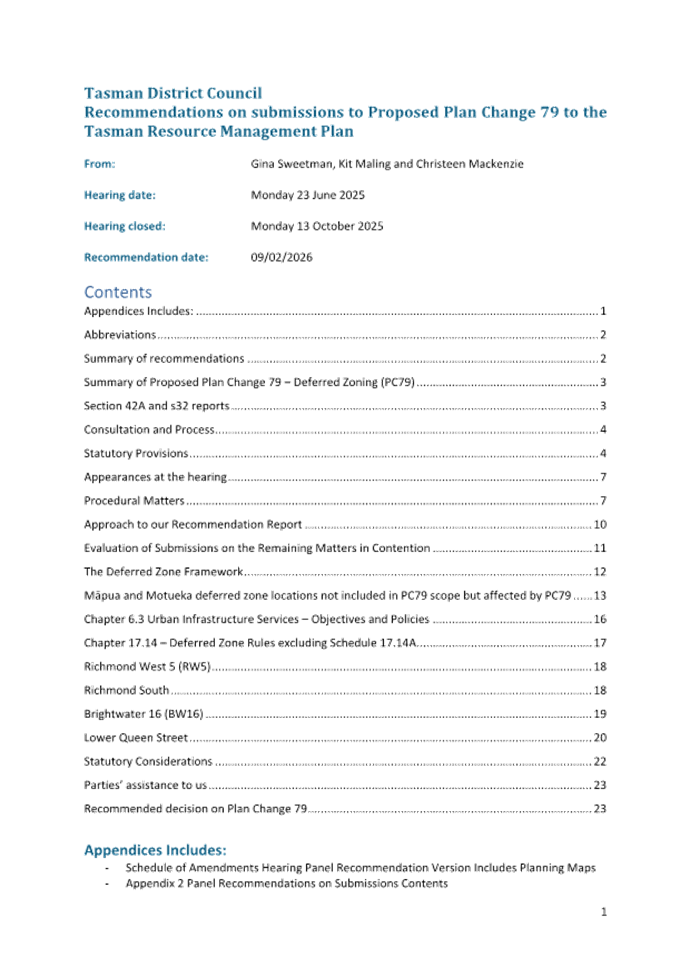
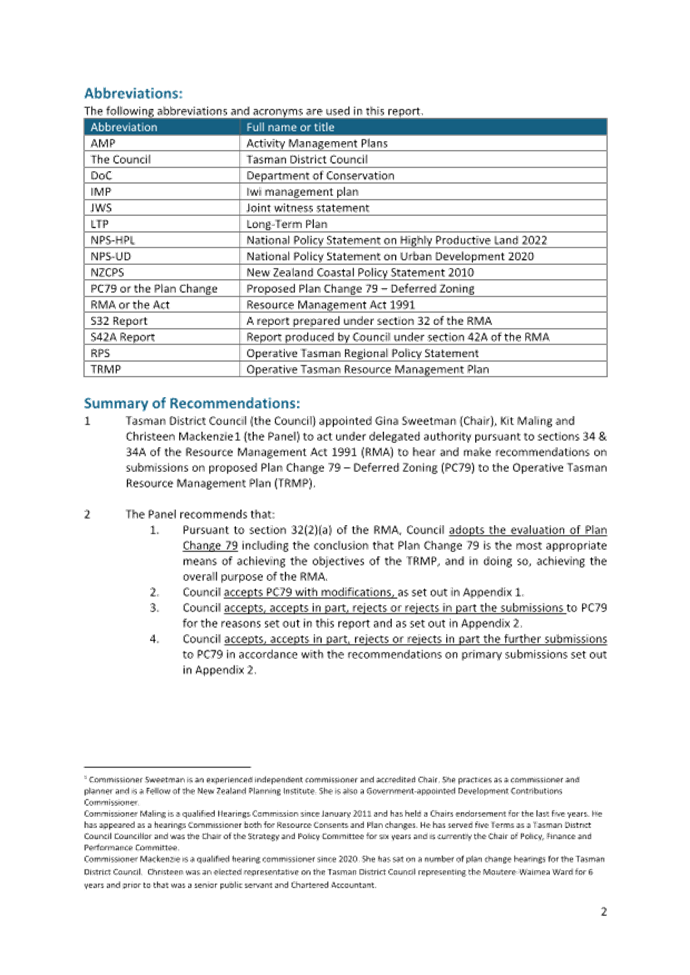
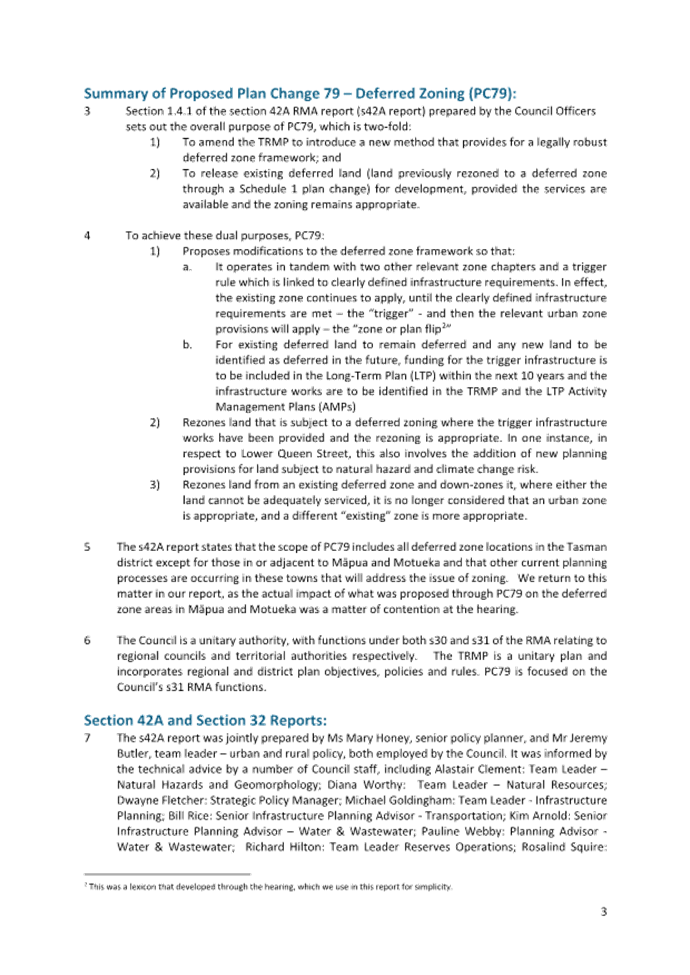
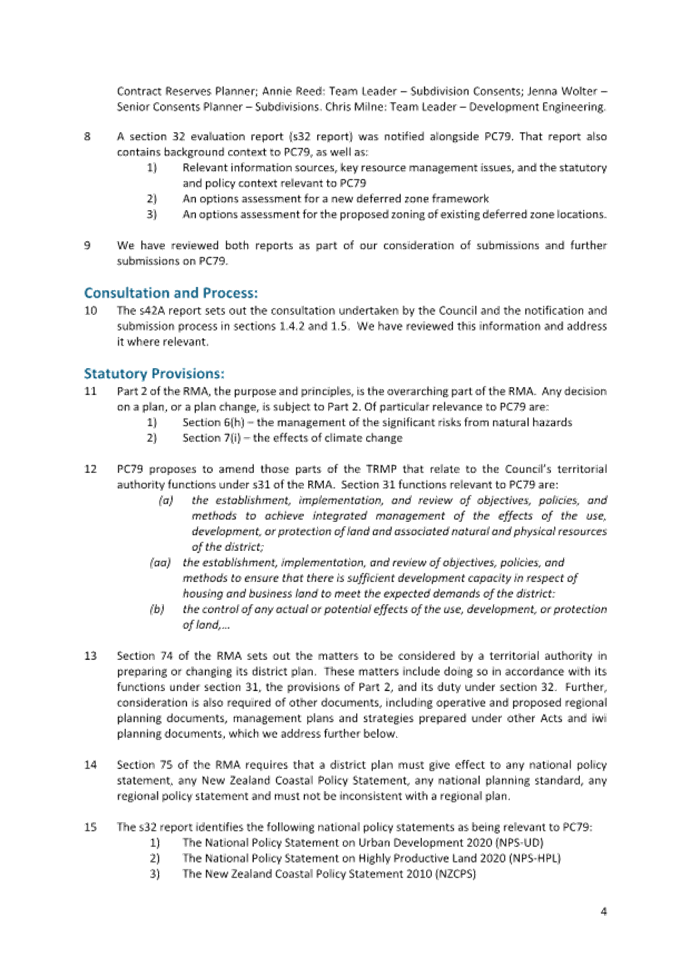
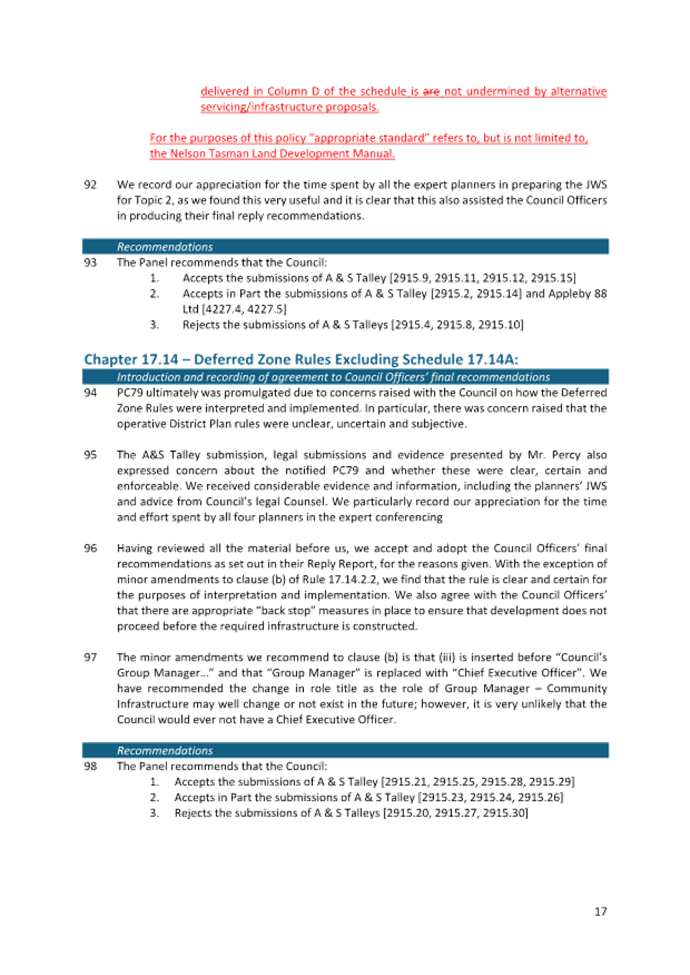
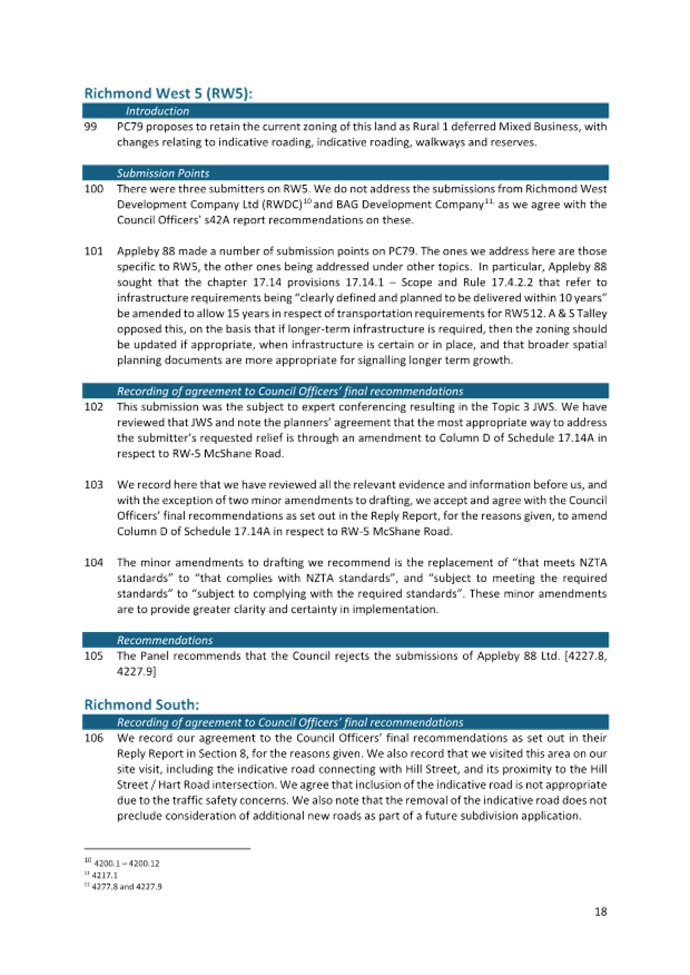
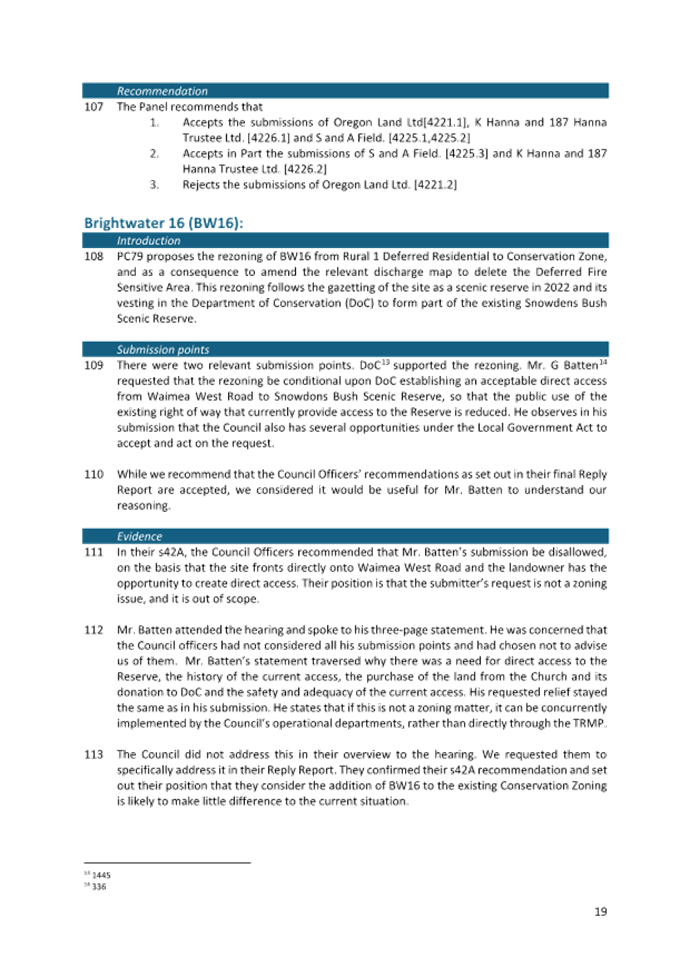
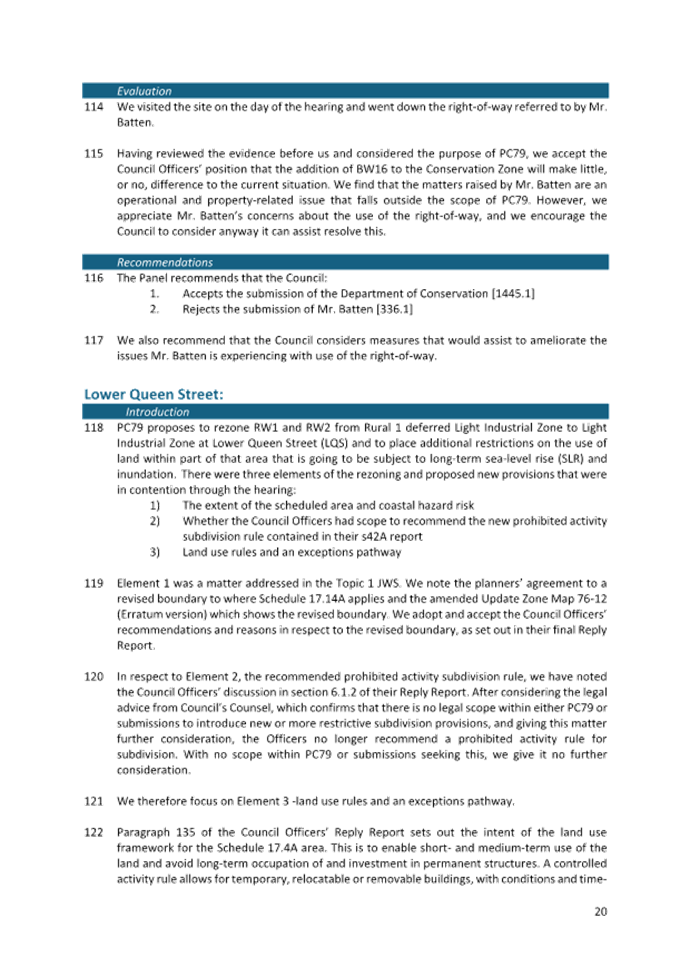
Plan Change 79 -
operative in part
Decision Required
|
Report
To:
|
Tasman
District Council
|
|
Meeting
Date:
|
28
May 2026
|
|
Report
Author:
|
Jeremy
Butler, Team Leader - Urban and Rural Policy
|
|
Report
Authorisers:
|
Barry
Johnson, Environmental Policy Manager
|
|
Report
Number:
|
RCN26-05-15
|
1. Purpose of the
Report / Te Take mō te Pūrongo
1.1 This report seeks that
Council approve Plan Change 79 in part, limited to those provisions that
are not subject to appeal, and to make that part of the plan change operative.
1.2 The report is procedural and
gives effect to Council’s existing decision in respect of zoning and
development‑enabling
provisions that have not been appealed, without prejudicing the Environment
Court’s consideration of the appeal.
2. Summary / Te
Tuhinga Whakarāpoto
2.1 Council adopted the
recommendation Plan Change 79 on 19 February 2026. An appeal
has since been lodged against specific provisions of the decision. The appeal
does not relate to all parts of the Plan Change. The zoning and development‑enabling
provisions proposed to be made operative are not subject to appeal and are
clearly severable from the matters before the Environment Court.
2.2 This report seeks Council
approval to make Plan Change 79 operative in part, limited to the
provisions that have not been appealed, in accordance with Cl 17(2) Schedule 1
of the RMA 1991.
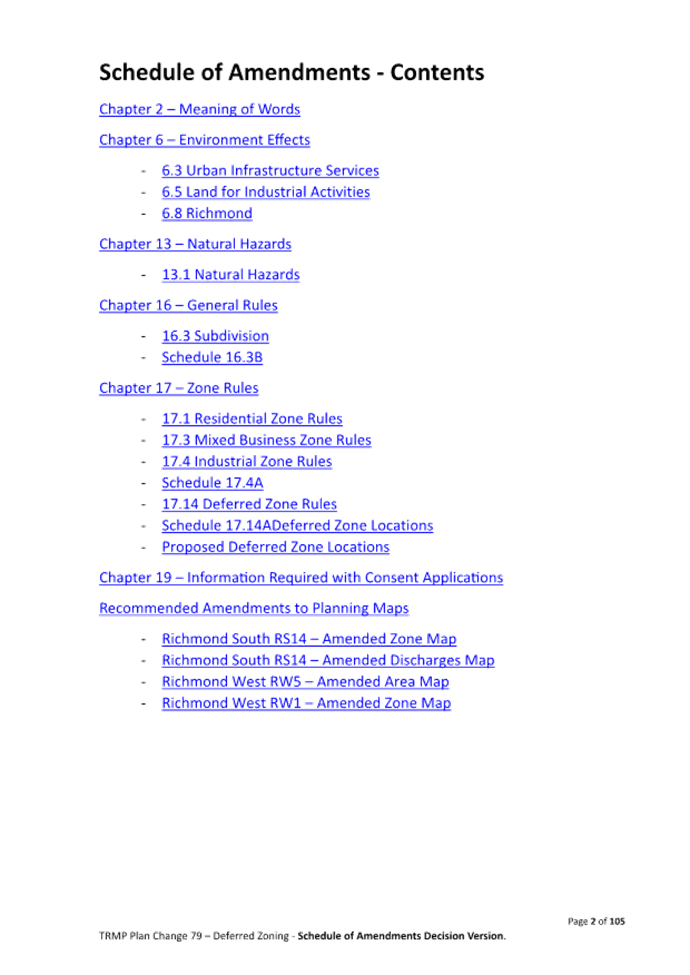
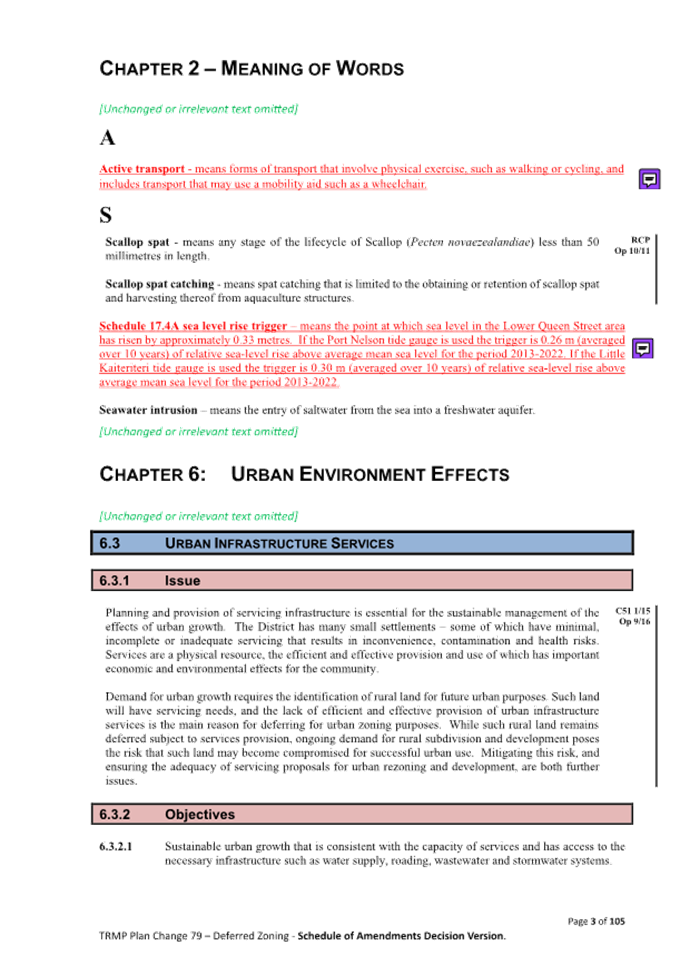
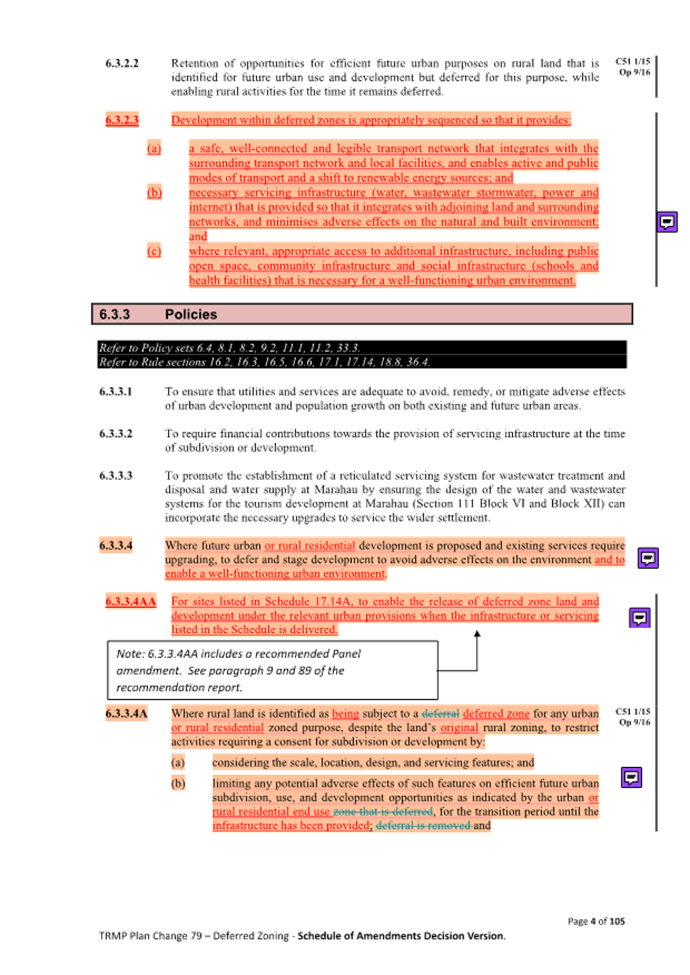
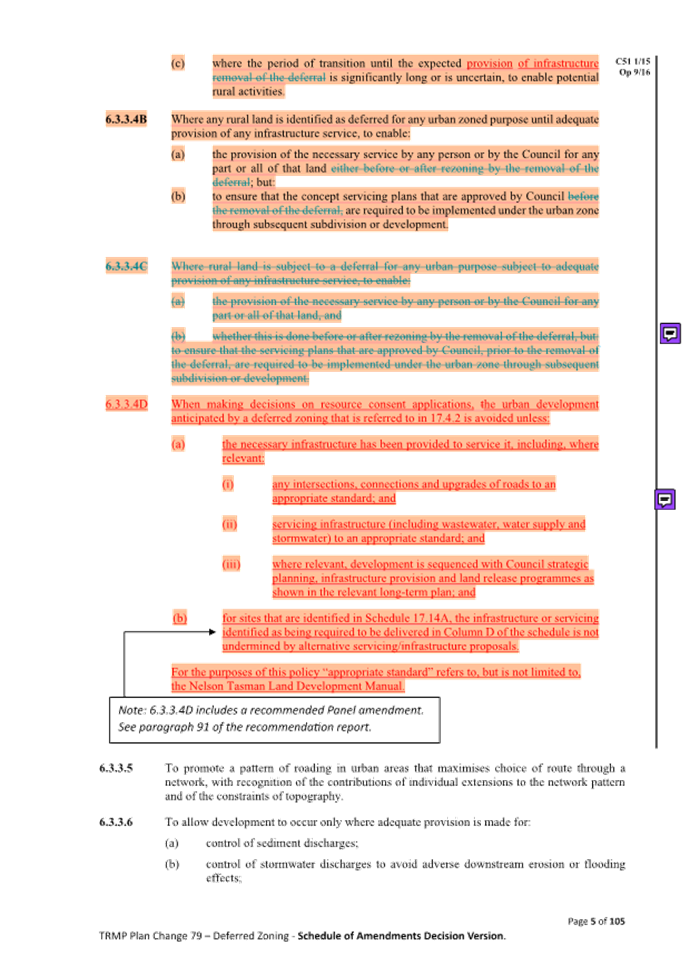
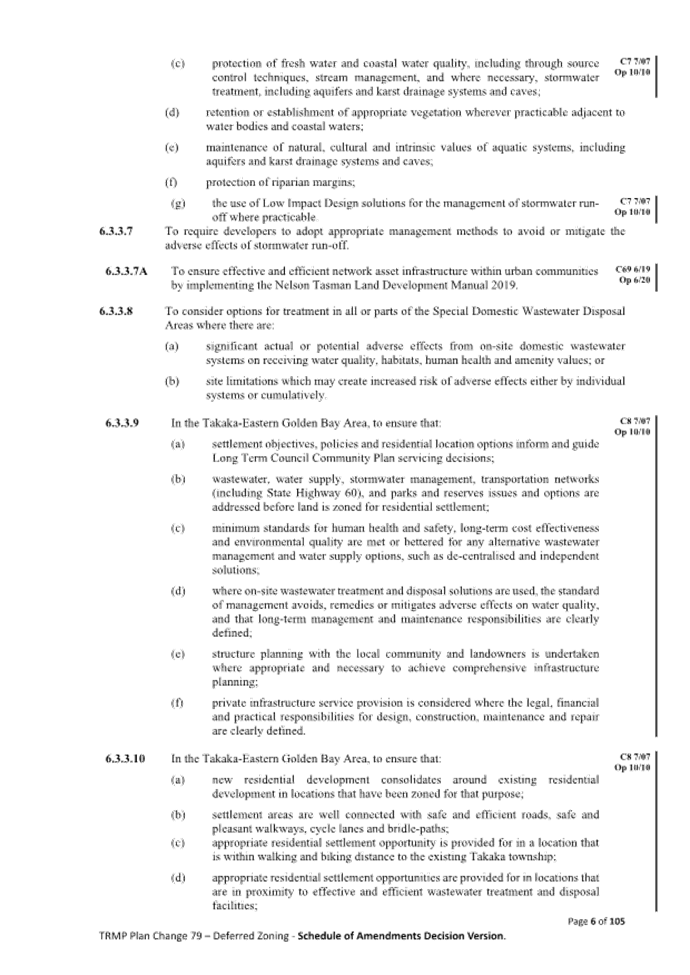
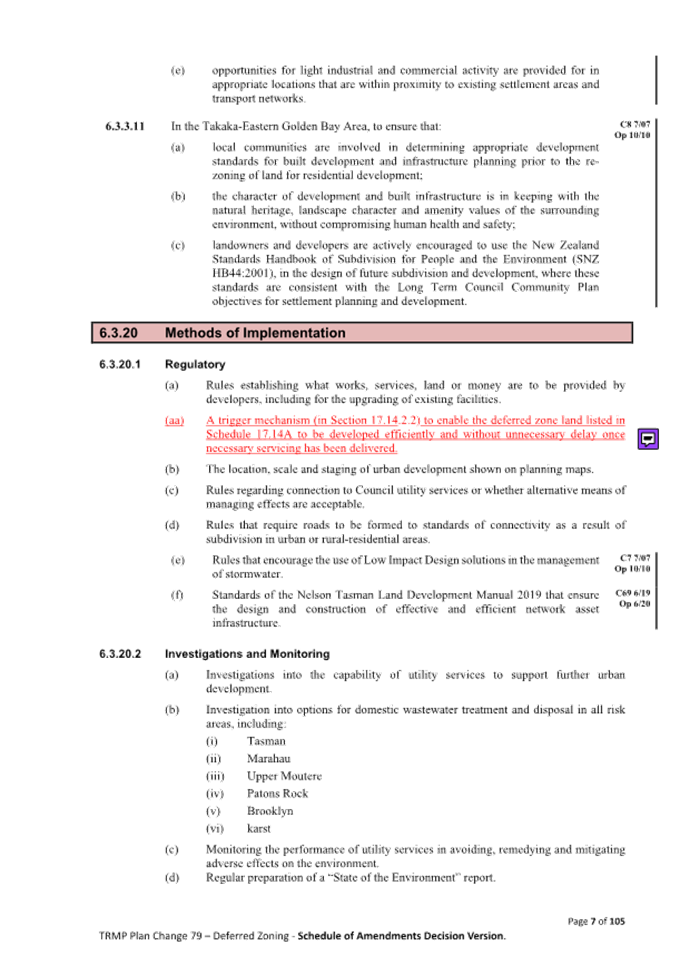
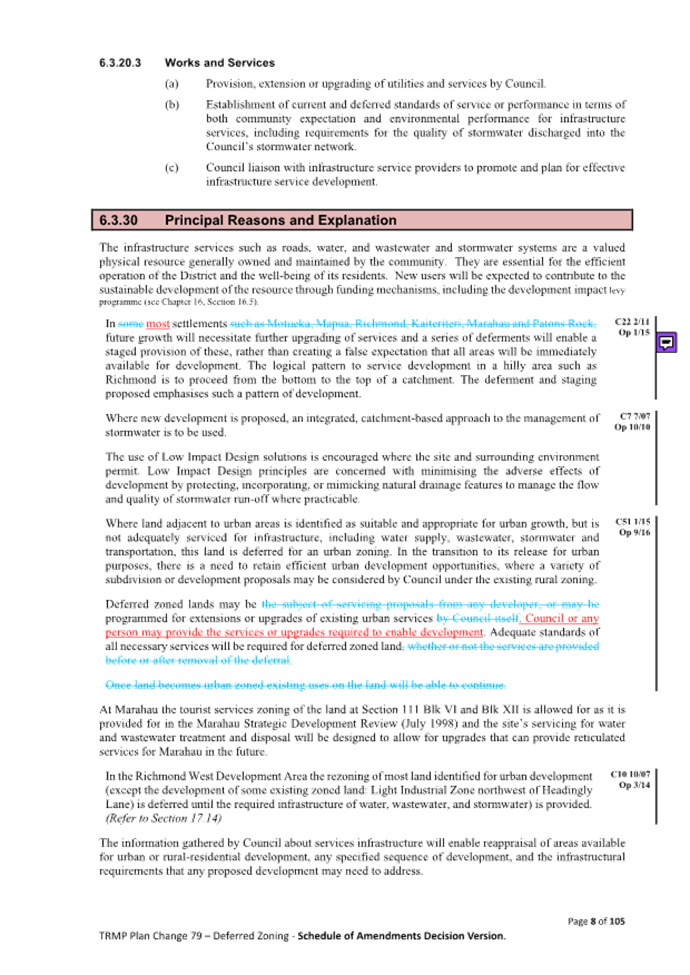
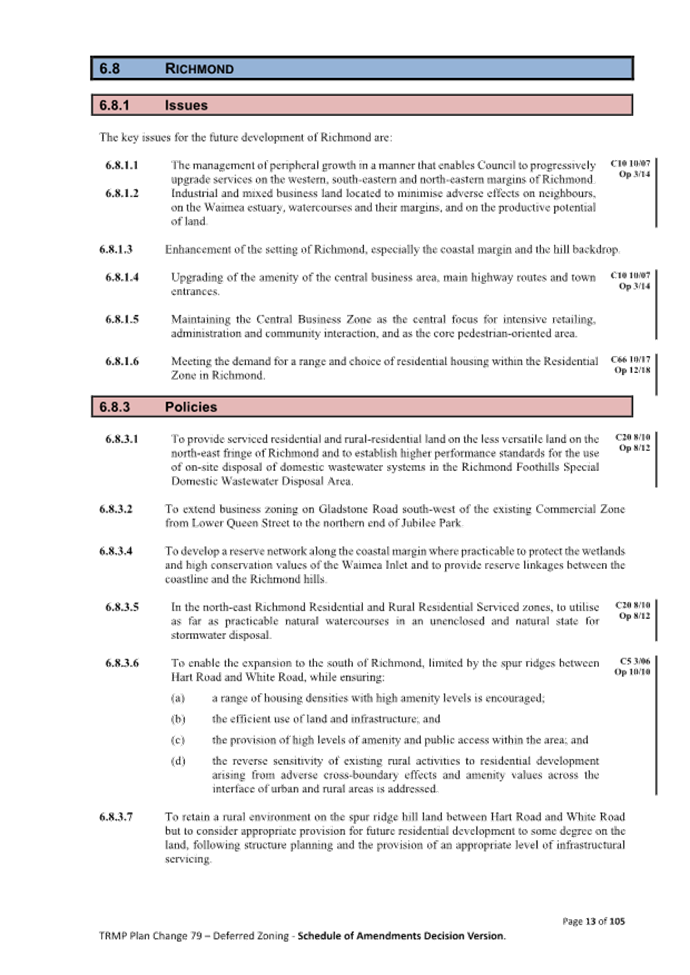
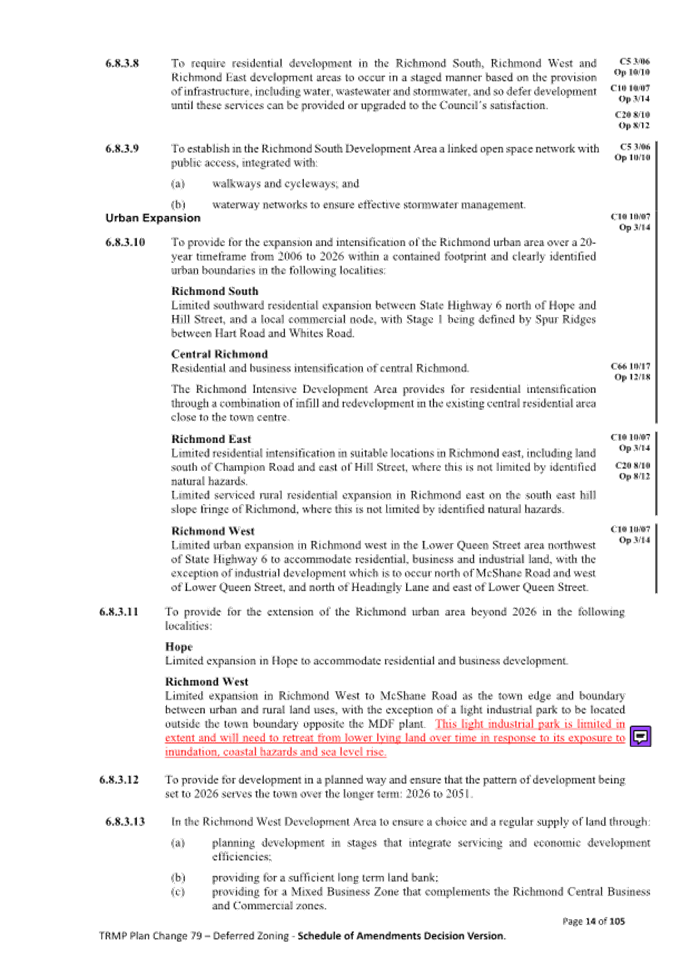
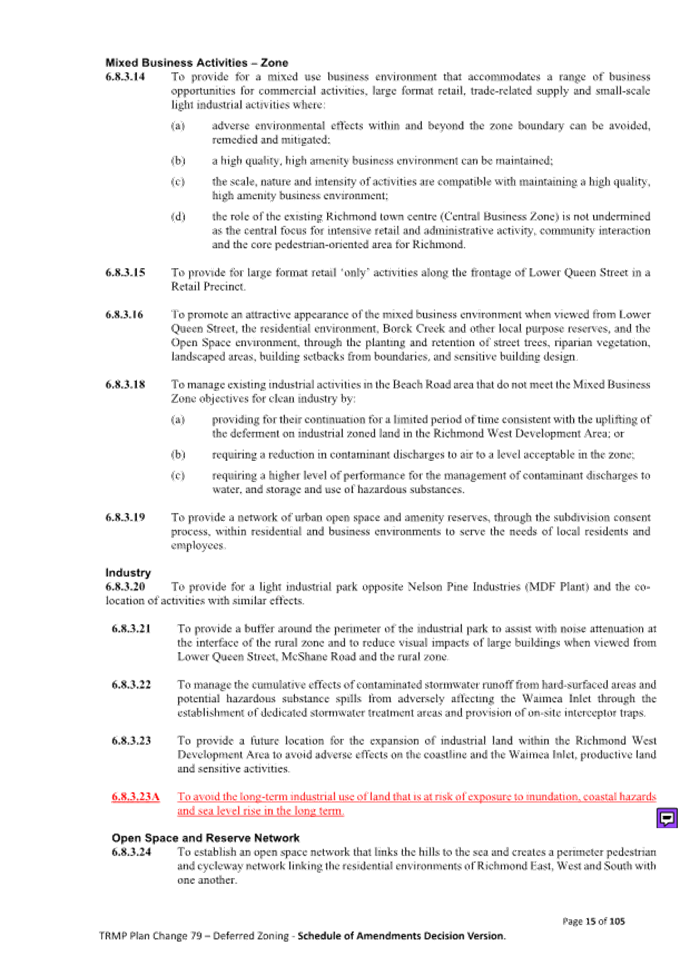
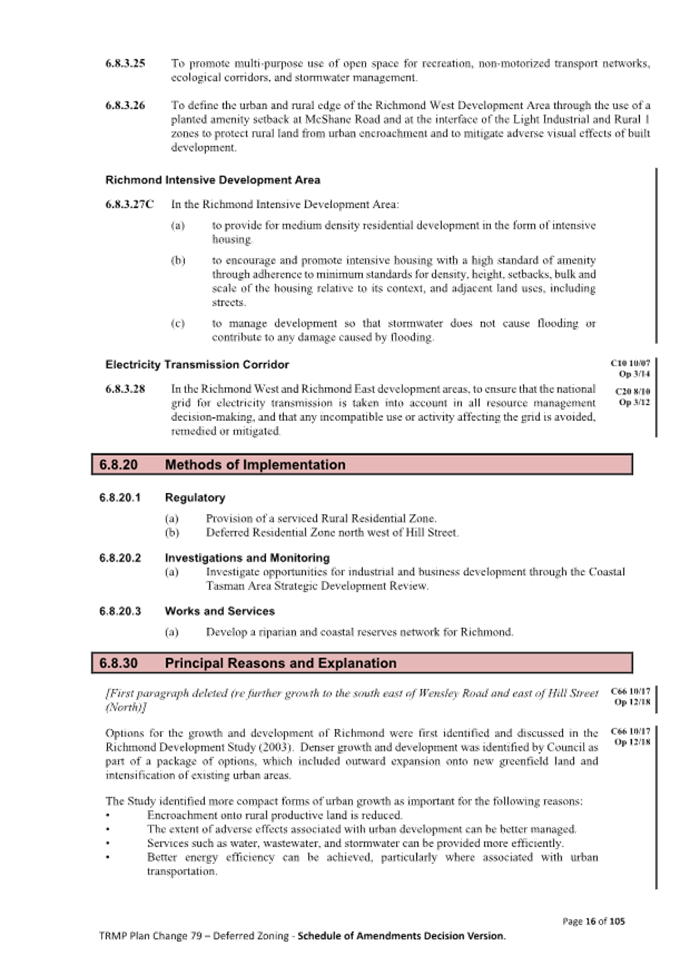
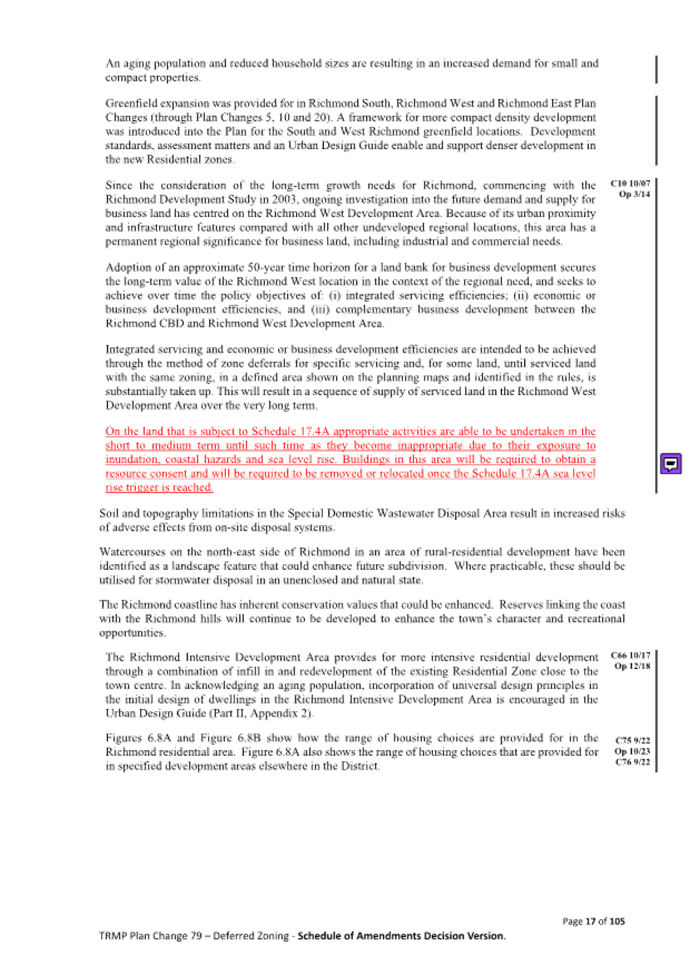
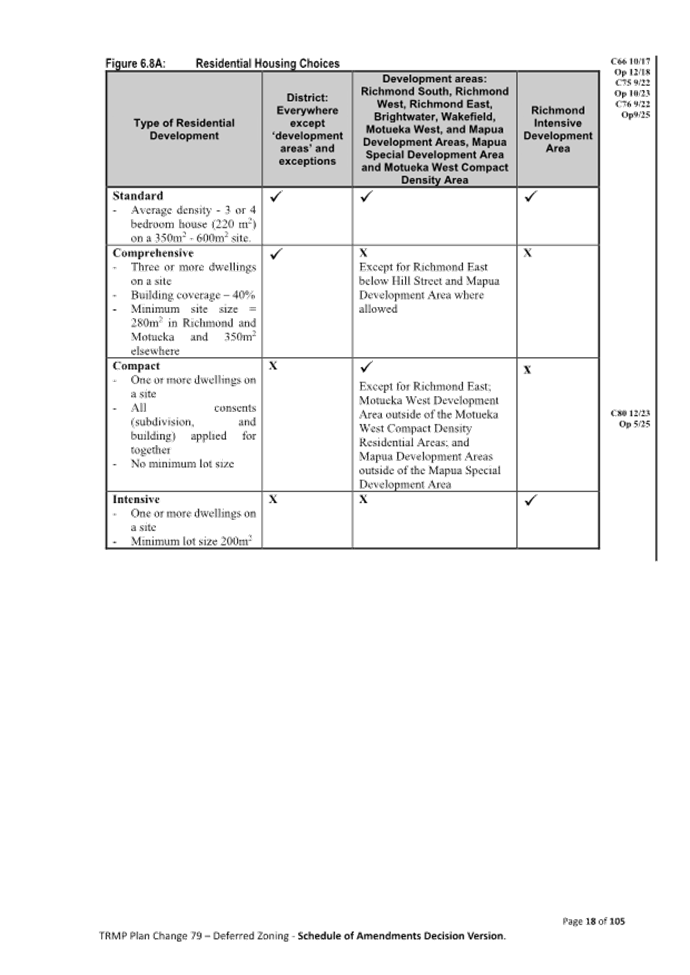
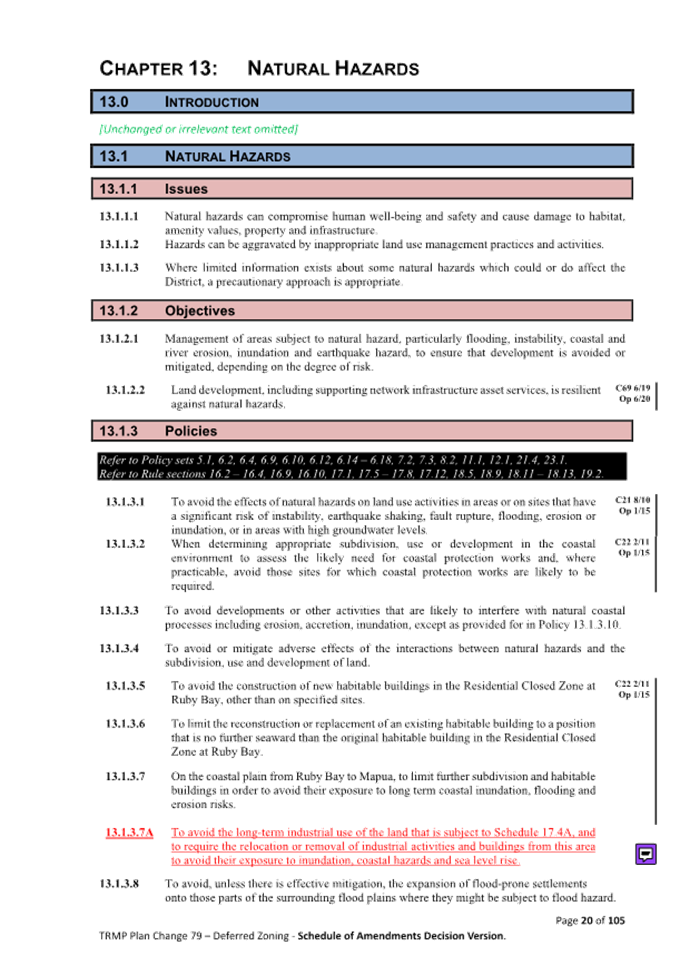
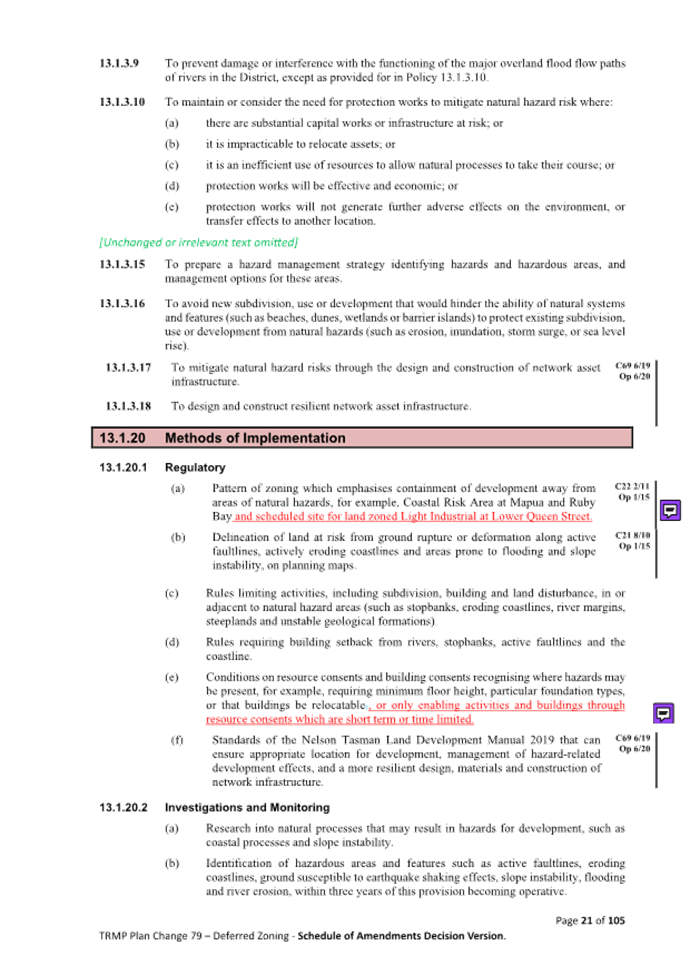
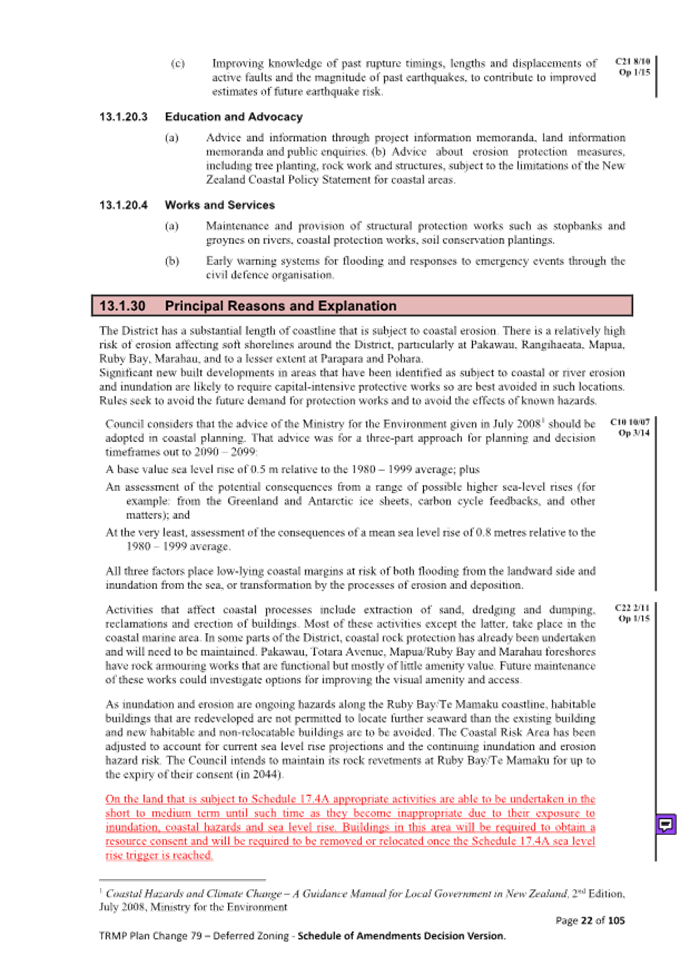
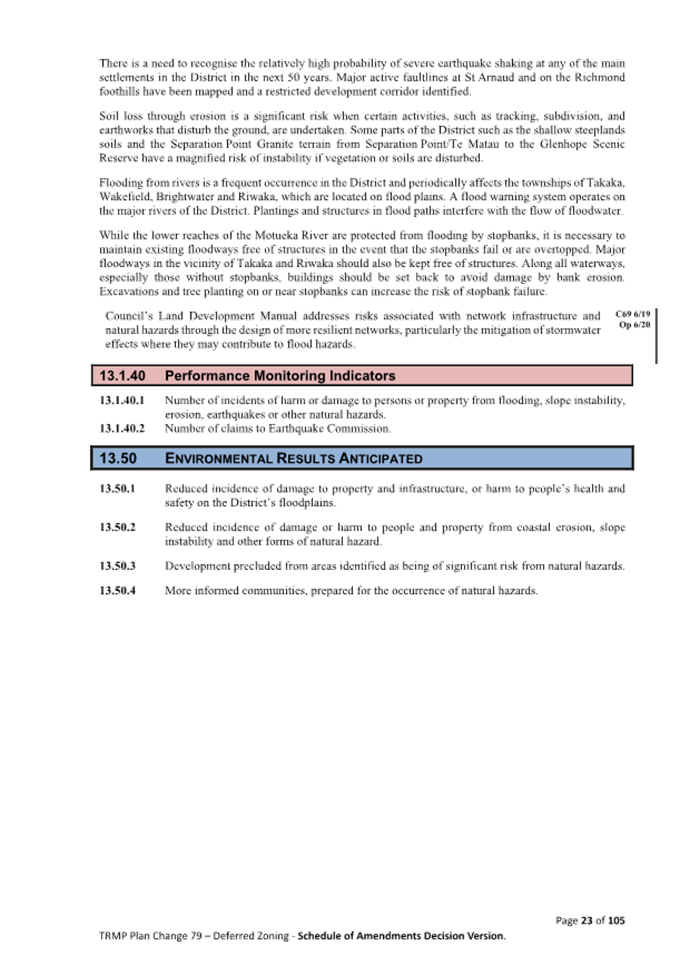
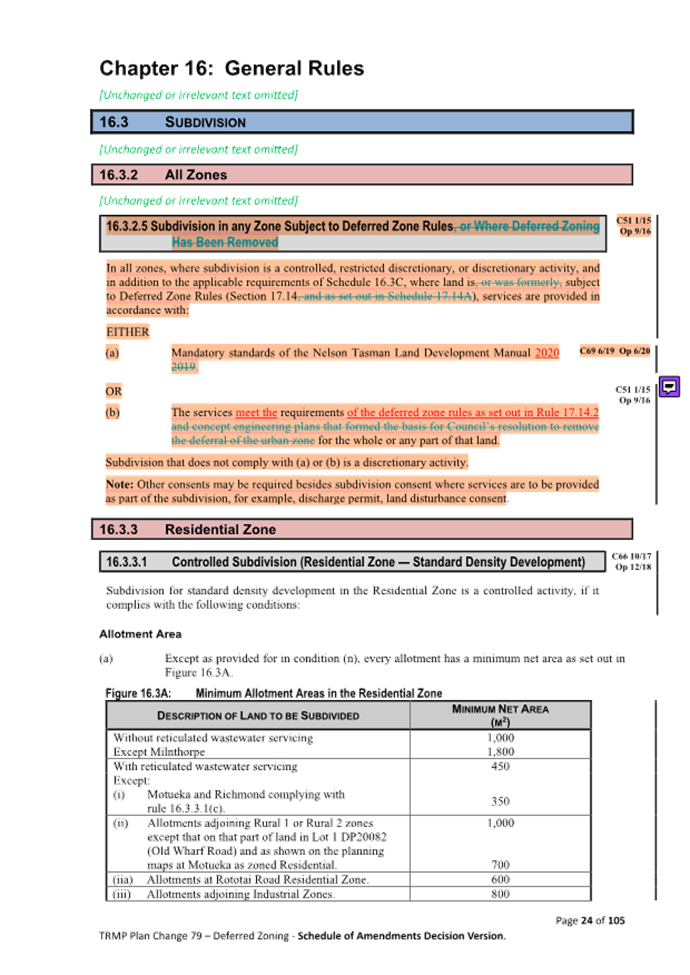
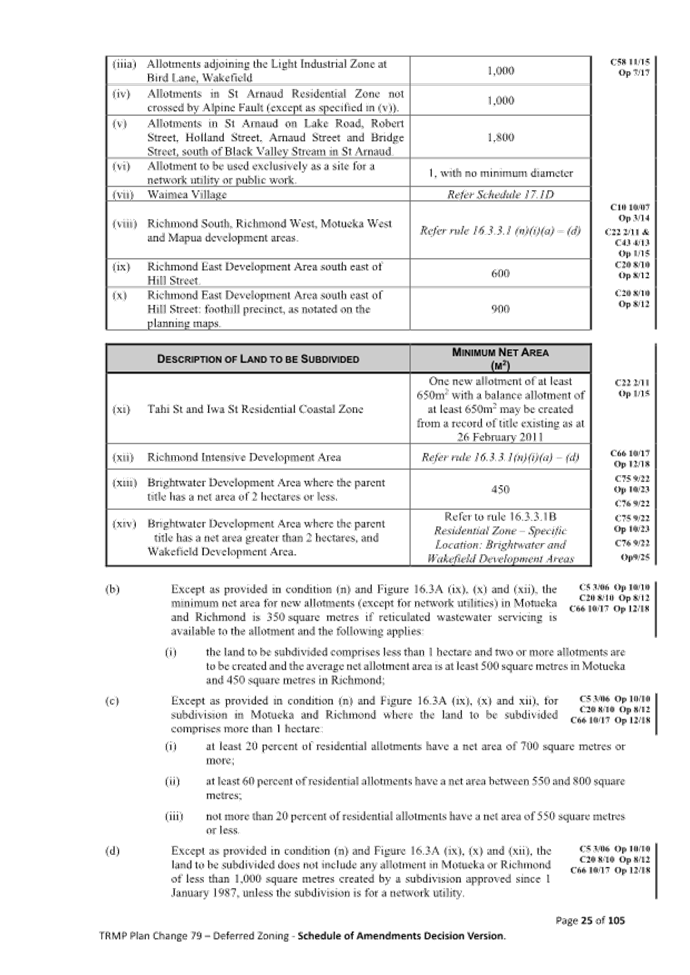
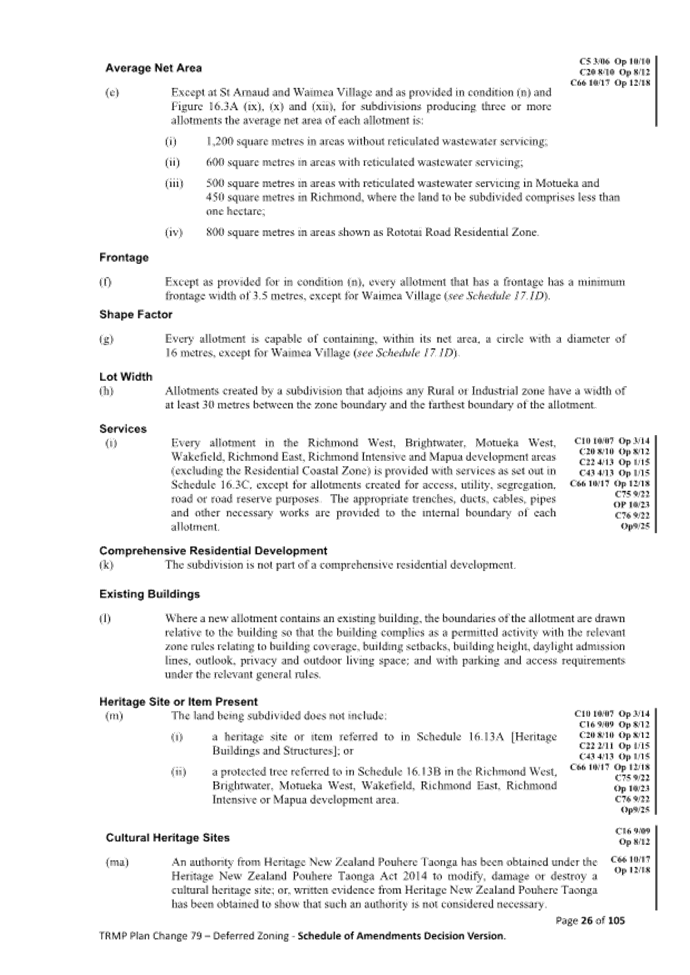
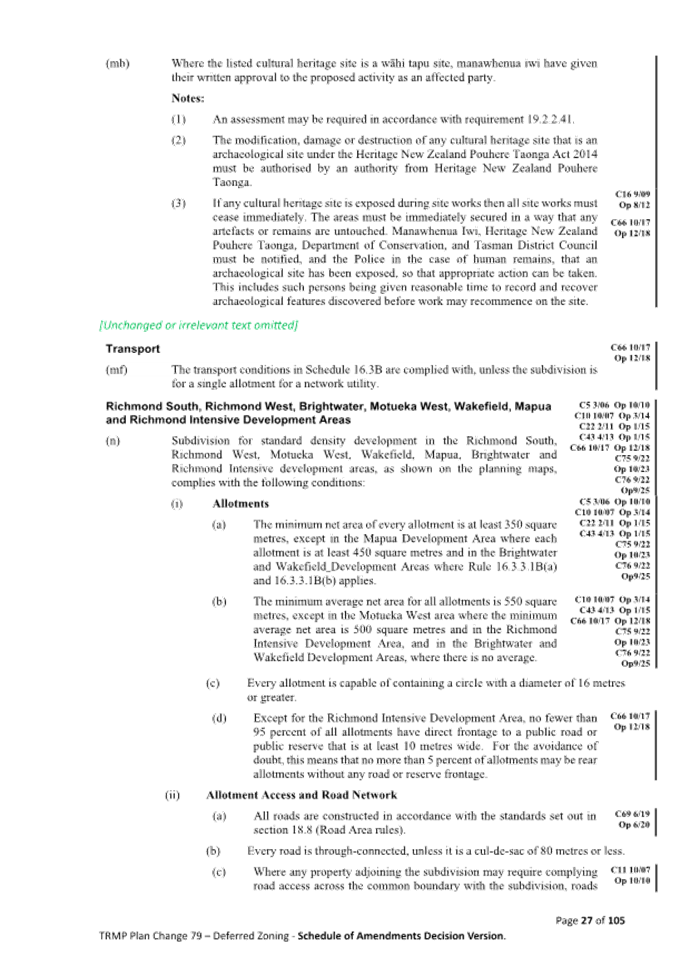
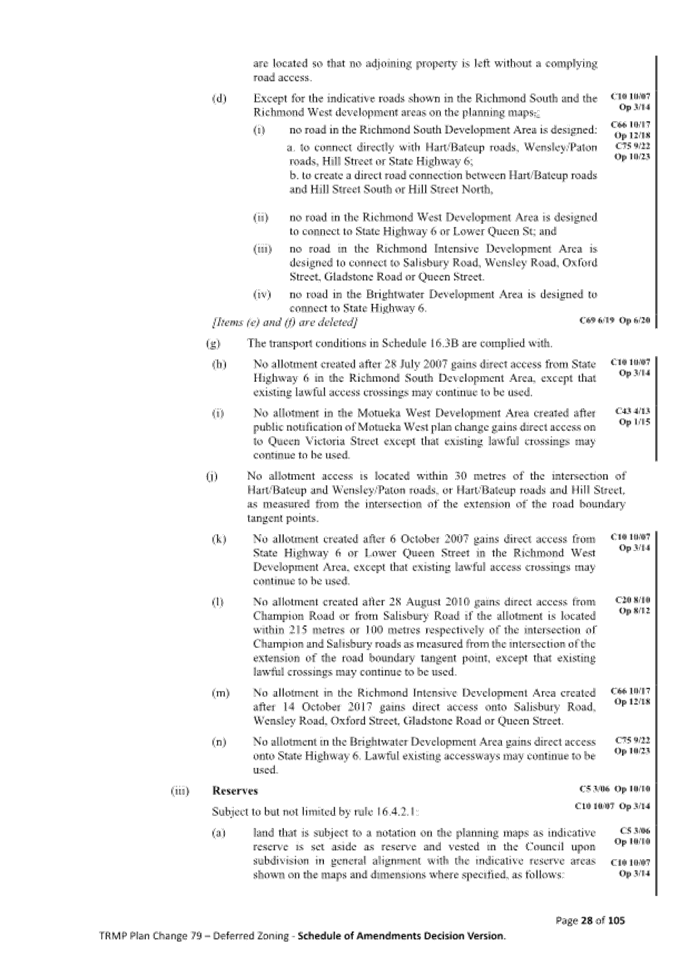
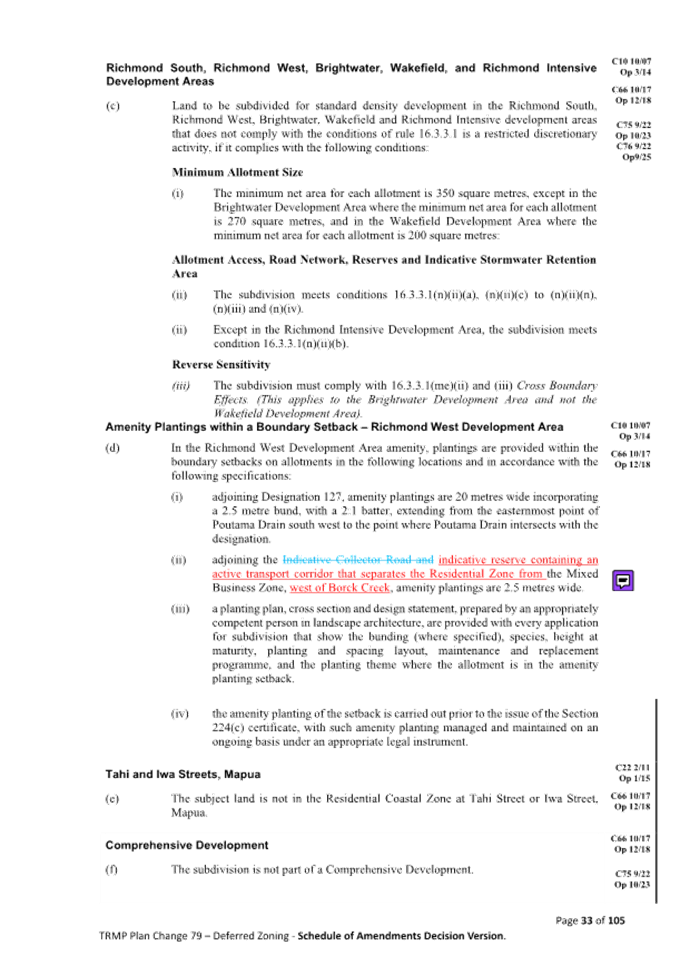
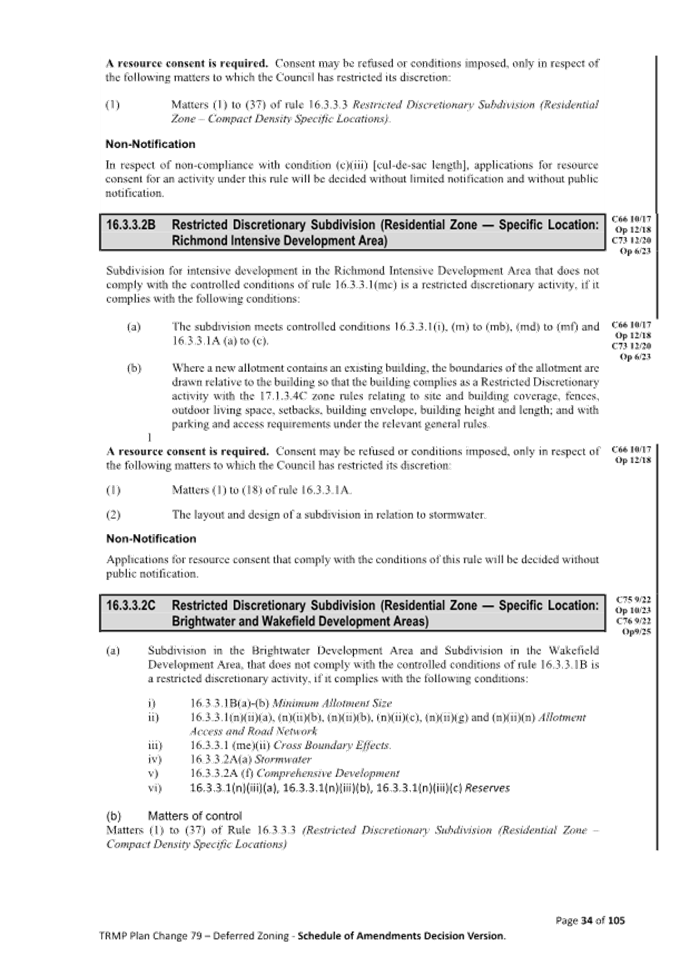
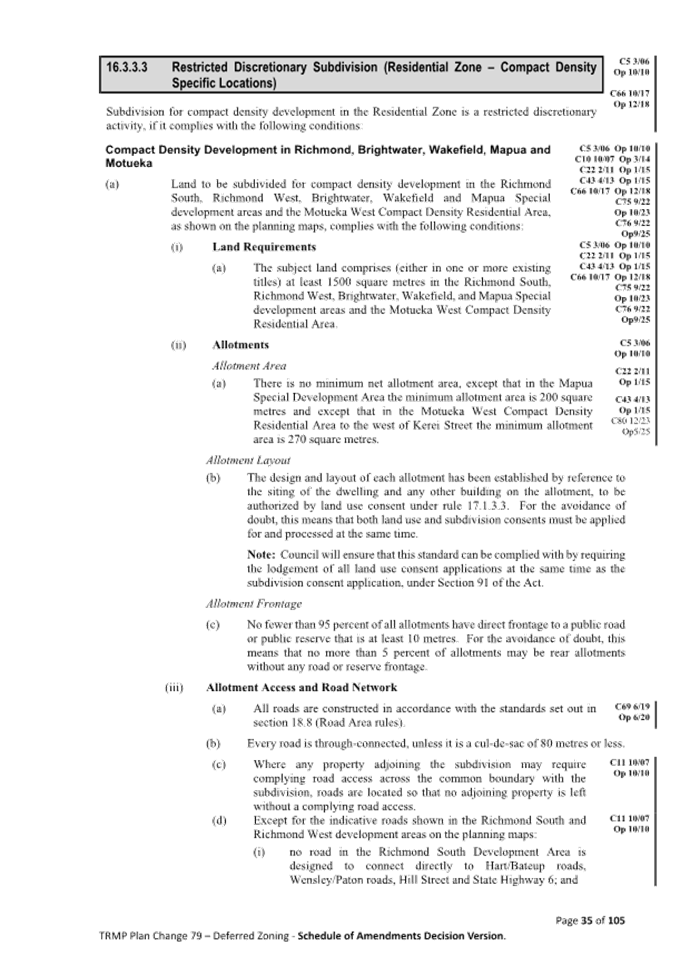
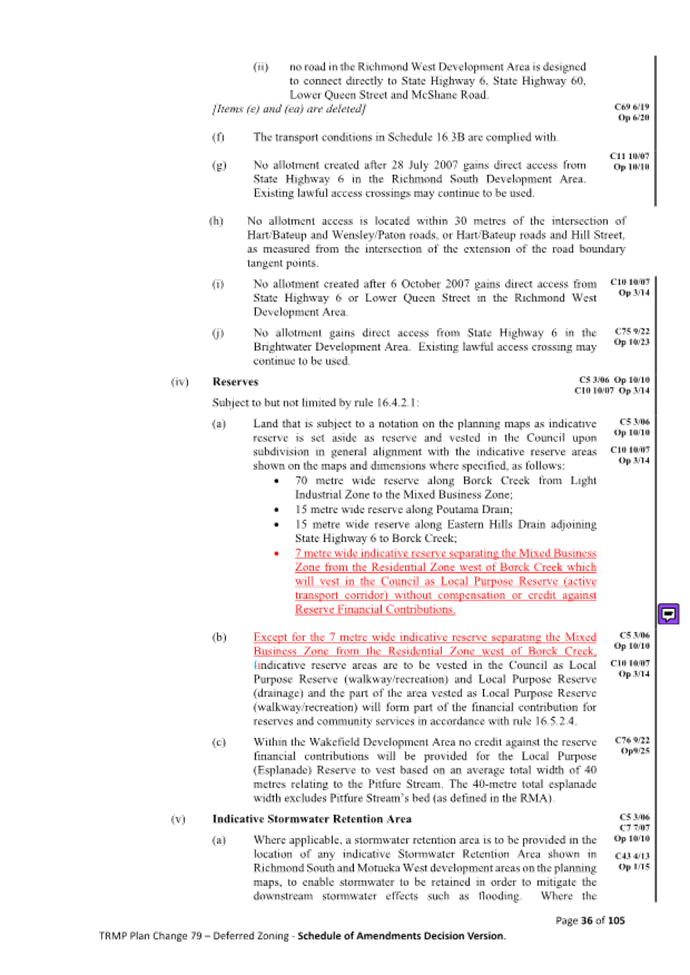
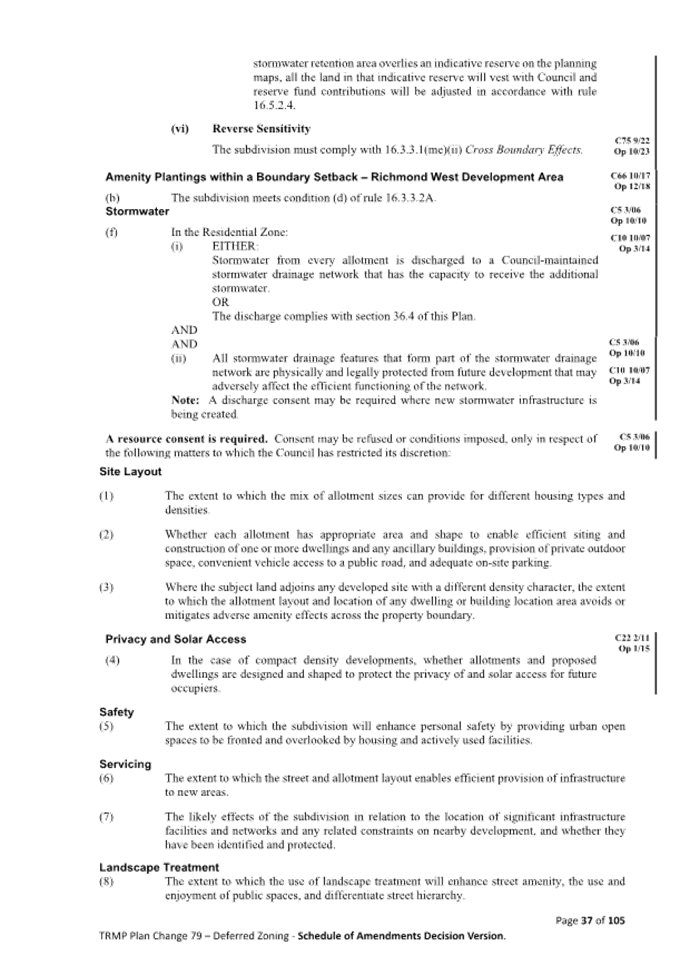
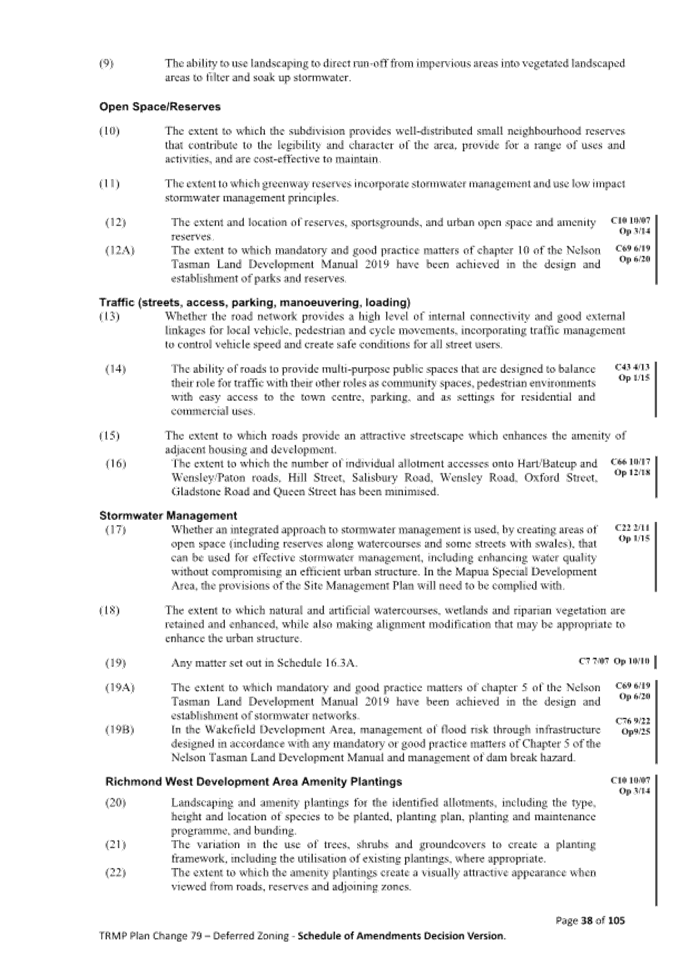
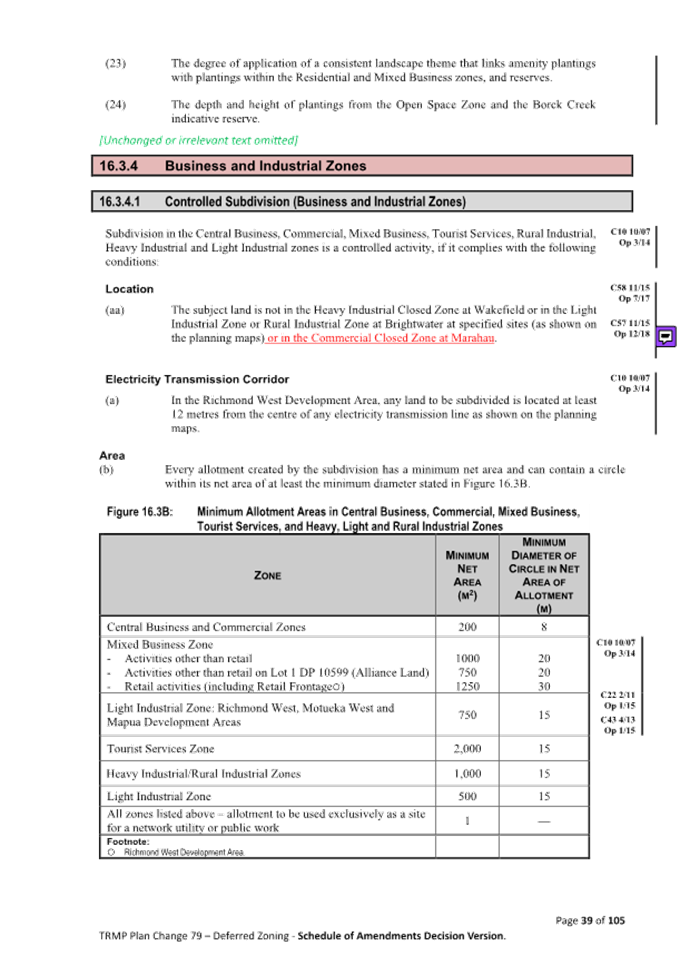
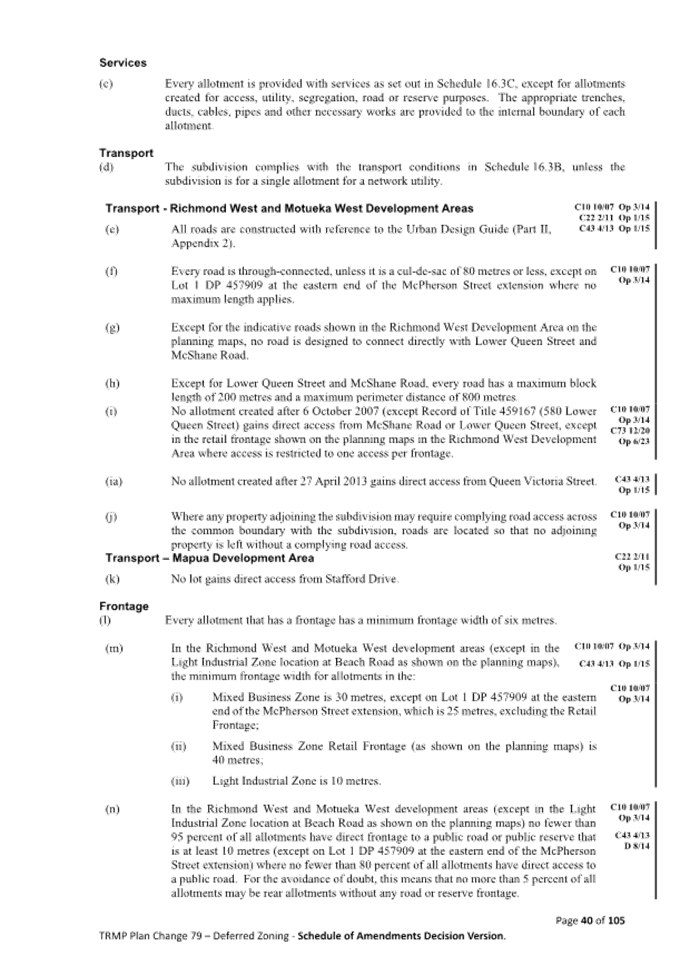
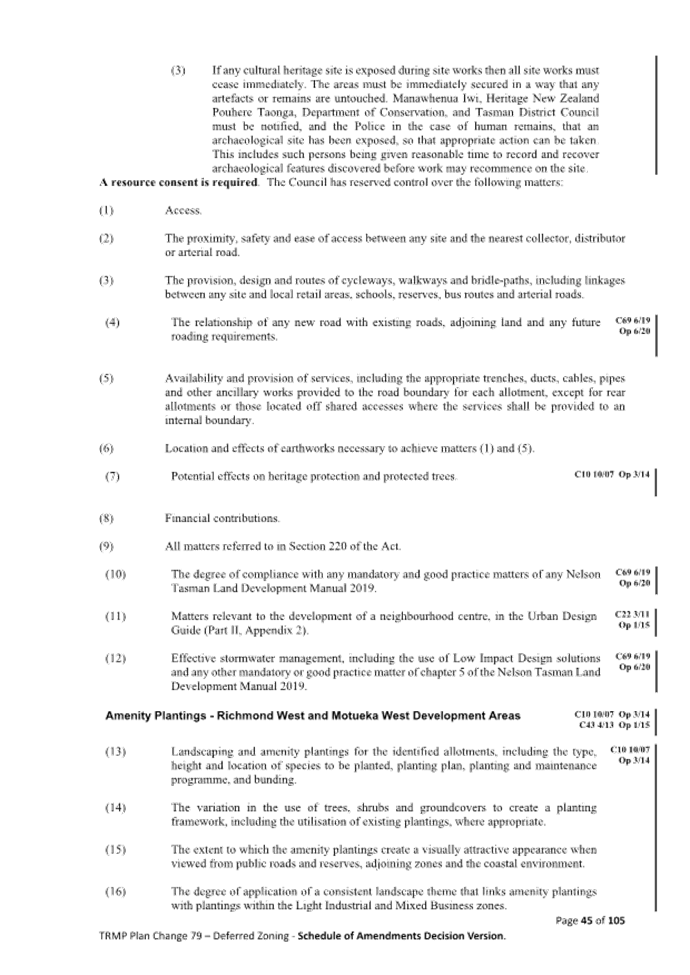
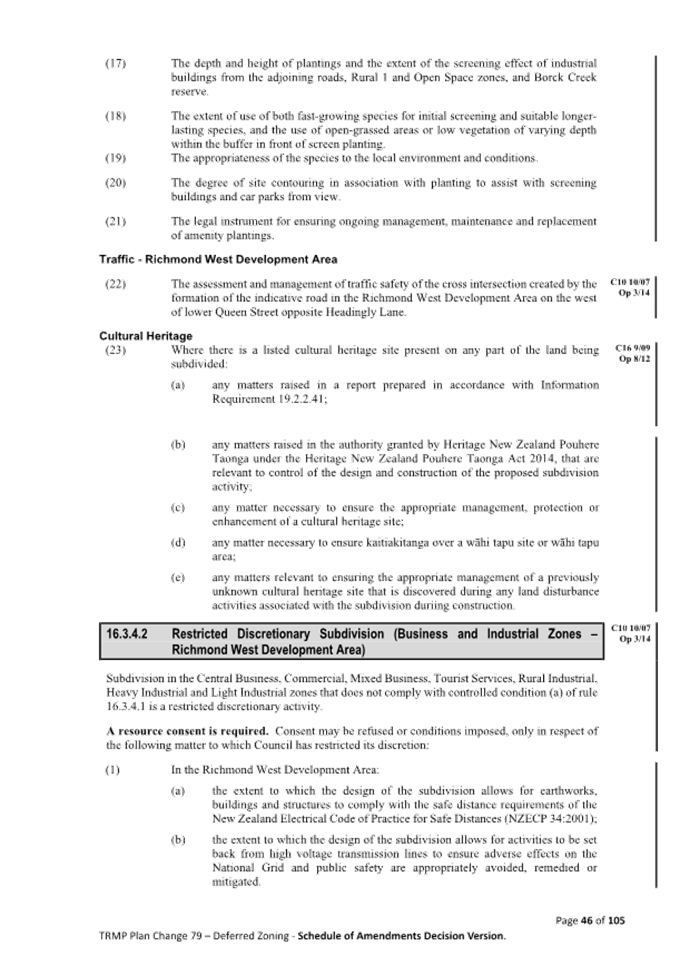
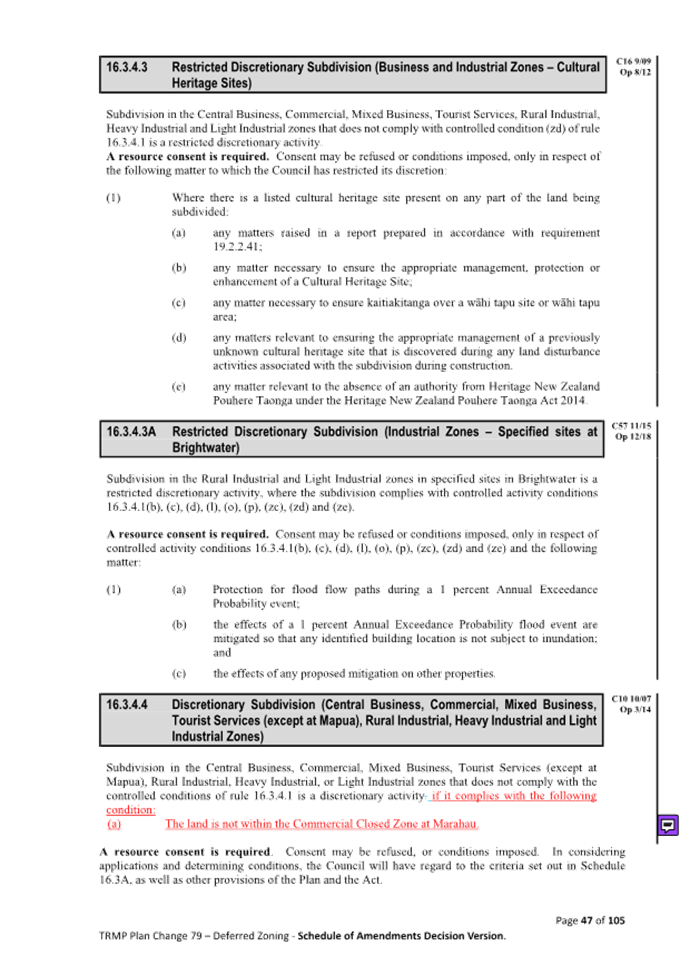
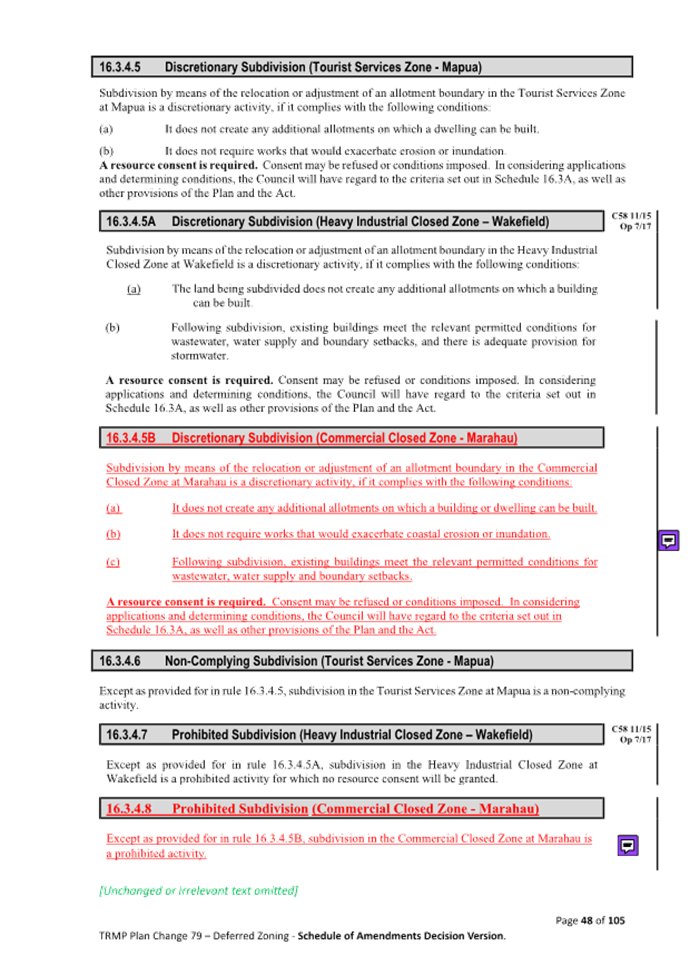
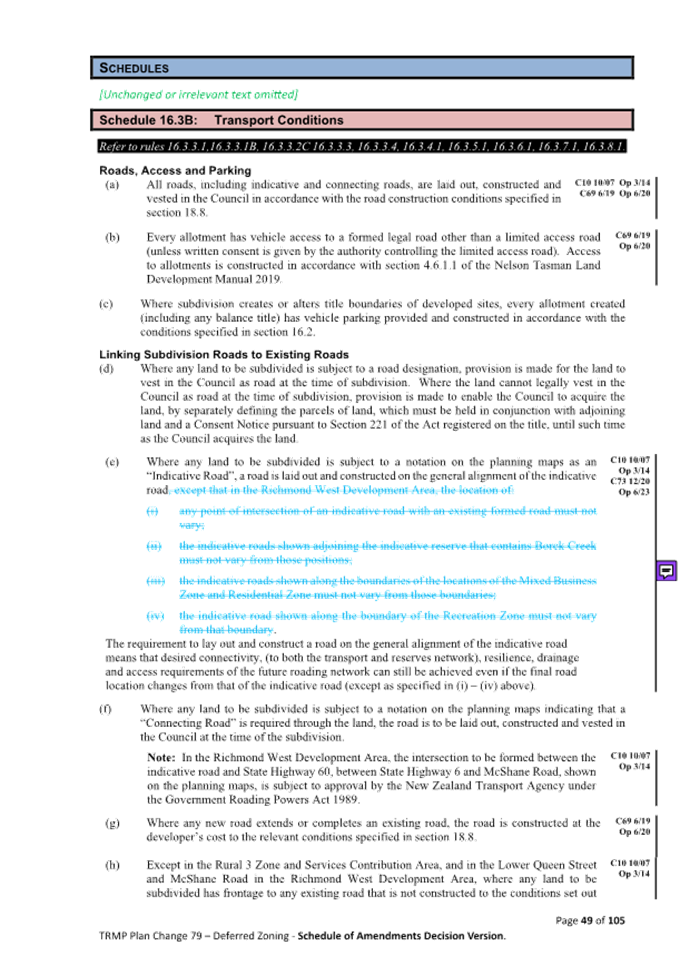
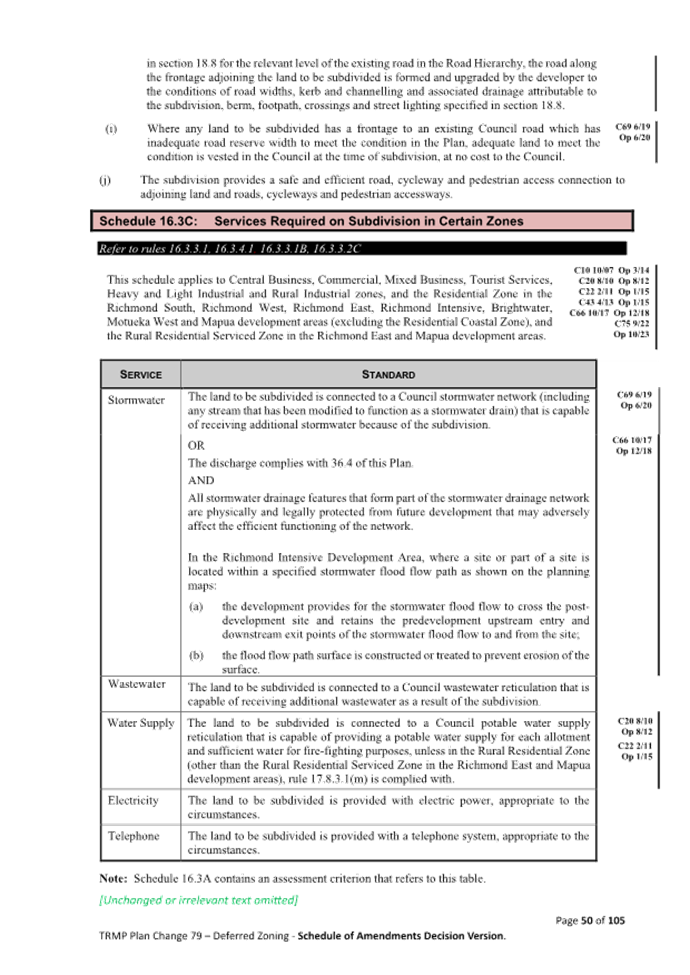
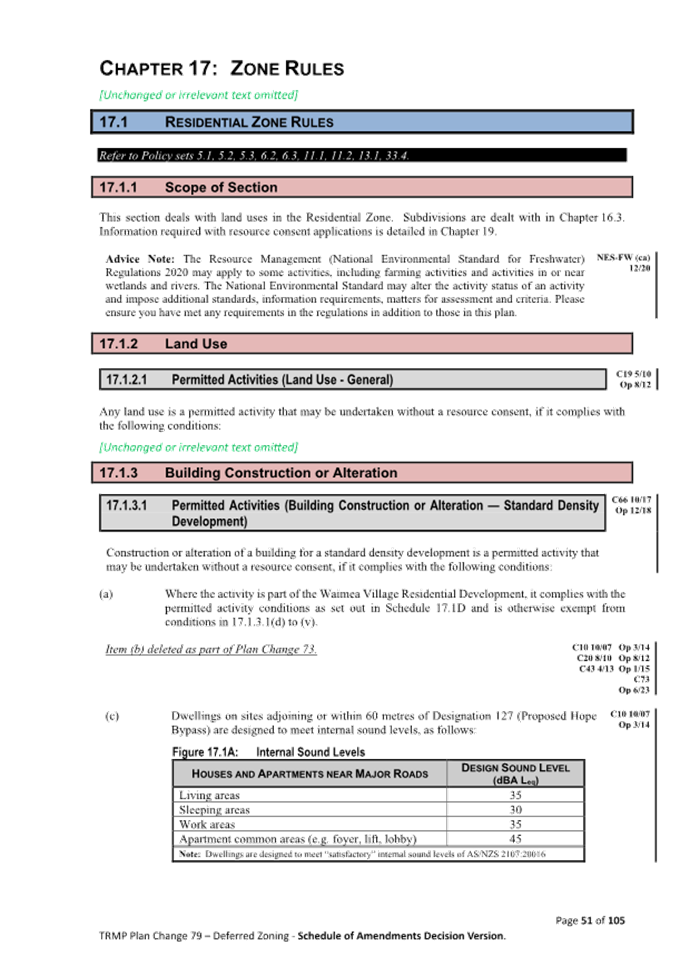
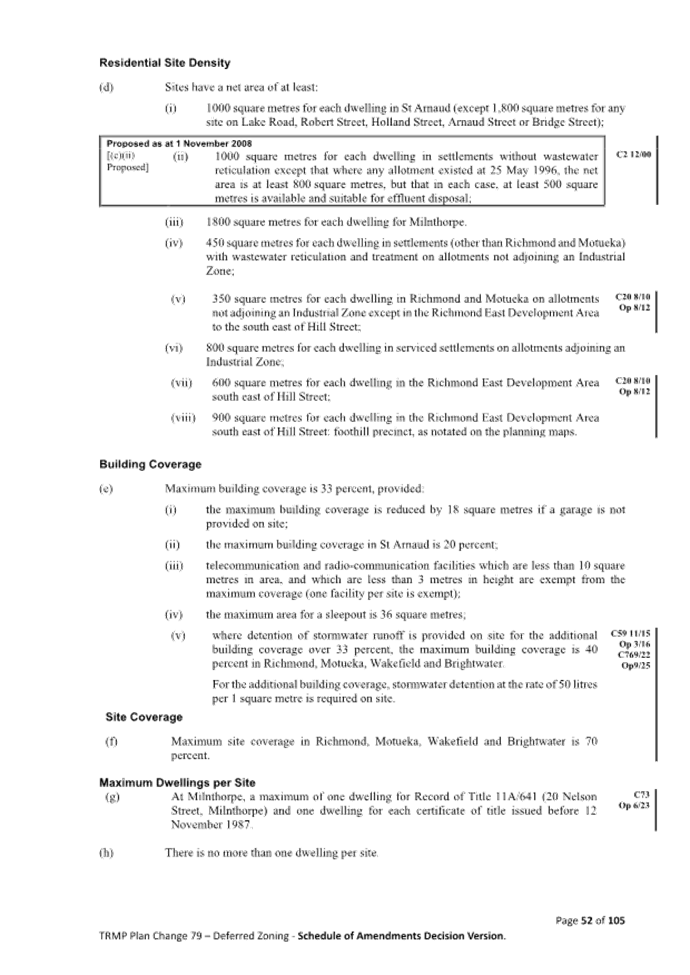
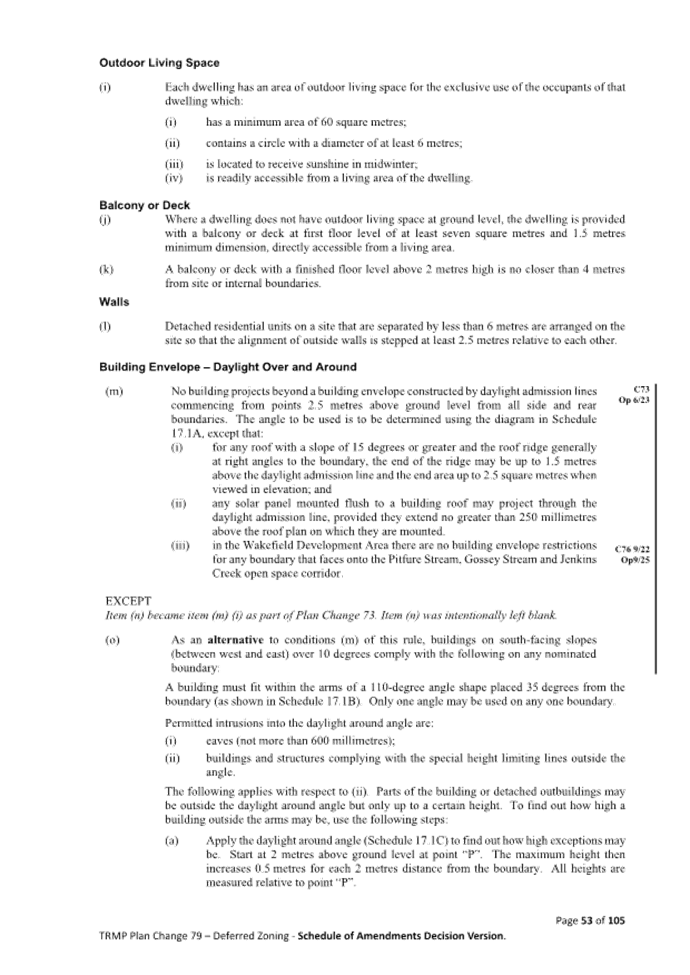
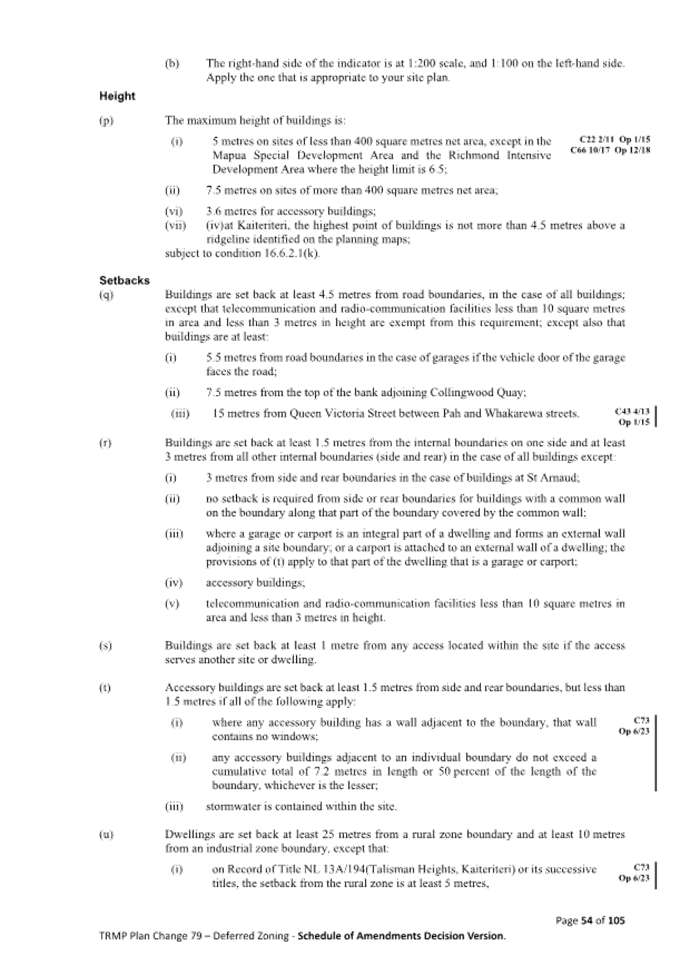
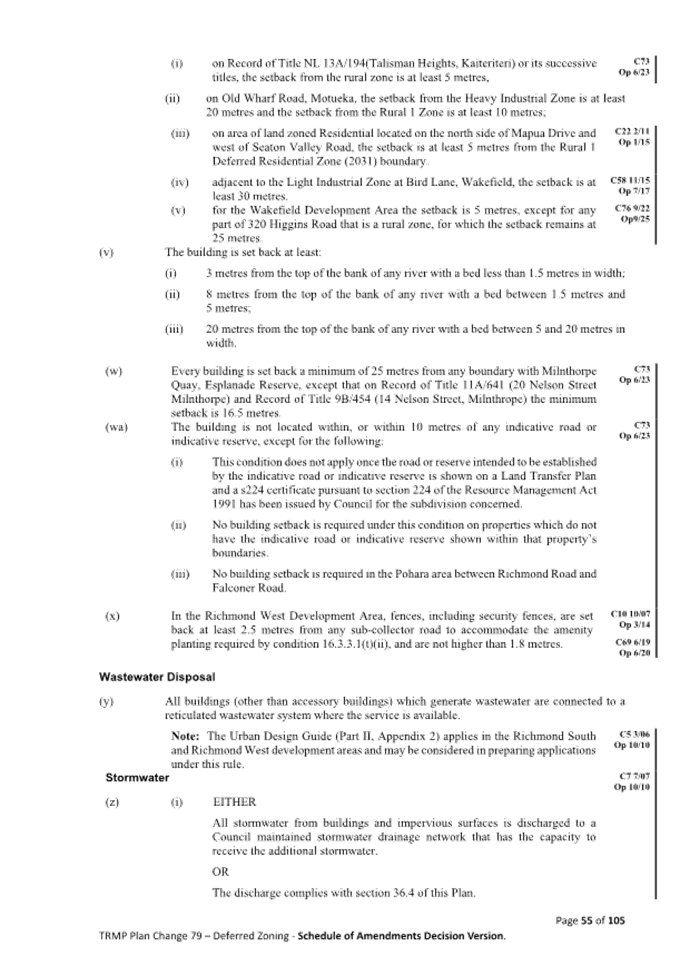
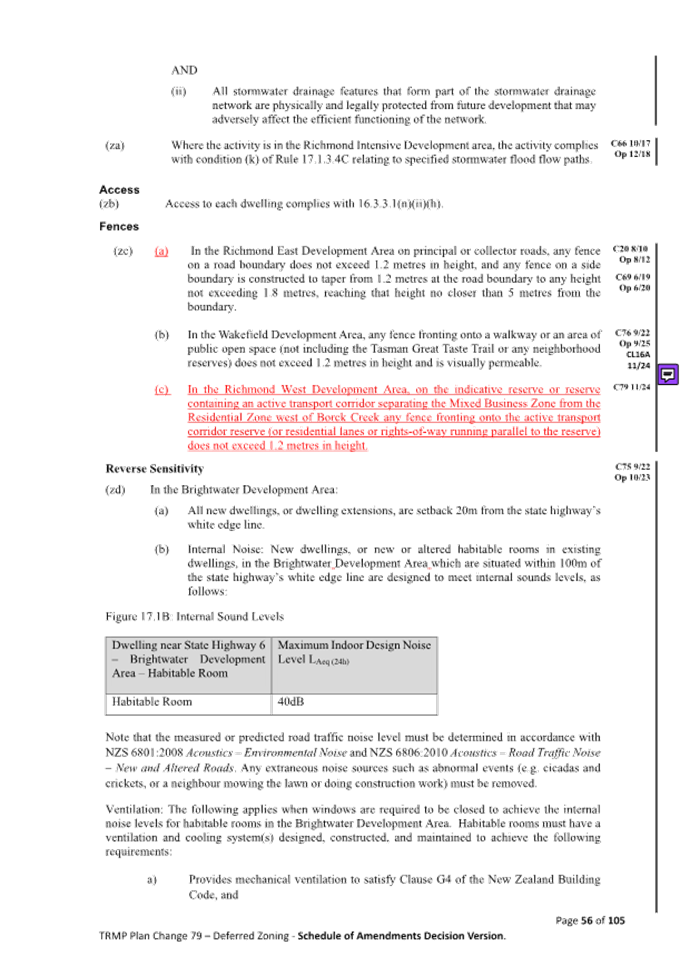
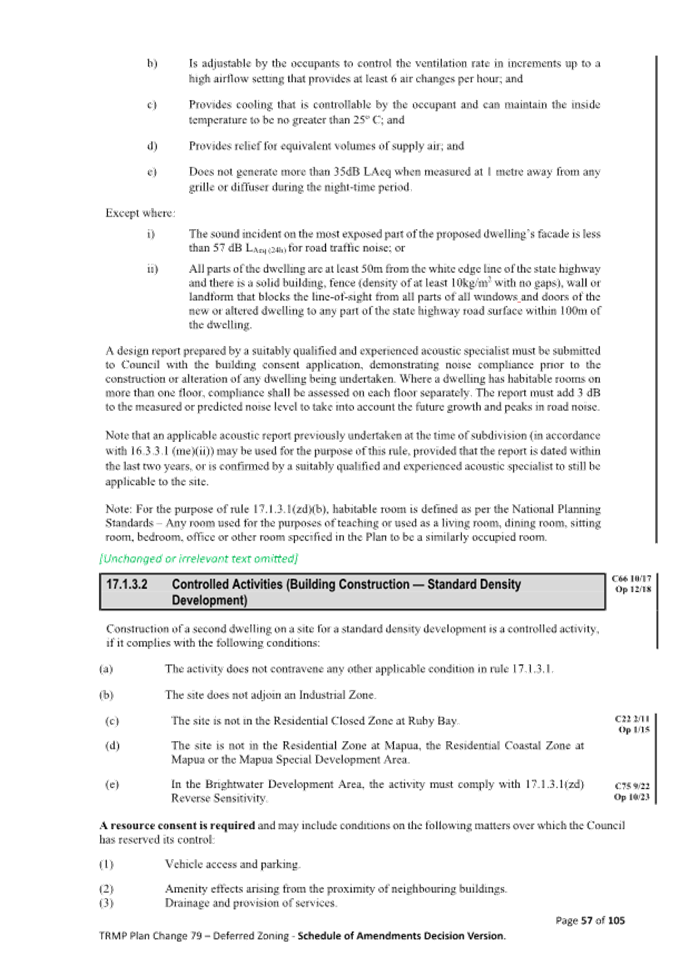
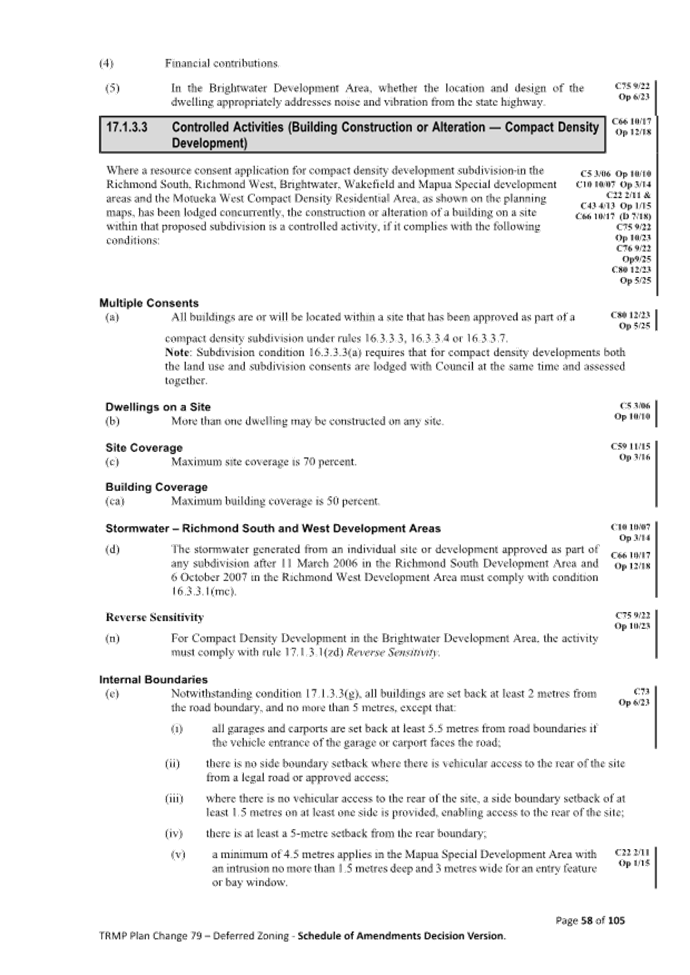
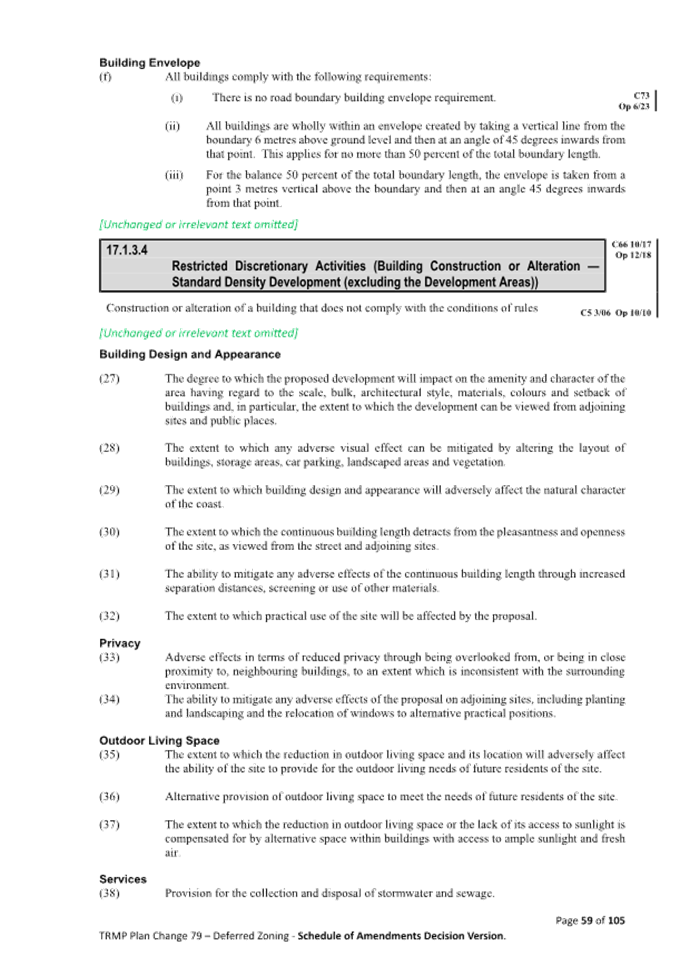
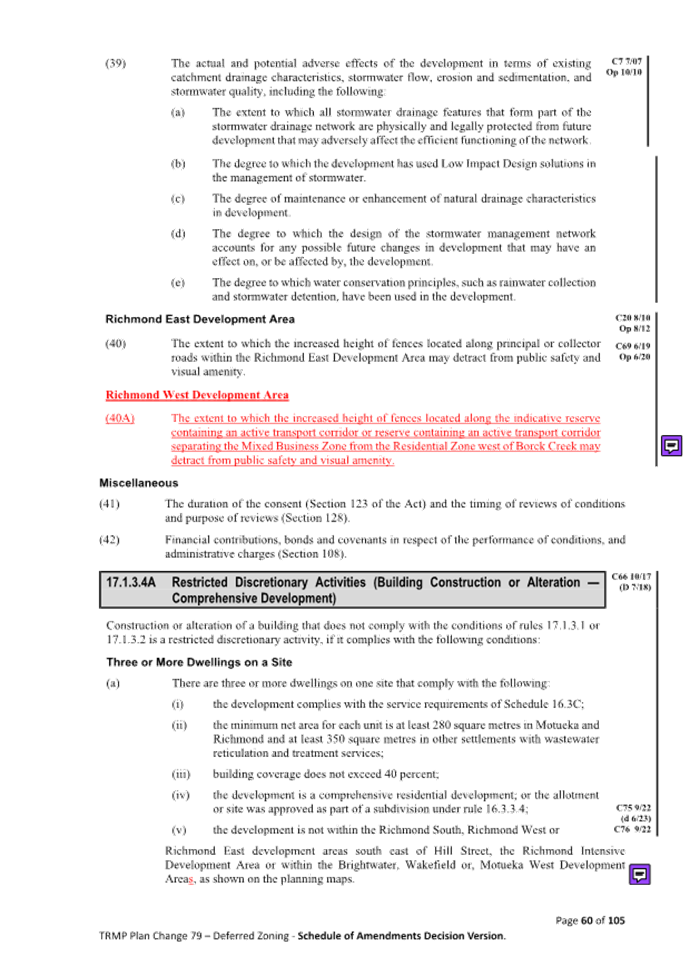
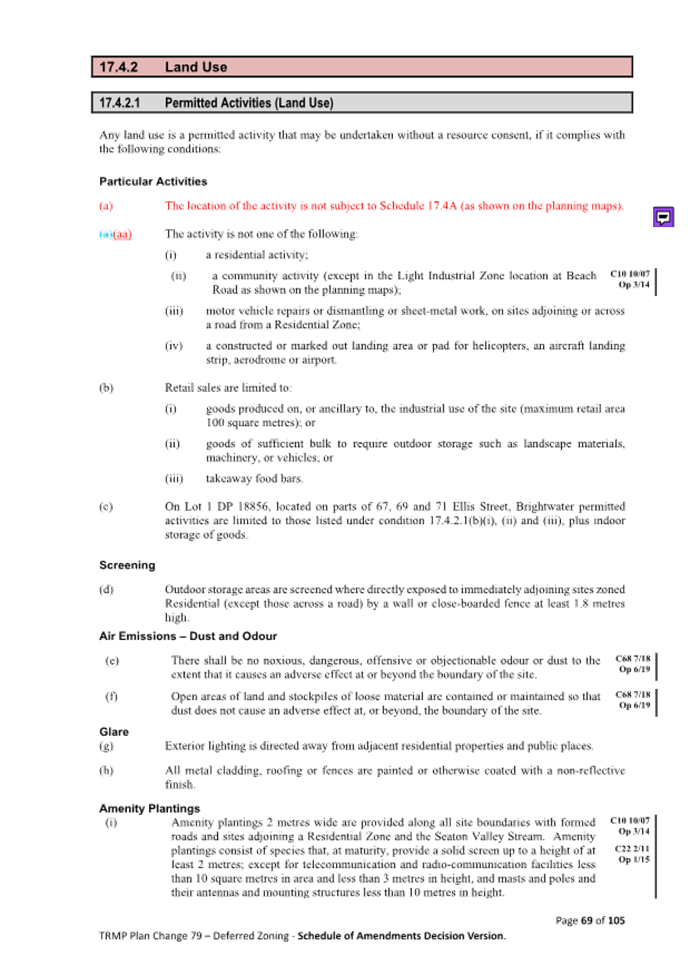
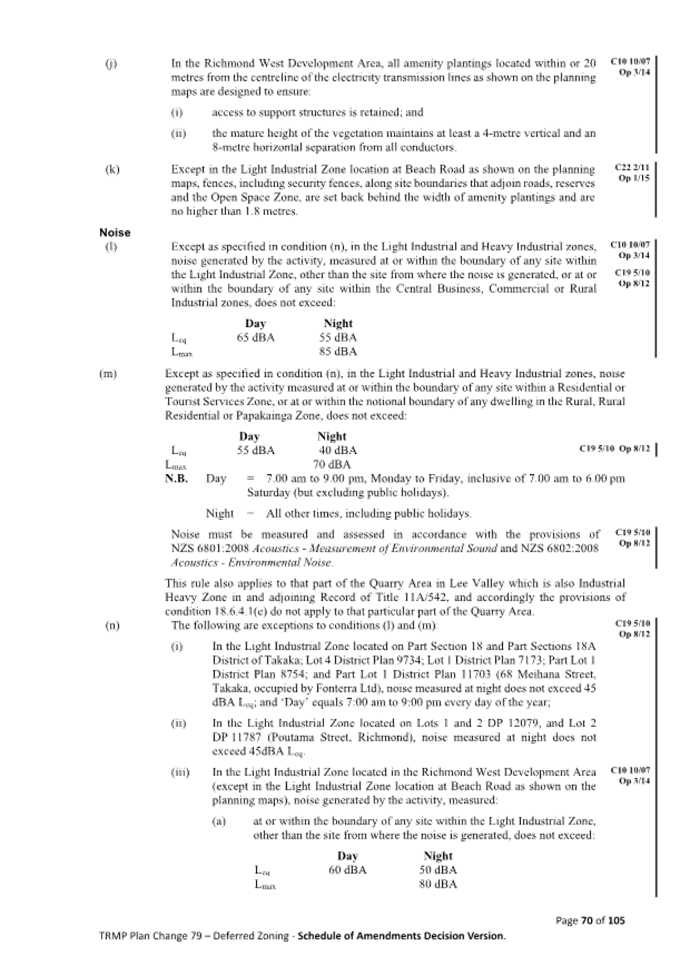
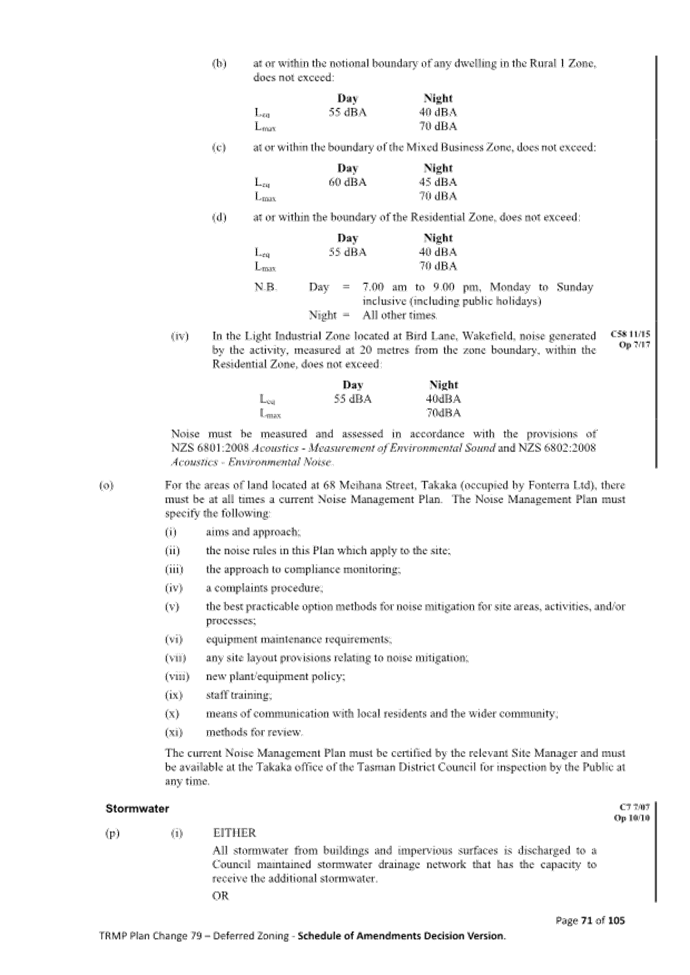
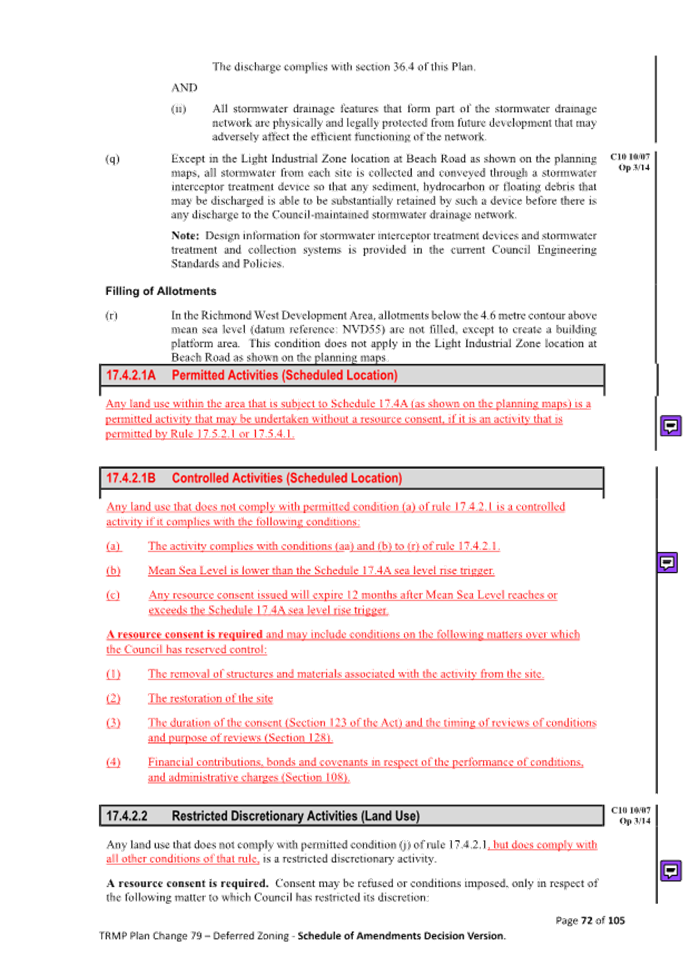
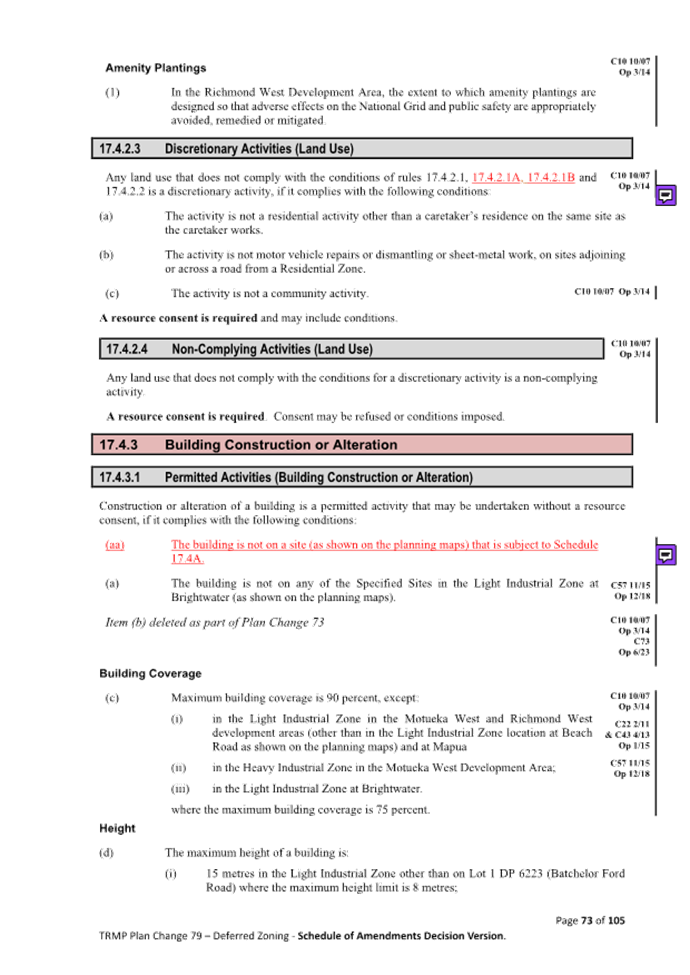
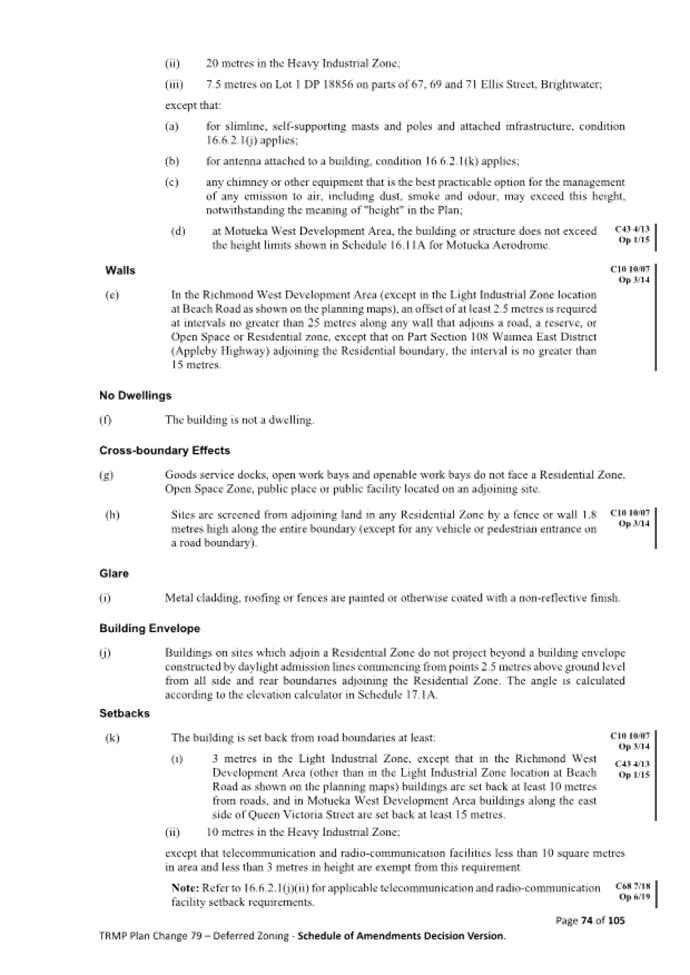
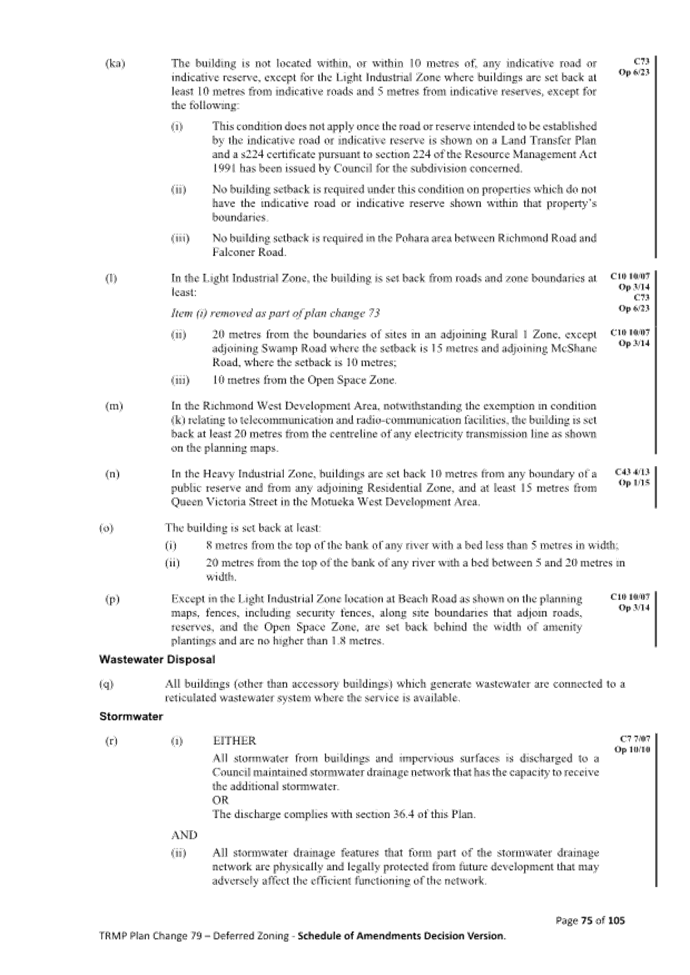
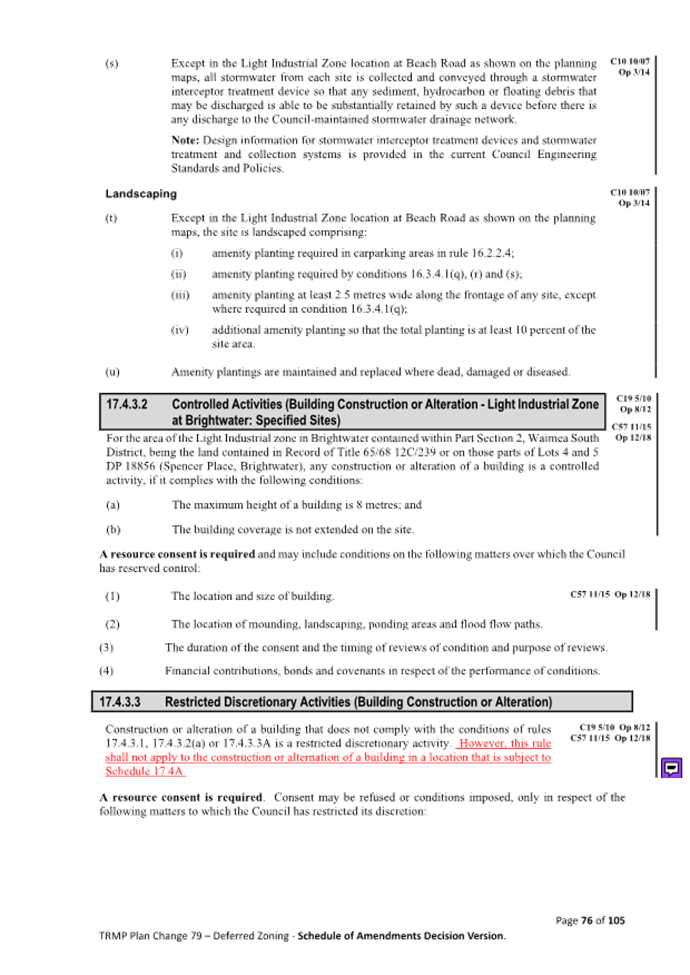
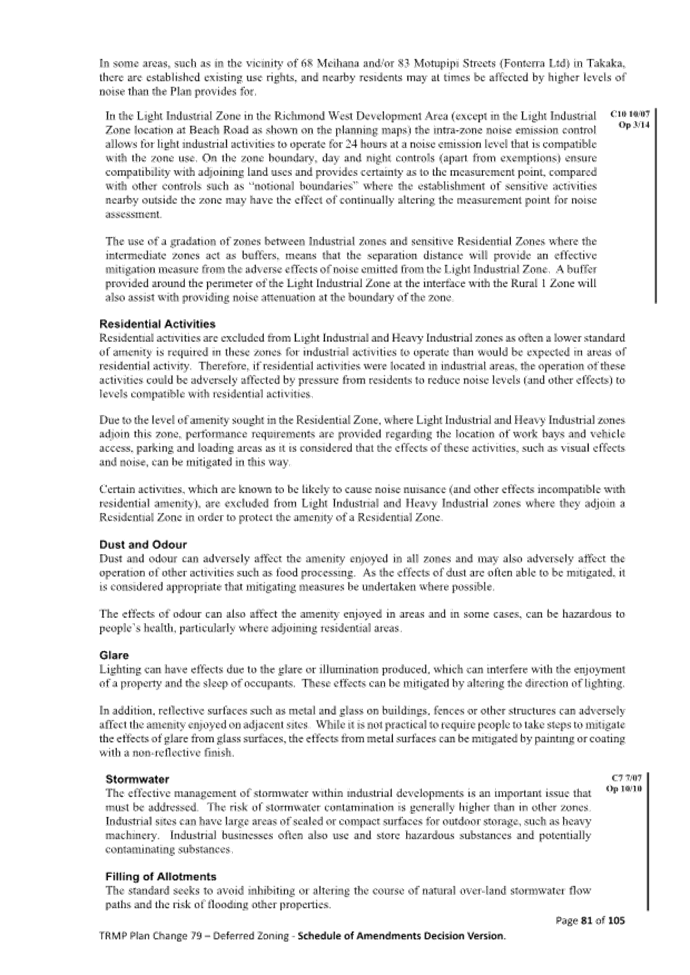
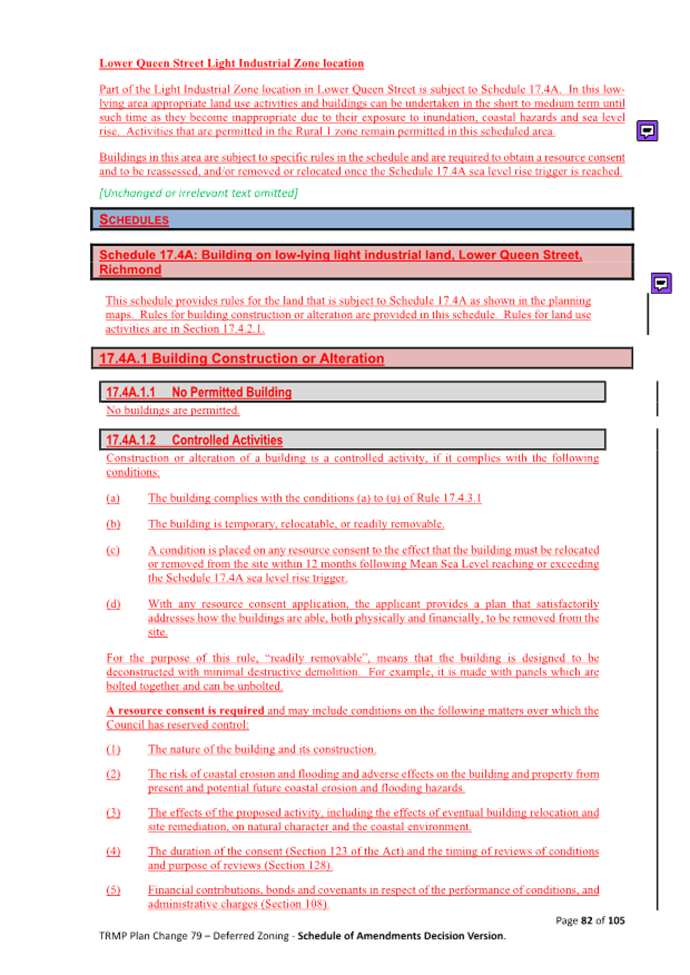
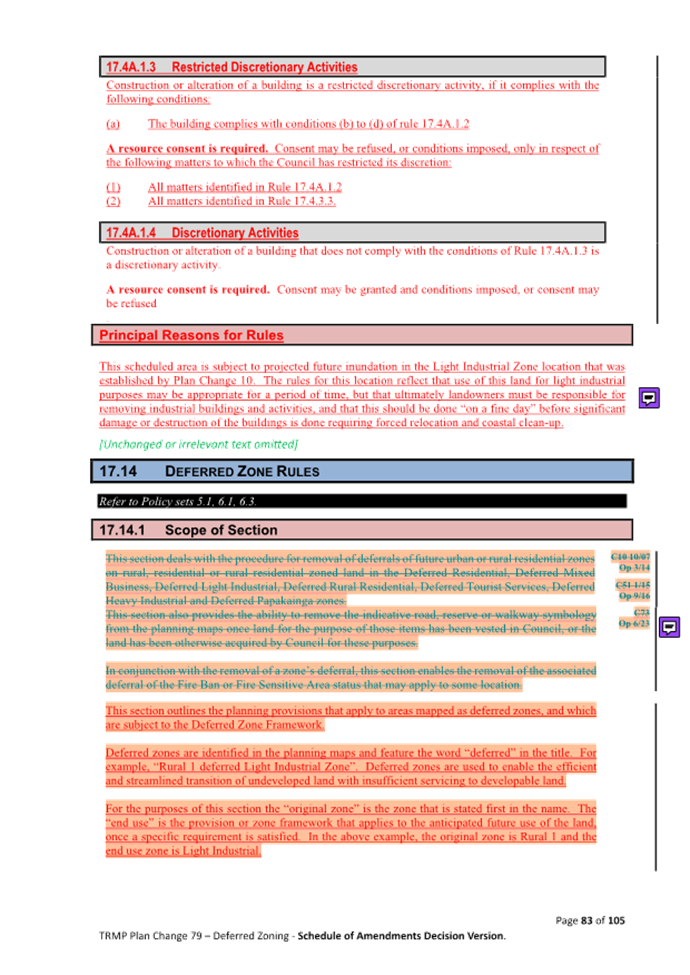
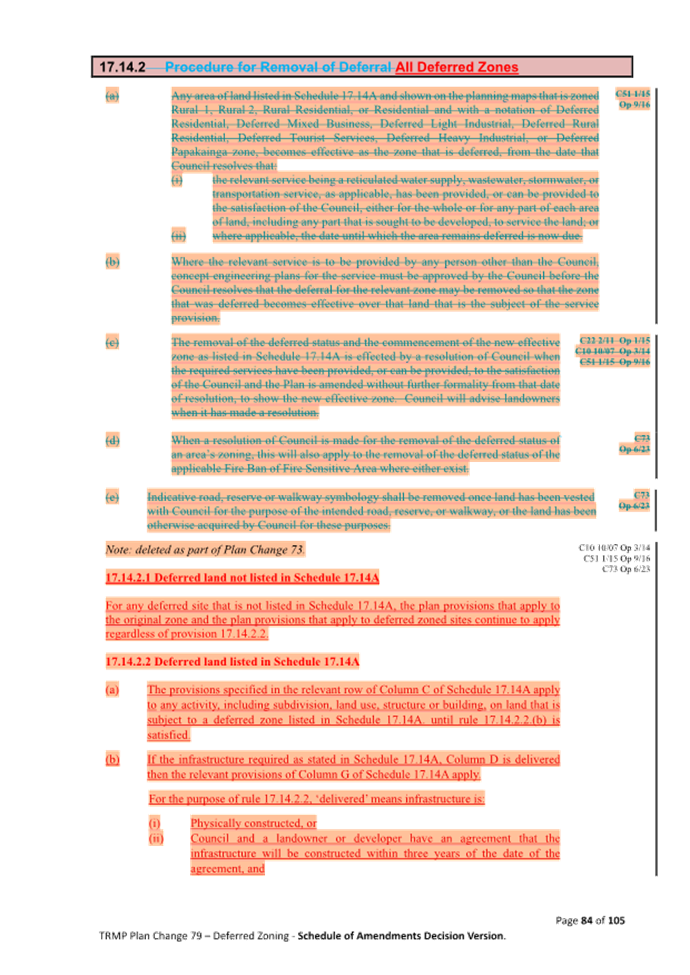
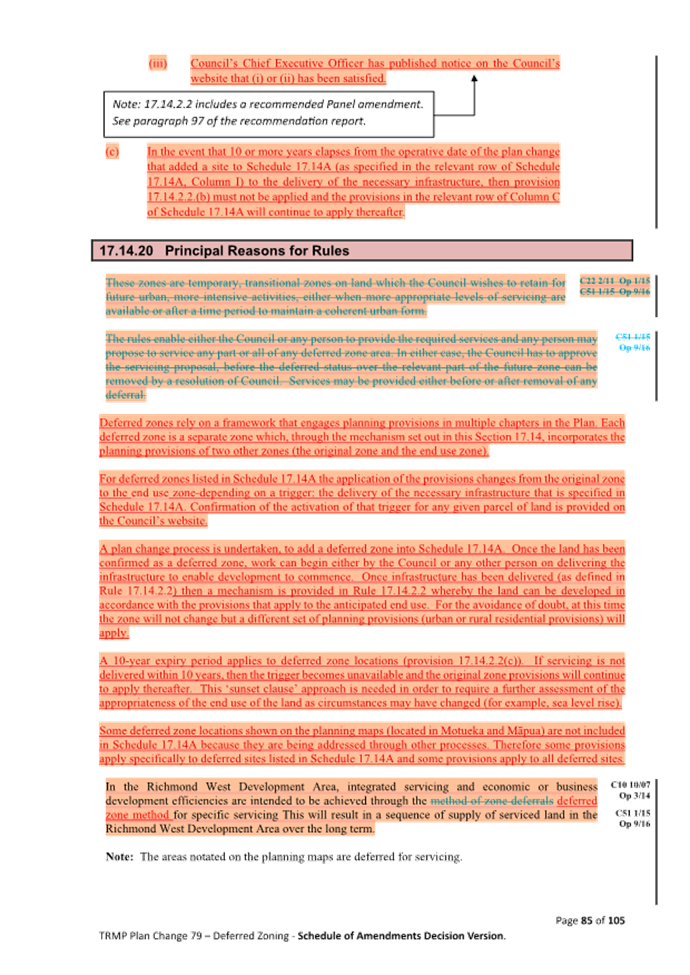
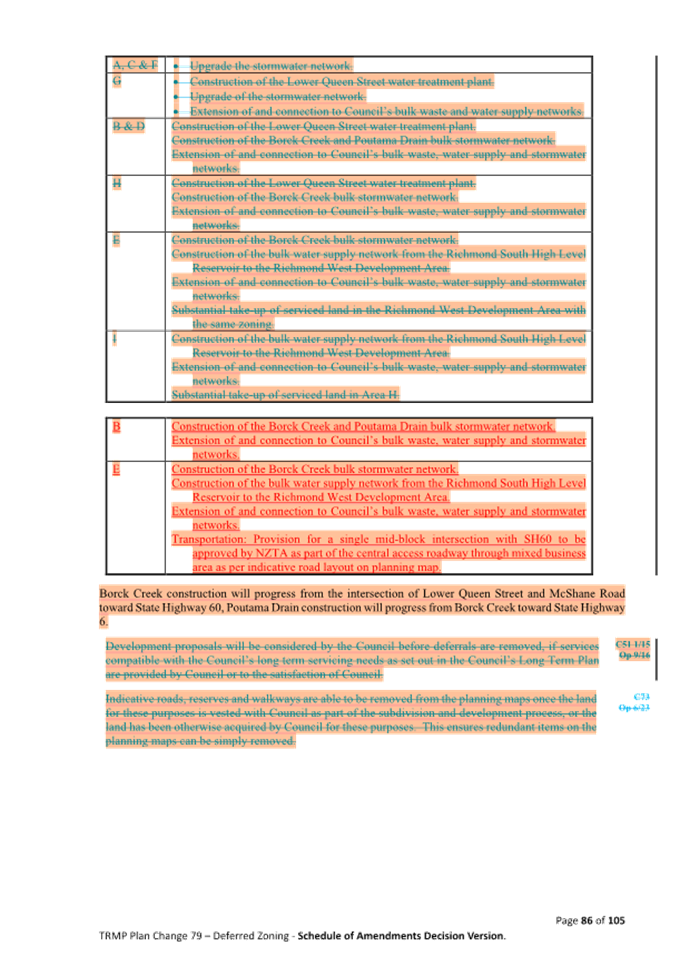
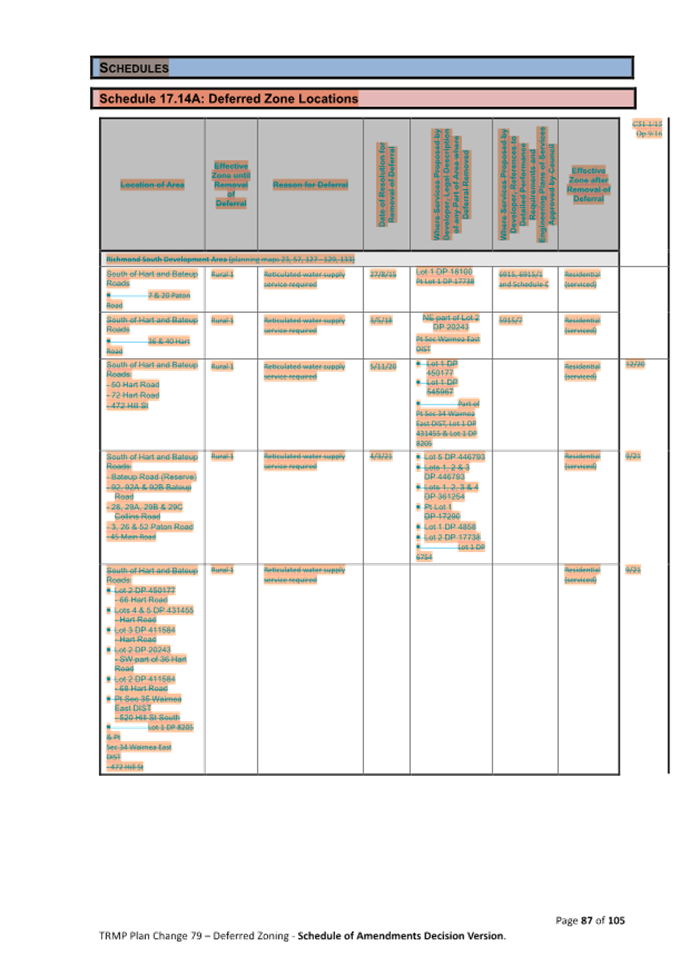
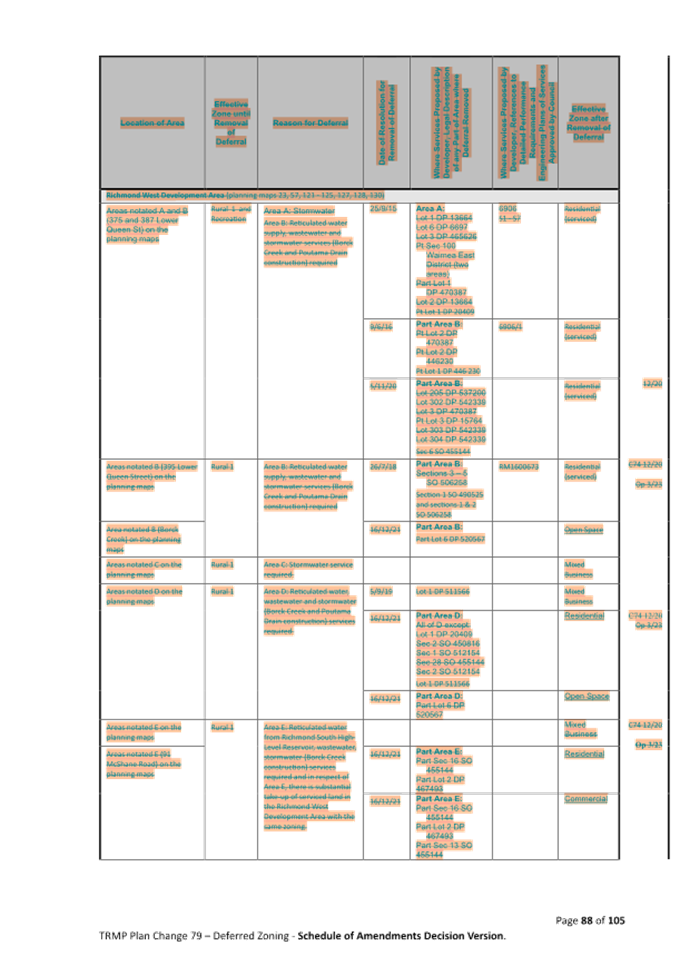
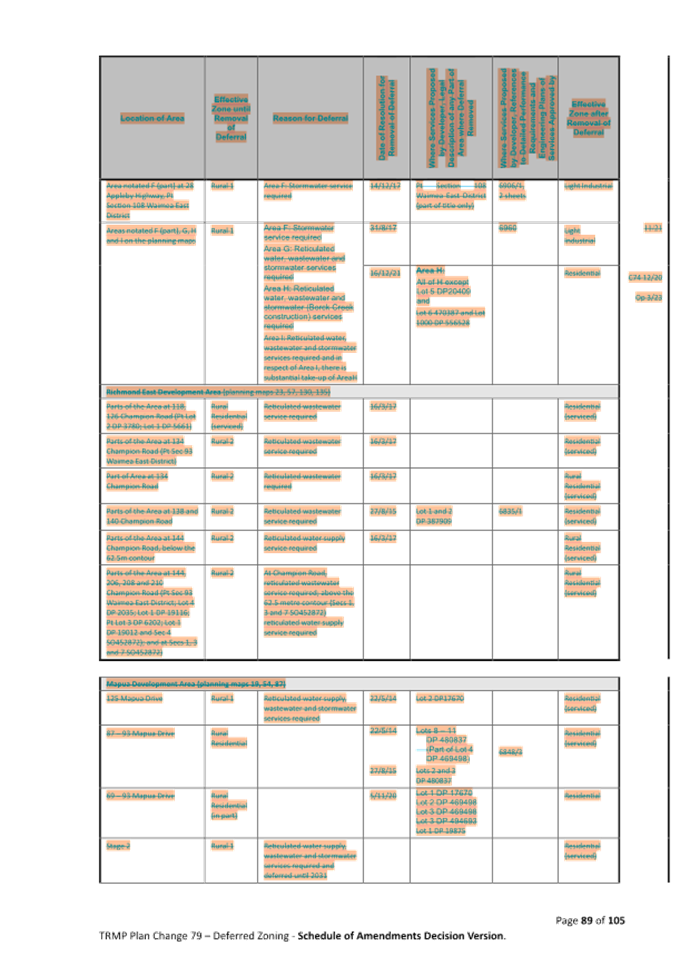
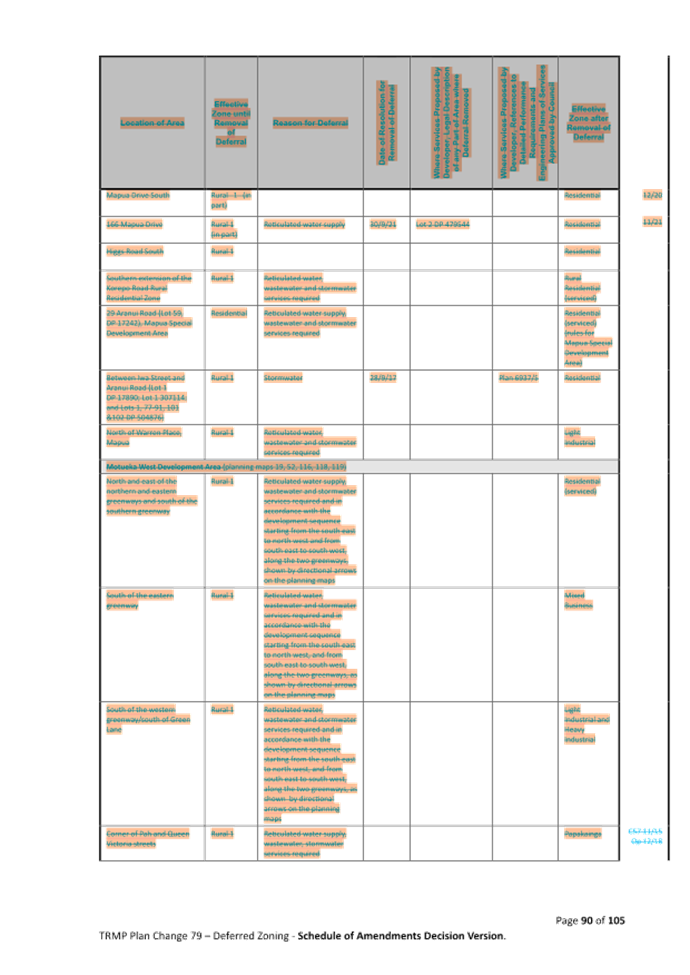
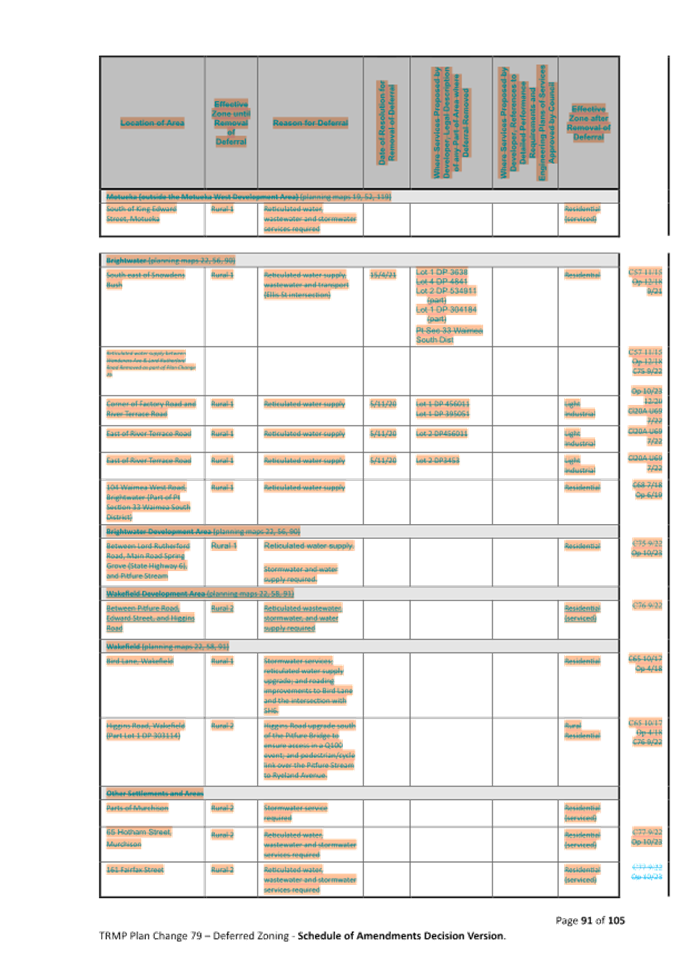
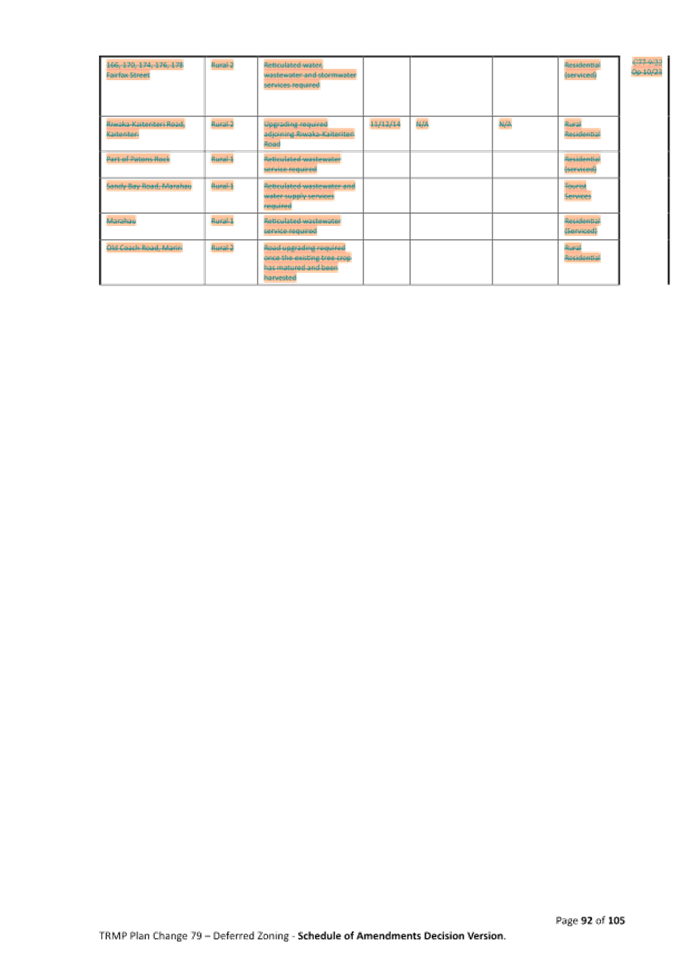
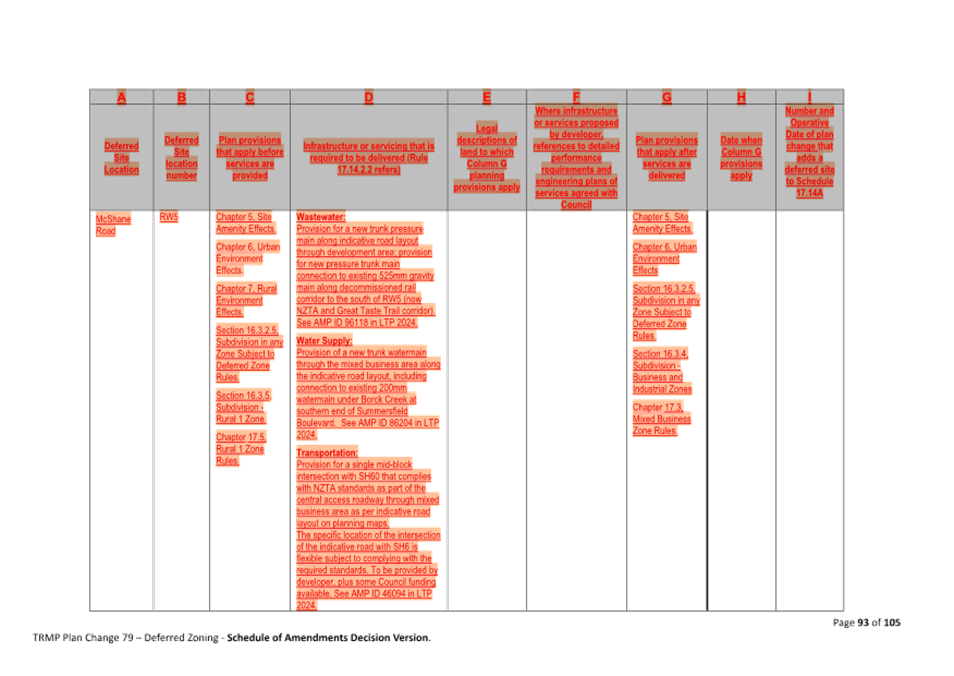
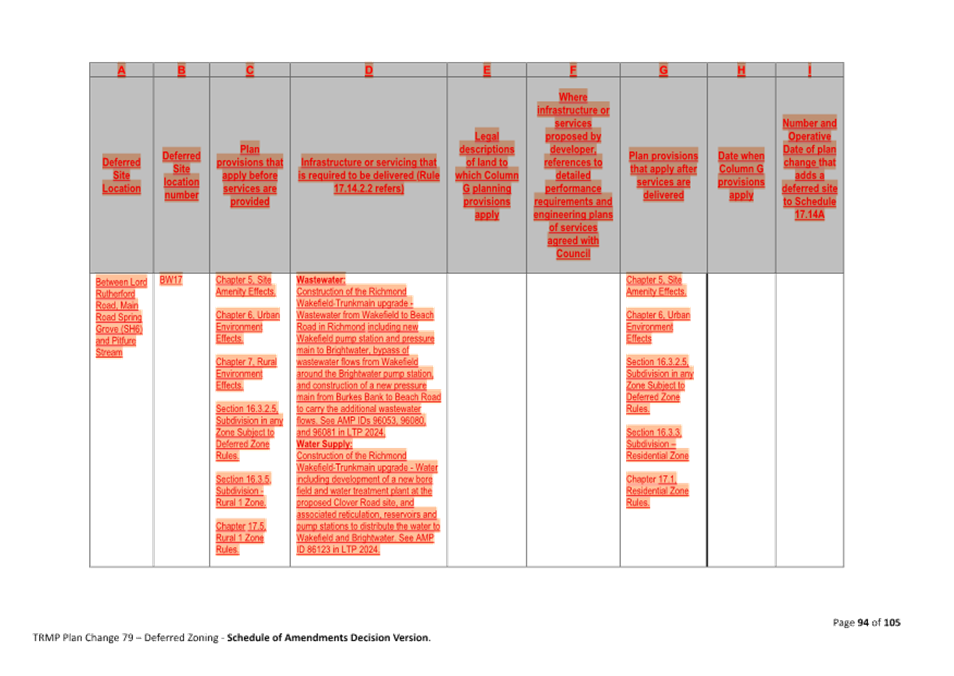
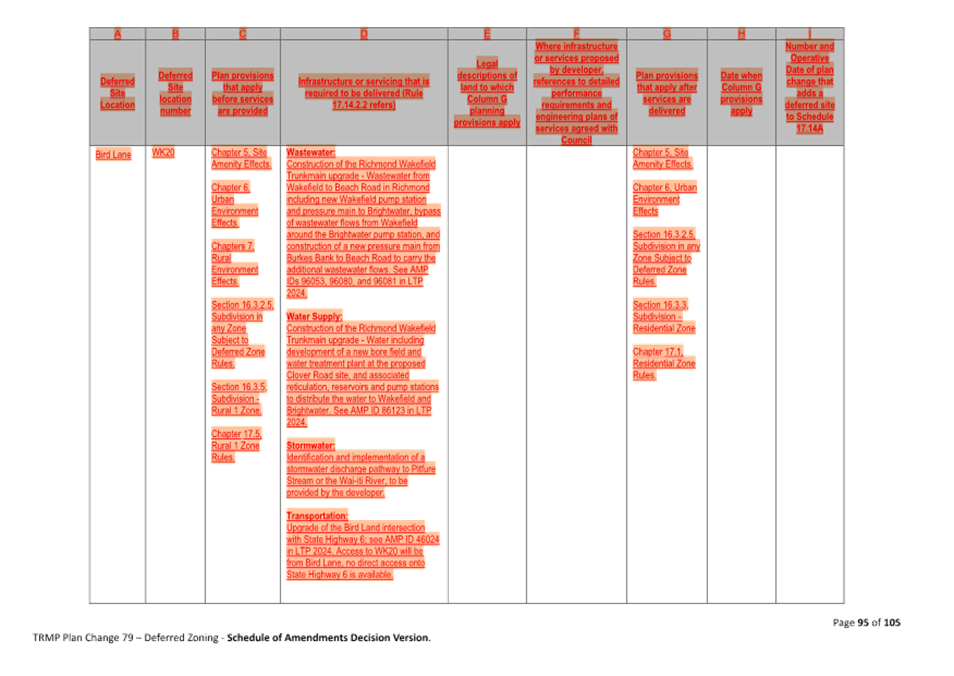
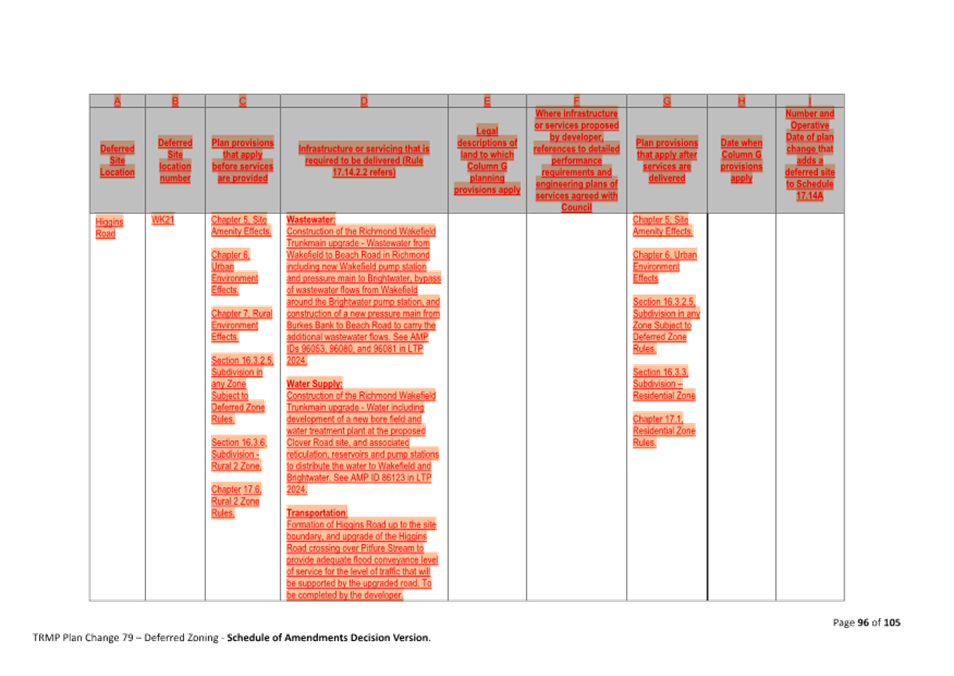
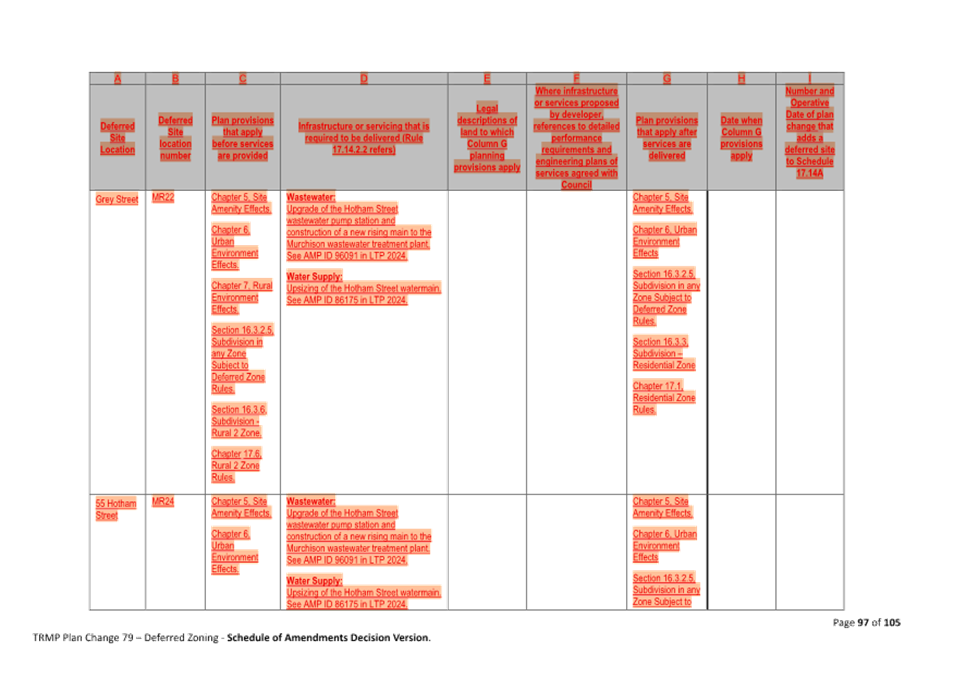
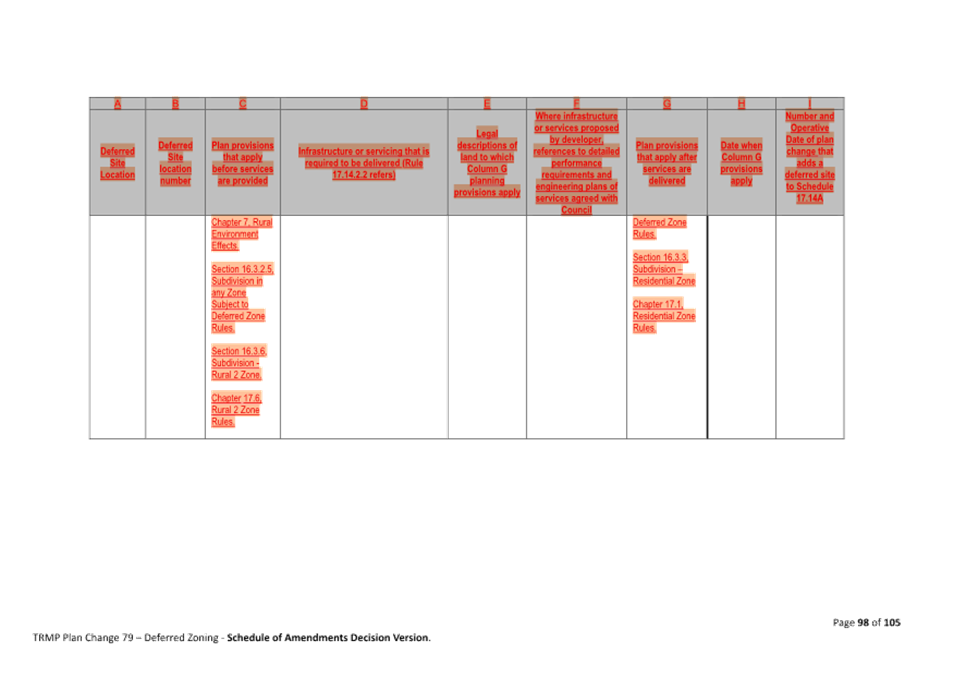
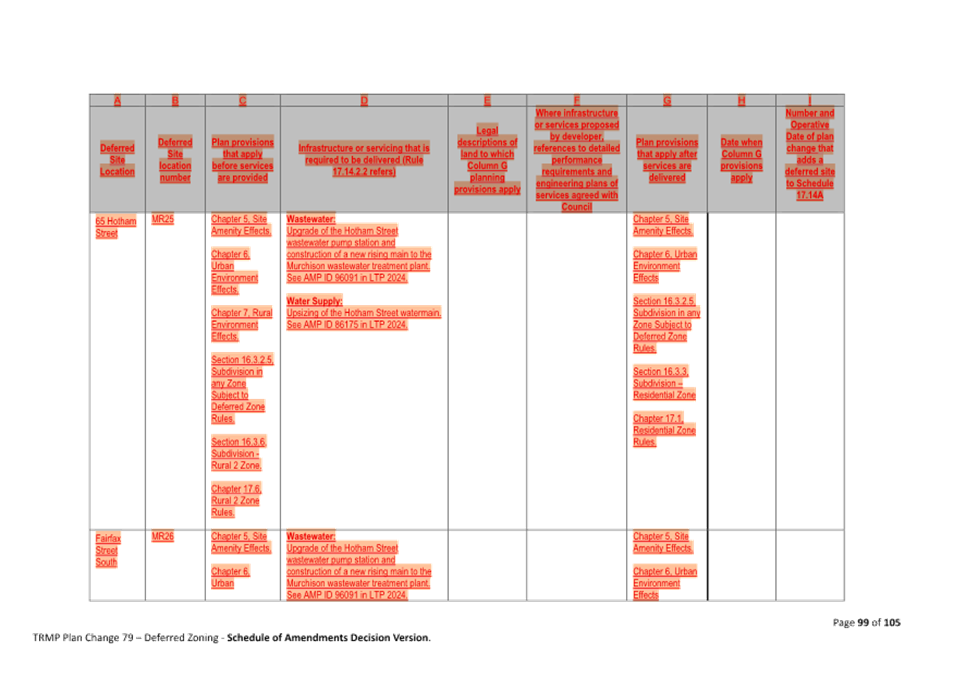
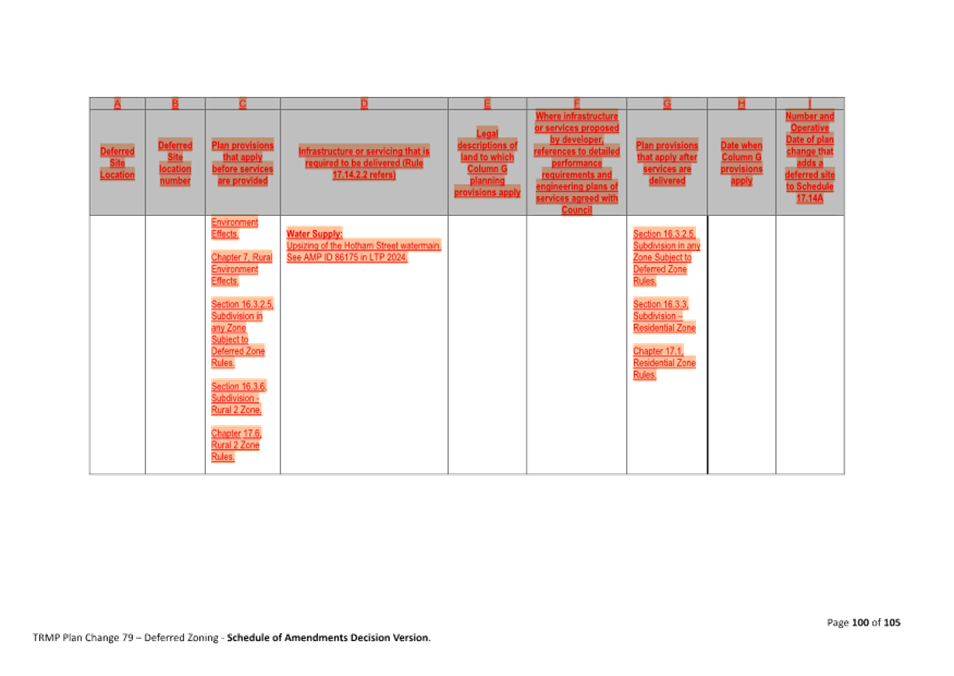
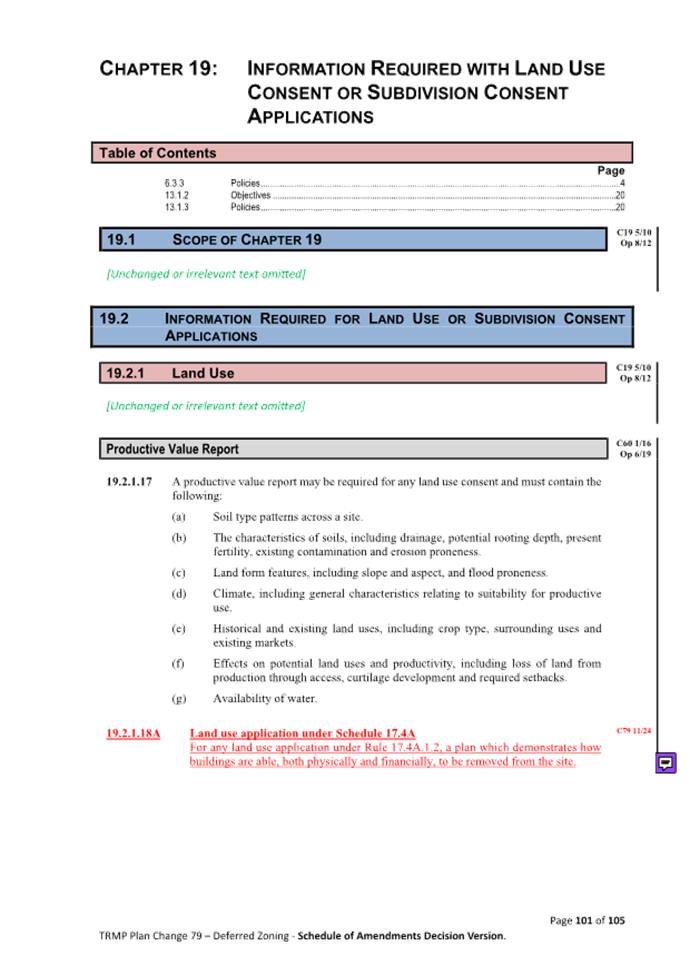
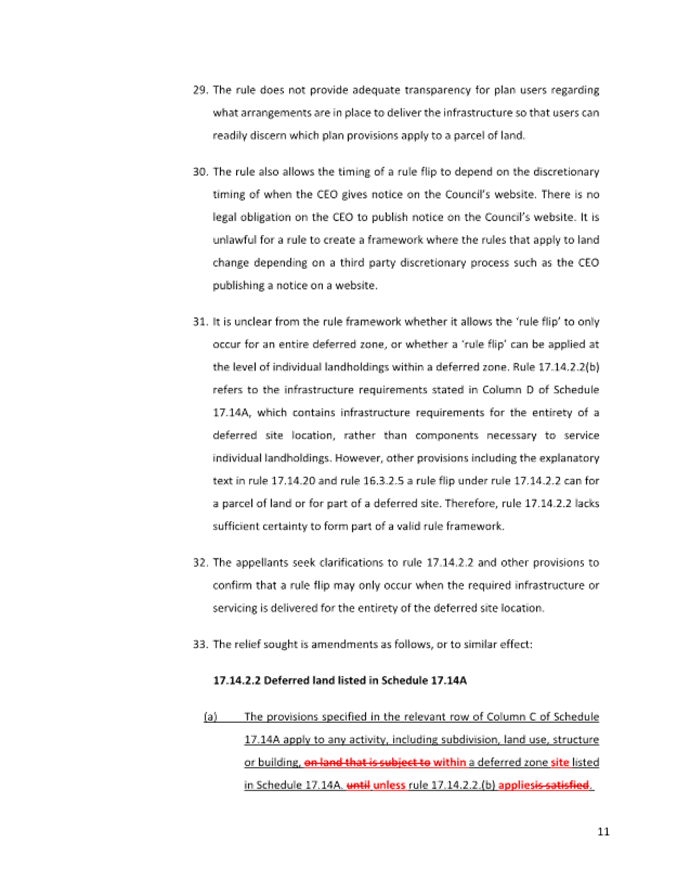
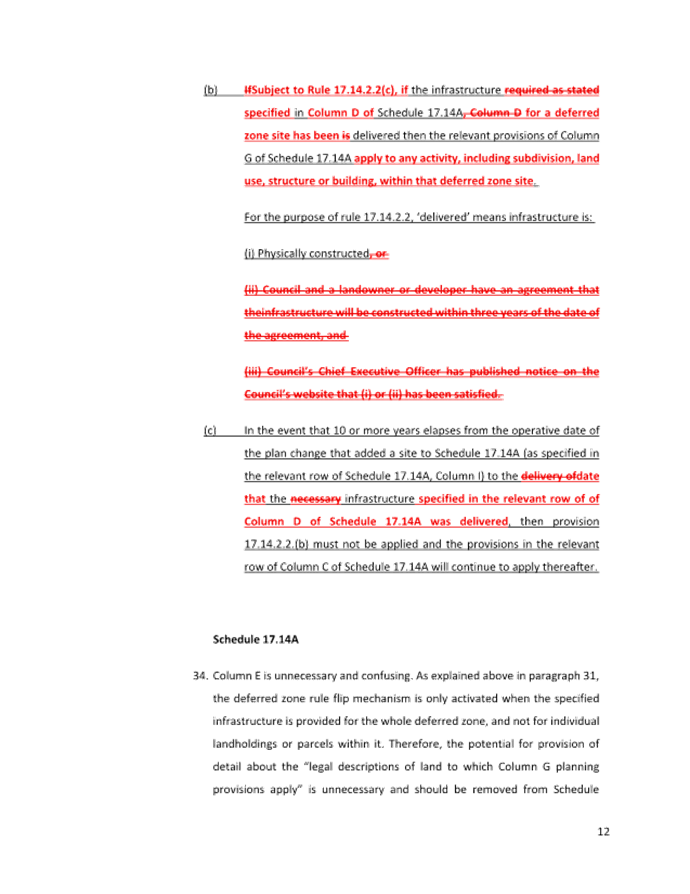
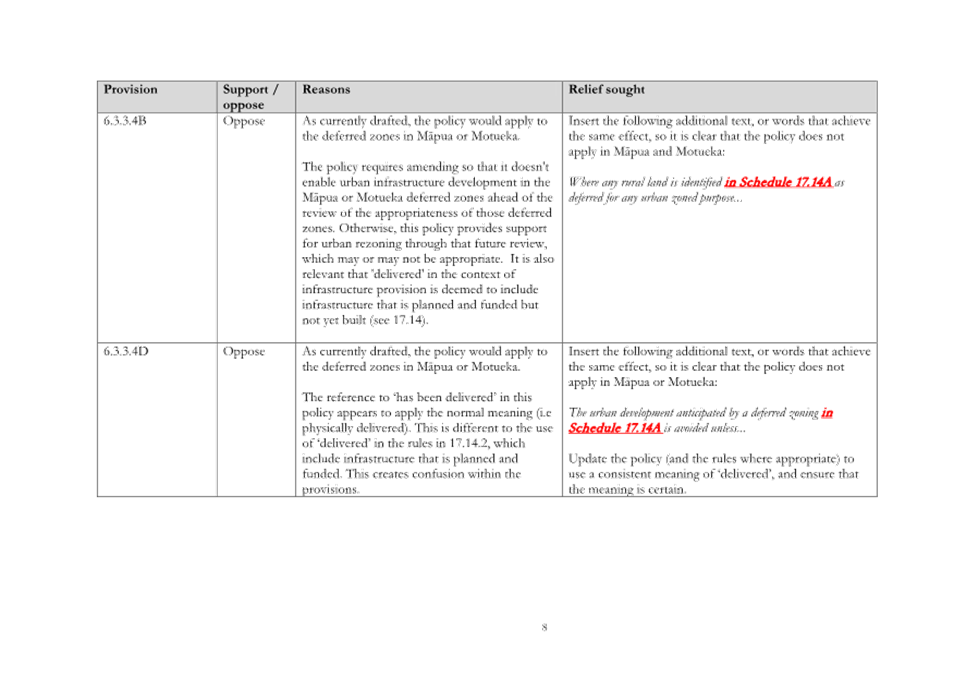
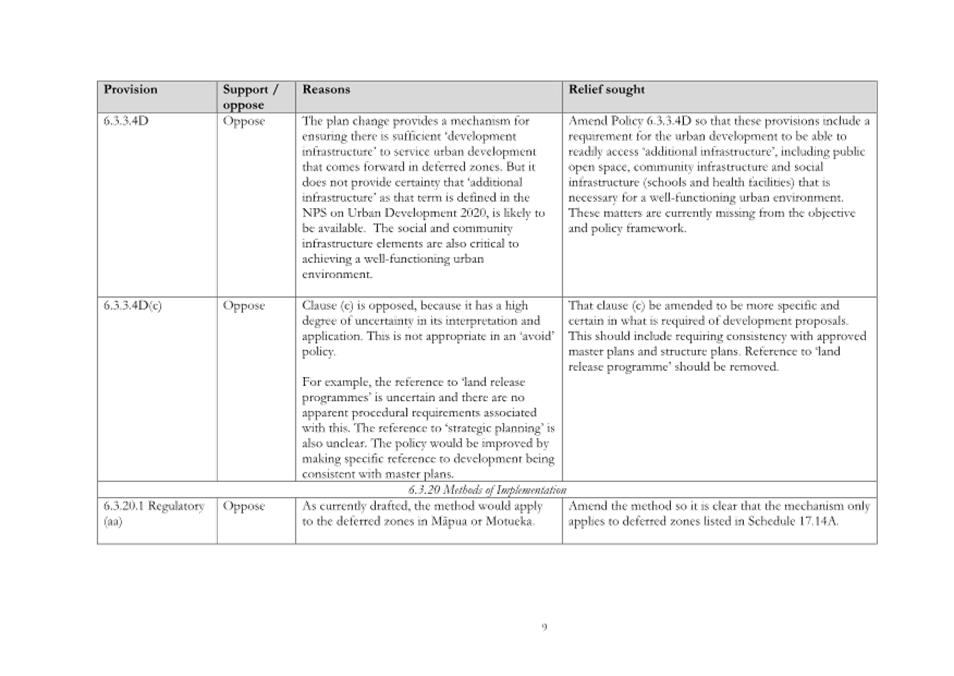
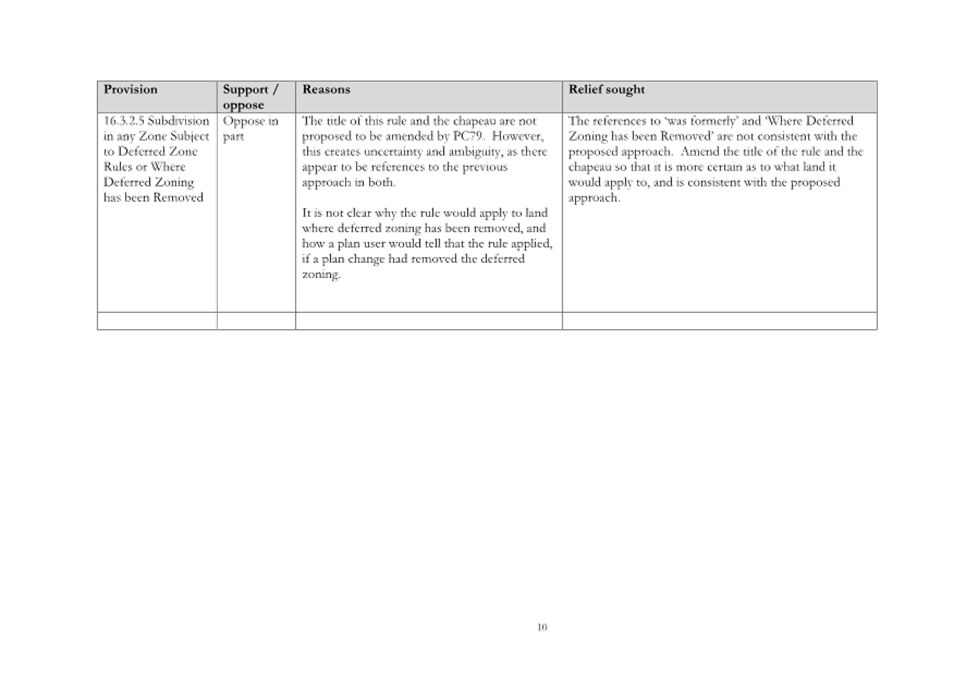
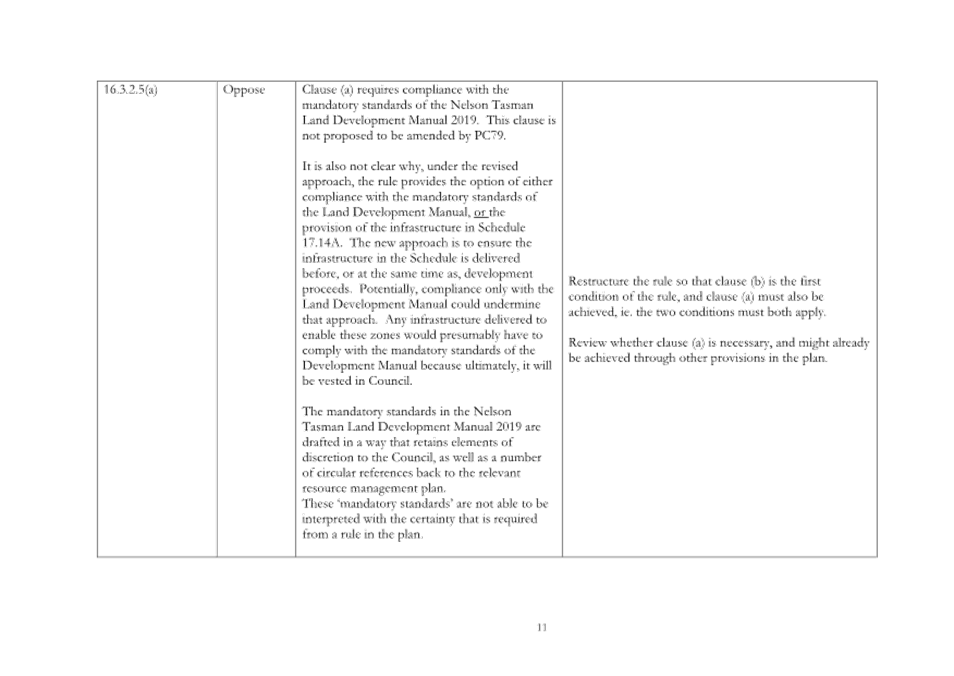
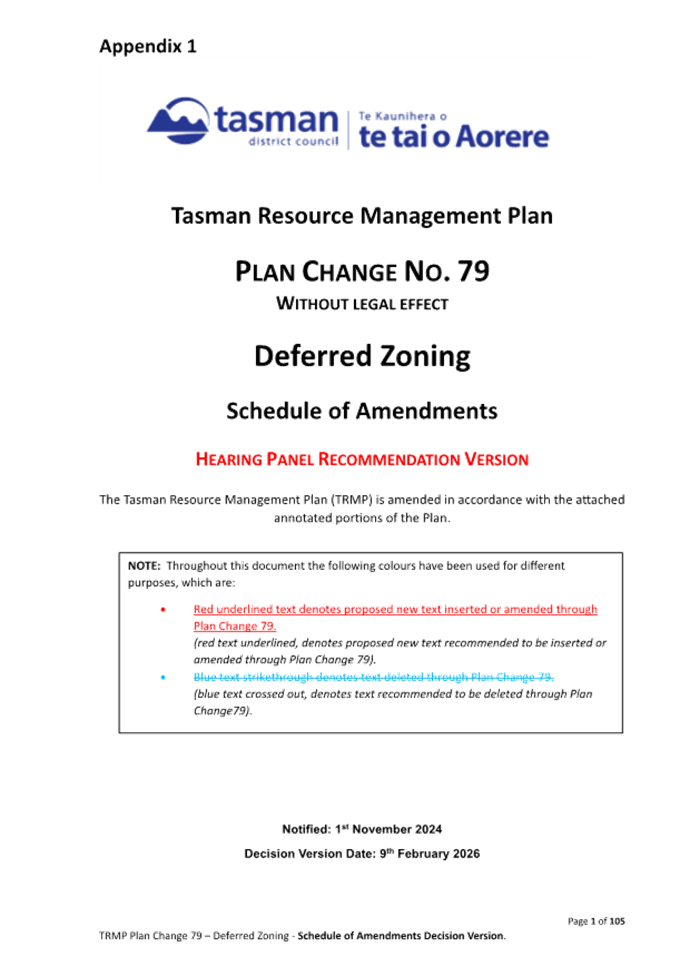
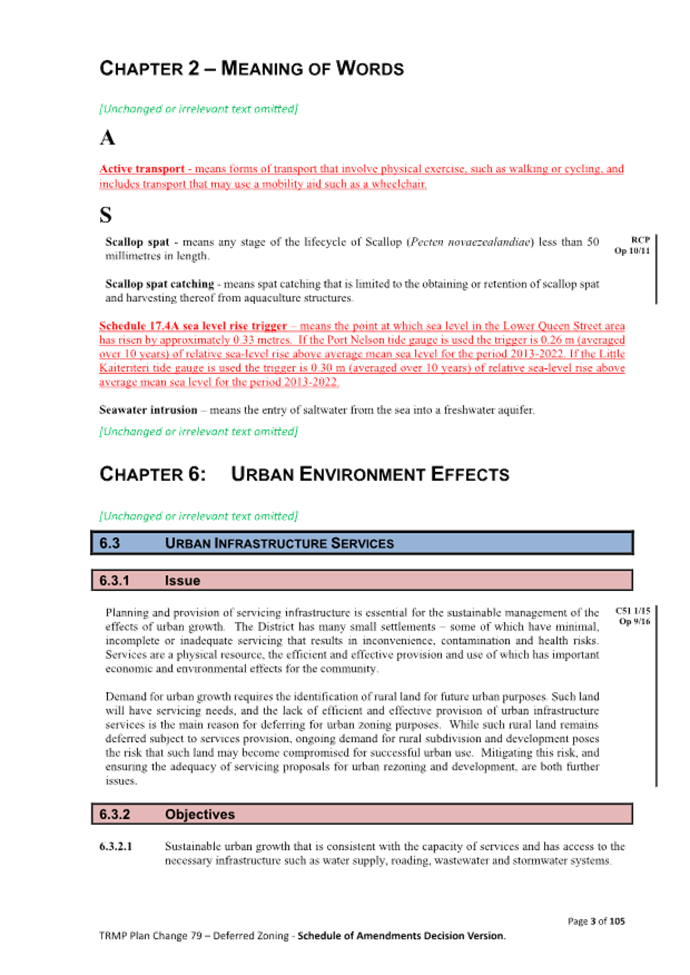
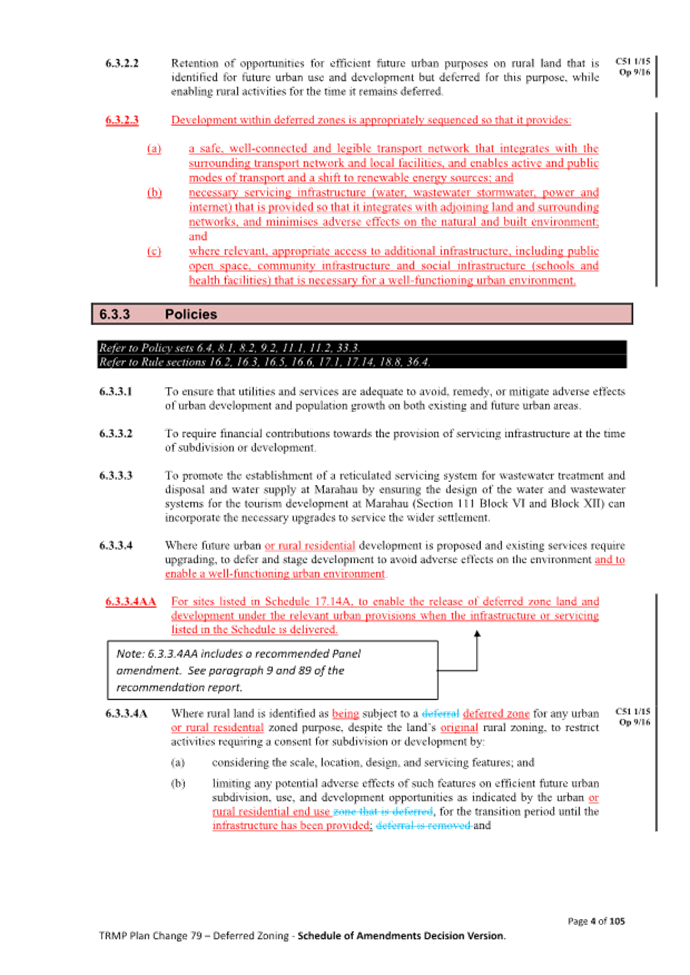
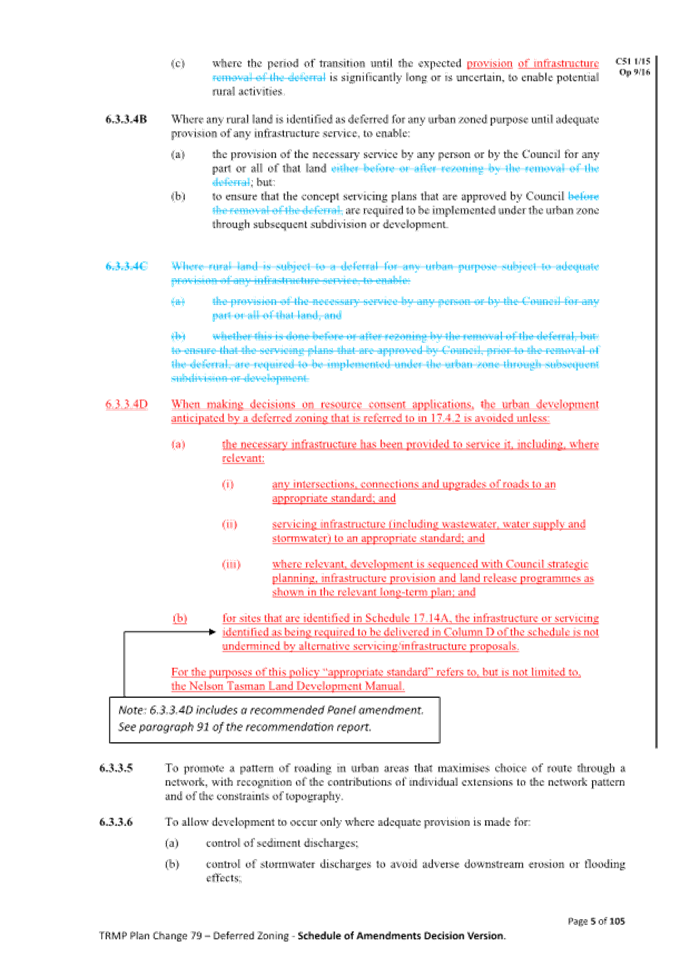
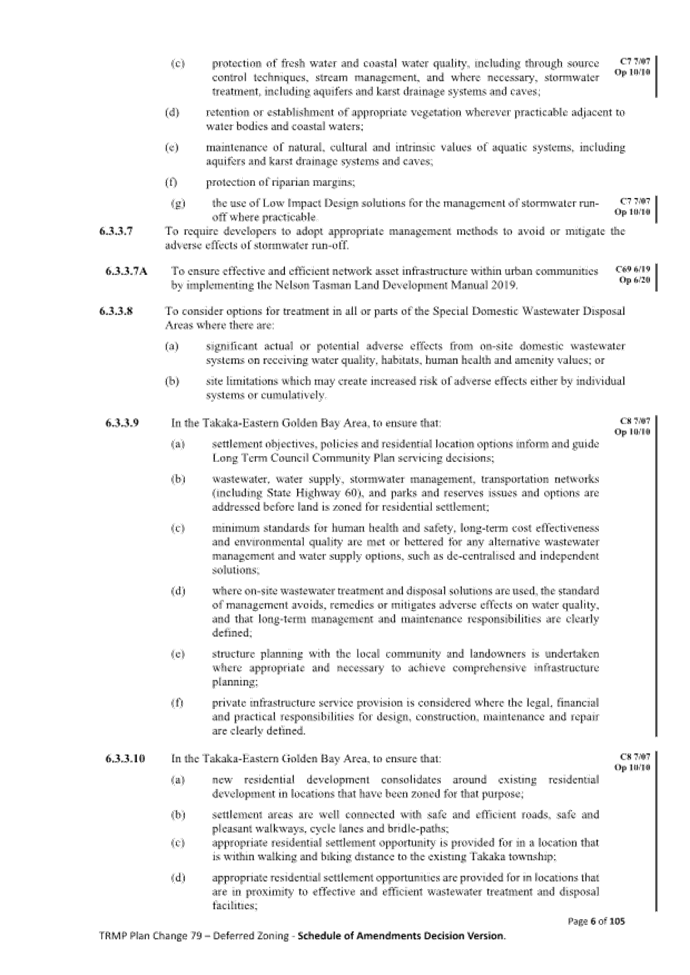
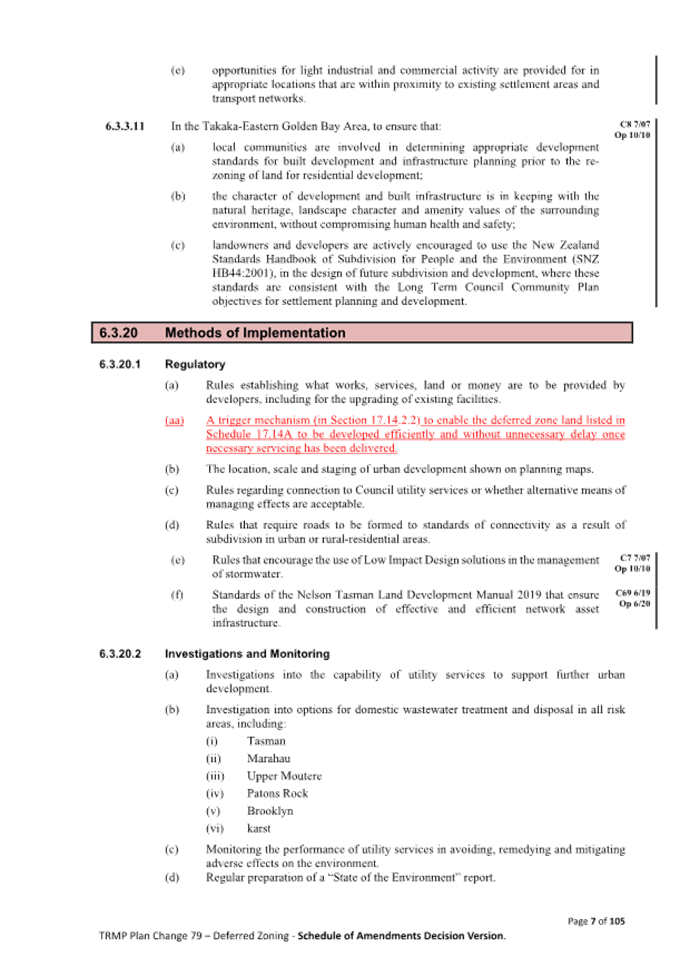
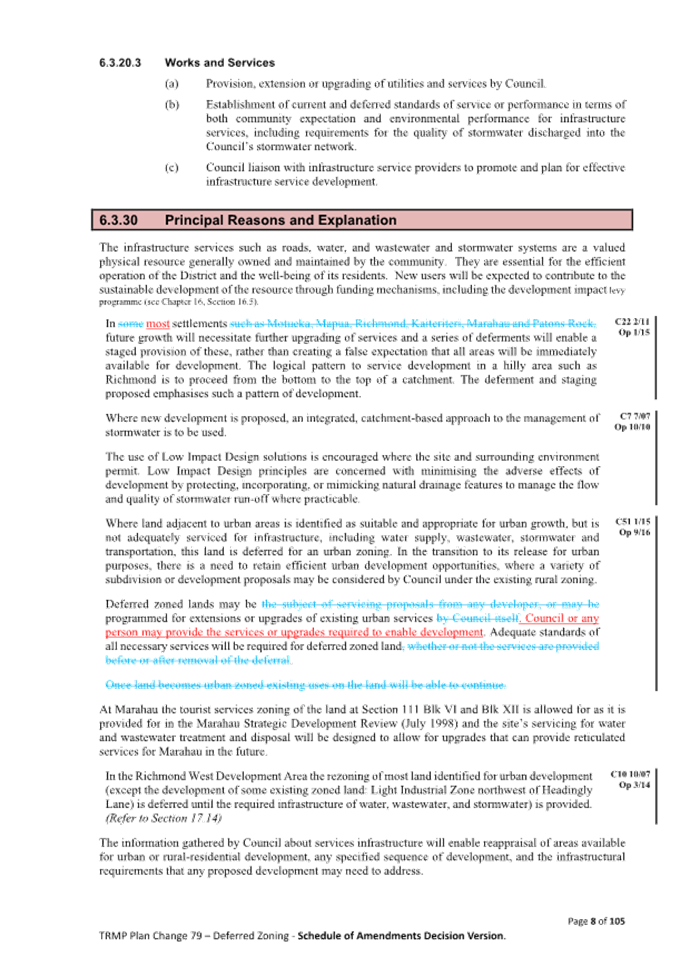
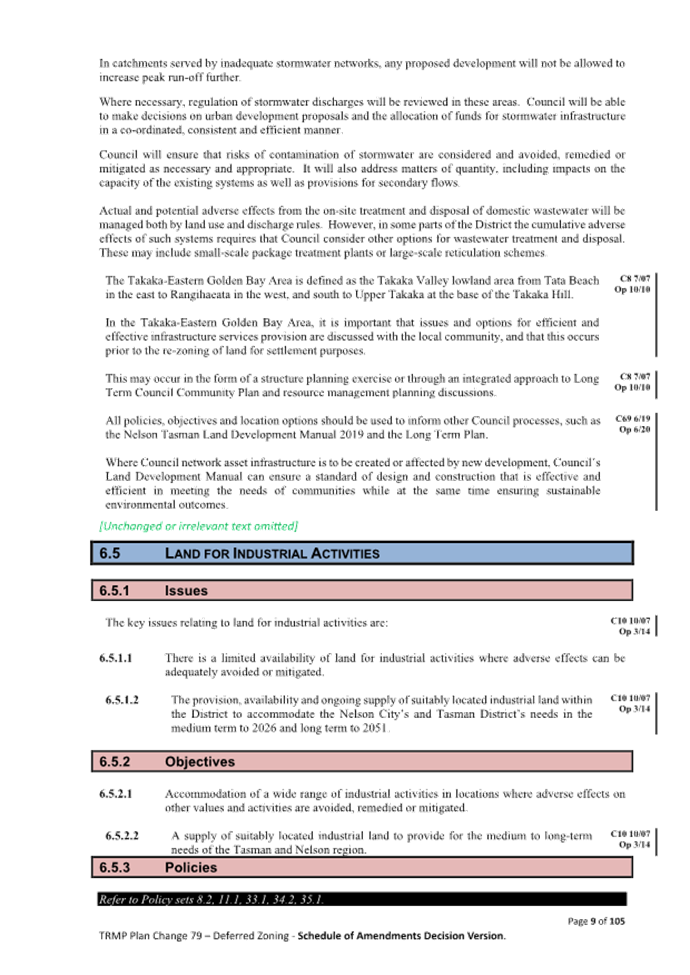
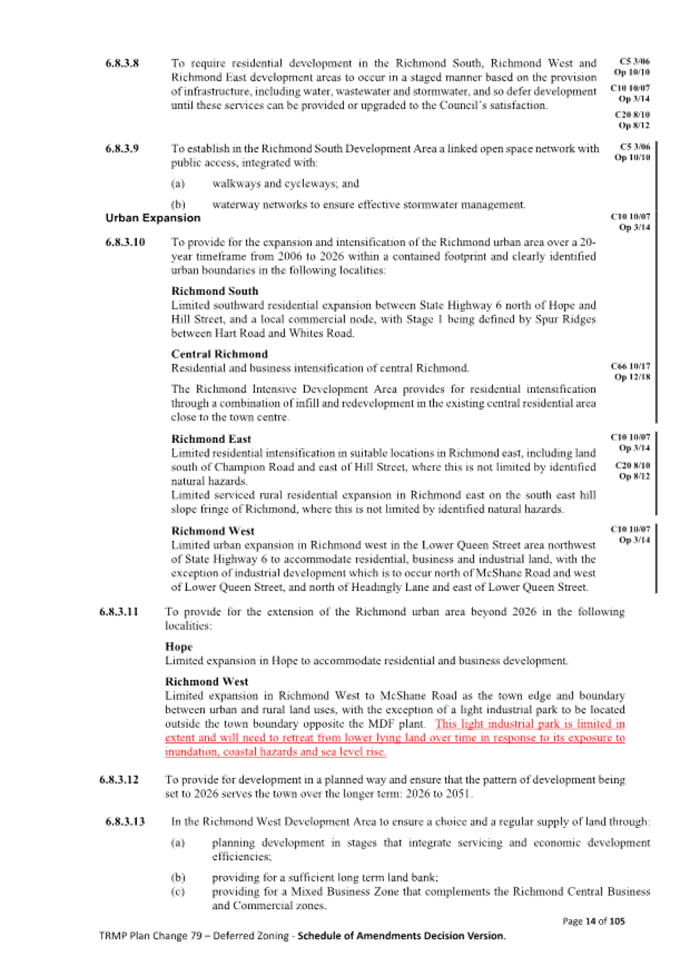
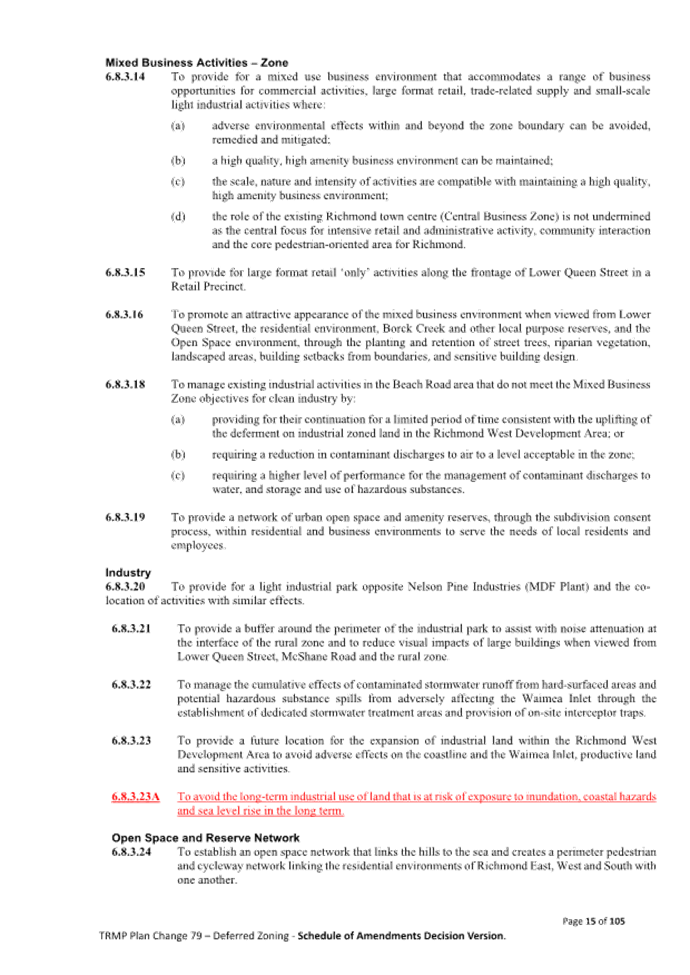
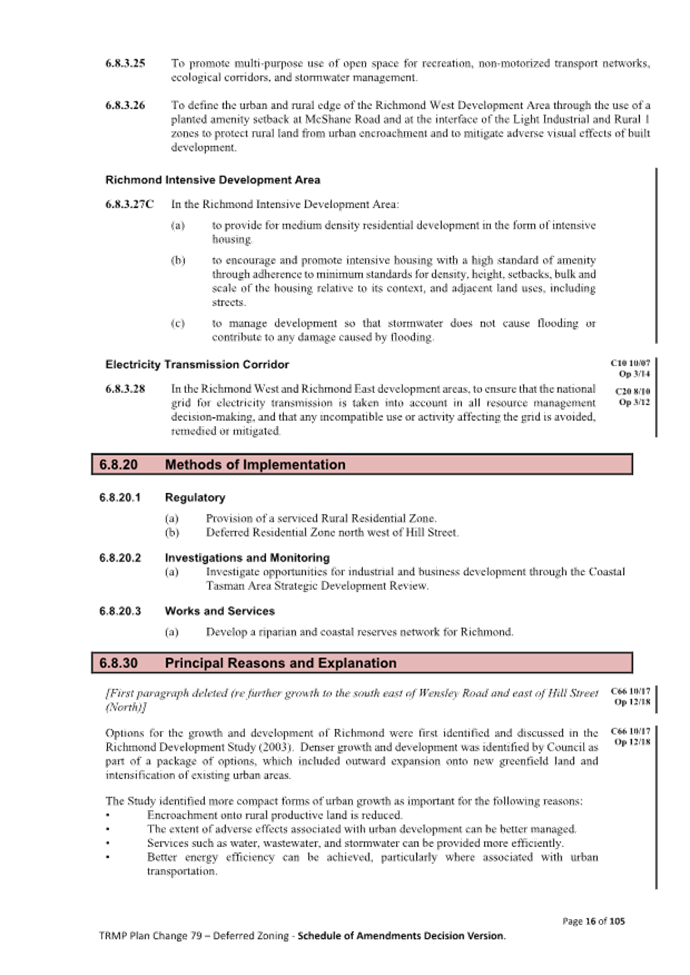
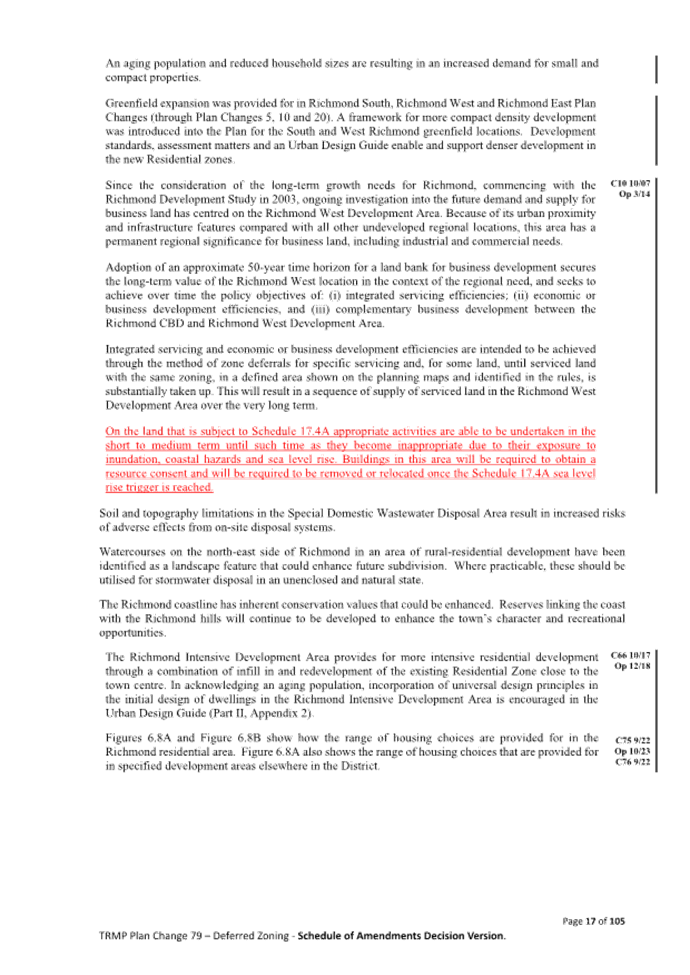
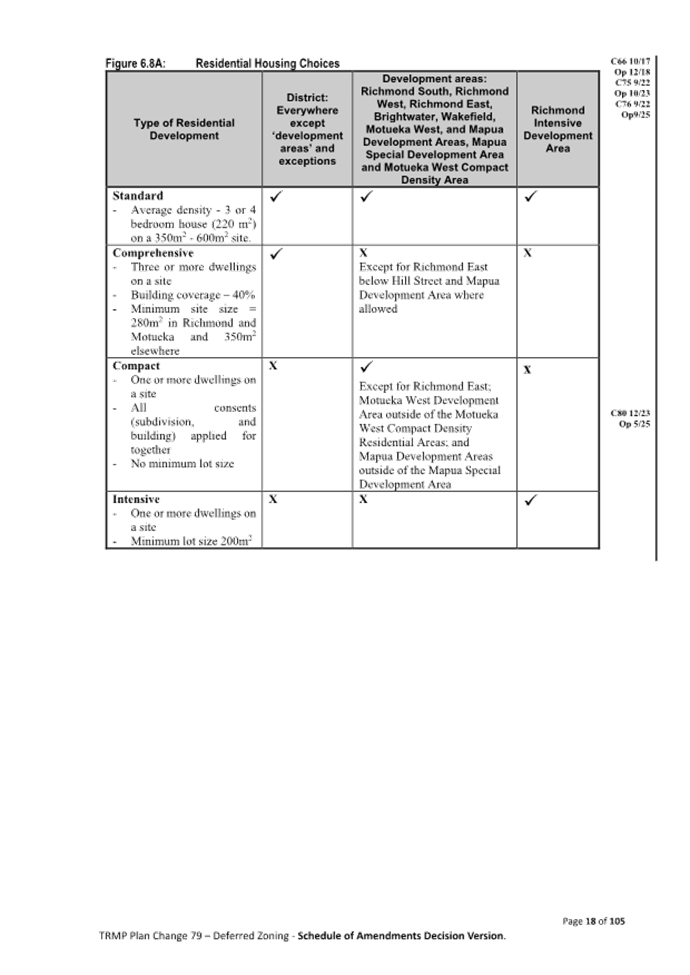
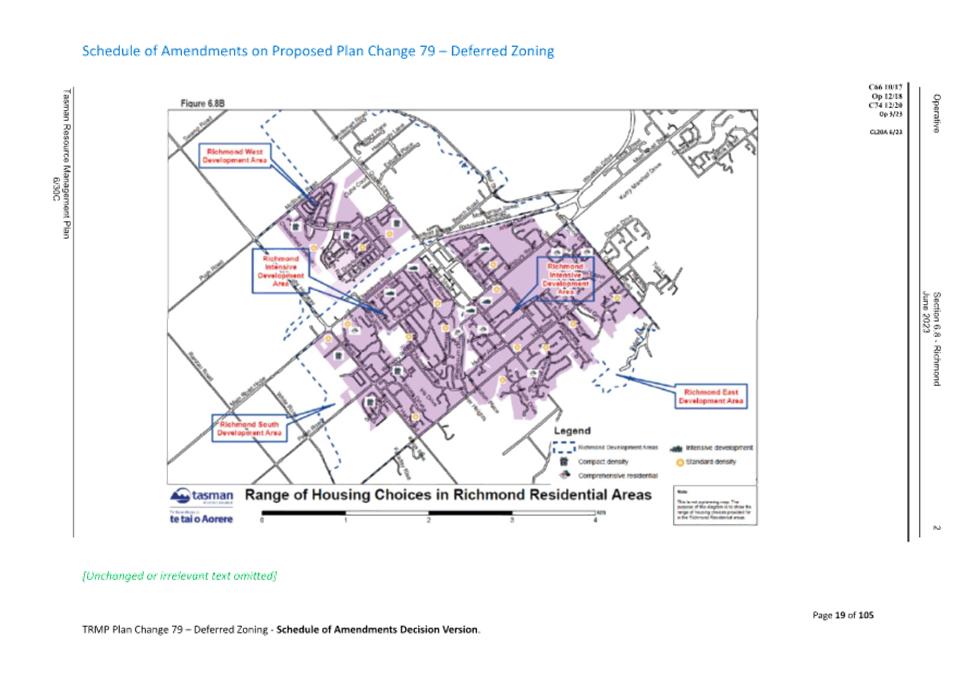
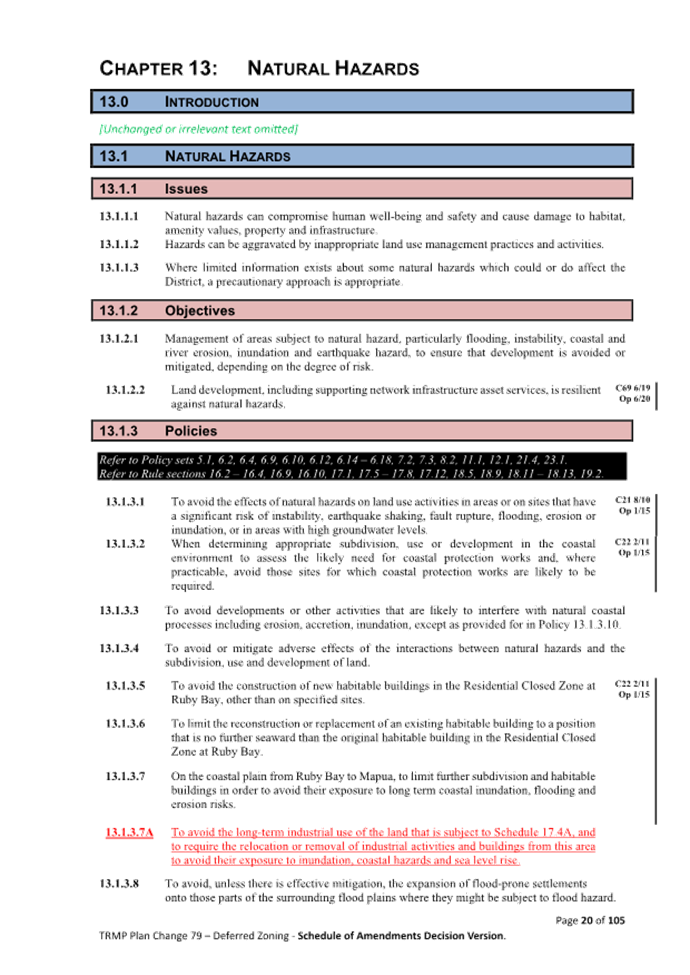
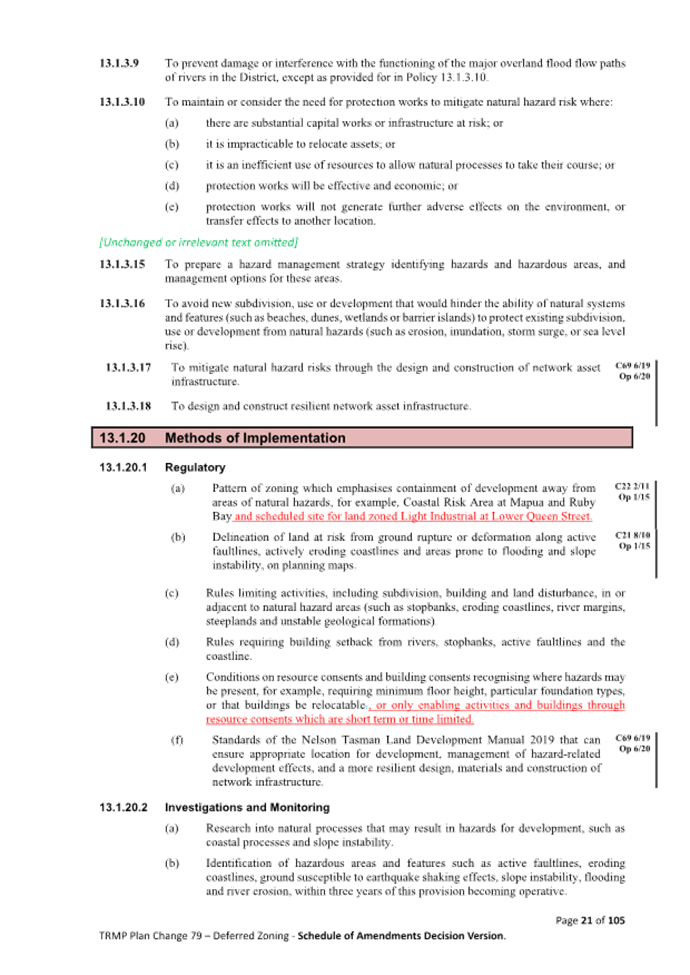
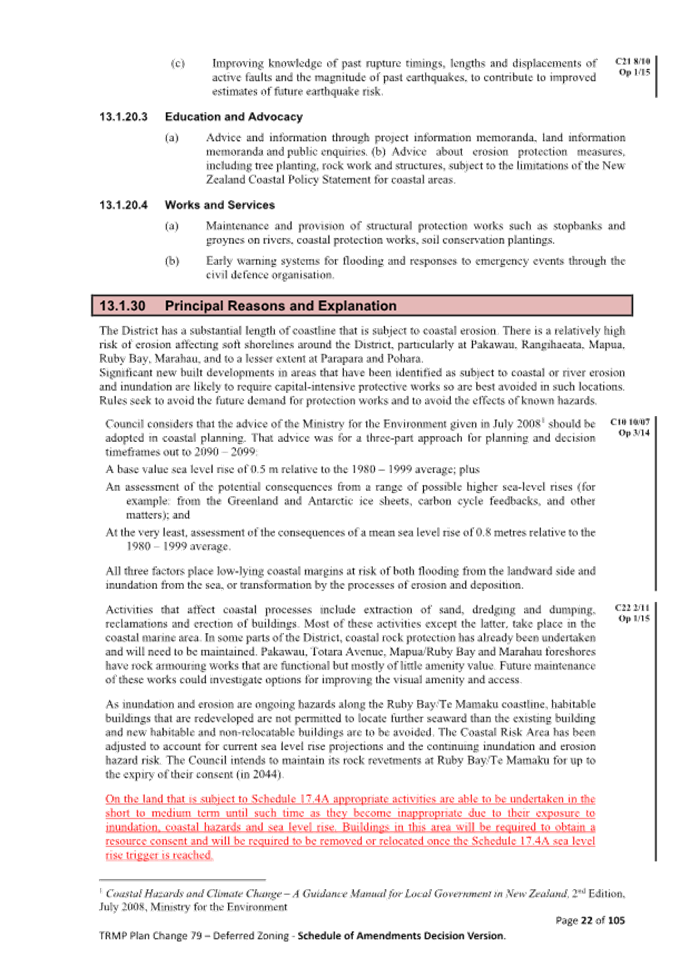
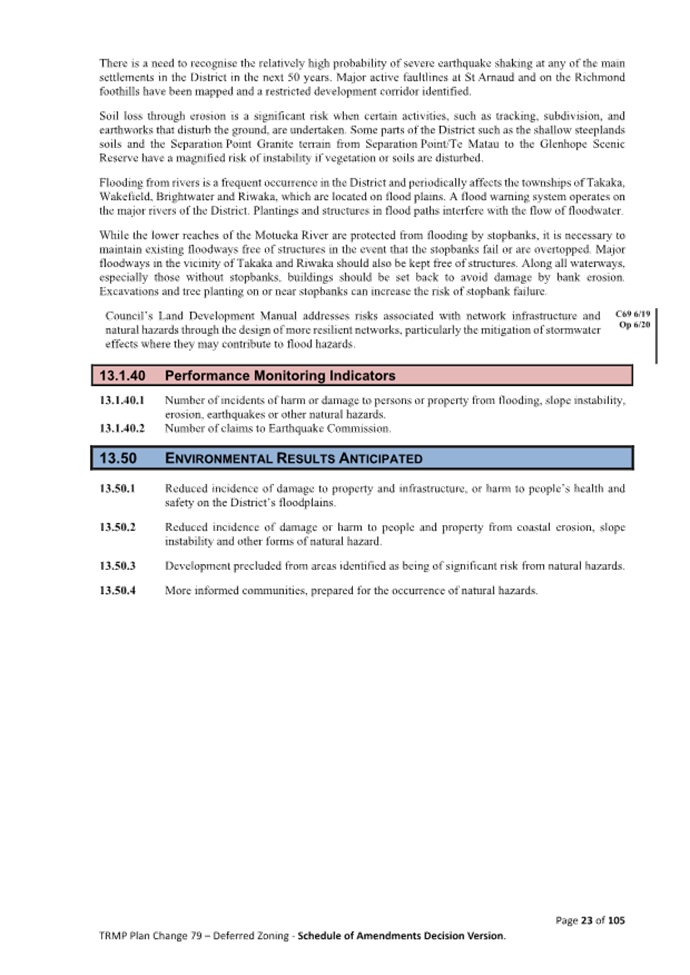
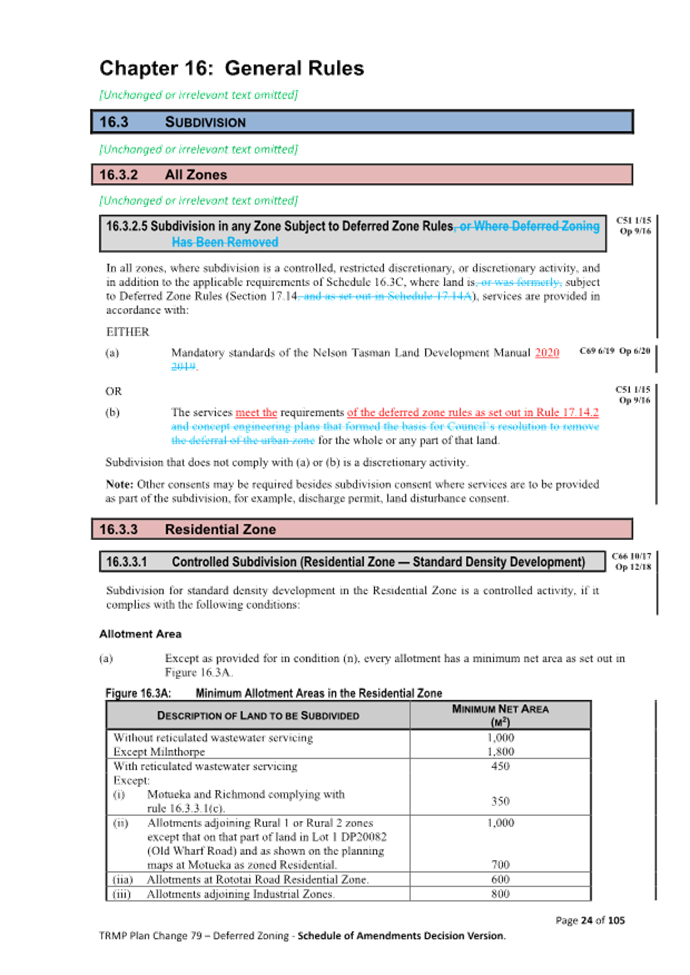
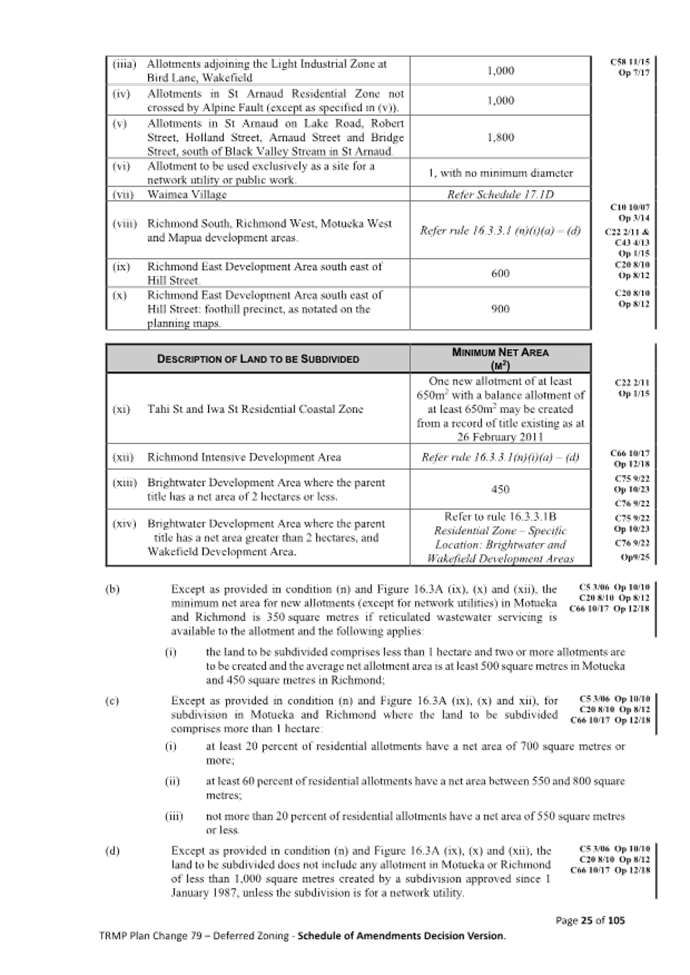
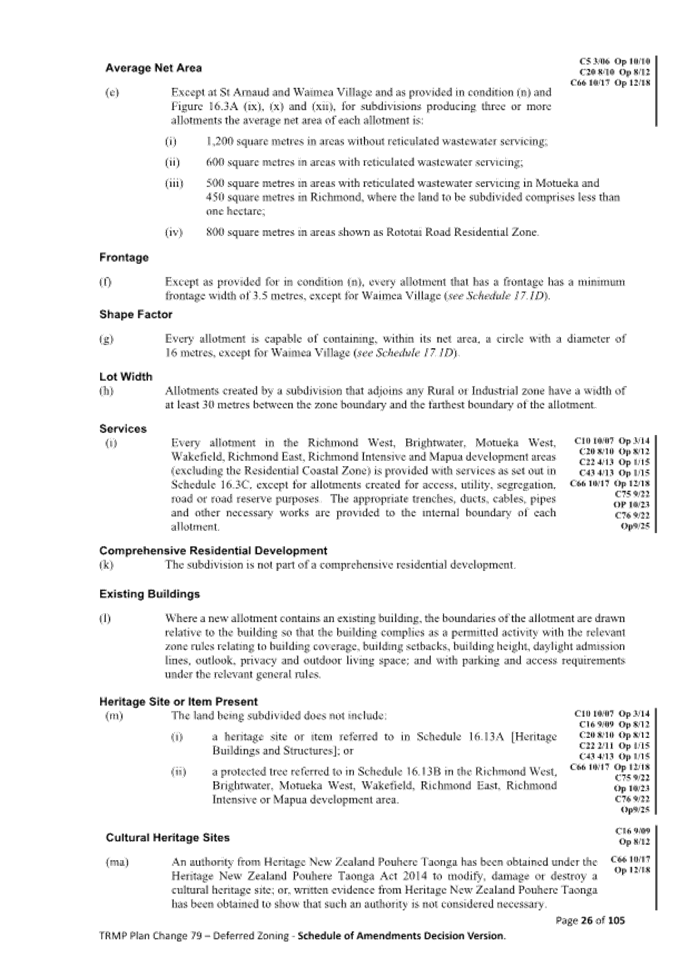
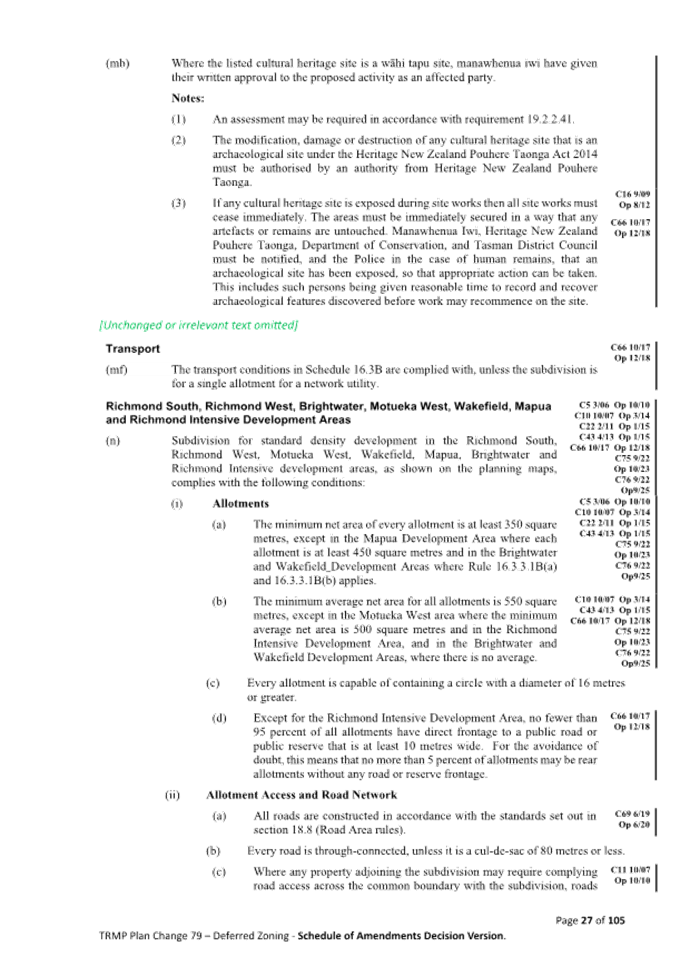
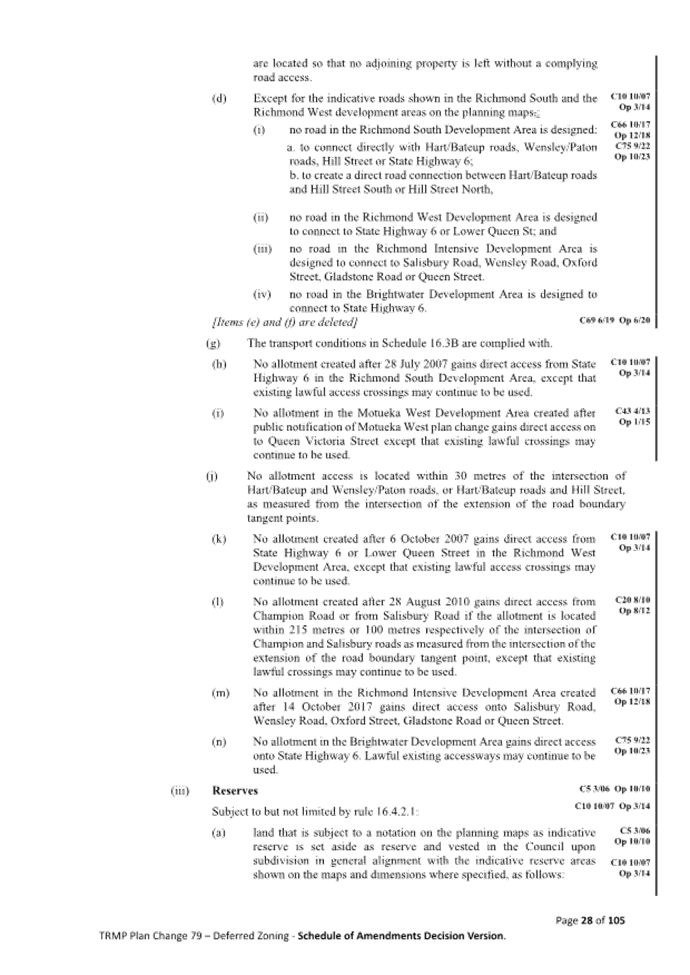
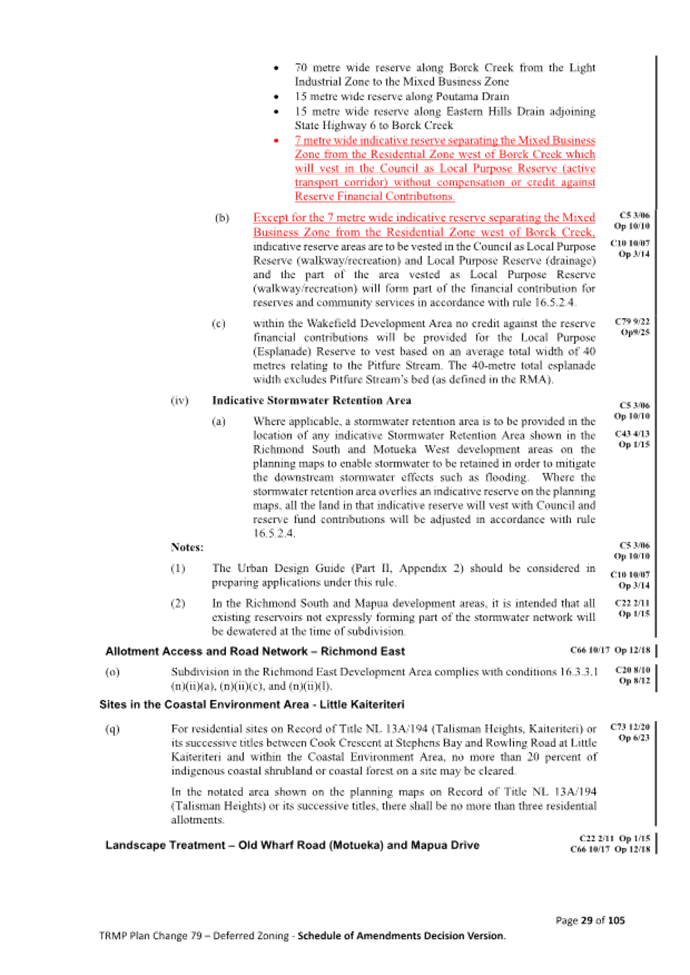
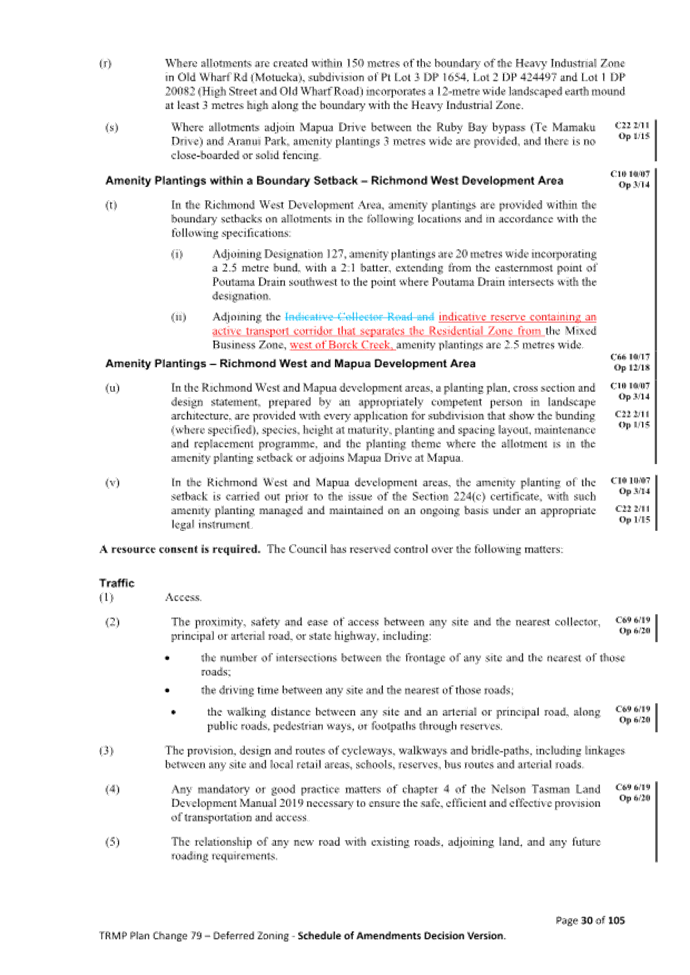
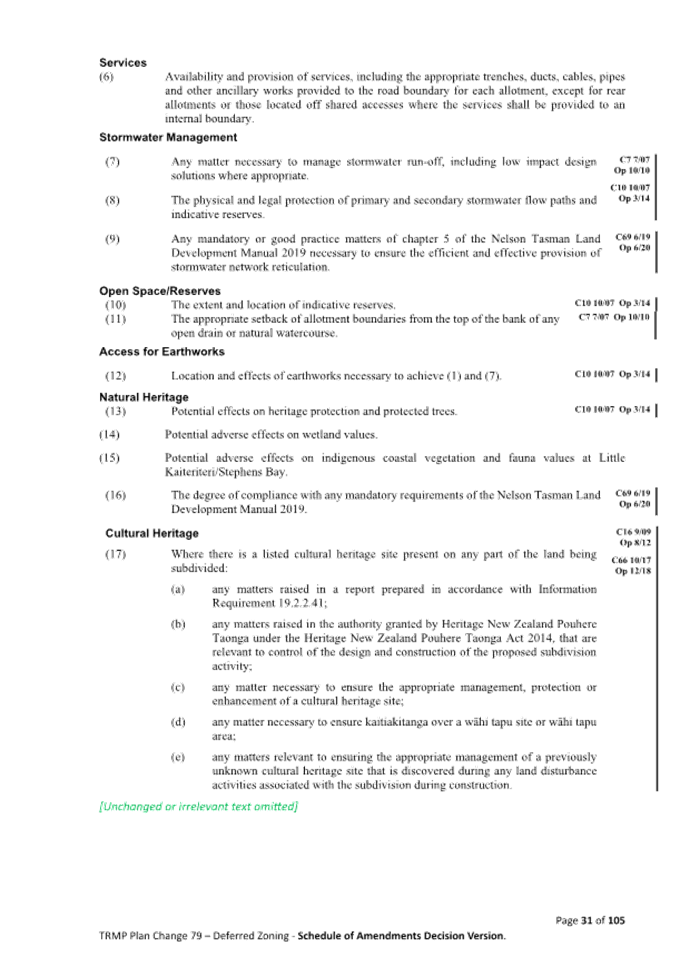
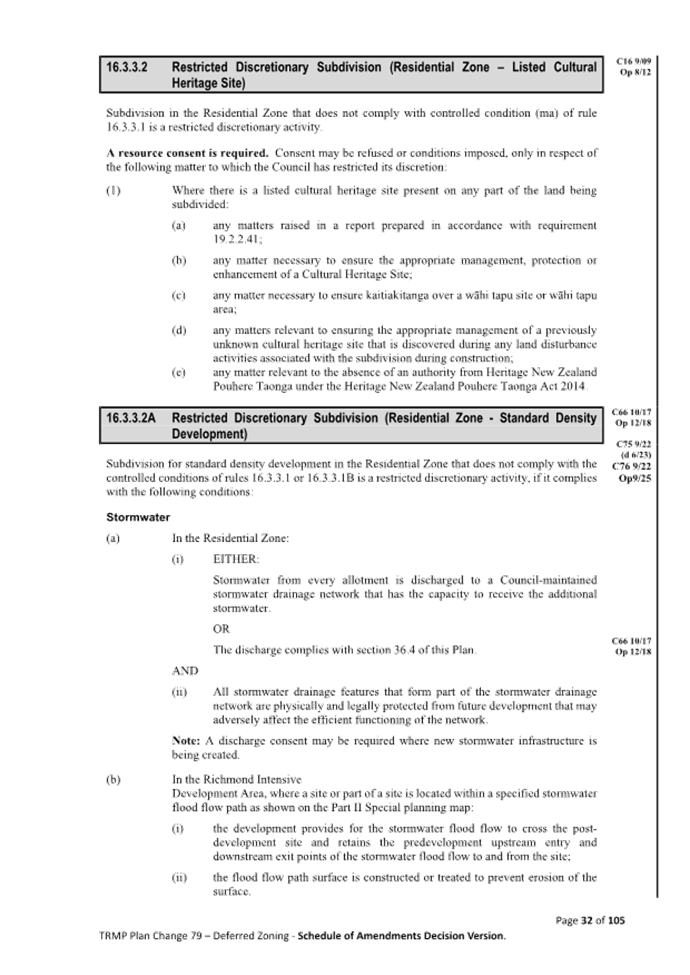
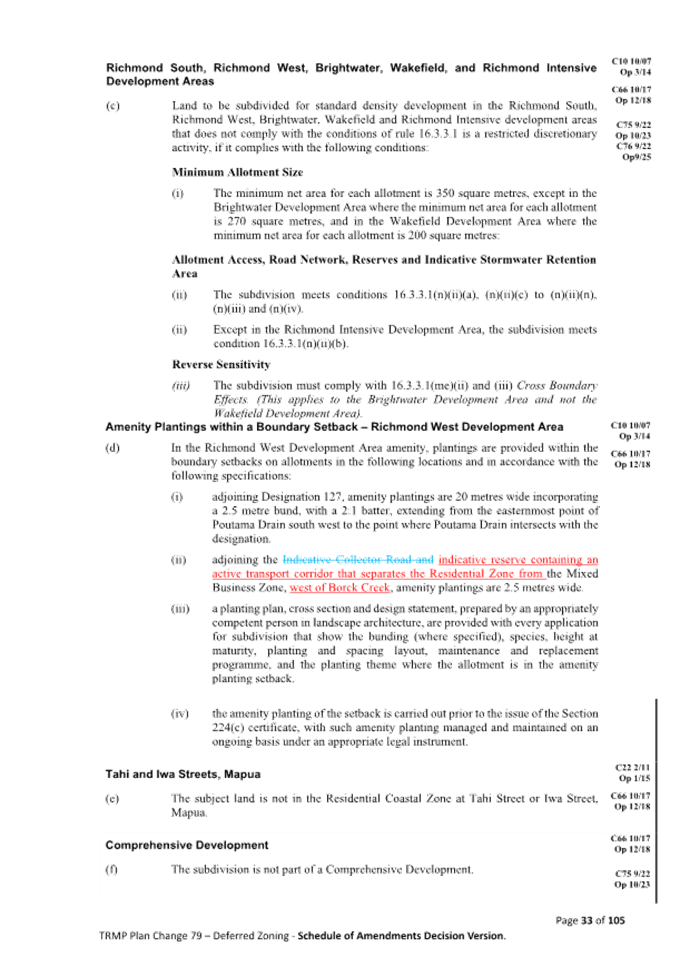
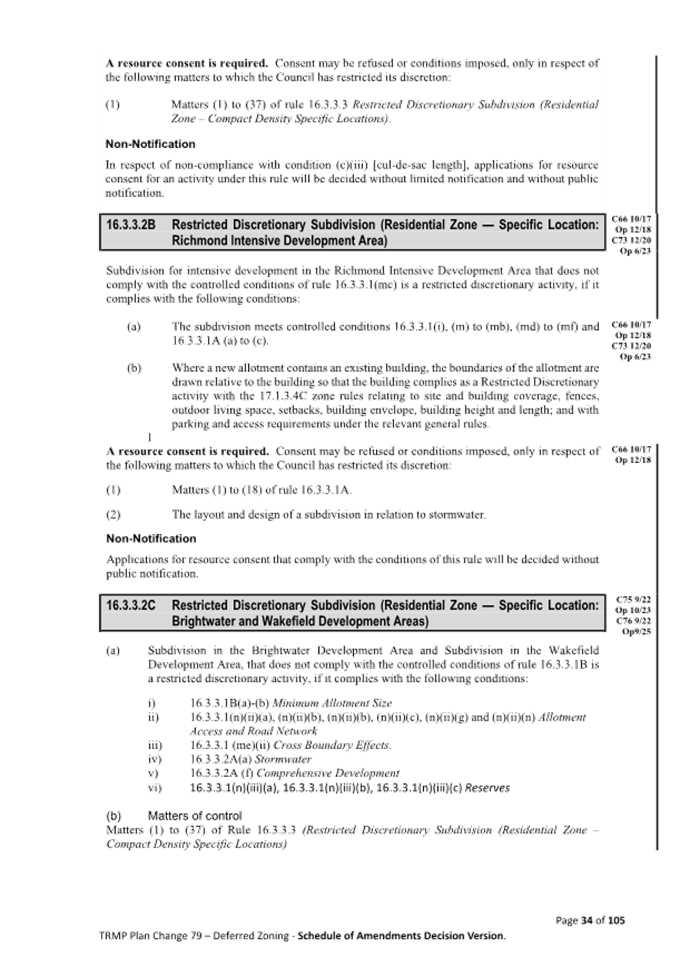
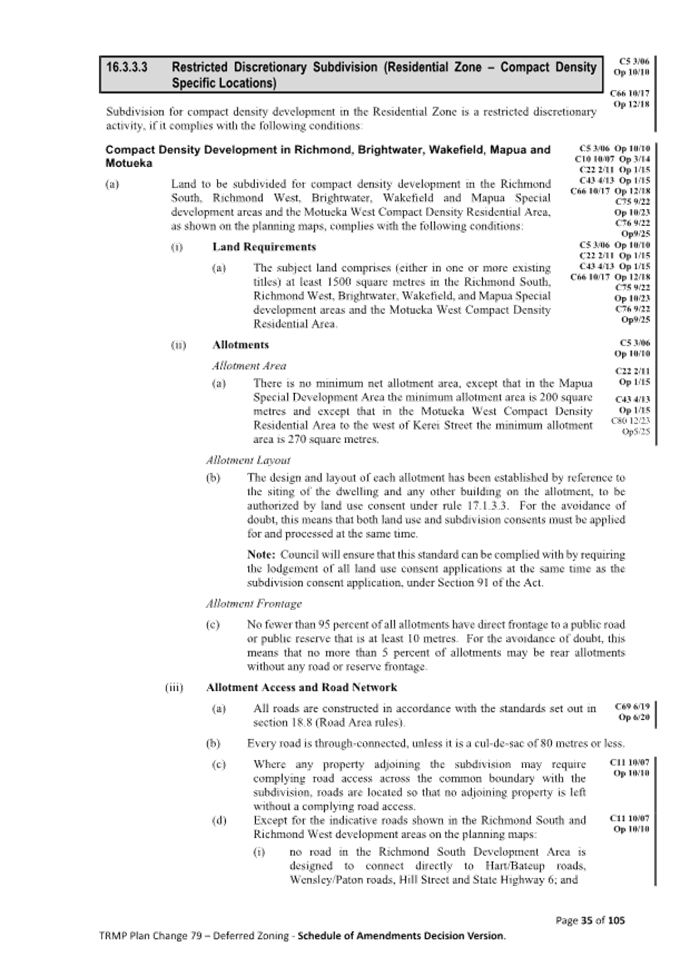
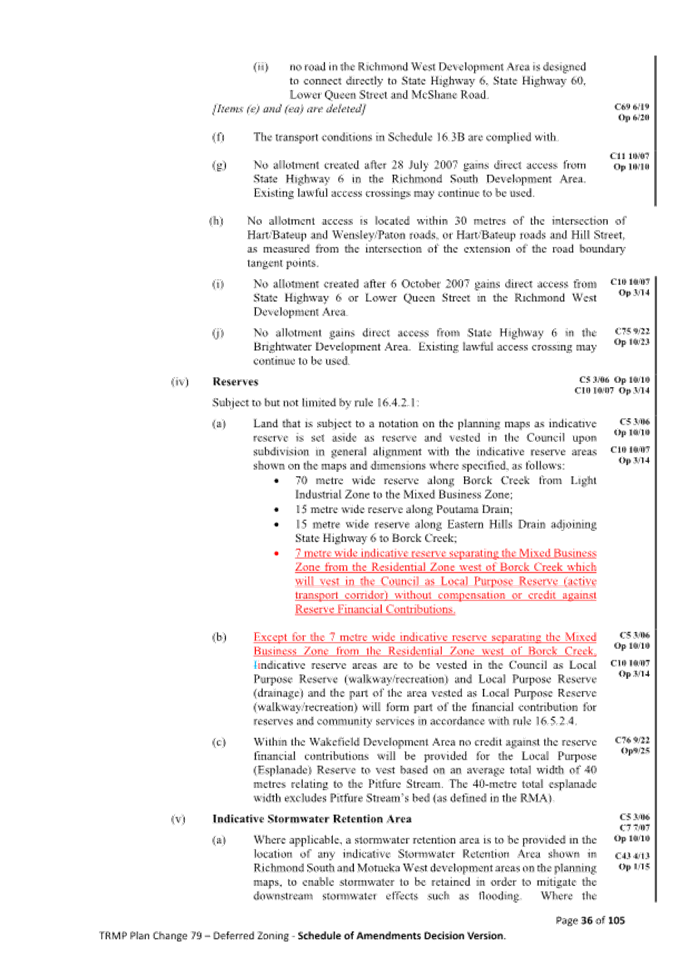
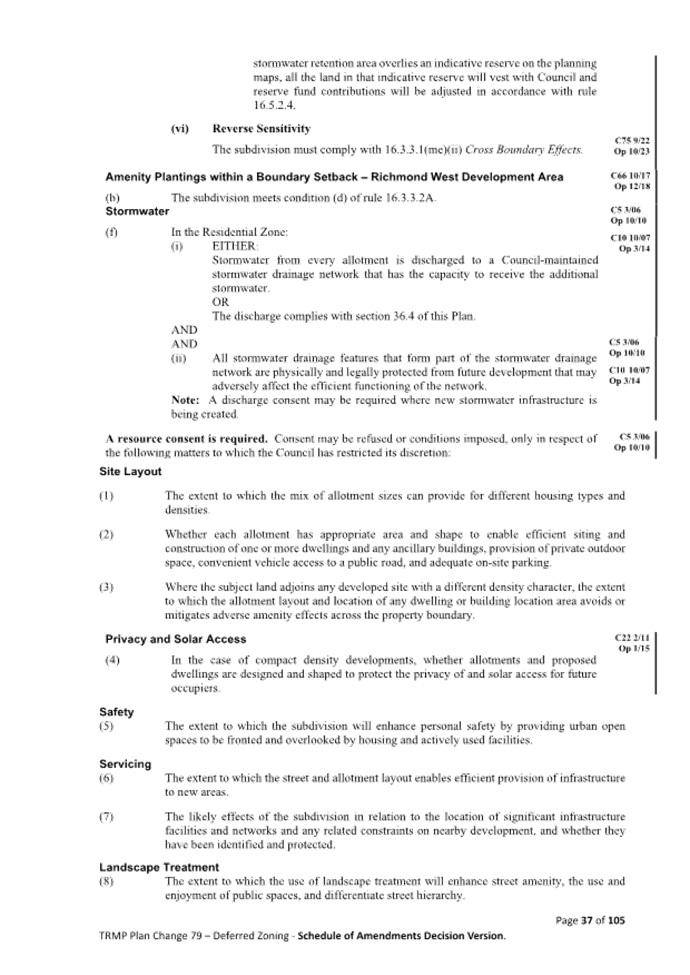
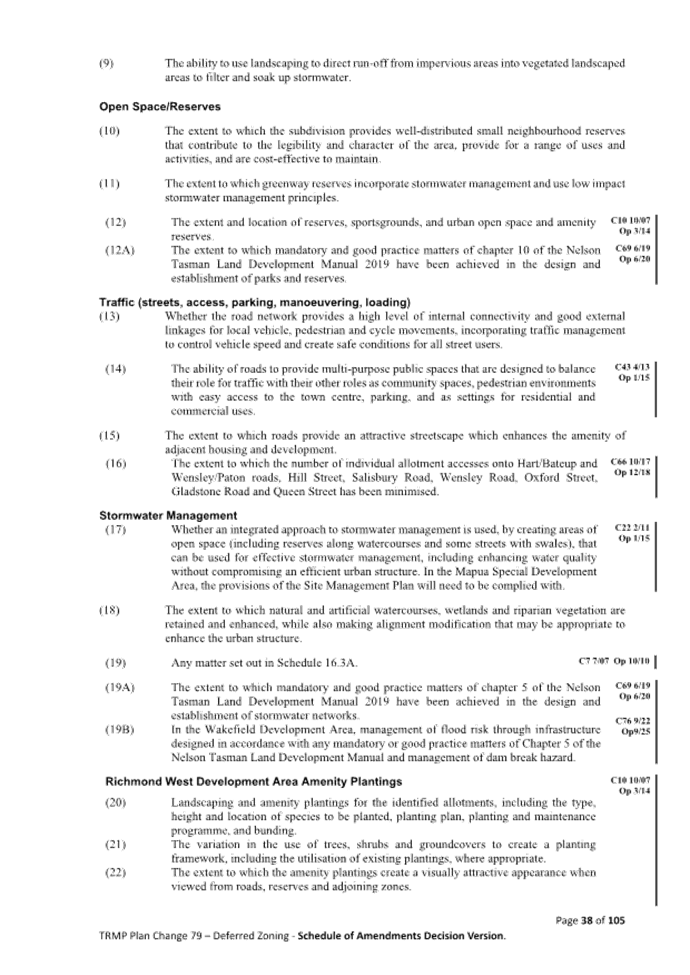
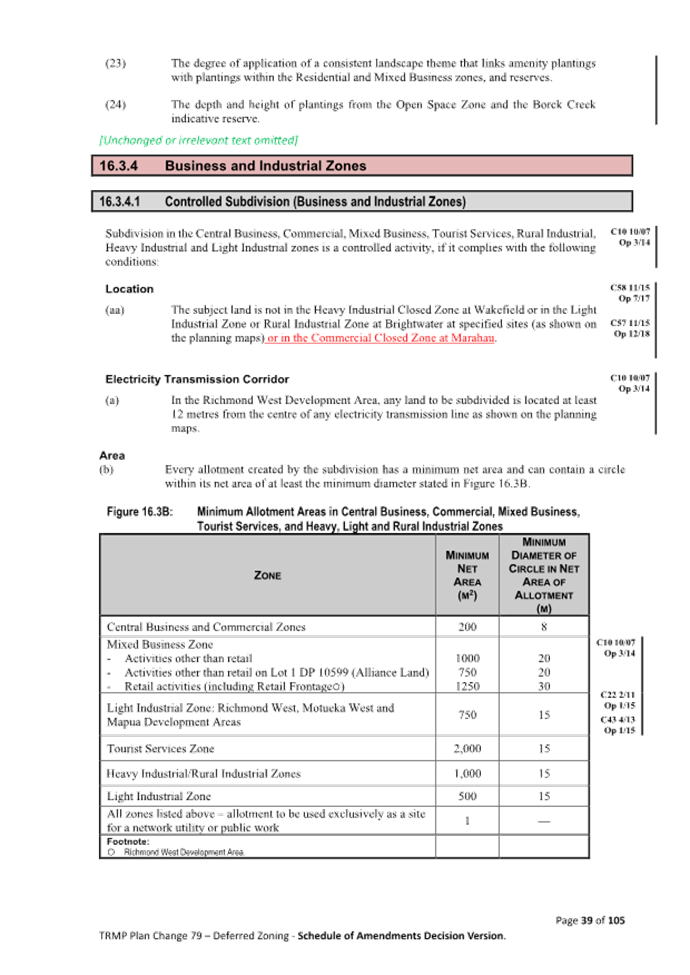
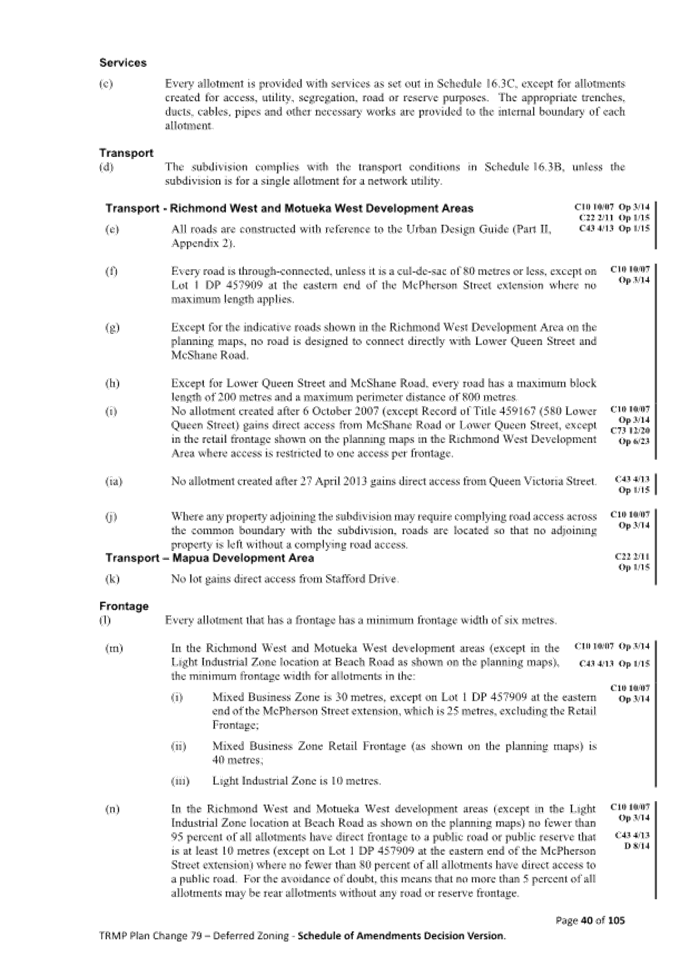
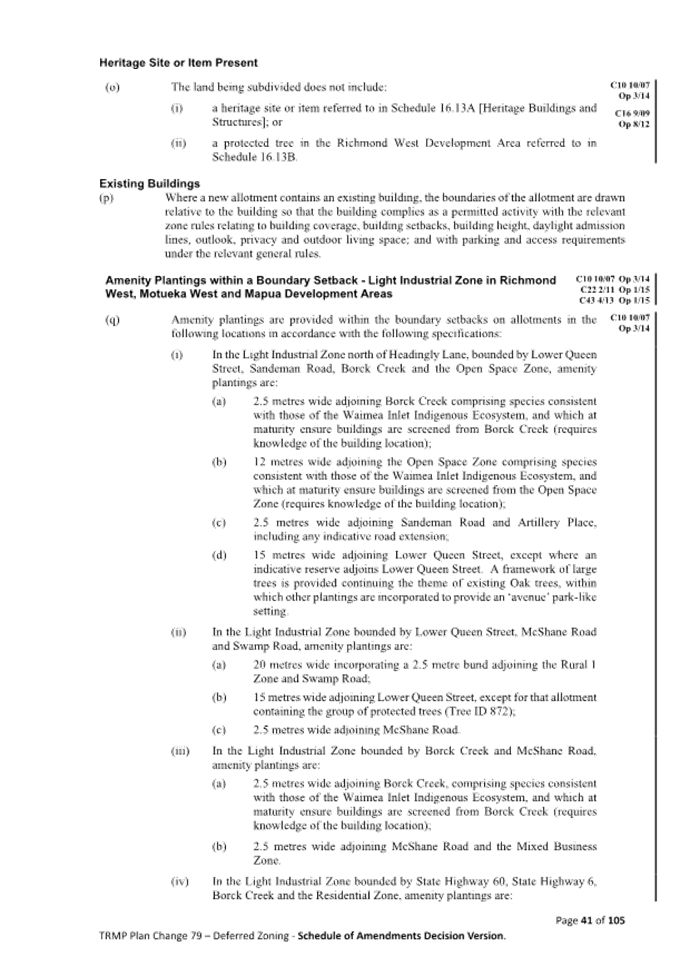
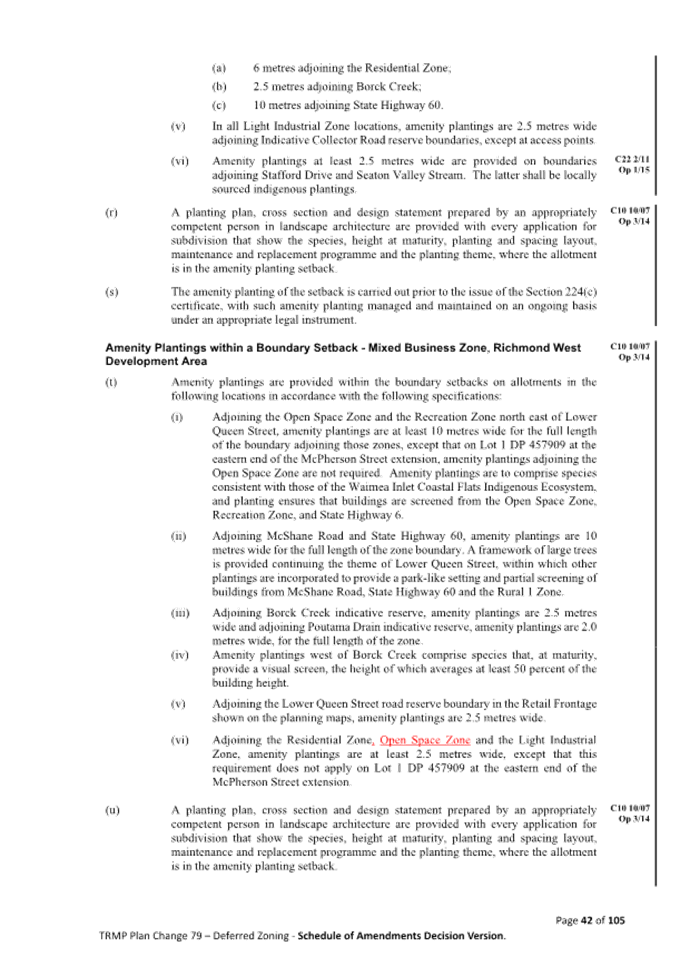
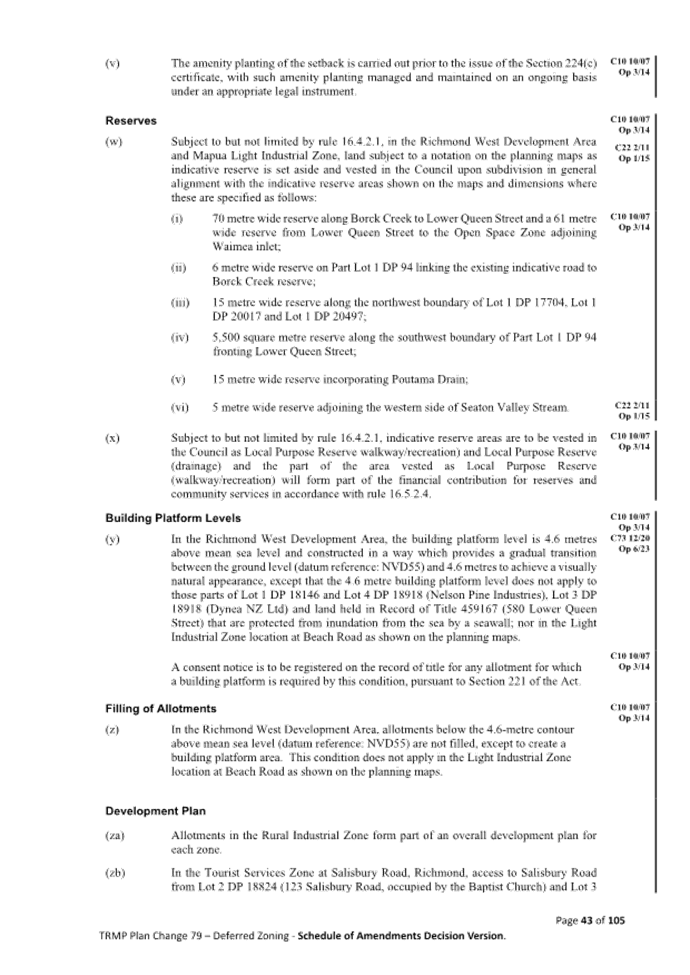
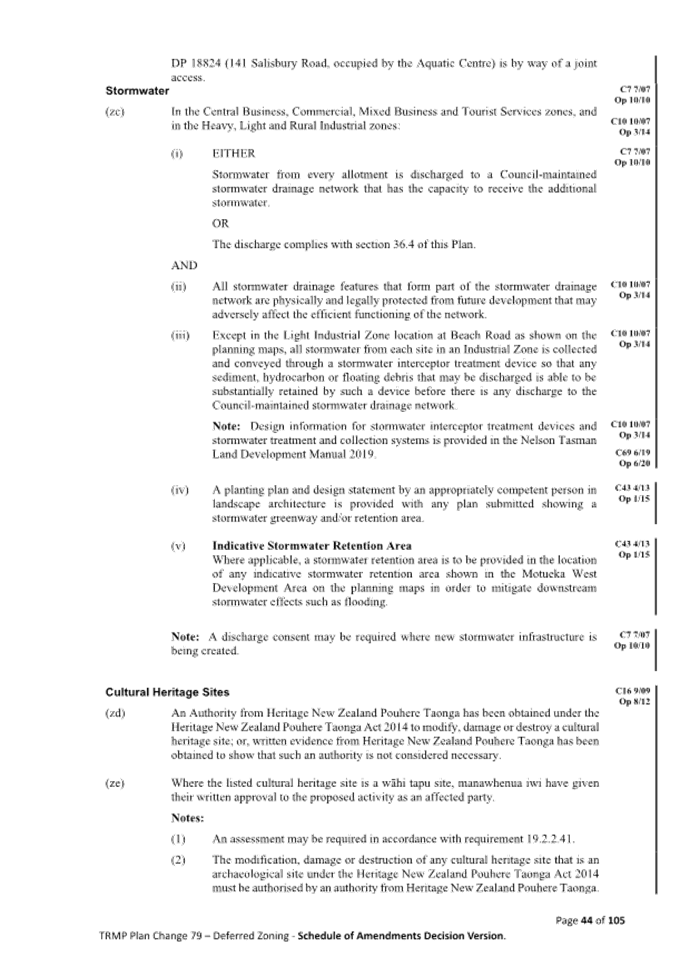
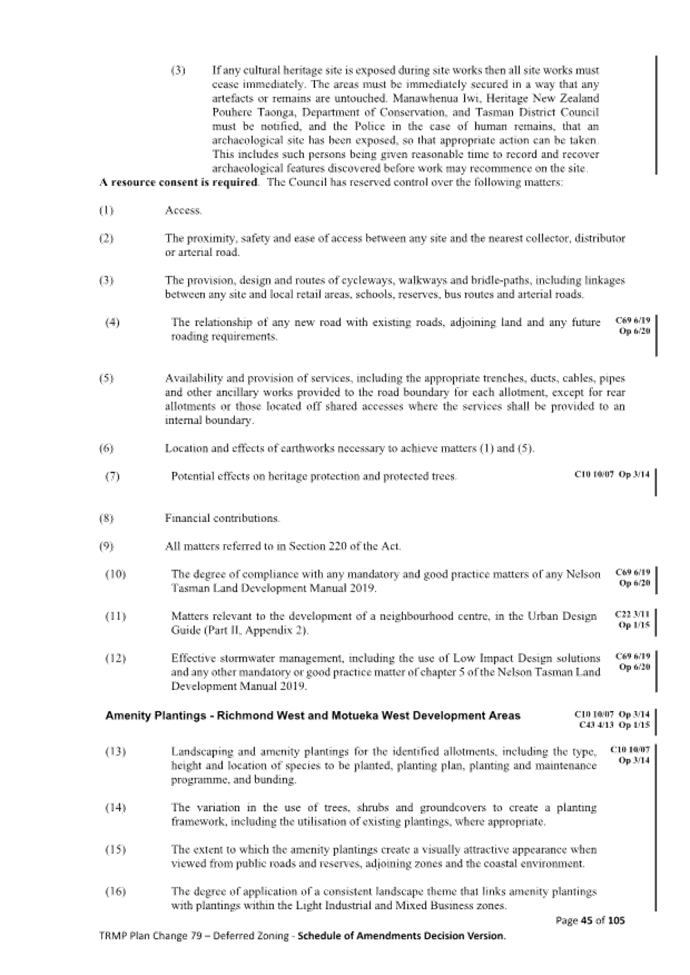
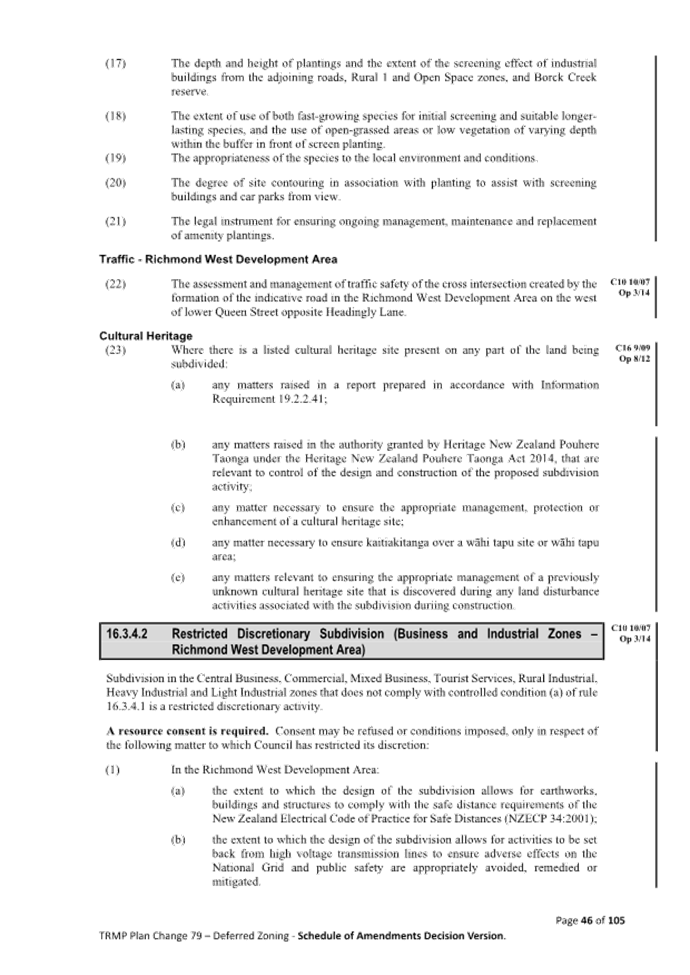
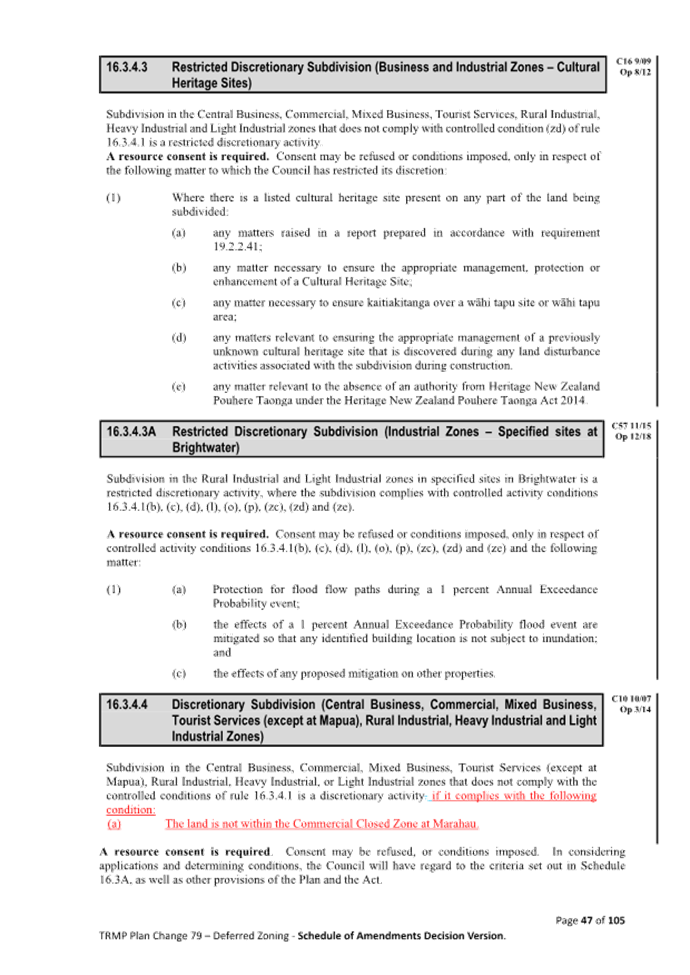
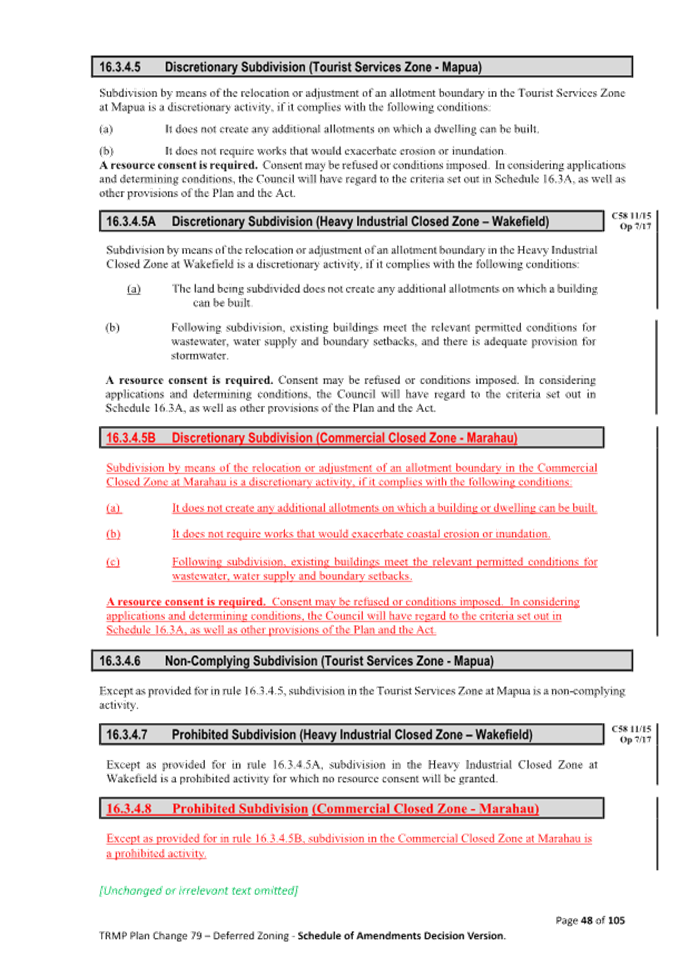
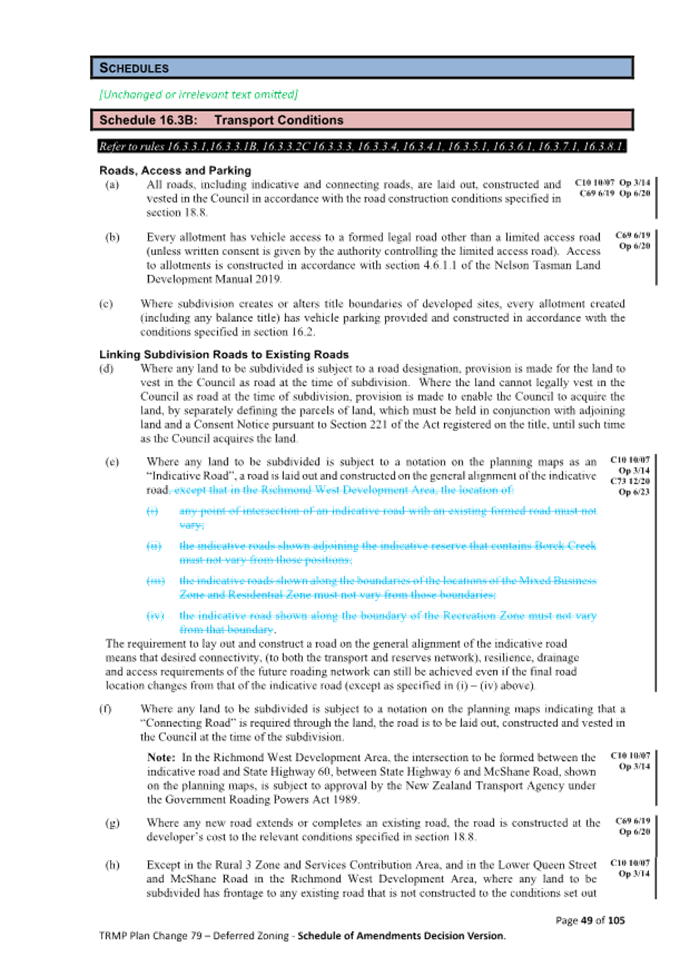
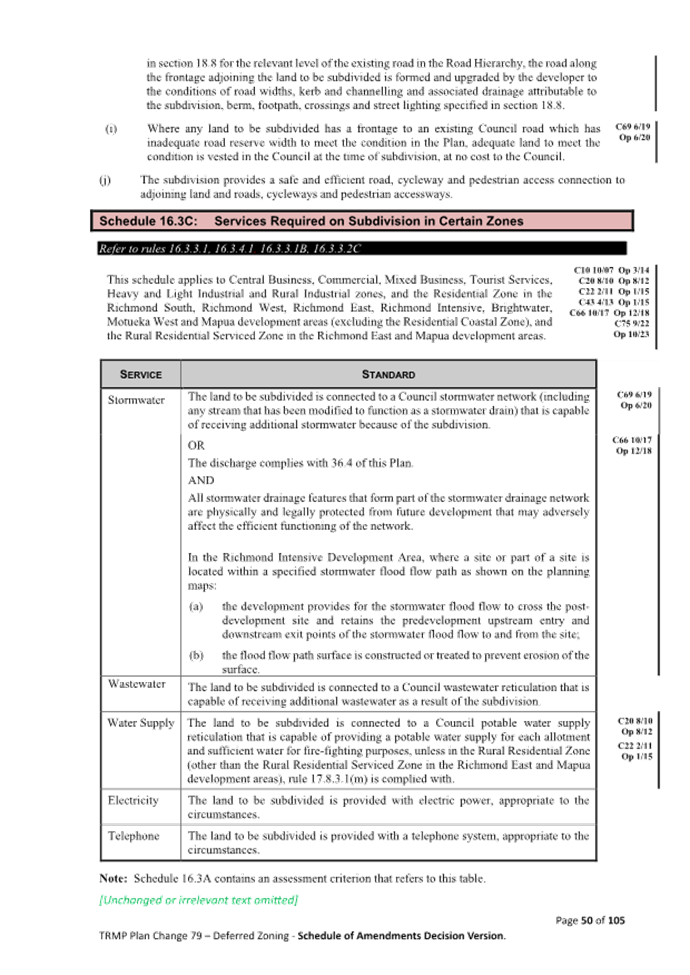
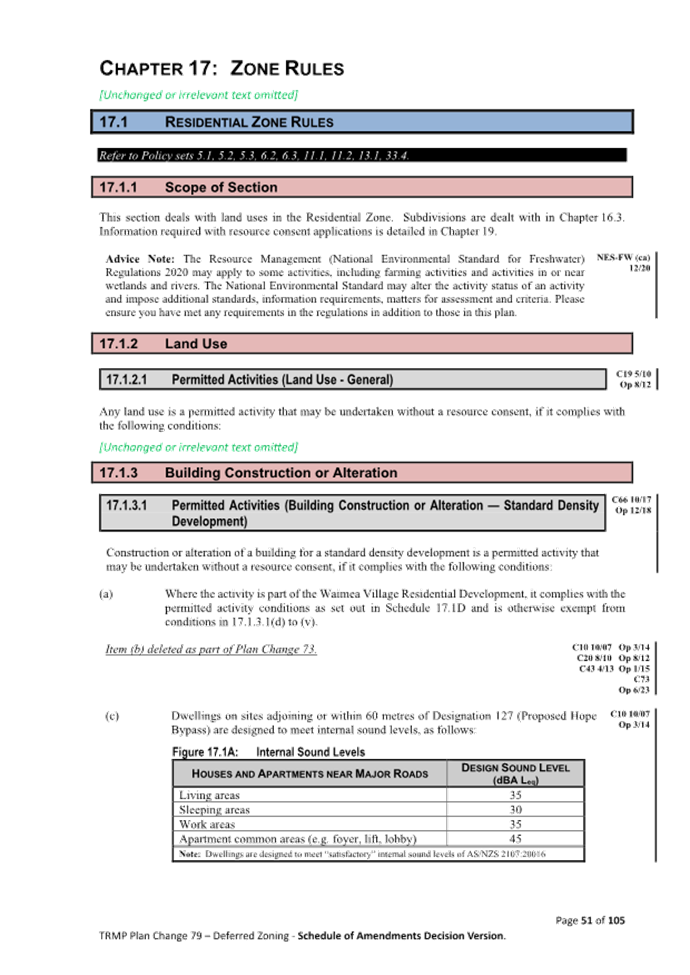
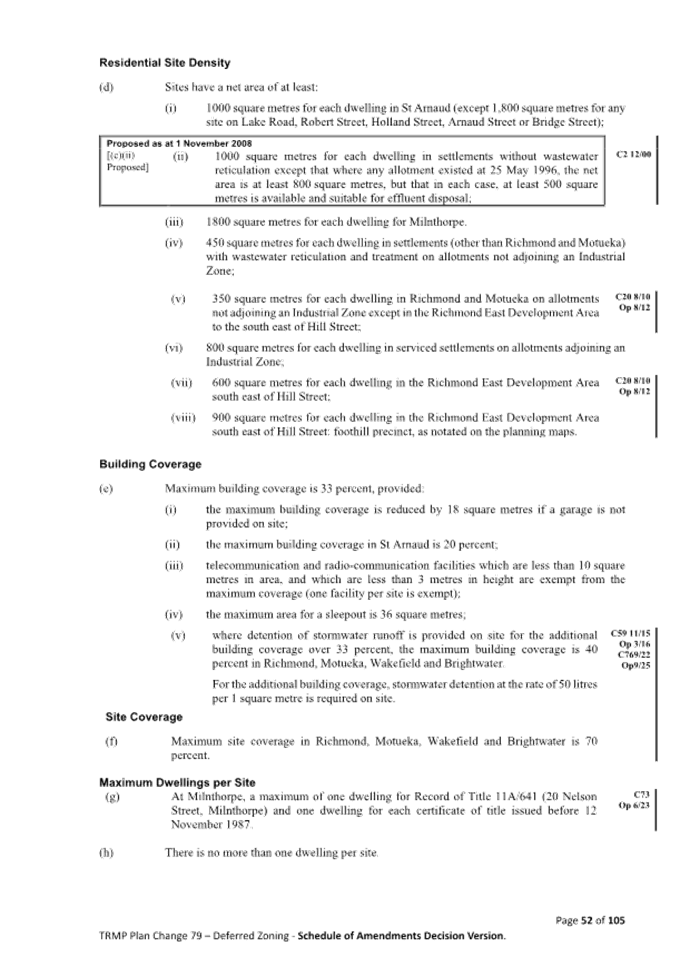
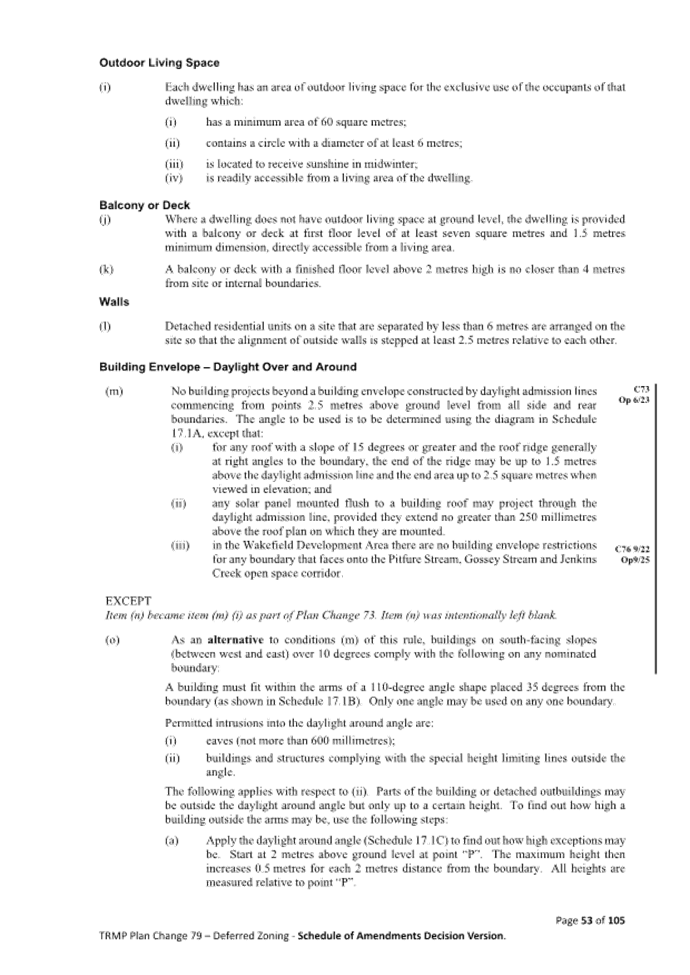
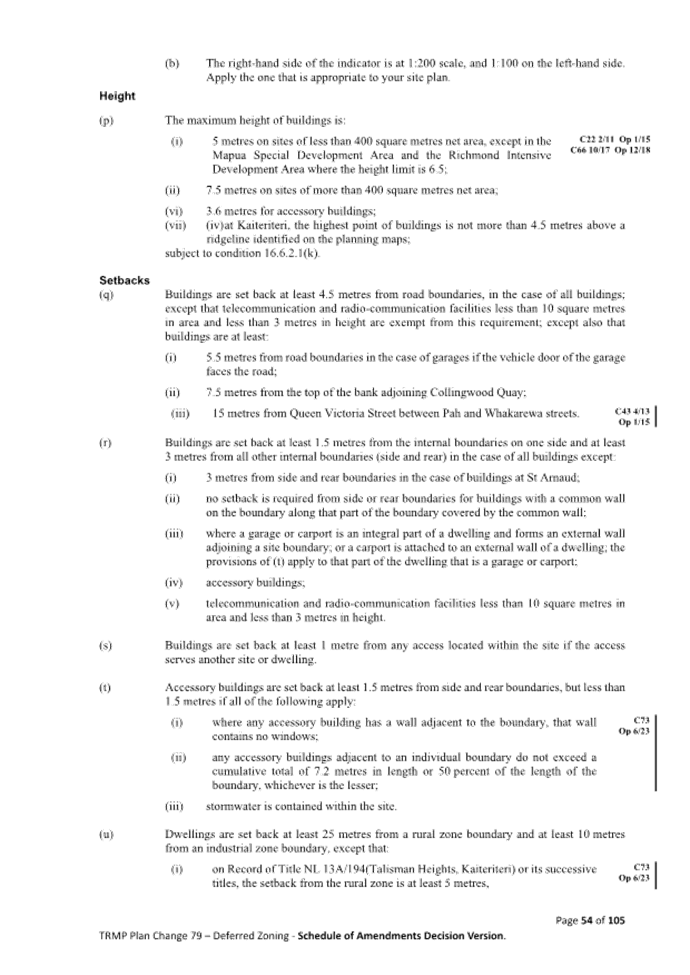
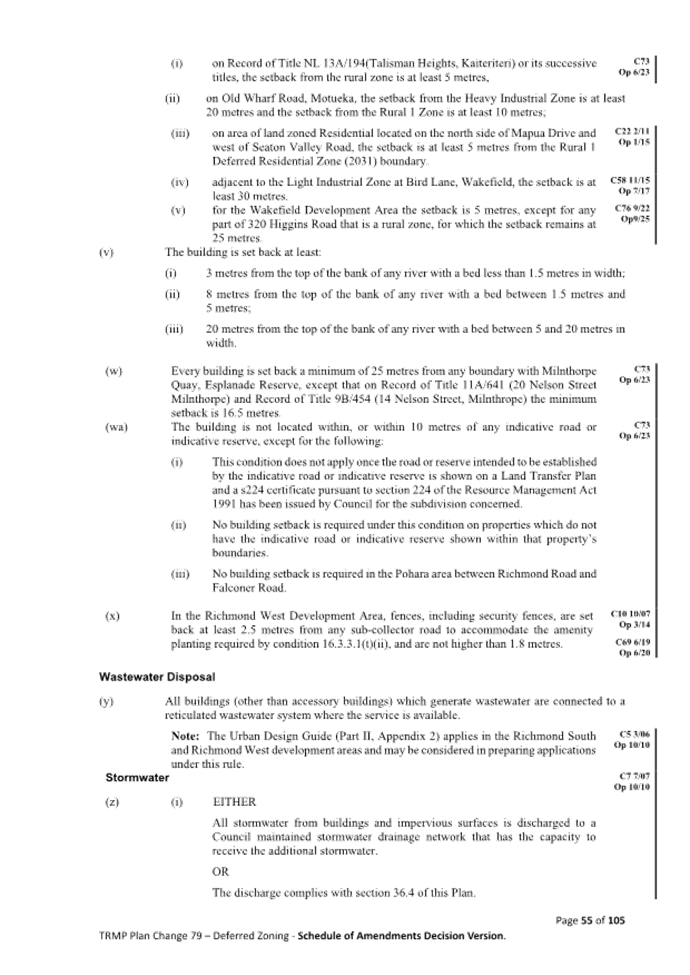
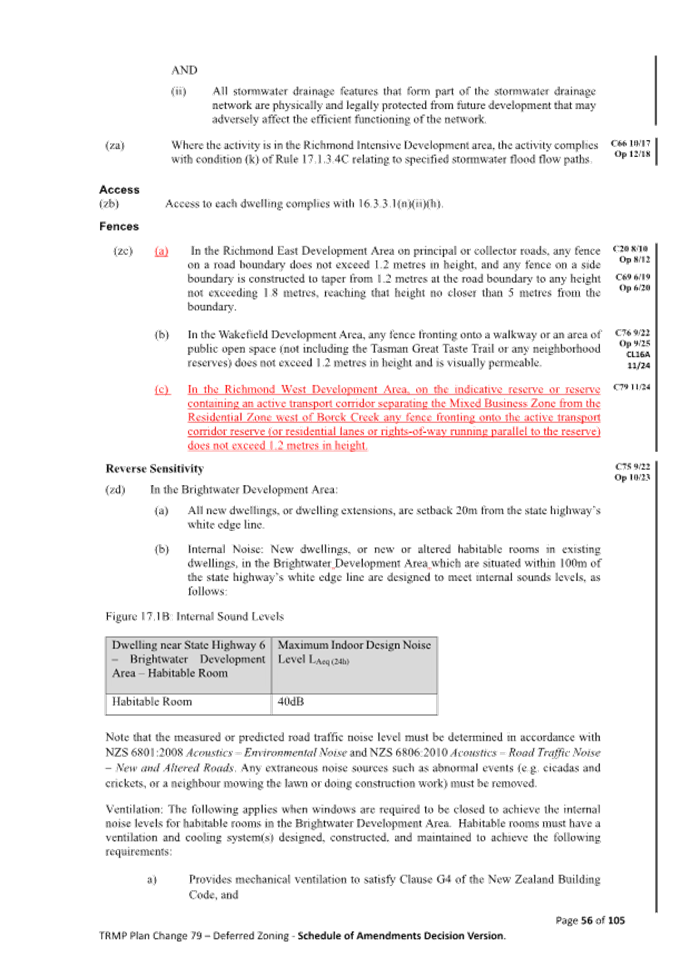
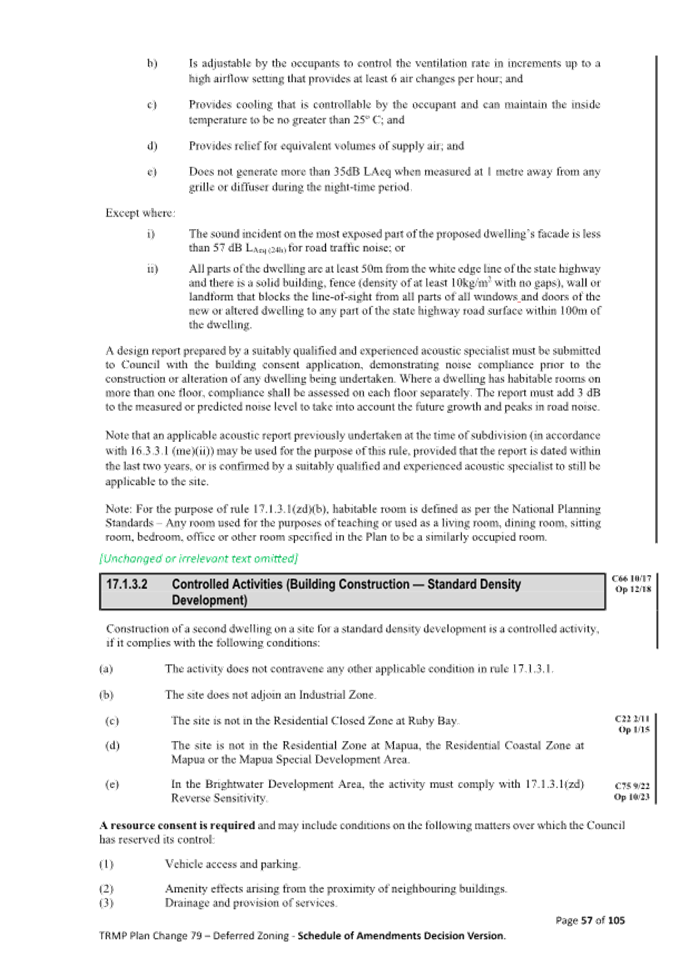
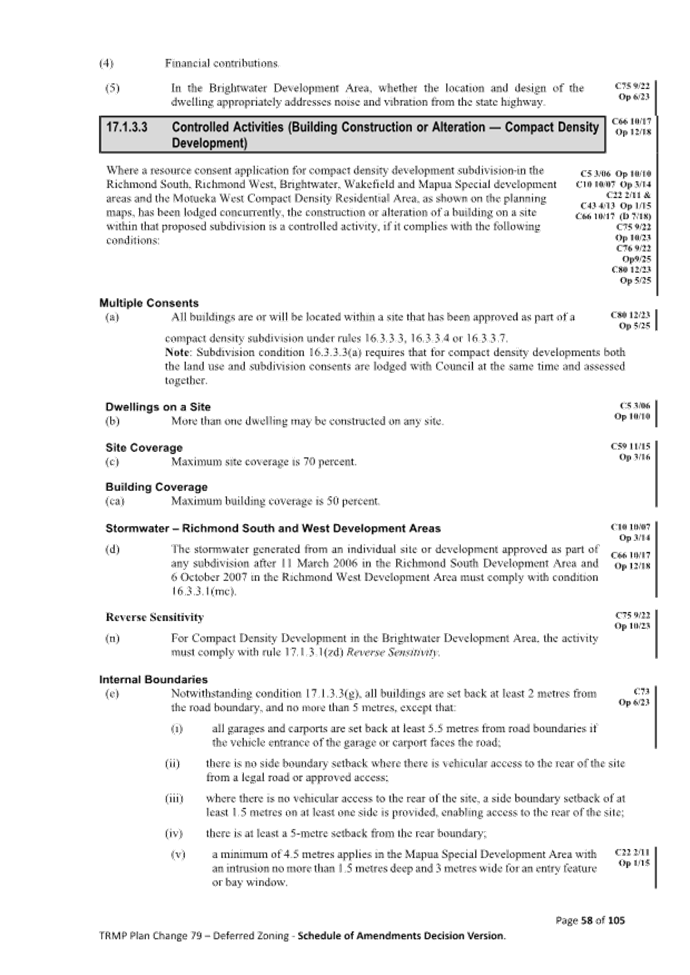
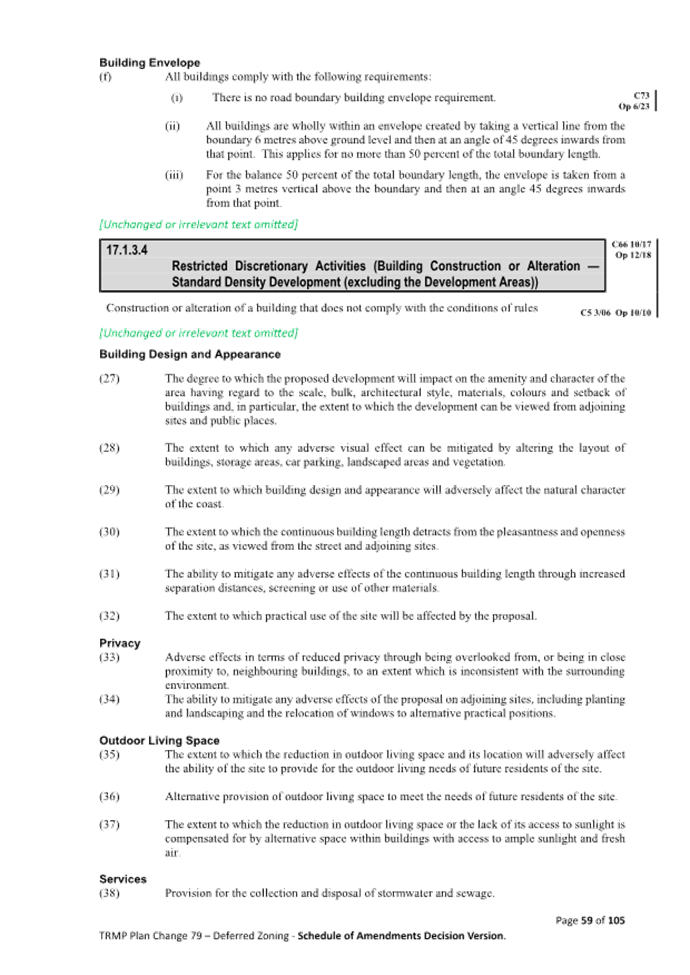
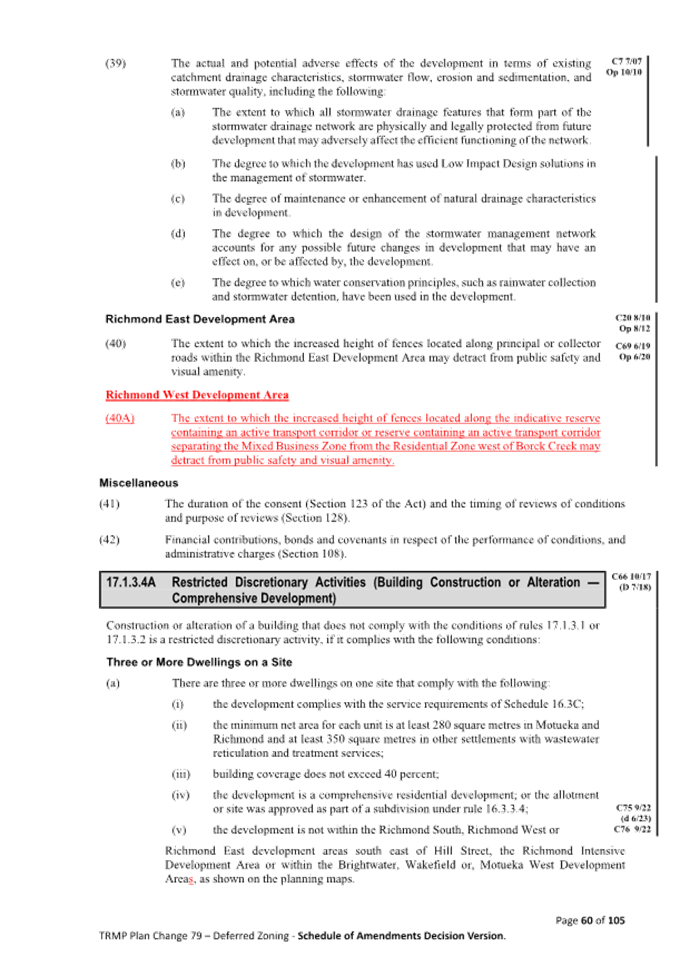
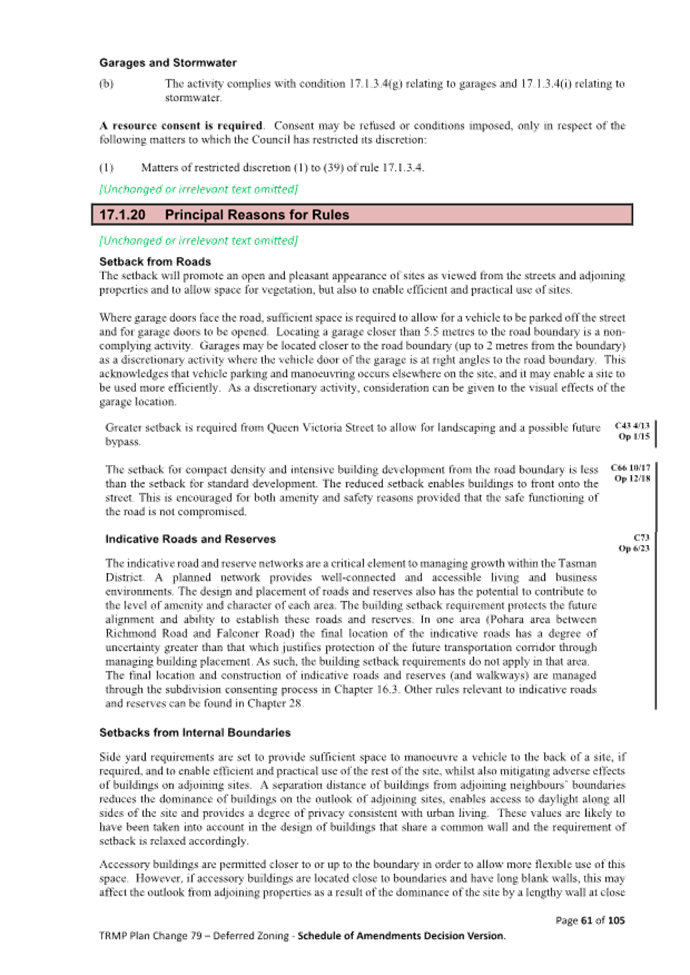
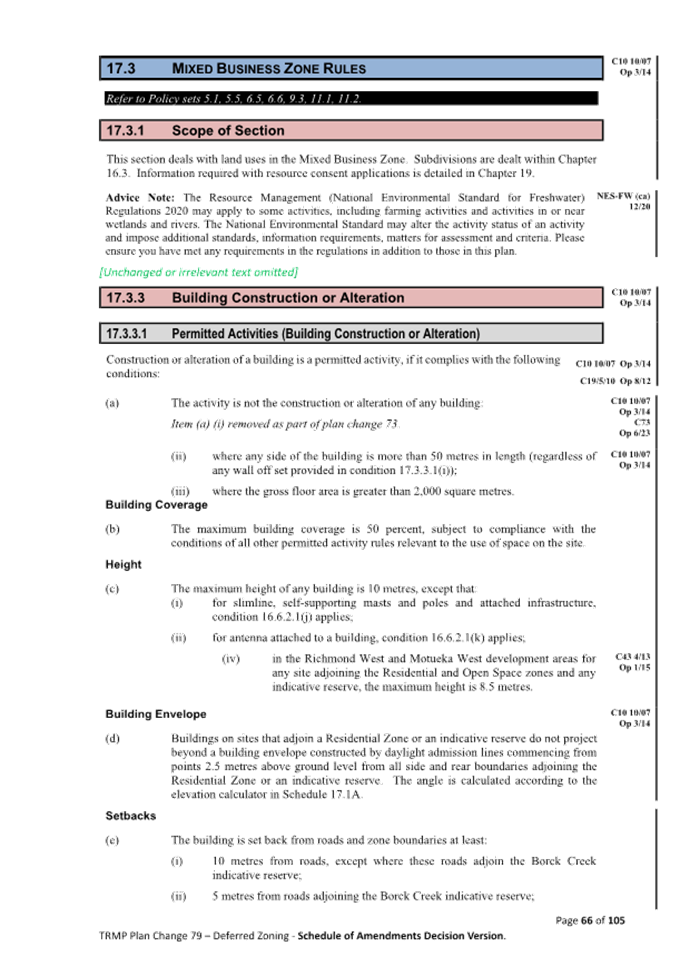
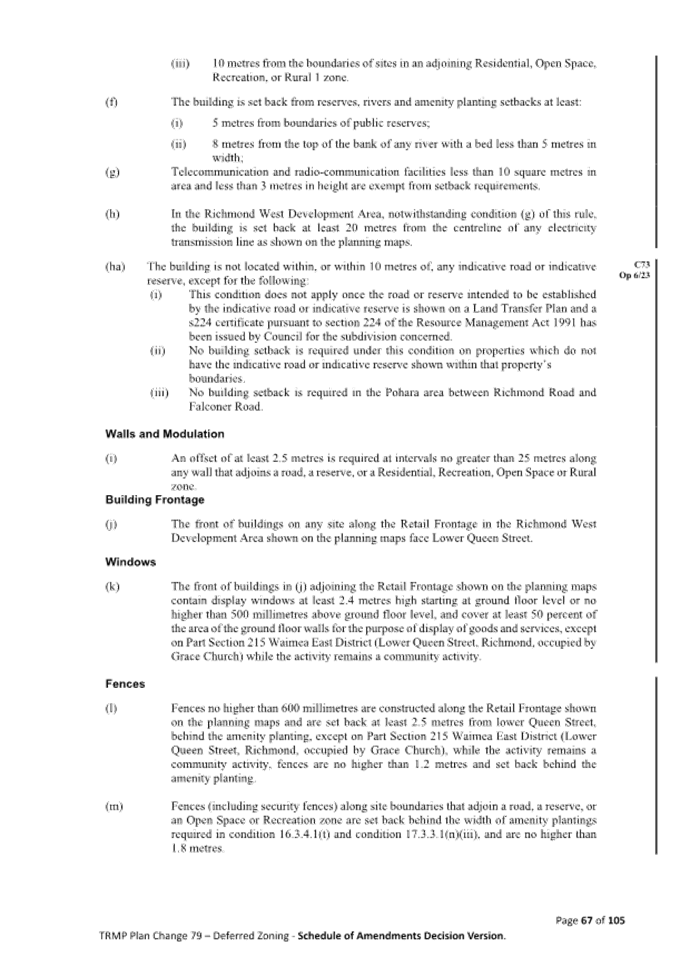
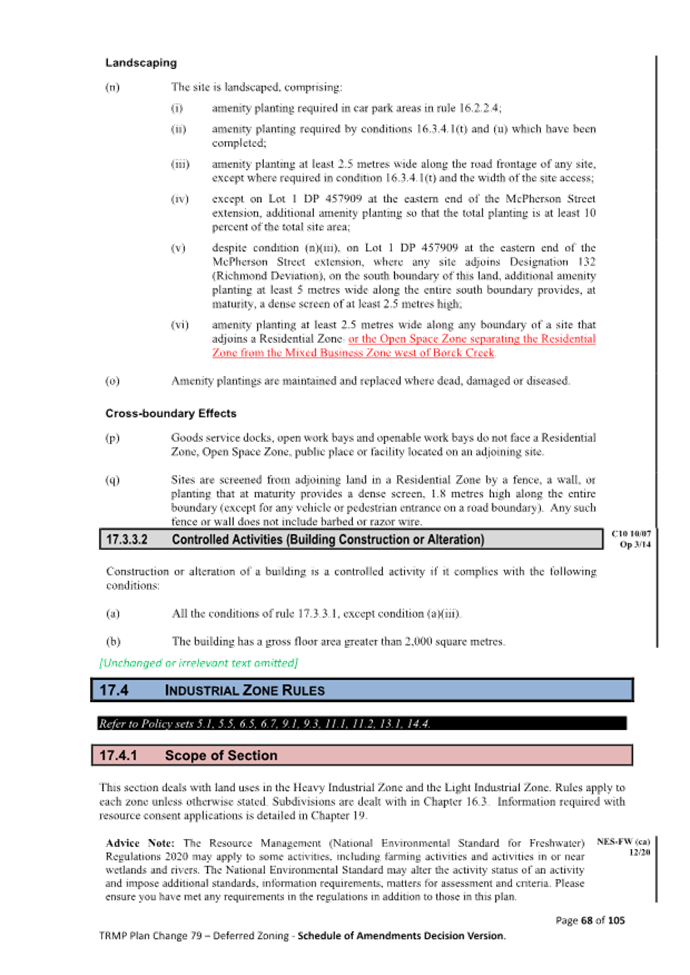
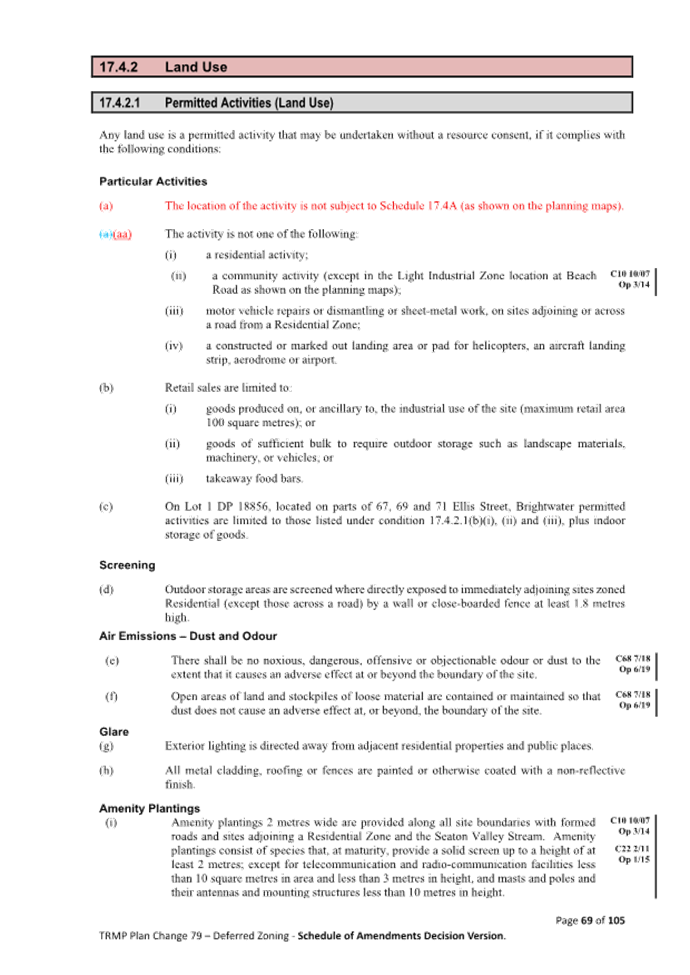
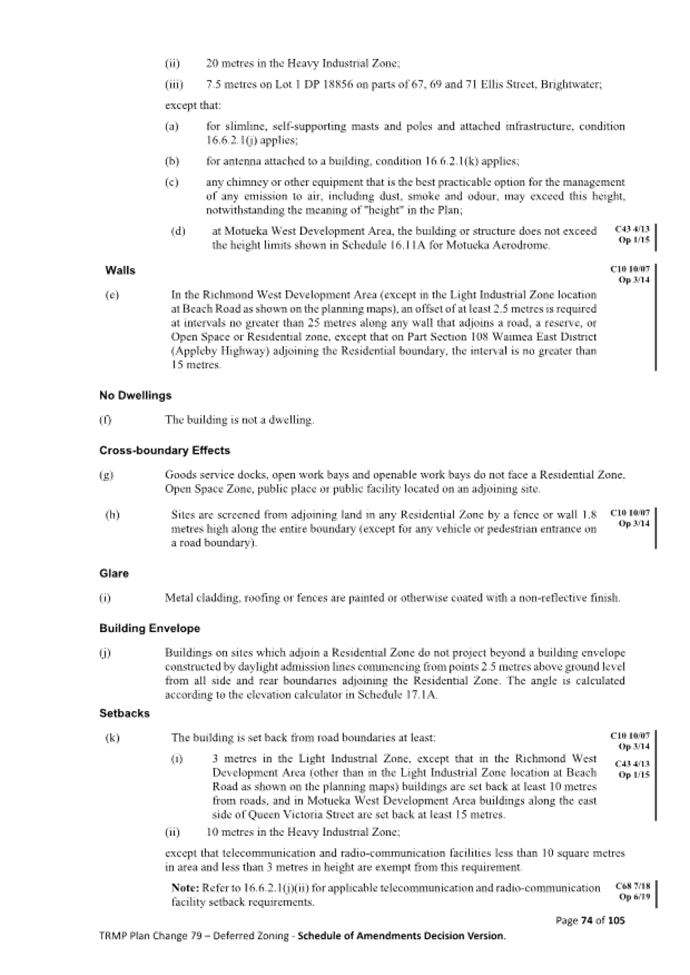
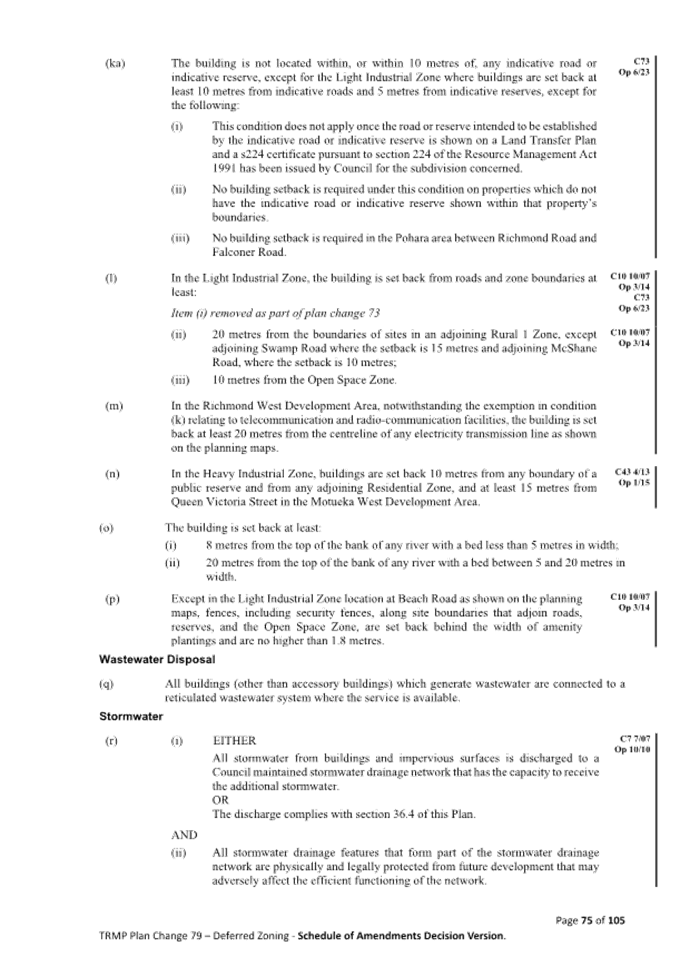
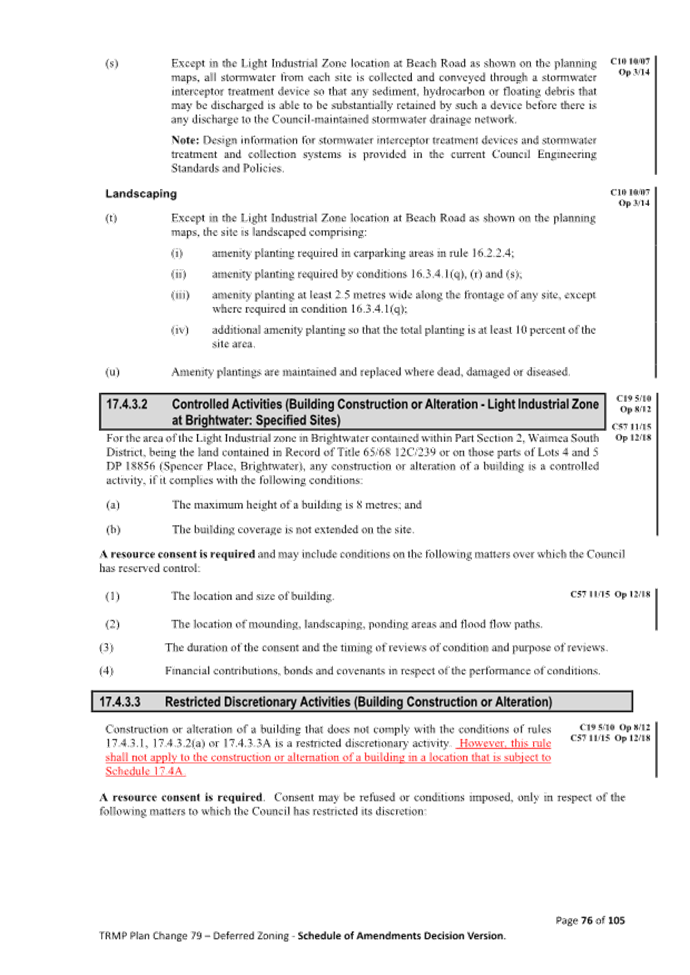
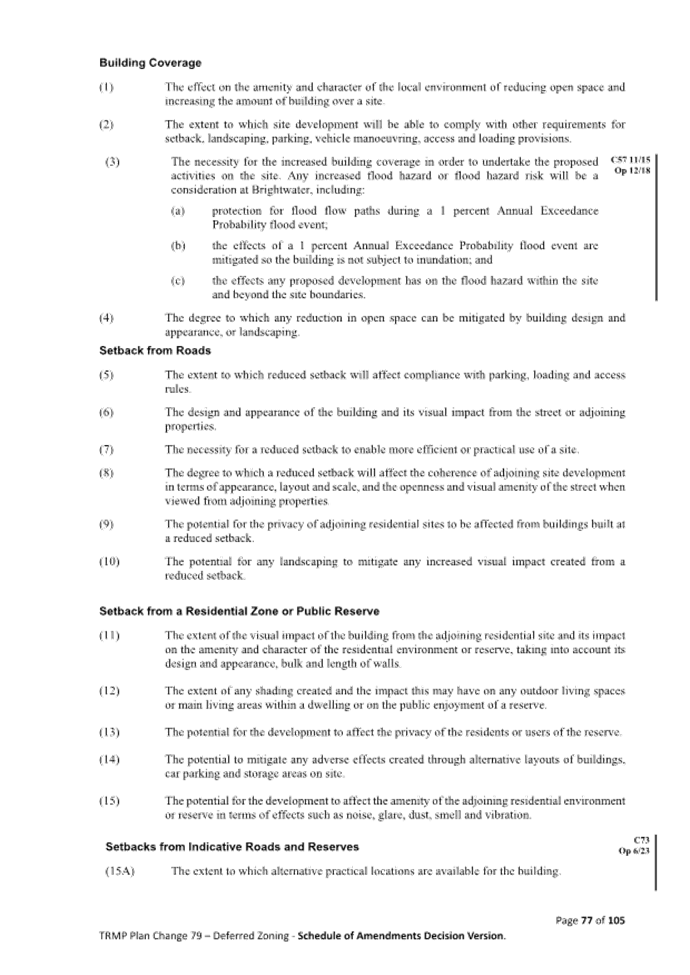
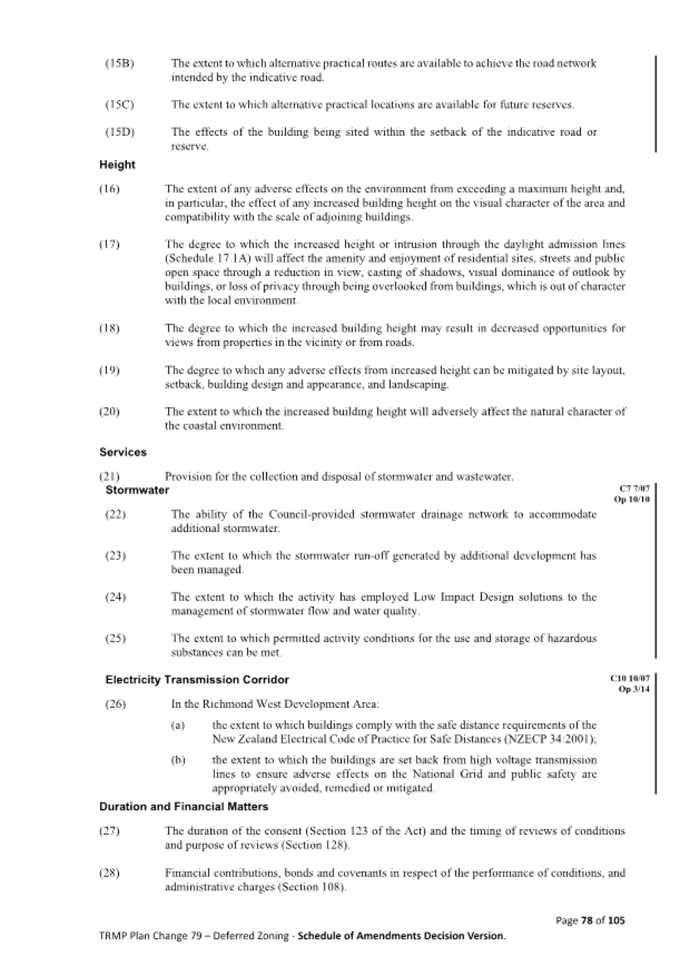
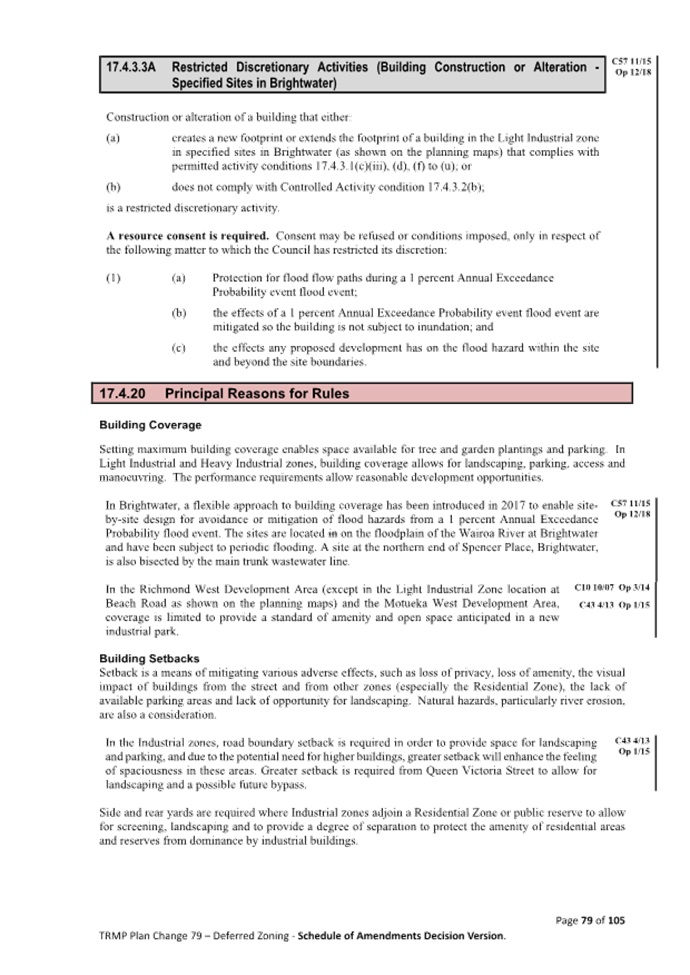
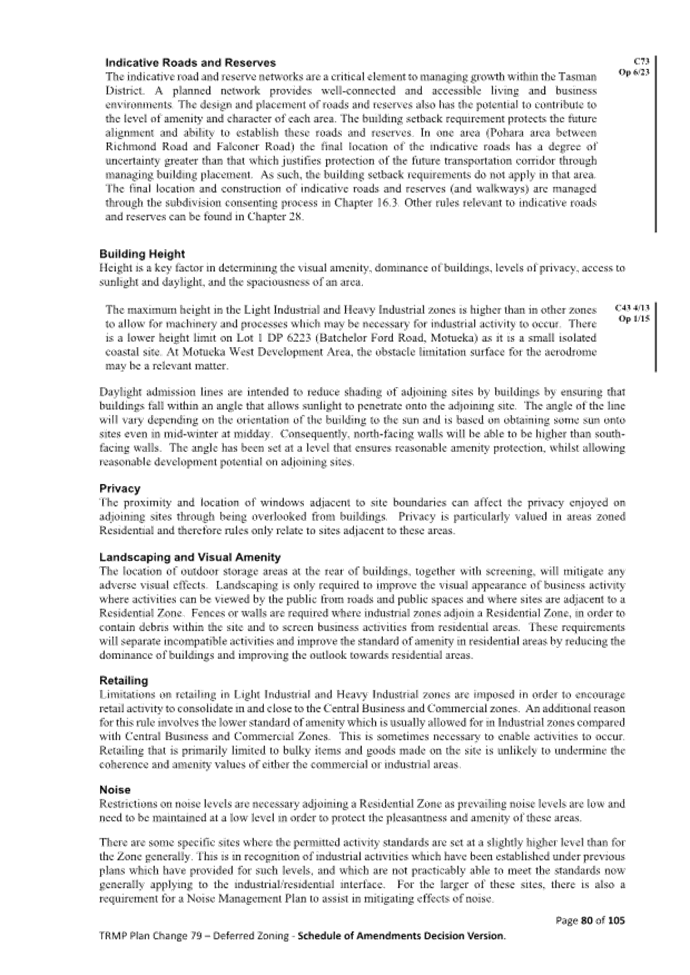
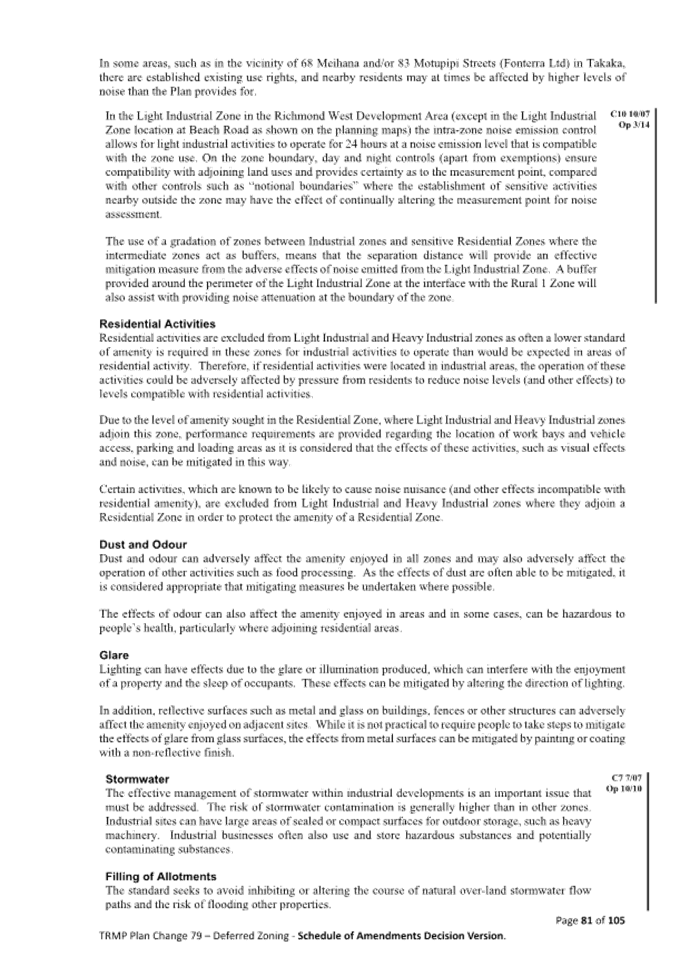
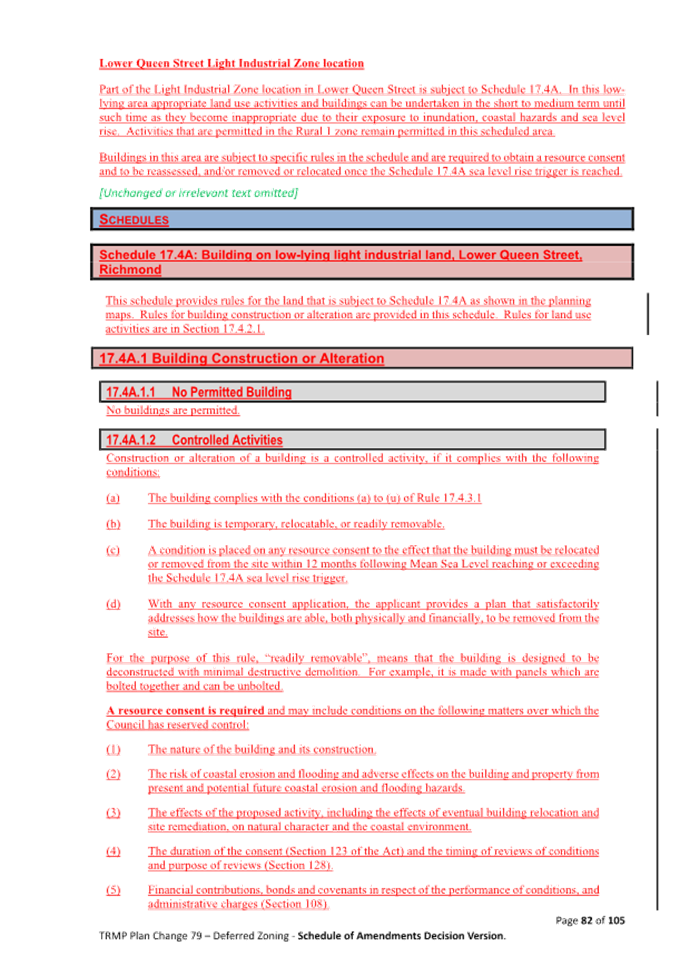
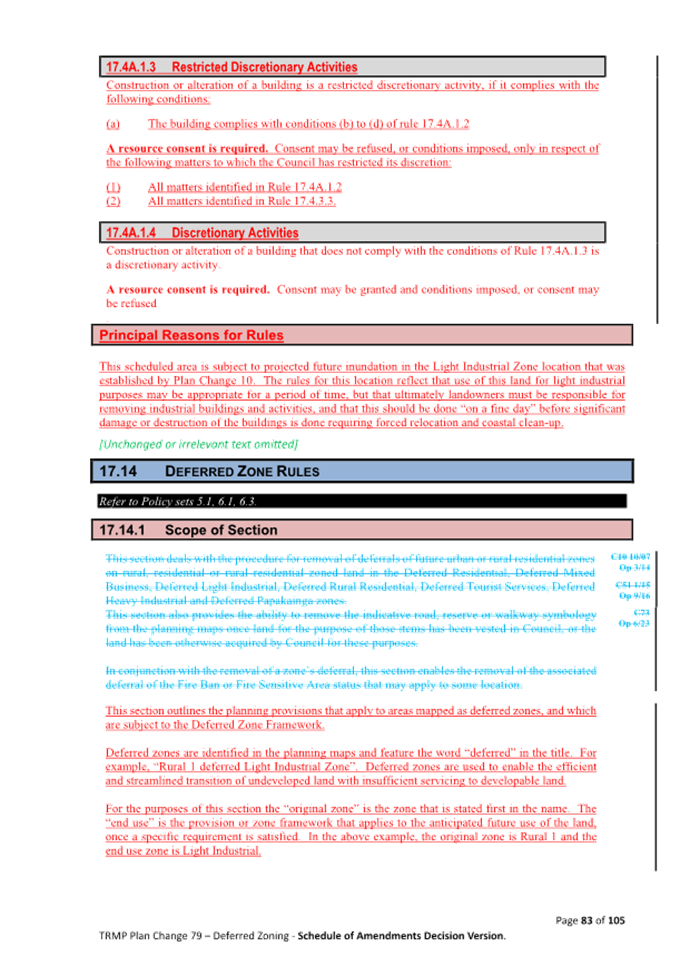
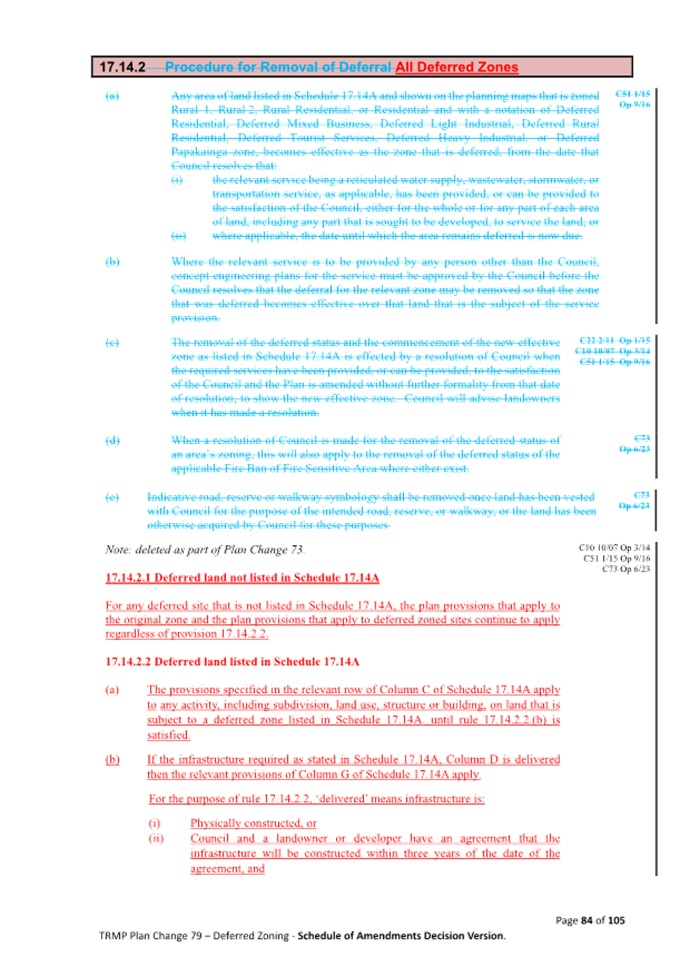
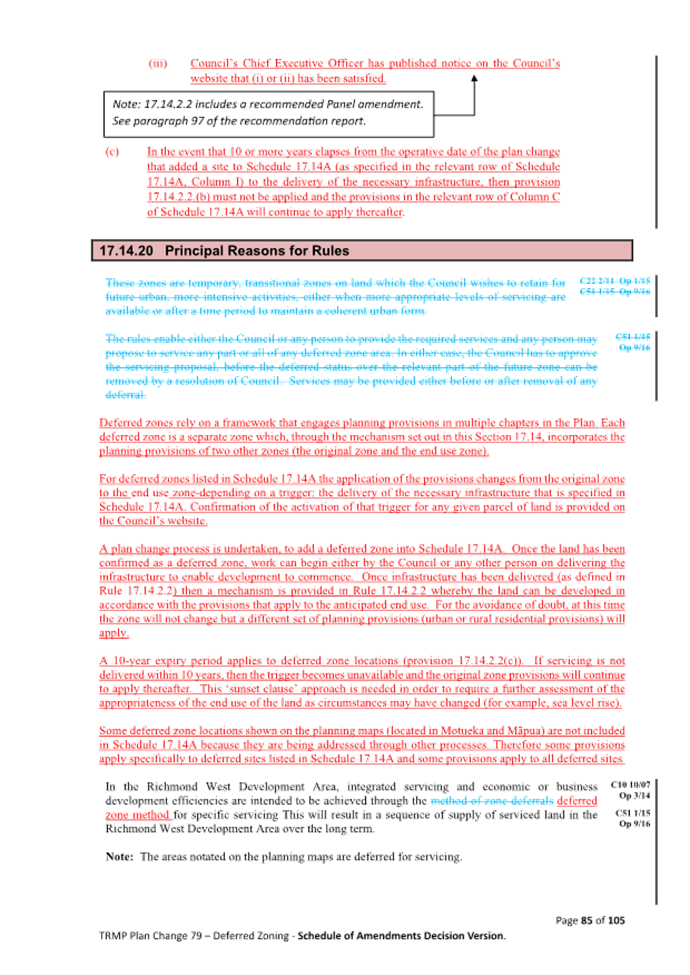
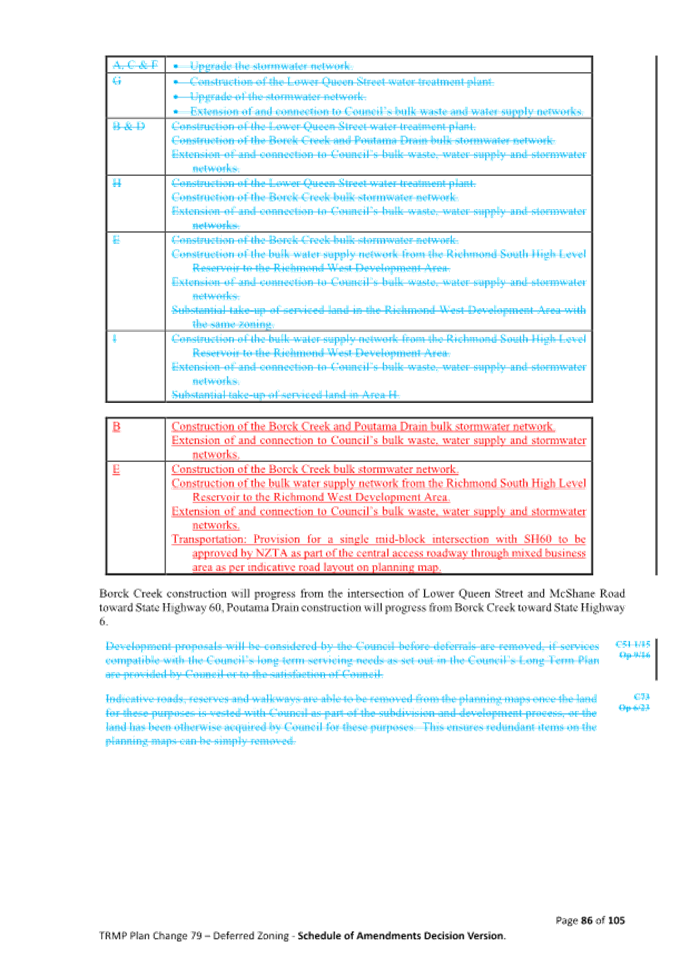
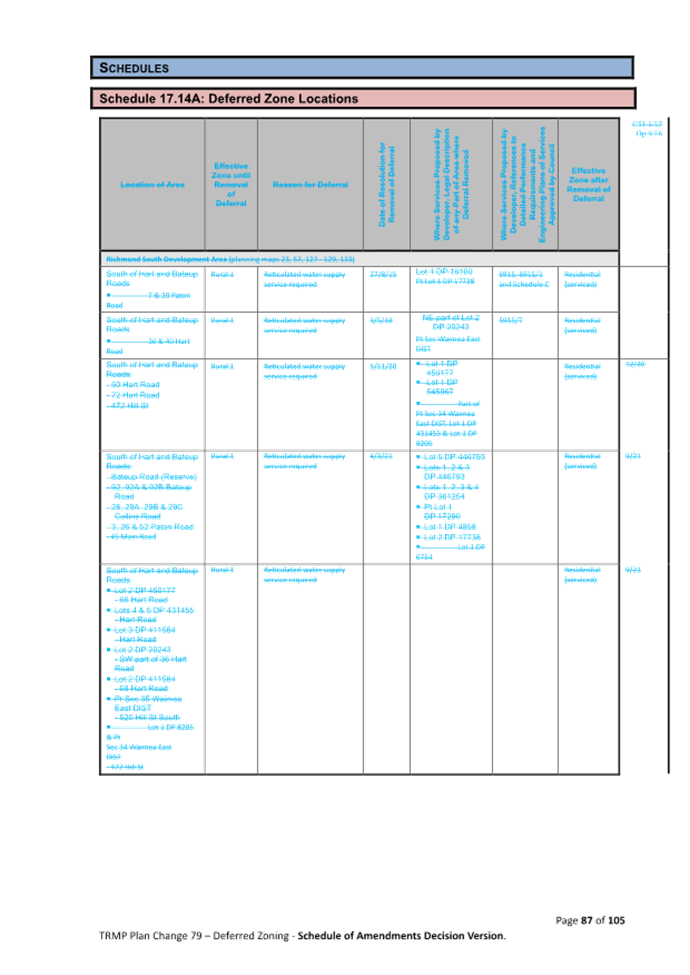
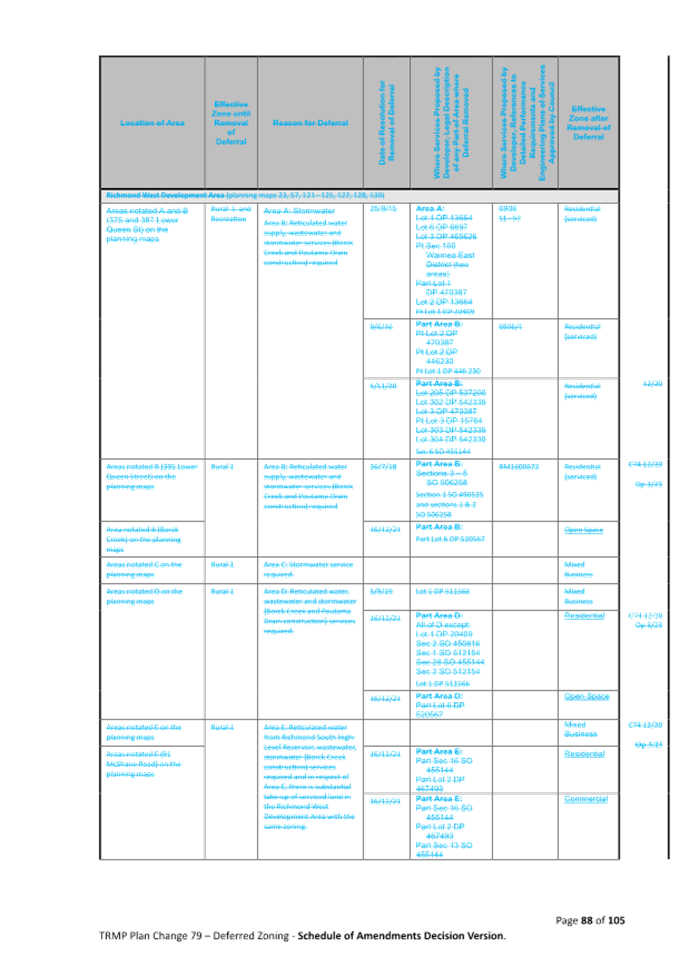
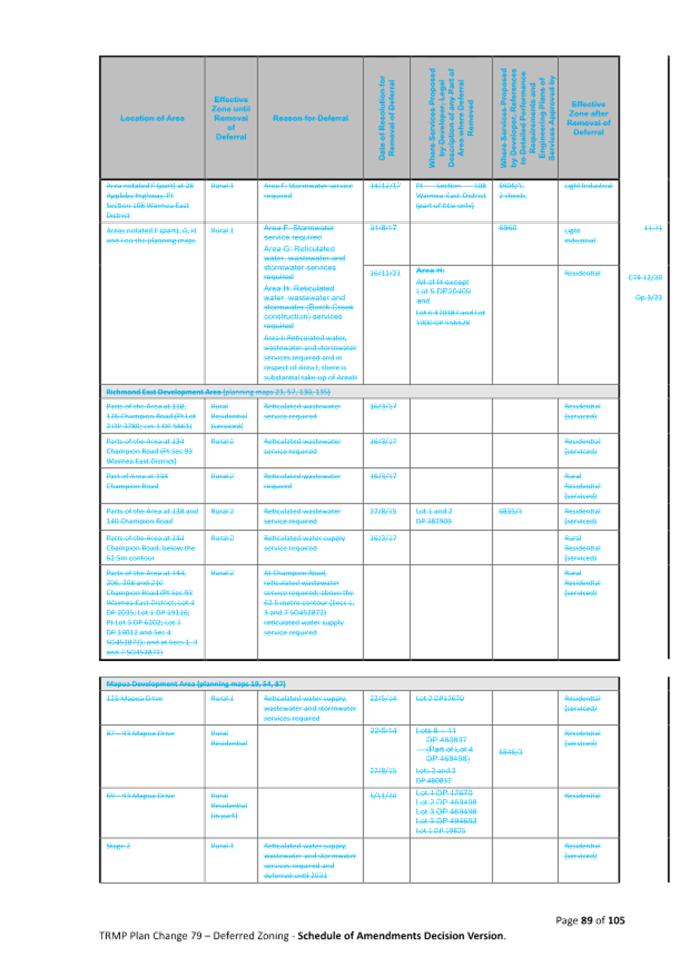
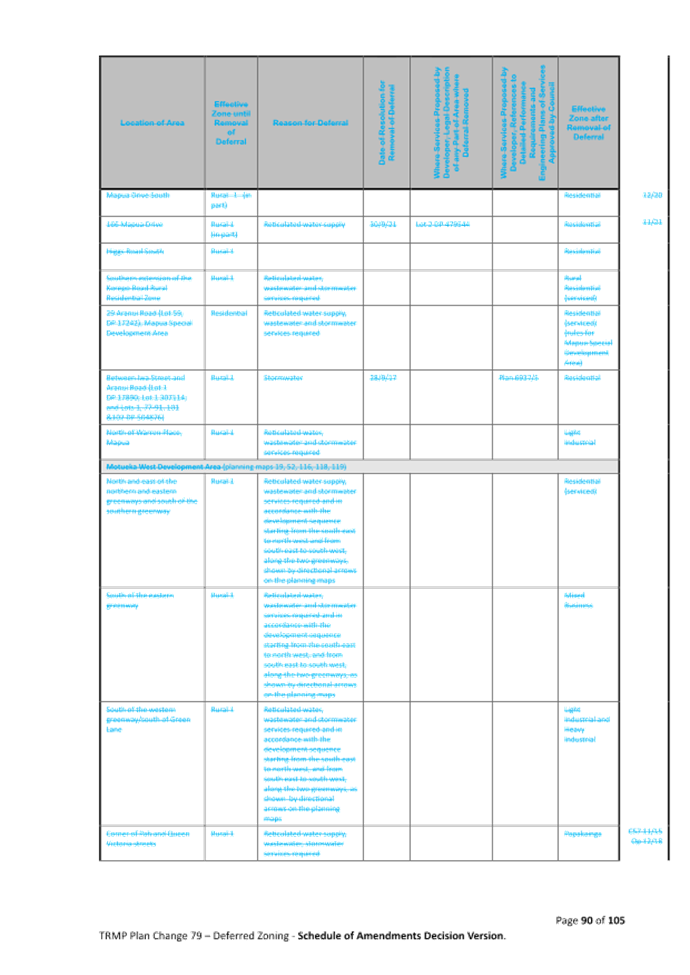
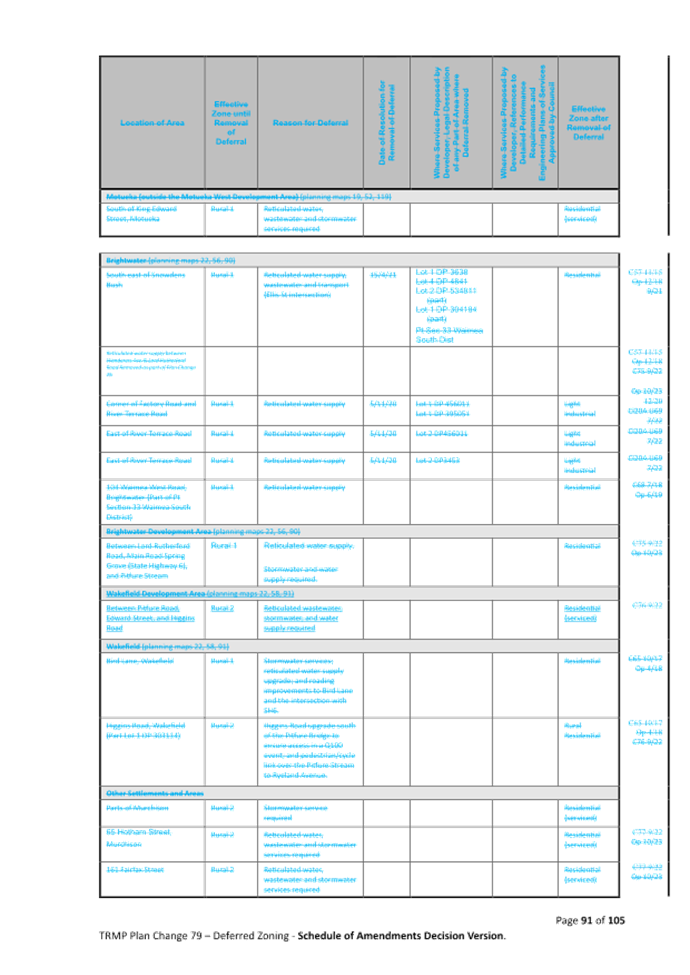
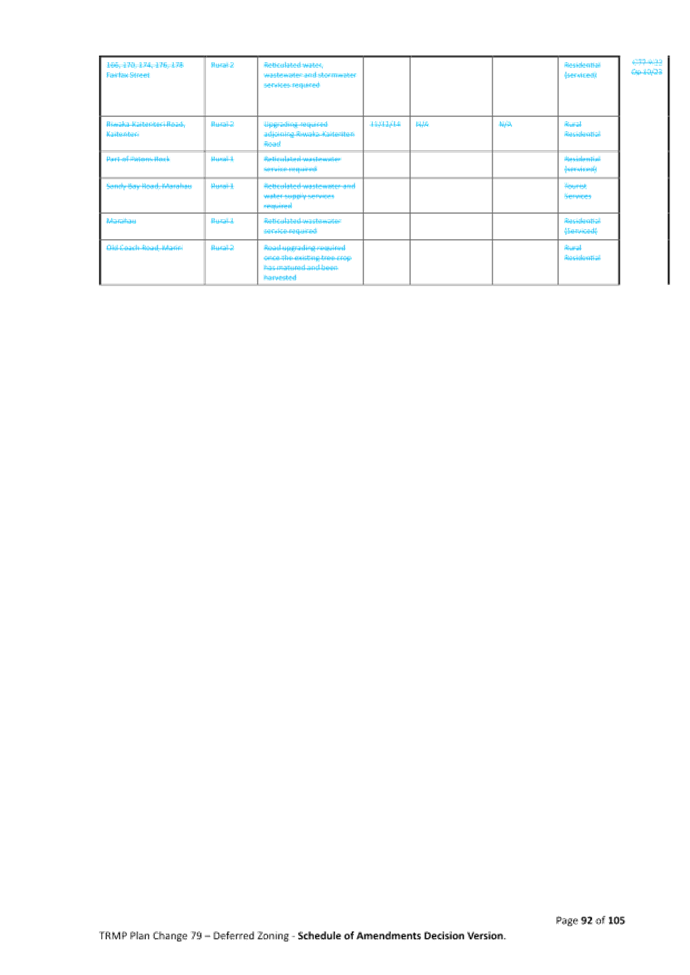
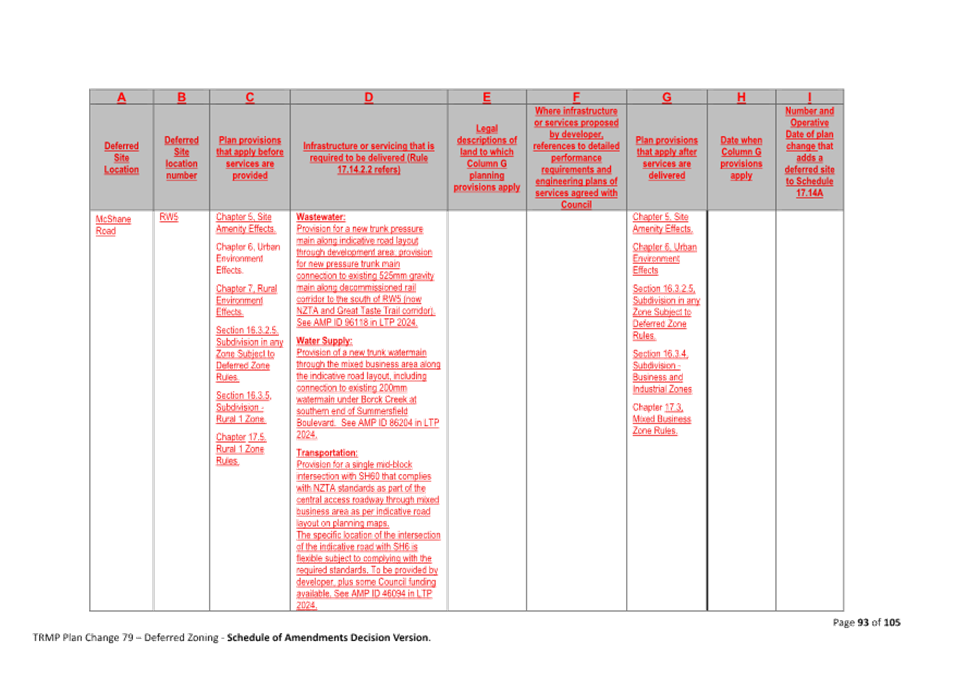
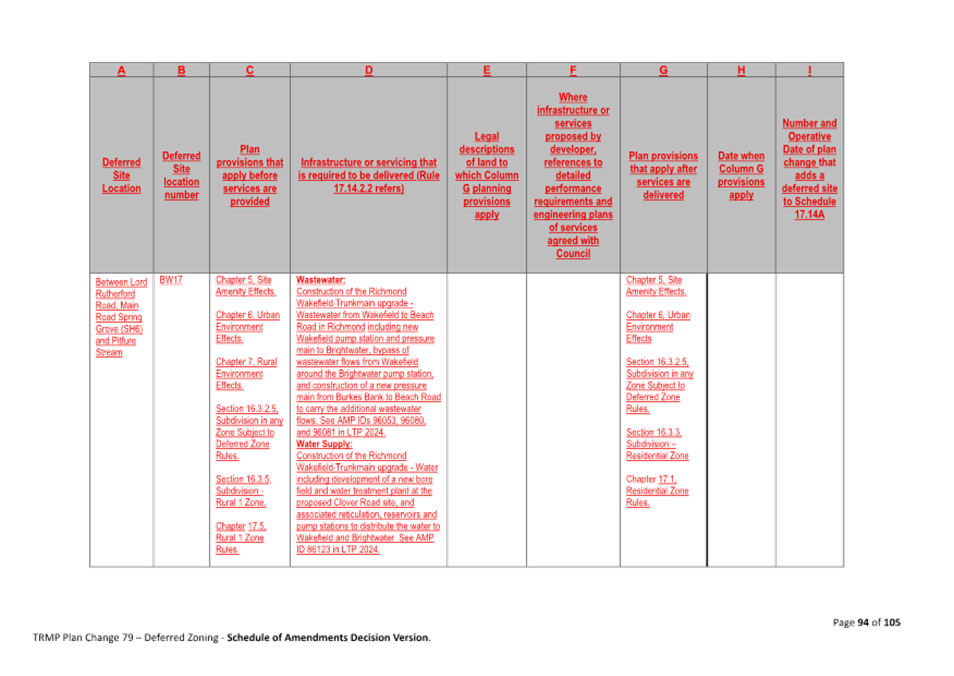
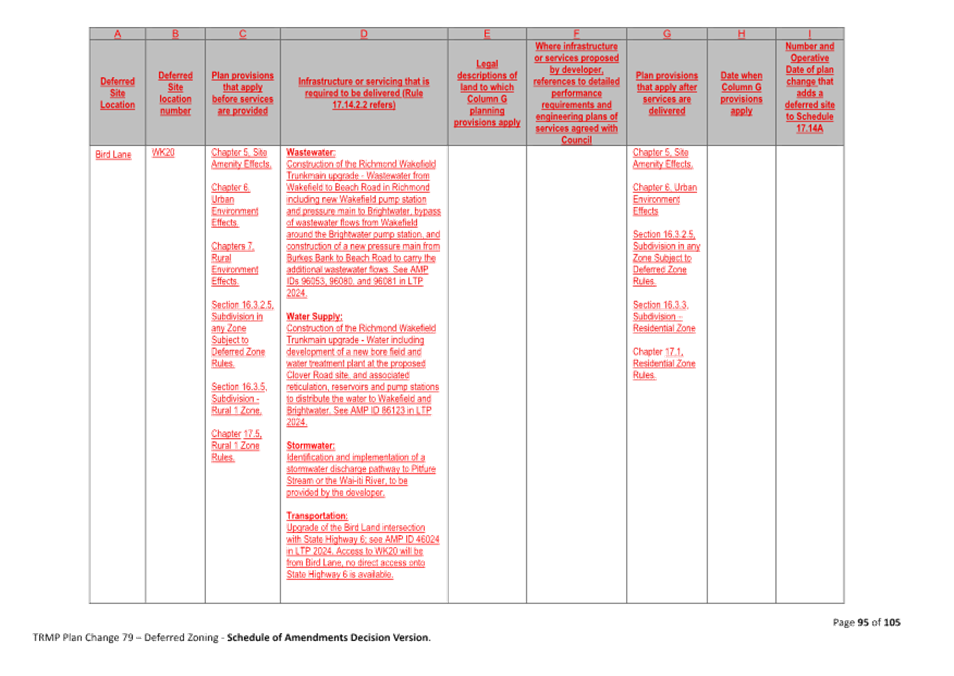
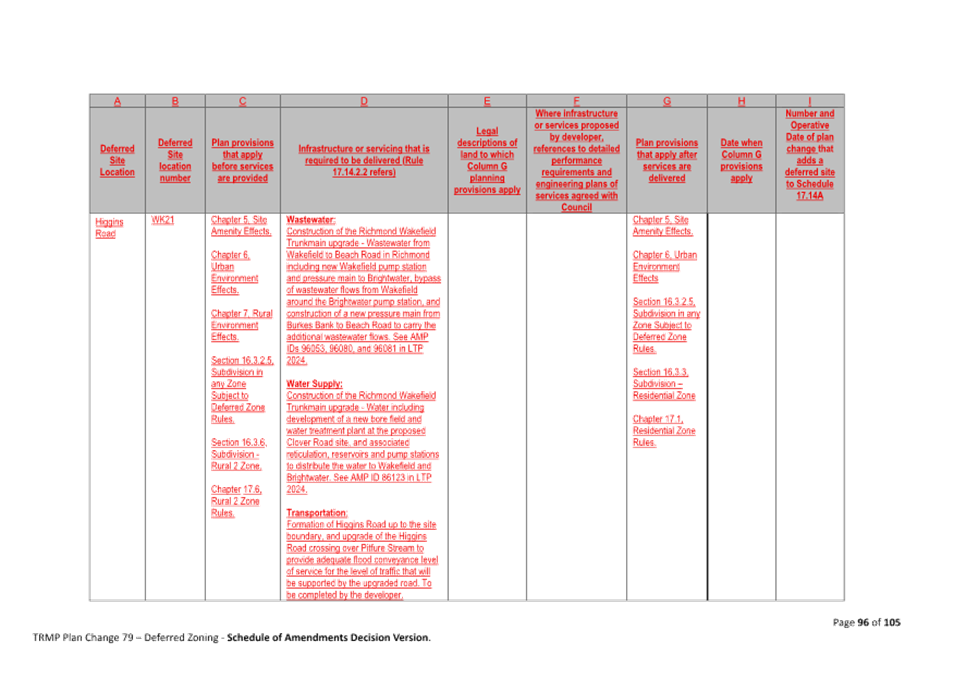
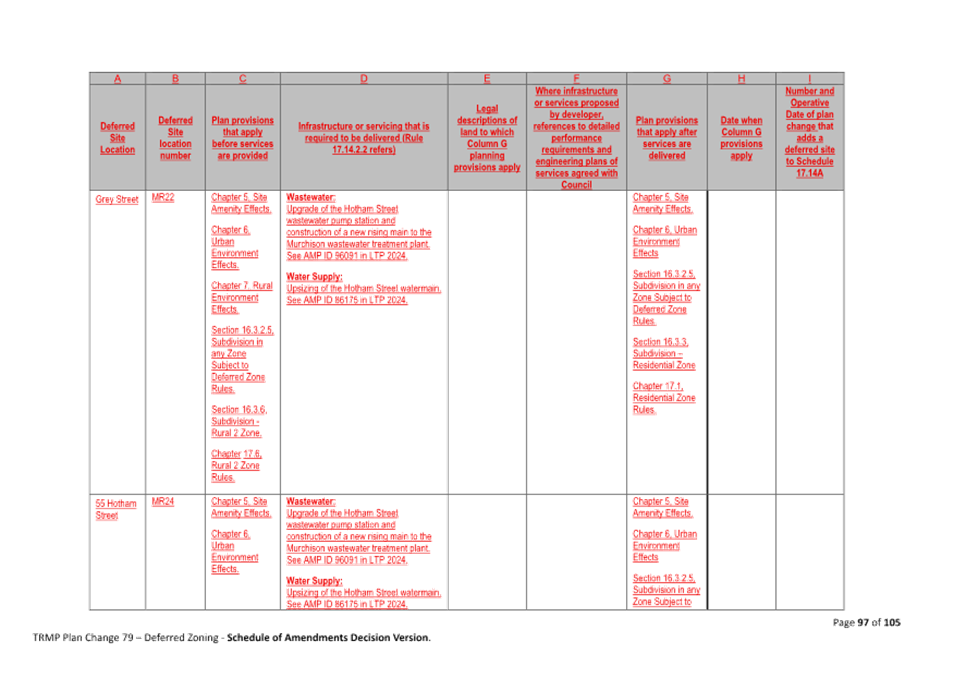
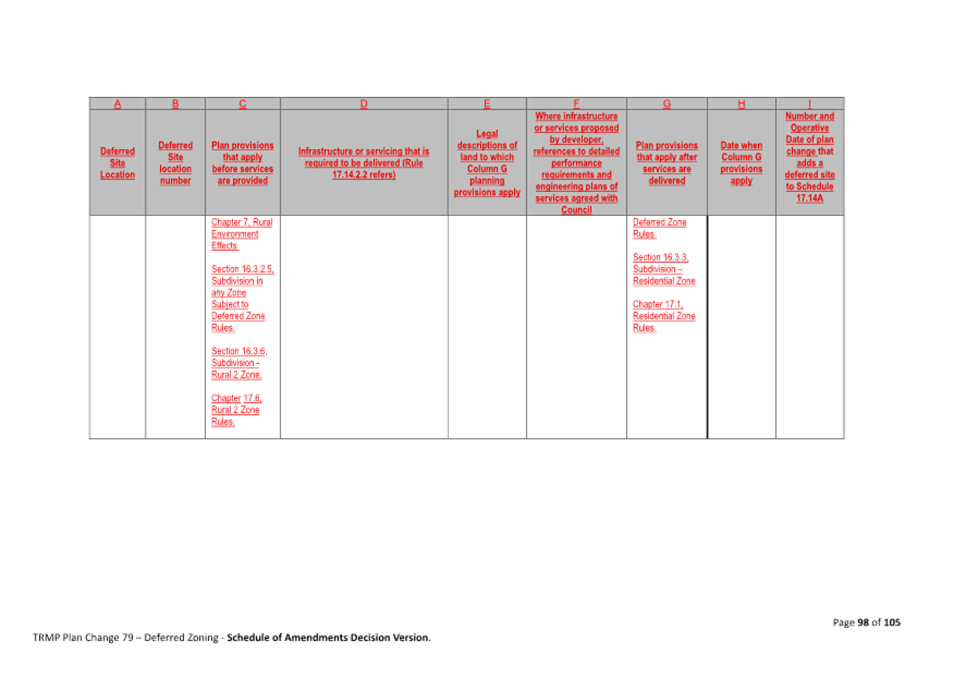
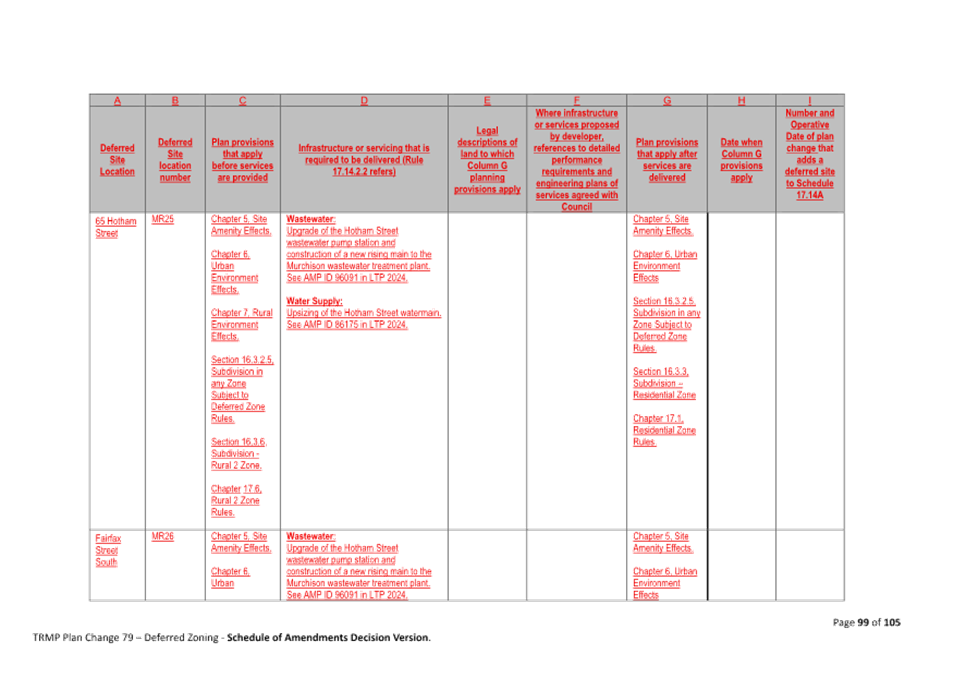
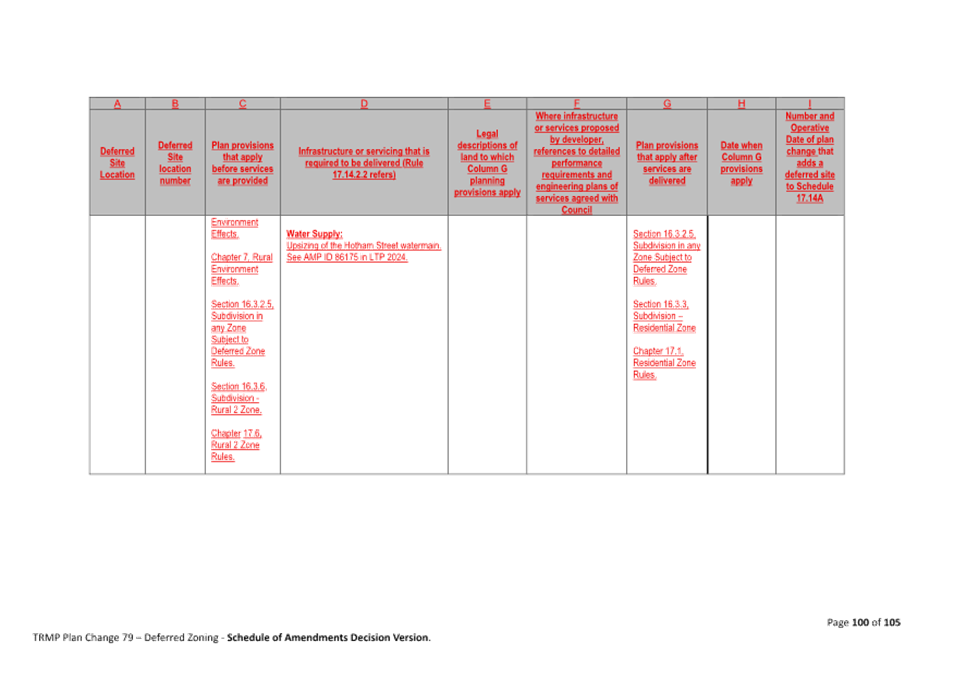
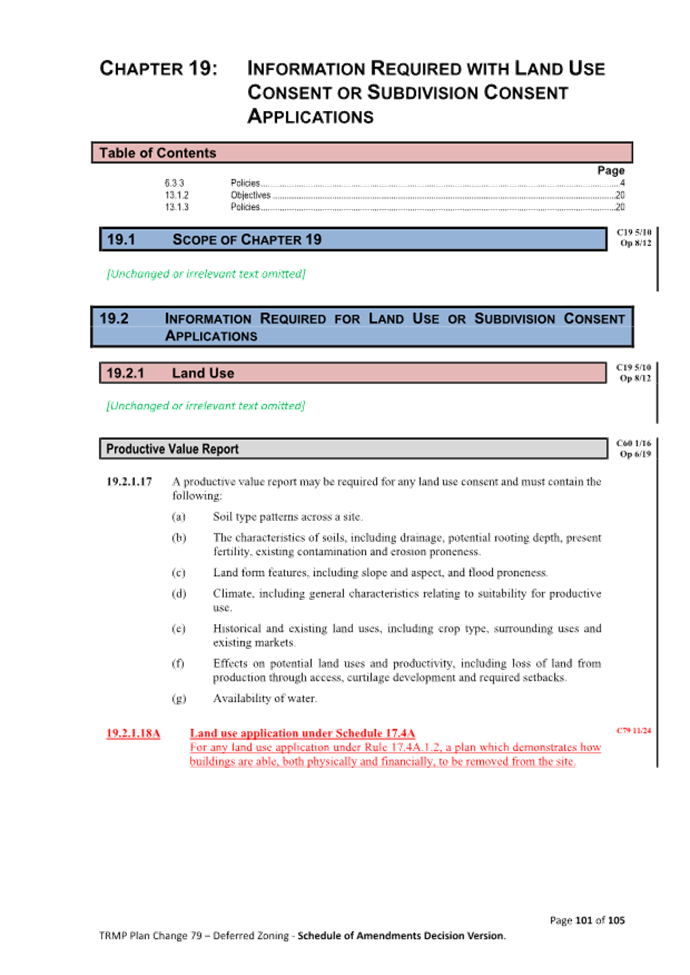
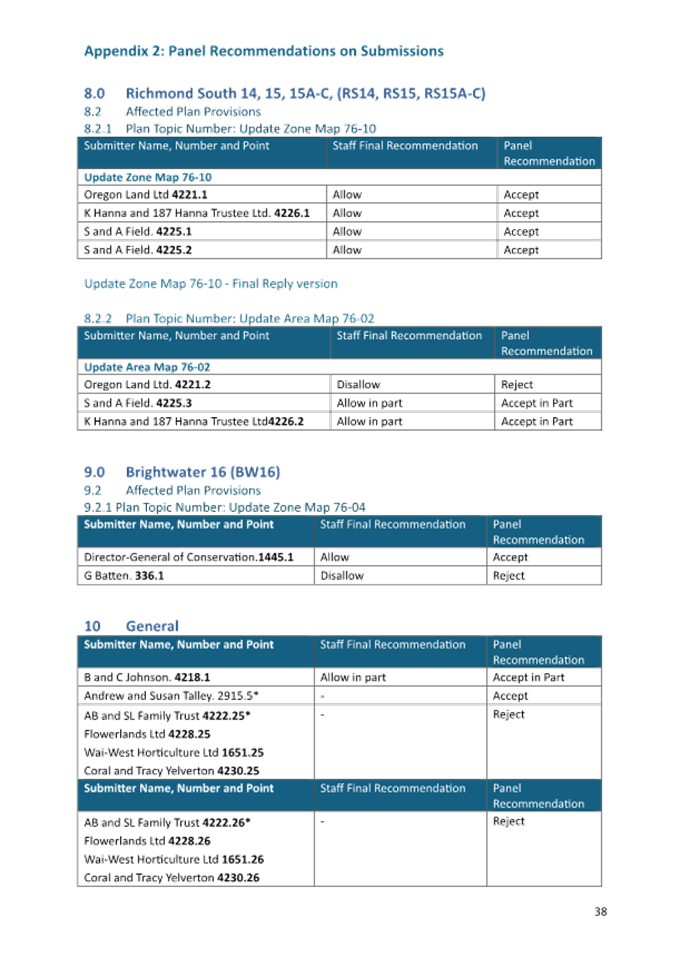
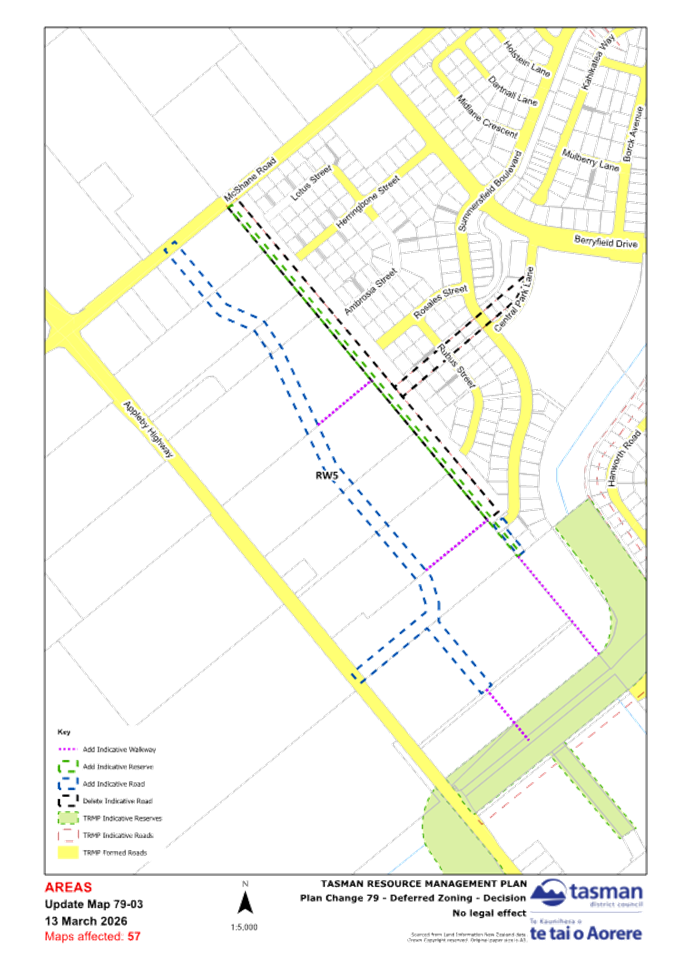
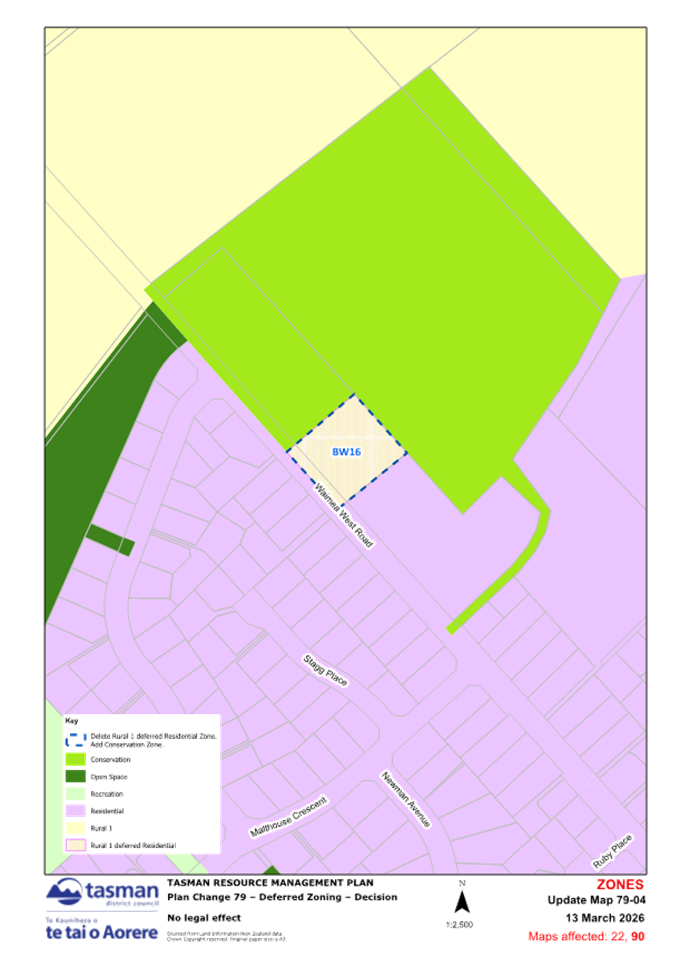
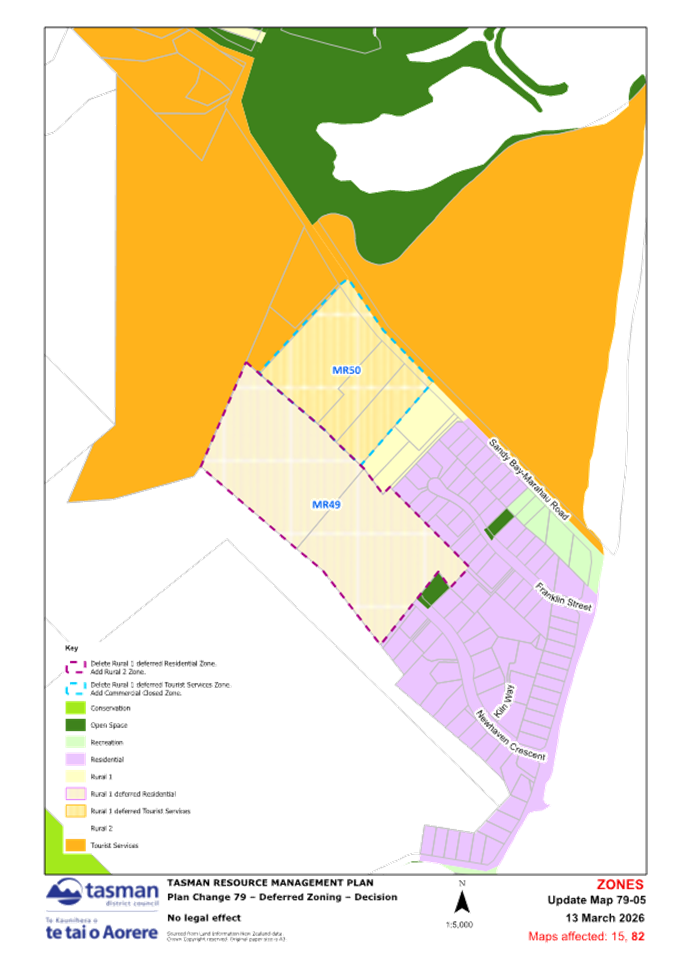
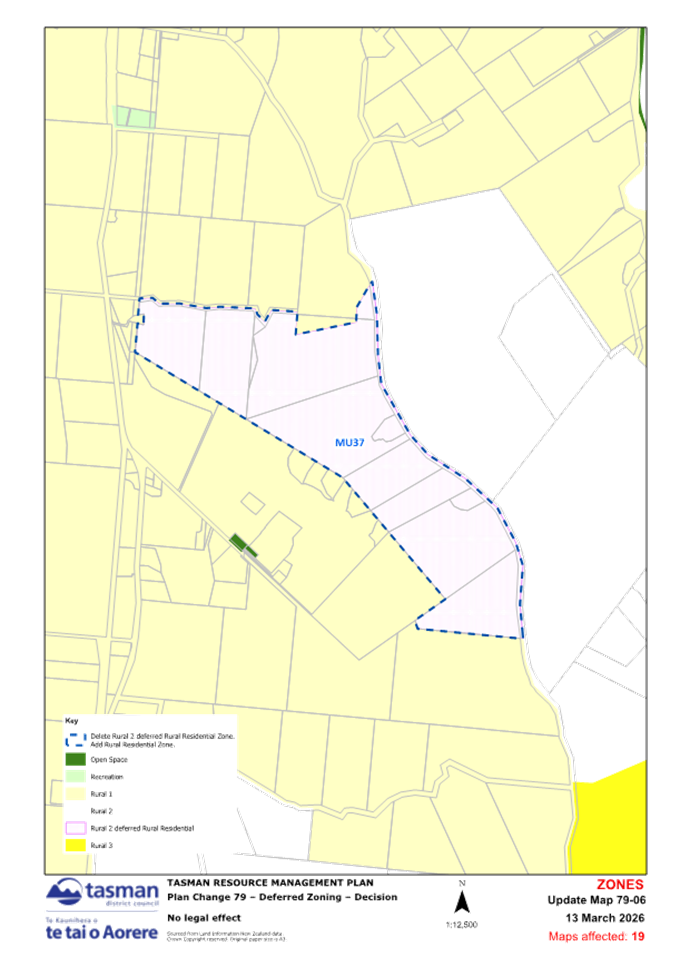
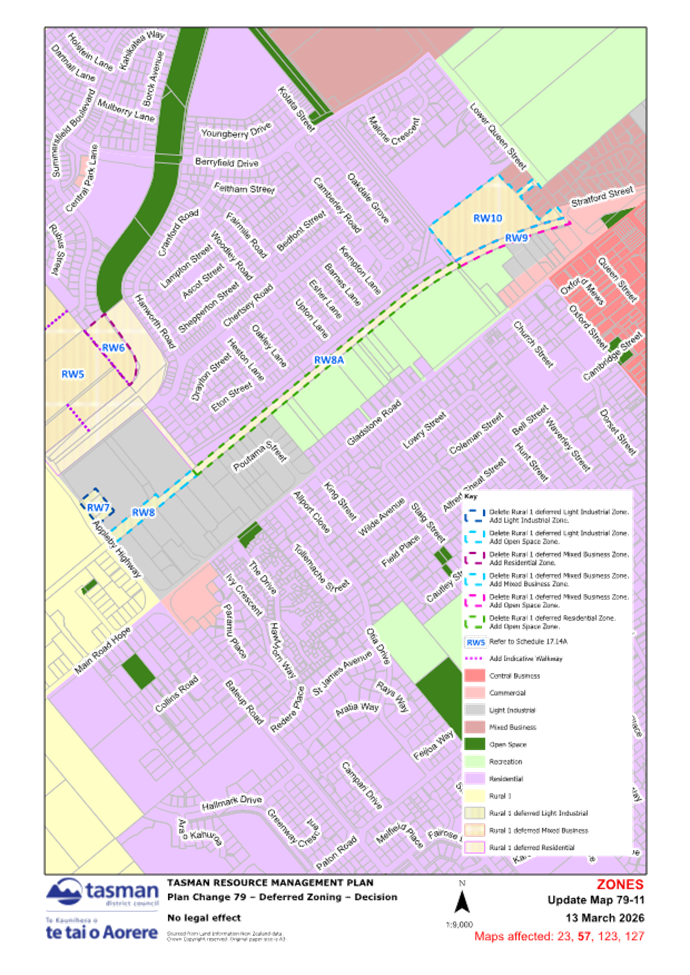
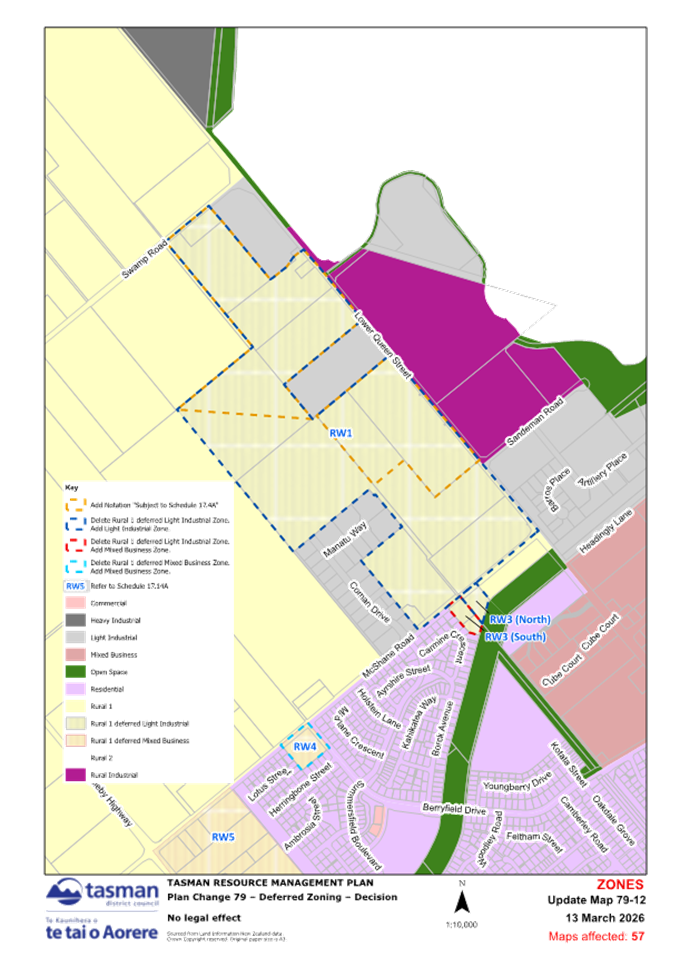
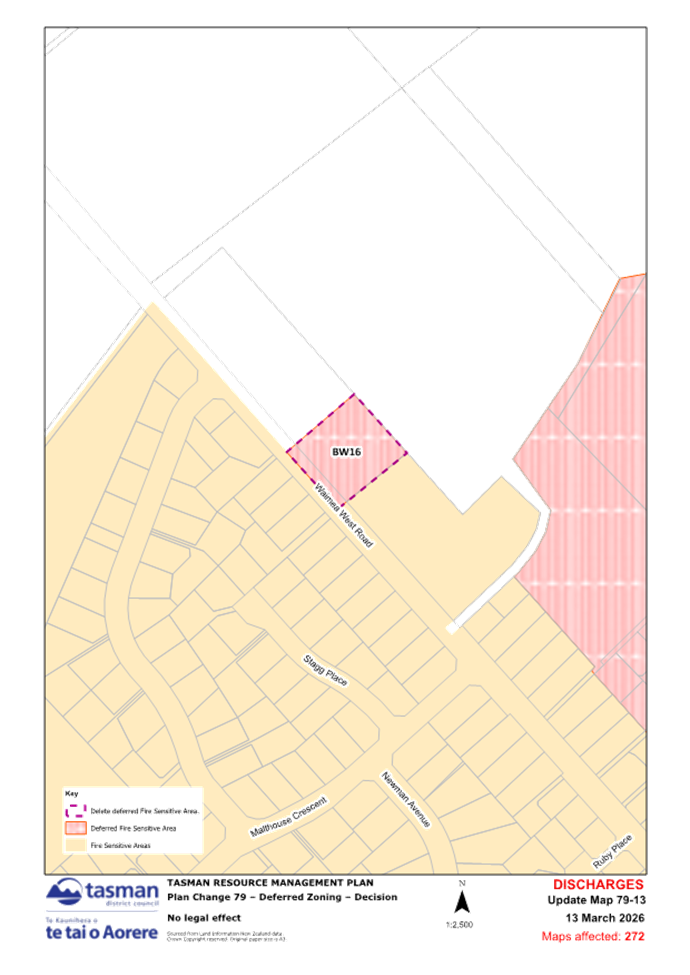
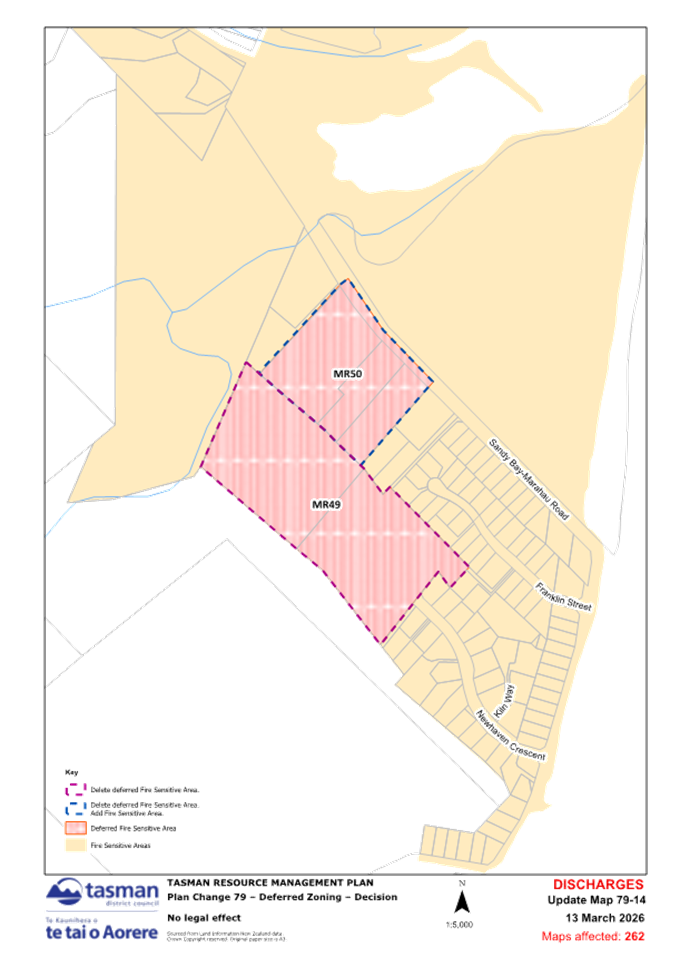
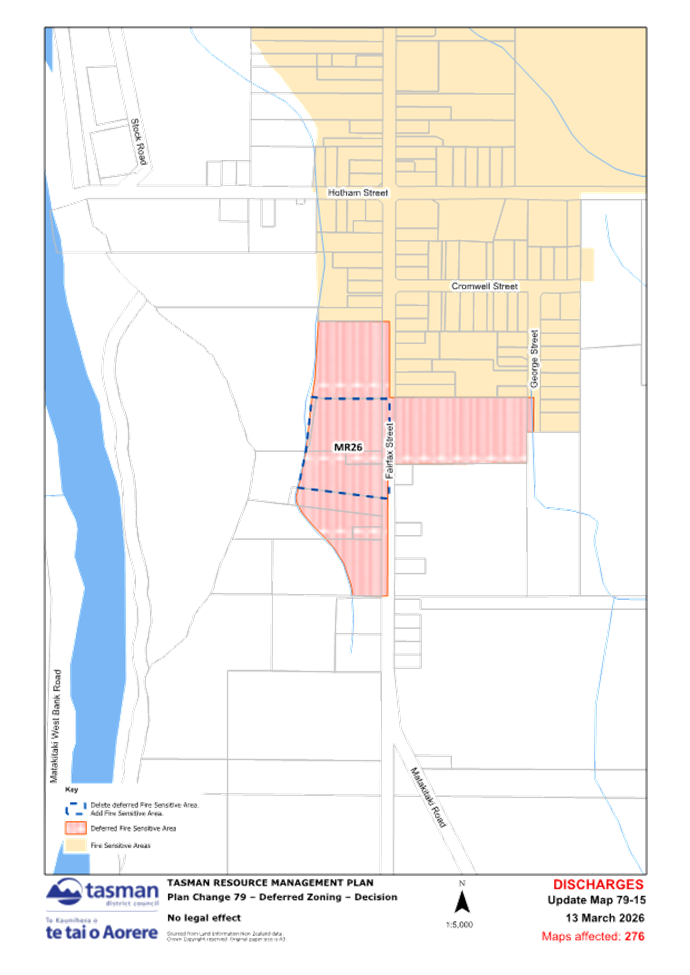
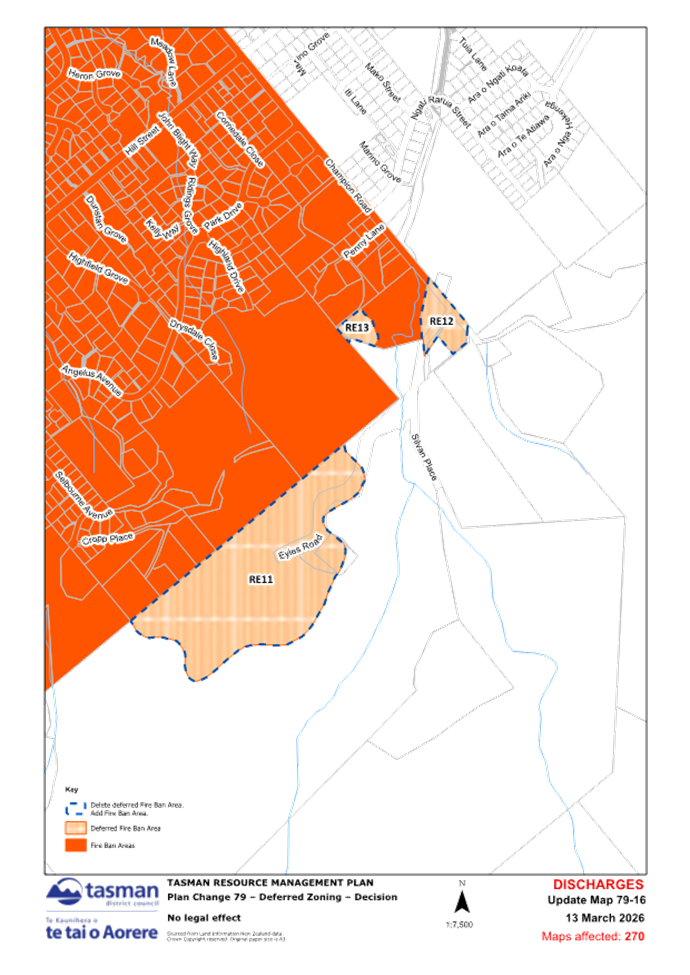
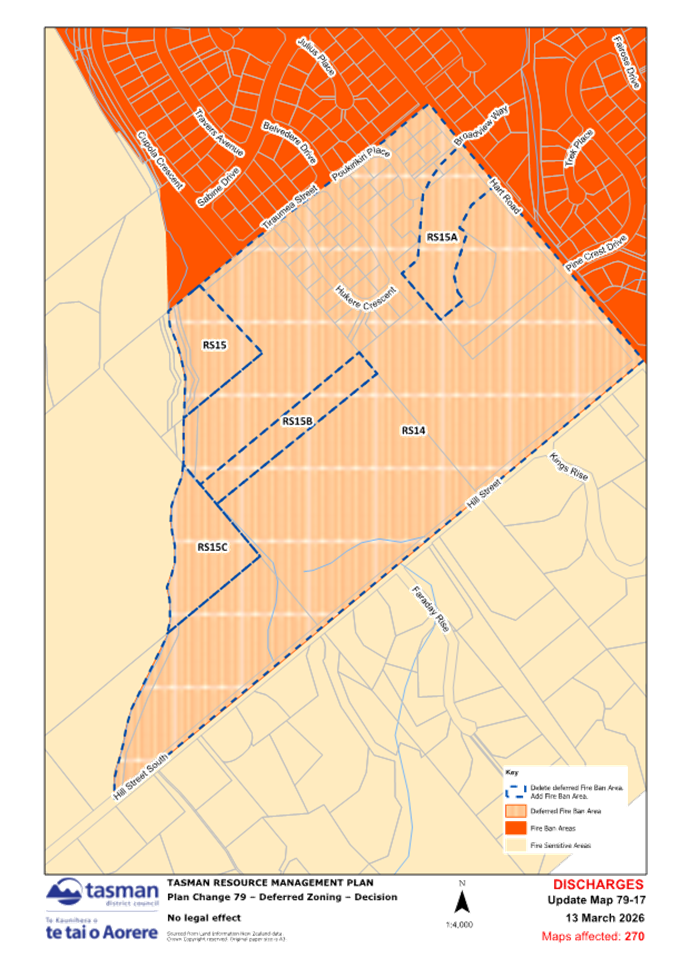
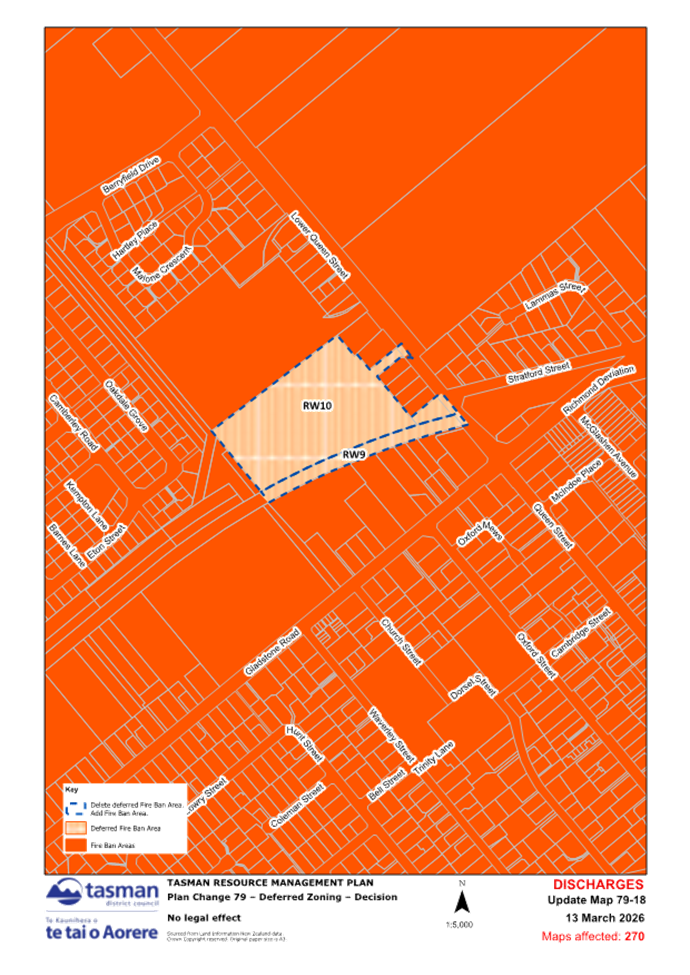
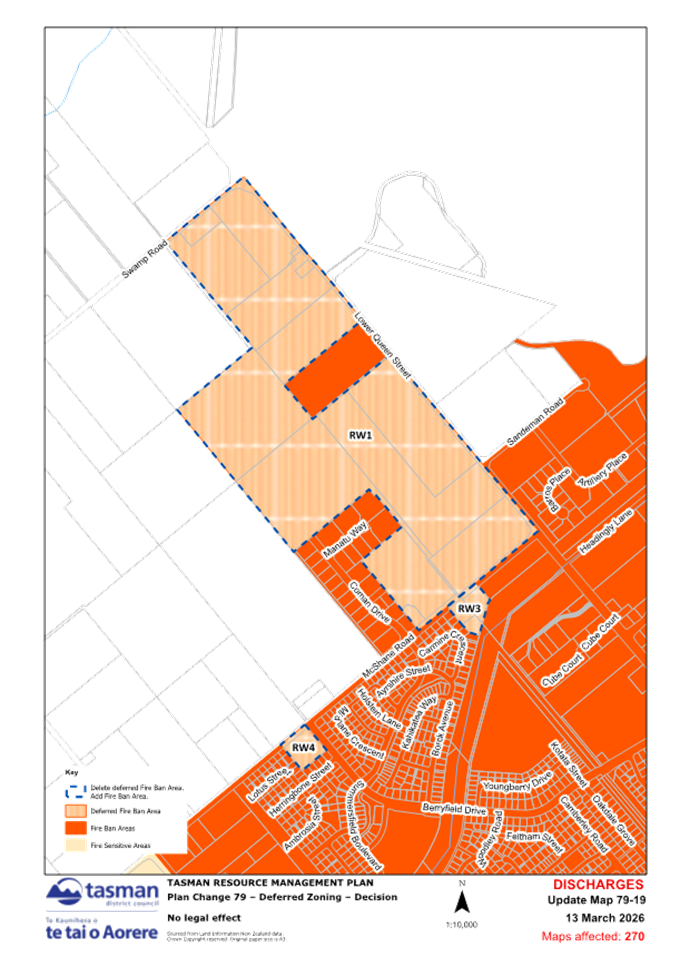
2.3 Attachment 1 shows
highlighted in orange all the amendments to
the TRMP which will NOT be approved and will not become operative. All
unhighlighted provisions in that document, as well as the zone, area and
discharge maps that formed part of the plan change, will be approved under this
resolution and will be made operative as soon as practicable.
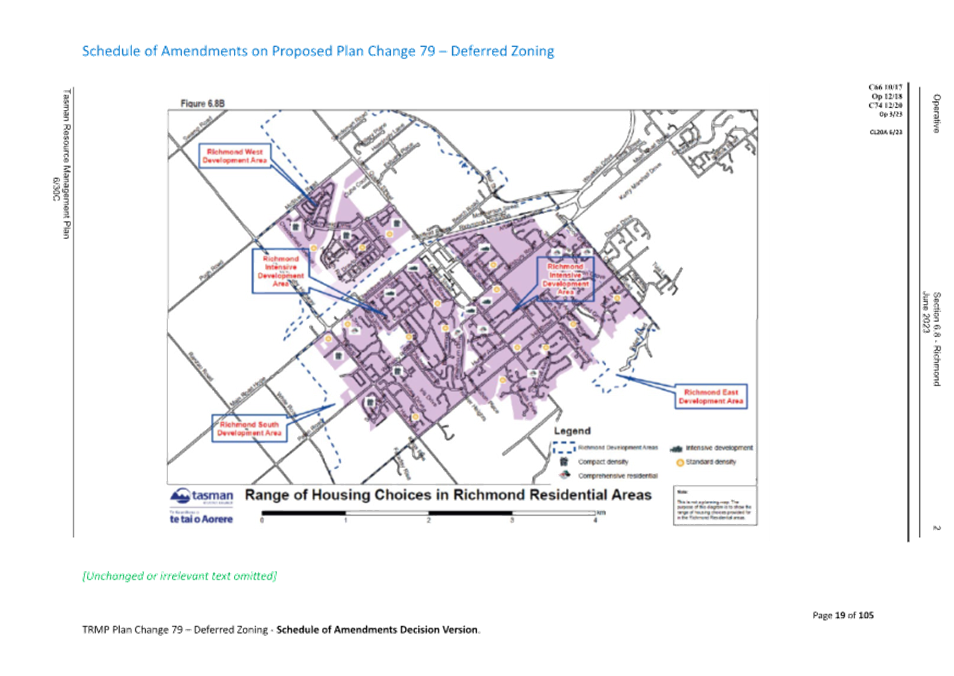
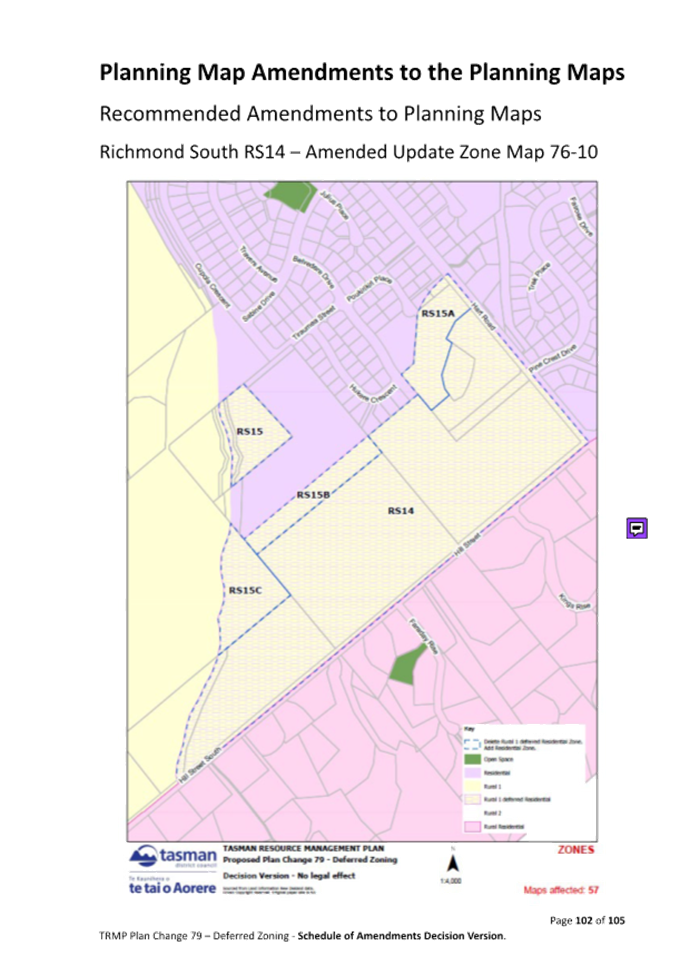
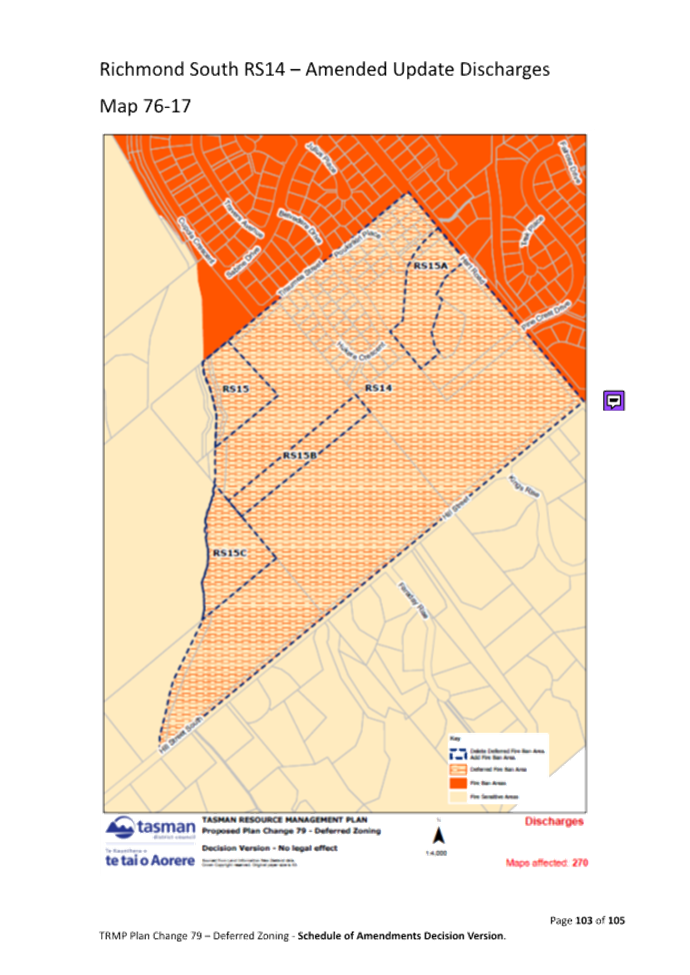
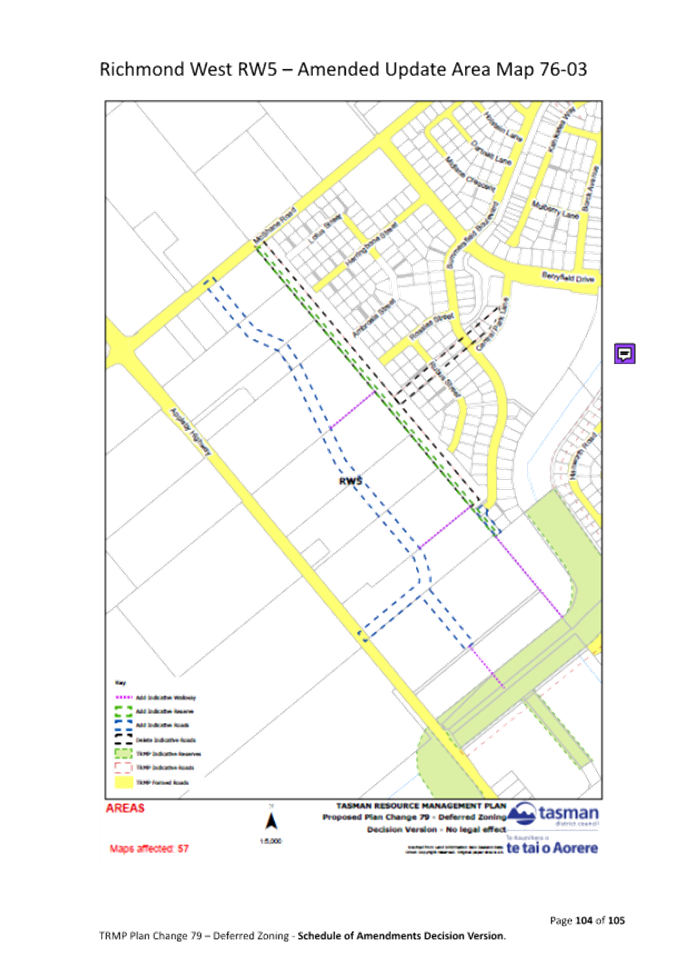
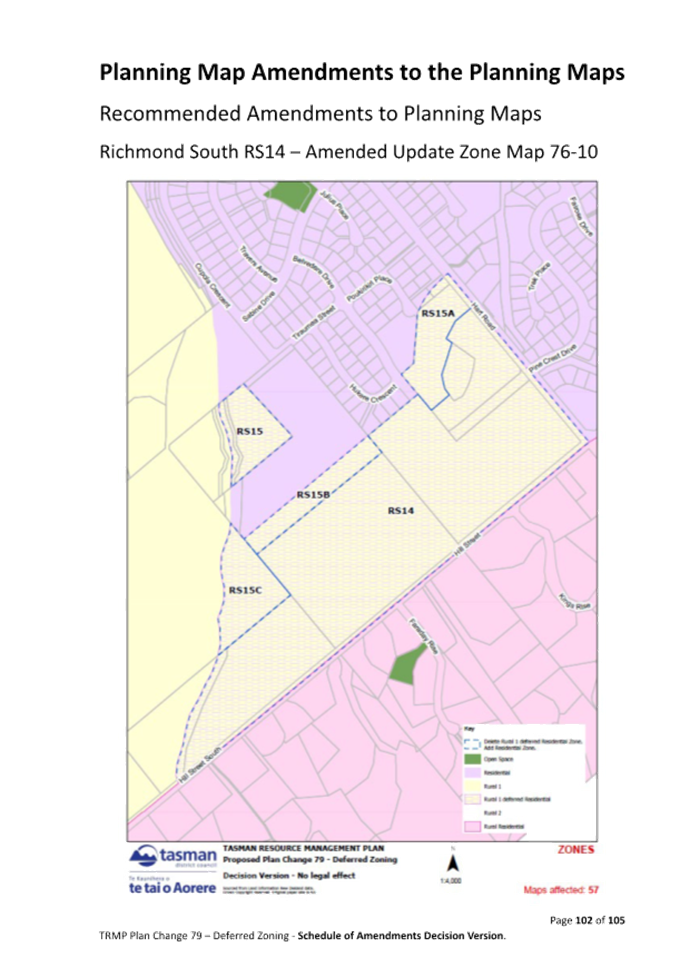
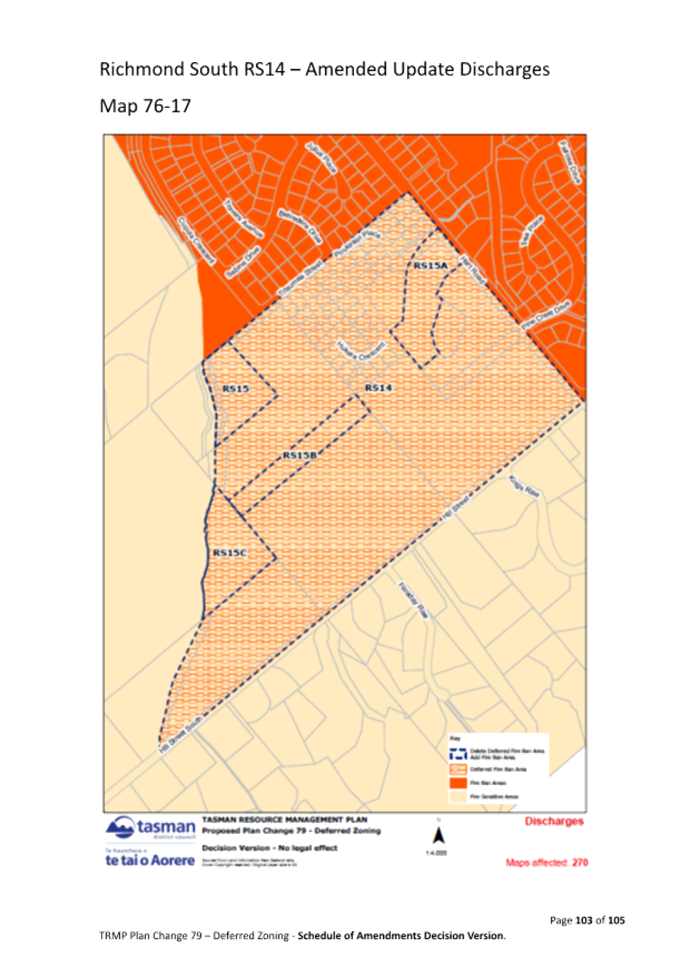
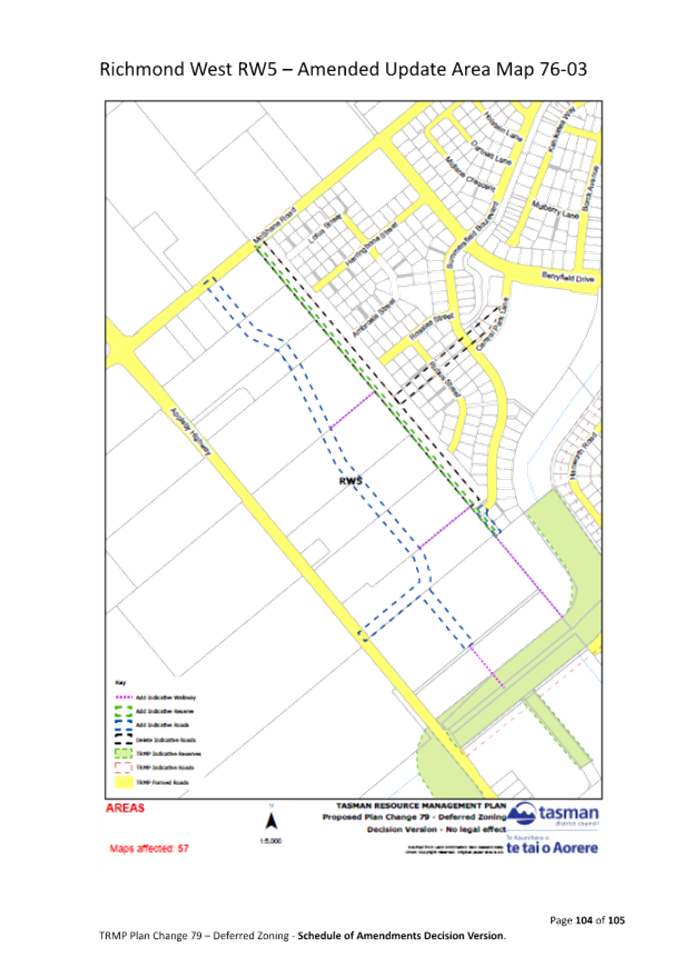
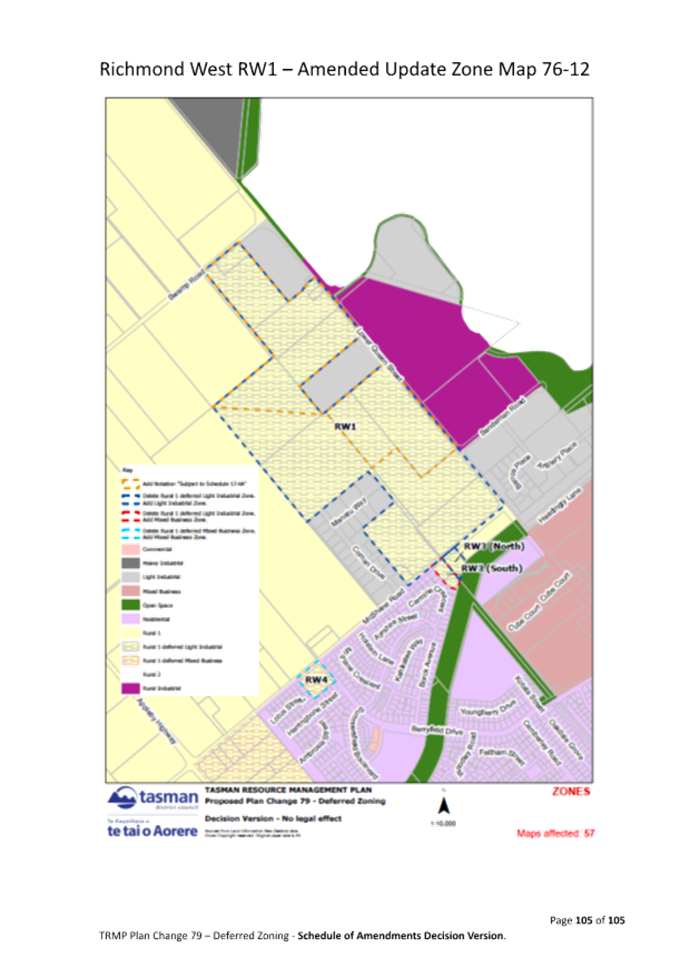
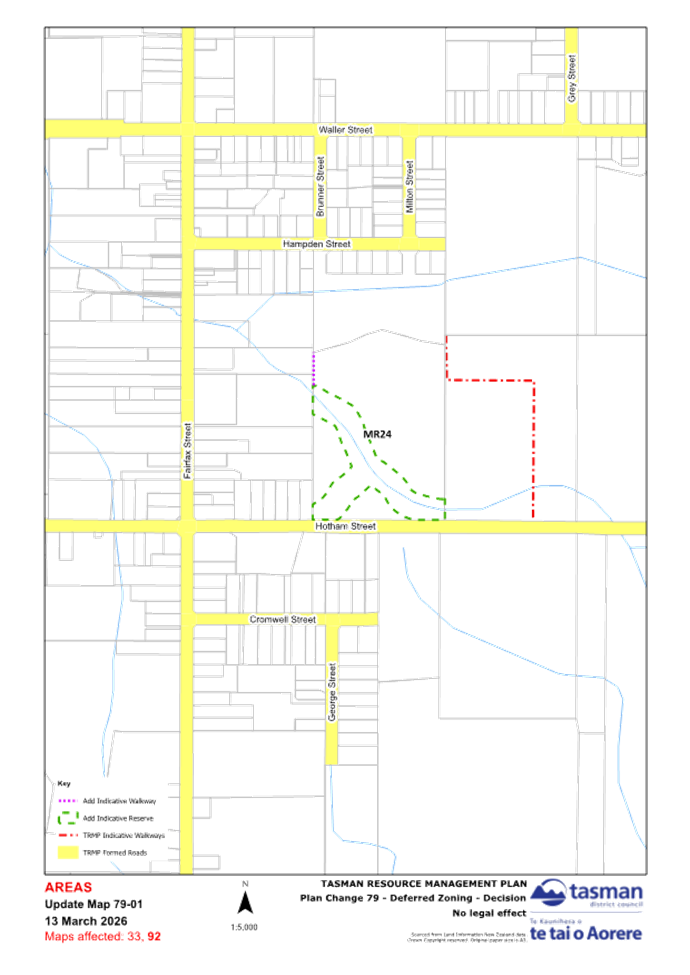
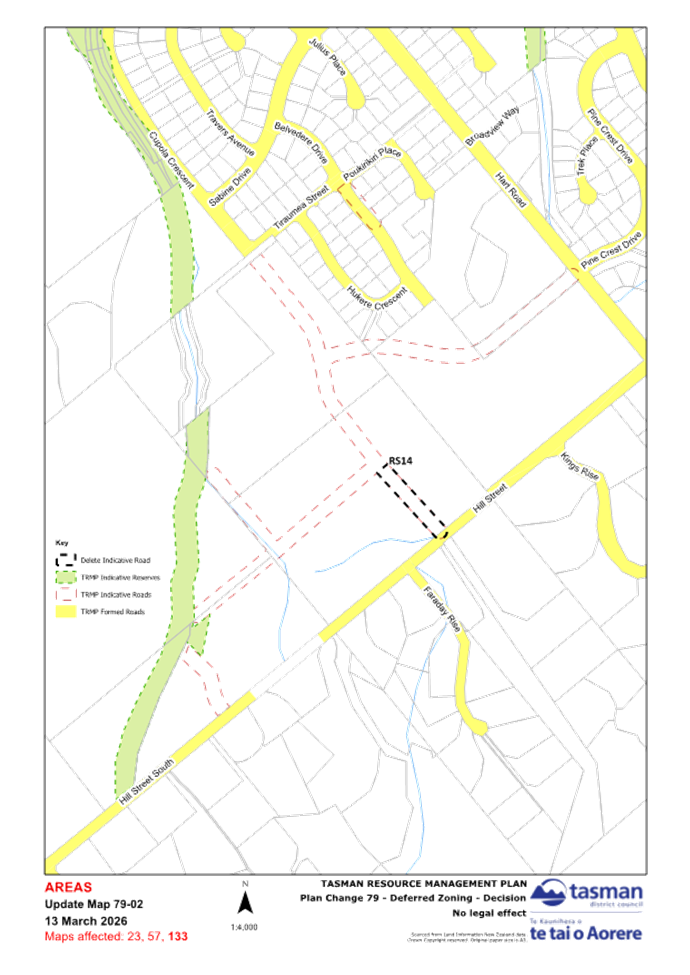
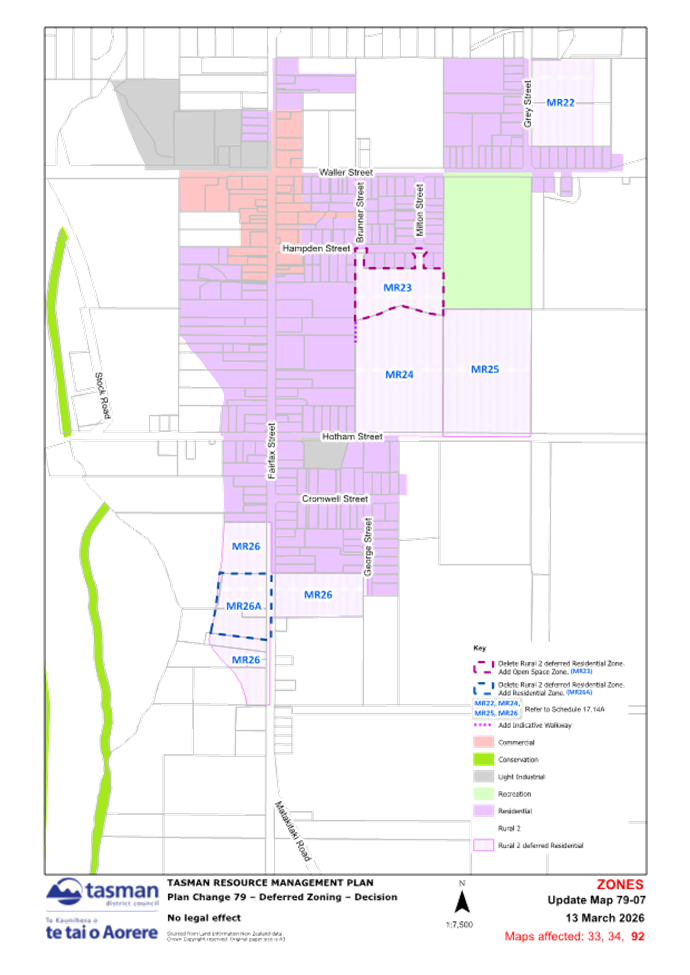
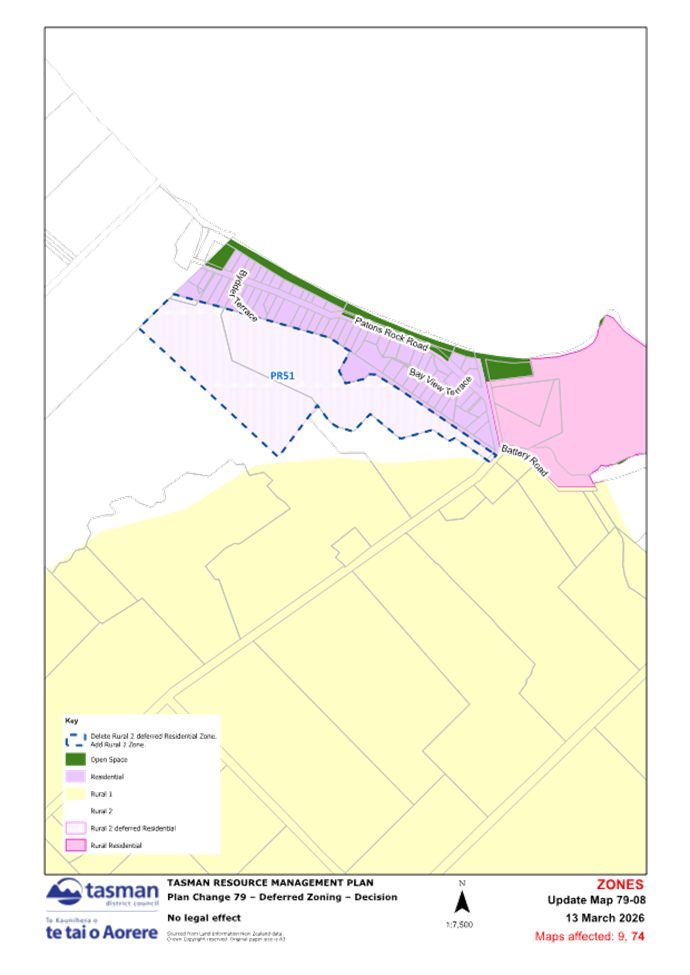
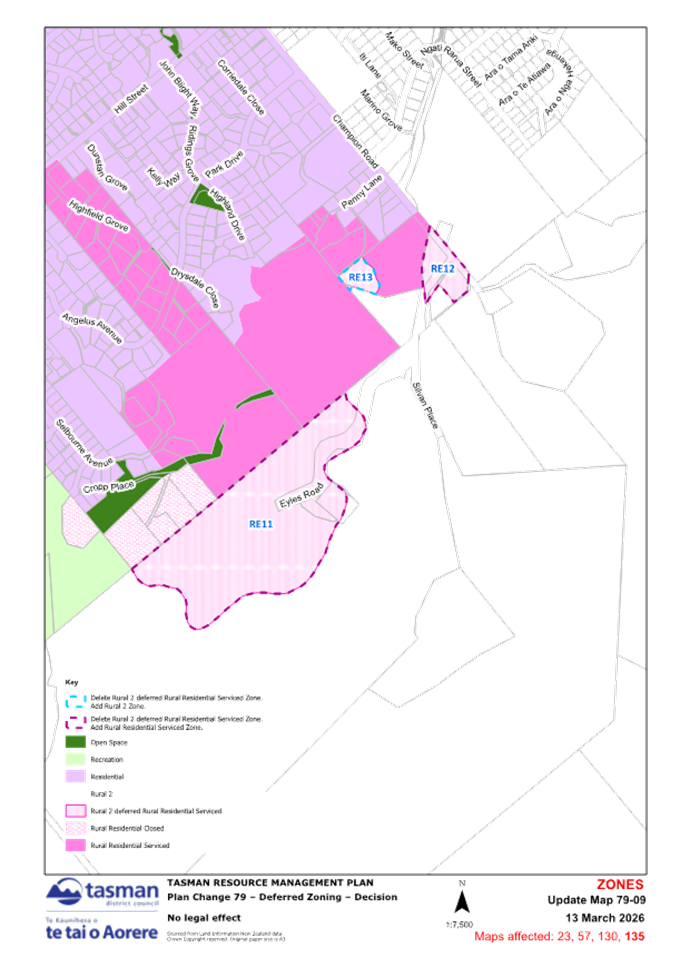
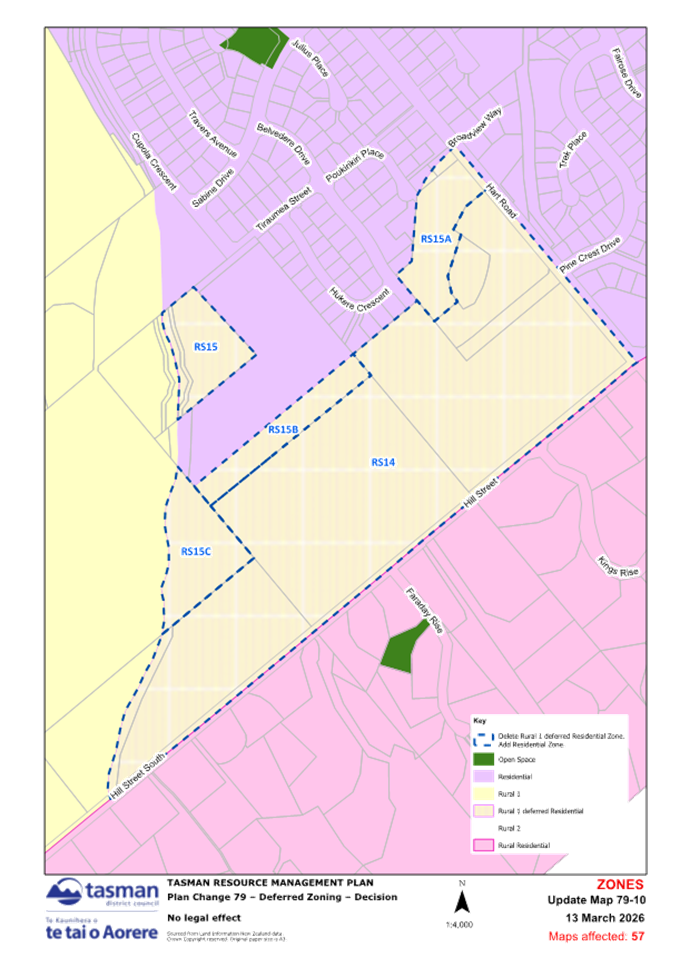
2.4 All area, zone and discharge
maps are also attached and are to be approved and made operative.
3. Recommendation/s /
Ngā Tūtohunga
That the Tasman
District Council
1. Approves
Plan Change 79 – Deferred Zoning in part, being those parts of Plan
Change 79 that are not highlighted in orange in Attachment 1 to the agenda
report, and the zoning, area and discharge Decision maps. Also to recognise
that the provisions which are highlighted in orange in Attachment 1 are not
approved and remain subject to appeal; and
2. Approves
the affixing of the Tasman District Council seal to the approved provisions and
the public notification of their operative date.
4.1 Plan Change 79 –
Deferred Zoning (PC79) was publicly notified in November 2024 and progressed
through the Schedule 1 process under the Resource Management Act 1991. The
primary purpose of PC79 was to amend the Tasman Resource Management Plan (TRMP)
to introduce a revised and more robust deferred zone framework, and to give
effect to that framework by rezoning and managing a range of existing deferred
sites across the District.
4.2 In particular, PC79 sought
to:
· clarify how
deferred zones transition to their intended end‑use zones;
· link the release
of deferred land to clearly specified infrastructure requirements; and
· enable the
release, retention, or re‑zoning of existing deferred land where this was
considered appropriate following assessment through the plan change process.
4.3 Following notification, PC79
was the subject of submissions, further submissions, and a hearing before an
independent Hearing Panel. The Hearing Panel issued its recommendations to
Council, addressing the submissions received and recommending amendments to the
notified provisions.
4.4 On 19 February 2026, Council
considered the Hearing Panel’s recommendations and resolved to adopt
decisions on PC79. That decision accepted, accepted in part, or rejected
submissions and further submissions, and approved changes to the TRMP as set out
in the Council’s decision documentation and Schedule of Amendments.
4.5 The Council’s decision
on PC79 was released on 13 March 2026, in accordance with Schedule 1 of the
Resource Management Act. As a result, an appeal period commenced during which
appeals could be lodged with the Environment Court.
4.6 An appeal has since been
lodged against specific parts of the PC79 decision. The appeal does not
challenge the entirety of PC79. Instead, it is limited in scope to particular
objectives, policies and rules.
4.7 Under the Resource
Management Act, where a plan change decision is appealed in part, Council may
approve part, if all submissions or appeals relating to that part have been
disposed of; see cl 17 Schedule 1. While the drafting of cl 17 does not
explicitly address a situation where no appeal has been filed against certain
provisions (c.f. ‘disposed of’) the clause applies to these
circumstances because the submissions on those parts have been disposed of and
therefore Council may effectively treat them as unchallenged parts of PC79 and
approve them. The effect is that part of the plan change will become
operative, while preserving the Environment Court’s jurisdiction over the
appealed provisions.
4.8 This report addresses
whether, and to what extent, provisions of PC79 can be made operative at this
stage. It does not reconsider the merits of PC79 or the decisions made by
Council on 19 February 2026. Its purpose is solely to enable Council to make
those parts of the PC79 decision that are not under appeal operative.
5. Analysis
and Advice / Tātaritanga me ngā tohutohu
Status of Plan
Change 79
5.1 Council
adopted the recommendation on Plan Change 79 (PC79) on 19 February 2026, with
the decision released on 13 March 2026. At that point, PC79 moved to decision‑stage
under Schedule 1 of the Resource Management Act 1991 (RMA).
5.2 An
appeal has been lodged against specific provisions of the PC79 decision. The
appeal does not relate to all aspects of the plan change. As a consequence,
PC79 is now partially subject to the Environment Court’s jurisdiction,
which may result in changes to PC79.
Statutory
Authority to Make PC79 Operative in Part
5.3 Clause 17(2)
of Schedule 1 of the Resource Management Act 1991 provides that a local
authority may approve part of a plan, where all submissions or appeals relating
to that part have been disposed of. In this case, the appeal to Plan Change 79
is limited in scope, and the provisions proposed to be approved are not subject
to appeal.
5.4 Once approved in part under
Clause 17, Clause 20 of Schedule 1 provides for Council to
publicly notify the date on which those approved provisions become operative.
5.5 This
approach reflects established and accepted practice under Schedule 1, allowing
provisions that are not subject to further consideration, including Environment
Court litigation, to take effect without further delay.
Severability of
the Unappealed Provisions
5.6 The appeal to PC79 is
limited in scope and is directed at particular objectives, policies and rules
that relate to the deferral mechanism. The remaining provisions of PC79 have
not been appealed by any party and are discrete from those under appeal.
5.7 The
provisions not under appeal are capable of operating independently of the
appealed provisions and can be integrated into the operative TRMP without
affecting:
· the scope of the
appeal; or
· the Environment
Court’s ability to determine the appealed matters.
Why approve and
make operative in part now?
5.8 In
recommending that PC79 be made partially operative, it is important that the
appeal is confined to a discrete set of provisions relating to the deferred
zoning mechanism and does not extend to the site‑specific
rezoning outcomes or the provisions that enable development on land that has
been ‘up‑zoned’ (i.e. the zoning has been amended so it is no longer deferred).
5.9 One reason for proceeding to
make the provisions not under appeal operative at this stage improves the
clarity and usability of the TRMP. This is particularly relevant given the
imminent public notification of Plan Change 81. Maintaining a clean and up‑to‑date operative planning
framework will assist the public to understand the operative baseline from
which Plan Change 81 is proposed, and to make informed submissions, as well as
assisting with the usability of the Plan generally.
Advice to Council
5.10 This report does not reconsider the
merits of PC79. It is procedural in nature and is confined to implementing
Council’s earlier decision to the extent permitted by the RMA.
5.11 It is therefore lawful for Council to
approve and make PC79 operative in part, limited to those parts of PC79 where
the submissions on those parts have been disposed of. Put another way, it
can approve the PC79 provisions that are not subject (directly or indirectly)
to appeal.
5.12 Staff are confident that the identified
parts of PC79 can be approved and made operative because the provisions and
rezonings relate specifically to rezonings and site specific provisions,
whereas the appeal is focused on the deferral mechanism.
5.13 This approach gives effect to
Council’s decision of 19 February 2026, provides regulatory certainty
where possible, improves and assists with the readability and usability of the
Plan and preserves the appeal process for the provisions that remain before the
Environment Court.
6. Financial
or Budgetary Implications / Ngā Ritenga ā-Pūtea
6.1 The provisions of Plan
Change 79 that are not subject to appeal include those that implement
zoning changes and enable development to proceed on
sites identified for urban use. These provisions give effect to Council’s
decision to release specified locations from deferred zoning where
infrastructure is in place and the resulting urban zoning is no longer in
dispute. Enabling development on these locations will provide return on
investment for Council for the infrastructure it has installed.
6.2 The appealed provisions are
discrete and separable from the zoning and development‑enabling
provisions proposed to be made operative. Making the provisions not under
appeal operative at this stage will enable development to proceed on the up‑zoned
sites without prejudicing or constraining the Environment Court’s
consideration of the appeal.
6.3 Management of the appeal
– being a separate matter – will involve additional legal and staff
costs.
7.1 The options
are outlined in the following table:
|
Option
|
Advantage
|
Disadvantage
|
|
1.
|
Make Plan Change 79 operative in part
|
Gives effect
to Council’s decision of 19 February 2026 in respect of the
provisions that have been disposed of and are not under appeal.
Enables the
zoning changes and development‑enabling provisions for the up‑zoned
locations to take effect, providing certainty for landowners and consent
processing.
Approves
usability and readability of the Plan.
Is consistent
with Clause 17(2) of Schedule 1 of the Resource Management Act
1991 and established practice where only part of a plan change decision is
under appeal.
Preserves the
Environment Court’s jurisdiction over the appealed provisions.
|
None
identified. The appealed provisions remain unaffected and are excluded from
becoming operative at this time.
|
|
2.
|
Defer making any part of Plan Change 79 operative until
the appeal is resolved
|
Defers implementation of all provisions until the appeal
process is complete
|
Delays the
operation of zoning provisions not under appeal that are no longer in
dispute.
Defers
development enabled by the up‑zoned locations, contrary to
Council’s earlier decision.
Provides no practical benefit where severable provisions
can lawfully be made operative in part
|
7.2 Option 1 is
recommended.
8.1 A plan change must be
approved by Council before it is made operative by public notification under cl
20 Schedule 1 to the Resource Management Act 1991. This is an
administrative process rather than a substantive decision. There is a
quirk in the Resource Management Act 1991 as it states that rules become
operative once they are beyond challenge but then goes on to state in a later
clause that to make a plan or change operative requires approval by Council and
then it must affix its seal to the change.
8.2 Clause 17(2) of
Schedule 1 of the Resource Management Act 1991 provides that Council may
approve part of a plan where all submissions or appeals relating to that part
have been disposed of. In this case, the provisions proposed to be made operative
are not subject to appeal, therefore any submissions on those provisions have
been disposed of.
8.3 The appealed provisions of
Plan Change 79 remain subject to the jurisdiction of the Environment
Court and will not be approved under this process.
8.4 Once approved in part under
Clause 17, Clause 20 of Schedule 1 enables Council to
publicly notify the date on which the approved PC79 provisions become
operative.
9. Iwi
Engagement / Whakawhitiwhiti ā-Hapori Māori
9.1 Iwi were engaged through the
Schedule 1 process for Plan Change 79, including during pre‑notification
and formal consultation stages. That engagement informed Council’s
decision on the plan change adopted on 19 February 2026.
9.2 This report does not
introduce new policy content or alter the substance of the Plan Change. It is
procedural in nature and relates solely to the implementation of provisions of
the existing decision not under appeal. As such, no additional iwi engagement
is required for the matters addressed in this report.
10. Significance
and Engagement / Hiranga me te Whakawhitiwhiti ā-Hapori Whānui
10.1 The Council is not
required to undertake further consultation prior to making the decision sought
through this report.
|
|
Issue
|
Level of
Significance
|
Explanation of
Assessment
|
|
1.
|
Is there a high level
of public interest, or is decision likely to be controversial?
|
Low
|
Procedural step and
of little interest to general public
|
|
2.
|
Are there impacts on
the social, economic, environmental or cultural aspects of well-being of the
community in the present or future?
|
Medium
|
Making the plan
change operative in part will release deferred zoned land that is serviced,
now and in the future for urban development. This will assist to satisfy the
residential, housing and business growth demands of the District.
|
|
3.
|
Is there a
significant impact arising from duration of the effects from the decision?
|
Low
|
As for 2 above.
|
|
4.
|
Does the decision
relate to a strategic asset? (refer Significance and Engagement Policy for
list of strategic assets)
|
No.
|
|
|
5.
|
Does the decision
create a substantial change in the level of service provided by Council?
|
No.
|
|
|
6.
|
Does the proposal,
activity or decision substantially affect debt, rates or Council finances in
any one year or more of the LTP?
|
No
|
|
|
7.
|
Does the decision
involve the sale of a substantial proportion or controlling interest in a CCO
or CCTO?
|
No
|
|
|
8.
|
Does the
proposal or decision involve entry into a private sector partnership or
contract to carry out the deliver on any Council group of activities?
|
No
|
|
|
9.
|
Does the proposal or
decision involve Council exiting from or entering into a group of
activities?
|
No
|
|
|
10.
|
Does the proposal
require particular consideration of the obligations of Te Mana O Te Wai
(TMOTW) relating to freshwater or particular consideration of current
legislation relating to water supply, wastewater and stormwater
infrastructure and services?
|
No
|
|
11. Communication
/ Whakawhitiwhiti Kōrero
11.1 If Council resolves to make Plan
Change 79 operative in part, public notice will be given in accordance
with Schedule 1 of the Resource Management Act 1991. The operative
provisions will be incorporated into the Tasman Resource Management Plan, and
the appeal status of the remaining provisions will continue to be clearly
identified.
11.2 No additional consultation or targeted
communications are proposed, as this decision gives effect to Council’s
existing decision and does not introduce new policy content.
12.1 The primary risk associated with making
Plan Change 79 operative in part is the potential for confusion if
operative and non‑operative
provisions are not clearly distinguished. This risk will be managed through
clear public notice and plan administration, with appealed provisions remaining
expressly identified as subject to the Environment Court process.
12.2 There is no legal risk in making Plan
Change 79 operative in part where provisions not under appeal are
severable from the matters under appeal. This approach is expressly provided
for under Schedule 1 of the Resource Management Act 1991 and does not
prejudice the appeal.
12.3 Deferring implementation of provisions
not under appeal would create a risk of unnecessary delay in giving effect to
Council’s decision, including delayed uptake of zoning provisions
intended to enable development of up‑zoned
locations. It also increases the risk of confusion for people seeking to
make submissions on PC81 when it is notified due to difficulty in identifying
which provisions relate to which plan change.
13. Climate
Change Considerations / Whakaaro Whakaaweawe Āhuarangi
13.1 Climate change considerations,
including natural hazard and sea level rise risks where relevant, were
addressed through the Schedule 1 process for Plan Change 79 and
informed Council’s decision adopted on 19 February 2026.
13.2 This report does not propose any new
zoning, policies or rules, nor does it alter the substantive content of Plan
Change 79. It is procedural in nature and relates only to making
provisions not under appeal operative.
13.3 As such, there are no additional
climate change implications arising from the matters addressed in this report
beyond those already considered through the plan change process.
14. Alignment
with Policy and Strategic Plans / Te Hangai ki ngā aupapa Here me ngā
Mahere Rautaki Tūraru
14.1 PC79 contributes to implementing the
Nelson Tasman Future Development Strategy (FDS) and assists the Council in
meeting its obligations under the National Policy Statement for Urban
Development.
14.2 PC79 also enables development that is
consistent with the Infrastructure Strategy to ensure that infrastructure that
is built by the Council is well utilised.
15. Conclusion
/ Kupu Whakatepe
15.1 The appeal to Plan Change 79 is
limited in scope and does not relate to all provisions of the plan change. The
zoning and development‑enabling
provisions proposed to be made operative are not subject to appeal and are
clearly severable from the matters before the Environment Court.
15.2 Clause 17(2) of Schedule 1
of the Resource Management Act 1991 enables Council to approve part of a plan
where all submissions or appeals relating to that part have been disposed of.
Making Plan Change 79 operative in part gives effect to Council’s
decision of 19 February 2026 in respect of the provisions not under
appeal, without prejudicing the appeal.
16. Next Steps
and Timeline / Ngā Mahi Whai Ake
16.1 If Council resolves
to make Plan Change 79 operative in part:
· the
approved provisions not under appeal will be sealed in
accordance with Clause 17 of Schedule 1;
· public
notice of the operative provisions and operative date will be given in
accordance with Clause 20 of Schedule 1;
· the
operative provisions will be incorporated into the Tasman Resource Management
Plan and into Plan Change 81 which is due to be publicly notified soon; and
· the
appealed provisions will remain subject to the Environment Court process until
the appeal is resolved.
|
1.⇩
|
Provisions
to be approved (not highlighted) and not approved (highlighted in orange)
|
13
|
|
2.⇩
|
Appeal
document
|
118
|
|
3.⇩
|
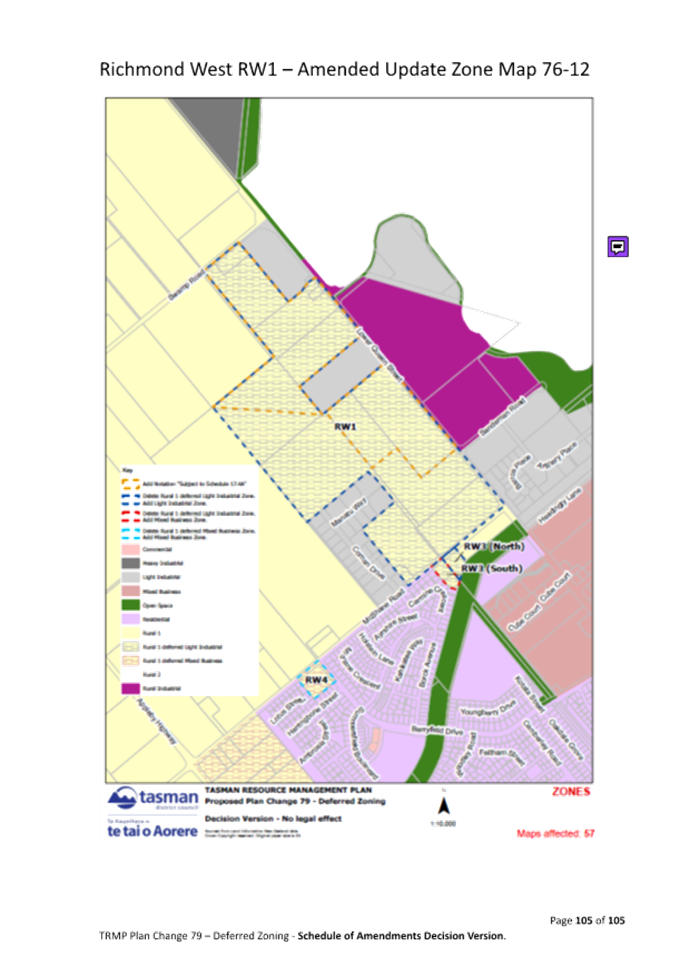
Map: Areas
Murchison
|
333
|
|
4.⇩
|
Map: Areas
Richmond South
|
334
|
|
5.⇩
|
Map: Areas
Richmond West
|
335
|
|
6.⇩
|
Map: Zones
Brightwater
|
336
|
|
7.⇩
|
Map: Zones
Marahau
|
337
|
|
8.⇩
|
Map: Zones
Moutere
|
338
|
|
9.⇩
|
Map: Zones
Murchison
|
339
|
|
10.⇩
|
Map: Zones
Patons Rock
|
340
|
|
11.⇩
|
Map: Zones
Richmond East
|
341
|
|
12.⇩
|
Map: Zones
Richmond South
|
342
|
|
13.⇩
|
Map: Zones
Richmond West A
|
343
|
|
14.⇩
|
Map: Zones
Richmond West B
|
344
|
|
15.⇩
|
Map:
Discharges Brightwater
|
345
|
|
16.⇩
|
Map:
Discharges Marahau
|
346
|
|
17.⇩
|
Map:
Discharges Murchison
|
347
|
|
18.⇩
|
Map:
Discharges Richmond East
|
348
|
|
19.⇩
|
Map:
Discharges Richmond South
|
349
|
|
20.⇩
|
Map:
Discharges Richmond West A
|
350
|
|
21.⇩
|
Map:
Discharges Richmond West B
|
351
|
7.2 Annual Plan 2026/2027 and Schedule of Fees and
Charges - Deliberations Report
Decision Required
|
Report
To:
|
Tasman
District Council
|
|
Meeting
Date:
|
28
May 2026
|
|
Report
Author:
|
Amy
Smith, Community Policy Advisor; Emily Garland, Graduate Community Policy
Advisor; Dwayne Fletcher, Strategic Planning & Enterprise Manager; Matthew
McGlinchey, Financial Strategy & Planning Manager; Alan Bywater, Team
Leader - Community Policy
|
|
Report
Authorisers:
|
Dwayne
Fletcher, Strategic Planning & Enterprise Manager; Leonie Rae, Chief
Executive Officer
|
|
Report
Number:
|
RCN26-05-14
|
1. Purpose
of the Report / Te Take mō te Pūrongo
1.1 The
purpose of this report is to:
1.1.1 Provide a summary of submissions received on the Annual
Plan 2026/2027 and Schedule of Fees and Charges 2026/2027;
1.1.2 Provide the Mayor and Councilors with an opportunity to
discuss and obtain advice from staff on matters raised in the submissions; and
1.1.3 Make decisions on matters to be included in the Annual
Plan 226/2027.
2. Summary
/ Te Tuhinga Whakarāpoto
2.1 At
its meeting on 19 March 2026 the Council made a series of decisions on changes
from the Long-Term Plan 2024-2034 (LTP) for 2026/2027.
2.2 The
net outcome of these changes was a rates revenue increase of 9.9% (excluding
growth) for 2026/2027, and net debt is project to be $320m. This was an
increase compared to the 5.2% (excluding growth) planned for Year 3 of the LTP.
As a result, the Council agreed to consult on the Annual Plan 2026/2027 and
Schedule of Fees and Charges 2026/2027.
2.3 At
its meeting on 2 April, the Council adopted a consultation document and
supporting material and a public consultation period was open from 2 April
until 3 May 2026. The Submissions Hearing meeting was held on 14 May and 44
submitters were heard.
2.4 There
were 367 submissions received over the consultation period, including 46 from
groups and organisations. Staff have prepared an overview of the submissions (Attachment
1) and all submissions can be accessed and viewed here: TDC
Submissions.
2.5 Two
other matters have arisen over the last few weeks that staff wish to address in
the final Annual Plan:
2.5.1 Estimated operating fuel price impact of $1.8m for
2026/2027 (1.48% additional rates) and a capital impact of roading resealing of
$1.05m ($105k loan servicing, or 0.09% additional rates).
2.5.2 A review of the deliverability of the capital programme
for 2025/2026 and the proposed capital programme 2026/2027, which has resulted
in proposed budget reductions with reduction in rates of 0.14% and a reduction
in net debt of $1.7m.
2.6 In
the 7 May Council report, the following financial pressures in 2025/2026 were
raised:
2.6.1 Three Waters maintenance overspend of $1.85m.
2.6.2 Oil price impact of $328k (a decrease from the
previously advised $500k).
2.7 Staff
believe these costs can be absorbed within the current financial year without
impacting the 2026/2027 Annual Plan. This is due to careful management of costs
in some areas to provide temporary relief and additional revenue from gravel
extraction and water consumption.
2.8 Staff
advise amending the proposed fee structure for property files, as a result of
feedback received in submissions. The dog control fees are to be adopted at this meeting as proposed,
to enable the statutory notification requirements to be met. The remainder of
the schedule of fees and charges will be presented for adoption at the 25 June
2026 Council meeting.
2.9 Overall
the impacts of the above listed items is a rates increase for the 2026/2027 of
11.3% (excluding growth), which is an increase of 1.4% on what we consulted on.
Debt would be $650k, less than the $320m, consulted on.
2.10 To
reduce the impact of this increase on the community at a difficult time, staff
have investigated the feasibility of increasing forest harvesting in the short
term. We believe we can generate an additional $1.0m (net) for the 2026/2027
year, although advice from PF Olsen will not be finalised when
this report is circulated. This will result in a rates revenue increase
of 10.5% instead of 11.3% (excluding growth). Note that any
lift in revenue for 2026/2027 is only temporary and not sustainable into the future
– it will reduce forestry income in future years.
2.11 Elected
members may want to consider this option as it increases the proportion of
operating expenditure funded from operating revenue, which supports the
Council’s objective of improving financial sustainability over time.
2.12 If
the Council wants to retain the 9.9% (excluding growth) rates revenue increase
it consulted on, it could increase debt funding of operational costs for
2026/2027 by $750k. This would smooth the impact of the oil price shock on the
community, assuming it is temporary in nature. This is relativity
straightforward but will shift us further from financial sustainability and may
put more pressure on the rates increase required for following financial years,
especially 2027/2028.
2.13 Staff
have not included service reviews as an option to reduce costs. The
organisation operates lean for the services it offers, three such reviews have
occurred in recent years and another is currently progressing within the LTP,
organisation resources are strained, and there is insufficient time or
resources to complete this process and undertake any necessary consultation in
time to finalise the Annual Plan 2026/2027 in approximately four weeks time.
3. Recommendation/s
/ Ngā Tūtohunga
That the Tasman
District Council
1. receives
the Annual Plan 2026/2027 and Schedule of Fees and Charges - Deliberations
Report RCN26-05-14; and
Changes and financial impacts
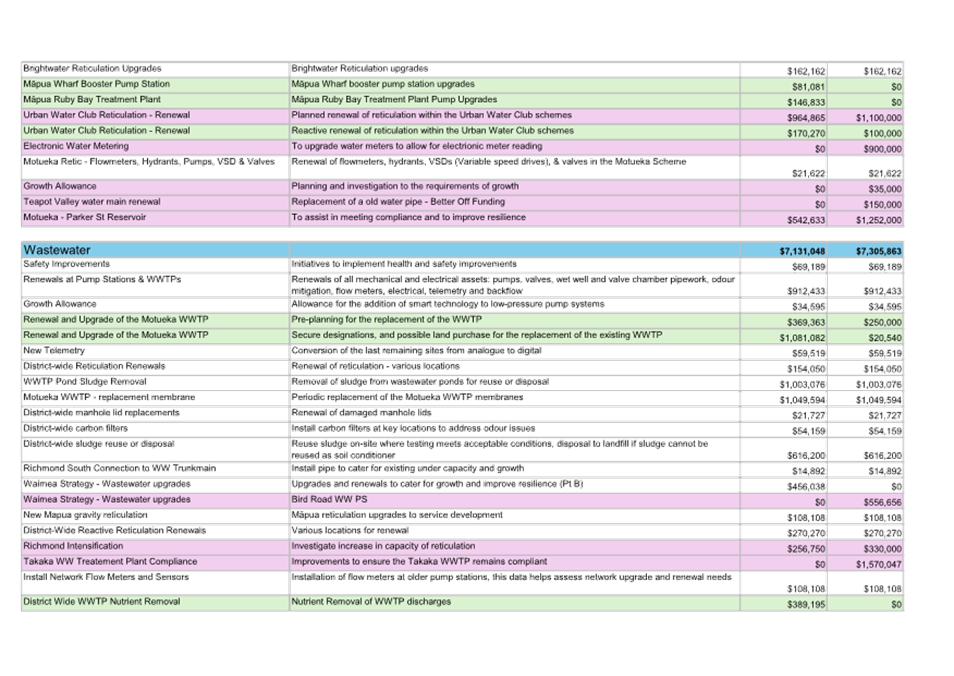
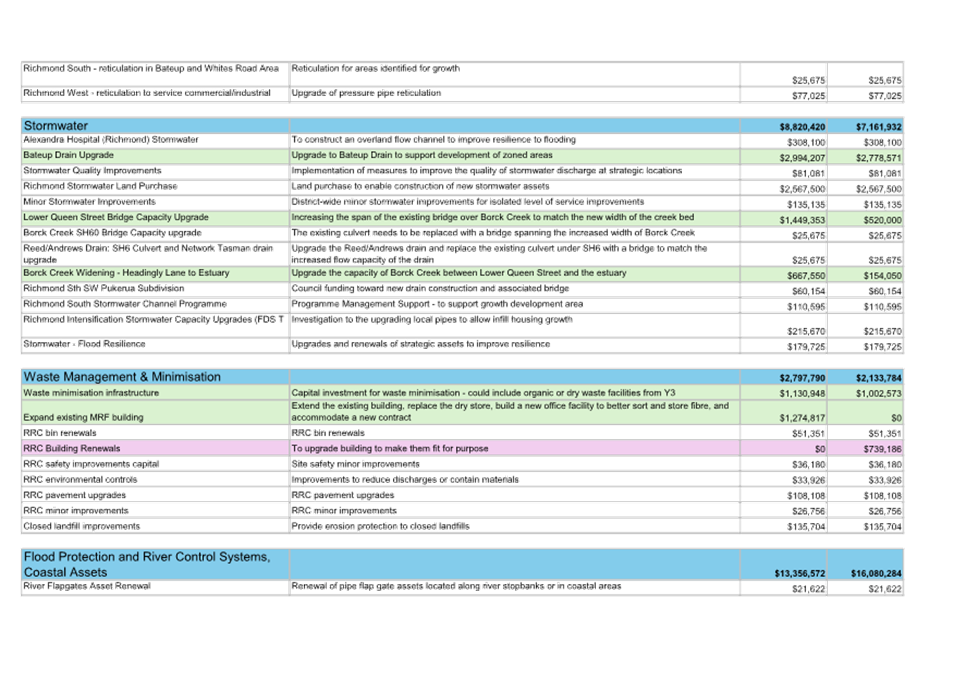
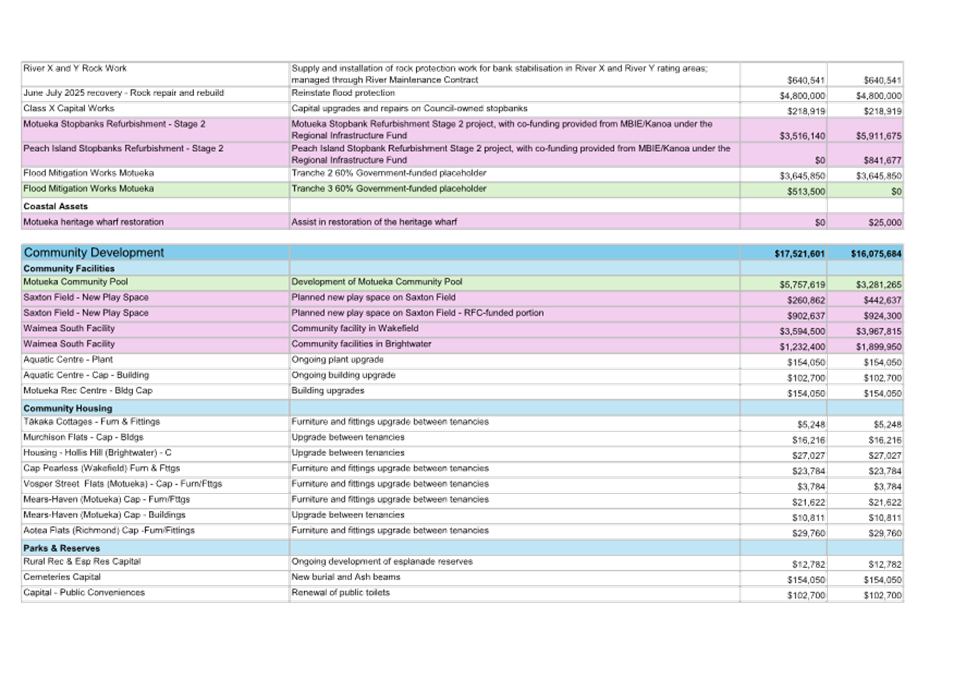
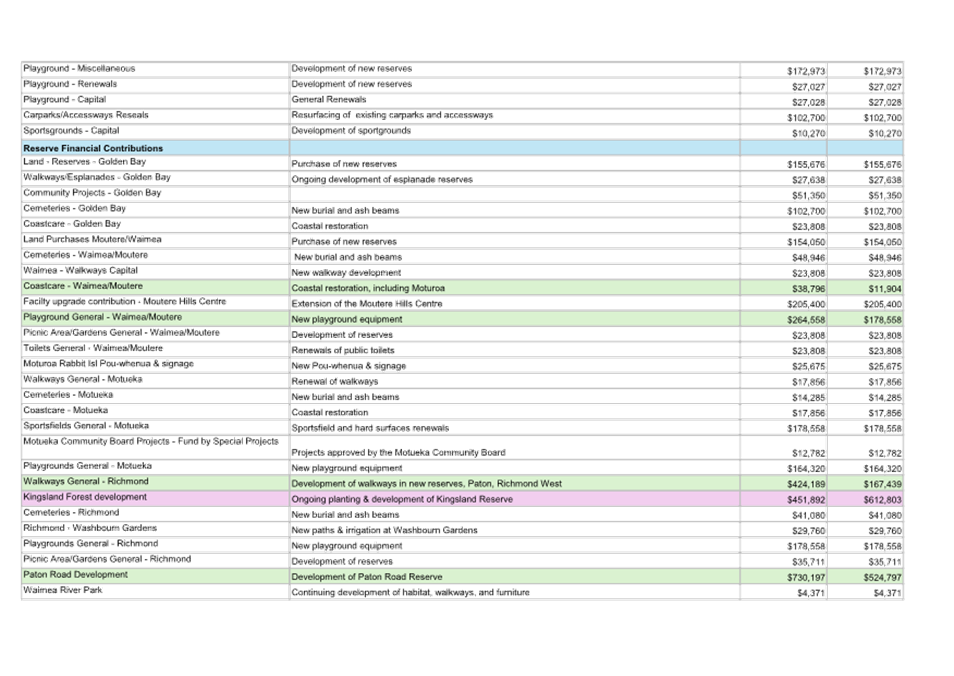
2. approves the revised capital programme for 2026/2027 in Attachment 1
to the agenda report, noting the projects that have been delayed and likely
consequences of these changes; and
3. notes that fuel cost increases are estimated to increase operating
costs for core services by $1.8m across Council and by $1.05m in the capital
transportation activity in 2026/2027, and that this has been included in
revised budgets; and
4. notes that staff expect increased maintenance costs in Three Waters
activities and contract fuel costs in 2025/2026 will be largely offset by
additional revenue or savings within the same activities and have no material
bearing on the starting position for the 2026/2027 year; and
Key proposals in the Annual Plan
5. approves
the introduction of a recovery rate for five years to
repay the costs of the 2025 weather events only, charged as a uniform fixed
amount per rating unit in the Annual Plan 2026/2027; and
6. requests staff to amend the Revenue and Financing Policy and Funding
Impact Statement to be consistent with resolution 5. (a recovery rate for five
years) for adoption at the 25 June 2026 Council meeting; and
7. agrees to the following next steps for the three community
facilities projects:
7.1 pause and defer the Tapawera Community Hub project to the next Long
Term Plan; and
7.2 continue
the Waimea South facilities projects (Wakefield Community Hub and Brightwater
facilities), as planned; and
7.3
continue the Motueka Pool project as planned, progressing through the design
stage; and
8. agrees to slow funded depreciation for roading assets as proposed in
the consultation document, with a target of 21% to be reached by the end of
2026/2027; and
9. agrees
to retain most fees and charges as proposed and make the following changes to
the fee structure for property files:
9.4 reducing
the proposed fee for individual property owners from $30 to $25 per property
file; and
9.5 retaining
the proposed ‘pay as you go’ charge of $60 per property file; and
9.6 introducing
a flat rate of $40 per property file for bulk users, rather than the proposed
$3,000 fee for 60 files (equivalent to $50 per file); and
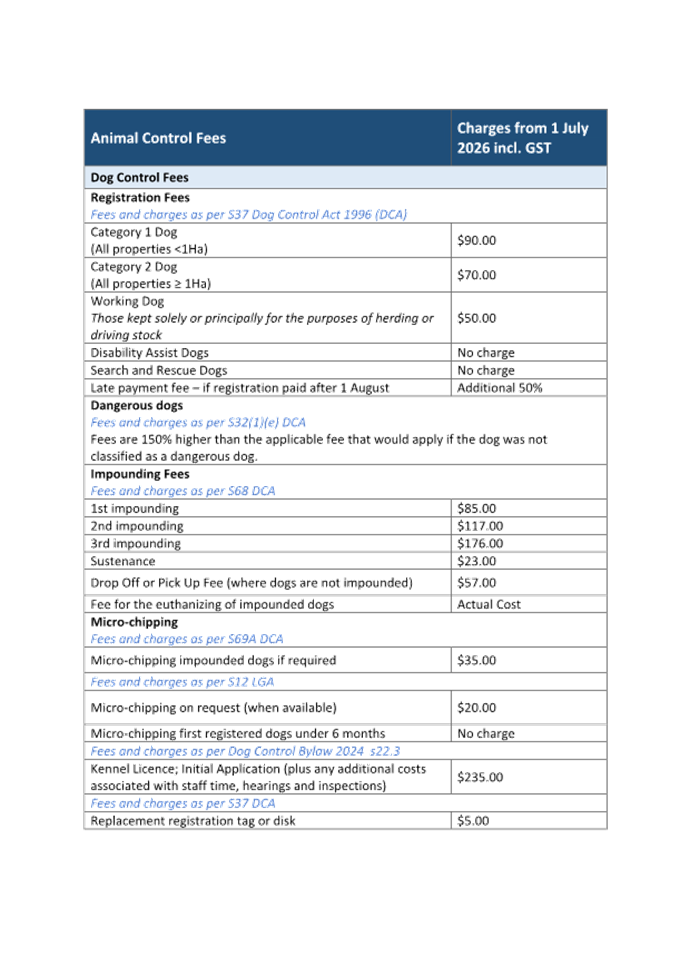
10. adopts the Dog Control fees set out in Attachment 3 to the agenda
report, to allow for public notification in the month before the fees take
effect, in accordance with the Dog Control Act 1996; and
Response to submissions
11. notes in-principle support from the Motueka Community Board to
allocate funding from its 2025/2026 Special Projects Fund to the Motueka
Heritage Wharf Restoration Project, and this will be considered by the Board at
its 16 June 2026 meeting; and
12. notes
staff advice at paragraph 0 of this report in response to requests from the
Motueka Community Board in its submission; and
13. requests
staff further develop funding options for the Eighty Eight Valley Water Scheme
based on percentages of the urban metered charge, for further consideration in
the Long Term Plan 2027-2037; and
14. notes
that a comprehensive rating review for rivers has been initiated; and
15. declines the request to start maintaining the section of Tasman View
Road from the junction with Harley Ridge to “the Lookout”; and
16. notes that budget provision for stormwater improvements on Welsh
Place, Richmond has been included in the Annual Plan budget; and
17. notes that project scoping for work on the Riuwaka River stopbanks
has been initiated and staff are working directly with affected landowners; and
Finalising the Annual Plan
18. notes
that the net impact of cost increases of $1.7m to the Annual Plan results in a
total rate revenue increase of 11.3% (excluding growth) and end of year net
debt of $319.4m for 2026/2027; and
19. agrees
that a $1.0m increase in net forestry income is used to reduce the rates
revenue requirement for 2026/2027 to 10.5%, noting this lift is not sustainable
and will reduce future forestry income; and
20. agrees
the remaining impacts of cost increases to the Annual Plan 2026/2027 will be
funded via rates, resulting in a 10.5% rates revenue increase;
OR
agrees that the remaining
impacts of cost increases to the Annual Plan 2026/2027 will be funded via debts
resulting in a rates revenue increase of 9.9%; and
21. notes
that the Annual Plan 2026/2027 will be presented for adoption at the Tasman
District Council meeting on 25 June 2026.
4.1 Since the adoption of the LTP 2024-2034 and the Annual Plan
2025/2026, there have been a range of factors that have increased the
Council’s expected costs for 2026/2027. The primary drivers of
these increased costs are:
4.1.1 The impacts of the
June/July 2025 weather events;
4.1.2 New costs resulting from
water supply and resource management regulation from central government;
4.1.3 Higher than anticipated
interest rates, loan repayment and depreciation funding (as a result of
increased asset valuations);
4.1.4 Higher than anticipated
operating costs for the Regional Sewerage Business Unit, resulting from
Council’s increased use (capacity) of the network to support
growth;
4.1.5 Higher than anticipated
reactive maintenance costs in Three Waters, Transportation and Reserves and
Facilities activities; and
4.1.6 Increased Waimea
Community Dam costs re settlement $3.8m.
4.2 In addition, expenditure forecasts for the 2025/2026 year
indicated that the Council will have a larger net operating deficit than
planned (i.e. more unfavourable) because of the impact of the weather event
(net impact $14.6m). This affects the financial starting position for the
2026/2027 Annual Plan year.
4.3 We
are unable to maintain our current Levels of Service within the planned (LTP)
rates increase or indicative rates increase identified in the last Annual Plan
process. A forecast rates rise of 11.2% (excluding growth) for the Annual Plan
2026/2027 was identified in November 2025.
4.4 To
try and limit the impact of the increasing costs on rate increases for
2026/2027 the Council has:
4.4.1 Sold approximately
$0.35m of unencumbered ETS credits to reduce the rates requirement for
2026/2027 by -0.3%.
4.4.2 Proposed reducing
planned increases in funding depreciation from operating revenues
(i.e.‘cash funding’ depreciation) for roading by 3%, from 24% to
21%, by the end of 2026/202, against our target of 49% by 2030, reducing the
rates requirement for 2026/2027 by -0.5% or approximately $650,000.
4.4.3 Proposed a new 2025
Weather Event Recovery Rate to fund the recovery costs (debt) of $14.6m
resulting from the 2025 weather events ($2.8m in 2026/2027 rating year).
4.4.4 Proposed pausing and
deferring the Tapawera Community Hub project to the next LTP process.
4.4.5 Proposed increasing most
fees and charges by 7.0%.
4.4.6 Adjusted operational and
capital budgets.
4.5 At its meeting on 19 March 2026, the
Council made a series of decisions on changes from the LTP 2024-2034 for
inclusion in the Annual Plan for consultation.
4.6 At its meeting on 2 April 2026, the
Council adopted a consultation document and supporting material, including the
draft Schedule of Fees and Charges 2026/2027, for a public consultation period
that ran from 2 April to 3 May 2026.
5. Analysis
and Advice / Tātaritanga me ngā tohutohu
5.1 This section:
5.1.1 covers a range of cost impacts that have been identified
since consultation began;
5.1.2 summarises the feedback received during consultation;
5.1.3 presents submitter requests, staff advice and
recommendations; and
5.1.4 discusses the net impact of
these changes to the Annual Plan and sets out the options available to the Council, with recommendations.
Changes and impacts identified since consultation
5.2 A number of changes are proposed by
staff that have financial implications and are discussed below. The changes
have resulted as further information has come to light since the draft Annual
Plan was approved for consultation.
Current year operational position
5.3 Several cost escalations are hitting the
current financial year, but staff forecast these will largely offset by
additional revenue from gravel extraction and water consumption or reductions
elsewhere due to careful management of costs to provide temporary relief,
largely within the same activities. Overall, these are not forecast to
materially affect the starting position of the 2026/2027 financial year
compared to the forecast used to underpin the Annual Plan 2026/2027 position to
date.
5.4 Cost increases include additional
maintenance costs in Three Waters and additional fuel costs across the board.
Areas where there will be savings against budget for the current 2025/2026
financial year include (but is not limited to);
5.4.1 Gravel Income $300k more than planned
5.4.2 Targeted volumetric water: $650k higher than planned
(noted earlier)
5.4.3 Operational NRSBU costs: $515k lower than planned
5.4.4 Net interest costs: $250k lower than planned
These savings
are indicative.
There is a risk
that the forecast savings do not eventuate. If this is the case the deficit
position will need to be recovered in the first year of the LTP. An activity
report on the final year-end closed account positions will be presented to the
Strategic, Finance and Performance Committee when it meets on 17th
September. The required transfers of balances will be submitted for approval at
that meeting.
Impact of
the fuel crisis
5.5 In a report to the Council on 7 May
2026 (refer to RCN26-05-10), the potential cost of the fuel crisis was noted
across the Council. These figures have been reviewed and the impacts for
2026/2027 updated in the table below:
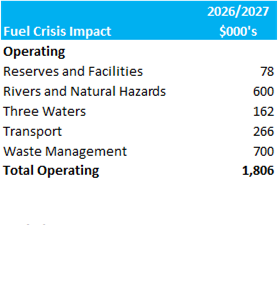
The figures in
the table are still indicative only; the reality may be better or worse and how
this plays out is extremely difficult to predict.
Changes to
the 2026/2027 capital programme
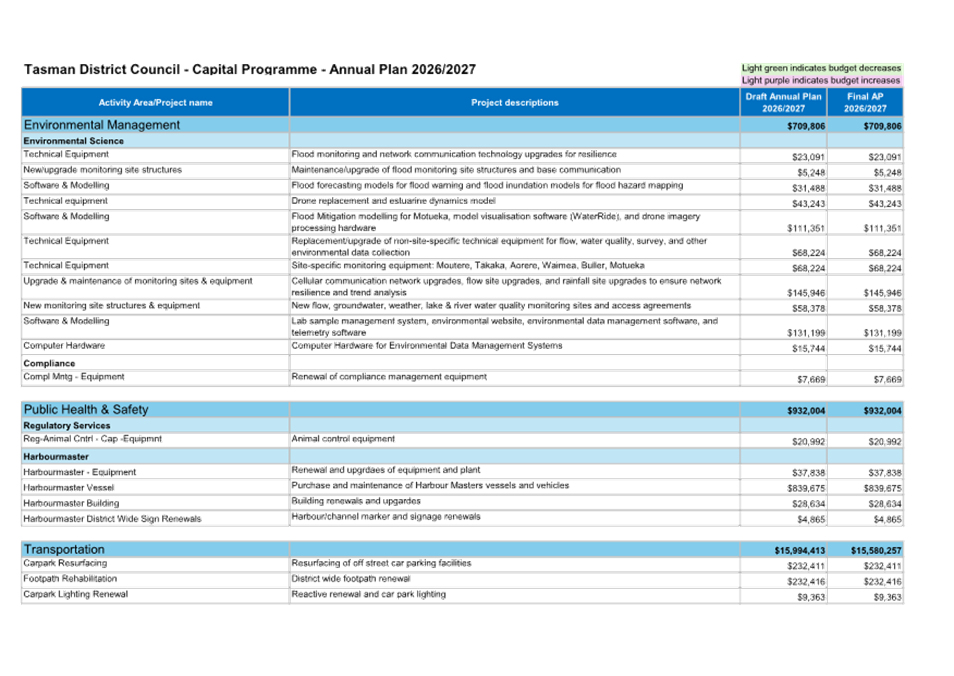
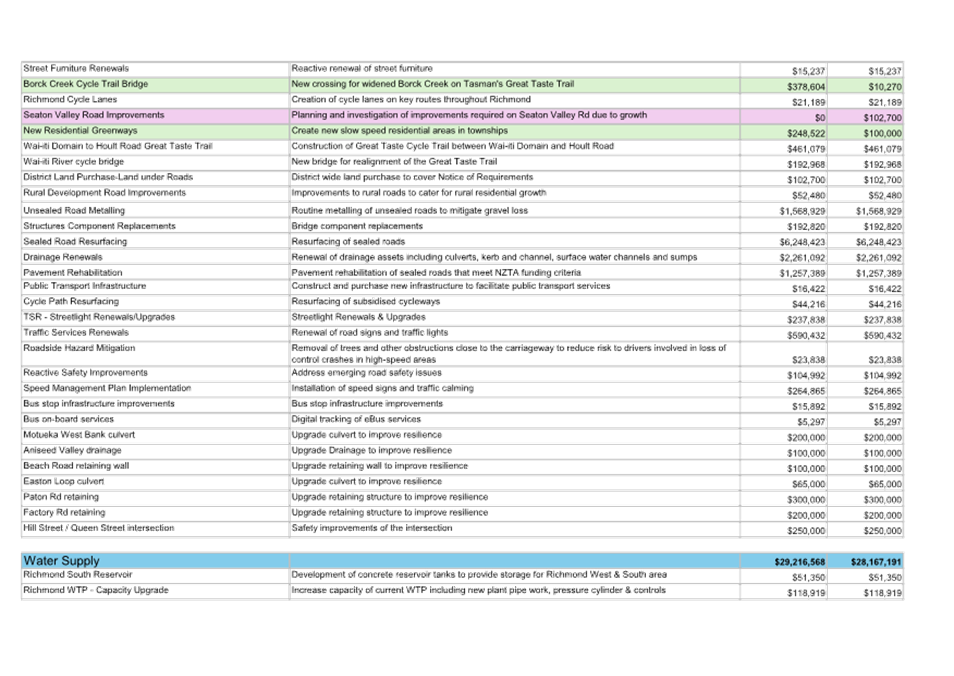
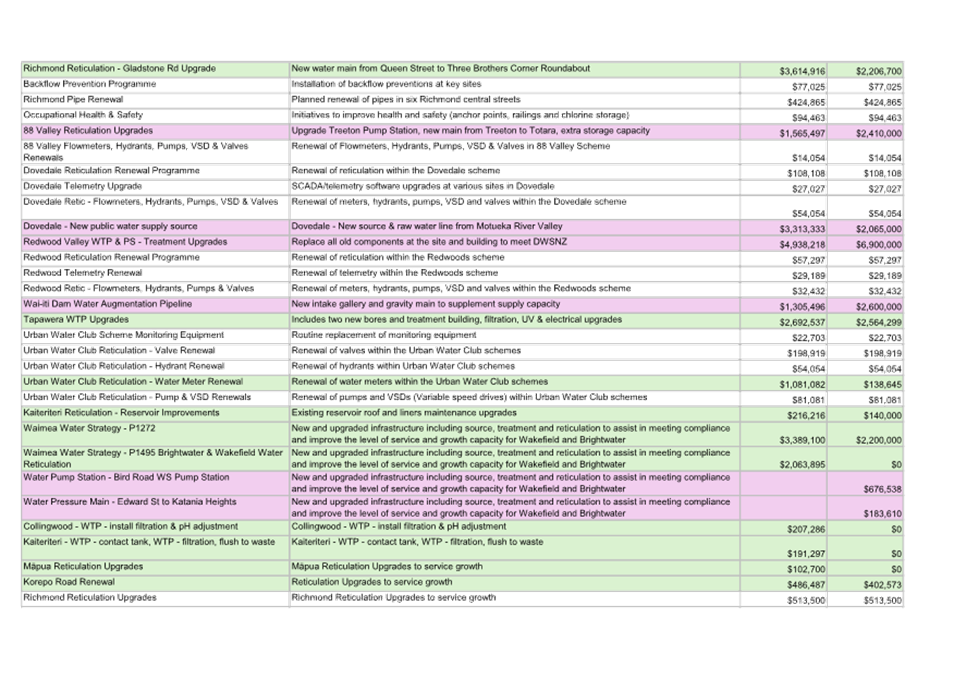
5.6 Changes to the proposed capital programme are shown in Attachment 1
and result in a net reduction of approximately $650k for 2026/2027. These
changes have resulted from:
5.6.1 Updated delivery forecasting:
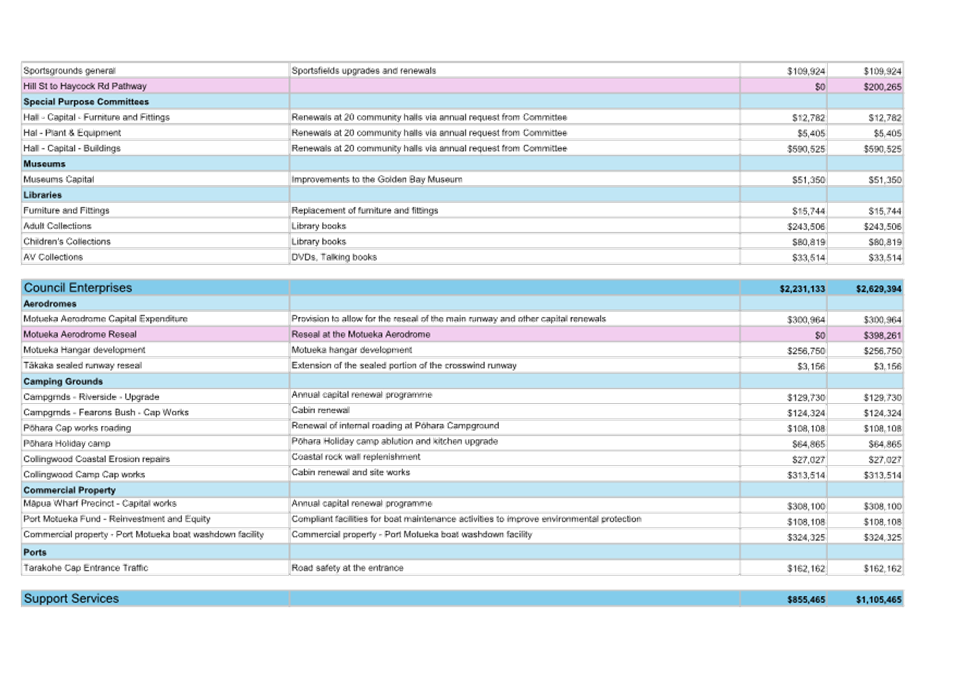
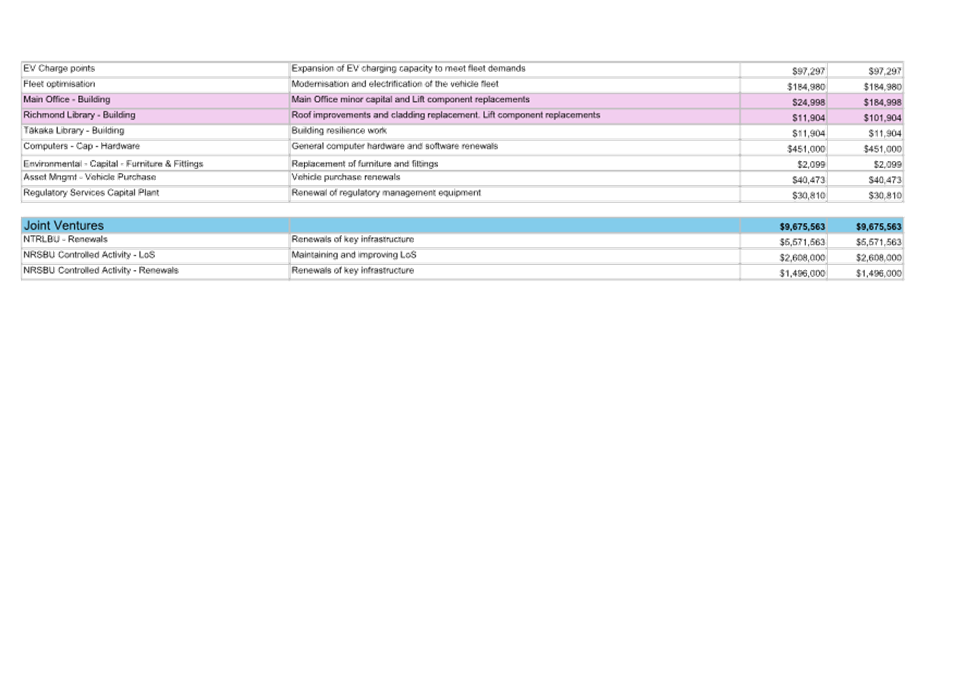
Ongoing reforecasting of both the current year and Annual Plan year programmes
indicates that a number of projects will not be completed this year and have
been deferred into 2026/2027. This reduces costs in 2025/2026 but impacts the
Annual Plan capital programme. The most significant movements are:
5.6.1.1 River stopbank refurbishment
$3.2m (deferral of current year budget).
5.6.1.2 Tākaka wastewater
treatment plant compliance $1.57m (deferral of current year budget).
5.6.1.3 Redwood Valley water supply
compliance upgrades $2m (deferral of current year budget and budget forward
from 2027/2028).
5.6.1.4 Wai-iti Dam augmentation
pipeline $2.6m (deferral of current year budget and increase to enable land
purchase to complete the project).
There are a range of smaller
adjustments reflecting improved cost and timing information.
5.6.2 Three Waters phasing and
programme refinement: Initial detailed phasing work in Three Waters has been
applied to the Annual Plan, reducing the Three Waters capital programme from
$49.0m to $42.6m. Further reductions have been identified in residential green
space (-$148k) and tranche 3 of the river stopbank refurbishment (-$513k).
5.6.3 Asset renewals brought forward:
Condition assessments previously identified elevator component replacements for
the Council main building and Richmond Library were not needed in 2026/2027.
Recent failures and the increased risk of further outages mean these renewals
are now required earlier and have been added to the Annual Plan capital
programme ($260k).
5.6.4 The overall capital programme
was $98.0m and reduced by $10.2m once the capital lag was applied. The final
capital budget for 2026/2027 is $87.8m.
Further
savings to offset cost increases
5.7 Staff
have not included service reviews as an option to reduce costs because:
5.7.1 There is not sufficient time
before 1 July 2026 Annual Plan to undertake a review and further consultation
on any meaningful changes.
5.7.2 The Council runs lean and has
also been through three service and budget reviews in recent years. The Council
has very limited capacity to respond to further shocks and has exhausted our
ability to absorb any increases in operational costs for 2026/2027 without
major changes to the business.
5.7.3 The LTP 2027/2037 process is
underway, involves consideration by the Council of potential long-term changes,
and is already straining organisational capability.
5.8 Options for funding the overall
increases in costs and the impact of any submissions are discussed later in
this report.
Consultation summary
5.9 Public consultation on the Annual
Plan 2026/2027, including the draft Schedule of Fees and Charges, commenced on
2 April 2026 and closed 3 May 2027. The Submissions Hearing meeting was held on
14 May and 44 submitters were heard.
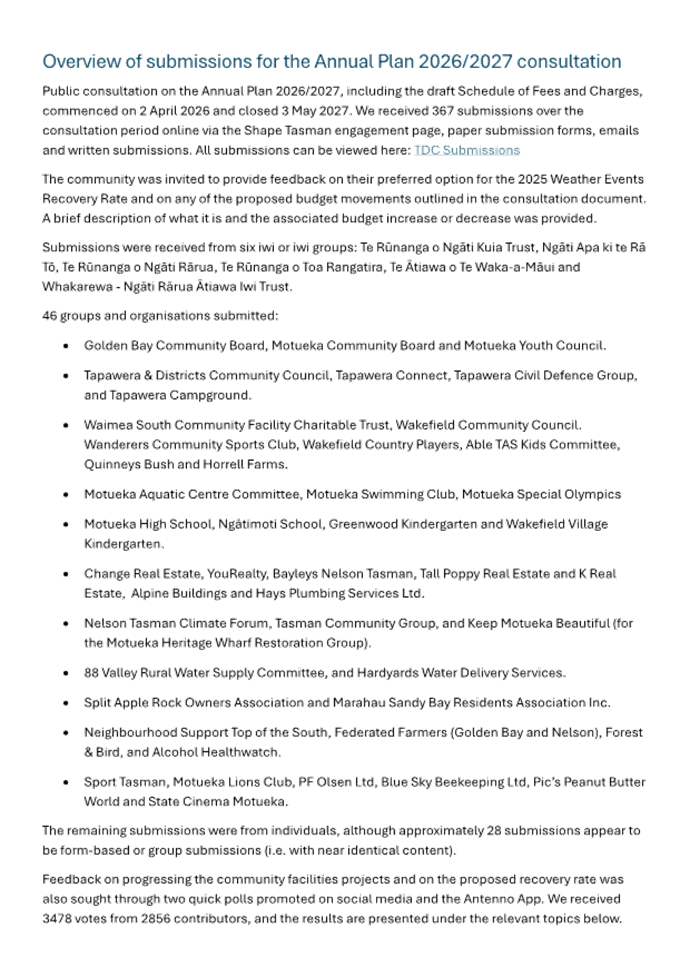
5.10 We received 367 submissions over the
consultation period including from 46 groups and organisations. We received
online submissions via the Shape Tasman engagement page, paper submission
forms, email submissions and written submissions.
5.11 We have prepared an overview of the
submissions (Attachment 2). All submissions can be viewed here: TDC Submissions.
5.12 Community views were also sought through two
quick polls on progressing or the community facilities projects and on the
proposed recovery rate. These were promoted via social media channels and
Antenno. We received 3,478 votes from 2,856 contributors.
5.13 The submission feedback regarding the
proposals in the consultation document has been summarised below.
2025 Weather Events Rating
5.14 The
consultation document presented four options for establishing a new rate to
fund the $14.6m recovery costs of the 2025 weather events:
5.14.1 Option 1: A targeted district-wide recovery
rate for five years to repay the costs of the 2025 weather events only, charged
as a uniform amount of $125. This was presented as the Council’s
preferred option
5.14.2 Option 2: A targeted district-wide recovery
rate for five years to repay the costs of the 2025 weather events only, charged
based on capital value.
5.14.3 Option 3: A targeted district-wide recovery
and resilience rate, charged as a uniform amount, to repay the initial weather
event costs and then continue as an ongoing fund for future natural hazard
events.
5.14.4 Option 4: A
targeted district-wide recovery and resilience rate, charged based on capital
value, to repay the initial weather event costs and then continue as an ongoing fund for future natural hazard events.
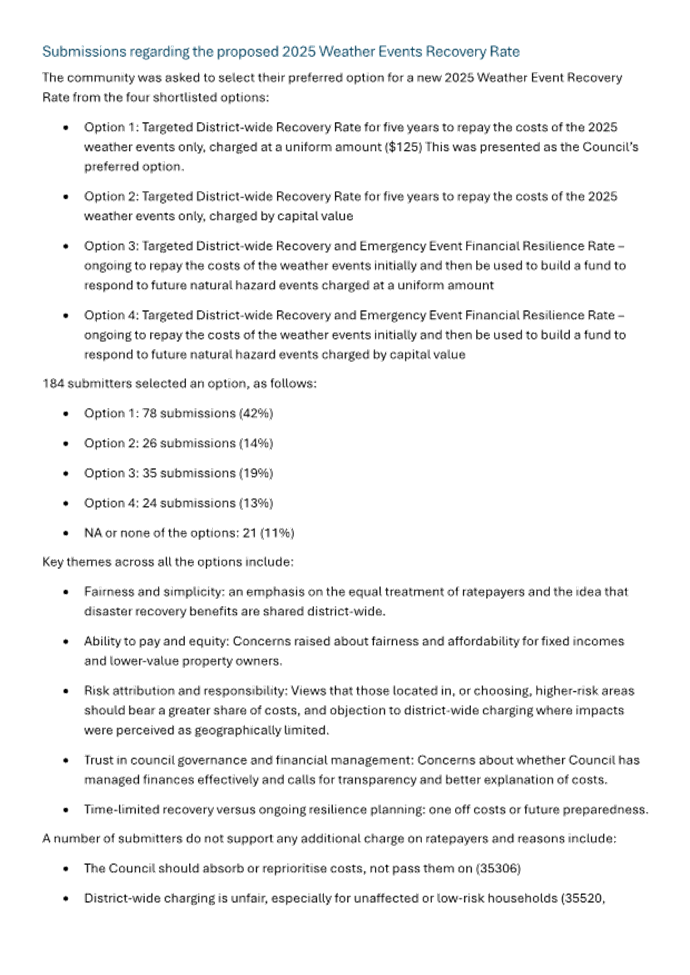
5.15 Council received 184 submissions on the proposed 2025 weather events
recovery rate, with submitters selecting an option as follows:
5.15.1 Option 1: 78 submissions (42%)
5.15.2 Option 2: 26 submissions (14%)
5.15.3 Option 3: 35 submissions (19%)
5.15.4 Option 4: 24 submissions (13%)
5.15.5 NA or none of the options: 21 (11%)
5.16 The
quick poll on the recovery rate options received 346 votes from 309
contributors as follows:
5.16.1 Option 1: 124 votes (36%)
5.16.2 Option 2: 83 votes (24%)
5.16.3 Option 3: 73 votes (21%)
5.16.4 Option 4: 66 votes (19%)
5.17 The
main themes across all submissions on the proposed recovery rate were:
5.17.1 Fairness and simplicity
5.17.2 Ability to pay and equity
5.17.3 Risk attribution and responsibility
5.17.4 Trust in council governance and financial
management
5.17.5 Time-limited recovery versus ongoing
resilience planning
5.18 Submitters
who preferred Options 1 and 3 generally supported equal treatment of
ratepayers. They considered that the benefits of disaster recovery are shared
across the district. Some also supported a time-limited rate rather than an
ongoing charge.
5.19 Several
submitters who preferred Options 1 and 3 said capital value is not a good
measure of a person’s ability to pay. In contrast, submitters who
preferred Options 2 and 4 considered that owners of higher-value properties are
generally better able to contribute more.
5.20 Some
submitters who preferred Option 2 felt that people not directly affected should
not be required to help fund the recovery. They also considered that those
living in higher-risk areas should meet more of the cost.
5.21 Several
submitters who preferred Options 3 and 4 said similar events are likely to
happen again and that an ongoing fund is needed to improve future preparedness
and response.
5.22 Some submitters across all options raised
concerns about Council’s financial management and whether money collected
for recovery and resilience would be used only for those purposes. Others said
the recovery costs should instead be met through Council savings, insurance, or
central government support.
5.23 A
small number of submitters suggested hybrid and other rating options,
including:
5.23.1 District-wide and targeted components; or
5.23.2 Capital value and uniform rate components;
or
5.23.3 Capital value with
a cap.
5.24 Submitter 35441 suggested that the establishment of
a dedicated extreme weather response fund as a joint Council and charitable
trust. A few submitters also raised concerns about the process used to
develop and consult on the recovery rate.
5.25 The main arguments raised by submitters reflect the
matters already considered by Council during workshops and meetings when the
consultation options and preferred option were developed. These issues have
already been weighed up by elected members as part of the decision-making
process.
5.26 The question of whether ratepayers in higher risk
areas of the District should bear all or a higher proportion of the costs for
funding was discussed during Annual Plan workshops. However, the idea of
hybrid rates was not discussed. At the 19 March 2026 meeting the Council made
decisions about its proposals in the Annual Plan. These included proposing a
targeted district-wide recovery rate for five years to repay the costs of the
2025 weather events only, charged as a uniform amount. The report stated three
other options that would be included in the consultation document. None of
these was a hybrid option.
5.27 If the Council was to introduce rating to fund the
2025 weather event which departs from the four options consulted on at this
stage in the process, it would open itself up to significant risk of legal
challenge. If the Council wants to introduce a hybrid rating model, it will
need to re-consult with the community on this new option.
5.28 Based on the number of submitters supporting each
option, the feedback received and its consistency with the Council’s
Financial Strategy, staff advise proceeding with Option 1: A targeted
district-wide recovery rate for five years to repay the costs of the 2025
weather events only, charged as a uniform amount of $125.
5.29 The Council should also critically evaluate the
concerns raised about the process used to introduce this rate and use that to
help improve future rating processes.
Operating budget movements
5.30 The consultation document invited feedback
on the proposed operating budget movements and 74 submitters responded to this
question. These views were overwhelmingly unsupportive or critical of the
proposals. Dominant concerns include the affordability of rates increases, a
perceived lack of cost control, rising debt and long-term financial
sustainability.
5.31 A small number of submitters accept the
increases as necessary, but question specific areas and delivery efficiency.
5.32 At least 17 submissions were explicitly
form-based and a further 11 submissions showing strong evidence of coordinated
or near identical content. These submissions raised criticism of the
consultation process, claims of misleading financial information and views
around fiscal discipline, debt reduction, and staff and consultant cost
scrutiny.
Community facilities projects
5.33 The consultation document invited feedback
on progressing or pausing the three community facilities projects. 288
submitters responded to this question and the quick polls received 3,132 votes.
5.34 There is strong overall support for
progressing community facilities, driven primarily by high levels of support
within the directly affected communities that viewed these facilities as
essential infrastructure, not “nice to haves”.
5.35 70 submitters explicitly did not support
council investment in community facilities projects at this time, or actively
seek to pause, defer, or cancel them. This feedback focused on cost-of-living
pressures and rates affordability, high and growing Council debt, ongoing
operational costs and “non‑essential” spending, and was often
framed at a district‑wide
level.
Tapawera Community Hub
5.36 48 submitters provide feedback on the
Tapawera Community Hub project. The quick poll received 630 votes from 523
contributors. 22% (140 votes) supported contributing with the Tapawera Hub and
78% (490 votes) wanted to pause this project.
5.37 There is strong support to progress the project and
that the hub will be well utilised. Pausing the project is viewed by supporters
as risking loss of external funding, continued exposure to safety and
resilience risks and rural inequity.
5.38 Opposition is limited and focussed on project
readiness, consultation quality, and community division. Some submitters argue
that existing facilities could instead be refurbished instead.
5.39 The submissions received and views of the
submitters that spoke at the hearing meeting reflect mixed views regarding
progressing or pausing the Tapawera Community Hub project. The feedback
indicates the importance of ensuring that any future investment is well aligned
with the needs, priorities, and capacity of the local community.
5.40 We will continue to work alongside the Tapawera
community to explore how best to support their ambitions for a Community Hub,
recognising the need to balance service provision with affordability and local
expectations. Staff advise pausing the Tapawera Community Hub project and
deferring it to LTP 2027-2037 discussions, as proposed.
Waimea South Facilities
5.41 43 submitters provided feedback on the Waimea South
facilities projects. The quick poll results are as follows:
5.41.1 Wakefield Hub: 953 votes from 714
contributors. 53% (509 votes) supported continuing with the Wakefield Hub and
47% (477 voters) wanted to pause this project.
5.41.2 Brightwater facilities upgrade: 559 votes
from 475 contributors. 27% (151 votes) supported continuing with the
Brightwater facilities upgrade and 73% (408 votes) wanted to pause this
project.
5.42 There is strong local support to progress these
projects and submitters noted that pausing now would impose higher future
costs, undermine community effort, and damage trust.
5.43 Submitters opposing or wanting this project paused
expressed affordability and debt concerns, and preferred refurbishment of
existing facilities. Submitter 35579 has concerns about the site location for
the Wakefield Hub including parking, SH6 access and flood risk.
5.44 The submissions emphasize the importance of the
Waimea South facilities projects for supporting community wellbeing,
strengthening local connections and providing fit-for-purposes spaces for
community activities. The concerns raised by some submitters regarding costs
and alternative options are also acknowledged. Staff advise continuing with the
Waimea South facilities projects, as proposed.
Motueka Pool
5.45 116 submitters provided feedback on the
Motueka Pool project and the quick poll received 990 votes from 835
contributors. 58% (574 votes) supported continuing with the Motueka Pool and
42% (416 votes) wanted to pause this project.
5.46 There is extensive support for progressing the
Motueka Pool; it is viewed as long overdue and essential for health, wellbeing
and safety. Equity of access was frequently raised and submitters noted pausing
the project would exacerbate inequity and undermine public trust and community
donations. Submissions from five iwi (35452, 35455, 35549, 35553 and 35598)
expressed strong support for progressing the Motueka Pool project.
5.47 Limited opposition to this project is
largely general rather than Motueka-specific, citing reasons like affordability
concerns, and competing priorities. The Motueka Youth Council (35355) does not
see the need, citing natural water options and Richmond access.
5.48 It is evident in the submissions received and the
views shared by submitters who spoke at the hearing meeting that the Motueka
Pool project is of long-standing and considered to be essential local
infrastructure that will provide health, safety and social benefits to all of
the local community. The Council discussed this project at a confidential
workshop on 27 May 2026. Staff advise continuing the Motueka Pool project
through the design phase, as proposed.
Changes to the capital programme
5.49 The consultation document invited feedback
on the proposed changes to the capital programme. 91 submitters responded to
this question, 21 of whom provided no comments.
5.50 There is limited support for the capital
programme as a whole, but conditional support for selected high‑value or urgent projects
especially in essential infrastructure or specific community facilities. The
main sentiment is that the capital programme is too expansive for current
economic conditions, lacks clear prioritisation and inadequately demonstrates affordability,
necessity, and deliverability. Many submitters are asking Council to slow down,
narrow focus, improve transparency and better justify trade‑offs.
5.51 Changes to the proposed capital programme 2026/2027
are discussed in paragraph 0 and shown in Attachment 1.
Slowing planned funding of depreciation
for roading assets
5.52 The consultation document invited feedback
on the proposed slowing of planned funding of depreciation for roading assets.
91 submitters responded to this question, 22 of whom provided no comments.
There was broad consensus that roading is a core council function, but
disagreement on whether slowing depreciation is an acceptable mechanism for
managing current fiscal pressure.
5.53 Supportive submitters emphasised short‑term financial relief, economic context and/or the view that
depreciation is largely an accounting construct that can be adjusted without
impacting service delivery. Submitters opposing or arguing against deferred
funding of depreciation stressed intergenerational equity and viewed it as
short‑term budget optics that undermines asset integrity, increases debt,
and unfairly shifts costs to future ratepayers by “kicking the can down
the road”.
5.54 The Council began a programme to fully fund
depreciation in July 2015. The original goal in the LTP 2015-2025 was to
achieve this by June 2025. Subsequent LTPs and Annual Plans have extended the
timeframe, and full funding of depreciation is now planned for June 2030.
Extending the timeframe reduces rates in the short term but increases the
Council’s debt. The Department of Internal Affairs does not require
councils to fully fund depreciation by a specific date; Audit New Zealand is
satisfied as long as the Council continues to make progress.
5.55 By June 2028, all activities except Roading will
have depreciation fully funded. Recent high inflation has significantly
increased asset valuations and therefore depreciation costs, which has
contributed to pushing out the target date. By pushing out the target date it
has meant the Council can reduce the annual increase in rates.
5.56 The decision to aim for full funding by June 2030
was confirmed in the 2024–2034 LTP to help keep rates at manageable
levels. The Council considers this approach a prudent balance between rates
affordability and long term financial sustainability.
5.57 Feedback from submitters, both supportive and
opposed, has been noted and will inform deliberations for the LTP
2027–2037.
Changes to the Council’s fees and
charges
5.58 The consultation document invited feedback
on the proposed changes to Council’s fees and charges for 2026/2027. 115
submitters responded to this question, 17 of whom said ‘no’.
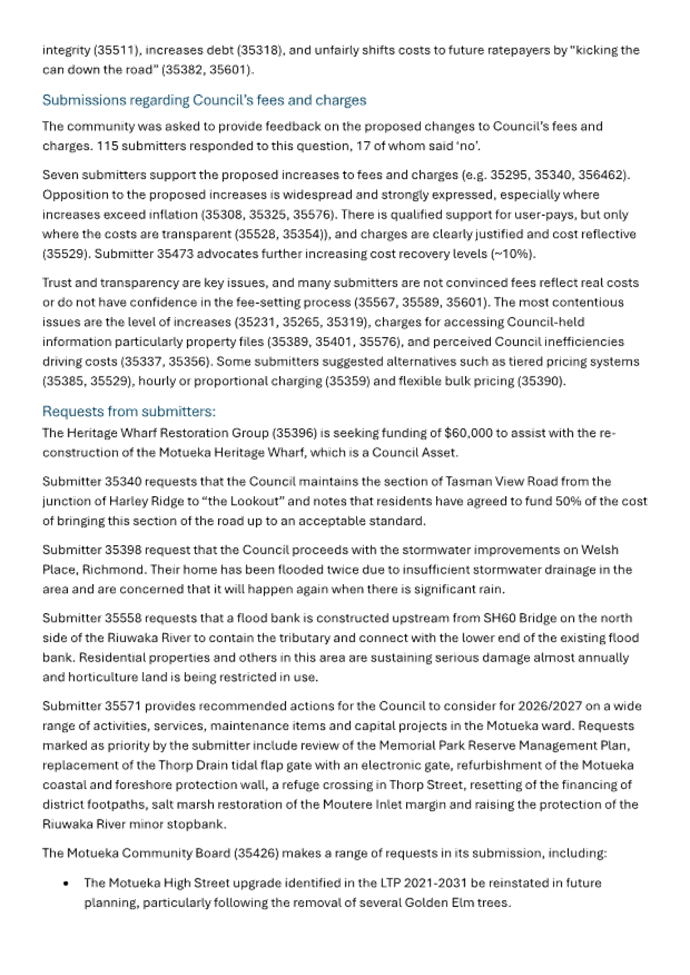
5.59 Seven submitters support the proposed increases to
fees and charges. Opposition to the proposed increases is widespread and
strongly expressed, especially where increases exceed inflation. There is
qualified support for user‑pays, but only where the costs are transparent and charges are
clearly justified and cost reflective. Submitter 35473 advocates further
increasing cost recovery levels (~10%).
5.60 Trust and transparency are key issues and
many submitters are not convinced fees reflect real costs or do not have
confidence in the fee-setting process. Contentious issues included the level of
increases, charges for accessing Council-held information particularly property
files, and perceived Council inefficiencies driving costs. Suggested
alternatives included tiered pricing systems, hourly or proportional charging
and flexible bulk pricing.
5.61 Twelve submitters provided feedback on the proposed
changes to how property file fees are charged. Submissions were received from
both individual property owners and bulk users. Property owners opposed the
introduction of a $30 fee to access their property files, stating that this
information has already been paid for through rates and they should not be
charged for access to their own information. Bulk users opposed the proposed
$3,000 fee for access to 60 files. They considered the 60-file threshold to be
arbitrary and the increase too large for real estate companies, and suggested a
more gradual increase. They also requested tiered pricing by volume access for
bulk users, and investment in digital access to property files.
5.62 Staff have considered the feedback and provide the
following changes to the proposed fee structure for property files for the
Council’s consideration:
5.62.1 charging individual property owners $25 per
property file, noting that preparing a file typically requires 30–60
minutes of staff time and that this approach helps reduce the burden on rates
by supporting a user-pays model.
5.62.2 retaining the proposed ‘pay as you
go’ charge of $60 per file.
5.62.3 In response to feedback on bulk user
charges, staff do not recommend proceeding with the proposed $3,000 fee for 60
files (equivalent to $50 per file). Instead, staff recommend a flat rate of $40
per file for bulk users. This would ensure all bulk users are charged a
consistent discounted rate, addressing inequities in the current annual fee of
$2,750 for unlimited access to files, where some users effectively pay around
$40 per file while others pay as little as $4 per file due to higher volumes.
5.63 One
submitter commented on the proposed increase to the bulk water take fee,
requesting a lower rate for bulk potable delivery operators compared to other
commercial users, as they supply water to rural homes. They also compared the
charge to those set by regional councils. The Council seeks to balance cost
recovery, fairness between users, and minimising impacts on the wider ratepayer
base. Bulk water charges reflect the infrastructure costs required to deliver
the service and are consistent with a user-pays approach, regardless of user
type. Staff advise retaining the proposed bulk water take charge.
5.64 Four submitters commented on the Project
Information Memorandum (PIM) fee increase. Views were mixed, with two
supporting a user‑pays approach and no rates subsidy, and two opposing the size of the
increase. Submitters that opposed suggested differential fees for project sizes
or amount of staff time needed. The increase in PIM fee this year is a step
towards user pays and has been calculated on the average time spent. PIMs for
consent‑exempt small dwellings may require more assessment, but there is
currently insufficient data to support differential fees. A single standard fee
provides transparency and simplicity during the implementation of the new
regulatory setting. Staff advise retaining the proposed PIM fees.
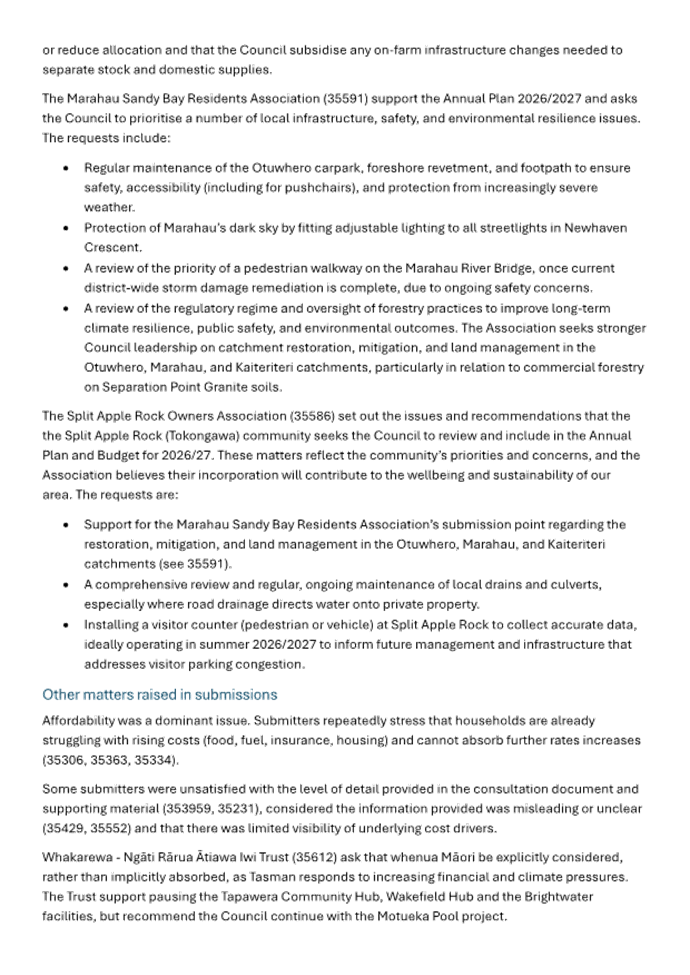
5.65 Seven submissions raised concerns about dog fees including cost, how
the three categories are set, and the level of fees for working dogs, with some
suggesting a cap of five dogs. Dog registration fees were not proposed to
change. The three categories are based on property size to reflect that dogs on
larger properties generally require fewer council resources. The ‘working
dog’ fee is set at 55% of the ‘category 1’ fee, which staff
consider reflects the level of control work required. A cap of five
working dogs was considered; however, any reduction in fees would need to be
offset by increasing charges for other dog owners to maintain overall cost
recovery.
5.66 Staff advise retaining the proposed fees for Animal Control. The
Dog Control Act 1996 (s.37[6]) requires that the Council publicly notify the
Dog Control fees fixed for the registration year, in a newspaper circulating in
the District, at least once during the month preceding the start of every
registration year. In addition, pound fees are required to be adopted at least
14 days before the resolution comes into effect and be publicly notified in a
newspaper circulating in the District.
5.67 To enable us to meet these notification requirements, this report
includes a resolution to adopt the Dog Control fees set out in Attachment 3
at this meeting. The remainder of the schedule of fees and charges will be
presented for adoption at the 25 June 2026 Council meeting.
Other matters raised in submissions
5.68 Affordability was a dominant concern,
particularly for households already experiencing cost pressures (food, fuel,
insurance, housing) and with limited capacity to absorb further increases in
rates or fees. Staff acknowledge these concerns and that efforts address the
Council’s financial and economic challenges are
occurring in the same context of financial pressure being experienced by the
community. In developing the proposed Annual Plan, the Council sought to
balance affordability with the need to maintain current services levels and
business operations.
5.69 Some submitters expressed concern about the
level of detail provided in the consultation document and supporting material,
noting the information was unclear, potentially misleading, or lacked
visibility of underlying cost drivers. The feedback received is acknowledged
and staff consider the information provided was appropriate for an Annual Plan
consultation (as opposed to more detailed information for a LTP consultation); there is an inherent challenge in balancing sufficient detail with
accessible information that supports public engagement.
Requests received from submitters
The Motueka
Heritage Wharf
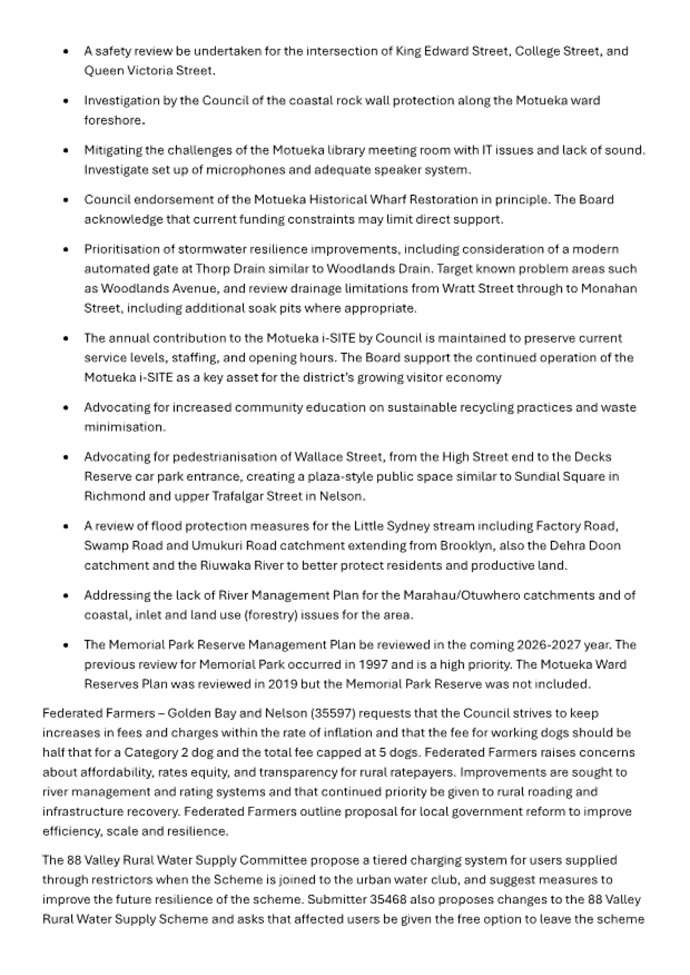
5.70 The Heritage Wharf Restoration Group (35396)
is seeking funding of $60,000 to assist with the re-construction of the Motueka
Heritage Wharf, which is a significant Council historical structure.
5.71 The Council was updated on the Group’s
proposal and presented with its business case for the restoration work and
associated funding request at the Environment, Regulatory and Operations
Committee meeting on 12 May. The project and funding options were discussed but
no decision was made and the matter is to be covered at this meeting.
5.72 At its meeting on 19 May, the Motueka
Community Board also discussed the project and indicated in-principle support
to allocate funding from its 2025/2026 Special Projects Fund. Staff will
present a report at the next Board meeting on 16 June.
5.73 Staff advise that Motueka Reserve Facilities
Contributions are already allocated to other projects, including the Motueka
Pool. Council may wish to allocate capital budget to this request but, given
the indicative funding support from the Motueka Community Board, this is not
recommended by staff as funding is not currently included in the Annual Plan
budgets.
Motueka Community Board
5.74 The Motueka
Community Board (35426) makes a range of requests to the Council, listed below
along with staff advice:
5.74.1 Motueka Beautification and Public Spaces:
Request that the Motueka High Street upgrade identified in the LTP 2021-2031 be
reinstated in future planning, particularly following the removal of several
Golden Elm trees.
5.74.2 This would be a matter for Council. At
present, there has been no indication from the Mayor and Councillors to include
a project of this nature in the next LTP, and it would likely be challenging to
accommodate given current financial constraints.
5.74.3 Road safety review: Requests that a safety
review be undertaken for the intersection of King Edward Street, College
Street, and Queen Victoria Street.
5.74.4 Staff will revisit this intersection,
noting that a range of measures have previously been implemented to improve
signage and visibility. More substantive safety improvements would likely
require a full upgrade, such as a roundabout, and this is estimated to cost up
to $1m and require land purchase. At this stage, it is unclear whether there is
capacity within the LTP and Council’s financial constraints to
accommodate a project of this scale
5.74.5 Coastal Protection Investigation: Requests
that Council investigate the coastal rock wall protection along the Motueka
ward foreshore.
5.74.6 The Council’s Coastal Assets activity
does not have records of significant coastal rock protection infrastructure
along the Motueka ward foreshore, other than the wall at Marahau. Existing
coastal rock protection features will need to be identified and investigated on
a case-by-case basis to determine history, ownership, and maintenance
responsibility. Staff note there is informal fill/erosion protection along the
coastline, including in some road reserve. These will continue to be monitored
to ensure that the road and cycle trail network are not adversely affected by
coastal erosion.
5.74.7 Motueka Library Big Meeting Room: Mitigate
the challenges of the library meeting room with IT issues and lack of sound.
Investigate set up of microphones and adequate speaker system.
5.74.8 Staff agree with the Board’s concerns
and will investigate the matters raised.
5.74.9 Motueka Historical Wharf Restoration: The
Motueka Community Board requests that Tasman District Council endorse the
Motueka Historical Wharf Restoration in principle. The Board acknowledge
current funding constraints may limit direct support.
5.74.10 Stormwater: Prioritise improvements to stormwater
resilience, including consideration of a modern automated gate at Thorp Drain
similar to Woodlands Drain. Target known problem areas such as Woodlands
Avenue, and review drainage limitations from Wratt Street through to Monahan
Street, including additional soak pits where appropriate.
5.74.11 Staff advise that replacement of the Thorp Drain tide
gate is under consideration, alongside related work Woodlands Drain tide gate
near the Recreation Centre. Minor improvements for Woodlands Avenue are being
priced, however capacity in this area is very limited due to low ground levels.
In addition, high groundwater levels mean soakage solutions may not be
effective for the design storm events.
5.74.12 Motueka i-SITE: Support the continued operation of the
Motueka i-SITE as a key asset for the district’s growing visitor economy.
Request that Council maintain its annual contribution to preserve current
service levels, staffing, and opening hours.
5.74.13 Staff advise that the annual contribution to the
i-SITE has been allocated in the Annual Plan budget.
5.74.14 Wallace Street: Advocate for pedestrianisation of
Wallace Street, from the High Street end to the Decks Reserve car park
entrance, creating a plaza-style public space similar to Sundial Square in
Richmond and upper Trafalgar Street in Nelson.
5.74.15 Staff consider that this proposal would best be
contemplated as part of a town centre upgrade project, as requested above by
the Board.
5.74.16 Rivers: Review flood protection measures for the
Little Sydney stream including Factory Road, Swamp Road and Umukuri Road
catchment extending from Brooklyn, also the Dehra Doon catchment and the
Riuwaka River to better protect residents and productive land.
5.74.17 There is currently no flood protection level of
service for the Little Sydney stream and associated drains around the Factory
Road, Swamp Road, and Umukuri Road areas, other than the benefit received from
the Lower Motueka and Riuwaka stopbank systems. However, a scheme-plan for this
area has been prepared in the past (1972) and it is the intention of staff to
revisit this plan and develop improvement options for this area.
5.74.18 Otuwhero and Marahau Rivers Catchments: There is no
River Management Plan for the Marahau/Otuwhero catchments, which needs to be
addressed. Coastal, inlet and land use (forestry) issues for the area
similarly.
5.74.19 Council does not provide any river management level of
service to the Otuwhero and Marahau Rivers; there is no River X or River Y
rating area at these locations and Council provides no active river management
service in unmanaged/River Z areas. However, staff have initiated a
comprehensive review of the current river rating system, which will include an
assessment of existing unrated areas like Otuwhero and Marahau, to see if the
current system is fit for purpose and to provide greater clarity around river
management levels of service. Our Catchments and Land Use team can work with
landowners in these catchments to improve river and land management over time.
5.74.20 Memorial Park Reserve Management Plan: Request that
this Reserve Management Plan be reviewed in the coming 2026-2027 year. The
previous review for Memorial Park occurred in 1997 and is a high priority. The
Motueka Ward Reserves Plan was reviewed in 2019 but the Memorial Park Reserve
was not included.
5.74.21 Staff advise that the review of the Memorial Park
Management Plan is scheduled to begin in 2027/2028, with no capacity to bring
this work forward into the already committed 2026/2027 work programme.
5.75 Submitter
35571 provides a wide range of recommended actions for the Council to consider
for 2026/2027, including requests marked as priority by the submitter. These
matters are covered in the Motueka Community Board requests above.
Eighty Eight Valley Water
Scheme
5.76 The
Eighty Eight Valley Rural Water Supply Committee (35505) suggests
a tiered rating system for users of this scheme, when the scheme joins the
urban water club. This would be a departure from the rating for similar urban
extensions. The submission argues that:
5.76.1 Rural users of the scheme have additional
infrastructure costs not provided by the Council (e.g. tanks and pipework).
5.76.2 Existing users have sought to retain the
rural stockwater scheme rather than become part of the urban reticulation but
the Council has made other decisions.
5.76.3 Holders of larger numbers of units are
required to use highly treated potable water for their stockwater and other
non-potable rural needs.
5.76.4 Holders of larger numbers of units will
likely relinquish some of their units because of cost increases.
5.76.5 Users have already paid for the existing
reticulation (some through helping to install the scheme, unpaid in 1981) and
installed internal reticulation on their farms and properties which require
upgrades if their source of water is changed
5.77 During the 2027/2028 year the Eighty Eight Valley water scheme will
be split into two parts:
5.77.1 Lower part – north of Totara View
water tanks will effectively become an urban extension receiving treated water
from the Wakefield urban supply.
5.77.2 Upper part – Parkes Stream to Totara
View will effectively become stock water with staff investigating
different models for its ongoing operation.
5.78 Staff consider that many of the arguments being
advanced are valid and are concerned that applying the full urban extension
charges will result in some (more) users leaving the scheme and the number of
units others use being reduced. This in turn will increase the costs to those
in the water club.
5.79 Staff support in general terms adopting a rating
schedule based on percentages of the urban metered charge for the Eighty Eight
Valley Scheme and seek an indication today from elected members about
developing this further for consideration in the LTP 2027-2037.
5.80 The submission also raised potential resilience
issues for the scheme and staff will investigate options to improve resilience
of the supply from the existing Eighty Eight Valley intake, as part of the
rationalisation of the Brightwater, Wakefield and Eighty Eight Vally schemes
5.81 Submitter
35468 opposes proposed changes to the 88 Valley Rural Water Supply Scheme,
arguing they will significantly increase costs for users who only need
untreated stock water and undermine the scheme’s original purpose. The submitter notes existing dissatisfaction with chlorination and
price increases, and raises concern that proposed bulk charges could make some
higher-allocation farms uneconomic if required to take fully treated water.
They also suggest that the changes could reduce property values and requests
that affected users be given the free option to leave the scheme or reduce
allocation, along with Council subsidisation for any required on-farm
infrastructure changes to separate stock and domestic supplies. The submitter
further seeks longer-term planning, including consideration of
ageing infrastructure and potential rezoning toward rural residential if
potable supply reduces the viability of grazing, with early landowner
involvement in planning.
5.82 Staff acknowledge concerns about potential cost increases for users,
particularly those reliant on stock water, and note the issues raised regarding
subsidies and equity. However,
the scheme operates as a closed account, with all costs borne by its users.
Accordingly, any changes required to meet current and future regulatory
requirements, including drinking water standards, must be funded through the
scheme.
5.83 The
proposal to incorporate part of the scheme into the urban supply network is
intended to spread costs across a wider user base. This is expected to improve
resilience and support compliance, while reducing the extent of costs that
would otherwise fall solely on existing scheme users. Staff also acknowledge
the importance of long-term planning for the scheme, including asset condition
and potential land use change. These matters will continue to be considered
through ongoing planning processes
Other requests
5.84 Federated
Farmers – Golden Bay and Nelson (35597) requests that the Council reviews
the river management and river rating system to develop a more simple,
transparent and effective system to fund and carry out crucial river work for
the benefit of the whole community. Staff advise they are initiating a
comprehensive rating review for rivers. Any changes would be informed by
consultation with the community and likely implemented in phases over several
years
5.85 Submitter 35340 requests that the Council
maintains part of Tasman View Road and notes that residents have agreed to fund
50% of the cost of bringing this section of the road up to an acceptable
standard.
5.86 The
Council’s Policy for requests to maintain unmaintained roads states that maintenance will not be undertaken unless sufficient funding is
available. It also provides that landowners may be required to meet upgrade
costs where Council has not approved funding. Staff advise there is no available maintenance funding to support this request and
no funding has been approved for an upgrade.
5.87 In addition to the upfront
upgrade costs, this proposal would require increased current and future budgets
to cover ongoing maintenance costs. While the individual cost increase may be
relatively small, there is a risk that it could set a precedent. Staff advise there are approximately 15
similar requests covering around 34km of road), which could require around
$100,000 per annum in additional maintenance funding. There may also be further
latent demand if such requests are supported. Staff recommend declining the
request to maintain part of Tasman View Road.
5.88 Submitter 35398 request that the Council
proceeds with the stormwater improvements on Welsh Place, Richmond. Their home
has been flooded twice due to insufficient stormwater drainage in the area and
are concerned that it will happen again when there is significant rain. Staff
advise that the design and consent for this work are complete and prices are
currently being sought. Budget provision has been included in the Annual Plan
and, subject to approval, the work is expected to be completed by the end of
2026.
5.89 Submitter 35558 requests that a flood bank
is constructed upstream from SH60 Bridge on the north side of the Riuwaka River
to contain the tributary and connect with the lower end of the existing flood
bank. Residential properties and others in this area are sustaining serious
damage almost annually and horticulture land is being restricted in use.
5.90 There is an existing flood bank on the north
side of the Riuwaka River upstream of SH60, but it is in poor condition with
deficiencies that need to be addressed. Staff are working directly with the
submitter and other affected landowners on this matter. The short-term repairs
will be undertaken within existing river maintenance budgets. Scoping for a
more comprehensive refurbishment or upgrade of the Riuwaka stopbanks has
commenced, with the aim of having a “shovel-ready” project for
future government funding opportunities. No capital funding is proposed for
this work in the Annual Plan 2026/2027, however it is expected to be considered
as part of the LTP 2027-2037.
5.91 Staff advice regarding requests made by the
Marahau Sandy Bay Residents Association (35591) and the Split Apple Rock Owners
Association (35586) in their submissions will be tabled for this meeting.
6. Financial
or Budgetary Implications / Ngā Ritenga ā-Pūtea
6.1 The net outcome of the fuel costs increases, capital programme
changes, and recommended changes in response to submissions on the draft Annual
Plan 2026/2027 is a revised rates revenue increase (excluding growth) of 11.3%
and net debt of $319.4m.
6.2 If
the Council wants to retain the rates revenue increase it consulted on of 9.9%
(excluding growth), its options are to plan additional forestry revenue of
circa $1.0m, or debt fund more of our operational cost for 2026/2027. Both are
relativity straightforward but will push us further from being financially
sustainable and put more pressure on the rates increase required for following
financial year (2027/2028).
6.3 Increasing net proceeds from forestry by
$1.0m in 2026/2027 appears feasible although advice from PF Olsen will not be
finalised when this report is circulated. Staff will update Council at the
meeting. Note that any lift in revenue for 2026/2027 is only temporary
and not sustainable into the future – it will reduce forestry income in
future years.
6.4 This would leave a rates revenue
increase of 10.5% (excluding growth). Staff recommend Council strike rates at
this level to ensure we move closer to financial sustainability.
6.5 Alternatively, the Council could elect
to further loan fund operations to keep the rates revenue increase at 9.9%.
6.6 Using additional forestry revenue
or debt funding options to lower rates are relativity straightforward but will
push us further from being financially sustainable and put more pressure on the
rates increase required for later financial years, especially 2027/2028.
6.7 The
table below summarises the impacts:
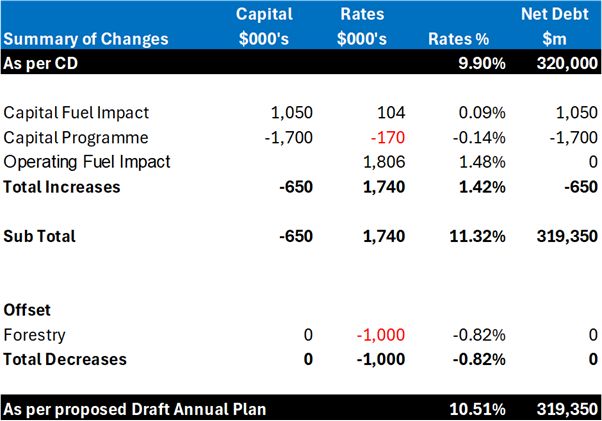
7.1 The main options available to the
Council are outlined in the following table:
|
Option
|
Advantage
|
Disadvantage
|
|
1
|
Accept all the recommended changes and
increase forestry revenue and rates in 2026/2027 to help meet some of
the additional fuel costs.
|
Retains the Council’s service
levels.
Reflects the cost to maintain current
business operations.
Enables the Annual Plan process to
progress and strike rates by 1 July 2026.
Responds to some requests for funding in
submissions and other changes since the consultation was adopted.
Maintains trajectory toward financial
sustainability.
|
Results in a 10.5% rates revenue increase
(excluding growth), a relatively high increase for our community to bear and
higher than we consulted on.
|
|
2
|
Accept all the recommended changes and
increase forestry revenue and debt in 2026/2027 to meet additional fuel
costs.
|
Retains the Council’s service
levels.
Reflects the cost to maintain current
business operations.
Enables the Annual Plan process to
progress and strike rates by 1 July 2026.
Responds to some requests for funding in
submissions and other changes since the consultation was adopted.
More affordable in short term to the
community.
|
Results in a 9.9% rates revenue increase
(excluding growth), a relatively high increase for our community to bear.
Council will increase borrowing to meet
the cost of current business operations, pushing the organisational further
away from financial sustainability in the short term.
|
|
3.
|
Accept some or none of the recommended
changes.
|
Depends on changes rejected – could
increase or decrease rates and net debt.
|
Depends on the changes rejected.
May compromise Annual Plan timeline,
risking striking the rates by 1 July 2026. This would have a very significant
impact on the Council’s Finances for 2026/2027 as our system would
require expensive and difficult changes to enable retrospective application
of rates increases.
This process would likely impact the
Council’s reputation.
|
7.2 Option 1 is recommended. Note that there
is not sufficient time before 1 July 2026 to undertake further consultation on
any new proposals or on proposals that significantly and/or materially differ
from the proposals that the Council has consulted on.
Requirements for the Annual Plan
8.1 Under section 95
of the Local Government Act 2002 (‘the LGA’) the Council must
prepare an Annual Plan for each financial year and consult in a way that meets
the requirements of section 82 before adopting the Annual Plan.
8.2 The general
presumption is that the Council will consult on its Annual Plan. This
requirement does not apply if the Annual Plan does not include significant or
material differences from the content of the LTP for the year in question.
8.3 At its meeting
on 2 April 2026 the Council concluded that the changes it proposed in its
Annual Plan 2026/2027 were material and that consultation should be carried out
under section 82 of the Local Government Act 2002.
8.4 Section 82(1)
contains several principles for consultation that the Council is required to
meet summarised below:
8.4.1 Interested or affected persons
should be provided with reasonable access to relevant information in a form
that is appropriate for their preferences.
8.4.2 Interested or affected persons
should be encouraged to present their views.
8.4.3 Interested or affected persons
should be given clear information about the purpose of the consultation and
scope of decisions.
8.4.4 Persons invited or encouraged to
present their views should be given a reasonable opportunity to do so in a
manner and format that meets their preferences and needs
8.4.5 The views presented should be
received by the Council with an open mind and should be given due
consideration.
8.4.6 Persons who present views should
be given access to a description of relevant decisions and explanatory material
relating to the decisions
8.5 Section 82(3) provides discretion
to the Council about how it observes these principles.
8.6 Section 97 of the LGA identifies
specific decisions that can only be taken if provided for in an LTP, meaning
that in this case an LTP amendment would have to be made. Decisions that alter
significantly the intended level of service provision for any significant
activity undertaken by the Council can only be made through an LTP.
8.7 In this case, several of the
proposed changes will have an impact on services but don’t affect levels
of service that are formally stated in the LTP 2024-2034. At least some of
these will be in significant activities but staff do not consider them to be
significant changes and therefore do not trigger the need to amend the LTP.
Effect of not adopting an annual plan
8.8 To
operate lawfully beyond 30 June 2026, the Council must adopt an annual
plan. While year three of the Council’s LTP provides some mandate
for the work and projects anticipated in year three to be completed, there will
be no rates revenue to fund the activity.
8.9 The
late adoption, after 30 June 2026, is a statutory breach. If the if the delay
impacts the rate setting and assessment process, and particularly if it led to
cashflow impacts, this would be of concern to the Auditor General and the
Minster of Local Government.
8.10 Part
10 of the LGA sets out the powers of the Minister of Local Government to
intervene in the affairs of local authorities in certain circumstances.
8.11 An
ongoing failure to adopt the annual plan in the circumstances would undoubtedly
constitute a “problem” for the purposes of section 256 of the LGA
which could trigger Ministerial intervention.
8.12 Intervention
would likely initially take the form of a request for information/explanation
(section 257). If the failure continued, this could escalate into more
intrusive interventions such as the appointment of a Crown review team (section
258) or Crown manager (section 258D).
8.13 There
would also be serious reputational damage to the Council.
Requirements for setting a new rate
8.14 The Council has the authority to set a new targeted
rate under the Local Government (Rating) Act 2002. Rates set by Council must
relate to a financial year and be in accordance with the relevant provisions of
the local authority’s long-term plan and funding impact statement for
that financial year.
8.15 The proposed 2025 Weather Events Recovery Rate is
not currently enabled by the existing Revenue and Financing Policy; the policy
must be amended in accordance with section 102 of the Local Government Act 2002
and consulted on in accordance with section 82.
8.16 Section 102(4)(a) requires consultation before
adopting or amending a Revenue & Financing Policy
8.17 Section 102(4)(b) allows a council to amend its
Revenue & Financing Policy at any time, provided it consults in accordance
with section 82 of the LGA before adopting the amendment
8.18 When deciding to introduce a new rate and amend the
Revenue & Financing Policy, Council must comply with section 101(3) of the
LGA.
8.19 Section 101 (3) (a) of the Local Government Act
2002 requires the Council to consider:
8.19.1 the community outcomes to
which the activity primarily contributes; and
8.19.2 the distribution of
benefits between the community as a whole, any identifiable part of the
community, and individuals; and
8.19.3 the period in or over
which those benefits are expected to occur; and
8.19.4 the extent to which the
actions or inaction of particular individuals or a group contribute to the need
to undertake the activity; and
8.19.5 the costs and benefits,
including consequences for transparency and accountability, of funding the
activity distinctly from other activities; and
8.20 Followed by Section 101(3)(b):
8.20.1 the overall impact of any
allocation of liability for revenue needs on the current and future social,
economic, environmental, and cultural well-being of the community.
8.21 An assessment of the options for the 2025 weather
events rate including a consideration of these legal requirements was attached
to report RCN26-03-14 at the Council meeting on 19 March 2026.
Effect of not setting the rates
8.22 As
noted above, the Council cannot set rates without the annual plan being
adopted.
8.23 Section 95(5)(a) of the Local Government Act 2002 provides that the
purpose of an annual plan is to contain the proposed annual budget and funding
impact statement (FIS) for the relevant financial year.
8.24 Section 23 of the Local Government (Rating) Act 2002 provides that
rates must be set for each year in accordance with the relevant provisions of a
council's long-term plan and FIS for that financial year (which is the annual
plan FIS for the purposes of the 2026/2027 year).
8.25 This means that rates cannot be set for any financial year until the
annual plan is adopted.
8.26 There is a mechanism in section 50 of the Local Government (Rating)
Act 2002 for an interim one-off rate invoice calculated at up to 25% of the
previous year’s rates. Staff advice is that this is complicated and
very rarely used. The current financial system would make this option expensive
to do and manage the ongoing consequences,
8.27 As noted above, failure to strike the rate would be a concern to the
Auditor-General and Minister.
Requirements for fees and charges
8.28 The Council can set charges
and fees:
8.28.1 under
section 12 of the LGA, which is a global empowering provision that enables the
Council to make decisions and undertake acts and activities in pursuit of its
functions;
8.28.2 under
section 150 of the LGA for certain functions provided for in bylaws or in
enactments that do not already explicitly provide for fees to be charged;
8.28.3 and
under other government legislation, for example, the Resource Management Act
1991 and the Building Act 2004.
8.29 The Council is required to consult on most fees in a manner that
meets the general requirements of section 82 of the LGA, which grants the
Council flexibility in choosing the most effective way to engage with the
community. However, the Council must consult on some charges using the Special
Consultative Procedure (SCP) as set out in section 83 of the LGA. This includes
Resource Consent fees (section 36(3) of the RMA 1991).
9. Iwi
Engagement / Whakawhitiwhiti ā-Hapori Māori
9.1 Iwi were
notified of the consultation on the Annual Plan and changes to the Schedule of
Fees and Charges via email from the Council’s Kaihautū and offered
the opportunity to provide feedback.
9.2 Submissions were received from
five iwi – Te Rūnanga o Ngāti Kuia Trust (35452), Ngāti
Apa ki te Rā Tō (35455), Te Rūnanga o Ngāti Rārua
(35549), Te Rūnanga o Toa Rangatira (35553), Te Ātiawa o Te Waka‑a‑Māui
(35598) – and strongly support progressing the Motueka Pool project.
9.3 Whakarewa - Ngāti Rārua
Ātiawa Iwi Trust (35612) submit that whenua Māori be explicitly
considered, rather than implicitly absorbed, as Tasman responds to increasing
financial and climate pressures. The Trust support pausing the Tapawera
Community Hub, Wakefield Hub and the Brightwater facilities, but recommend the
Council continue with the Motueka Pool project.
10. Significance
and Engagement / Hiranga me te Whakawhitiwhiti ā-Hapori Whānui
10.1 At the Council meeting on 2
April 2026 (refer to RCN26-04-11), the Council determined that the decisions to
be made in the Annual Plan, including the change to the rates revenue increase,
were significant. In addition, the changes collectively
were considered material. As a result, public
consultation has been carried out with the submissions period between 2 April
and 3 May 2026 to meet the requirements under the Local Government Act 2002.
10.2 At the same Council
meeting, the Council determined that the changes to the Schedule of Fees and
Charges had a low/medium level of significance to most members of the public,
while some charges may have a high level of significance to others, for example,
those residents on fixed incomes and who use services that the Council charges
for. The Council decided to carry out a special consultative procedure on the
draft schedule of fees and charges.
10.3 Managers across the
organisation were encouraged to communicate any of the changes in their area of
activity included in the Annual Plan consultation document with parties
affected or interested.
|
|
Issue
|
Level of
Significance
|
Explanation of
Assessment
|
|
1.
|
Is there a high level
of public interest, or is decision likely to be controversial?
|
High
|
There are multiple
changes proposed in the Annual Plan relating to different topics; it is
likely that one or more of them will be of higher public interest to a
reasonable proportion of the community, particularly the proposed 2025
Weather Event Recovery Rate.
The rates revenue
increase level is also likely to be of high public interest, particularly
those receiving Three Waters services.
|
|
2.
|
Are there impacts on
the social, economic, environmental or cultural aspects of well-being of the
community in the present or future?
|
Medium
|
There are multiple
changes in the Annual Plan that could have a range of wellbeing impacts; in
general the scale of the changes are not considered likely to have high
impact on wellbeing.
|
|
3.
|
Is there a
significant impact arising from duration of the effects from the decision?
|
Medium
|
For most of the
changes proposed in the Annual Plan the Council could choose to reverse them
at any point.
There are a minority
of changes that once implemented, reversing them would be very difficult e.g.
a one-off increase in forestry income.
The proposed 2025
Weather Event Recovery Rate is a five year commitment.
|
|
4.
|
Does the decision
relate to a strategic asset? (refer Significance and Engagement Policy for
list of strategic assets)
|
Low
|
A number of the
proposed changes impact strategic assets, but there is no proposal to change
the control or ownership of these assets.
|
|
5.
|
Does the decision
create a substantial change in the level of service provided by Council?
|
Low
|
The changes have
minor or negligible impacts on current levels of service.
|
|
6.
|
Does the proposal,
activity or decision substantially affect debt, rates or Council finances in
any one year or more of the LTP?
|
High
|
The changes are
intended to reduce the rates revenue requirement by several percent for the
2026/2027 year.
|
|
7.
|
Does the decision
involve the sale of a substantial proportion or controlling interest in a CCO
or CCTO?
|
No
|
This decision does
not have any impact on a CCO or CCTO.
|
|
8.
|
Does the
proposal or decision involve entry into a private sector partnership or
contract to carry out the deliver on any Council group of activities?
|
No
|
This decision does
not involve a private sector partnership or contract.
|
|
9.
|
Does the proposal or
decision involve Council exiting from or entering into a group of
activities?
|
No
|
This decision does
not involve the Council exiting from or entering into a group of activities.
|
|
10.
|
Does the proposal
require particular consideration of the obligations of Te Mana O Te Wai
(TMOTW) relating to freshwater or particular consideration of current
legislation relating to water supply, wastewater and stormwater
infrastructure and services?
|
No
|
This decision does
not require consideration of the obligations of Te Mana O Te Wai (TMOTW).
|
11. Communication
/ Whakawhitiwhiti Kōrero
11.1 The Annual Plan consultation was publicised in
Newsline, newspaper advertising, Shape Tasman and through social media.
11.2 The Council’s decisions on the Annual Plan
2026/2027 will be communicated through the media,
Newsline, Shape Tasman and through social media.
11.3 Once the Annual Plan has
been adopted, staff will write to the submitters to inform them of the decision
made.
12.1 As noted in the 2 April 2026 report to adopt the
Annual Plan consultation document, carrying out a 35-day consultation period
and providing for submitters to be heard at the submissions hearing meeting
helps moderate the legal risk that the Council’s decisions on the Annual
Plan will be challenged through a judicial review.
12.2 There remains potential reputational risk if the
Council decides to pause the Tapawera Community Hub
project and defer it to LTP discussions. The two options considered by the
Council – to either continue the project as planned, or to pause and
defer the project – were presented in the Annual Plan consultation
document, enabling people to share their views for elected members to consider
and deliberate at this meeting.
13. Climate
Change Considerations / Whakaaro
Whakaaweawe Āhuarangi
13.1 The overall impact on
climate resilience and adaptation of the decisions regarding proposed budgets
for 2026/2027 will be minimal.
14. Alignment
with Policy and Strategic Plans / Te Hangai ki ngā aupapa Here me ngā
Mahere Rautaki Tūraru
14.1 The Council is attempting
to deliver on its vision Thriving and Resilient Tasman and the strategic
priorities in the LTP 2024-2034, whilst avoiding the cost of rates being
unaffordable.
14.2 The Council has considered
some changes to help reduce the burden on ratepayers. Some of these are not
proposed for inclusion in the Annual Plan because of the perceived substantial
impact they will have on this vision and strategic priorities.
14.3 The introduction of a rate
to fund the costs of the 2025 weather events is consistent with the
Council’s current Financial Strategy and approach to unplanned events.
Setting a new targeted rate requires an amendment to the Council’s
Revenue and Financing Policy and Financial Impact Statement.
15. Conclusion
/ Kupu Whakatepe
15.1 The Council has had to
confront considerable cost increases in the development of the Annual Plan
2026/2027. A range of changes and initiatives have been identified to provide
some savings, but these have not been enough to offset the cost increases. As a
result, the rates revenue requirement and debt for 2026/2027 is higher than
planned in the LTP.
15.2 To keep the Annual Plan
process progressing in time to strike rates by 30 June 2026, Council adopted an
Annual Plan consultation document and carried out consultation between 2 April
and 3 May 2026. 367 submissions were received and X submitters heard at the
Submissions Hearing meeting on 14 May 2026.
15.3 This report enables the
Council to consider those submissions and seeks decisions on what to include in
its Annual Plan 2026/2027.
16. Next
Steps and Timeline / Ngā Mahi Whai Ake
16.1 The final Annual Plan 2026/2027 is to be adopted on 25 June 2026.
|
1.⇩
|
Annual
Plan 2026/2027 Capital Programme
|
380
|
|
2.⇩
|
Overview
of submissions from the Annual Plan 2026/2027 consultation
|
389
|
|
3.⇩
|
Dog
Control Fees 2026/2027
|
399
|