Notice
is given that an ordinary meeting of the Tasman District Council will be held
on:
|
Date:
Time:
Meeting
Room:
Venue:
|
Thursday 11 December 2025
9.30am
Tasman Council Chamber
189 Queen Street, Richmond
This meeting will be livestreamed on Tasman District Council - YouTube
|
|
Tasman
District Council
Kaunihera
Katoa
AGENDA
|
MEMBERSHIP
|
Mayor
|
Mayor T King
|
|
|
Deputy Mayor
|
Deputy Mayor B Maru
|
|
|
Councillors
|
Councillor C Butler
|
Councillor K Maling
|
|
|
Councillor J Ellis
|
Councillor D McNamara
|
|
|
Councillor K Ferneyhough
|
Councillor P Morgan
|
|
|
Councillor M Greening
|
Councillor T Neubauer
|
|
|
Councillor J Gully
|
Councillor T Walker
|
|
|
Councillor M Hume
|
Councillor D Woods
|
|
|
Councillor M Kininmonth
|
|
(Quorum 8 members)
|
|
|
Contact Telephone: 03 543 8400
Email: tdc.governance@tasman.govt.nz
Website: www.tasman.govt.nz
|
Tasman District
Council
Agenda – 11 December 2025
AGENDA
1 Opening, Welcome, KARAKIA
2 Apologies
and Leave of Absence
|
Recommendation
That the apologies be accepted.
|
3 Public
Forum
3.1 Tapawera Connect - Rachel Moffat......................................................................... 4
4 Declarations
of Interest
5 LATE
ITEMS
6 Confirmation
of minutes
|
That the minutes of
the Tasman District Council meeting held on Thursday, 13 November 2025, be
confirmed as a true and correct record of the meeting.
|
7 Reports
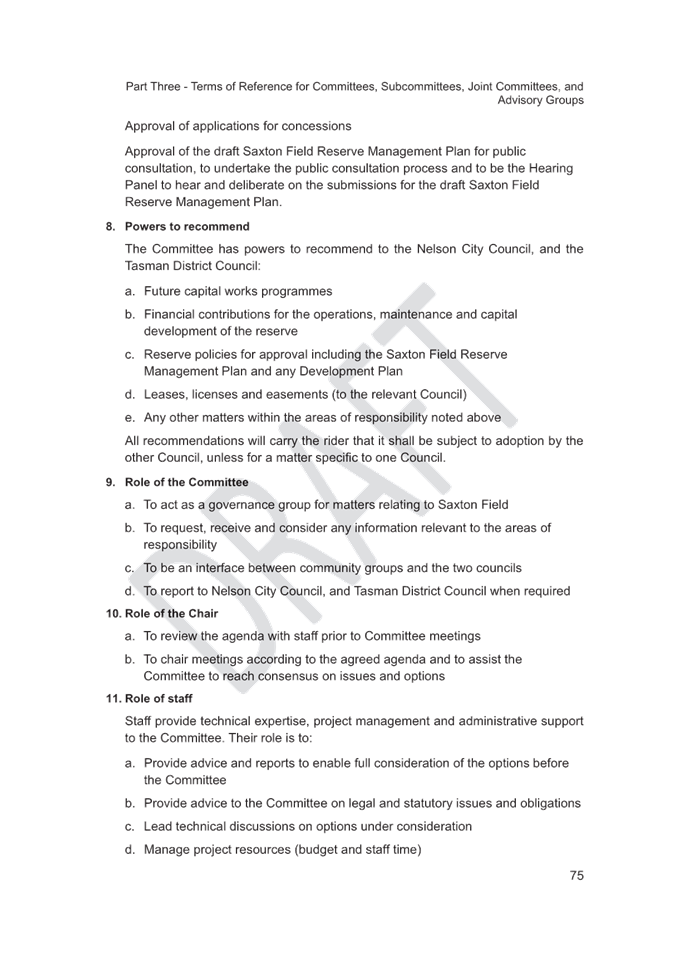
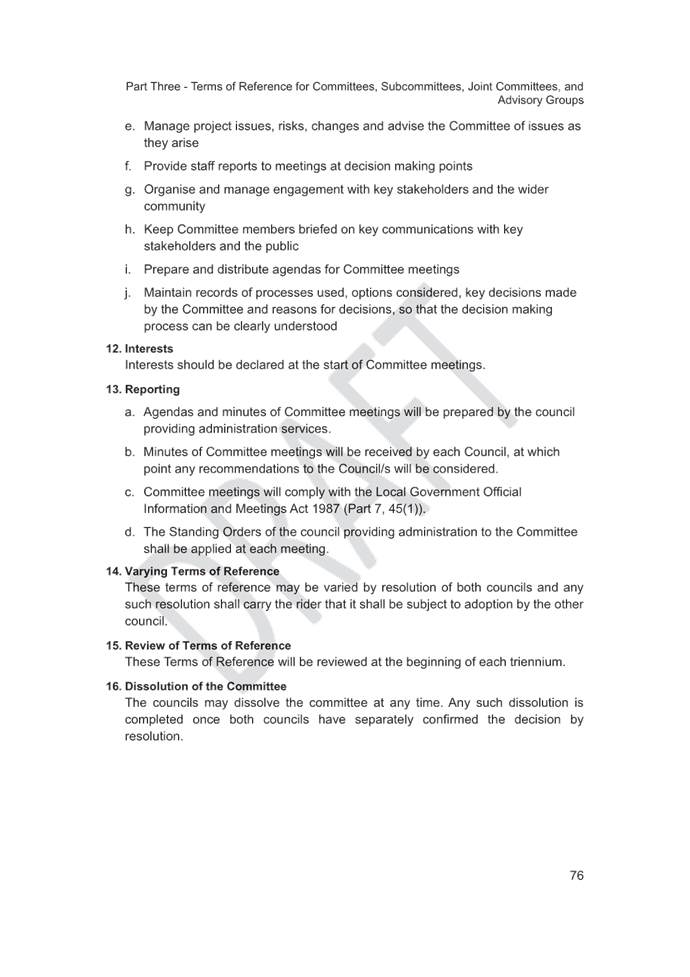
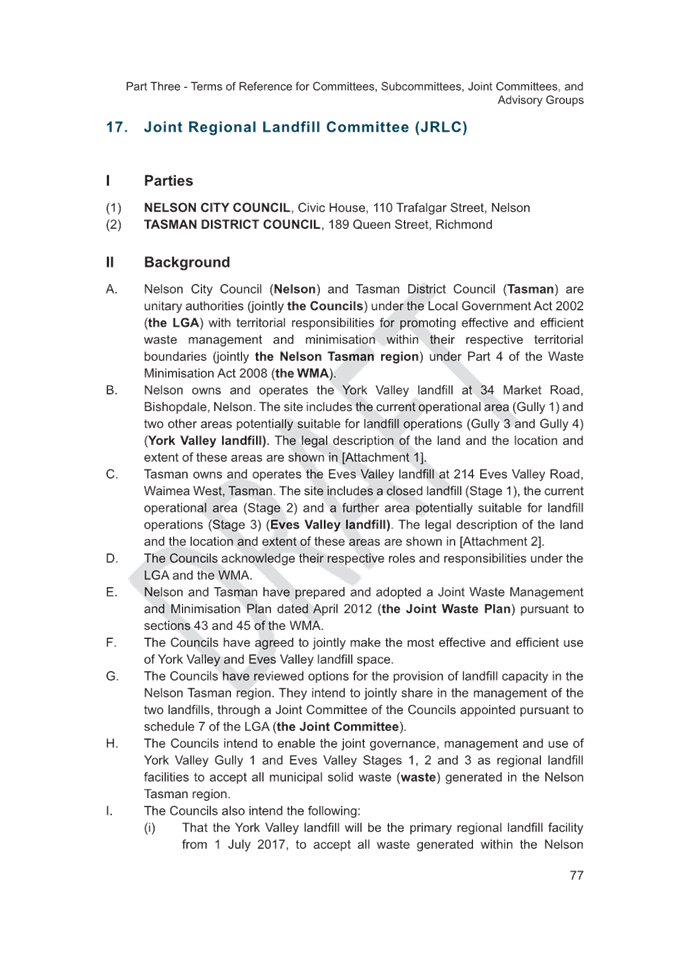
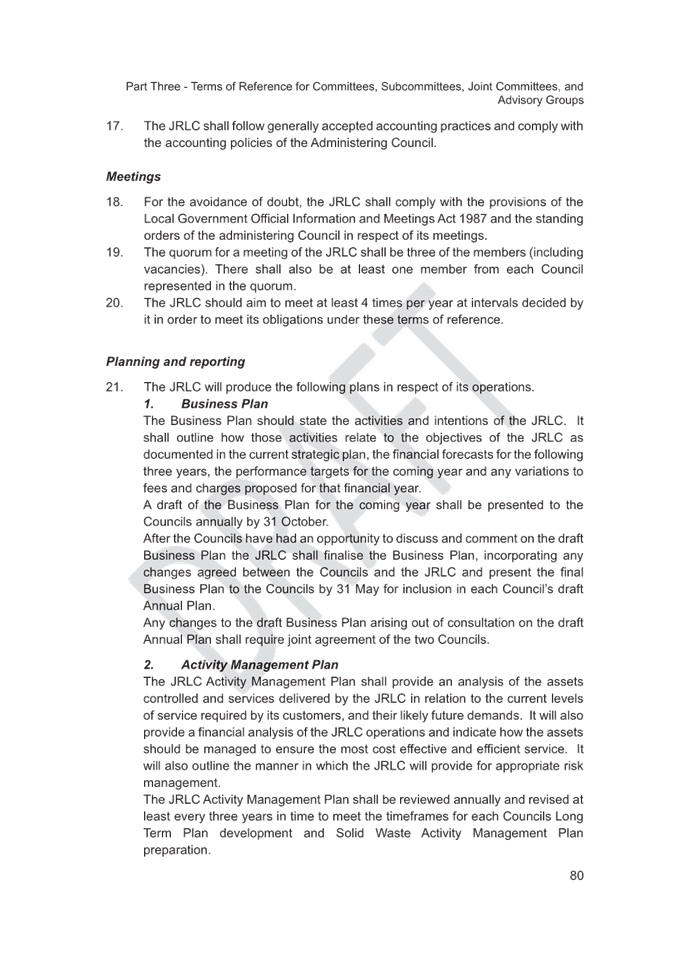
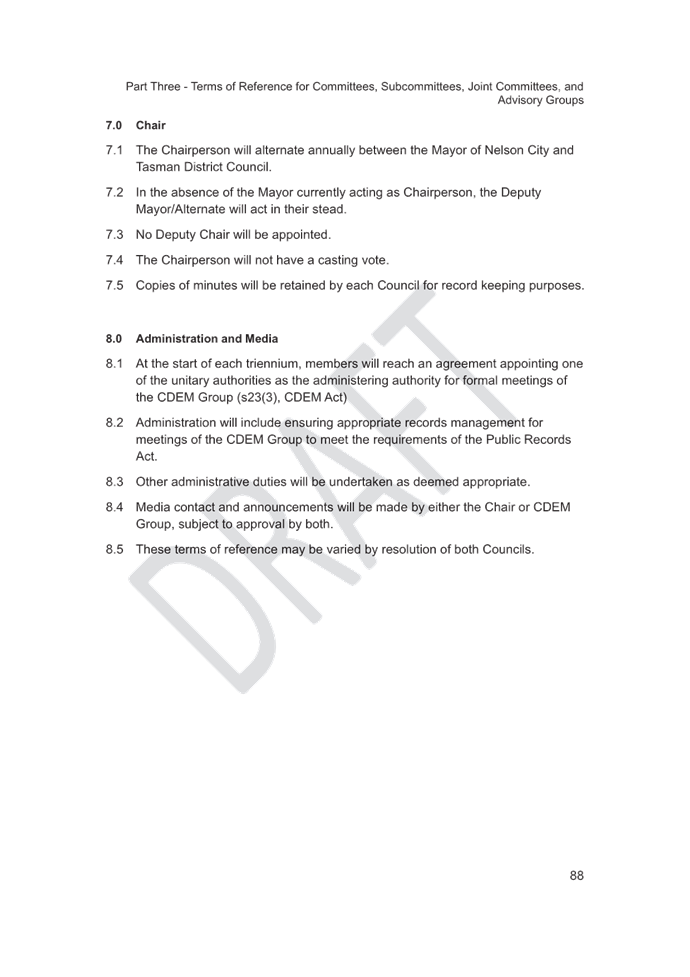
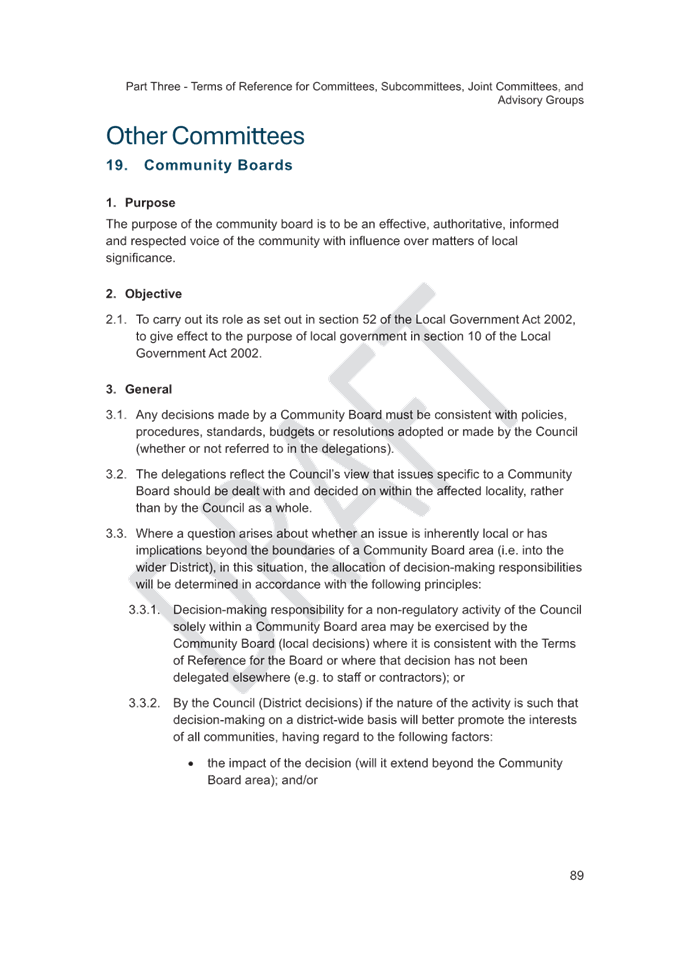
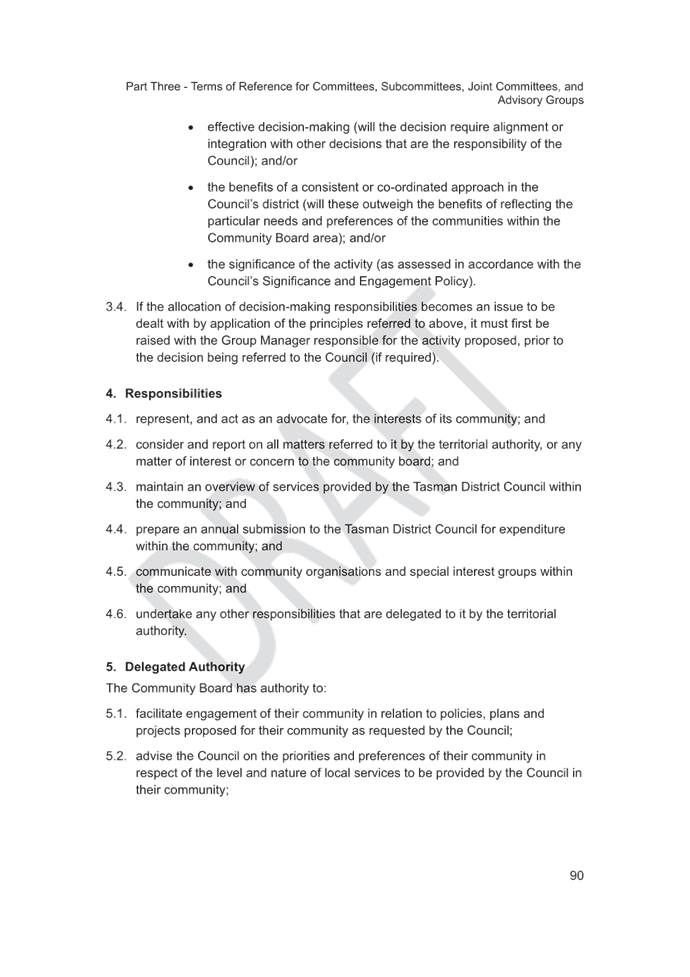
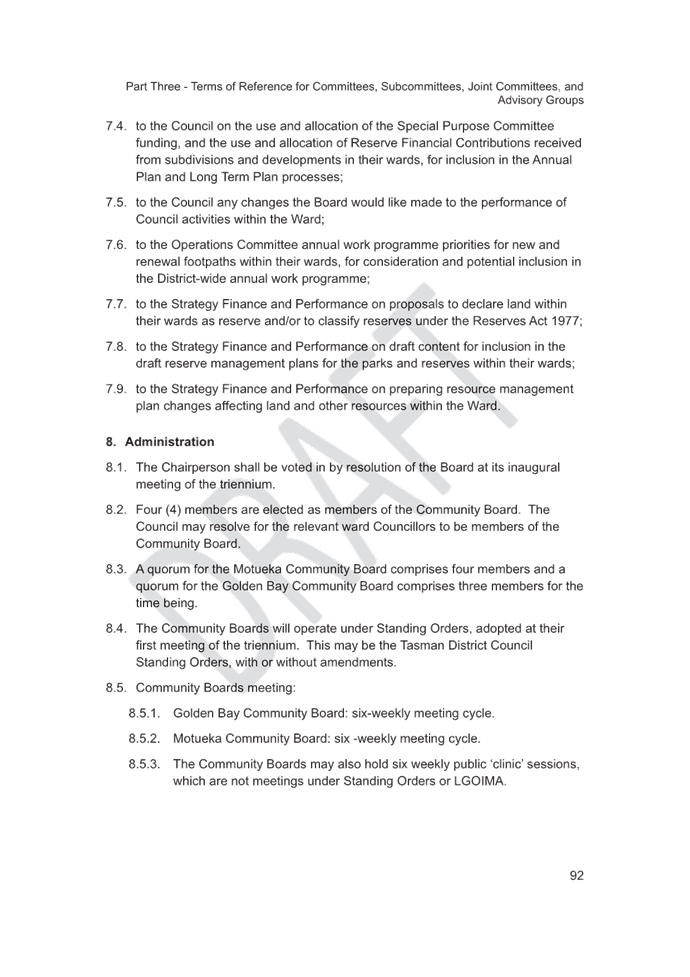
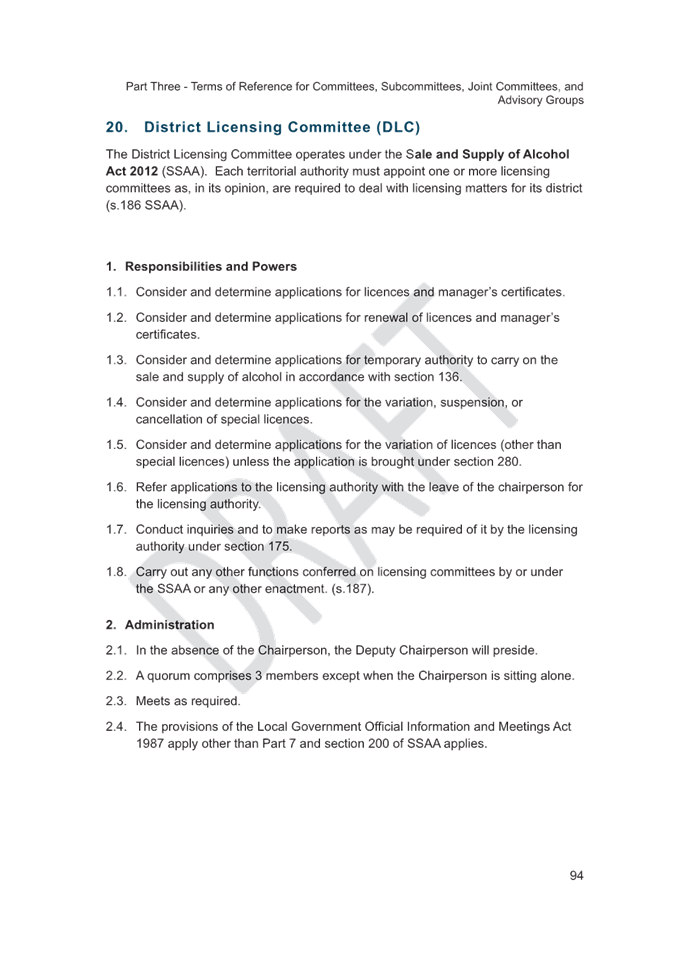
7.1 Tasman District Council Delegations
Register 2025 - 2028................................... 5
7.2 Membership of Tasman District Council and
Nelson City Council Joint Committees 109
7.3 Notice of Motion – Councillor
Timo Neubauer................................................... 114
7.4 Golden Bay Ward reserves - proposed process
to classify existing reserves and review the RMP..................................................................................................................... 118
7.5 Quarterly Treasury Report................................................................................... 135
7.6 Financial Report Year to Date October 2025...................................................... 144
7.7 Acoustic Insulation Condition in Plan
Change 81............................................... 153
7.8 Richmond Tennis Club Funding Request........................................................... 161
7.9 Upgrading Furniture and Technology in the
Council Chamber........................... 166
7.10 Tasman District Council Schedule of Meetings 2026......................................... 169
7.11 Waimea Water Limited - Annual Report 2025..................................................... 185
8 Confidential
Session
8.1 Procedural
motion to exclude the public............................................................. 229
8.2 Waimea Water Limited - Statement of
Expectations.......................................... 229
8.3 Waimea Community Dam - Risk Update............................................................ 229
9 CLOSING
KARAKIA
Tasman District
Council
Agenda – 11 December 2025
3 Public
Forum
3.1
Tapawera Connect -
Rachel Moffat
|
Report
To:
|
Tasman
District Council
|
|
Meeting
Date:
|
11
December 2025
|
|
Report
Number:
|
RCN25-12-1
|
1. Public
Forum / Te Matapaki Tūmatanui
Rachel Moffat, on behalf of Tapawera
Connect, will speak in public forum regarding the Tapawera Community Hub.
Nil
Tasman District
Council
Agenda – 11 December 2025
7 Reports
7.1
Tasman District
Council Delegations Register 2025 - 2028
Decision Required
|
Report
To:
|
Tasman
District Council
|
|
Meeting
Date:
|
11
December 2025
|
|
Report
Author:
|
Leith
Townshend, General Counsel; Robyn Byrne, Governance Manager
|
|
Report
Authorisers:
|
Steve
Manners, Chief Operating Officer
|
|
Report
Number:
|
RCN25-12-2
|
1. Purpose
of the Report / Te Take mō te Pūrongo
1.1 To
adopt the Tasman District Council Delegations Register for the 2025 –
2028 triennium.
2. Summary
/ Te Tuhinga Whakarāpoto
2.1 At
the 13 November 2025 Council meeting, the Council established its committees,
subcommittees and other subordinate decision-making bodies in order to assist
with the governance functions of the Council. Joint committees with Nelson City
Council are scheduled to be adopted on 11 December 2025.
2.2 The
committees and subordinate decision-making bodies established by Council at its
inaugural meeting are unable to meet until Council has resolved the terms of
reference in respect of each one.
2.3 It
is considered best practice for the delegated responsibility of each committee,
sub-committee and subordinate decision-making body to be captured in a
Delegations Register and adopted by Council early in each triennium. This
ensures clarity when Committees’ are making decisions under
delegation.
3. Recommendation/s
/ Ngā Tūtohunga
That the Tasman District Council
1. receives
the Tasman District Council Delegations Register 2025 - 2028 report RCN25-12-2;
and
2. adopts the Tasman District Council Delegations
Register for the 2025 – 2028 council term (Attachment 1 to the agenda
report); and
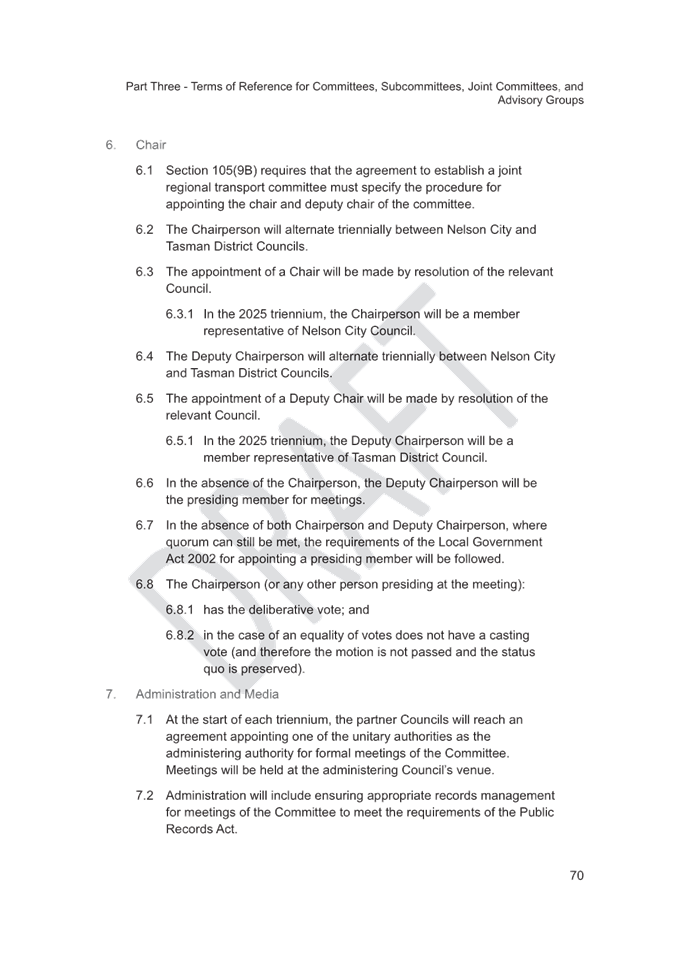
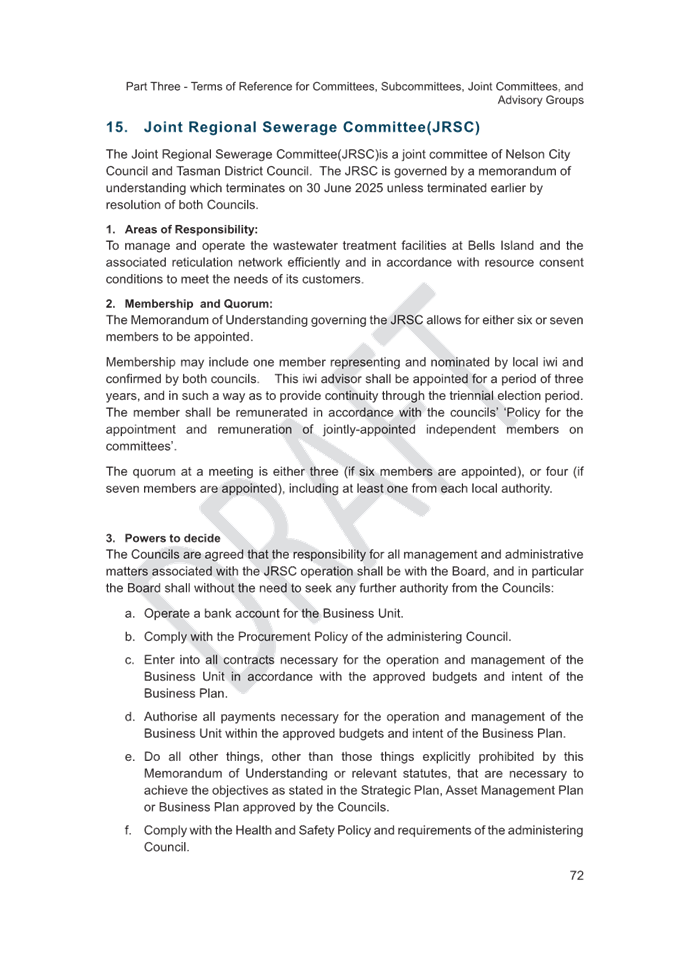
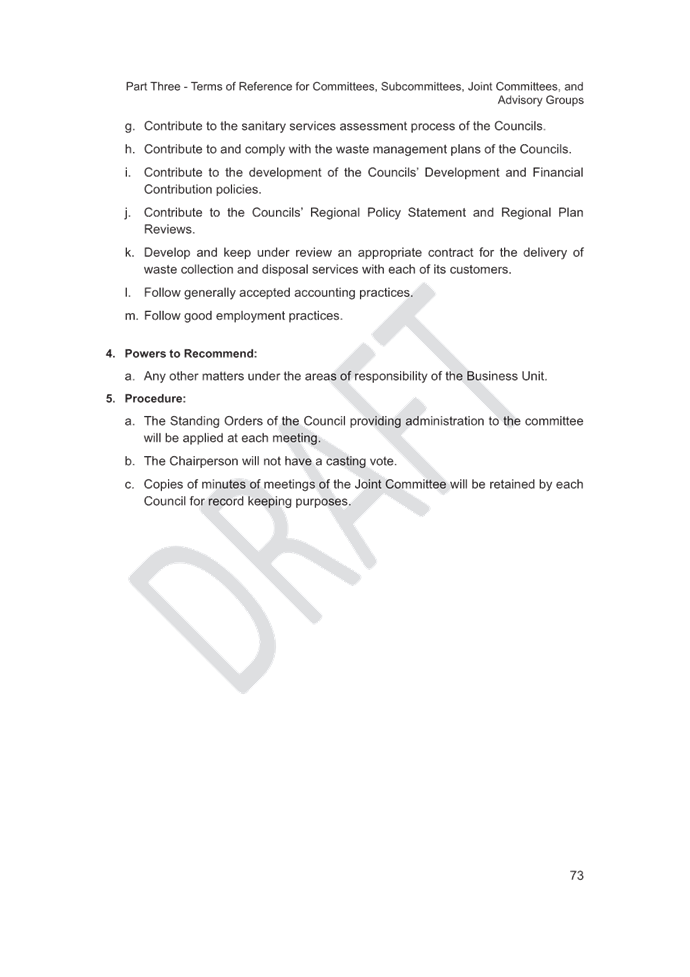
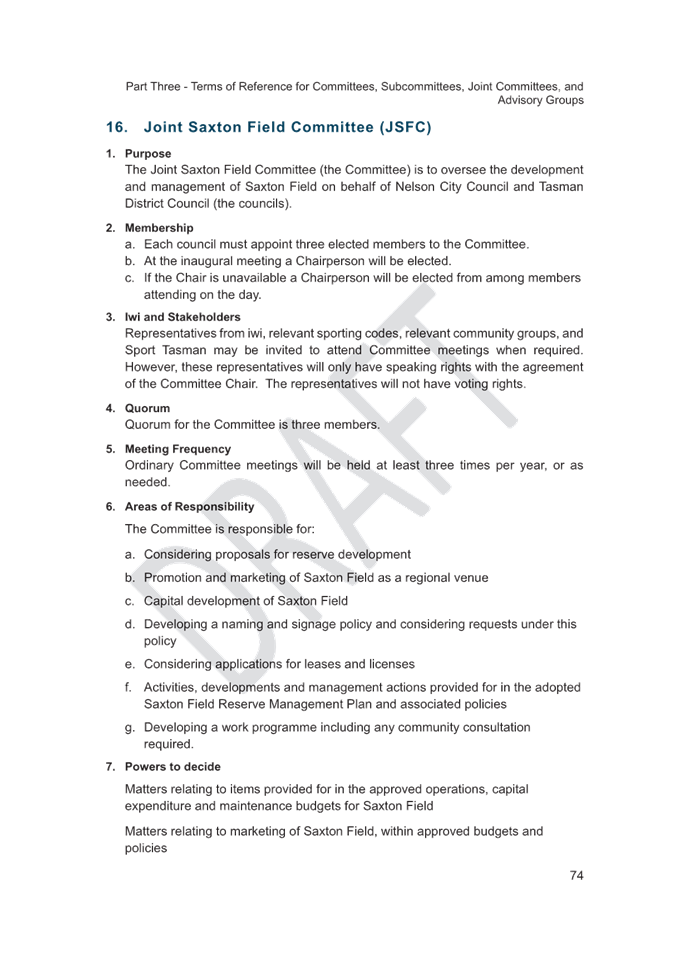
3. notes that the delegations and terms of reference in
the Joint Committees are made subject to the same delegations and terms of
reference being approved by Nelson City Council; and
4. authorises the Chief Executive Officer, or their
delegate, to update the Delegations Register as required by Council
resolutions, legislative changes or minor administrative changes.
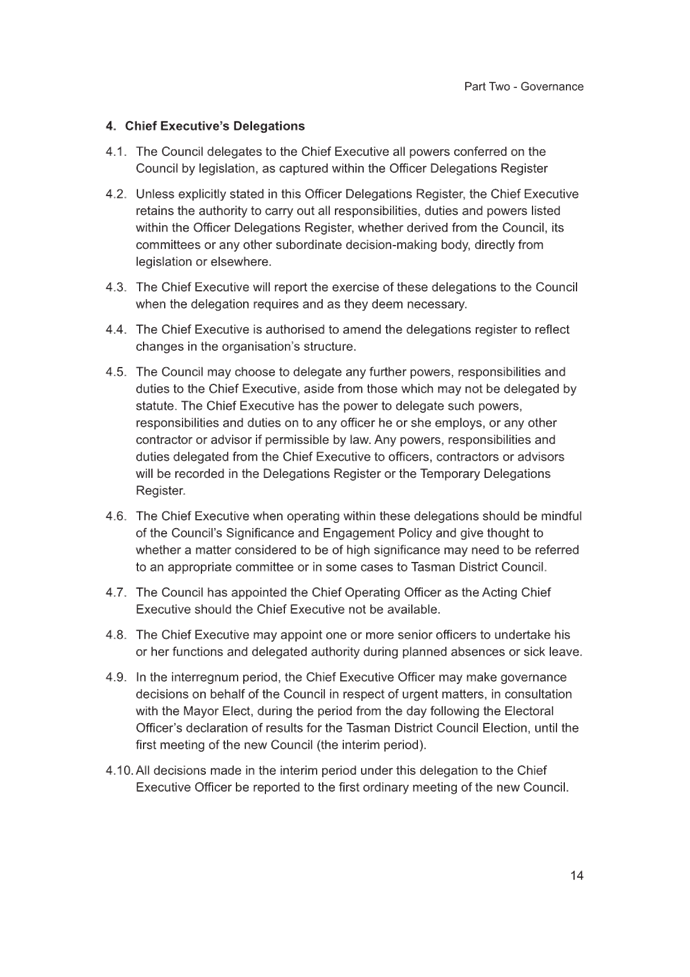
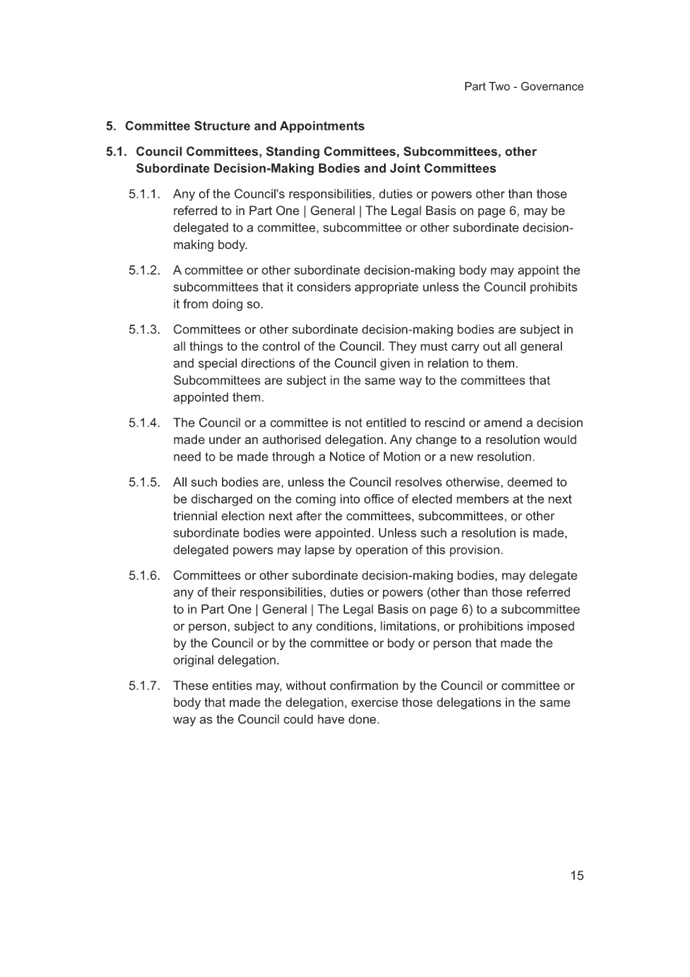
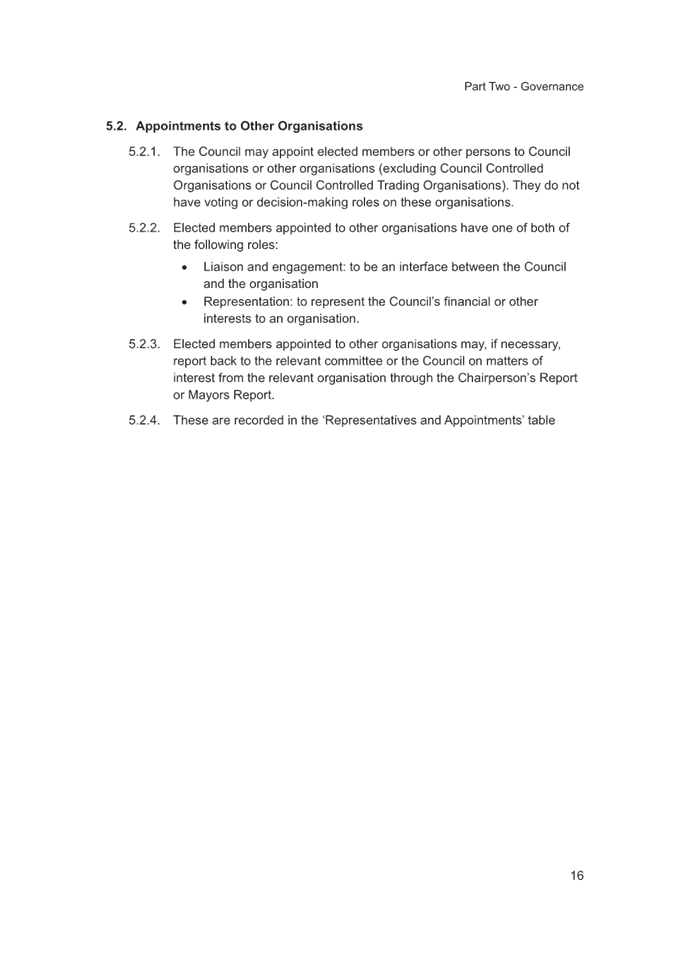
4.1 Delegations
are powers and responsibilities that the Council allows committees,
sub-committees or Council staff to exercise on the Council’s behalf.
These powers and responsibilities come from legislation, Council-made bylaws
and policies or the Council’s general powers as a body corporate.
4.2 Previously the Council has maintained a
Delegations Register that included both governance and staff delegations. The
staff delegations section has been removed from the Register and in the future
will be included in a digital register designed specifically for New Zealand
local government. The Chief Executive Officer is responsible for staff
delegations.
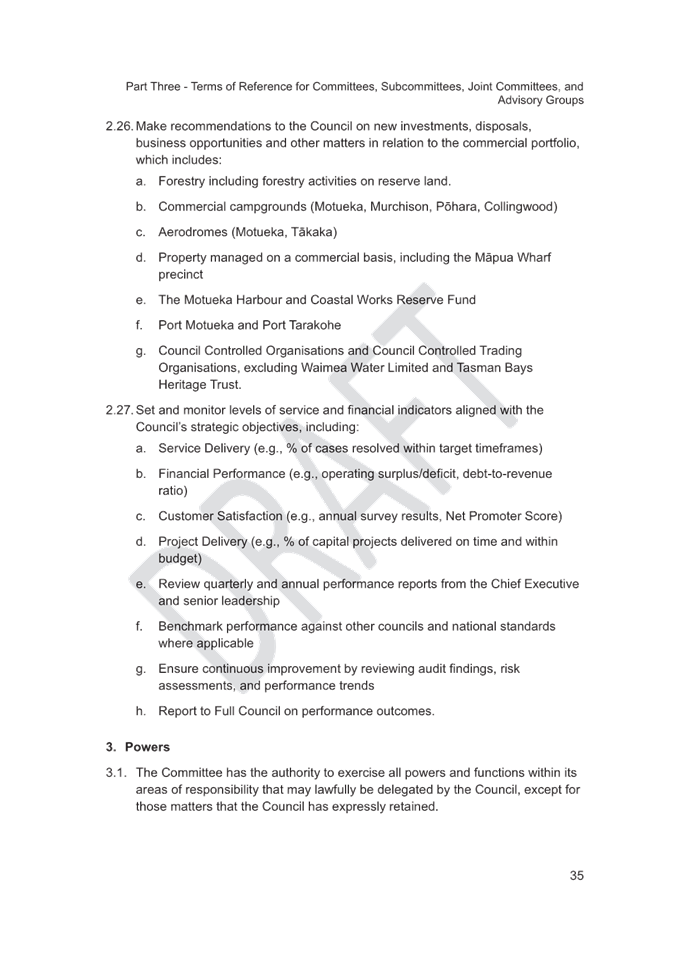
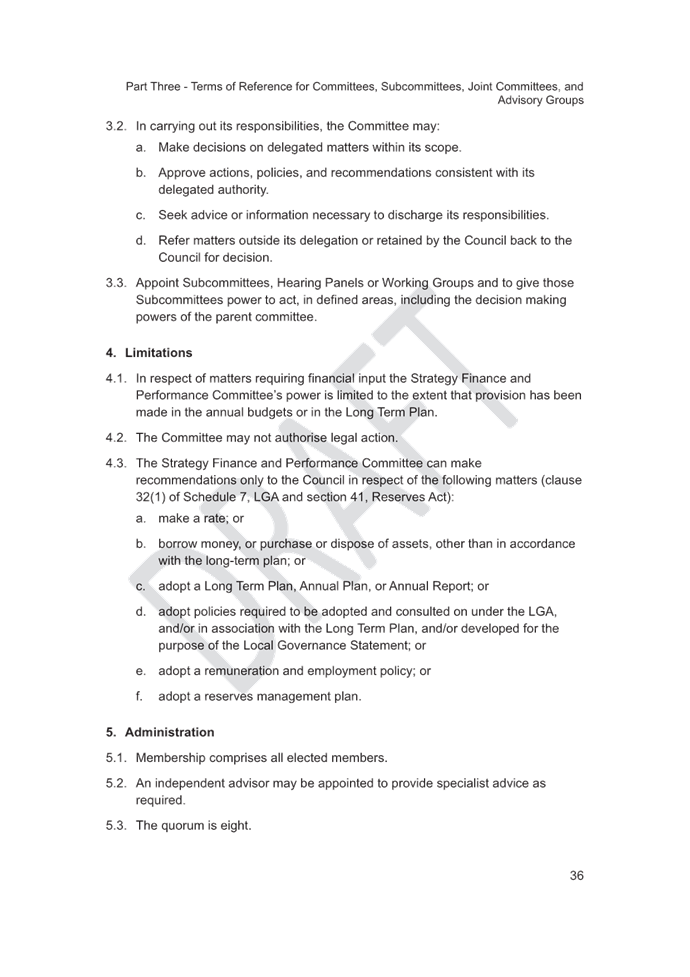
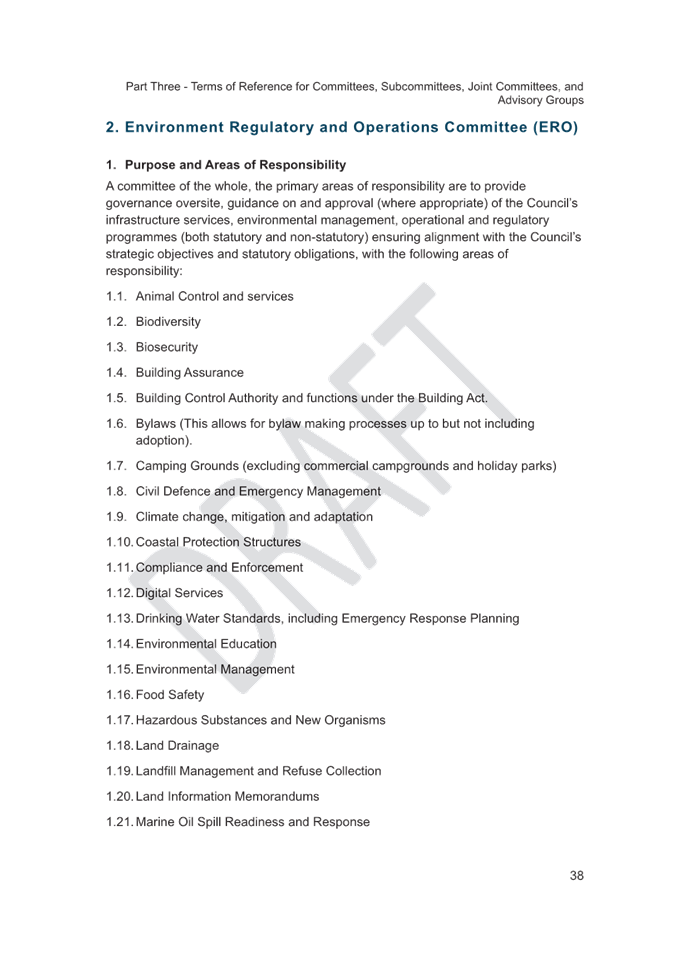
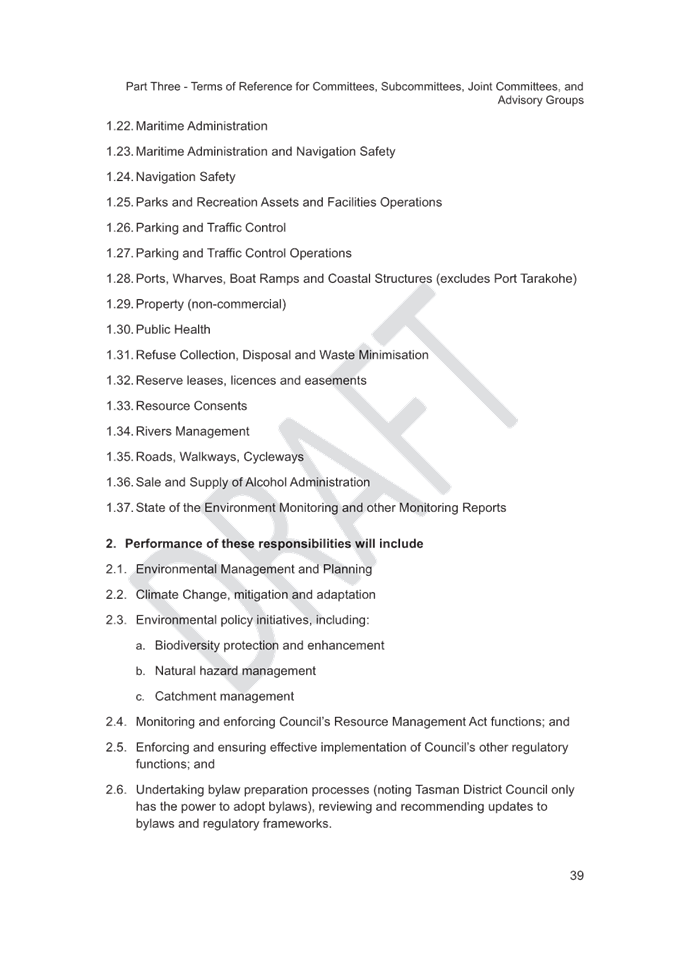
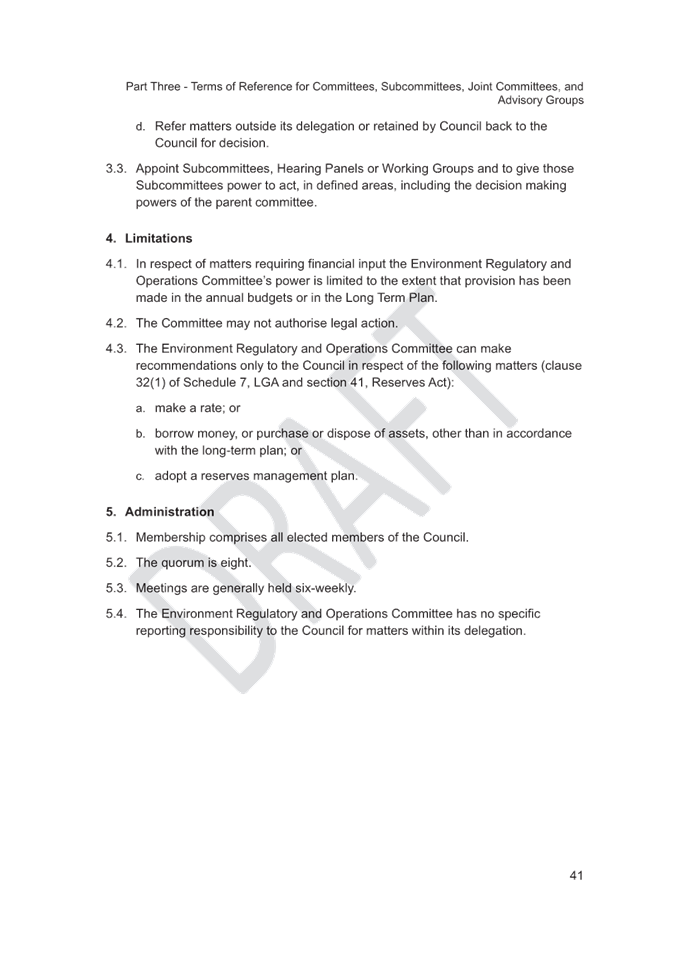
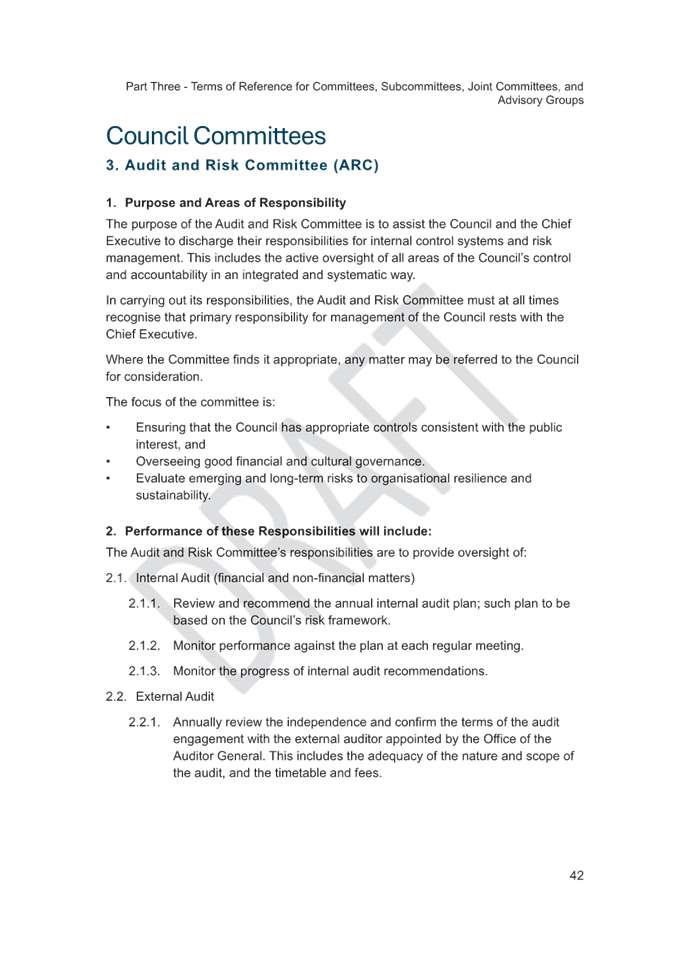
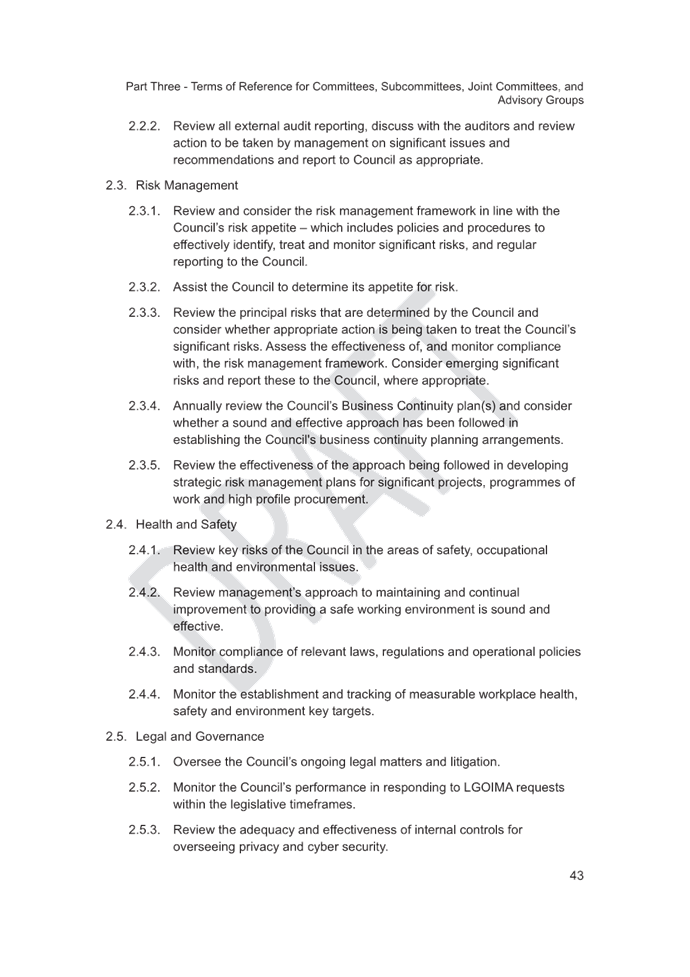
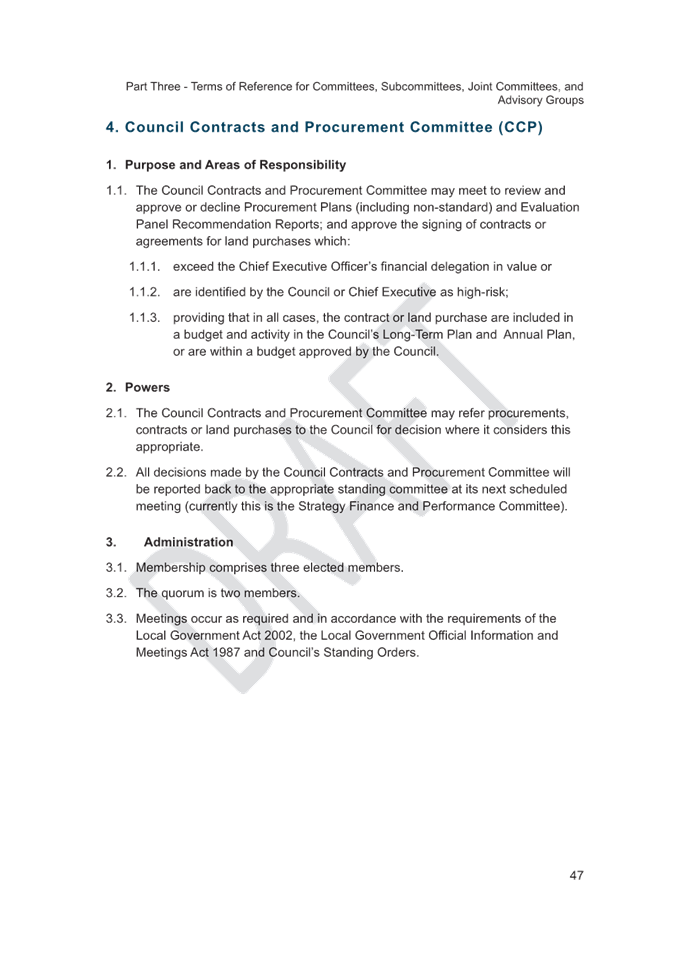
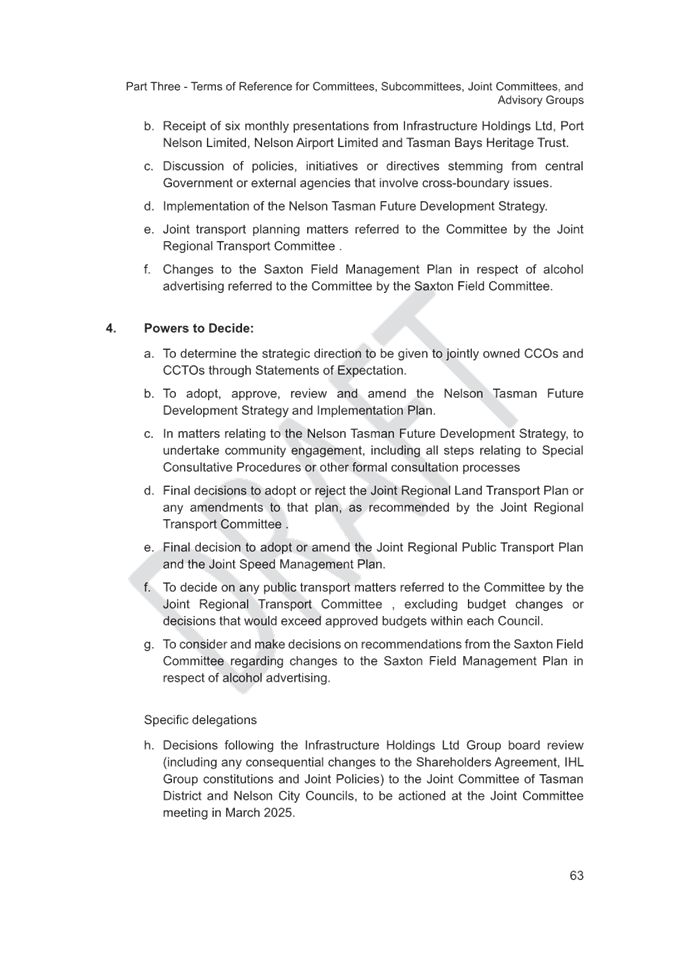
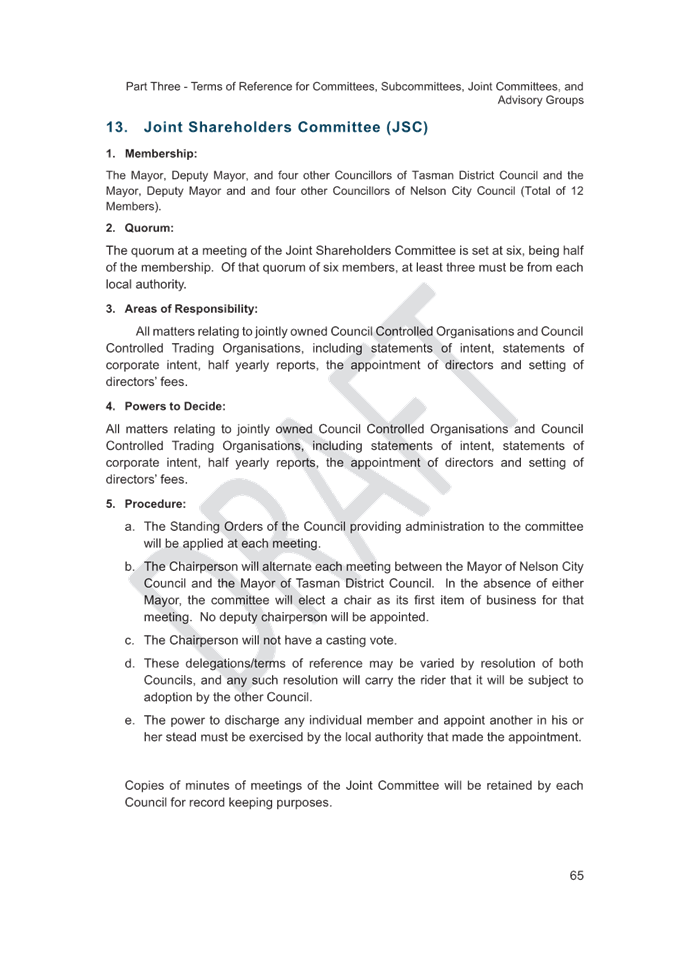
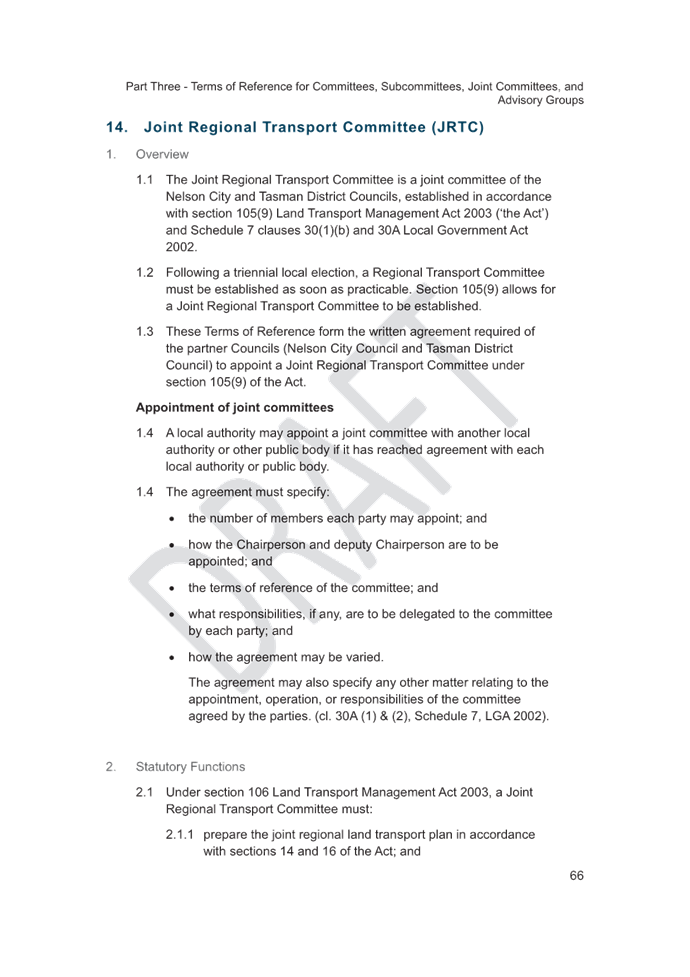
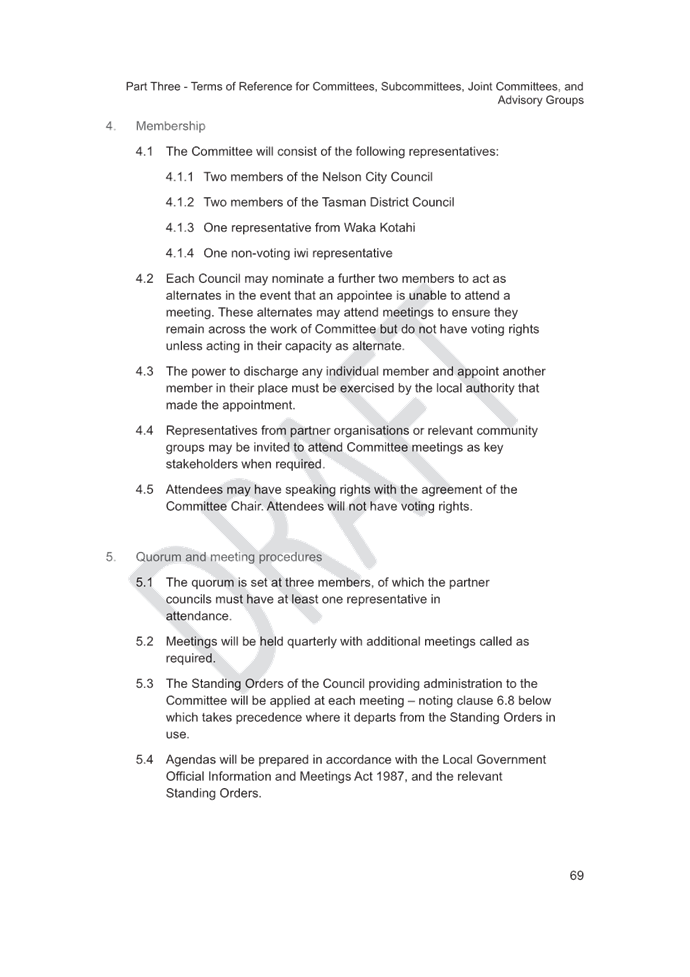
4.3 The Draft Delegations Register 2025-2028
is attached (Attachment 1)
5. Analysis
and Advice / Tātaritanga me ngā tohutohu
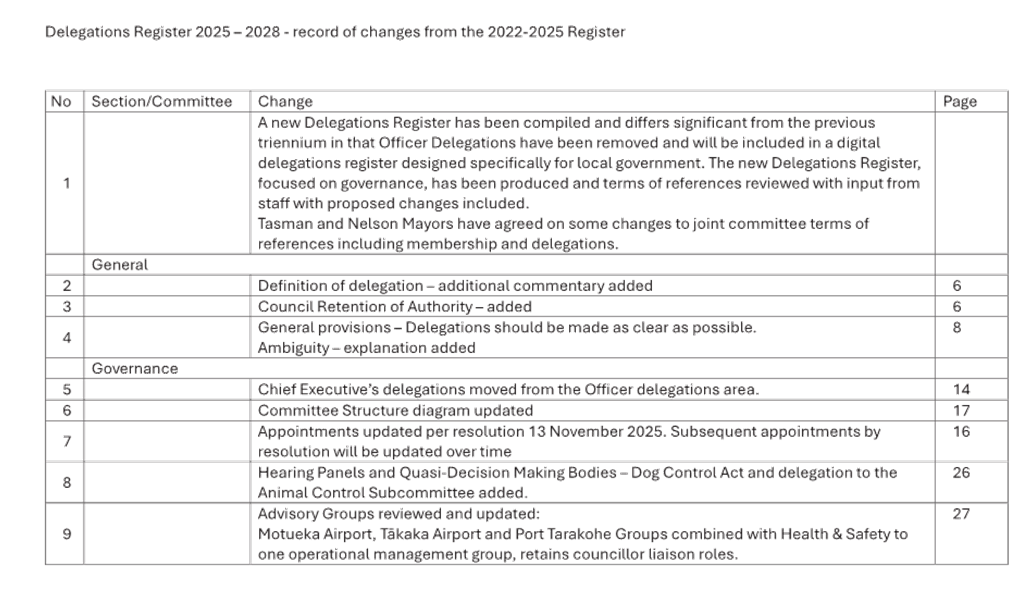
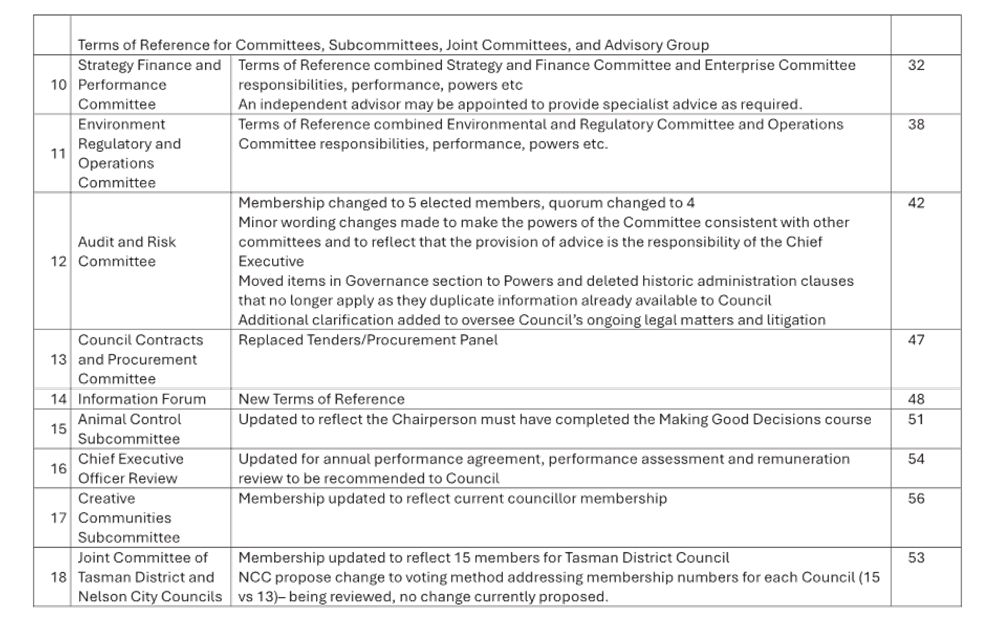
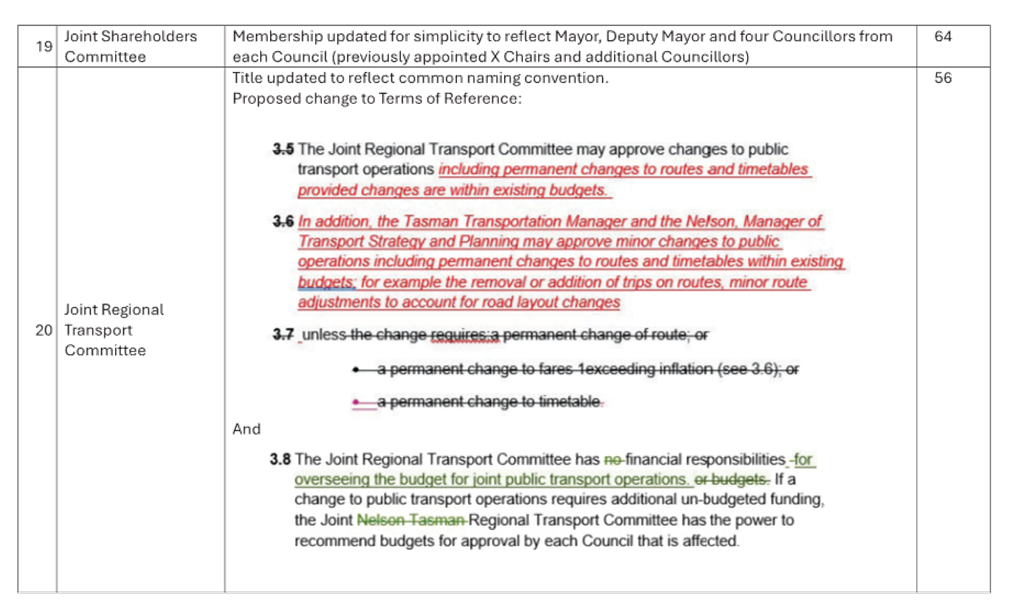
5.1 A full review of delegations has been
undertaken, and this report discusses proposed changes to the previously
adopted Delegations Register and a change log has been provided (Attachment
2).
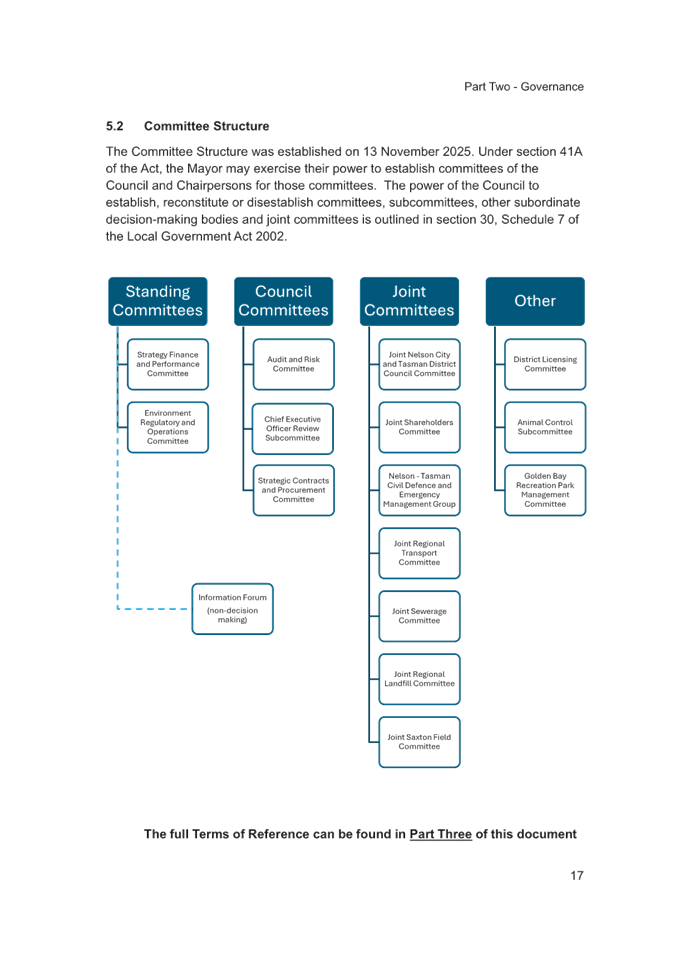
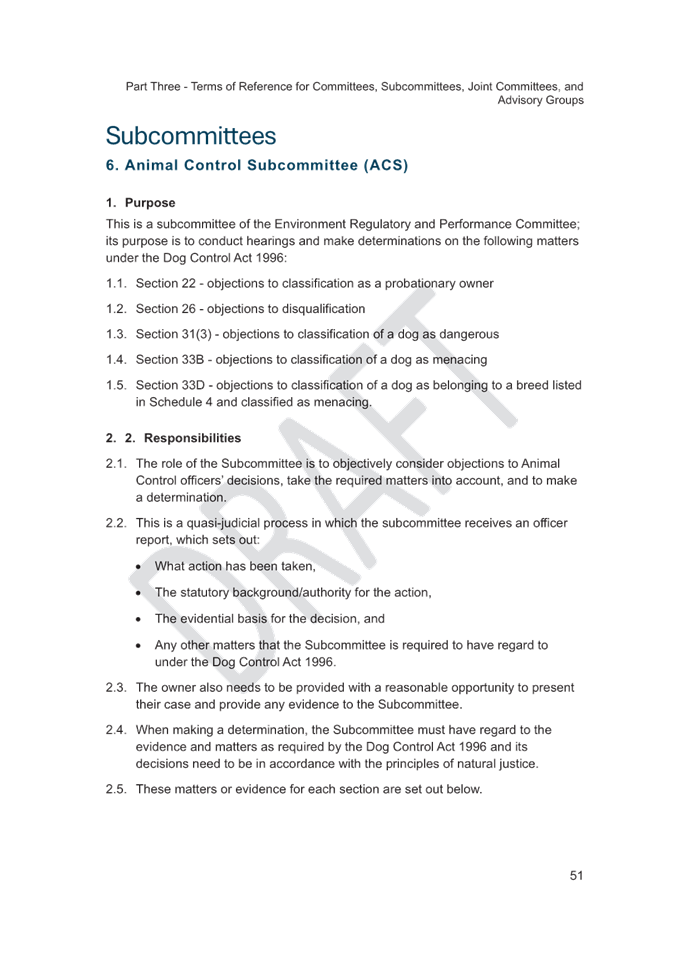
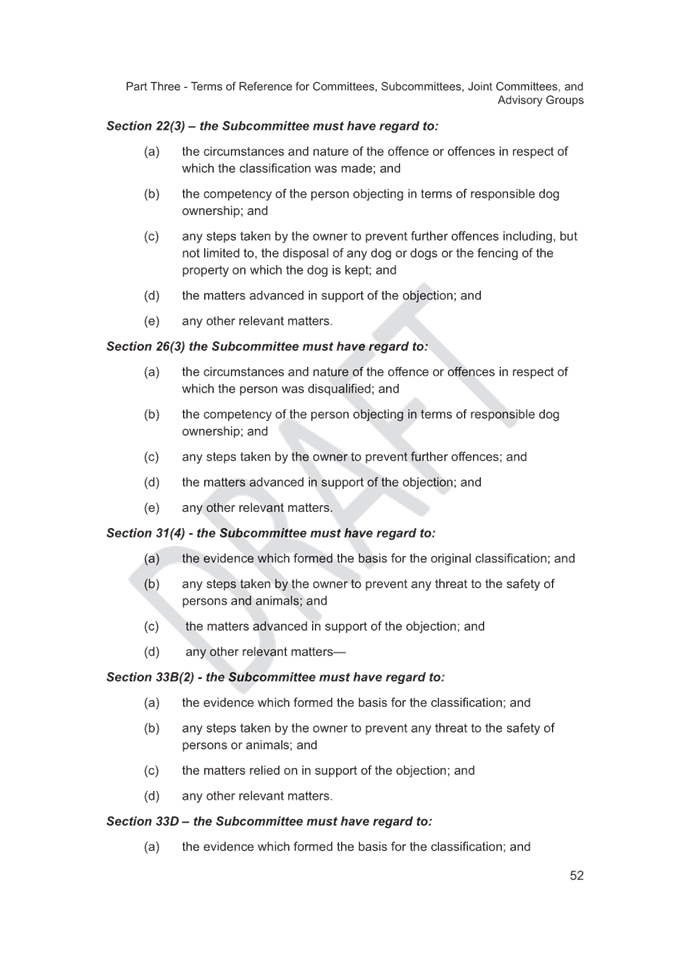
5.2 Terms of reference have been developed
to provide for the change in committee structure adopted at the 13 November
meeting, providing for merged committees aligning with the organisational
structure.
5.3 Council’s two standing committees
of the whole Council, Strategy Finance and Performance and Environment
Regulatory and Operations Committees are proposed to have with full
decision-making responsibilities, except for what cannot be delegated. Staff
have updated their terms of reference to reflect this.
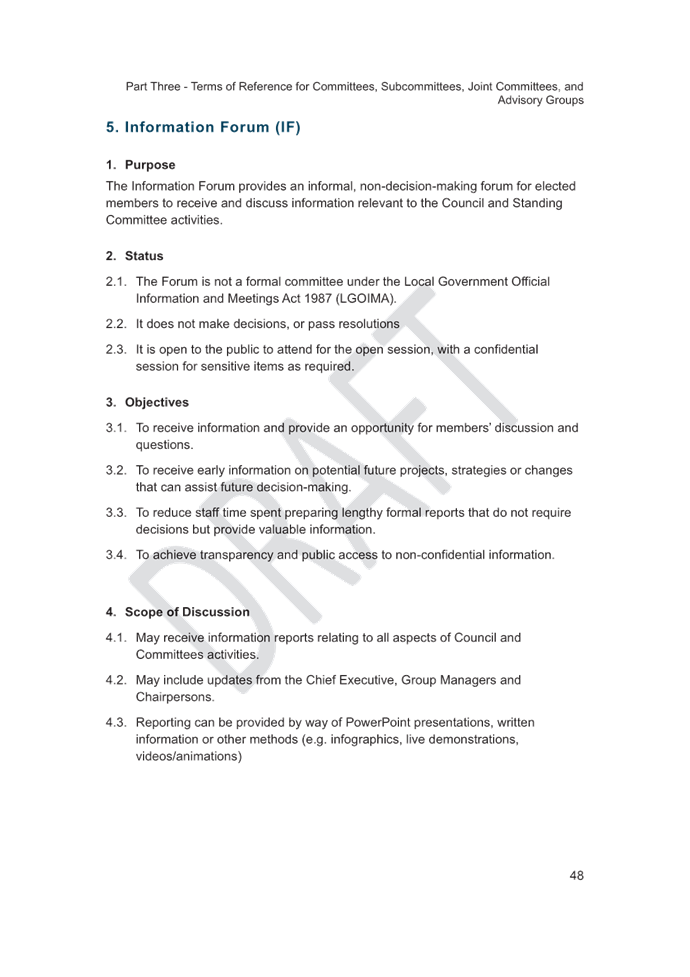
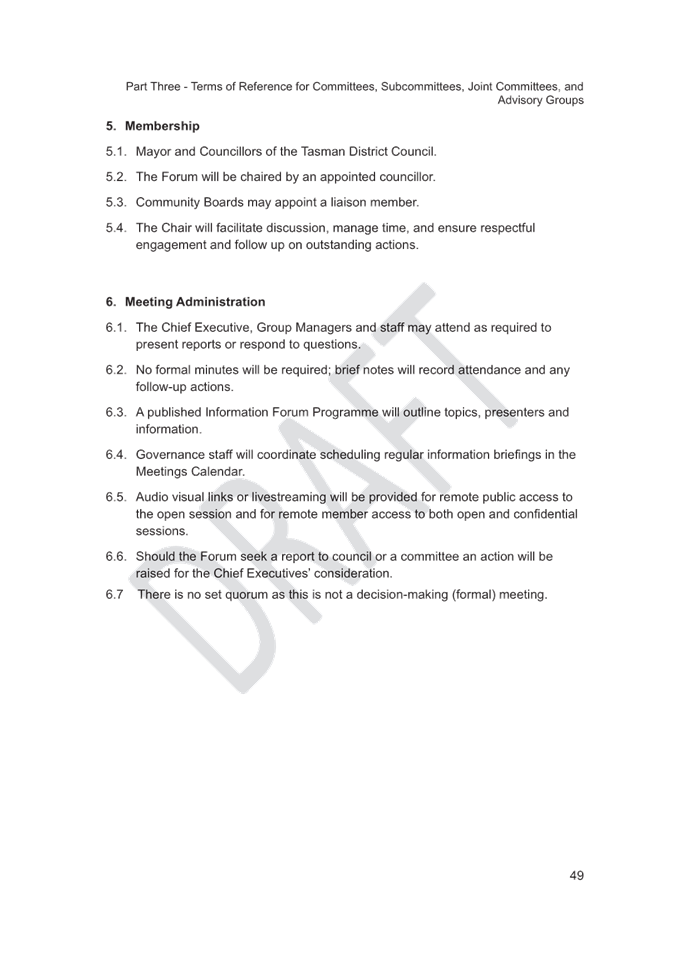
5.4 An Information Forum, with full
membership has been established with terms of reference allowing for multiple
ways of receiving information and future-focused reports to be provided. While
not a formal meeting under LGOIMAs these meetings will be open to the public
and include a public forum.
5.5 Joint committees with Nelson City
Council and Tasman District Council have been reviewed and changes include
aligning naming conventions, updating membership and reporting requirements.
5.6 Two new joint Advisory Groups have been proposed. The Terms of
Reference for the Joint Climate Change Advisory Group and the Joint Building
Authority Advisory Group are scheduled to be brought to Council for
consideration in 2026.
6. Financial
or Budgetary Implications / Ngā Ritenga ā-Pūtea
6.1 There are no direct budgetary
consequences related to the decision to approve the Delegations Register.
6.2 To the extent that delegations to
Committees allow the spending of ratepayer funds this can only be within
budgets already approved by Council. If there is a request for unbudgeted
expenditure then this will need to be approved by Council.
7.1 Council can choose to adopt the
Delegations Register presented either in whole or in part, or to not adopt the
Delegations Register as presented.
7.2 Any proposed changes to the terms of
reference to the joint committees will need to also be approved by Nelson City
Council.
7.3 Unless powers are delegated by Council,
responsibility for decision-making remains with Council.
8.1 Clause 32 Schedule 7 of the Local
Government Act 2002 provides for the Council to delegate certain powers and
functions to the Chief Executive Officer and staff, excluding the powers which
only the Council can exercise, such as setting the rates.
8.2 If the Committee or other body which has
been delegated powers decides that, because of the nature of the decision, that
it should be made by Council then there is nothing stopping the Committee or
other body referring the decision to Council.
9. Iwi
Engagement / Whakawhitiwhiti ā-Hapori Māori
9.1 No engagement with iwi has been
undertaken, the proposed amendments are of an operational nature.
10. Significance
and Engagement / Hiranga me te Whakawhitiwhiti ā-Hapori Whānui
10.1 The delegations contained in the register are to
the Committees of Council and made for administrative efficiency. The overall
assessment of the significance of this decision is considered to be low.
|
|
Issue
|
Level of
Significance
|
Explanation of
Assessment
|
|
1.
|
Is there a high level
of public interest, or is decision likely to be controversial?
|
Low
|
|
|
2.
|
Are there impacts on
the social, economic, environmental or cultural aspects of well-being of the
community in the present or future?
|
Low
|
|
|
3.
|
Is there a
significant impact arising from duration of the effects from the decision?
|
No
|
|
|
4.
|
Does the decision
relate to a strategic asset? (refer Significance and Engagement Policy for
list of strategic assets)
|
No
|
|
|
5.
|
Does the decision
create a substantial change in the level of service provided by Council?
|
No
|
|
|
6.
|
Does the proposal,
activity or decision substantially affect debt, rates or Council finances in
any one year or more of the LTP?
|
No
|
|
|
7.
|
Does the decision
involve the sale of a substantial proportion or controlling interest in a CCO
or CCTO?
|
No
|
|
|
8.
|
Does the
proposal or decision involve entry into a private sector partnership or
contract to carry out the deliver on any Council group of activities?
|
No
|
|
|
9.
|
Does the proposal or
decision involve Council exiting from or entering into a group of
activities?
|
No
|
|
|
10.
|
Does the proposal
require particular consideration of the obligations of Te Mana O Te Wai
(TMOTW) relating to freshwater or particular consideration of current
legislation relating to water supply, wastewater and stormwater
infrastructure and services?
|
No
|
|
11. Communication
/ Whakawhitiwhiti Kōrero
11.1 The Delegations Register will be published to the
Council website for information and staff will be advised.
12.1 There is no change to the risk level from the
previous Delegations Register.
13. Climate
Change Considerations / Whakaaro
Whakaaweawe Āhuarangi
13.1 There are no climate change considerations arising
from the amendments to the delegations.
14. Alignment
with Policy and Strategic Plans / Te Hangai ki ngā aupapa Here me ngā
Mahere Rautaki Tūraru
14.1 The Delegations Register includes the
Council’s policy in relation to delegations.
15. Conclusion
/ Kupu Whakatepe
15.1 If the Council adopts the Delegations Register the
terms of reference will take effect immediately. They will then be published on
the Council’s website.
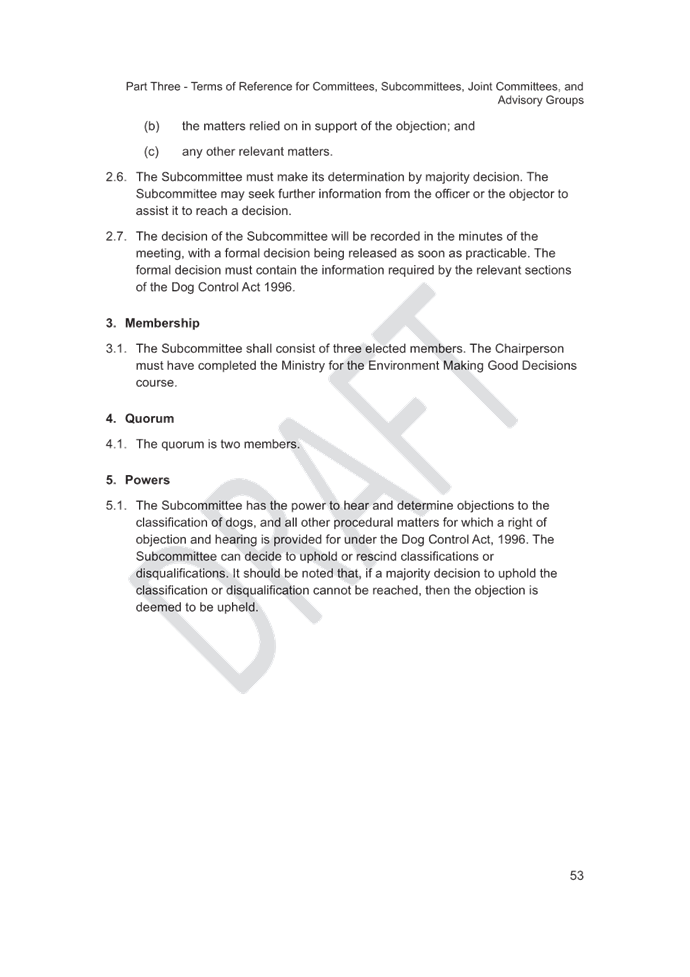
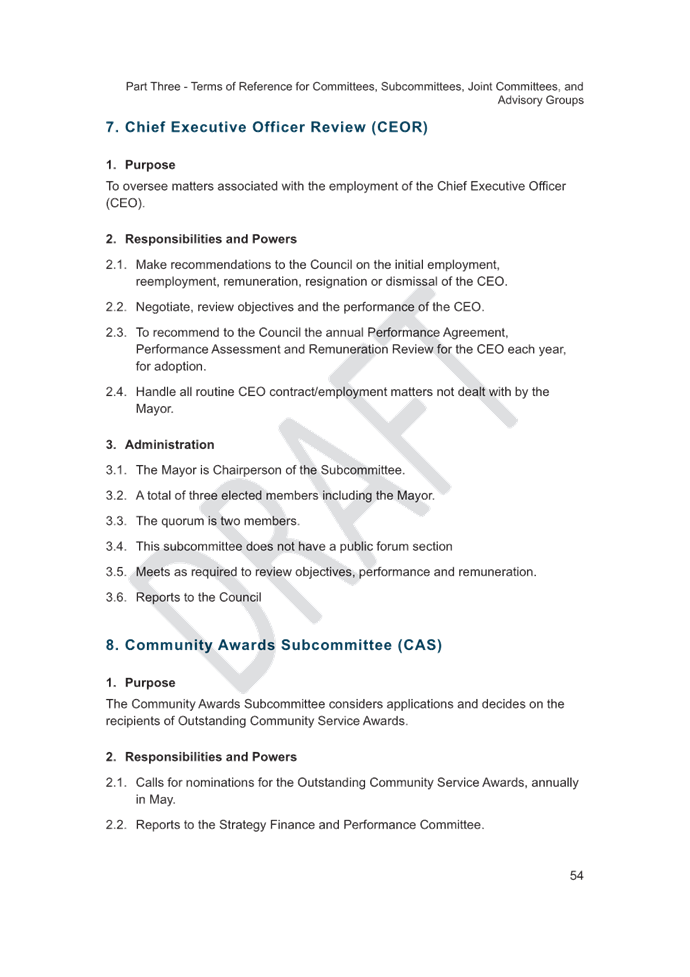
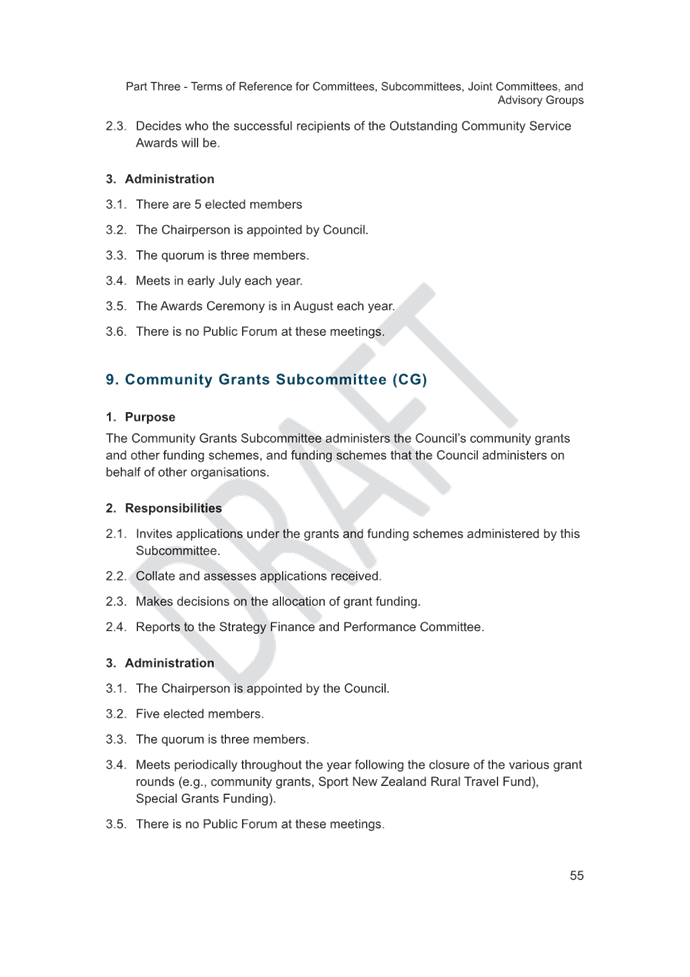
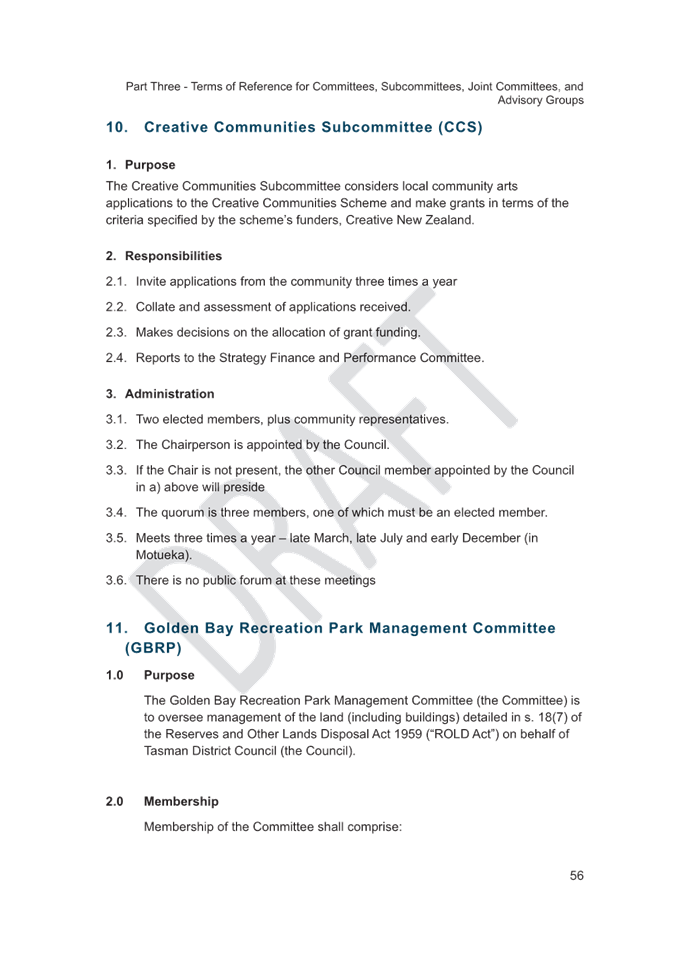
|
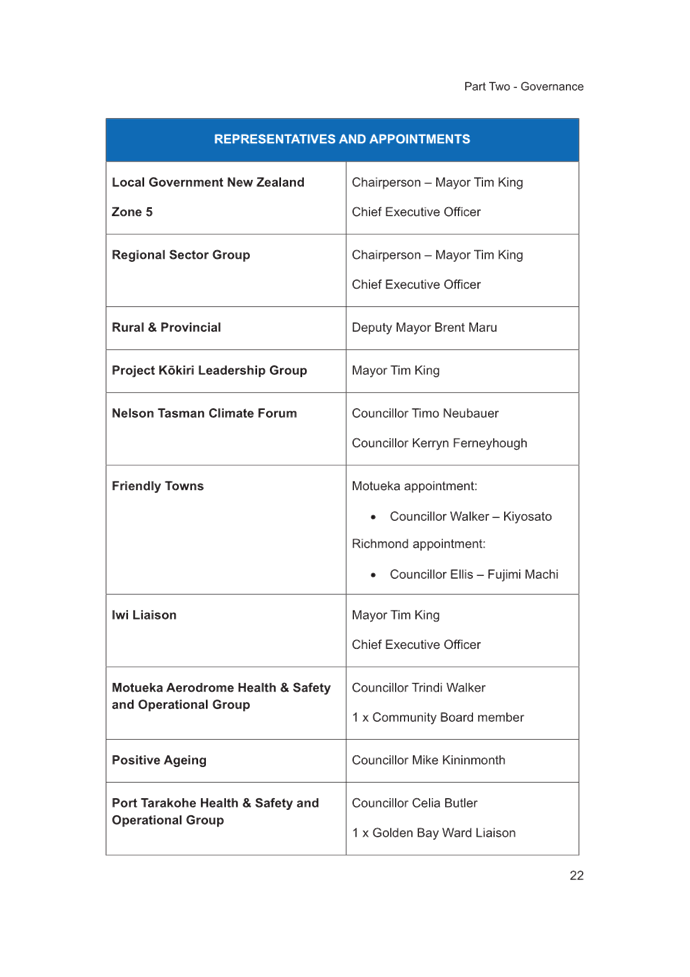
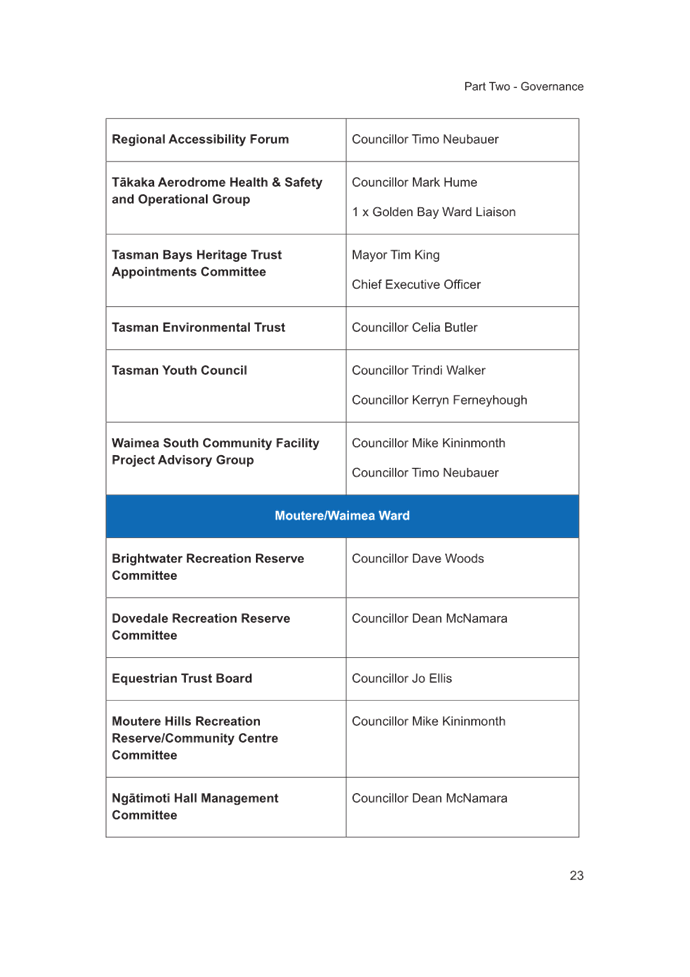
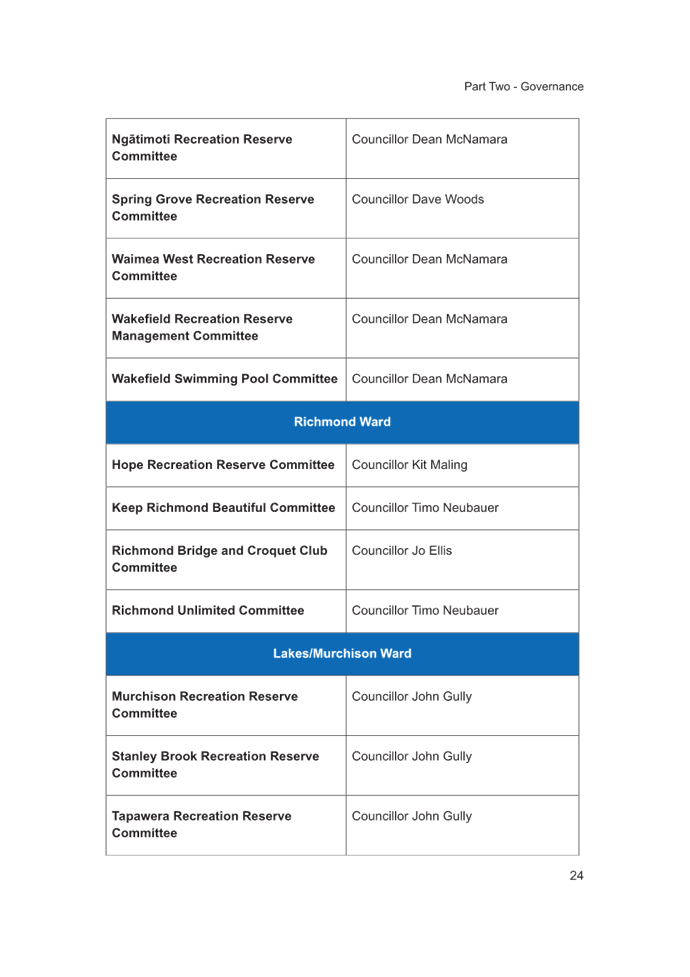
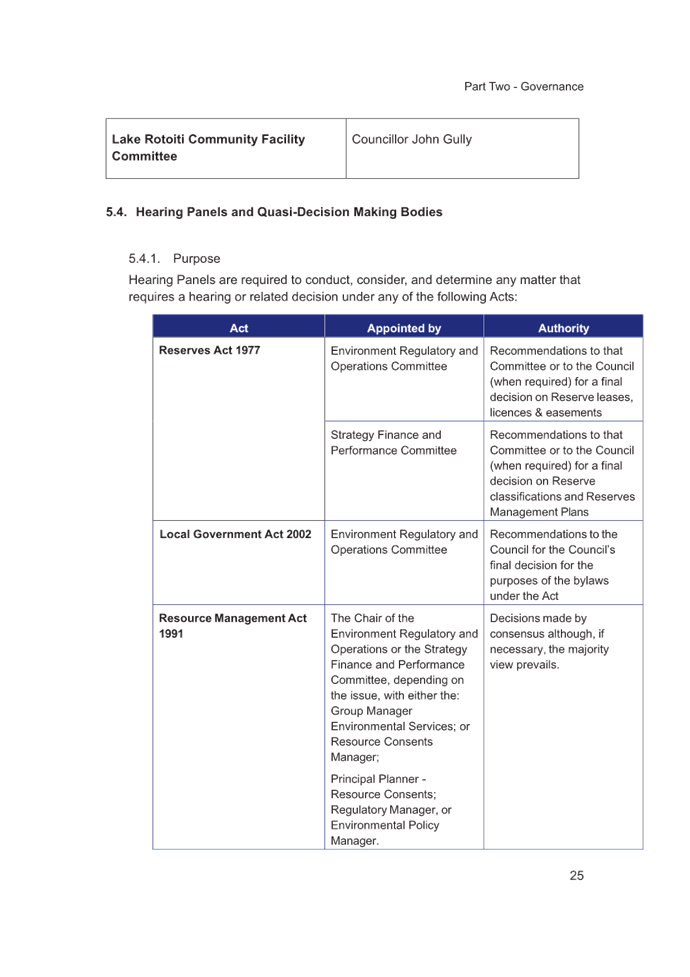
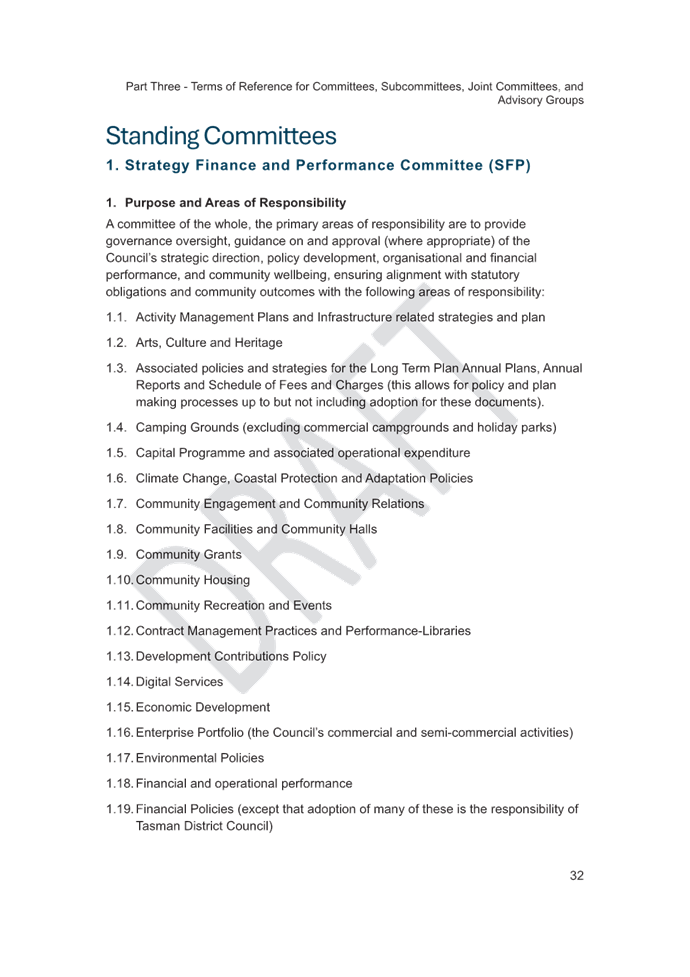
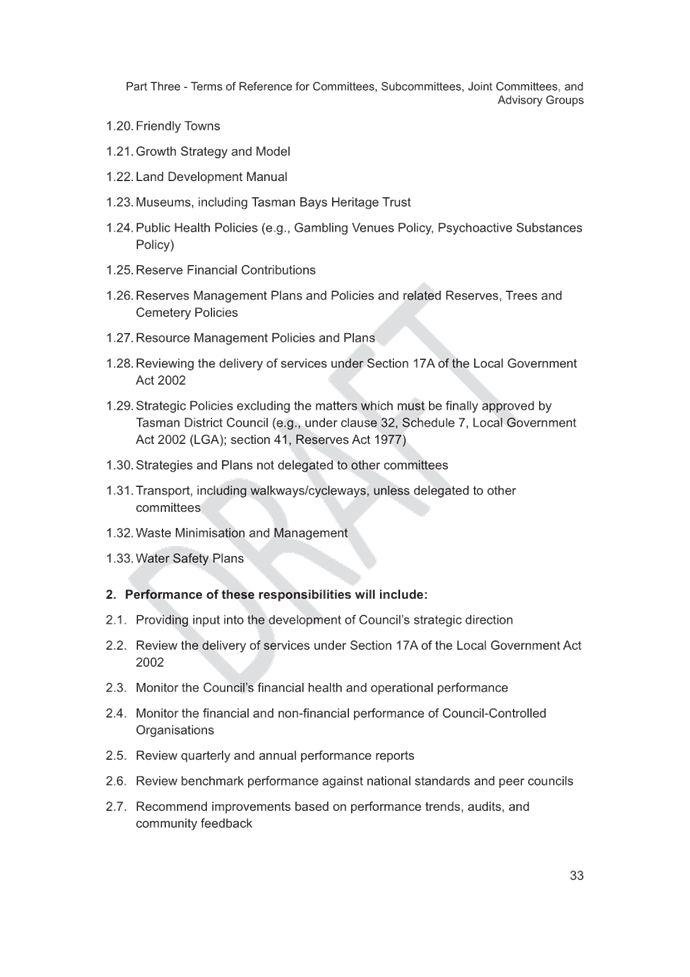
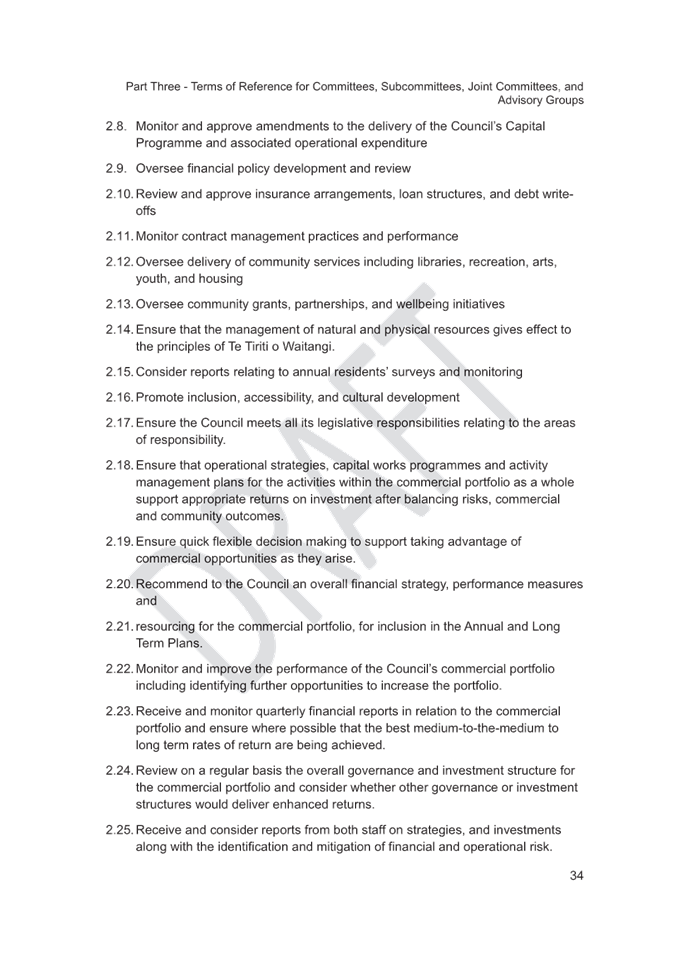
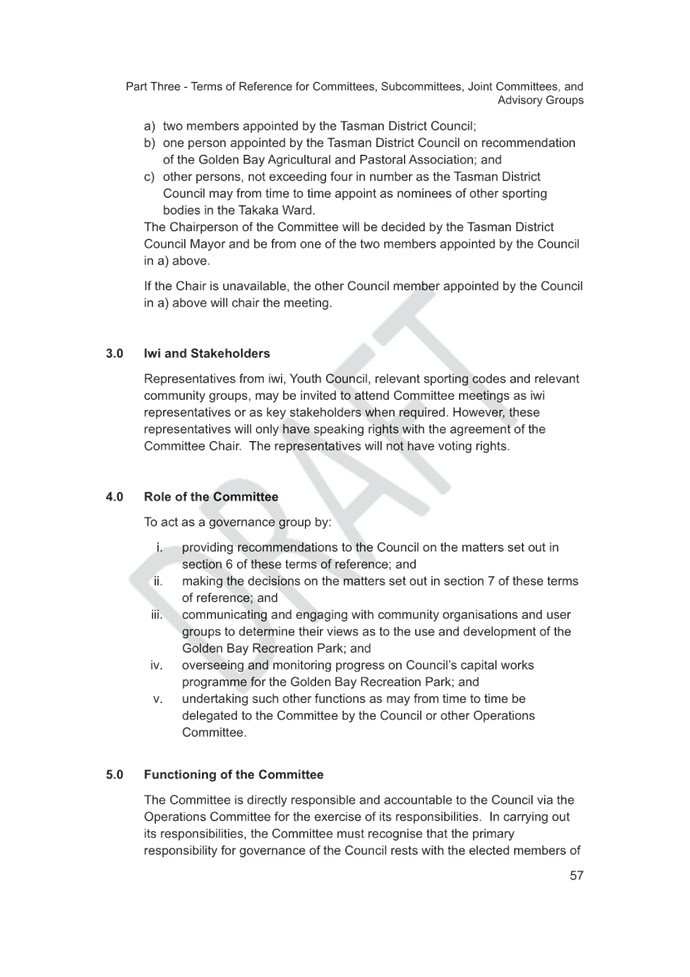
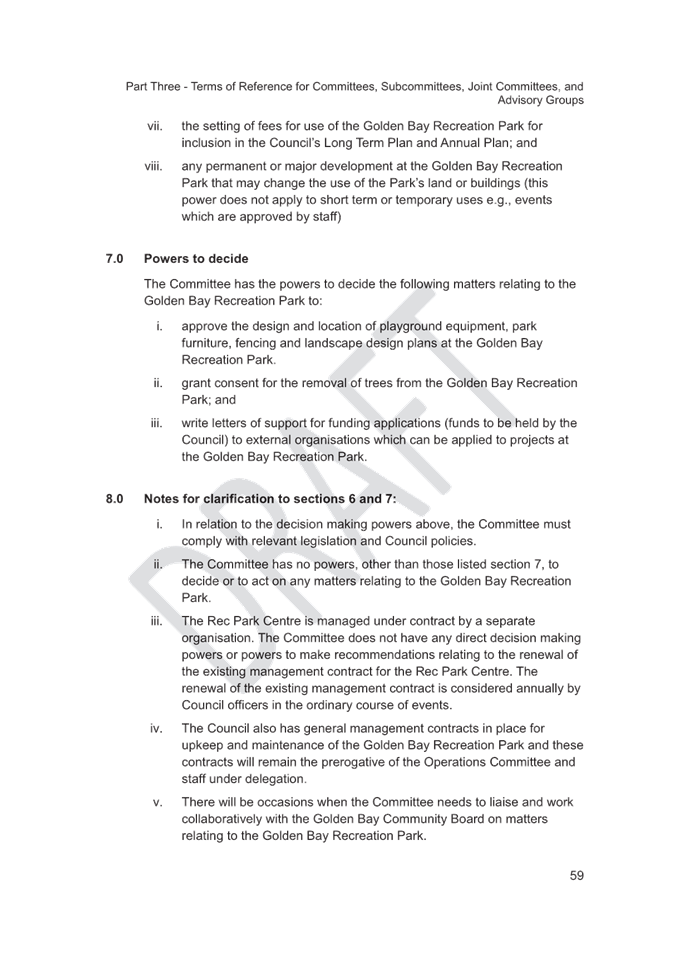
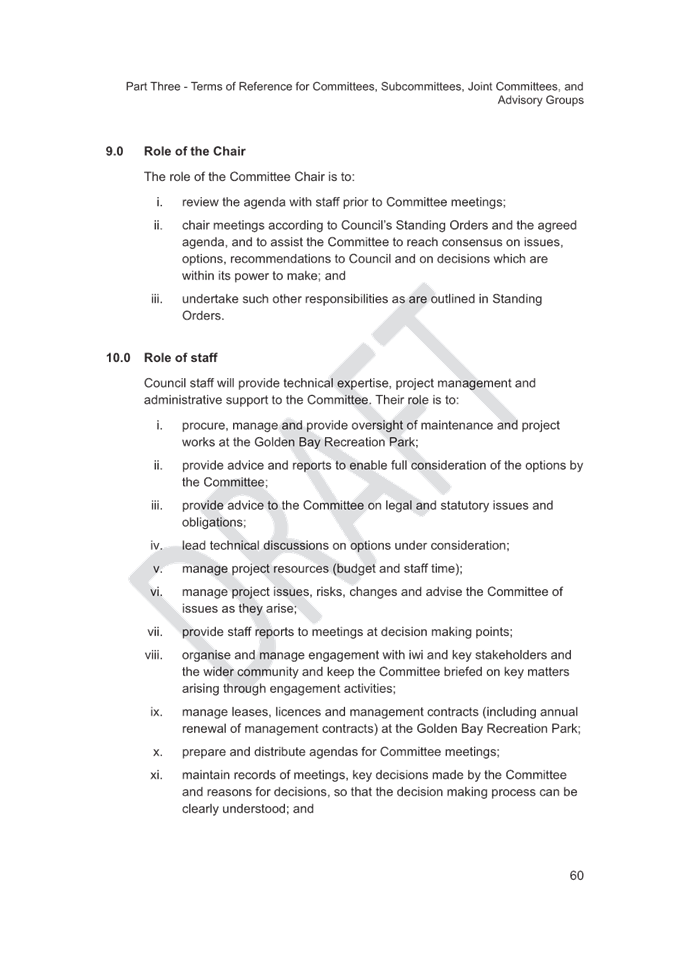
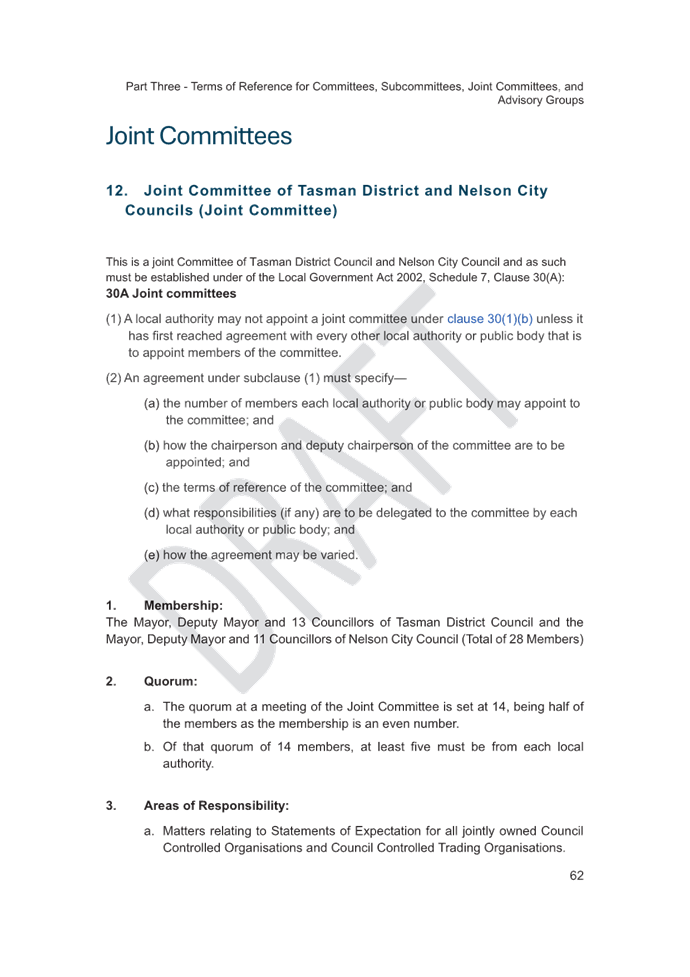
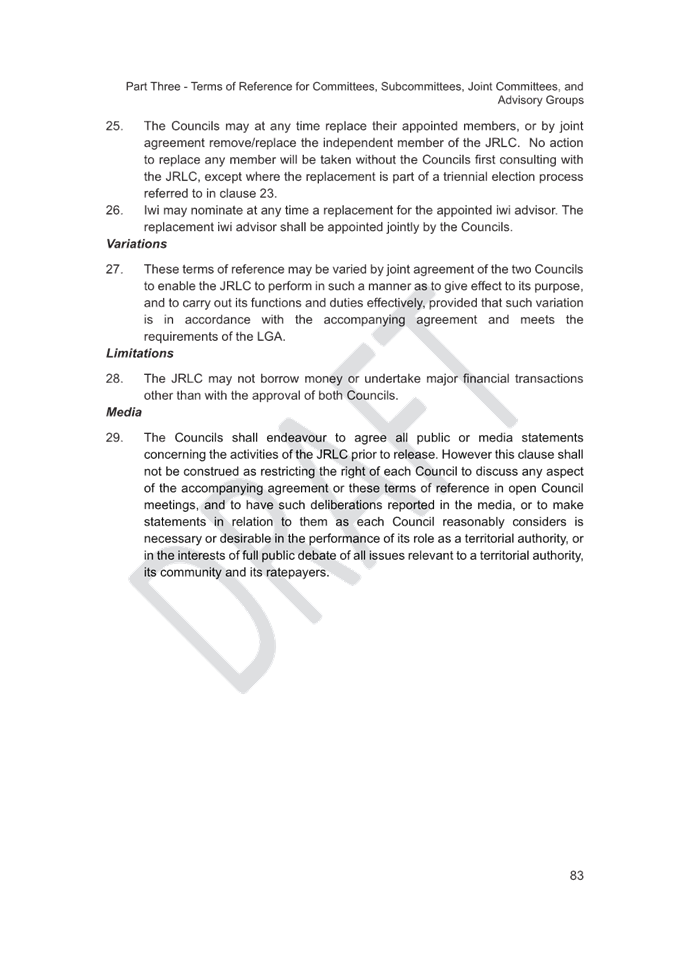
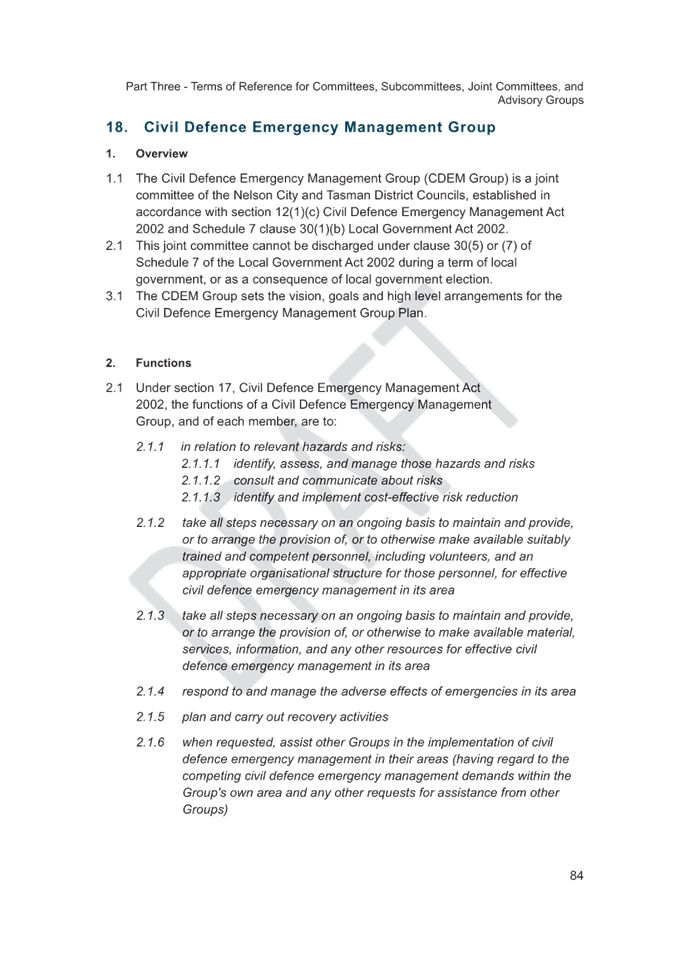
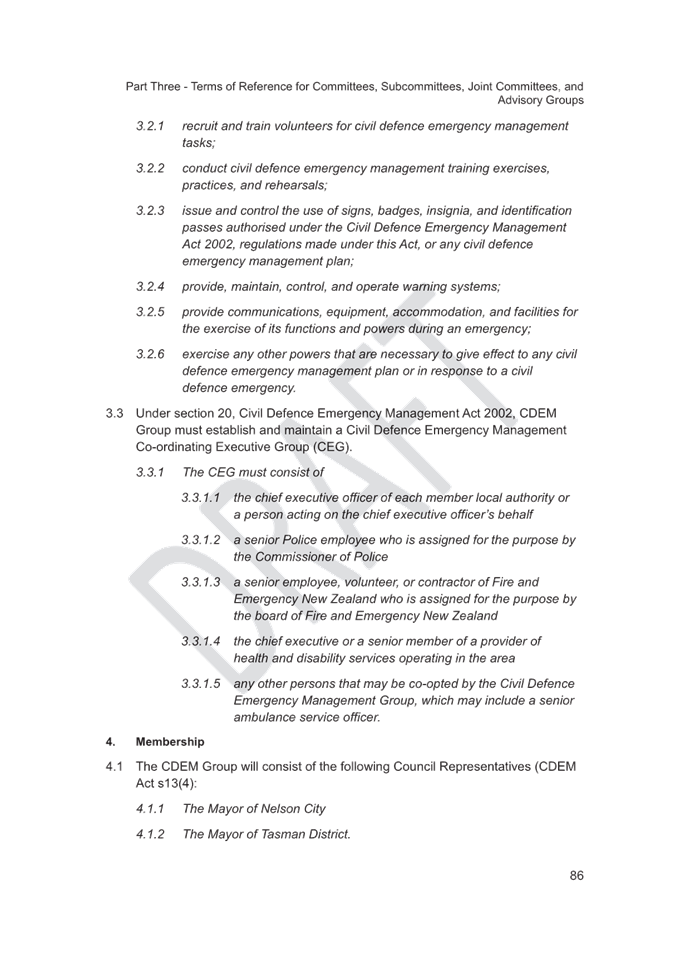
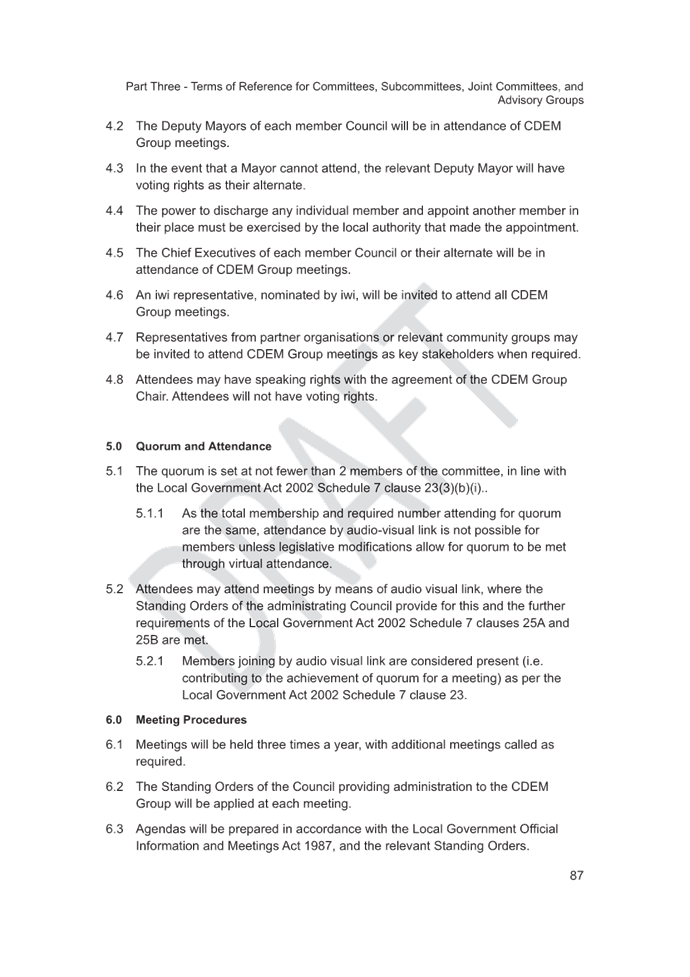
1.⇩
|
DRAFT
Delegations Register 2025-2028
|
10
|
|
2.⇩
|
Delegations
Register Change Log 2025
|
105
|
Tasman District
Council
Agenda – 11 December 2025



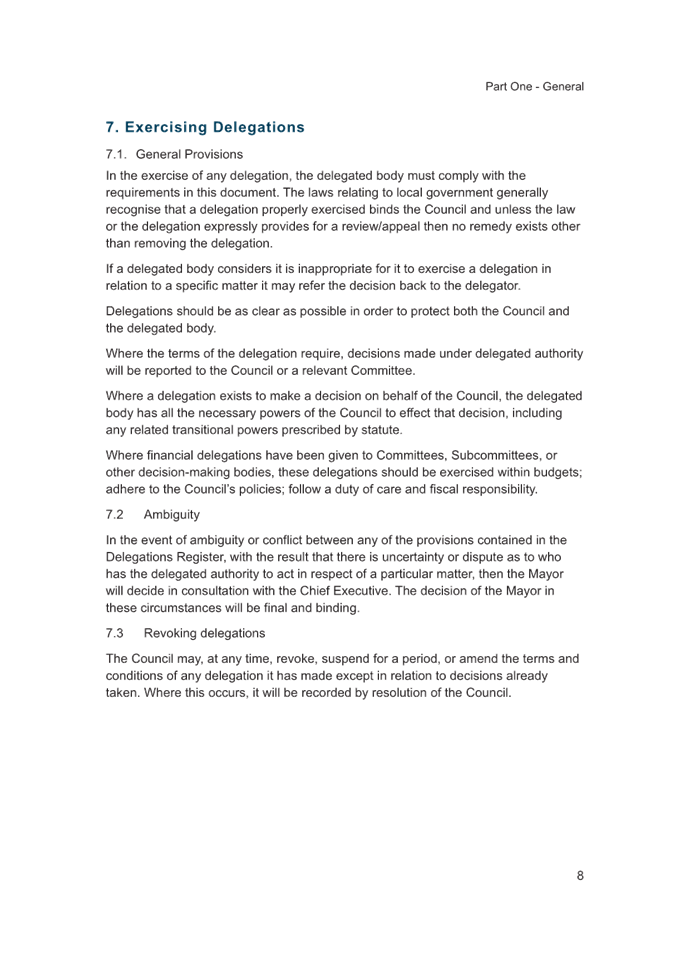

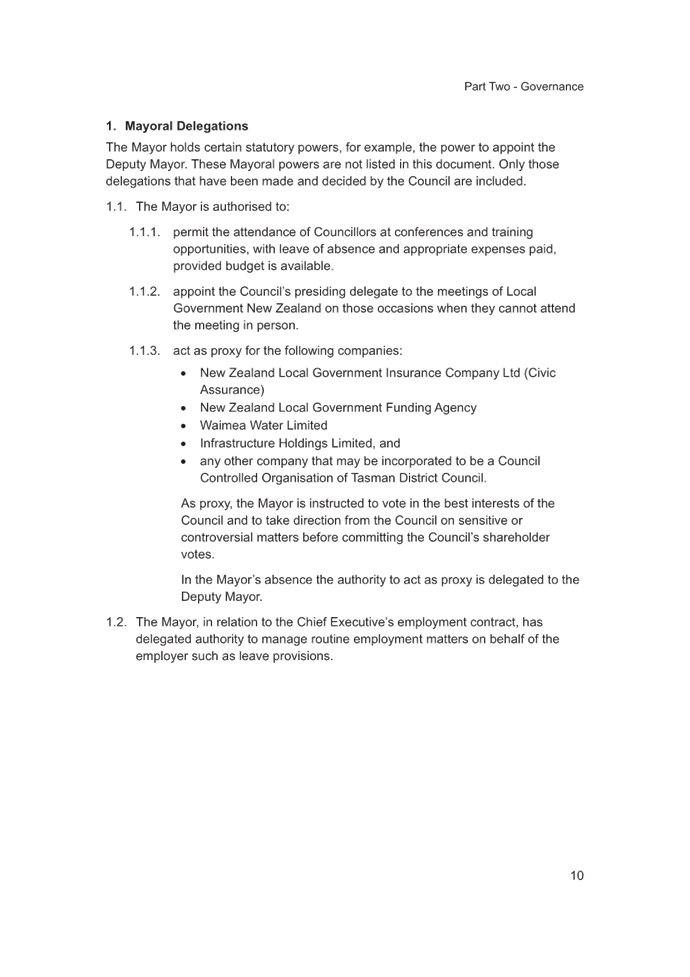
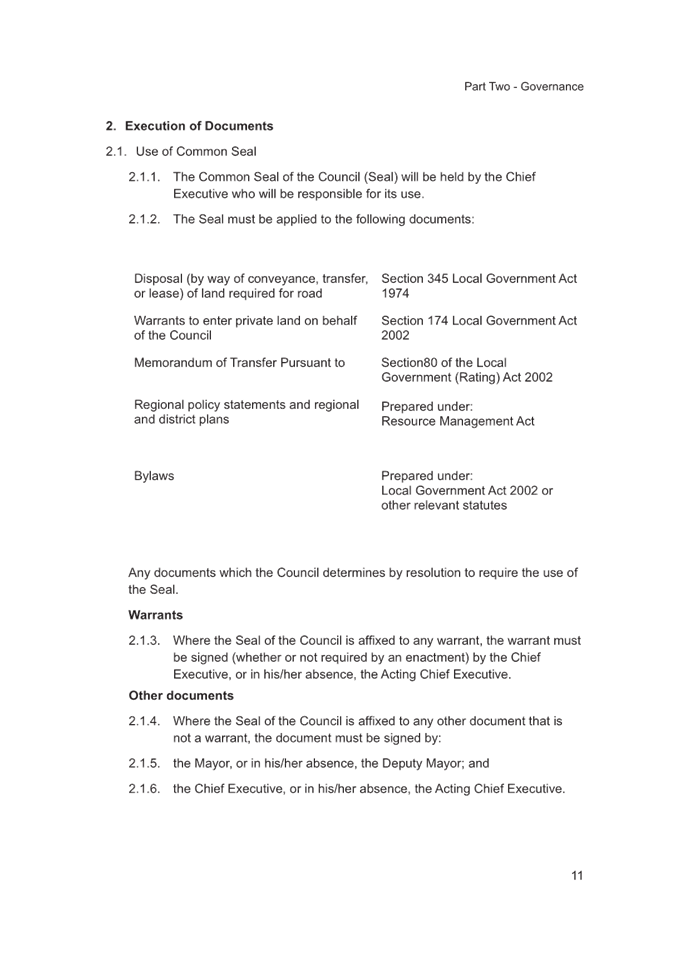

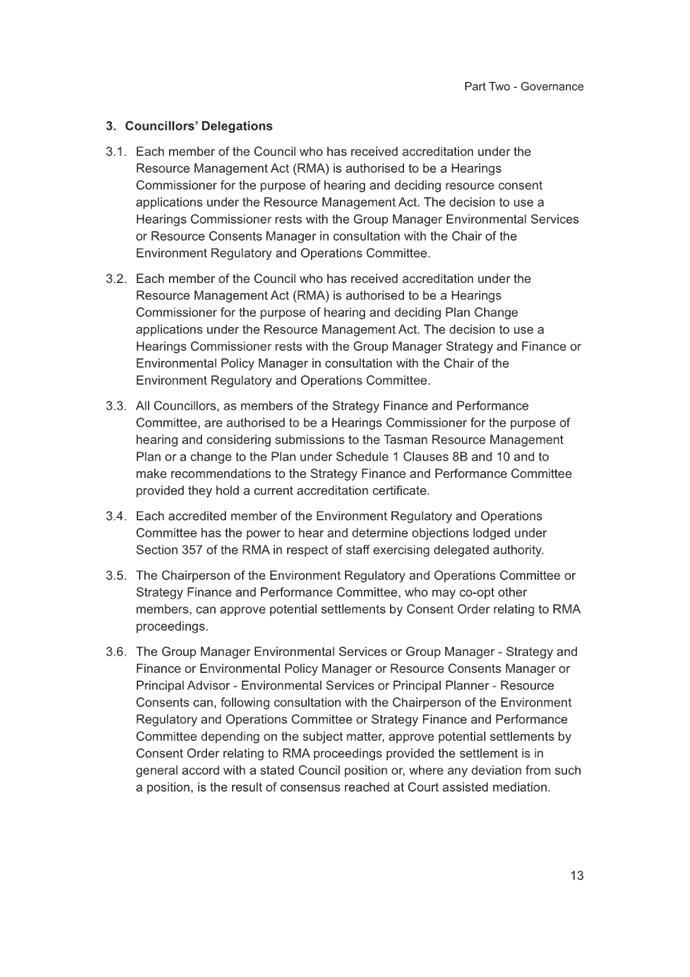
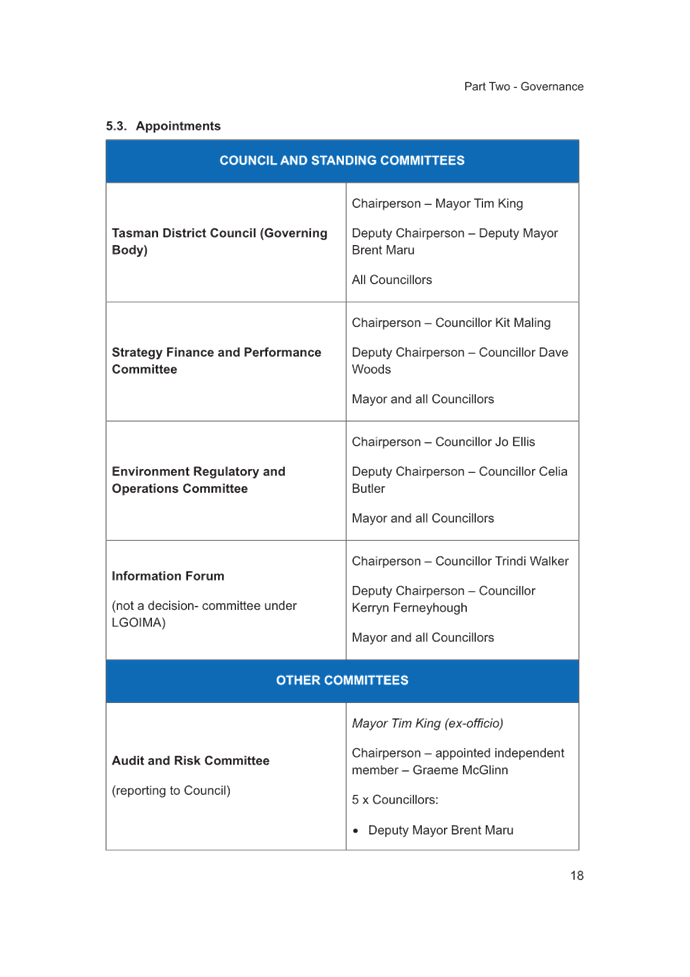
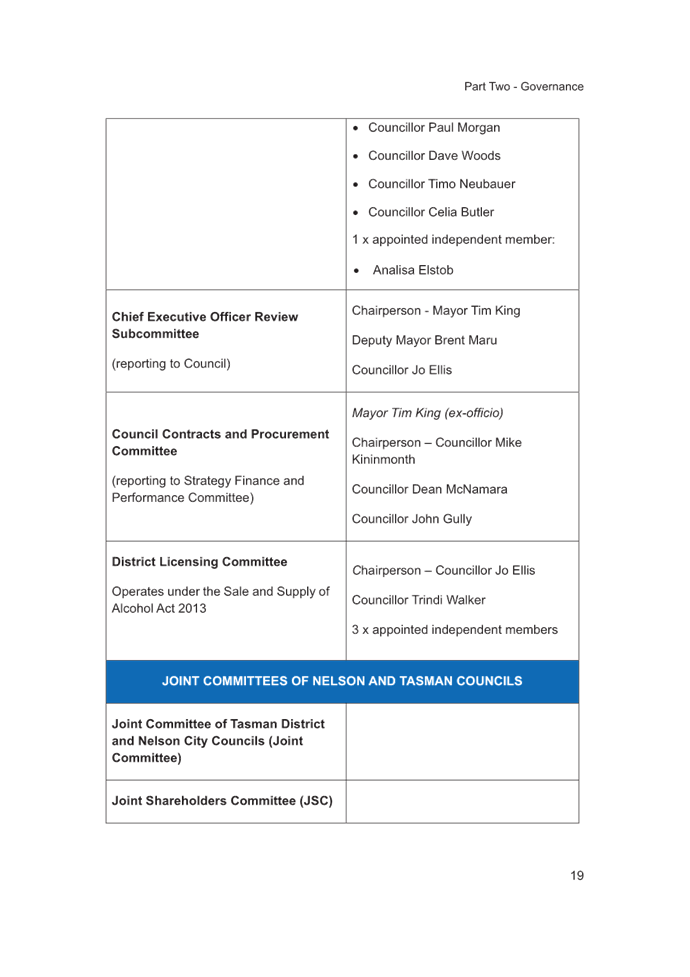
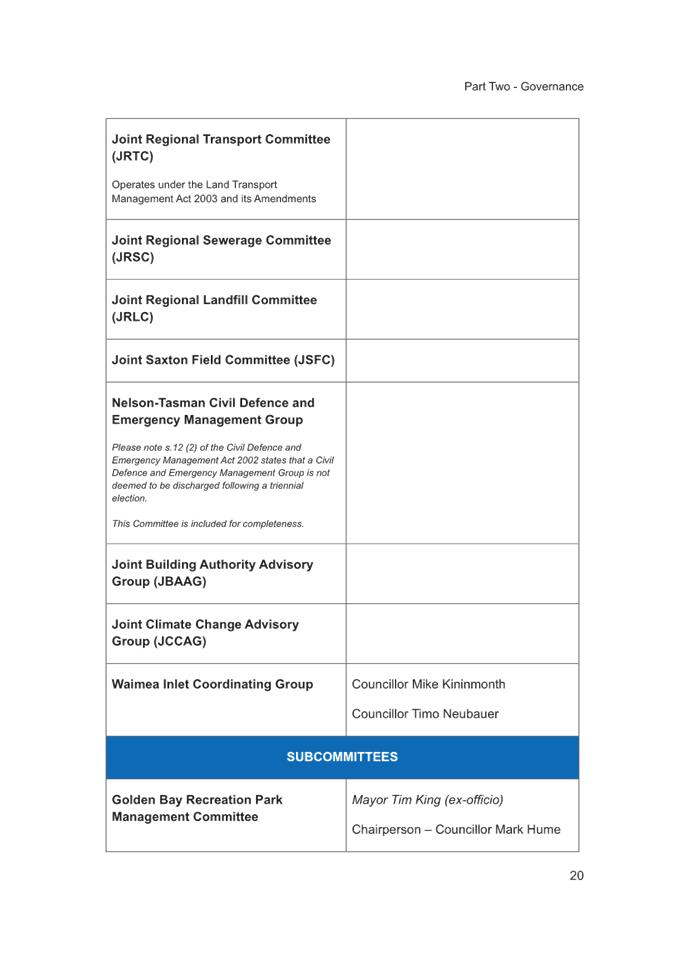
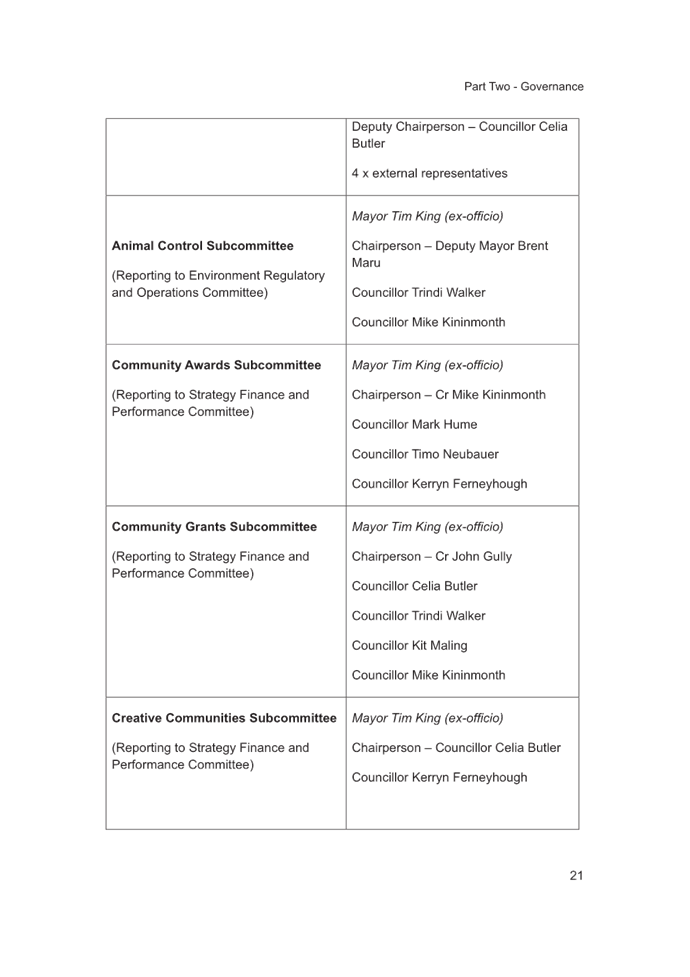





















Tasman District Council Agenda – 11 December 2025
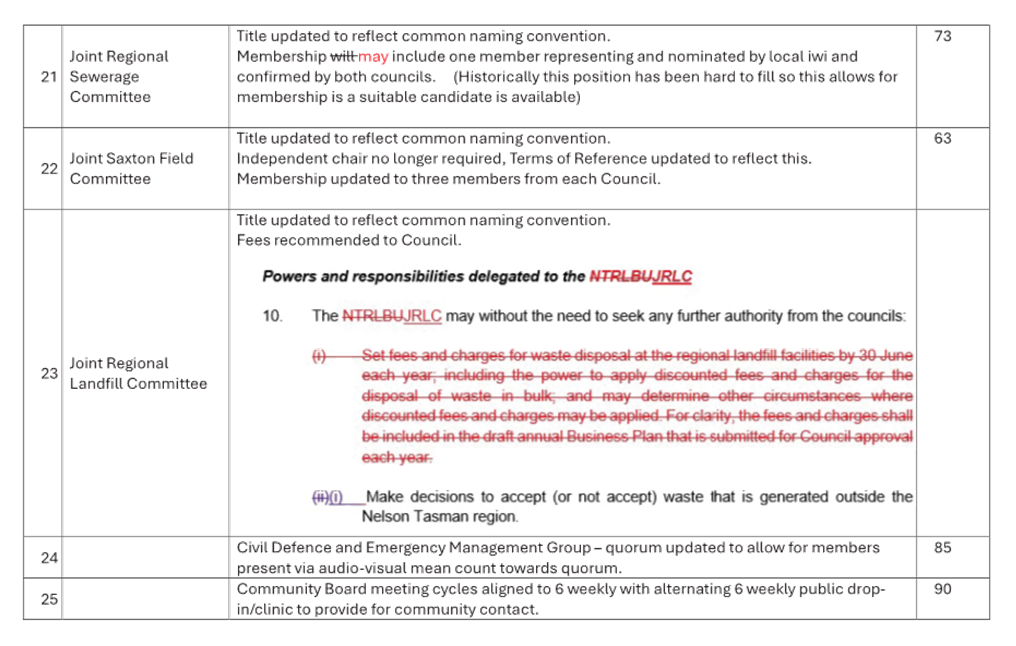
Tasman District Council Agenda – 11 December 2025
7.2 Membership of Tasman District Council and
Nelson City Council Joint Committees
Decision Required
|
Report
To:
|
Tasman
District Council
|
|
Meeting
Date:
|
11
December 2025
|
|
Report
Author:
|
Robyn
Byrne, Governance Manager
|
|
Report
Authorisers:
|
Steve
Manners, Chief Operating Officer
|
|
Report
Number:
|
RCN25-12-3
|
1. Purpose
of the Report / Te Take mō te Pūrongo
1.1 To
appoint the membership of Tasman District Council and Nelson City Council joint
committees.
2. Summary
/ Te Tuhinga Whakarāpoto
2.1 The
Terms of Reference of the joint committees of Tasman District and Nelson City
councils have been included in the Delegations Register, to be adopted at this
meeting, 11 December 2025.
2.2 Membership
was deferred at the first ordinary meeting on 15 November and it is now
appropriate to establish the membership of the committees.
2.3 The
Mayor has elected to make recommendations for the membership of each committee
for councillors to vote on instead of exercising the powers conferred on him
under Section 41A of the Local Government Act 2002.
3. Recommendation/s
/ Ngā Tūtohunga
That the Tasman
District Council
1. receives
the Membership of Tasman District Council and Nelson City Council Joint
Committees RCN25-12-3; and
2. appoints the membership of the Tasman District Council
and Nelson City Council joint committees as follows:
|
JOINT COMMITTEES OF NELSON
AND TASMAN COUNCILS
|
|
Joint
Committee of Nelson and Tasman Council (Joint Committee)
|
Mayor
Deputy Mayor
All other Councillors
|
|
|
Joint
Shareholders Committee
(JSC)
|
Mayor
Deputy Mayor
Councillor Jo Ellis
Councillor Kit Maling
Councillor Mike Kininmonth
Councillor Paul Morgan
|
|
|
Joint
Regional Transport Committee
(JRTC)
|
Mayor (ex-officio)
Deputy Mayor Maru
Councillor Jo Ellis
Alternates
Councillor Celia Butler
Councillor John Gully
1 x Waka Kōtahi representative
– Emma Speight (with voting rights)
|
|
|
Joint
Regional Sewerage Committee (JRSC)
|
Mayor (ex-officio)
Councillor Kit Maling (Chairperson)
Councillor Dave Woods
|
|
|
Joint
Regional Landfill Committee (JRLC)
|
Mayor (ex-officio)
Councillor Dean McNamara
Councillor Trindi Walker
|
|
|
Joint
Saxton Field Committee
(JSFC)
|
Councillor Mike Kininmonth
Councillor Kit Maling
Councillor Timo Neubauer
|
|
|
Civil
Defence and Emergency Management Group
Please note s.12 (2) of the Civil Defence and
Emergency Management Act 2002 states that a Civil Defence and Emergency
Management Group is not deemed to be discharged following a triennial
election. This Committee is included for completeness.
|
Mayor (Chairperson – alternates each triennium)
Deputy Mayor (alternate)
|
|
|
Joint
Building Authority Advisory Group
(JBAAG)
Terms of Reference to be confirmed
|
Deputy Mayor Brent Maru
Councillor Jo Ellis
|
|
|
Joint Climate
Change Advisory Group
(JCCAG)
Terms of
Reference to be confirmed
|
Councillor Kerryn Ferneyhough (Chairperson)
Councillor Timo Neubauer
Councillor John Gully
|
|
|
Waimea Inlet
Coordination Group
|
Councillor Mike Kininmonth
Alternate
Councillor Timo Neubauer
|
|
4. Financial
or Budgetary Implications / Ngā Ritenga ā-Pūtea
4.1 The suggested elected member
appointments have no financial or budgetary implications other than already
budgeted for.
5.1 The Council may vote to make these
appointments as per the Mayor’s recommendations or may vote on any other
nominations that are made by a councillor at the meeting.
6.1 The Mayor has chosen not to utilise his
powers under Section 41A of the Local Government Act
2002. Clause 31 (1) & (2), Schedule 7, provides for the appointment of
membership of committees and subcommittees.
7. Iwi
Engagement / Whakawhitiwhiti ā-Hapori Māori
7.1 Iwi have not been consulted in the
preparation of this report. A further report regarding iwi representation will
be brought to a future meeting.
8. Significance
and Engagement / Hiranga me te Whakawhitiwhiti ā-Hapori Whānui
8.1 The appointment of these positions is of
low significance. No public consultation is required. It is a decision solely
for the Council.
|
|
Issue
|
Level of
Significance
|
Explanation of
Assessment
|
|
1.
|
Is there a high level
of public interest, or is decision likely to be controversial?
|
Low
|
|
|
2.
|
Are there impacts on
the social, economic, environmental or cultural aspects of well-being of the
community in the present or future?
|
No
|
|
|
3.
|
Is there a
significant impact arising from duration of the effects from the decision?
|
No
|
|
|
4.
|
Does the decision
relate to a strategic asset? (refer Significance and Engagement Policy for
list of strategic assets)
|
No
|
|
|
5.
|
Does the decision
create a substantial change in the level of service provided by Council?
|
No
|
|
|
6.
|
Does the proposal,
activity or decision substantially affect debt, rates or Council finances in
any one year or more of the LTP?
|
No
|
|
|
7.
|
Does the decision
involve the sale of a substantial proportion or controlling interest in a CCO
or CCTO?
|
No
|
|
|
8.
|
Does the
proposal or decision involve entry into a private sector partnership or
contract to carry out the deliver on any Council group of activities?
|
No
|
|
|
9.
|
Does the proposal or
decision involve Council exiting from or entering into a group of
activities?
|
No
|
|
|
10.
|
Does the proposal
require particular consideration of the obligations of Te Mana O Te Wai
(TMOTW) relating to freshwater or particular consideration of current
legislation relating to water supply, wastewater and stormwater
infrastructure and services?
|
No
|
|
9. Communication
/ Whakawhitiwhiti Kōrero
9.1 Not applicable.
10.1 The risks associated with committee appointments
are minimal.
11. Climate
Change Considerations / Whakaaro
Whakaaweawe Āhuarangi
11.1 Little or no impact.
12. Alignment
with Policy and Strategic Plans / Te Hangai ki ngā aupapa Here me ngā
Mahere Rautaki Tūraru
12.1 Not applicable.
13. Conclusion
/ Kupu Whakatepe
13.1 The Council is asked to make these appointments,
either based on the Mayor’s recommendations, or through majority voting
for other nominations made on the day.
14. Next
Steps and Timeline / Ngā Mahi Whai Ake
14.1 Once the appointments are made, they will be publicly notified and
staff will complete the administration required to populate the membership of
the joint committees and the Council’s website will be updated
accordingly.
Nil
Tasman District
Council
Agenda – 11 December 2025
7.3 Notice of Motion – Councillor Timo
Neubauer
|
Report
To:
|
Tasman
District Council
|
|
Meeting
Date:
|
11
December 2025
|
|
Report
Author:
|
Councillor
Timo Neubauer
|
|
Report
Number:
|
RCN25-12-4
|
1. Purpose
of the Report / Te Take mō te Pūrongo
1.1 To
consider the notice of motion from Councillor Timo Neubauer.
1.2 A
copy of the Notice of Motion received by the Chief Executive from Councillor
Timo Neubauer is attached.
1.3 I, Councillor Timo Neubauer
hereby give notice that at the Tasman District Council meeting held on
Thursday, 11 December 2025 I will move the following motion, seconded by
Councillor Dave Woods:
2. Recommendation/s
/ Ngā Tūtohunga
That the Tasman District Council
1. Request
that staff prepare a feasibility report on organising a professional urban
design competition (and potentially a student competition) that produces
spatial concepts illustrating how Richmond can accommodate at least 30 years of
predicted population and employment growth through well-designed urban
intensification within its existing urban area, while:
a. considering
economic development factors (e.g. prioritising Central Business and Medium
Density Residential Zones of PC81);
b. considering
amenity;
c. protecting
productive land;
d. reducing
long-term operational infrastructure costs;
e. enhancing
environmental outcomes; and
2. Request that this report details the scope and process for the
competition, to be brought back to Council (or an appropriate Council
committee) for approval to proceed with such a competition. This is to include:
a. Objectives
and desired outcomes (e.g. better connectivity, transit-supportive corridors,
spatial restructuring of existing low-density neighbourhoods for efficient,
well-designed intensification, housing diversity, better stormwater management
through water-sensitive urban design and improved public realm quality);
b. Eligible
participants (e.g. New Zealand-based or international urban designers,
registered architects, registered landscape architects, planning consultancies
or in the case of a student competition, student teams from urban design,
architecture, landscape architecture or planning disciplines);
c. Information
and materials to be provided to competitors;
d. Competition
deliverables (e.g. two A0 sheets, landscape format - one illustrated plan at
1:3,000 scale, one more detailed neighbourhood plan at 1:1,500 and three
illustrations of key situations - plus one physical model of neighbourhood at
scale 1:1,500, separate indicative unit and GFA schedule, specified sheet
layout, plan orientation, no markings to identify submitter other than entry
number);
e. Pre-assessment checks
(e.g. min 30-year growth target is met) and assessment criteria;
f. Competition
judges/jury (e.g. Council governance representative(s), Council operative
representative, independent urban design specialists, together ensuring strong
representation of spatial urban design skills, chaired by professional urban
designer);
g. Proposed
pool of prize money and structure (1st prize, 2nd prize,
3rd prize plus honourable mentions to be determined by jury) and
potential for the winner’s future involvement in more detailed planning
process;
h. Budget estimate and
potential external funding or sponsorship opportunities;
i. Exhibition
venue options and PR opportunities; and
j. A proposed timeline
aligned with the Regional Spatial Strategy and the Long-Term Plan; and
3. Note
that the purpose of such competition is not to predetermine zoning or
consenting decisions, but to provide strategic, visual, and spatial evidence
that:
a. Demonstrates
feasible intensification scenarios;
b. Supports
community engagements and informed discussion;
c. Provides
Council with high-quality conceptual material for long-term planning.
|
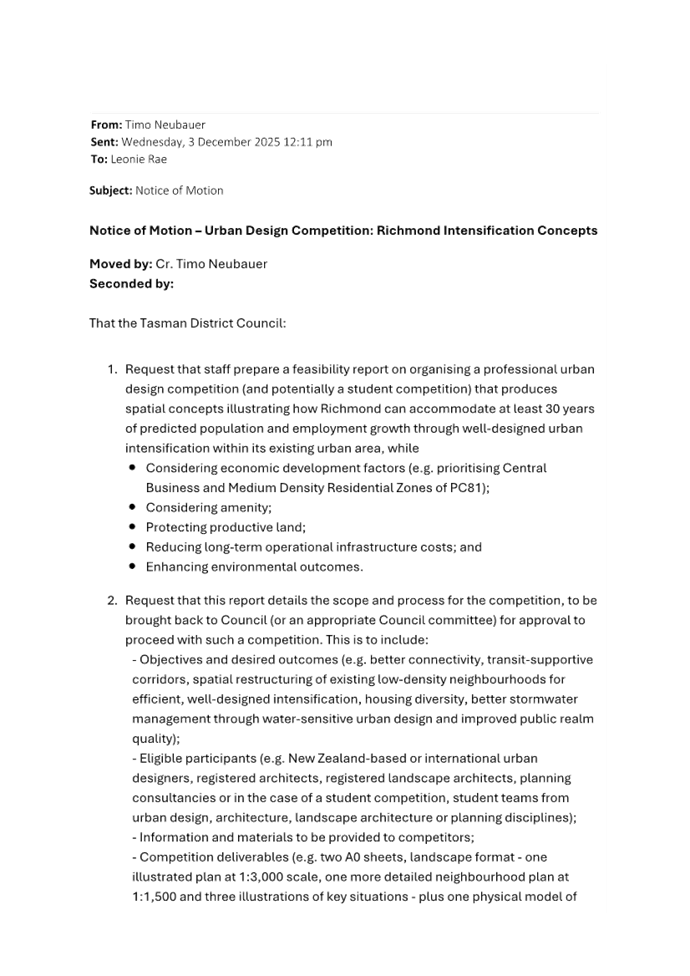
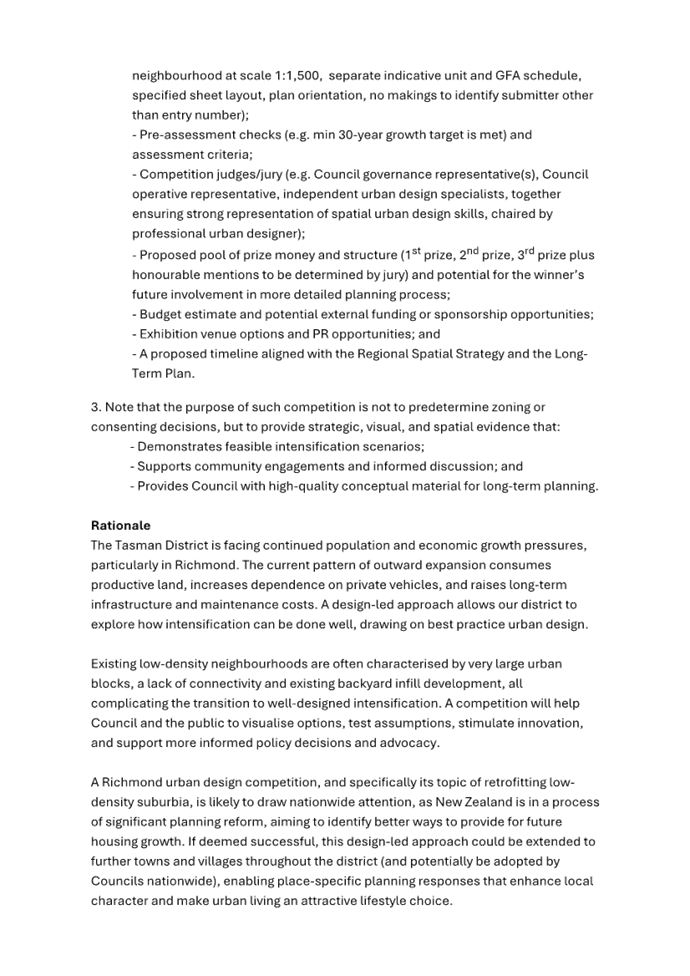
1.⇩
|
Notice of
Motion Attachment - Councillor Timo Neubauer
|
116
|
Tasman District
Council
Agenda – 11 December 2025
Tasman District Council Agenda – 11 December 2025
7.4 Golden Bay Ward reserves - proposed process to
classify existing reserves and review the RMP
Decision Required
|
Report
To:
|
Tasman
District Council
|
|
Meeting
Date:
|
11
December 2025
|
|
Report
Author:
|
Anna
Gerraty, Senior Community Policy Advisor
|
|
Report
Authorisers:
|
John
Ridd, Group Manager - Customer & Community; Susan McLean, Group Manager -
Strategy & Finance
|
|
Report
Number:
|
RCN25-12-5
|
1. Purpose
of the Report / Te Take mō te Pūrongo
1.1 The
purpose of this report is to:
1.1.1 inform the Council of the legal requirement to classify
existing reserves within the Golden Bay Ward before reviewing the Reserve
Management Plan (RMP) for that Ward;
1.1.2 seek agreement to initiate a process to classify those
existing reserves within the Ward that have not yet been formally classified in
accordance with Section 16 of the Reserves Act 1977 (the Act);
1.1.3 seek endorsement of the proposed process to review the
Golden Bay Ward RMP; and
1.1.4 seek agreement to publicly notify an invitation for
suggestions/ideas for inclusion in a Draft Golden Bay Ward RMP.
2. Summary
/ Te Tuhinga Whakarāpoto
2.1 This
report covers two work streams relating to management of reserves within Golden
Bay Ward:
(a) classification
of existing reserves under the Reserves Act 1977; and
(b) the proposed process for reviewing the RMPs
for Golden Bay Ward and Tata Beach.
2.2 The
existing reserve management plan for Golden Bay Ward, adopted in 2003, covers
many of the reserves located within the Ward. A separate Tata Beach RMP was
adopted in 2007, covering several reserves in the vicinity of Tata Beach.
Neither plan has been reviewed.
2.3 The
Council is the administering body for these reserves and therefore responsible
for classifying them and preparing a management plan for the reserves.
2.4 Classification
of many of the existing reserves (i.e. those that are already subject to the
Act) located in Golden Bay Ward remains an outstanding issue that needs to be
addressed. Most reserves have never been formally classified under the
Act. Classification needs to be undertaken before the Council publicly notifies
a Draft Golden Bay Ward RMP, to achieve compliance with section 41(3) of the
Act.
2.5 The
Council has delegated responsibility from the Minister of Conservation to
classify reserves under the Act. Staff recommend that the Council
resolves to initiate a process to classify existing reserves in this Ward,
under the Act.
2.6 Attachment
1 outlines the proposed timeline for both Ward reserves projects, with a
recommended project completion date of August 2026 for reserve classification.
This would allow public notice of final reserve classification to be included
within the New Zealand Gazette before public notification of a draft RMP.
2.7 The
second work stream is to prepare a single reserve management plan for all
Council-administered reserves located within the Golden Bay Ward.
2.8 Key
milestones in the proposed RMP review process include:
2.8.1 11 December 2025: The Council
resolves to seek written suggestions for inclusion in the draft RMP.
2.8.2 23 January to 30 March 2026:
Seeking ideas’ initial community engagement round.
2.8.3 April to June 2026: Development
of an initial draft Golden Bay Ward RMP.
2.8.4 June to July 2026: Iwi and
Golden Bay Community Board provide feedback on initial draft RMP.
2.8.5 September 2026: Strategy Finance
and Performance Committee considers and approves the draft RMP for public
release.
2.8.6 Mid-September to mid-November
2026: Draft RMP open for submissions for two months.
2.8.7 December 2026: Hearing Panel
holds hearing and deliberates on all submissions received.
2.8.8 January 2027: Staff amend RMP as
per Hearing Panel instructions and prepare decision report.
2.8.9 February 2027: Final RMP
considered and adopted by the Council.
3. Recommendation/s
/ Ngā Tūtohunga
That the Tasman
District Council
1. receives
the Golden Bay Ward reserves - proposed process to classify existing reserves
and review the RMP RCN25-12-5; and
2. agrees
to exercise the delegation from the Minister of Conservation to begin the
process of classifying existing reserve areas within Golden Bay Ward, in
accordance with Section 16 of the Reserves Act 1977; and
3. agrees
that, in terms of Section 41(5A) of the Reserves Act 1977, written suggestions
for inclusion in the Draft Golden Bay Ward Reserve Management Plan would
materially assist in its preparation; and
4. agrees
to publicly notify, pursuant to Section 41 of the Reserves Act 1977, an
invitation for suggestions/ideas for inclusion in a Draft Golden Bay Ward
Reserve Management Plan; and
5. agrees
that the areas of land to be covered by the Reserve Management Plan includes
all parks and reserve land owned or administered by the Council within the
Golden Bay Ward:
5.1 including
all reserves in the vicinity of Tata Beach, recreation reserves and some local
purpose reserves (walkways, esplanade reserves, community facilities, car parks
etc); and
5.2 excluding
Local Purpose (Road) Reserves and Local Purpose (Utility) Reserves or other
such land that has been reserved solely for provision of water, wastewater or
stormwater services; and
6. agrees
that staff prepare background information on Golden Bay Ward reserves for
display on the Council’s website and officers to assist the public
consultation processes associated with reserve classification and the Reserve
Management Plan review; and
7. agrees
that staff publish an article in the 23 January 2026 edition of Newsline,
inviting suggestions/ideas for inclusion in a Draft Golden Bay Ward Reserve
Management Plan, stating that suggestions may be made up until 30 March 2026;
and
8. agrees
that staff confirm that the appointment/vesting of each of the reserves to be
covered by the Golden Bay Reserve Management Plan is held with the Council and
to report back to the Council prior to public notification of a Draft Golden
Bay Ward Reserve Management Plan; and
9. agrees
that staff engage with Manawhenua ki Mohua, Te Tauihu iwi and the Golden Bay
Community Board, and consult with reserve/hall management committees within
Golden Bay Ward, along with a wide cross section of the community, during the
reserve classification and management plan review processes.
4.1 Over
25 years ago, the Council moved to a system of grouping reserves into Wards and
preparing management plans that covered most reserves within each Ward.
The Moturoa/Rabbit Island RMP, Tata Beach RMP and Abel Tasman Foreshore RMP are
exceptions to this – all other reserves that the Council administers
within Tasman District are covered by Ward RMPs.
4.2 In 2013, the Council adopted the
‘Reserves General Policies’ document, which covers all reserves in
the District.This high-level policy guidance does not need to be repeated in
Ward Reserve Management Plans. However, RMPs should outline any exceptions to
the general policies and provide more specific details to guide management of
individual reserves.
4.3 The existing Golden Bay Ward RMP
(2003) and Tata Beach RMP (2007) covers many, but not all, parcels of land that
have been reserved for recreation, scenic or local purposes. The Council
is the administering body for these reserves and therefore responsible for
classifying the reserves and preparing and reviewing a management plan for the
reserves.
4.4 A recent inventory revealed that
219 parcels of land, managed as 117 separate reserves, are administered by the
Council within the Golden Bay Ward. Reserve areas not currently included within
the existing Golden Bay Ward RMP include some Tata Beach reserves, some local
purpose reserves and several new reserves that have been vested in the Council
since the RMP was adopted.
4.5 Classification of existing
reserves needs to be completed before preparing a reserve management plan, to
comply with section 41(3) of the Reserves Act 1977 which states: “The
management plan shall provide for and ensure the use, enjoyment, maintenance,
protection, and preservation, as the case may require, and, to the extent that
the administering body's resources permit, the development, as appropriate, of
the reserve for the purposes for which it is classified, and shall
incorporate and ensure compliance with the principles set out in section 17,
section 18, section 19, section 20, section 21, section 22, or section 23, as
the case may be, for a reserve of that classification.” [emphasis
added]
5. Analysis
and Advice / Tātaritanga me ngā tohutohu
RESERVE CLASSIFICATION PROJECT
Classification of existing reserves
under the Reserves Act 1977
5.1 Classification
of reserves under the Act identifies the primary purpose of a reserve and helps
direct its management, usage and development. Classifying land as reserve
provides an additional layer of legislative protection under the Act.
Classification binds the Council and limits (to a greater or lesser extent) how
the land can be used. This increases the protection that the land has and
provides the community with certainty as to the types of activities that can
take place on the land.
5.2 The
Act outlines a process and methodology for the declaration, classification and
reclassification of land as a reserve:
· Section 14 provides the Council with the statutory authority to pass
a resolution to declare any land owned by the Council as a reserve subject to
undertaking the necessary public notification procedures under section 119 of
the Act.
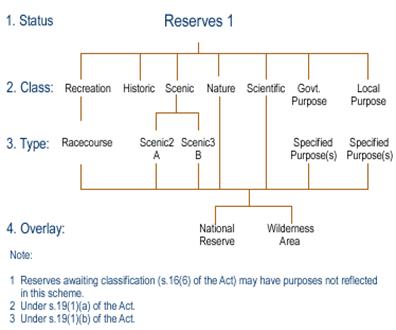
· Classification is a mandatory process under section 16 of the Act
which involves assigning a reserve (or parts of a reserve) to the appropriate
class (and, if required, the type and overlay) within the framework shown in
the diagram below. The “class” determines the principle or primary
purpose of the reserve. The determination of an appropriate classification
category for a reserve should follow a robust methodology and criteria and is a
matter the community should have adequate input into.
· Section 24 outlines the process to reclassify reserves.
Reclassification may be needed to:
(i) change the primary purpose to highlight one set of features over
another; or
(ii) allow new activities to occur that cannot occur under the
current classification.
Framework for Classification
5.3 The
four-tier framework of reserve classification under the Reserves Act is shown
in the diagram below.
5.4 Overlays
are unlikely to be required for reserves located within Golden Bay Ward (Nature
and Scientific reserves tend to be administered by the Department of
Conservation, not councils). However, some reserves are likely to require a
‘Type’ – eg Class: Local Purpose, Type: Hall.
Delegated authority to classify reserves
5.5 On
12 June 2013, the Minister of Conservation signed off an Instrument of
Delegation for Territorial Authorities pursuant to section 10 of the Reserves
Act 1977. The delegation provides the Council with the authority to classify or
reclassify reserves under sections 14, 16 and 24, provided the title of the
reserve was not derived from the Crown. Before 2013, the Minister was
responsible for classifying reserves.
Classifying reserves in Golden Bay Ward
5.6 To
date, we have identified 219 parcels of land within Golden Bay Ward that the
Council administers as reserves. These land parcels represent 117 reserves
(some reserves comprise of two or more land parcels). Of these, we expect very
few will have been classified under the Reserves Act 1977, meaning that the
Council will need to undertake the process to classify these existing
reserves. We will send the Department of Conservation our list of
reserves and ask them to check their records to confirm that this is the
case.
5.7 Until
the time that the reserves are classified, section 16(6) of the Act
applies. Section 16(6) states: “Subject to subsection (7), every
existing reserve shall be held and administered for the purpose of its existing
reservation, and the administering body shall continue to control and manage
the reserve under the appropriate provisions of this Act pending its
classification under subsection (1)”.
5.8 Section
16 of the Reserves Act 1977 sets out the process for classifying reserves. The
final step in the process is publication of a notice in the New Zealand
Gazette, which describes the classification of each reserve (refer sections
16(1) and 16(2) of the Act).
5.9 As
reserve classification is mandatory, the Council needs to undertake a process
to classify all existing reserves within Golden Bay Ward that have not
previously been classified.
5.10 Public
notice of the intention to classify is required under s16 of the Act, unless
the classification meets the test outlined in s16(5), i.e. “(a) the
classification proposed for any reserve is substantially the same as the
purpose for which the reserve was held and administered immediately before the
commencement of this Act”.
5.11 Staff
recommend that the Council initiates a public consultation process to classify
existing reserves in the Golden Bay Ward that have not yet been classified, as
per s16 of the Act, and completes this process before agreeing to publicly
notify a Draft Golden Bay Ward RMP.
Methodology to select reserve
classification
5.12 A
thorough methodology should be followed to determine the appropriate
classification categories for each reserve.
5.13 Over
the next few months, staff will undertake background research on each reserve
to be classified. Staff will obtain the acquisition history of each land parcel
and visit the sites to assess the primary and secondary values, purpose,
current and potential use, and contribution to the wider open space context.
5.14 This
information will be assessed against the criteria in the Reserves Act 1977 and
the Department of Conservation’s Reserves Act Guide, to determine the
most appropriate classification category. The assessment will also consider
whether any of the current and potential uses or activities should be
restricted in future.
5.15 Note
that some sites have a range of functions and values worthy of recognition and
protection, meaning more than one classification could be appropriate. The
recommended classification should reflect the primary purpose of the land as
well as enabling appropriate activities to take place. Secondary values can be
protected by provisions in the reserve management plan.
Consultation on reserve classification
proposals
5.16 A
summary of information will be attached to a report to the Strategy Finance and
Performance Committee, setting out the proposed classification of each existing
reserve to be classified. We aim to complete this report by April 2026 (see
timeline in Attachment 1). This report will also request that the Committee
publicly notifies the proposed reserve classifications and calls for
submissions.
Properties not formally protected as
reserves under the Act
5.17 Several
park/‘reserve’ areas that the Council administers in the Golden Bay
Ward are not held or protected as reserves under the Act. Most of these
were purchased (or gifted to the Council) with fee simple title and have never
been formally declared to be a reserve under the Act.
5.18 While
these areas form key parts of our open space network in Golden Bay Ward, we
recommend retaining them as is (i.e. not declaring them as reserves under the
Act) at this point in time. The reason for this is that Wakatū
Incorporated has asked the Council to defer any processes that may result in
changes to land status (e.g. declaring land as reserve) until the High Court
has made its determination regarding the Nelson Tenths Reserves. Further
details about this case are provided in paragraphs 5.20 to 5.26 below.
5.19 Staff
recommend including all areas of fee simple land that the Council manages as
parks/open spaces within the Draft Golden Bay Ward Reserve Management Plan.
Provided it is clearly stated that these parcels are not reserves under the
Act, we can still provide useful management direction for these areas, under
the umbrella of the Plan. This approach has been taken for all other Ward RMPs.
Nelson Tenths Reserves case
5.20 On
28 February 2017, the Supreme Court released its decision in Proprietors of
Wakatū & Rore Stafford v Attorney- General [2017] NZSC 17, allowing
the appeal, and sending the case back to the High Court to determine matters of
breach, loss and remedy.
5.21 The
case relates to the creation of the Nelson Tenths Reserves, in the early days
of colonial New Zealand. It seeks to secure the return of land from the Crown
to make up the full ‘tenth’ that was guaranteed to Māori, but
which the Crown never reserved in full.
5.22 This
is not a Treaty claim. It is a private law claim centred on the establishment
of Nelson/Tasman by the New Zealand Company in 1839-1845. It is about the
rights of Māori customary landowners to hold the Crown to account in
circumstances where the Crown agreed to act on their behalf in fulfilling the
terms of the Spain award. Under the Spain award, land amounting to
one-tenth of the recommended grant to the Company was to be reserved for the
benefit of the original Māori owners. Only 5,100 acres of the 15,100 acres
of tenth reserves were identified and reserved at the time of the award.
5.23 The
Supreme Court did not finally decide the case, on the basis that the High Court
still needs to make findings on the extent to which the Crown has acted in
breach of its fiduciary duties, and on what remedies should be granted for
those breaches. The case has been referred back to the High Court to decide
these further points.
5.24 The Supreme Court’s decision is
significant because it is the first time a New Zealand court has found that the
Crown owes fiduciary duties to Māori landowners to protect their property
rights. Accordingly, the Crown has a legal obligation to
protect those rights and fulfil the terms of the Trust relating to the Tenths
Reserves and Occupation Lands.
5.25 In 2023, a significant phase of the case occurred.
The 10-week trial held in Wellington’s High Court focused on the
Crown’s liability and the valuation of losses experienced by Māori
landowners. The plaintiffs estimate that restitution could amount to over $2
billion, reflecting both the land lost and the harm caused by the Crown's
failure to uphold its fiduciary duties. Further legal deliberations have been
ongoing regarding the extent of the breaches by the Crown.
5.26 The Government lodged an appeal on the High Court ruling made in
October 2024, meaning the case remains unresolved as at December 2025.
RESERVE MANAGEMENT PLAN PROJECT
Proposed process for reviewing the
reserve management plan
5.27 This
part of the report outlines the proposed process to review the Golden Bay Ward
Reserve Management Plan. Section 41 of the Reserves Act 1977 sets out the legal
requirements for this management planning process.
5.28 The
attached project plan overview outlines the key steps in the process, with an
anticipated completion date of February 2027.
5.29 The
first steps that the administering body for the reserves (i.e. the Council)
must undertake are:
(i) make a decision to begin the plan
review process;
(ii) determine the areas of land to be
covered by the RMP;
(iii) determine which areas are reserves
subject to the Reserves Act 1977;
(iv) confirm that the appointment or vesting is
held;
(v) determine whether or not there are any
unclassified reserves to be covered by the RMP;
(vi) resolve (in terms of s.41(5A)) whether or not
written suggestions on the proposed RMP would materially assist in its
preparation; and
(vii) decide who to consult.
Each of these
steps is discussed in more detail below.
5.30 Once
these decisions have been made, staff will prepare information for public
release and invite suggestions on the proposed RMP.
5.31 Staff
recommend that adequate time (two months) is provided for the first stage of
the process and that a range of community engagement tools are employed, to
encourage participation from a wide cross-section of the community.
5.32 The
Act requires that the draft RMP is made publicly available for comment (i.e.
open for formal written submissions) for a period of at least two months and
that hearings be held for those who wish to speak to their submission.
This formal stage of the public consultation process is planned to start in
September 2026 (see Attachment 1).
5.33 The
Council also must appoint a Hearing Panel to hear submissions on the Draft RMP.
This step of the process can take place after the Council approves the release
of the Draft RMP for public comment (scheduled for September 2026).
5.34 As
there is likely to be a moderate level of interest in the proposed RMP, this
report includes detailed information on each of the steps that the Council
needs to consider for developing this plan.
Steps in Plan review process
Step 1: Make a decision to begin the RMP
review process
5.35 The
existing Golden Bay Ward RMP was adopted in 2003 and Tata Beach RMP was adopted
in 2007. Neither have been through a complete plan review process. Reserve
management plans should be ‘living documents’ that are continually
reviewed in response to issues that arise. As both plans are well overdue for
review; it is recommended that this process begins now.
Step 2: Determine the areas of land to be covered by the RMP
5.36 Staff
recommend that the areas of land to be covered by the RMP should include all
parks and reserves within the Golden Bay Ward, including Tata Beach reserves,
but excluding Local Purpose (Road or Utility) Reserves or similar.
Step 3: Determine which areas are reserves subject to the Reserves
Act 1977
5.37 Staff
have identified 219 parcels of land within the Golden Bay Ward that are owned
and/or administered by the Council that should be included within the RMP.
Staff are still working through the process of determining which are already
subject to the Reserves Act (existing reserves) and those areas that are fee
simple land owned by the Council.
Step 4: Confirm that the appointment or vesting is held
5.38 Staff
still have more work to complete before we can confirm this for each of the
parcels of land within Golden Bay Ward.
Step 5: Determine whether or not there are any unclassified reserves
to be covered by the RMP
5.39 As
outlined in the subsection on reserve classification above, many of the
existing reserves within Golden Bay Ward have never been formally classified
under the Reserves Act 1977. Classification must be undertaken via resolution
of Council and publication of a notice in the New Zealand Gazette before a
Draft RMP is publicly notified.
Step 6: Resolve, in terms of s41(5A),
whether or not written suggestions on the proposed RMP would materially assist
in its preparation
5.40 Section
41 of the Reserves Act 1977 states:
“(5)
Before preparing a management plan for any 1 or more reserves under its
control, the administering body shall — (a) give public notice of
its intention to do so; and (b) in that notice, invite persons and
organisations interested to send to the administering body at its office
written suggestions on the proposed plan within a time specified in the notice;
and (c) in preparing that management plan, give full consideration to any
such comments received.
(5A) Nothing
in subsection (5) shall apply in any case where the administering body has, by
resolution, determined that written suggestions on the proposed plan would not
materially assist in its preparation.”
5.41 Staff
recommend that the Council seeks written suggestions on the Draft RMP, and that
a two-month period is made available for this stage of the process. This will
enable us to engage with Manawhenua ki Mohua, Te Tauihu iwi, the Golden Bay
Community Board, and reserve/hall management committees, along with a wide
cross-section of the Golden Bay community, to seek ideas and other feedback,
and develop a Draft RMP in a collaborative way.
5.42 Once
the Council approves the release of a Draft RMP, the next stage is to invite
written submissions and hold hearings.
Step 7: Decide who to consult with
5.43 Staff
recommend that consultation with Manawhenua ki Mohua and Te Tauihu iwi is
undertaken separately to community engagement, given the Council’s
responsibilities under the Local Government Act, Reserves Act and Treaty
settlements. Guidance on involvement of iwi in reserve management planning is
included in the ‘Guide for Reserve Administering Bodies’ (available
on the DOC website). Each of the eight Te Tauihu iwi have a significant
interest in the Golden Bay Ward.
5.44 Staff
also recommend consulting with a wide range of organisations and people from
the local community, including reserve/hall management committees. Community
engagement should aim to be as inclusive as possible.
6. Financial
or Budgetary Implications / Ngā Ritenga ā-Pūtea
6.1 The
budget for both projects has been provided for in the Council’s Long Term
Plan.
7.1 The options are outlined in the
following table:
|
Option
|
Advantage
|
Disadvantage
|
|
1(a)
|
Initiate a full public consultation
process to classify existing reserves in Golden Bay Ward in accordance with
Section 16 of the Reserves Act 1977.
|
All interested parties can have input to this process.
|
No obvious disadvantage.
|
|
1(b)
|
Defer the task of declaring land as
reserve (and assigning it a classification) under the Reserves Act until the
Nelson Tenths Reserve claim has been resolved.
|
This option aligns with the process the
Council has used for all other Ward reserves projects. If this same approach
is taken to the Golden Bay Ward reserves project, then all land to be
declared as reserves within Tasman District could be dealt with at one time.
A public consultation process would be required.
|
Some people may wish to see land areas given a higher
level of legal protection as soon as possible, rather than delaying this
task.
|
|
1(c)
|
Initiate both reserve projects
concurrently; and agree to follow the proposed process for undertaking the
RMP review (subject to any further changes that the Council may have), noting
that the reserve classification process needs to be completed before a Draft
RMP is publicly notified.
|
The public will have three opportunities
to provide feedback: firstly by providing ideas and suggestions for inclusion
in the draft RMP and during the two formal consultation rounds (one for
reserve classification and the other for the RMP).
|
Length of time to review RMP is extended
by two months, to include initial ‘seeking ideas’ round.
|
|
2
|
Defer the classification of existing
reserves in Golden Bay Ward.
|
This would free up staff time for other
projects.
|
The legality of the RMP could be challenged, as reserves
must be managed in accordance with their purpose (i.e. classification).
|
|
3
|
Defer the RMP review.
|
This would free up staff time for other
projects.
|
The existing RMPs are 20 years old. They do not cover many
of the park and reserve areas within the Golden Bay Ward, meaning no specific
management guidance is in place for these. Guidance provided for other parks
and reserves is outdated.
If the RMP review is deferred, the public will not have a
say in how the Ward reserves are to be managed in future.
|
|
4
|
Choose not to seek suggestions from the
public prior to drafting the RMP.
|
This could speed up the RMP review
process.
|
Staff will have no understanding of public opinion on how
parks and reserves in the Ward should be managed.
If feedback was limited to comments on a draft RMP only,
substantial rework of the document be needed, potentially requiring a further
round of consultation to give others the opportunity to comment.
|
7.2 Option 1(a)-(c) is recommended.
8.1 The
reserve classification and plan review processes will be undertaken in
accordance with the Reserves Act 1977, as outlined in section 5 of this
report.
8.2 Once finalised and adopted by the
Council, the Golden Bay Ward RMP document will replace the current RMP. Tata
Beach reserves will be included within the new RMP.
9. Iwi
Engagement / Whakawhitiwhiti ā-Hapori Māori
9.1 Staff recommend that consultation
with Manawhenua ki Mohua and Te Tauihu iwi is undertaken separately to
community engagement, given the Council’s responsibilities under the
Local Government Act, Reserves Act and Treaty settlements. Guidance on involvement
of iwi in reserve management planning is included in the ‘Guide for
Reserve Administering Bodies’ (available on the DOC website). Each
of the eight Te Tauihu iwi have a significant interest in Golden Bay Ward
reserves.
9.2 Earlier this year staff provided
information to iwi on both projects and asked iwi Taiao staff members about how
they wished to be involved.
10. Significance
and Engagement / Hiranga me te Whakawhitiwhiti ā-Hapori Whānui
10.1 As
outlined in the following table, staff consider that these two projects will be
of low to medium significance to residents of Golden Bay Ward/Tasman District,
but of high significance to some iwi/Māori.
10.2 Formal
public consultation is required under the Reserves Act 1977.
10.3 Given
the level of interest in this area, staff consider it appropriate that a
two-stage engagement process is undertaken for development of the Golden Bay
Ward RMP, as outlined in Section 5 of this report.
|
|
Issue
|
Level of
Significance
|
Explanation of
Assessment
|
|
1.
|
Is there a high level
of public interest, or is decision likely to be controversial?
|
Medium
|
The proposals to
classify reserves and review the RMP will be of interest to iwi, nearby
residents, community groups and other parties/organisations. Golden Bay Ward
residents are likely to be more interested than those in other parts of the
District. Some iwi/Māori are likely to have a high level of interest in
these projects.
|
|
2.
|
Are there impacts on
the social, economic, environmental or cultural aspects of well-being of the
community in the present or future?
|
Low
|
Encouraging
participation in a two-step engagement process for RMP development
contributes to community wellbeing.
|
|
3.
|
Is there a
significant impact arising from duration of the effects from the decision?
|
Low
|
This report
encourages the Council to publicly notify its intention to seek suggestions
and ideas for inclusion in a Draft Golden Bay Ward RMP. No land status will
change as a result of this report.
|
|
4.
|
Does the decision
relate to a strategic asset? (refer Significance and Engagement Policy for
list of strategic assets)
|
N/A
|
|
|
5.
|
Does the decision
create a substantial change in the level of service provided by Council?
|
N/A
|
|
|
6.
|
Does the proposal,
activity or decision substantially affect debt, rates or Council finances in
any one year or more of the LTP?
|
N/A
|
|
|
7.
|
Does the decision
involve the sale of a substantial proportion or controlling interest in a CCO
or CCTO?
|
N/A
|
|
|
8.
|
Does the
proposal or decision involve entry into a private sector partnership or
contract to carry out the deliver on any Council group of activities?
|
N/A
|
|
|
9.
|
Does the proposal or
decision involve Council exiting from or entering into a group of
activities?
|
N/A
|
|
|
10.
|
Does the proposal
require particular consideration of the obligations of Te Mana O Te Wai
(TMOTW) relating to freshwater or particular consideration of current
legislation relating to water supply, wastewater and stormwater
infrastructure and services?
|
N/A
|
|
11. Communication
/ Whakawhitiwhiti Kōrero
11.1 Public notification of the opportunity to provide
feedback and ideas for inclusion in the draft RMP will be included in the 23
January 2026 edition of Newsline. Proposals to classify reserves will also be
publicly notified later in 2026.
11.2 Staff will create a Shape Tasman webpage for
consultation purposes and encourage participation via the Council’s
social media channels. Hard copies of consultation material will be available
for viewing at the Council’s Golden Bay office and library.
12.1 The
risks associated with approving the proposed process for classifying the
existing reserves and reviewing the RMP are minimal, given that there will be
the opportunity for public feedback to be incorporated into reserve
classification and the development of the Draft RMP.
12.2 There
is a slight risk with delaying the task of declaring land as a reserve (and
assigning it a classification) under the Reserves Act. Some people may want the
Council to declare areas of fee simple land that we currently manage as a
park/recreation ground/open space area as reserve as soon as possible, rather
than waiting for the Nelson Tenths Reserve case to be resolved by the High
Court. However, there would be a reputational risk for the Council with
iwi if it was to declare these areas reserve before the case is resolved. These
areas of land will be included within the RMP and managed in accordance with
the objectives and policies included in the final RMP – i.e. continue to
be treated as if they were reserves.
12.3 The
risks associated with approving the proposed process for reviewing the RMP is
minimal, given that there will be the opportunity for public feedback to be
incorporated into the draft RMP.
12.4 The
public will have two opportunities to participate in RMP development: firstly,
by suggesting ideas for inclusion and secondly, by making submissions on the
draft RMP (and speaking to their submission at a hearing, if they wish) once
publicly notified.
13. Climate
Change Considerations / Whakaaro
Whakaaweawe Āhuarangi
13.1 The matter requiring a decision in this report was
considered by staff in accordance with the process set out in the
Council’s ‘Climate Change Consideration Guide 2024’.
13.2 The proposal will have no significant implications
for greenhouse gas emissions over its lifetime and therefore does not require
an approach to reduce them.
13.3 Climate change impacts will not have any direct
effect upon the proposal over its lifetime.
13.4 The proposal neither contributes to, nor detracts
from, the Council’s and central government policies and commitments
relating to climate change.
14.1 The Council has delegated authority from the
Minister of Conservation under the Reserves Act 1977 to classify reserves
(other than those derived from the Crown) and to prepare, review and adopt
reserve management plans (see paragraph 5.5 above for further details).
14.2 Under the Community Board terms of reference, the
Golden Bay Community Board has the power to make recommendations on the
following matters in relation to local parks and reserves in its ward:
a) proposed developments on reserves;
b) proposals to declare lands as reserves or to classify
reserves; and
c) draft content for inclusion in the draft reserve
management plans.
14.3 The power is recommendatory only and final
decisions will sit with the Council for proposed developments and setting aside
new reserves or classifying reserves, or the Strategy Finance and Performance
Committee for including content in draft reserve management plans.
14.4 The Council may also request that the Board
facilitate engagement of their community in relation to policies, plans and
projects proposed for their community.
14.5 In relation to these two
Ward reserves projects, the Golden Bay Community Board should be provided with
an initial draft list of proposed reserve classifications for their
consideration before the Council receives a report on whether to publicly
notify proposals to classify reserves in the ward. Similarly, the Board should
receive an initial draft RMP for their consideration before the Strategy
Finance and Performance Committee receives a report on whether to publicly
notify a draft Golden Bay Ward RMP, so that any Board recommendations can be
incorporated into that report to the Committee. Staff will liaise with the
Golden Bay Community Board throughout the reserve classification and management
plan review processes.
15. Conclusion
/ Kupu Whakatepe
15.1 The
Golden Bay Ward RMP is well overdue for a full review. The proposed process and
timeline anticipates adoption of a final RMP by February 2027.
15.2 All
reserves to be covered by the RMP must first be classified under the Reserves
Act 1977 (this is a mandatory requirement). Staff propose to run the two
processes concurrently initially, but to complete the reserve classification
prior to public notification of a Draft Golden Bay Ward RMP, to ensure
compliance with the Act.
16. Next
Steps and Timeline / Ngā Mahi Whai Ake
Reserve classification project –
next steps
16.1 If
Council approval to initiate the reserve classification project is granted,
staff will aim to complete this project by August 2026, prior to public
notification of a Draft RMP.
16.2 Staff
will collate all relevant information on existing reserves to be classified and
finalise a methodology for determining the most relevant reserve classification
and type. This information will be made available to iwi, reserve/hall
management committees and the Golden Bay Community Board, who staff will
consult with before the public notification stage of the reserve classification
process.
16.3 In
April 2026, the Council will consider a staff report requesting that the
Council give public notice of the intention to classify each of the existing
reserves in the Ward. This report will include an attachment outlining the
proposed classification for each reserve and rationale. Any recommendations
received from the Golden Bay Community Board will be included within this
report, for the Council’s consideration.
16.4 The
public will then have the opportunity to submit on the proposed reserve
classifications. Submissions will be open for at least one month and a hearing
held, if required.
16.5 In
August 2026, the Council will consider a staff report requesting the Council,
under delegated authority from the Minister of Conservation, resolves to
classify the reserves in accordance with the outcome of the public consultation
process.
16.6 The
final step in the process, once the Council has resolved to classify the
reserves, is for a notice to be published in the New Zealand Gazette.
Golden Bay Ward Reserve Management Plan
review project – next steps
16.7 If
the Council’s approval to seek ideas for inclusion in the draft RMP is
granted, community engagement will commence from January 2026. The formal
consultation (submissions) period, which will take place once the draft RMP is
publicly notified, is likely to run from mid-September to mid-November 2026.
16.8 Any
recommendations received from the Golden Bay Community Board on draft RMP
content will be included within a staff report to the Strategy Finance and
Performance Committee requesting public notification of the draft RMP, for the
Committee’s consideration.
16.9 It
is anticipated that the hearing of submissions and deliberations on the draft
RMP would occur in December 2026. The Golden Bay Ward RMP document would
then be finalised for approval by the Council at their February 2027 meeting.
Project timelines
16.10 A
combined timeline for both projects is presented in Attachment 1 to this
report. Please note that these dates may be subject to change, as both projects
will need to fit in around the Long Term Plan 2027-2037 project (much of the
LTP preparation work will take place during 2026).
|
1.⇩
|
Combined
timeline for Golden Bay Ward reserves projects
|
134
|
Tasman District
Council
Agenda – 11 December 2025
Tasman District
Council
Agenda – 11 December 2025
7.5 Quarterly Treasury Report
Information Only - No Decision
Required
|
Report
To:
|
Tasman
District Council
|
|
Meeting
Date:
|
11
December 2025
|
|
Report
Author:
|
James
Bagnall, Financial Analyst
|
|
Report
Authorisers:
|
Matthew
McGlinchey, Financial Strategy & Planning Manager
|
|
Report
Number:
|
RCN25-12-6
|
1. Summary
/ Te Tuhinga Whakarāpoto
1.1 This
report provides an update on the Council's Treasury operations, reporting on
compliance with the 2024 Treasury Risk Management Policy, along with a finance
market update.
1.2 As
at 30 November 2025, the Council's total debt was $407.9 million, and its Net
Debt stood at $282.0 million against a policy limit of $315.5 million (160% of
forecast annual revenue). Net Debt is above average due to timing: just before
the quarterly rates influx in mid-November.
1.3 The
Council is compliant with all limits in the 2024 Treasury Risk Management
Policy: §4.2 Borrowing Capacity; §6.2.2 Liquidity Funding/Risk
Position; and §6.3 Counterparty Risk.
1.4 The interest rate
differential between the amount the Council has pre-funded from the Local
Government Funding Agency (LGFA) and the amount re-invested in bank term
deposits is – for the first time in a long time – a negative
differential, i.e. there is now an interest cost associated with being able to
choose when to re-finance. Pre-funding remains a valuable treasury tool but is
being undertaken at a lower level than the previous
100%-of-next-year’s-loans refinancing, given this short-term penalty for
a long-term advantage.
1.5 The Council’s cost
of borrowing (loan interest, swaps interest differential, facility fees) is
3.619% on Total Debt, compared to a budget of 4.23% (set in Mar-25). This helps
compensate for some unbudgeted Treasury costs arising from the current review
and procurement of transactional banking services.
1.6 Four
consecutive quarters of <3% inflation (i.e. within target) explains the RBNZ
forecasting modest short-term OCR decreases. However, since the last forecast,
y/y inflation has risen above 3%, retrospectively justifying financial markets
offering wholesale interest rates that rise in the mid- to long-term. Despite
this, the RBNZ just lowered the OCR to 2.25% and published a lower forecast OCR
track. Financial markets didn't believe them, and wholesale interest rates
climbed higher. The situation is somewhat volatile, especially given the
geo-political environment. The Council has to pay market rates, making current
long-term borrowing and hedging less attractive.
1.7 NZ
ETS carbon credits prices in the secondary market (the ones people actually
trade) have been dropping rapidly since 4 November 2025 when the government
announced plans to unlink carbon credit volumes from NZ's commitments under the
UN's Paris Agreement. If volumes are not restricted, they will lose scarcity
and become worthless.
1.8 The
Council has pre-funded $20 million of April 2026's $36 million maturing
borrowings. Pre-funding improves the Council’s liquidity position and is
seen as positive from a credit-rating perspective as it helps reduce
refinancing risk. However, the extra cost is currently only offset by term
deposit returns when borrowing terms are two years or less, so no more
pre-funding is planned.
1.9 Crown
Irrigation Investments Limited (CIIL) interest-free facilities total $25.5
million following repayment of the first $2.5 million tranche of the Waimea
Community Dam Environmental Loan. They were provided to assist with funding and
cost over-runs for the Waimea Community Dam. Additional advances for this
project were all sourced from the LGFA.
1.10 The
Crown Regional Holdings Limited (CRHL) loan agreement (the Kānoa Loan) to
support the Port Tarakohe facilities upgrade provided $6 million at 0% interest
for five years; due for re-financing in June 2034.
These 0%
interest borrowings reduce the average cost of borrowing. A substantial portion
($18 million) of the concessional loans flows through to Waimea Water Limited
(WWL) and reduces their water charges to both Waimea Irrigators Limited and the
Council.
2. Recommendation/s
/ Ngā Tūtohunga
That the Tasman District Council
1. receives the Quarterly Treasury Report RCN25-12-6.
3.1 At
31 August 2025, the Council's total debt was $376.4 million. The key activities
since the last report were:
October 2025:
3.1.1 Final $1.5 million of the Kānoa Loan drawn for the
Port Tarakohe facilities upgrade.
3.1.2 $10 million new borrowing to help fund 2025 winter
Capital expenditure.
3.1.3 $10 million additional pre-funding borrowing to help
re-finance April 2026 maturities.
3.1.4 $10 million short-term funding borrowed for two months
to provide cash flow to cover the lag between paying for weather event
remediation and receiving funding from NZTA/insurance.
3.1.5 $16.2 million pass-through borrowing for WWL (irrigator
capacity) re-financed.
November 2025:
3.1.6 Re-issued $5 million of commercial paper, part of the
Council's rolling $15 million.
3.1.7 Advanced $0.34 million to WWL to help irrigators with
increasing interest costs.
4. Treasury November 2025
Borrowing
4.1 The
Council is compliant with all covenants in the 2024 Treasury Risk Management
Policy, §4.2, and the dynamic Net Debt cap in the LTP 2024-34 Financial
Strategy.
|
§4.2:
Borrowing
|
Nov 2025
|
Within Limits
|
Possible Limit
|
|
Net external debt ≤20% of equity*
|
10.5%
|
✔
|
$535m
|
Net Debt
|
|
Net external debt ≤160% of total operating revenue*
|
156.9%
|
✔
|
$288m
|
Net Debt
|
|
Net interest* ≤15% of total revenue*
|
6.4%
|
✔
|
$27m
|
Net Interest
|
|
Net interest* ≤25% of total rates*
|
10.3%
|
✔
|
$28m
|
Net Interest
|
|
Liquidity ≥110% of total external debt
|
118.9%
|
✔
|
$427m
|
External Debt
|
|
LTP Financial
Strategy
|
Nov 2025
|
Within Limits
|
Possible Limit
|
|
Net external debt ≤160% of annual operating revenue**
|
143.0%
|
✔
|
$315m
|
Net Debt
|
|
* Latest audited results: Annual Report 2025, published
30-Oct-25
** Forecast
|
4.2 The
actual result closest to the limit sets the indicative maximum borrowing
amount. The Net Debt vs Operating Revenue limit in the Treasury Policy would be
breached if Net Debt rose >$288 million. This is an unintended consequence
of the policy's stipulation that ratios need to be calculated on the latest
audited results. The intention was to replicate the LTP Financial Strategy
limit (i.e. 160% of forecast operating revenue = $315m possible
limit); this will be corrected in the next review of the Treasury Policy.
4.3 The
interest-to-revenue and interest-to-rates limits are sensitive to movements in
borrowing costs. The current high limit on potential borrowings is due to the
historically low interest rates (perpetuated using interest rate swaps).
4.4 LGFA
financial covenants continue to be the same or less conservative than the
Council's 2024 Treasury Risk Management Policy limits.
Debt Levels
|
$407.9m
|
Total Debt
|
All borrowing
|
|
$305.2m
|
Gross Debt
|
Total Debt, minus
pre-funded and pass-through loans
|
|
$282.0m
|
Net Debt
|
Gross Debt, minus
all other deposits
|
Cost of
Borrowing and Cost of Funds
|
3.221%
|
Cost of Loans
|
Interest, as % of
Total Debt
|
|
1.234%
|
Cost of Swaps
|
Interest
differential (w.a. 0.348% of Total Debt)
|
|
0.409%
|
Cost of
Facilities
|
Line fees (w.a.
0.050% of Total Debt)
|
|
3.619%
|
Cost of
Borrowing
|
Total interest
and fees, as % of Total Debt
|
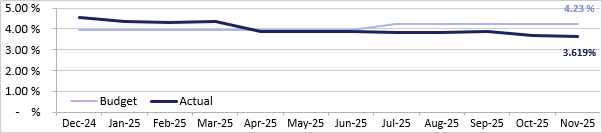
Interest
Rate Risk Position
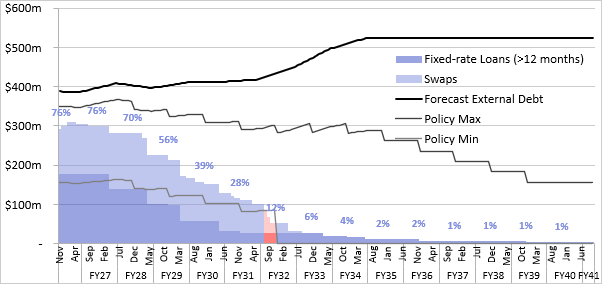
4.5 This
shows a snapshot of the current fixed-rate debt – fixed-rate loans and
floating-to-fixed swaps – with a maturity greater than 12 months,
charting its maturity over time against a corridor of the policy maximum and
minimum levels (as a % of forecast Gross Debt). "Fixed- rate" is
defined as having an interest rate resetting maturity/expiry date greater than
12 months away.
4.6 The
current debt forecast includes fixed-rate loans for pass-through lending to
WWL. However, these loans are all short- to medium-term, so drop out of the
chart relatively early even though they are forecast to be re-financed for
decades. Despite this, the current position is still compliant because of
forward-start swaps which take effect in future years.
|
§6.1.2:
Interest Rate Risk
|
Minimum
|
Maximum
|
Fixed*
|
Within Limits
|
|
Current
|
40%
|
90%
|
76%
|
✔
|
|
Until Nov 2026
|
40%
|
90%
|
76%
|
✔
|
|
Until Nov 2027
|
35%
|
85%
|
70%
|
✔
|
|
* Fixed-rate loans and swaps still available at future date
÷ forecast debt at future date
|
Interest
Rate Swaps
4.7 The
GM Strategy & Finance has delegated authority to enter into interest rate
swaps on behalf of the Council, on the proviso that such transactions are
reported back to the Council. The Council’s approval is required before
entering into long-dated swaps with a maturity over 12 years.
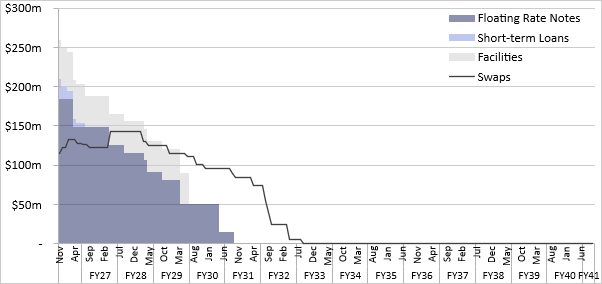
Liquidity
4.8 The
liquidity ratio calculation represents the total committed bank facilities and
term debt amounts, together with liquid investments – the Available
Financial Accommodation – over the external debt amount (total debt minus
pre-funded loans). The liquidity ratio is 118.9% (target: >110%) and
represents the debt headroom available within the Council’s facilities,
along with cash available over and above its existing external debt.
Funding
Maturity Risk Position
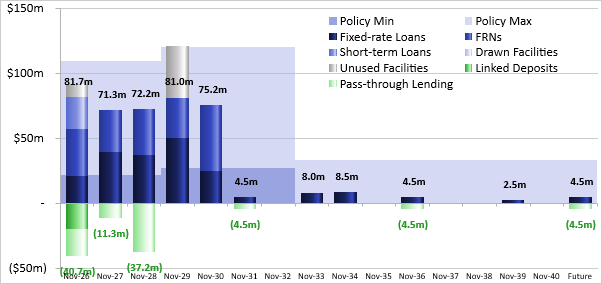
4.9 This
chart groups loan maturities in 12-month blocks. Also shown are available
facilities, deposits linked to pre-funding loans, and pass-through loans. The
shaded background shows the maximum and minimum liquidity maturity bands
(including facilities) in the 2024 Treasury Risk Management Policy:
|
§6.2.2:
Liquidity*/Funding Risk
|
Minimum
|
Maximum
|
Nov 2025
|
Within Limits
|
|
0 – 3 Years
|
15%
|
60%
|
49%
|
✔
|
|
3 – 7 Years
|
25%
|
85%
|
46%
|
✔
|
|
7+ Years
|
0%
|
60%
|
5%
|
✔
|
|
* Including facilities, and net of linked deposits
|
4.10 Ensuring
a spread of maturities reduces the risk of having to find large amounts of
capital, or re-finance loans, at a time in the future in which market
conditions may be unfavourable.
Counterparty
Credit Risk
4.11 The
2024 Treasury Risk Management Policy, §6.3 requires that New Zealand
registered banks (as counterparties) must have a minimum S&P (or
equivalent) short-term rating of
A-1+ or long-term rating of AA-. All the Council’s counterparty banks are
S&P AA- rated.
|
§6.3:
Counterparty Risk – $30m
|
Deposits*
|
Swaps**
|
Nov 2025
|
Within Limits
|
|
ANZ
|
-
|
$11.0m
|
$11.0m
|
✔
|
|
ASB
|
$23.2m
|
$2.3m
|
$15.5m
|
✔
|
|
BNZ
|
$20.0m
|
-
|
$20.0m
|
✔
|
|
Westpac
|
$0.0m
|
$8.1m
|
$8.1m
|
✔
|
|
* 100% of principal
** 3% of notional value × remaining years
|
Current
Borrowings
|
Counterparty
|
Fixed*
|
Floating
|
Nov 2025
|
|
LGFA
|
$167.1m
|
$184.3m
|
$351.4m
|
|
LGFA (short-term Commercial Paper)
|
-
|
$25.0m
|
$25.0m
|
|
Crown Irrigation Investments Ltd
(interest-free loans)
|
$25.5m
|
-
|
$25.5m
|
|
Crown Regional Holdings Ltd
(low-interest loans)
|
$6.0m
|
-
|
$6.0m
|
|
ASB Facility/Overdraft
|
-
|
-
|
-
|
|
Westpac Facility
|
-
|
-
|
-
|
|
Total
|
$198.6m
|
$209.3m
|
$407.9m
|
|
* Having an interest rate resetting maturity/expiry date
greater than 12 months.
|
Local Water
Done Well
4.12 Future debt forecasts
include the three waters activities remaining with the Council and are based on
the draft 2024-34 Long Term Plan projections.
Waimea Water
Limited (WWL)
4.13 Future debt forecasts
include $82.7 million on-lent through Shareholder Advances from the Council to
WWL.
|
Source
|
Interest
|
Principal
|
Re-finance
|
|
WWL Shareholder Advances for the
Council
|
|
|
|
|
CIIL cost overrun Loan
|
0%
|
$9.2m
|
Dec-25 to Dec-40
|
|
LGFA
|
5.097%
|
$21.0m
|
May-28
|
|
Total
|
3.542%
|
$30.2m
|
|
|
WWL Shareholder Advances for WIL
|
|
|
|
|
CIIL Cost overrun
|
0%
|
$8.8m
|
Dec-25 to Dec-40
|
|
LGFA
|
3.600%
|
$16.2m
|
Apr-26
|
|
LGFA (the Council pays interest until
Jun-26)
|
3.760%
|
$10.1m
|
Apr-27
|
|
LGFA
|
3.825%
|
$0.8m
|
Jun-27
|
|
LGFA
|
3.345%
|
$16.2m
|
May-28
|
|
Total
|
2.956%
|
$52.2m
|
|
5.1 The
Council’s cash investments total $43.2 million with an average interest
rate of 2.97%. In line with the Treasury Policy, specific reserves are not kept
as cash. The Council continues to maintain adequate cash reserves and committed
bank facilities to support any drawdown against specified reserves.
5.2 The
individual investment balances are as follows:
|
Counterparty
|
Nov 2025
|
Interest
|
|
ASB
|
Call Account
|
$23,168,245
|
2.25%
|
|
BNZ
|
Call Account
|
$99
|
-
|
|
Westpac
|
Call Account
|
$2,103
|
0.05%
|
|
ASB
|
On-call Money-market
|
$3,374
|
2.10%
|
|
BNZ
|
Term Deposit (329 Days)
|
$10,000,000
|
4.00%
|
|
BNZ
|
Term Deposit (189 Days)
|
$10,000,000
|
3.63%
|
|
Total
|
$43,173,821
|
2.97%
|
5.3 Since October
2021, ASB has included the Council in the all-of-government arrangement which
pays interest on call account balances at the previous day's OCR. This is
currently better than the ASB on-call money-market account rate that other
customers receive. This account was previously used for daily surplus cash.
6. Emissions Trading Scheme
6.1 The
objective of the Emissions Trading Scheme (ETS) carbon credit policy is to
minimise the impact of the movements in the carbon credit prices on the
Council.
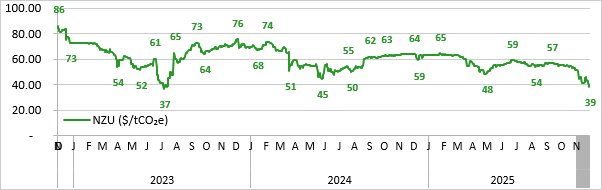
6.2 Recent
decisions by the New Zealand government to contradict Climate Change Commission
advice and boost auction volumes have resulted in large recent declines in the
NZU price and failed auctions, both due to over-supply of carbon credits.
6.3 The
government announced impending changes to climate change law on 4 November
2025. These included that NZ ETS credit volumes will be unlinked from NZ's
climate targets under the UN's Paris Agreement. The natural market reaction to
a scarce commodity becoming unrestricted is to see its value drop rapidly,
which it has, dropping from an already low $50.70/tCO₂e to $38.50/tCO₂e in 3 weeks.
6.4 ETS
risk is managed under the limits in the 2024 Treasury Risk Management Policy,
§6.4.
|
§6.4:
Forward Cover Risk
|
Minimum
|
Maximum
|
Oct 2021
|
Within Limits
|
|
Committed*
|
80%
|
100%
|
100%
|
✔
|
|
Forecast Period
|
|
|
|
|
|
0 – 1 Years
|
0%
|
80%
|
80%
|
✔
|
|
1 – 2 Years
|
0%
|
50%
|
50%
|
✔
|
|
2 – 3 Years
|
0%
|
30%
|
0%
|
✔
|
|
* Exposure becomes committed in Jan-Mar (quarter following
emission period as the Council must report emissions from the previous year)
|
6.5 Consultation has started on
proposed amendments to the ETS. There are two sets of proposed amendments to
strengthen the ETS framework and to reduce the complexity around the forestry
scheme. The Council has no direct exposure to landfills' ETS liabilities as
these are managed through the Nelson Tasman Regional Landfill Business Unit.
6.6 The Council has
sold, through the Enterprise Activity, $3m of unencumbered ETS credits to
partly fund the FY25 operating deficit. An additional $3m of unencumbered
credits have been sold to provide the seed funding for the DRF. These
transactions leave the Council with few, if any, remaining unencumbered
credits.
7.1 Recent LGFA bonds issues have continued
the last two years' success, still receiving three to five times as many bids
as bonds on offer, helped by a weaker NZD and increased risk-aversion in the
investment market.
7.2 The LGFA Sustainable Asset Pool (GSS and
Climate Action Loans to councils and CCOs) is now $3.46 billion so they have
plenty of sustainable assets to back both the 2030 and 2032 Sustainable
Financing Bonds (SFBs) (which they started issuing in the January 2025 tender
to strong retail demand).
7.3 Interest and
swap rates currently on offer indicate a market expectation of further
decreasing interest rates in the short- to mid-term, followed by a gradual
increase in later years. The RBNZ now only has one target: 1-3% y/y inflation.
Four consecutive quarters of <3% inflation (as measured by the CPI) explains
the RBNZ forecasting modest short-term OCR decreases. However, beyond the
RBNZ's short- to medium-term forecasts the market has no guidance, and current
global uncertainty is causing higher long-term interest rates. The latest
quarter where y/y inflation has risen above 3% is providing extra justification
for high long-term forecast rates.
8.1 The Treasury cost centre operates
as the Council’s internal bank. It manages the external costs of
borrowing and allocates them across internal loans within individual
activities. It also pays/charges interest on reserves and activity balances. In
accordance with the Treasury Risk Management Policy, these interest rates are
set quarterly. For the quarter starting October 2025, interest is charged at
3.89%* on loans and overdrawn closed account balances and paid at 2.795%** on
credit balances.
* Weighted
average cost of borrowing at 30 June 2025
** 90-day BKBM
rate, set on the last day of the previous quarter
9. LGFA Environmental, Social and Governance
Borrowing
9.1 The LGFA is looking to borrowing
councils to support its Environmental, Social and Governance (ESG) reporting
and funding initiatives. Investors are increasingly applying these
non-financial factors as part of their analysis to identify material risks and
growth opportunities. Councils who can align their new borrowing to these
factors get a slightly reduced interest rate from the LGFA. Council staff will
be reviewing how we can assist with reporting tracking ESG factors and
borrowing over the next 12 months, e.g. rivers and flood protection remediation
work after the weather events.
Nil
Tasman District
Council
Agenda – 11 December 2025
7.6 Financial Report Year to Date October 2025
Information Only - No Decision
Required
|
Report
To:
|
Tasman
District Council
|
|
Meeting
Date:
|
11
December 2025
|
|
Report
Author:
|
Paul
Egan, Management Accounting Manager
|
|
Report
Authorisers:
|
Matthew
McGlinchey, Financial Strategy & Planning Manager
|
|
Report
Number:
|
RCN25-12-7
|
1. Summary
/ Te Tuhinga Whakarāpoto
1.1 This financial
report provides an update on key financial information for the four months
ending 31 October 2025.
1.2 Weather events at the end of June 2025
and continuing into July 2025 have had a negative impact on the overall
financial position of Council.
1.3 Summarised facts:
1.3.1 The Council had operating expenditure of $18.9 million related
to the weather events, being mainly maintenance in nature. The full cost
to the organisation is more, once staff time is included. The expenditure
is ongoing and will most likely flow into the 2026/2027 financial year.
1.3.2 $12.0 million of external income related to the weather events
has been recognised in these accounts.
1.3.3 Net debt has risen $17.5 million since 30 June 2025, largely
driven by weather event related expenditure. While $12.0 million of
weather event related income has been recognised at 31 October, $11.0 million
of this was not received at that date.
1.3.4 The weather events have displaced both planned maintenance
expenditure and capital expenditure, with totals of both lower year to date,
but they are expected to increase significantly in the second half of the
year.
1.3.5 The balanced budget benchmark is 91.39% at 31 October, under
the budget of 94.72%.
1.3.6 No weather event related insurance recoveries have been
recognised at 31 October.
1.4 Considering the operational impact of
the weather event (a net amount of $6.9 million), the accounting deficit only
being $483,000 worse than year to date budget is a good result. The
second half of the year will, however, see continuing weather event related
expenditure and a catch up of contractually obligated maintenance expenditure
displaced. As such, the deficit will increase as the year progresses.
2. Recommendation/s
/ Ngā Tūtohunga
That the Tasman District Council
1. receives the Financial Report Year to Date
October 2025 report RCN25-12-7.
3. Balanced
Budget Benchmark
3.1 The balanced
budget benchmark is part of a suite of benchmarks as defined in the Local
Government (Financial Reporting and Prudence) Regulations 2014. These
benchmarks are included in the Council’s Annual Reports, Annual Plans and
Long-Term Plans.
Chart 1.
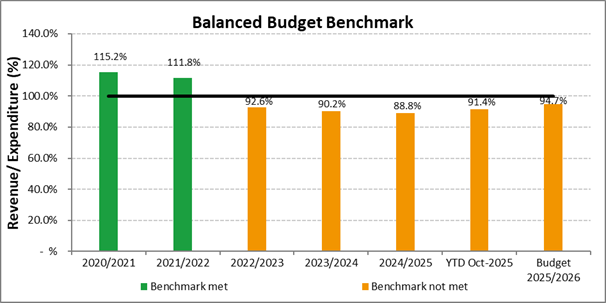
3.2 As can be seen in the chart above, not
all operating expenses are being funded from operating expenditure. The
budget allows for some operating expenditure to be funded from other sources
– using reserves, or loan funded. The loan funded expenditure is
primarily for the Digital Innovation Programme, the Tasman Resource Management
Plan and Saxton Field Joint Committee capital expenditure.
3.3 Please note that the official balanced
budget benchmark calculation includes some capital subsidies. If adjusted
to remove these, it would be lower 89.6% YTD October, and 89.5% Budget.
3.4 Weather event response costs have
impacted this benchmark year to date, unless there are cost savings or
increased recoveries then the benchmark is unlikely to improve, with the
unfunded portion of operating expenditure being financed by debt.
Table 1.
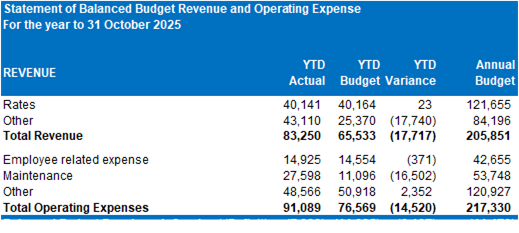
Simplistically,
the additional revenue and maintenance on a YTD basis shown above are all
driven by the weather event.
4.1 Statement of
Comprehensive Revenue and Expense

Note: The Annual
Plan is the adopted annual plan. The Annual Budget
column is the annual plan budget modified for budget carryovers, transfers and
additional expenditure approved. These are approved via appropriate delegation.
4.2 Development and
financial contributions
4.2.1 These contributions, mainly for future development, are
impacted by the economic conditions being $3.7 million below budget YTD.
Though later in the development cycle, new dwelling building consent
applications are also below last year’s volumes.
4.3 Operating
subsidies and grants
4.3.1 These are higher $13.0 million higher than YTD budget
and exceed full year budget. This is driven by increased subsidies receivable
from government agencies such as NZTA, MBIE and MfE.
4.4 Capital
Subsidies
4.4.1 These are $2.2 million below
budget year to date, with weather event related changes to MBIE funded Lower
Motueka River work, and programmed roading work being disrupted.
4.5 Fees
and charges
4.5.1 These are 38% of annual budget 33.33% of the way through
the year – being $2.1 million higher than budgeted.
4.5.2 This is driven by stronger income in solid waste fees at
transfer stations etc $475,000, chargeable services including building and
resource consenting are running ahead of budget, but are expected to come back
in line over the holiday period and some annual charging received early in the
year.
4.6 Other Gains
4.6.1 This is the sale of ETS credits ($3.0 million), resolved
to occur by Council, after the annual plan budget was approved.
4.7 Finance Expense
(net)
4.7.1 This is $1.2 million below budget at 31 October, but is
expected to increase to budgeted amounts by year end.
4.8 Employee related
expense
4.8.1 This is $371,000 higher than budget in the first four
months of the financial year due in part to weather event related additional
staffing costs. This is expected to return to budgeted levels over the
remainder of the year. Staff numbers are being actively managed re vacancies
start date by senior management.
4.8.2 Diversion of staff from capital projects to operating
work, due to the weather event, is also contributing to this higher operating
expense.
4.9 Maintenance
expense
4.9.1 This is an area where there are multiple factors present
around expenditure and offsetting subsidy and grant income.
4.9.2 Emergency event related maintenance expenditure to date
was $17.0 million. This will be offset in part by subsidies and
grants. Some of those subsides and grants have been able to be calculated
following agreement with the providers, however, other agreements had not been
confirmed at the time of closing out these financials. There will be an
unbudgeted local portion of maintenance expenditure, that will be financed via
debt in the short-term. These one-off amounts will have to be recovered
through higher Council income in future years.
4.9.3 Normal programmed and contracted maintenance work
continues, though some of it has been displaced until later in the year,
following the demands on resources from the weather event.
4.9.4 Normal (non-weather event related) maintenance work is
currently under budget and expected to continue to be under budget. As in
previous years, Water Supply and Wastewater continue to be a concern and are
tracking to exceed their reactive maintenance budgets.
 Table 2
5.1 The Long-Term Plan financial budgets
assume that the full capital works programme will not be delivered in its
entirety each year. This historical under-delivery is factored into the
forecast net debt levels and finance costs by the use of a capital lag.
5.2 Changes to the capital lead to
re-phasing and re-prioritisation. These changes in capital expenditure are
reflected in the transfers shown in the table below, with some items being
brought forward and others being rephased to future years.
5.3 With the annual
cycle of new project ramp up and the weather event impact, year-to-date
expenditure is 17% of the budget 33% of the way through the year. The
weather events led to internal and external resources being diverted to
response and recovery activities. As resources continue to get released
from that work, the capital works in the programme will resume.
5.4 As part of the
2026/2027 annual planning, the capital programme is being reviewed for what is
achievable for this year, and the impact on next and subsequent financial
years. This reprioritisation should aim to reset capital expenditure
expectations for next financial year and avoid large carry overs.
5.5 Budget, spend
and forecast by activity is summarised in the table on the next page.
Table 3
Capital
expenditure Excluding JV’S (000)’s
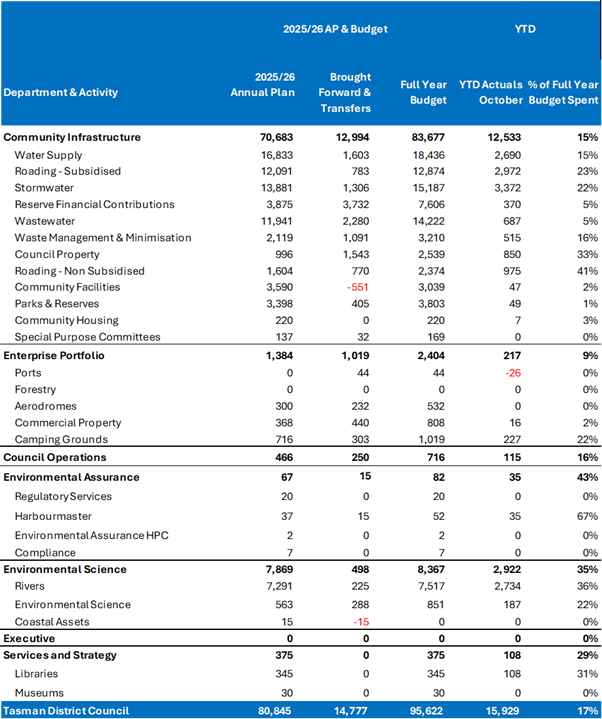
6. Statement of Financial Position (Balance
Sheet)
6.1 The
Statement of Financial Position
 Table 4
7. Net Debt and External Debt
7.1 The Treasury report, also presented at
this Council meeting, has more detail and analysis in this area. Note the
Treasury report is as at 30 November 2025.
7.2 On 31 October 2025, the Council's total
debt was $407.9 million, up from the $376.4 million at 30 June 2025. Net Debt
stood at $288.8 million, compared to 30 June 2025 of $271.3 million. The
budgeted net debt in the 2025/2026 Annual Plan is $305.0 million.
7.3 The pass-through Loans are Shareholder
advances to Waimea Water Limited for funding the Waimea Community Dam. These
loans are excluded in calculating the Council’s Net Debt position. They
are included in assessing the Council’s borrowing from the Local
Government Funding Agency (LGFA) and the LGFA covenants.
7.4 The linked deposits are the Council
pre-funding its April 2026 LGFA loan repayments. This pre-funding is part
of our Treasury borrowing strategy.
Table 5
Breakdown of
net debt
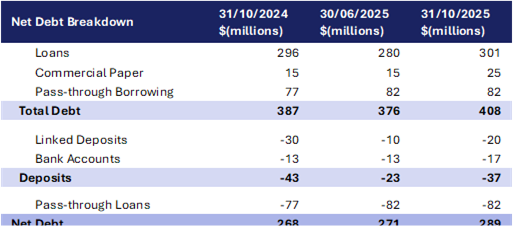
8.1 Rates
receivables are similar to the same period in the 2025/2026 year, after
allowing for rates income increases – the amount of the balance is due to
the timing of the report. Other receivables are up on the prior year with
weather event related subsidy and grant income recognised.
8.2 The receivables
summary is set out below:
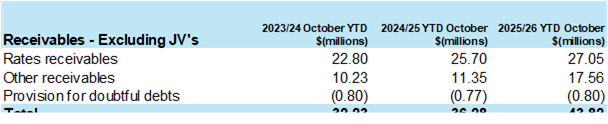
Nil
7.7 Acoustic Insulation Condition in Plan Change
81
Decision Required
|
Report
To:
|
Tasman
District Council
|
|
Meeting
Date:
|
11
December 2025
|
|
Report
Author:
|
Jeremy
Butler, Team Leader - Urban and Rural Policy
|
|
Report
Authorisers:
|
Susan
McLean, Group Manager - Strategy & Finance
|
|
Report
Number:
|
RCN25-12-8
|
1. Purpose
of the Report / Te Take mō te Pūrongo
1.1 To seek a resolution to include an acoustic insulation condition for
new dwellings in the proposed Medium Density Residential Zone (MDRZ) under Plan
Change 81 (PC81). The condition would help to manage adverse health and amenity
effects from road traffic noise. This follows legal advice that the inclusion
of the new condition could not rely on a previous resolution that allows for
minor amendments and correction of errors to be approved by the committee
chair.
2. Summary
/ Te Tuhinga Whakarāpoto
2.1 PC81
is pending notification to enable housing intensification and greenfield medium
density development. Erroneously it did not include a condition to manage road
traffic noise for new dwellings in the MDRZ.
2.2 Exposure
to high levels of road traffic noise is internationally recognised as causing
adverse health effects, including sleep disturbance, annoyance, and
cardiovascular impacts (WHO, 2018).
2.3 Styles
Group has provided preliminary advice recommending land use controls to require
acoustic insulation and mechanical ventilation for dwellings near high-noise
roads.
2.4 Three
methods are available: (1) modelled overlay, (2) standardised distance, (3)
refined standardised distance.
2.5 Due
to time constraints, it is recommended to notify the plan change including a
condition using a standardised distance (60m from white edge line), with the
expectation that submissions on the plan change will allow refinement to a
modelled overlay. A supporting policy amendment and definition is also
proposed.
2.6 The proposed condition will
ensure new dwellings provide for appropriate internal noise levels and occupant
comfort, protecting health and amenity. Following advice from our
consultant it will be limited to roads that cover 2000 or more vehicles per
day. This means: State Highway 6, State Highway 60,
Salisbury Road, Champion Road, Wensley Road, Oxford Street, Talbot Street, Hill
Street, Ellis Street, Berryfield Drive, Queen Street, Aranui Road, Mapua Drive,
Waimea West Road, Cambridge Street, William Street, Washbourn Drive.
2.7 Because the
rules are to be applied in the Medium Density Residential Zone, the insulation
requirements will only apply in that zone (and not existing Residential zone
areas).
3. Recommendation/s
/ Ngā Tūtohunga
That the Tasman District
Council
1. receives
the Acoustic Insulation Condition in Plan Change 81, report RCN25-12-8; and
2. approves the inclusion of amendments to the wording of
the Plan Change 81 Schedule of amendments to:
· Introduce a definition of “Habitable Room”
to the Tasman Resource Management Plan;
· amend Policy 11.1.3.4 to include human health as a
reason for mitigation of noise effects;
· amend Rule 17.1A.3.2 to include a condition requiring
noise insulation, appropriate design and a commissioning test report for any
new dwellings proposed to be built within 60m of the white edge line of
identified roads; and
· any other consequential changes needed to explanatory
text and supporting documents such as the Section 32 Assessment; and
3. delegates authority to the Strategy, Finance and
Performance Committee Chairperson to make any minor amendments to Change 1 to
the Tasman Regional Policy Statement and Plan Change 81 to the Tasman Resource
Management Plan prior to notification
4.1 PC81
has been developed to enable urban growth and intensification in Tasman
District, with rezoning for housing and business land in line with national
policy and local strategies.
4.2 At
the time of passing a resolution to notify PC81, no acoustic insulation
condition was included for MDRZ dwellings near major roads.
4.3 Subsequent
advice from Styles Group and NZTA Section 32 analysis highlights the need for
such controls to protect residents from adverse health effects of road traffic
noise.
4.4 The MDRZ
includes sites adjacent to high-noise transport corridors, where future traffic
growth is expected to increase noise exposure.
Progress of PC81 Notification
4.5 As well as a resolution to notify C1 to
the Regional Policy Statement and PC81 to the Tasman Regional Policy Statement,
the Strategy and Policy Committee in the previous term agreed to seek approval
to use the Streamlined Planning Process (SPP) and/or an exemption to the plan
stop legislation.
4.6 Both have been applied for, with a
preference for the SPP. At the time of writing, no formal indication has
been received from the Minister. However, staff have strong reason to think
that the Minister will, before long, issue a direction to use the SPP.
The direction may be issued this year, but it is not clear whether the plan
changes will be able to be notified this year.
5. Analysis
and Advice / Tātaritanga me ngā tohutohu
Issue:
5.1 International
and national evidence (WHO, NZTA, Styles Group) demonstrates significant health
risks from road traffic noise above 55 dB LAeq(24hr).
5.2 Without
controls, new dwellings in the MDRZ may expose residents to unacceptable noise
levels, impacting health and amenity.
5.3 Three
methods for land use controls can be applied:
Modelled overlay: Uses
acoustic modelling to define affected areas; most efficient and targeted but
requires time and data.
Standardised distance:
Applies a fixed setback (e.g., 60m) from white edge line; less precise but can
be implemented quickly.
Refined standardised
distance: Uses modelling to validate the setback; balances efficiency and
practicality.
5.4 Given
time constraints, a standardised distance is recommended for notification, with
the intention to refine setback distances through submissions and subsequent
hearing proceses.
Proposed Amendments:
5.5 A
new definition of “Habitable Room” is to be included in Chapter 2
of the TRMP as follows:
Habitable
Room – means the interior parts
of a building used for any residential activity but excluding any bathroom,
laundry, water closet, pantry, walk-in-wardrobe, corridor, hallway, lobby,
clothes drying room, garage, carport or other space of a specialised nature occupied
neither frequently nor for extended periods
5.6 The
following amendment is made to Policy 11.1.3.4:
11.1.3.4 To
avoid, remedy or mitigate adverse effects of traffic on human health and amenity
values.
5.7 The
following additional conditions are added to proposed Rule 17.1A.3.2:
(t) Any new
building or alteration to an existing building that contains a habitable room
within 60 metres of the white edge line of the following roads must be
designed, constructed and maintained so that road traffic noise from does not
exceed 40 dB LAeq (24 hour) in all habitable rooms:
(i) State
Highway 6
(ii) State
Highway 60
(iii) Salisbury
Road
(iv) Champion
Road
(v) Wensley
Road
(vi) Oxford
Street
(vii) Talbot Street
(viii) Hill Street
(ix) Ellis
Street
(x) Berryfield
Drive
(xii) Queen Street
(xiii) Aranui Road
(xiv) Mapua Drive
(xv) Waimea West
Road
(xvi) Cambridge Street
(xvii) William Street
(xviii) Washbourn Drive
Written
certification of compliance from a Suitably Qualified and Experienced Acoustic
Consultant shall be submitted with the relevant building consent application.
The certification shall be based on the existing measured or predicted noise
levels plus 3 dB. Noise level predictions for the building may be modelled by a
Suitably Qualified and Experienced Acoustic Consultant using a recognised
computer modelling method for road traffic, having regard to factors such as
barrier attenuation, the location of the dwelling relative to the road,
topographical features and any intervening structures.
(u) If opening
windows of habitable rooms must be closed to achieve the design noise levels in
Condition (t) those rooms must be designed, constructed and maintained with a
mechanical ventilation system that achieves the following requirements:
(i)
Provides mechanical ventilation that can operate continuously to satisfy clause
G4 of the New Zealand Building Code and that provides at least 1 air change per
hour, but no less than 7.5L/s per occupant; and
(ii)
Provides cooling and heating that is controllable by the occupant and can
maintain the inside temperature between 18°C and 25°C when assessed
using a 2.5% design weather condition for Tasman; and
(iii) Any
system installed, must not generate more than 35 dB LAeq(30s) when
measured 1 metre away from any grille or diffuser. The noise level must be
measured after the system has cooled the rooms to the temperatures in (ii)
above, or after a period of 30 minutes from the commencement of cooling
(whichever is the lesser);
OR:
(iv)
Alternatively, instead of (i) to (iii) above, a design verified by a suitably
qualified and experienced HVAC expert stating the design proposed will provide
ventilation and internal space temperature controls to meet or exceed the
outcomes described in (i) to (iii) above.
(v) A commissioning
report must be submitted to the Council prior to occupation of the building
demonstrating compliance with the mechanical ventilation system performance
requirements in Conditions (t) and (u) above.
5.8 A
distance of 60 metres is used as this is the current standard in the TRMP and
has been applied to the Hope Bypass Road in existing rules.
Summary of amendments
5.9 A
definition and policy are included to provide support to the new rule
conditions.
5.10 New
dwellings within 60 metres of a high-noise road must be designed and
constructed to achieve an internal noise level of 40 dB LAeq(24hr)
in habitable rooms.
5.11 Mechanical
ventilation and cooling must be provided where windows need to be closed to
achieve noise standards. Certification by a qualified acoustic consultant
required at building consent stage.
5.12 These requirements are well-understood and
routinely implemented by architects, builders, and HVAC professionals in New
Zealand. Acoustic insulation and mechanical ventilation solutions are
standard, with clear specifications and products readily available for
compliance.
6. Financial
or Budgetary Implications / Ngā Ritenga ā-Pūtea
6.1 NZTA research indicates that the health and social costs of road
traffic noise exposure in New Zealand are substantial, measured in millions of
dollars annually. Acoustic insulation and ventilation requirements add only
0–2% to building costs, representing a highly cost-effective measure to
avoid these impacts.
6.2 No significant
impact on Council budgets; costs are borne by developers/owners.
7.1 The options are outlined in the
following table:
|
Option
|
Advantage
|
Disadvantage
|
|
1.
|
Notify condition using standardised
distance
|
Quick implementation; protects health
|
May over/under-capture affected sites
|
|
2.
|
Wait for modelled overlay
|
Most efficient and targeted
|
Delays notification; not feasible for
deadline. IF the minister grants the SPP then the timeline in the SPP notice
must be followed. This may mean there is no scope to wait.
|
|
3
|
Do nothing
|
No regulatory burden
|
Residents exposed to health risks; not
recommended.
Very likely to be raised through
submissions by NZTA. Will cause conflict and scope issues with state
highways versus other busy rules
|
7.2 Recommended: Option 1 and then refine through submissions.
8.1 The
proposed condition aligns with the Resource Management Act’s purpose to
promote sustainable management and protect health and amenity.
8.2 Legal advice
confirms a further resolution is required to include the condition, as it was
not in the original PC81 notification version and is outside the scope of the
existing resolution that allows for miner additions and corrections to be
agreed by the committee chair.
9. Iwi
Engagement / Whakawhitiwhiti ā-Hapori Māori
9.1 Engagement with iwi has occurred throughout PC81 development;
further consultation will be undertaken as part of the plan change process.
10. Significance
and Engagement / Hiranga me te Whakawhitiwhiti ā-Hapori Whānui
10.1 The significance of PC81 was addressed
previously. This significance assessment just relates to the issue of the
additional condition.
10.2 The overall level of significance is considered to
be low.
10.3 Extensive and comprehensive engagement was carried
out for PC81 generally. The issue of acoustic insulation alongside major roads
was not directly engaged on, but the evidence is clear, and the solutions are
very standard. Any issues are therefore able to be resolved through the
submission process.
|
|
Issue
|
Level of
Significance
|
Explanation of
Assessment
|
|
1.
|
Is there a high level
of public interest, or is decision likely to be controversial?
|
Low
|
Will only impact
developers and home owners who are developing or redeveloping close to major
roads.
|
|
2.
|
Are there impacts on
the social, economic, environmental or cultural aspects of well-being of the
community in the present or future?
|
Medium
|
Will support
healthier homes
|
|
3.
|
Is there a
significant impact arising from duration of the effects from the decision?
|
High
|
Intensification
housing is a long term issue, with new buildings being in place for several
generations
|
|
4.
|
Does the decision
relate to a strategic asset? (refer Significance and Engagement Policy for
list of strategic assets)
|
No
|
|
|
5.
|
Does the decision
create a substantial change in the level of service provided by Council?
|
No
|
|
|
6.
|
Does the proposal,
activity or decision substantially affect debt, rates or Council finances in
any one year or more of the LTP?
|
No
|
|
|
7.
|
Does the decision
involve the sale of a substantial proportion or controlling interest in a CCO
or CCTO?
|
No
|
|
|
8.
|
Does the
proposal or decision involve entry into a private sector partnership or
contract to carry out the deliver on any Council group of activities?
|
No
|
|
|
9.
|
Does the proposal or
decision involve Council exiting from or entering into a group of
activities?
|
No
|
|
|
10.
|
Does the proposal
require particular consideration of the obligations of Te Mana O Te Wai
(TMOTW) relating to freshwater or particular consideration of current
legislation relating to water supply, wastewater and stormwater
infrastructure and services?
|
No
|
|
11. Communication
/ Whakawhitiwhiti Kōrero
11.1 The inclusion of requirements for acoustic
insulation will be added to all relevant Council communication channels
appropriate to Plan Change 81.
12.1 Risk
of appeals or opposition from developers; mitigated by evidence base and
opportunity for refinement through submissions.
12.2 Risk of
over/under-capturing affected sites; addressed by intention to refine condition
post-notification.
13. Climate
Change Considerations / Whakaaro
Whakaaweawe Āhuarangi
13.1 Acoustic insulation may
support energy efficiency and resilience in dwellings.
14. Alignment
with Policy and Strategic Plans / Te Hangai ki ngā aupapa Here me ngā
Mahere Rautaki Tūraru
14.1 The proposed condition
supports national and local policy objectives for healthy, liveable urban
environments.
15. Conclusion
/ Kupu Whakatepe
15.1 Including an acoustic
insulation condition for new dwellings in the MDRZ under PC81 is necessary to
protect health and amenity, in line with best practice and
national/international evidence. Notifying a standardised distance condition
now allows timely implementation, with the opportunity to refine through
submissions.
16. Next
Steps and Timeline / Ngā Mahi Whai Ake
16.1 Include
the proposed condition as a component of PC81. Once
ministerial approval is gained notify PC81
16.2 Undertake
targeted engagement and statutory consultation (open
for submissions).
16.3 Refine the condition through the submissions and hearing process.
Nil
Tasman District
Council
Agenda – 11 December 2025
7.8 Richmond Tennis Club Funding Request
Decision Required
|
Report
To:
|
Tasman
District Council
|
|
Meeting
Date:
|
11
December 2025
|
|
Report
Author:
|
Rob
Coleman, Reserves Officer - Recreation and Systems; Grant Reburn, Reserves
and Facilities Manager
|
|
Report
Authorisers:
|
John
Ridd, Group Manager - Customer & Community
|
|
Report
Number:
|
RCN25-12-9
|
1. Purpose
of the Report / Te Take mō te Pūrongo
1.1 This
report is to request Reserves Financial Contribution (RFCs) funding of $50,000
from the 2025/26 Richmond RFCs account to cover some of the cost of the
Richmond Tennis Club’s new emergency access staircase, fire system and
emergency lighting on its clubroom building in Jubilee Park, Richmond.
2. Summary
/ Te Tuhinga Whakarāpoto
2.1 The
Richmond Tennis Club has requested funding towards the cost of replacing its
emergency access stairs ($52,000) and permanent fire system and emergency
lighting ($23,000) at its clubroom building at Jubilee Park, Richmond. The
total cost is $75,000.
2.2 Staff
propose funding 66% ($50,000) of the total cost from the Richmond Reserves
Financial Contributions account. This is in line with the RFCs funding policy.
The balance of the project cost would be covered by the Richmond Tennis Club.
3. Recommendation/s
/ Ngā Tūtohunga
That the Tasman
District Council
1. receives
the Richmond Tennis Club Funding Request report, RCN25-12-9; and
2. approves
the funding amount of $50,000 from the Richmond Reserves Financial
Contributions Account 2025/26 to contribute to the cost of a new staircase,
fire system and emergency lighting for the Richmond Tennis Club Building at
Jubilee Park, Richmond.
4.1 The
Richmond Tennis Club need to construct a fire escape staircase on their
clubroom building and a permanent fire and emergency lighting system. This is a
compliance requirement essential for building safety, accessibility, and
continued public use. Without it, the club cannot achieve full Code of
Compliance certification, putting community access and event use at risk.
Building consent for this project has been approved, and the Club is ready to
proceed once funding is secured.
4.2 The
Richmond Tennis Club is one of the largest and most active community tennis
providers in Tasman. The club has a five year lease with the Council that
expires on 30 November 2028.
4.3 The
club delivers:
4.3.1 year-round tennis and pickleball opportunities for all
ages and abilities;
4.3.2 community and social events promoting health, wellbeing,
and inclusion; and
4.3.3 a welcoming hub supporting the Council’s strategic
goals for active, connected communities.
4.4 The
project is shovel-ready, with a confirmed quote from a local building company
and can commence immediately upon funding approval.
4.5 The
Richmond Tennis Club would contribute one-third ($25,000) of total costs and
Council support via RFCs covering the remaining two-thirds ($50,000). The club
has funds earmarked to cover its share of the project costs.
4.6 This
project will:
4.6.1 bring the facility into full compliance;
4.6.2 improve safety and accessibility; and
4.6.3 ensure the clubrooms remain fit
for purpose for community sport and social use.
5. Analysis
and Advice / Tātaritanga me ngā tohutohu
5.1 Staff have considered the request for
additional funding and recommend assisting the club with the funding shortfall
up to a maximum of $50,000.
5.2 The Richmond Tennis Club provides a
valuable service to the Richmond community by offering facilities for tennis
and pickleball along with other social events.
6. Financial
or Budgetary Implications / Ngā Ritenga ā-Pūtea
6.1 The work ($50,000) will be funded within
existing Richmond RFCs budgets.
6.2 The balance of Richmond account as at 30th
June 2025 is $12M. Overall the RFC accounts for all wards have a balance in the
order of $24M, all of which is committed in the 2024/34 Long Term Plan.
7.1 The options are outlined in the
following table:
|
Option
|
Advantage
|
Disadvantage
|
|
1.
|
Approve the contribution of $50,000
towards the club’s outstanding commitments
|
The club can meet their project funding
responsibilities.
|
Requires the use of additional RFC
funding
|
|
2.
|
Decline the funding request
|
No further RFCs used on this project
|
Club will be impacted financially and
won’t receive code of compliance certification until they can pay
outstanding regulatory bills
|
7.2 Option 1 is recommended.
8.1 There are no known legal requirements
relating specifically to this decision.
8.2 The club is required to complete the
access and safety system works outlined before a code of compliance certificate
can be issued under the Building Act.
9. Iwi
Engagement / Whakawhitiwhiti ā-Hapori Māori
9.1 This decision has no known implications
for iwi.
10. Significance
and Engagement / Hiranga me te Whakawhitiwhiti ā-Hapori Whānui
|
|
Issue
|
Level of
Significance
|
Explanation of
Assessment
|
|
1.
|
Is there a high level
of public interest, or is decision likely to be controversial?
|
Low
|
There may be some
interest from other clubs.
|
|
2.
|
Are there impacts on
the social, economic, environmental or cultural aspects of well-being of the
community in the present or future?
|
Moderate
|
May impact on the
club’s ability to operate and provide a community service as this
decision will impact the club in terms of regulatory compliance.
|
|
3.
|
Is there a
significant impact arising from duration of the effects from the decision?
|
Moderate
|
There could
potentially be a significant impact on the club’s ability to continue
operating.
|
|
4.
|
Does the decision
relate to a strategic asset? (refer Significance and Engagement Policy for
list of strategic assets)
|
N.A
|
Private club asset on
Council owned land.
|
|
5.
|
Does the decision
create a substantial change in the level of service provided by Council?
|
No
|
N.A
|
|
6.
|
Does the proposal,
activity or decision substantially affect debt, rates or Council finances in
any one year or more of the LTP?
|
No
|
N/A
|
|
7.
|
Does the decision
involve the sale of a substantial proportion or controlling interest in a CCO
or CCTO?
|
N.A
|
N.A
|
|
8.
|
Does the
proposal or decision involve entry into a private sector partnership or
contract to carry out the deliver on any Council group of activities?
|
N.A
|
N.A
|
|
9.
|
Does the proposal or
decision involve Council exiting from or entering into a group of
activities?
|
N.A
|
N.A
|
|
10.
|
Does the proposal
require particular consideration of the obligations of Te Mana O Te Wai
(TMOTW) relating to freshwater or particular consideration of current
legislation relating to water supply, wastewater and stormwater
infrastructure and services?
|
N.A
|
N.A
|
11. Communication
/ Whakawhitiwhiti Kōrero
11.1 Communication has been carried out with the
Richmond Tennis Club and internal Council departments including the Finance
team.
12.1 If this decision is not approved, it may have
financial impacts for the club that could jeopardise its ability to operate
during the current season or even in the longer term if it does not obtain Code
of Compliance and meet its regulatory obligations.
12.2 There could be a precedent set that has negative
financial impacts for the Council if clubs on reserve land in similar
situations apply for RFC funding to cover their additional development
contribution costs.
13. Climate
Change Considerations / Whakaaro
Whakaaweawe Āhuarangi
13.1 There are no known impacts on climate change from
this decision.
14. Alignment
with Policy and Strategic Plans / Te Hangai ki ngā aupapa Here me ngā
Mahere Rautaki Tūraru
14.1 The request from the club for additional RFC
funding to assist with project costs does not conflict with any policies or
strategic plans.
15. Conclusion
/ Kupu Whakatepe
15.1 The request for funding from the Richmond Tennis
Club has come about due to work needed by the club to meet code of compliance
requirements for an emergency staircase and emergency fire and lighting
systems. On this basis it would seem reasonable to grant the club the funding
to help them achieve a fully compliant building.
16. Next
Steps and Timeline / Ngā Mahi Whai Ake
16.1 Should the funding be approved by Council prepare a funding
agreement between the club and Council.
Nil
Tasman District
Council
Agenda – 11 December 2025
7.9 Upgrading Furniture and Technology in the
Council Chamber
|
Report
To:
|
Tasman
District Council
|
|
Meeting
Date:
|
11
December 2025
|
|
Report
Author:
|
Steve
Manners, Chief Operating Officer
|
|
Report
Authorisers:
|
Leonie
Rae, Chief Executive Officer
|
|
Report
Number:
|
RCN25-12-10
|
1. Summary
/ Te Tuhinga Whakarāpoto
1.1 This report
provides information on the upgrade to the furniture and technology in the
Council Chamber. The objective is to improve the comfort, accessibility, and
effectiveness of the space for the Mayor and Councillors, staff, and the
public. Modernising the chamber environment will support better
decision-making, provide stability for hybrid and digital meetings, and ensure
compliance with health and safety standards.
2. Recommendation/s
/ Ngā Tūtohunga
That the Tasman District Council
1. receives the Upgrading Furniture and Technology in the Council
Chamber report; and
2. endorses the budgeted expenditure to upgrade Furniture and
Technology in the Council Chamber.
3.1 The Council Chamber is the central venue
for decision-making and public engagement. Over the years, the demands on this
space have evolved, particularly with the rise of digital engagement and hybrid
work models. The existing furniture and technology no longer adequately support
these requirements, leading to discomfort, inefficiencies, and accessibility
challenges.
3.2 The initial
approach that was considered for the Council Chamber, which included a full
upgrade of furniture, has been reconsidered and this paper outlines the new
changes in furniture and technology in the Chamber space.
4.1 The Executive Leadership Team (ELT) and
staff currently have to be seated around small tables, including alongside
media, and in the public gallery. This provides less space for the public and
is not an ideal environment for staff that attend the meetings.
4.2 The new Council has an additional
elected member to accommodate in the Council Chamber, along with Community
Board members attending Council and Standing Committees when invited.
4.3 There is an insufficient number of
microphones for all elected members and staff, and additional batteries are
also required for the existing units.
4.4 Outdated Furniture: The current tables
are not designed for modern meetings, the furniture is inflexible, limiting
options for different meeting formats and occupying more floor space in the
Council Chamber than is necessary.
4.5 Audio-visual systems are outdated and
somewhat unreliable, making it difficult to facilitate hybrid meetings and to
ensure all participants can see and hear proceedings clearly. Particularly the
chairperson, deputy chairperson and lead officer situated at the top table.
4.6 The bank of monitors provided for the
Governance team to administer the meeting restrict views and are not fit for
purpose.
5.1 Space reconfiguration (currently on
trial): Optimise the layout to support both traditional and collaborative
meeting formats, maximising the use of available space. Tables have been
sourced from within the Council, and re-purposed to reduce cost and provide for
the trial.
5.2 Smaller monitors for Governance team
plus two additional monitors for Chair’s table will make better use of
the desk spaces and will enable the chair to have better visibility of
on-screen participants, order papers and other information.
5.3 The new layout of the Council Chamber
space incorporates tables for ELT members to be present on the side of the
Chamber, and to be easily accessible to advise as required.
5.4 While the tables have been sourced
within the Council, they will require slight modification including privacy and
modesty panels and the provision of power outlets.
5.5 Additional microphone units and backup
batteries are required.
5.6 Power outlets are necessary to enable
the Mayor and Councillors to charge laptops and other devices during meetings
and need to be provisioned safely without training leads across the floor of
Chamber.
5.7 Early in 2026 we
will shift to Microsoft Teams to provide audio-visual support to Council
meetings. MS Teams is already licenced by the Council and will provide a more
familiar, and resilient interface for conducting meetings online. The shift to
MS Teams will reduce our software licensing costs for online meetings.
6.1 Whilst existing furniture has been
reused, and the investment in technology modest, the change to the layout, and
provisioning the Chamber for future years will result in costs to the Council.
6.2 These costs have already been budgeted
for, as part of Information Technology (Maintenance) and in Property
(Maintenance and Refurbishment). The costs identified in this paper are
well within budget.
6.3 While the
proposed upgrades require upfront investment, the minor refurbishment of
Chamber furniture and the upgrade of some technology will enable the Chamber to
continue to service the Council for several years to come, it will support
operational efficiency and will provide a more effective space for conducting
public meetings and more space will be allocated to the public gallery.
6.4 Reusing existing
tables lowers the cost of refurbishment by approximately $8,000. The costs
associated with the proposed refurbishment are summarised below.
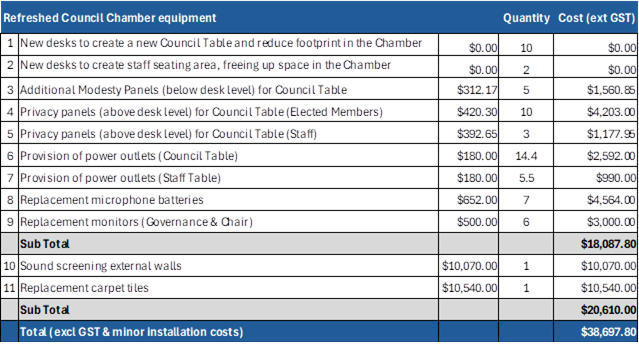
7.1 Upgrading the furniture and
technology in the Council Chamber will improve operational effectiveness,
inclusivity, and public engagement.
7.2 The technology used in the
chamber ranges from seven years old (Sound System) to just over five years old
(Camera/Projectors post COVID) and is fast approaching end of life.
Recent firmware upgrades have prolonged the life of the Audio equipment, but
these options do not extend to monitors. In coming years there will be a need
to replace the projectors but, for now, the existing hardware is performing
adequately.
7.3 Ordinarily, these changes would be made
as part of Council operations and would reflect good practice for routine
repairs and maintenance. However, consideration has been given to the desire of
the new Council to consider expenditure on the Council Chamber, and reflects a
commitment made to the Mayor and Councillors that, following the trial, a paper
would preface any commitment.
7.4 These changes will create a more
welcoming, modern, efficient space for the Council and the community it serves.
7.5 It is expected that we can
procure and install new furniture and technology in a phased
manner to minimise disruption. It is proposed that these changes take place
during the summer ’26 recession period (subject to supply timeframes).
Nil
Tasman District
Council
Agenda – 11 December 2025
7.10 Tasman District Council Schedule of Meetings 2026
Decision Required
|
Report
To:
|
Tasman
District Council
|
|
Meeting
Date:
|
11
December 2025
|
|
Report
Author:
|
Kelsey
McLean, Senior Governance Advisor
|
|
Report
Authorisers:
|
Robyn
Byrne, Governance Manager
|
|
Report
Number:
|
RCN25-12-11
|
1. Purpose
of the Report / Te Take mō te Pūrongo
1.1 To
present the Tasman District Council Schedule of Meetings 2026 (Meetings
Calendar) for adoption, in accordance with Clause 19, Schedule 7 of the Local
Government Act 2002.
2. Summary
/ Te Tuhinga Whakarāpoto
2.1 Clause
19 (6), Schedule 7 of the Local Government Act 2022 sets out requirements for
written notification of meetings to local authority elected members.
2.2 It
is standard practice for councils to adopt a schedule of meetings by resolution
in order to meet those legislative requirements (Attachment 1).
2.3 The proposed schedule (Attachment 1) outlines the upcoming
programme of Council, Committees, Subcommittees, Joint Committees, Community
Boards, forums, citizenship ceremonies, LGNZ Conference dates, user groups and
Youth Council meetings. It provides a high-level overview to support elected
members in planning, preparation, and effective participation.
2.4 The
proposed schedule is based on a four-weekly cycle for the Council and four (or
six)-weekly cycle for Standing Committees and the Information Forum, six-weekly
cycle for Community Boards, and quarterly for joint and single purpose
committees, e.g., Audit and Risk Committee.
2.5 The proposed schedule also provides information on Public Holidays
and School Holidays. A meeting-free week has been scheduled for the second week
of each School Holiday period, aligning with Nelson City Council’s
meeting-free weeks and providing for members to have some certainty around
breaks.
2.6 It
is noted that some meetings will be required to be arranged on an ‘as
needed’ basis, for example, Submission Hearings, Contracts and
Procurement Panel, Recreation Reserve Committees, Hall Management Committees,
Community Facility Committees and Animal Control Subcommittee meetings.
2.7 The
proposed schedule does not include workshops however Wednesday has been set
aside for workshops and when confirmed they will be added to the Meetings
Calendar.
2.8 To ensure efficiency and accommodate Council business, the schedule
may be amended as required. Elected members will be provided with as much
notice as possible of any changes, and timely agenda distribution and
compliance with legislative requirements will remain a priority. This
flexibility is permitted under Clause 19(6)(ii), Schedule 7 of the Local
Government Act 2002.
2.9 The proposed schedule had been compiled when we were notified of
potential Joint Committee name changes. The joint committees terms of reference
and membership will be presented at the 11 December meeting, and if approved,
the changes will be treated as a minor administrative update to the schedule
and actioned accordingly.
2.10 Elected
members also receive notification of upcoming Council meeting commitments for
the following week through the weekly Tasman Update. In addition, the
electronic Outlook meetings calendar and the elected members’ meetings
paper portal, LGHub, are also kept up to date. Elected members can access the
Outlook meetings calendar and LGHub via their Council laptops.
2.11 Council
and Committee meetings are also detailed on the Council’s website via the
Council’s meetings calendar and notified in the
Council’s two-weekly publication Newsline.
3. Recommendation/s
/ Ngā Tūtohunga
That the Tasman
District Council
1. receives
the Tasman District Council Schedule of Meetings 2026 report, RCN25-12-11; and
2. in accordance with Clause 19 (6),
Schedule 7 of the Local Government Act 2022, adopts the proposed Tasman District Council Schedule of Meetings 2026 in
Attachment 1 to the agenda report; and
3. notes
that the Schedule of Meetings may be amended, as required, to enable Council
business to be performed efficiently.
4.1 Adopting a schedule of meetings is in
accordance with Schedule 7 of the Local Government Act 2002 and assists the
scheduling of reports to promote efficient decision-making and work programme
planning.
5.1 The options are outlined in the
following table:
|
Option
|
Advantage
|
Disadvantage
|
|
1.
|
Adopt the proposed meeting schedule
|
Provides clarity for elected members and
staff regarding their meeting commitments and to meet legislative
requirements
|
None identified
|
|
2.
|
Decline to adopt the proposed meeting
schedule
|
None identified
|
Does not assist the Council to meet its
legislative requirements
|
|
3.
|
Amend the proposed meeting schedule
|
None identified, any changes to the
meeting schedule can be made as required
|
Does not allow staff time to consider the
consequences of moving meetings – significant planning has been
undertaken in developing the proposed schedule, taking multiple requirements
and preferences into account.
|
5.2 Option 1 is recommended.
6.1 This decision is in accordance with Clause
19 (6), Schedule 7 of the Local Government Act 2022 and the Tasman District
Council Standing Orders.
7. Iwi
Engagement / Whakawhitiwhiti ā-Hapori Māori
7.1 This is a procedural decision and no
engagement with iwi has taken place.
8. Significance
and Engagement / Hiranga me te Whakawhitiwhiti ā-Hapori Whānui
8.1 This is a decision for the Council, and
no engagement is required to set the Council’s Schedule of Meetings, it
is an internal process.
|
|
Issue
|
Level of
Significance
|
Explanation of
Assessment
|
|
1.
|
Is there a high level
of public interest, or is decision likely to be controversial?
|
Low
|
|
|
2.
|
Are there impacts on
the social, economic, environmental or cultural aspects of well-being of the
community in the present or future?
|
No
|
|
|
3.
|
Is there a
significant impact arising from duration of the effects from the decision?
|
No
|
|
|
4.
|
Does the decision
relate to a strategic asset? (refer Significance and Engagement Policy for
list of strategic assets)
|
No
|
|
|
5.
|
Does the decision
create a substantial change in the level of service provided by Council?
|
No
|
|
|
6.
|
Does the proposal,
activity or decision substantially affect debt, rates or Council finances in
any one year or more of the LTP?
|
No
|
|
|
7.
|
Does the decision
involve the sale of a substantial proportion or controlling interest in a CCO
or CCTO?
|
No
|
|
|
8.
|
Does the
proposal or decision involve entry into a private sector partnership or
contract to carry out the deliver on any Council group of activities?
|
No
|
|
|
9.
|
Does the proposal or
decision involve Council exiting from or entering into a group of
activities?
|
No
|
|
|
10.
|
Does the proposal
require particular consideration of the obligations of Te Mana O Te Wai
(TMOTW) relating to freshwater or particular consideration of current
legislation relating to water supply, wastewater and stormwater
infrastructure and services?
|
No
|
|
9. Financial
or Budgetary Implications / Ngā Ritenga ā-Pūtea
9.1 There are no direct budgetary
consequences related to the adoption of the meeting schedule.
10. Conclusion
/ Kupu Whakatepe
10.1 Staff recommend adoption of the Schedule of
Meetings 2026; this will allow elected members to plan their other
engagements/commitments accordingly and provide clarity for the public.
11. Next
Steps and Timeline / Ngā Mahi Whai Ake
11.1 If
the proposed Schedule of Meetings 2026 is adopted, staff will complete the
necessary administration, this includes the provision of a Calendar of Meetings
on the Council’s website for the public and the issuing of meeting
invitations to elected members, so that their diaries are appropriately up to
date with the meetings that they are required to attend.
|
1.⇩
|
Proposed
Meetings Schedule January - December 2026
|
173
|
Tasman District Council Agenda – 11 December 2025
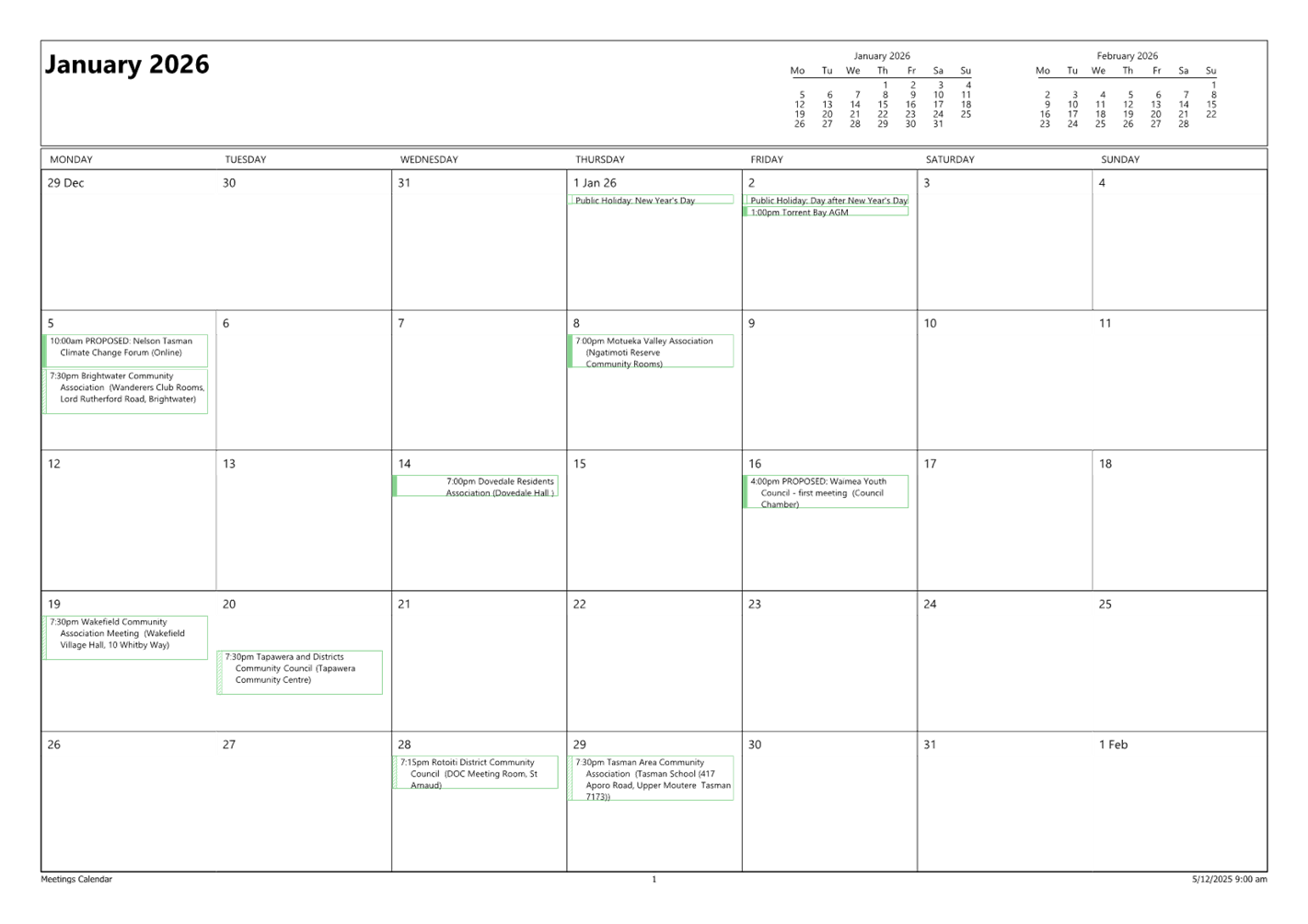
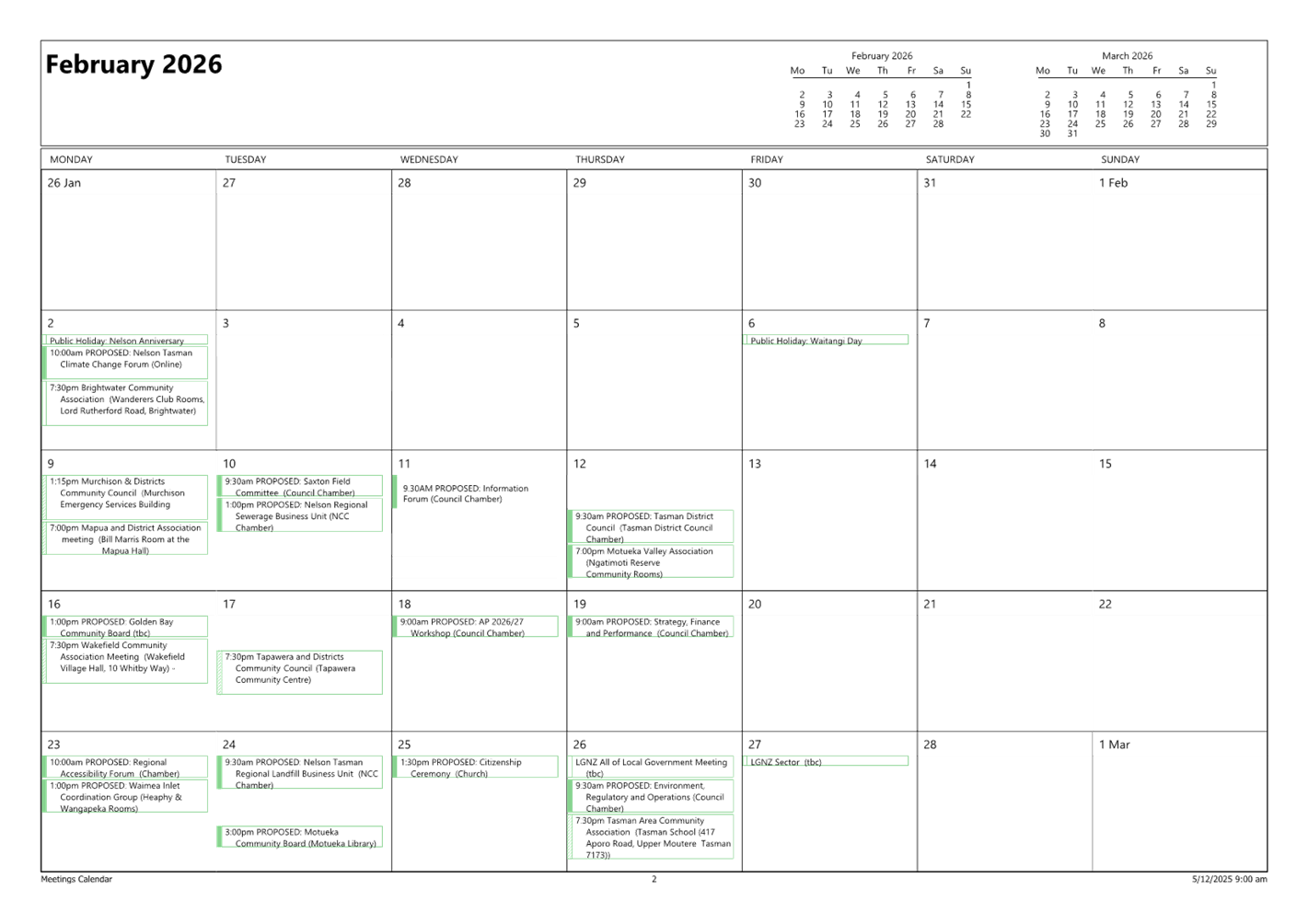
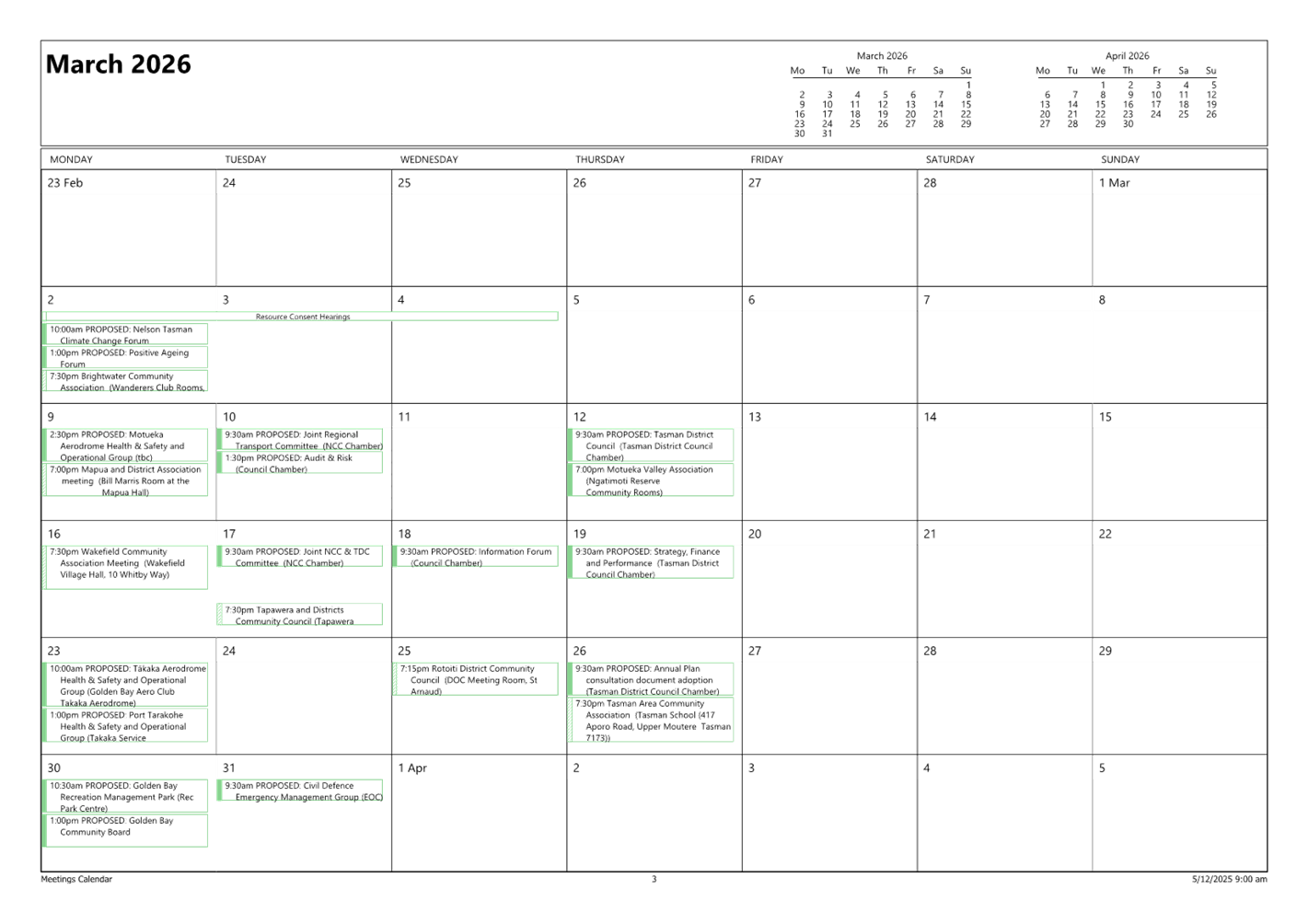
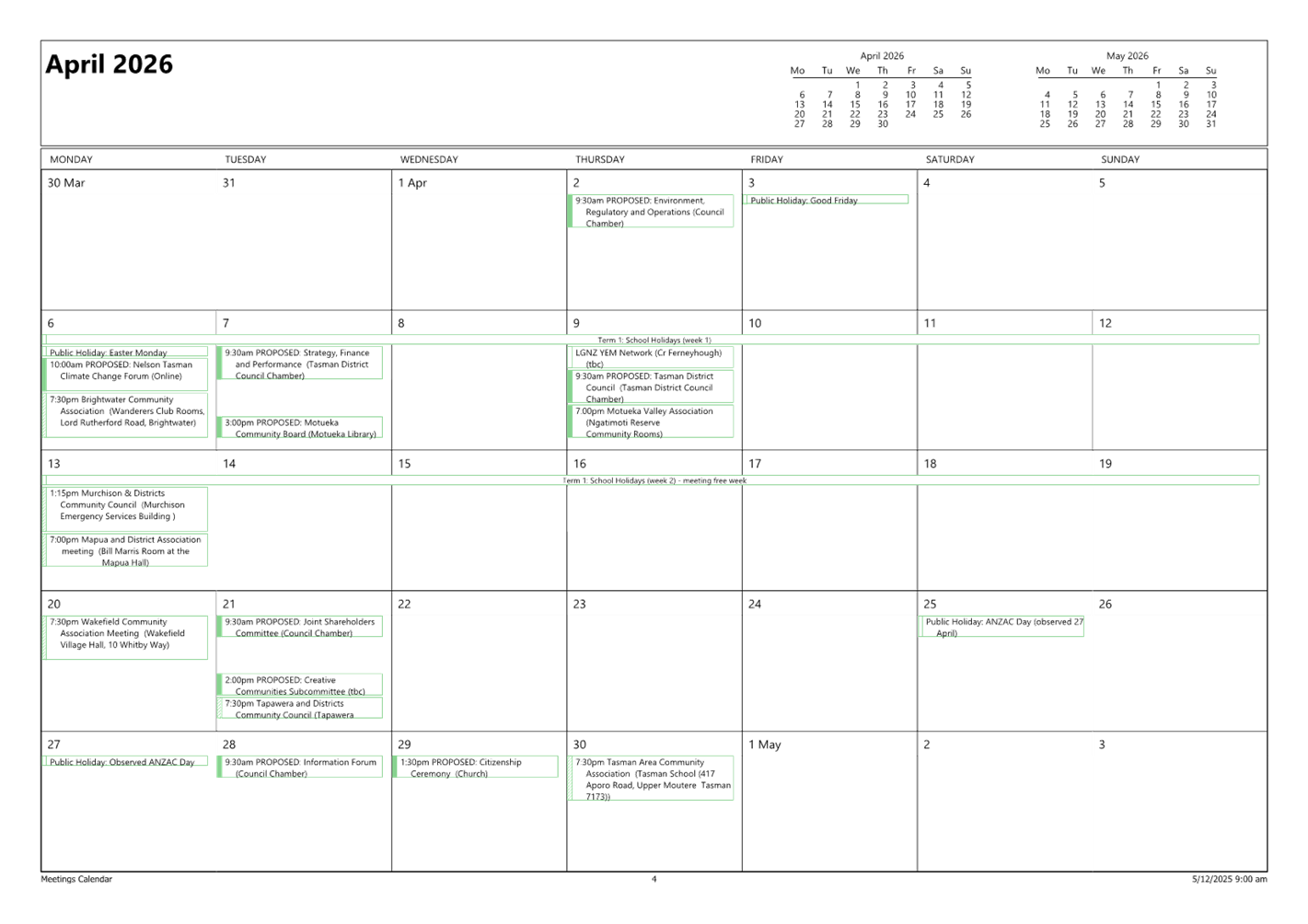
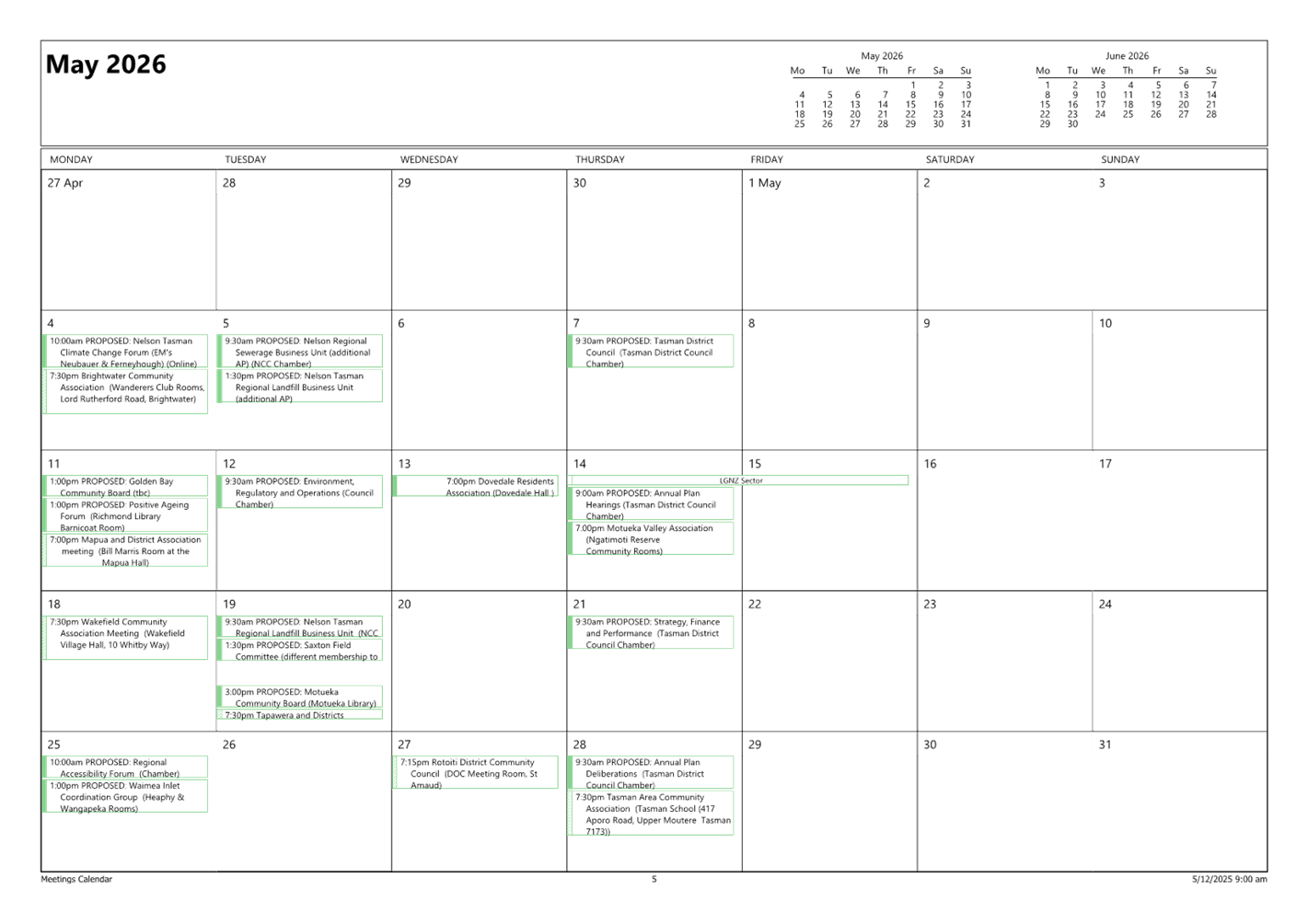
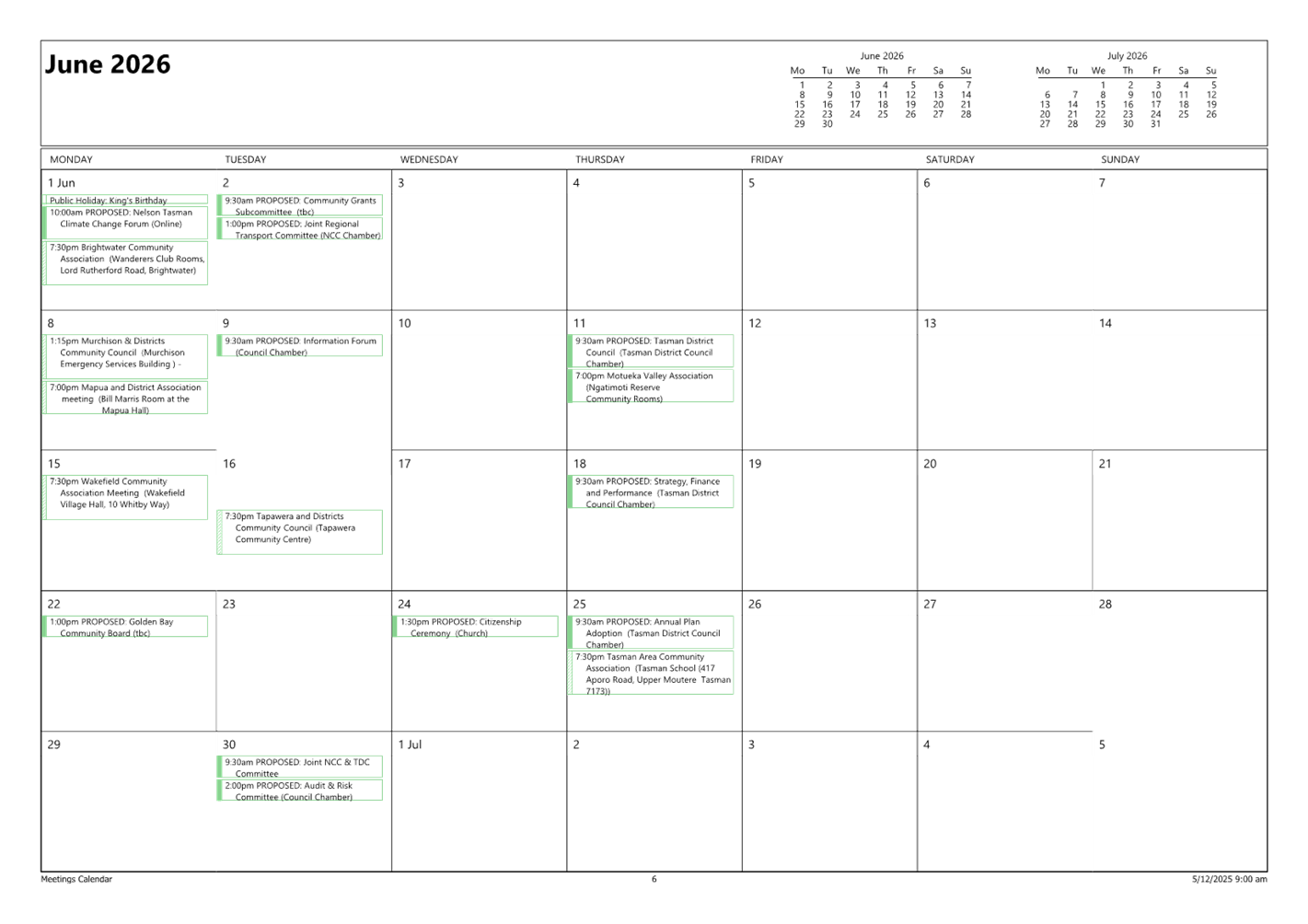
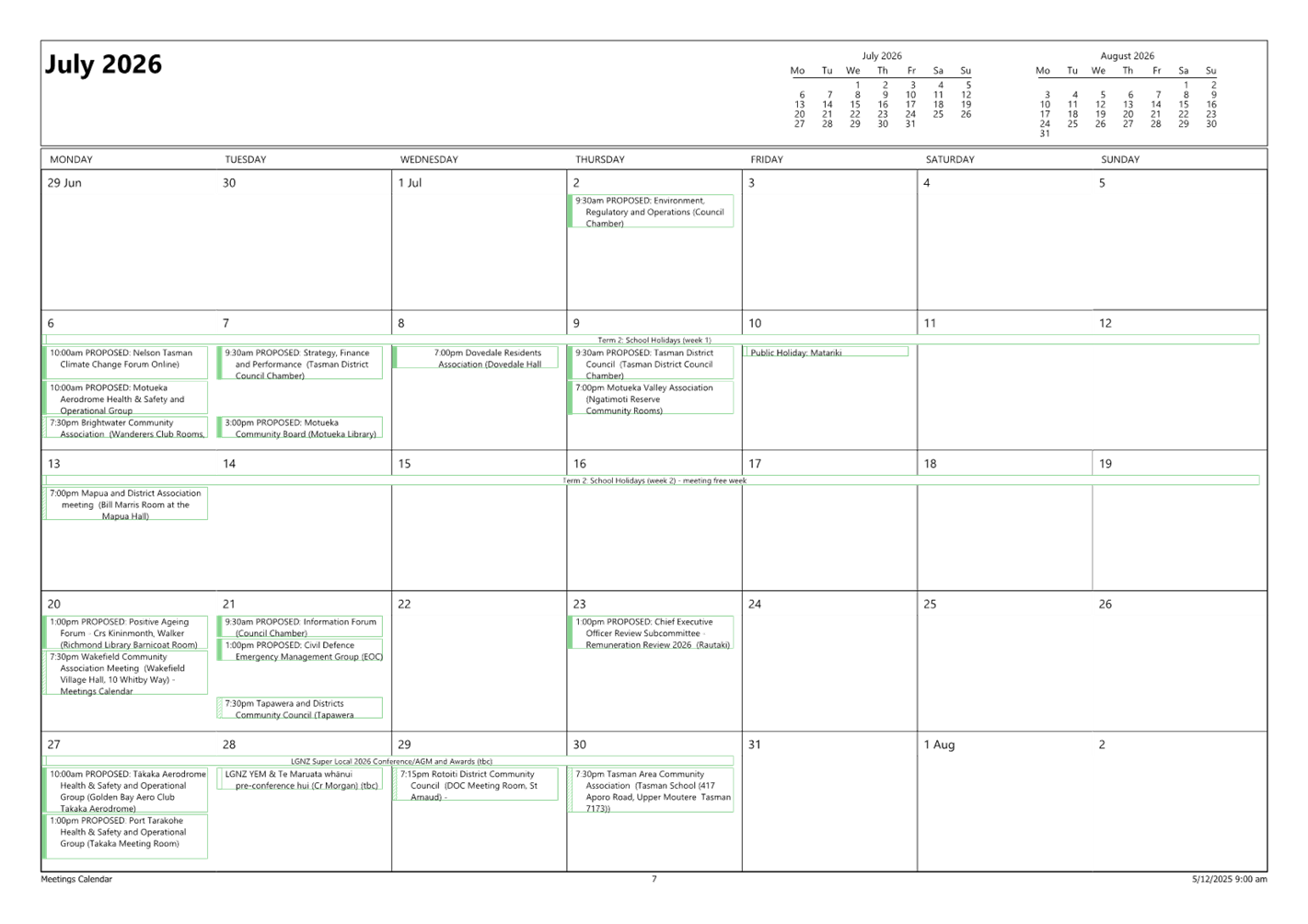
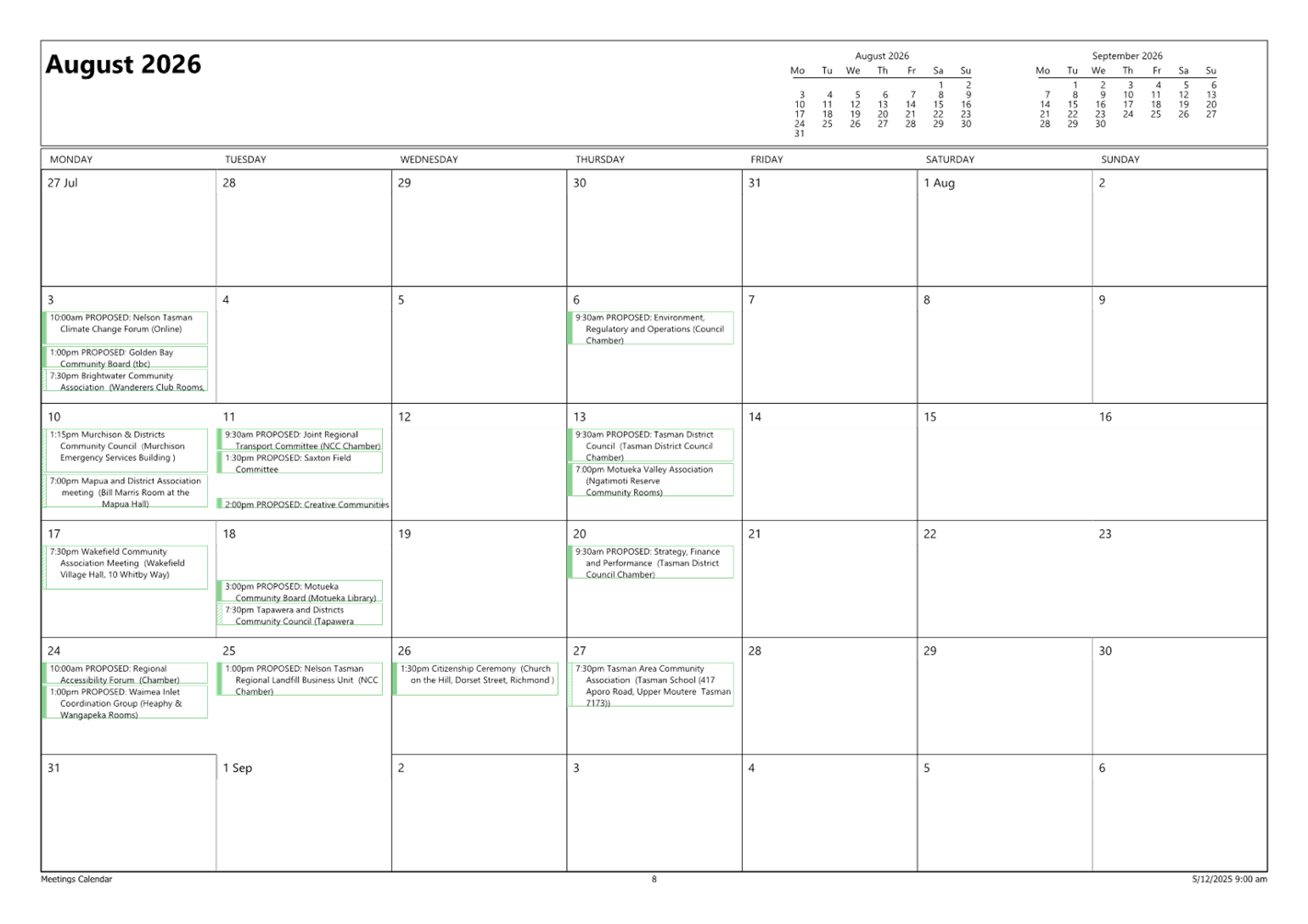
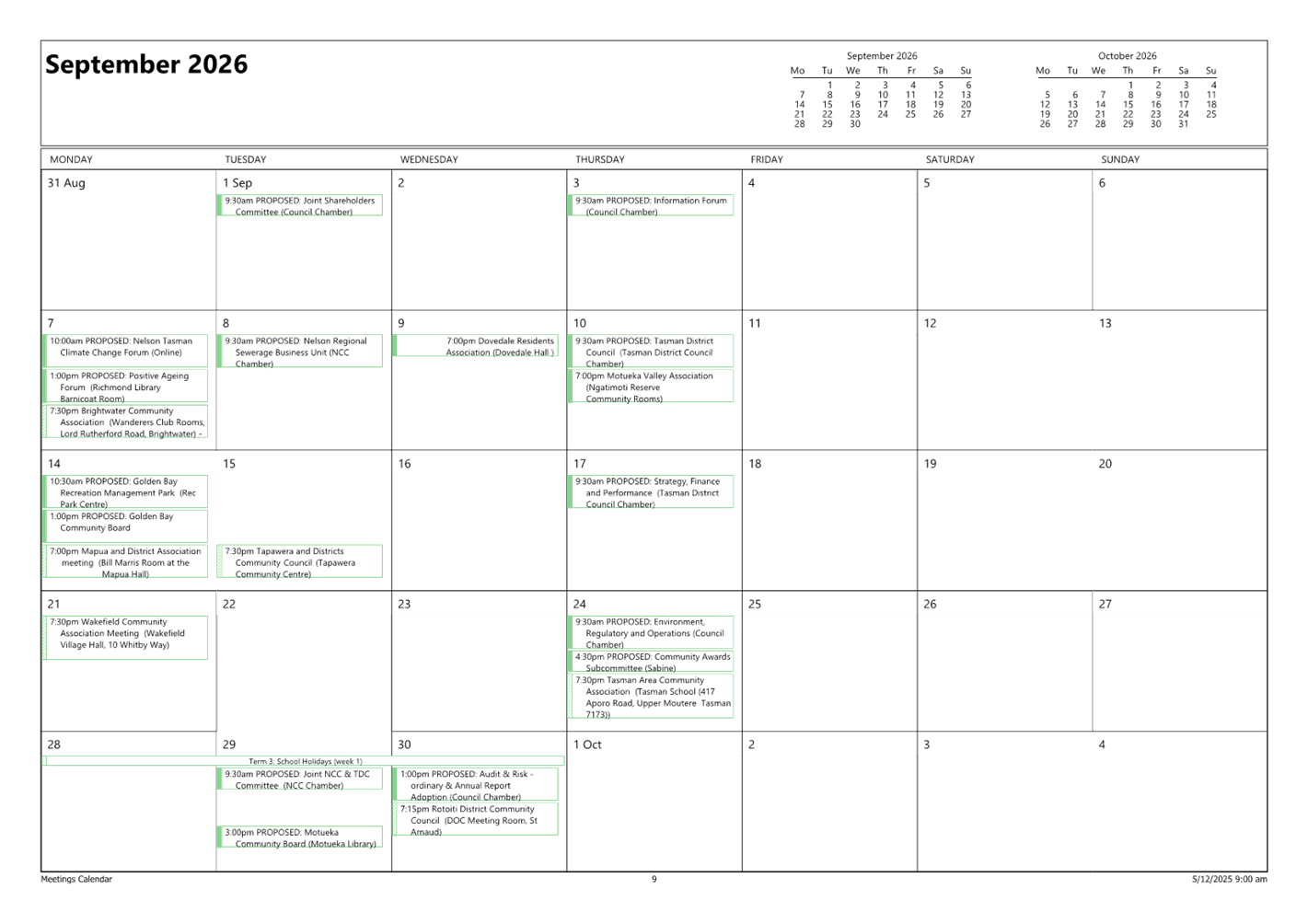
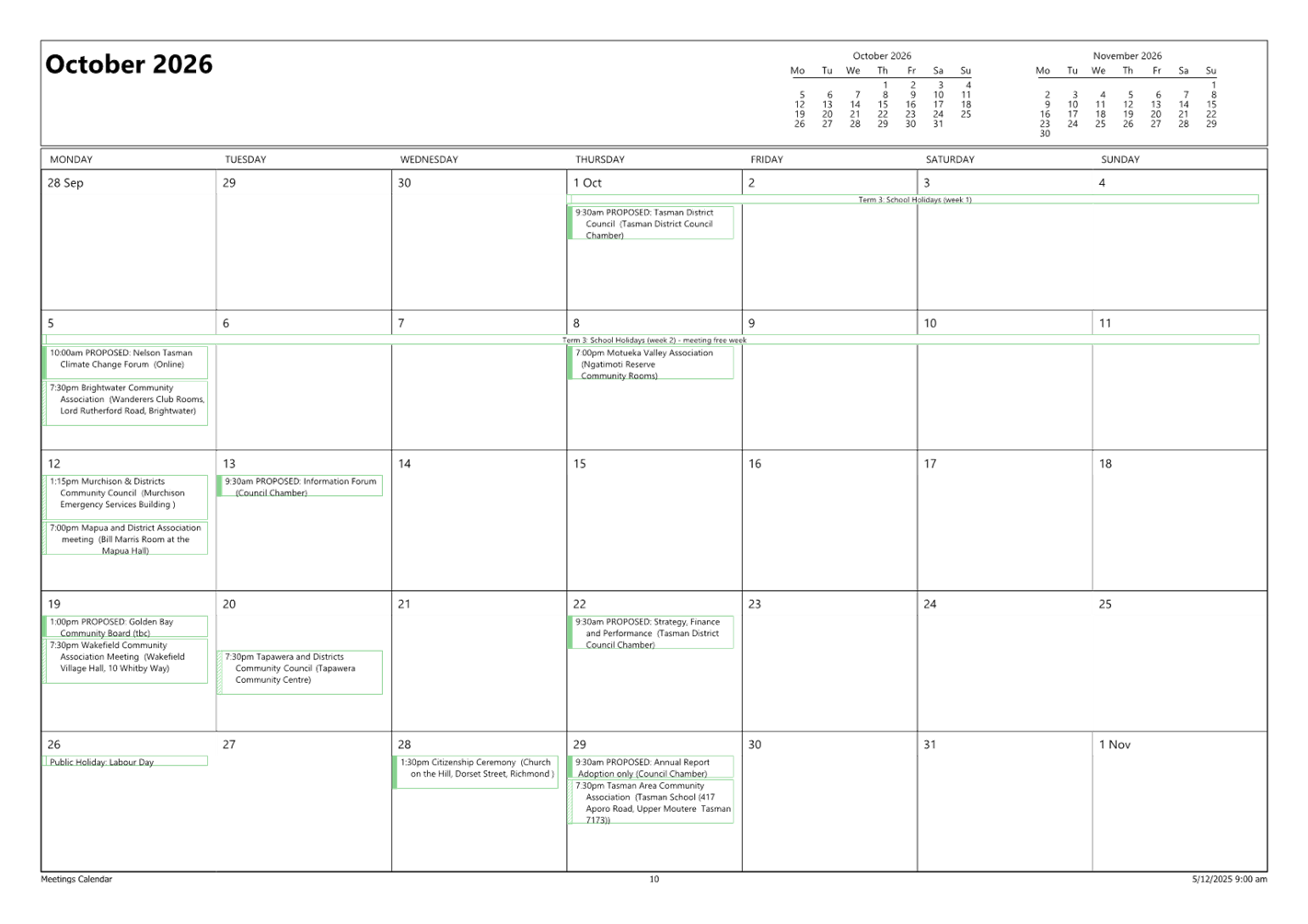
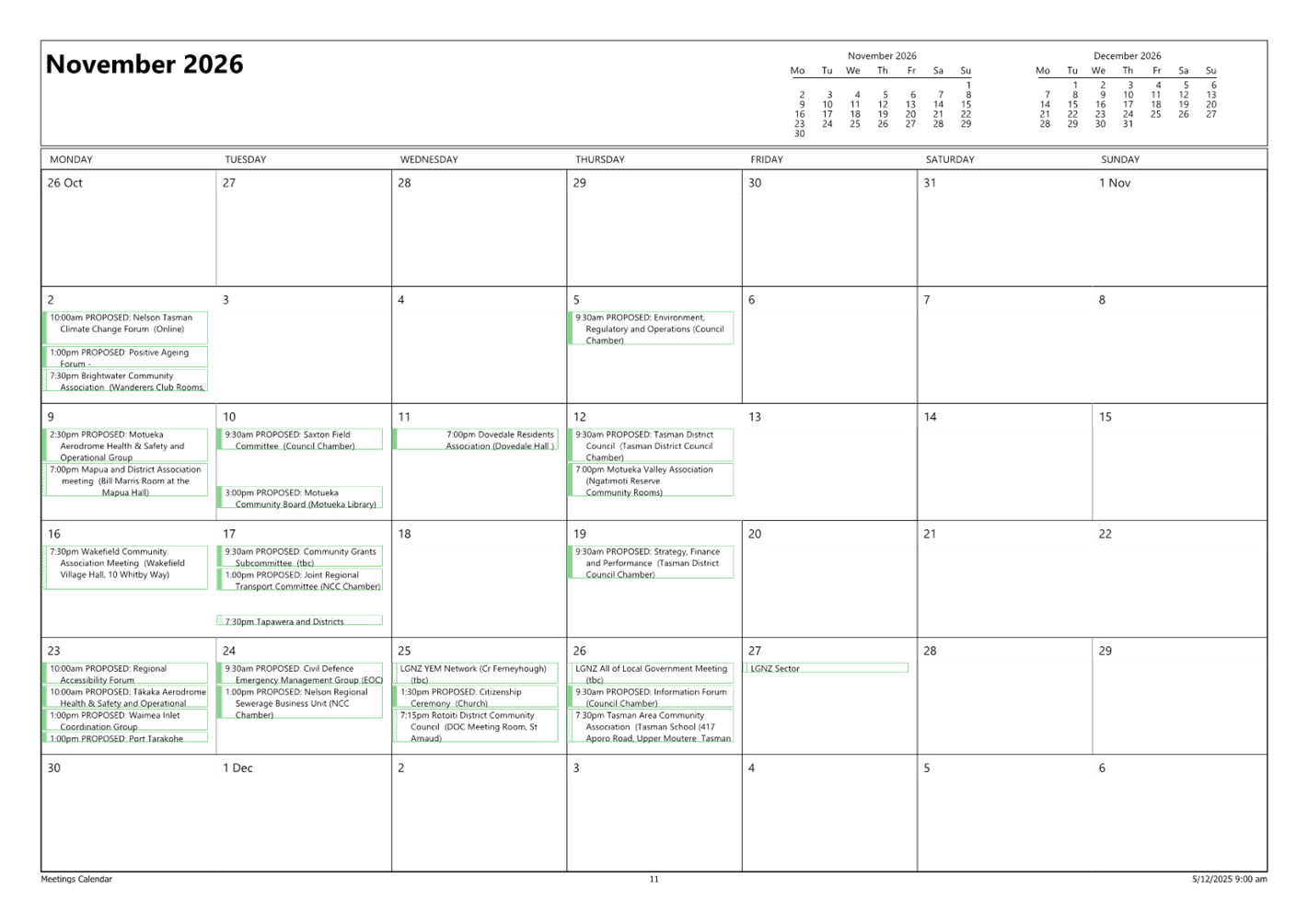
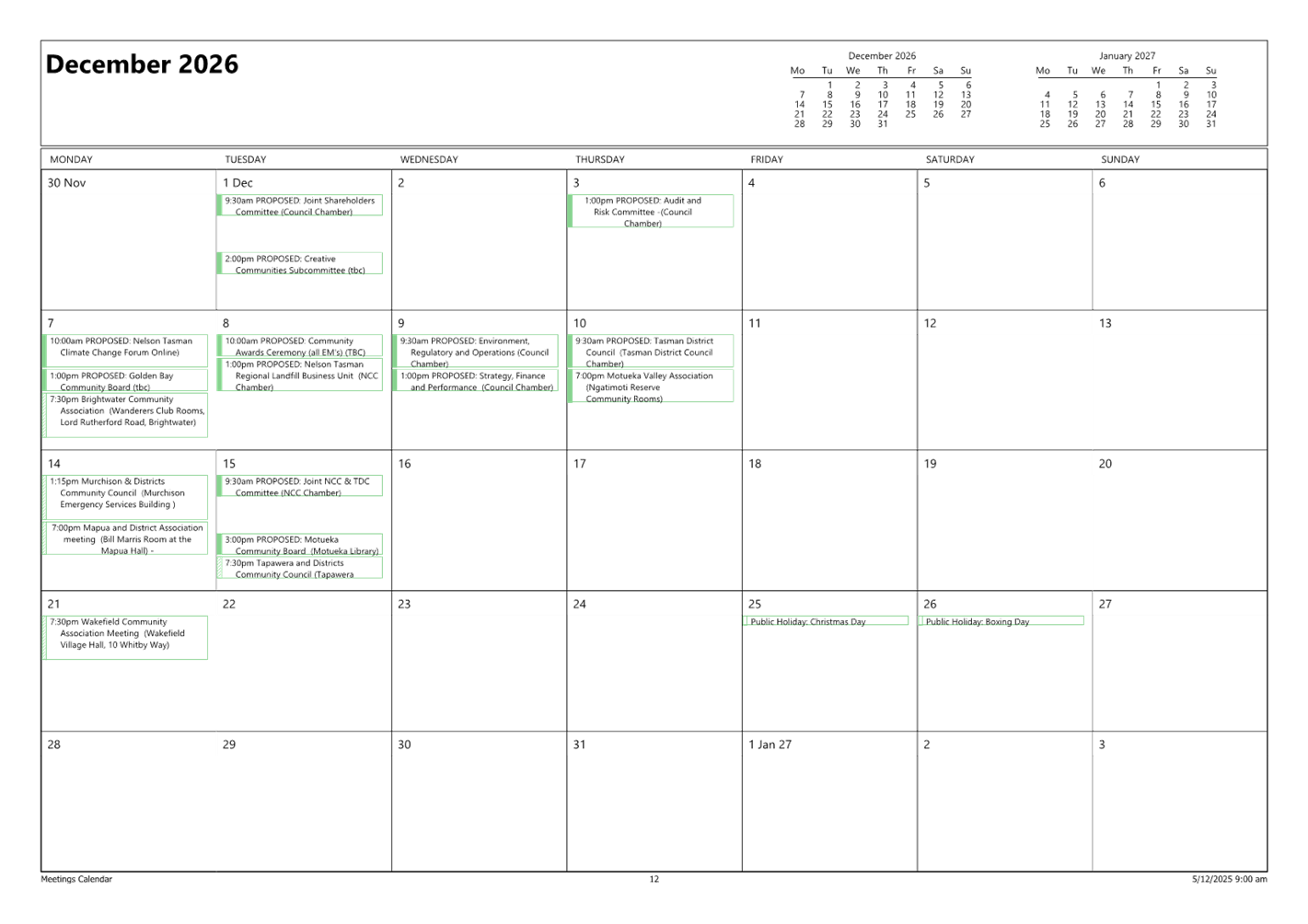
Tasman District Council Agenda – 11 December 2025
7.11 Waimea
Water Limited - Annual Report 2025
Information Only - No
Decision Required
|
Report To:
|
Tasman District Council
|
|
Meeting Date:
|
11 December 2025
|
|
Report Author:
|
Matthew McGlinchey, Finance Strategy & Planning
Manager
|
|
Report Authorisers:
|
Leonie Rae, Chief Executive Officer
|
|
Report Number:
|
RCN25-12-12
|
1. Summary
/ Te Tuhinga Whakarāpoto
1.1 The Waimea Water Limited (WWL) Annual
Report for the period ended 30 June 2025 is attached (Attachment 1). WWL
representatives will attend the Council meeting to present an update on the
project and to answer any questions on the Annual Report.
1.2 The attached copy of the Annual Report
has been approved by the Company Board and was adopted by the Joint Venture
Shareholders at the Company’s Annual General Meeting (AGM) on 7 November
2025.
1.3 The Company’s Annual Report meets
the requirements of both the Companies Act 1993 and the Local Government Act
2002.
1.4 The Company’s Annual Report was
made available to the public once it was adopted by the shareholders at the
Company’s Annual General Meeting.
1.5 There are no specific matters that staff
need to bring to the attention of the Council.
2. Recommendation/s
/ Ngā Tūtohunga
That the Tasman District Council
1. receives the Waimea Water Limited - Annual Report 2025, report RCN25-12-12; and
2. notes the delivery of the Waimea Water Limited Annual Report 2025 in
accordance with the requirements of the Local Government Act 2002.
3. Background
and Discussion
3.1 For convenience, an excerpt of the
report from the WWL Board Chairman, David Wright
which is included in the Annual Report is reproduced below. The full report is
attached (Attachment 1).
3.2 The Operating and Financial overview for
the year is set out on pages 22 to 37 of the Annual Report. The performance of
the Company against the Statement of Intent (SOI) is set out on page 11 of the
Annual Report. There are no matters that staff need to bring to the attention
of the Council.
3.3 The attached copy of the Annual Report
has been approved by the WWL Board. It was presented to the shareholders and
adopted at the Company’s Annual Meeting held on 7 November 2025.
3.4 The report has been provided to this
meeting to coincide with the regular WWL presentation on the project and to
allow the Council to consider the Company’s performance against the
Statement of Intent. Any questions on the Annual Report should be addressed to
the Company representatives during the presentation session.
3.5 The Annual Report has also been provided
by the Company to Waimea Irrigators Limited as the other shareholder in the
Company.
3.6 Extract of
Report from Board Chair – David Wright: “This financial year stands as a defining period for WWL, marking the
full transition from construction to operational status.
On 7
February 2025, the dam’s completion and opening was officially celebrated
— a historic moment and the culmination of over two decades of vision,
determination and collective effort, including six years of construction. The
official opening was a chance to thank and congratulate all the people who made
this much-needed infrastructure project possible, providing water security,
economic benefit and prosperity to the region for generations to come.
At the
opening celebration, many dignitaries were welcomed, including Prime Minister
Rt Hon Christopher Luxon, Minister for Infrastructure Chris Bishop, the South
Island Minister James Meager, Nelson MP Rachel Boyack, Mayors Tim King and Nick
Smith, Koata Ltd Chief Executive Hemi D Toia, as well as WWL directors, staff
and guests. As the Prime Minister said on the day, this project is an
“incredible legacy,” albeit one “we wish we’d got onto
sooner.” And as Rachel Boyack noted, the region now has water security,
which was something people across Aotearoa would be “very, very jealous
of.”
The dam
already demonstrated this value during the severe 2024 drought, augmenting
flows to protect urban supply, support local industry and safeguard river
health. This project is a testament to the engineering ingenuity and resilience
of the team and partners who have worked tirelessly through unprecedented
challenges to deliver an enduring legacy.
Over this
year, key highlights include the operational transition, the achievement of
full compliance with regulatory frameworks and the settlement of contractual
disputes with the Contractor. The final project investment was $211.2M.”
4.1 This is a routine matter and there are
no strategic matters or risks that the Council needs to consider in noting the
receipt of the WWL Annual Report.
5. Compliance with Funding and Other
Arrangements
Overview
5.1 To ensure compliance by all parties,
staff have developed a comprehensive timetable outlining reporting and
refinancing obligations for the Waimea Community Dam scheme. This schedule
addresses requirements under the financial and equity agreements as well as the
Company’s responsibilities pursuant to the Local Government Act 2002.
These obligations have been formally communicated to WWL. Staff have also
contacted CIIL in late October to obtain an assurance that WWL and Waimea
Irrigators Limited (WIL) have complied with the disclosure and other
requirements set out in the financing arrangements. It is intended that
this will be an annual request to CIIL actioned in July each year for the
preceding financial year.
Historical Non-Compliance
5.2 WWL has previously failed to provide the
required notice for financing and refinancing its loan drawdowns. This has
necessitated Council staff seeking dispensations from the LGFA.
5.3 While these dispensations have been
granted due to our strong relationship with LGFA, WWL has been formally advised
that adherence to the notice periods specified in the Shareholder Advance
Agreements is mandatory. Although we acknowledge the challenges WWL may face in
engaging WIL and obtaining timely responses, these challenges do not exempt WWL
from its contractual obligations. The agreements clearly outline default
provisions in such circumstances.
5.4 Kelly Norris, General Manager of WWL,
has assured Council that it has incorporated key dates into its forward
planning and is implementing systems to ensure compliance. No further action is
required on this matter at present.
Continuous Disclosure Requirements
5.5 As part of ongoing monitoring, the
Council notes the continuous disclosure requirement under the Wholesale Water
Augmentation Agreement (WWAA). Accordingly, WWL has been requested to write to
WIL annually to obtain the reporting and records specified in Clause 11 of the
WWL/WIL WWAA agreement.
5.6 Confirmation from WIL that these matters
are in order prior to the commencement of irrigation season is critical to
Council. WWL has confirmed that this process will commence in October
2025.
6. Policy | Legal Requirements | Plan
6.1 Under Section 67 of the Local Government
Act 2002:
6.1.1 A Council Controlled Organisation must, within three
months of the end of the financial year (30 October), deliver to shareholders
and make available to the public a report on the operations during the year.
6.1.2 The report must include the information required by
sections 68 and 69 of the LGA 2002 namely:
6.1.2.1 A comparison of
the Company’s performance with the Statement of Intent and
an explanation of any material variations.
6.1.2.2 State the dividend
(if any) to be paid.
6.1.2.3 Audited Financial
Statements for the year prepared using generally accepted
accounting practice (GAAP).
6.1.2.4 An audit report on
the financial statements and performance measures.
6.2 WWL has met the
statutory timeframe for delivering their Annual Report to shareholders.
7. Consideration of Financial or Budgetary
Implications
7.1 There are no financial or budgetary
implications arising from this noting report.
8.1 The Company has met the Annual Report
requirements in the Statement of Intent and delivered its report late but
otherwise in accordance with the Local Government Act 2002.
9.1 The Company has made their Annual Report
publicly available on their website.
9.2 The Waimea Water Limited Annual Report
(or a link to the report) will be published on the Council’s website
within seven (7) working days of this meeting.
|
1.⇩
|
Waimea
Water Limited Annual Report 2025
|
189
|
Tasman District
Council
Agenda – 11 December 2025

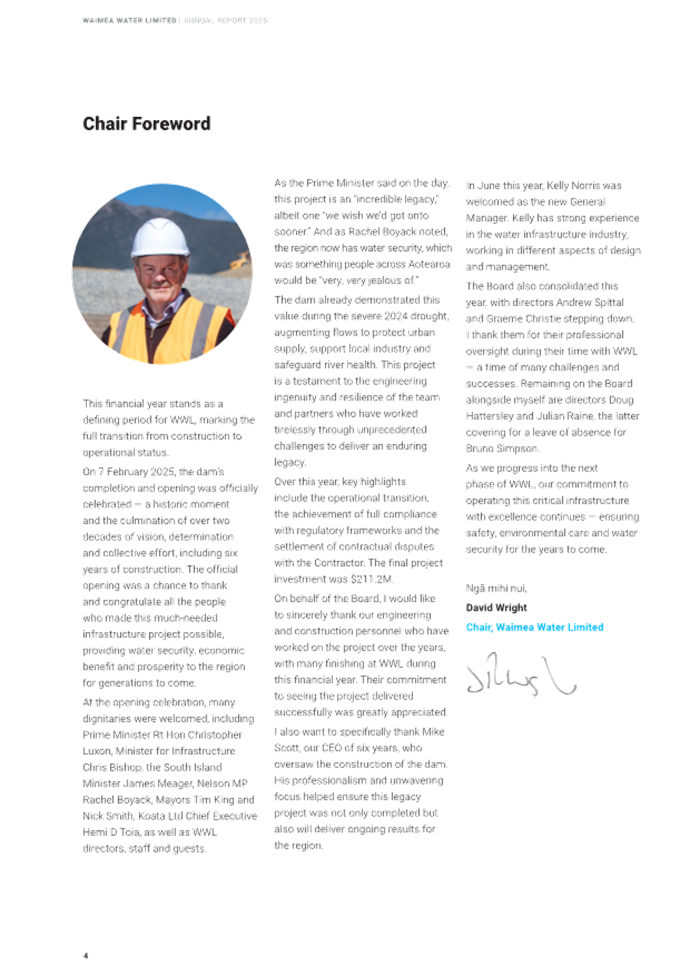
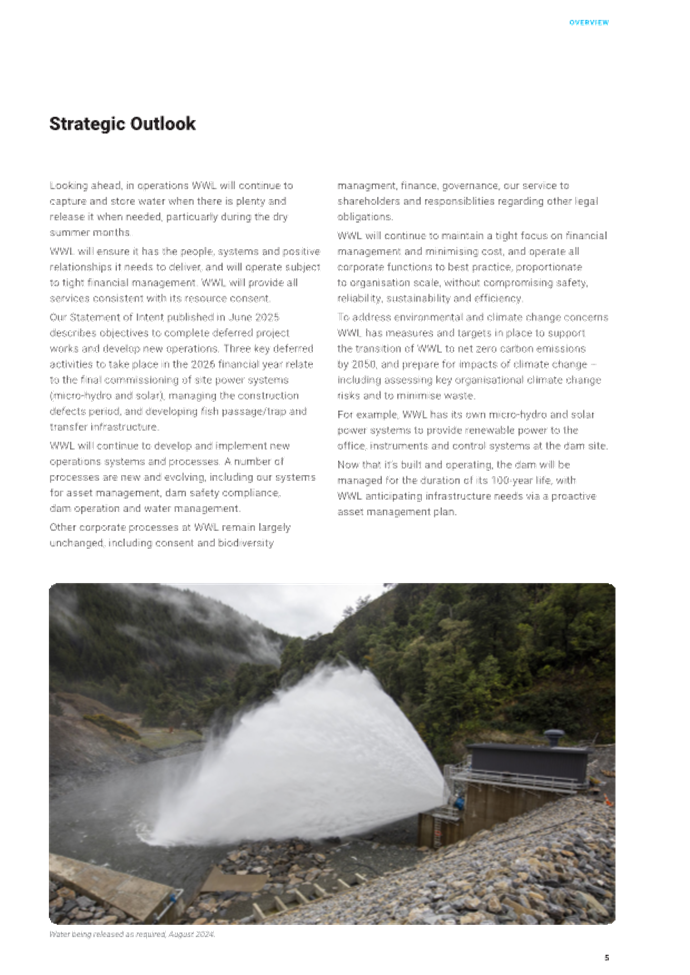
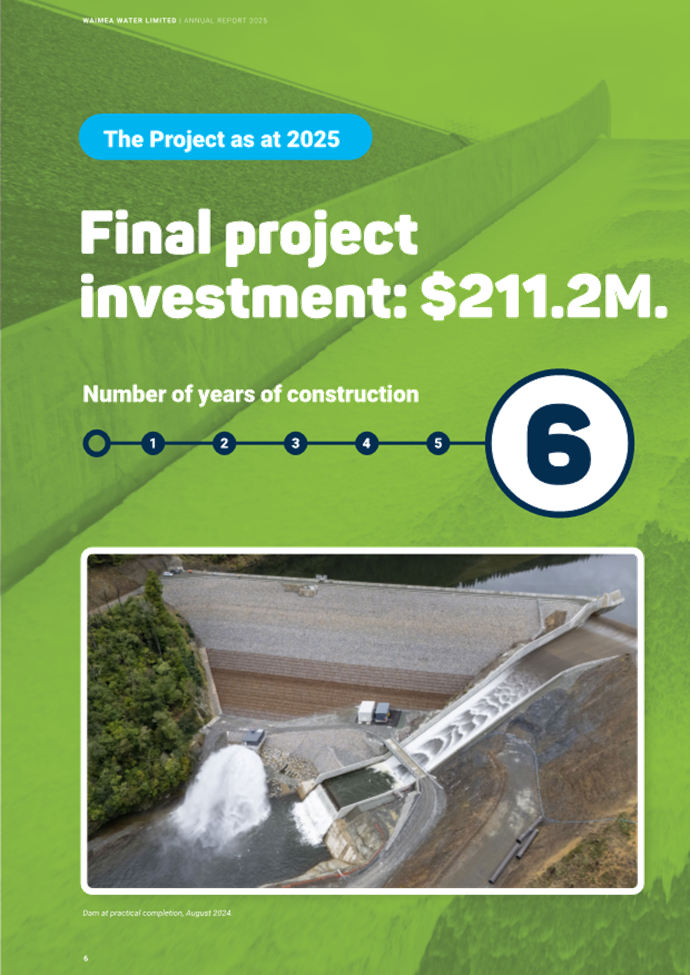
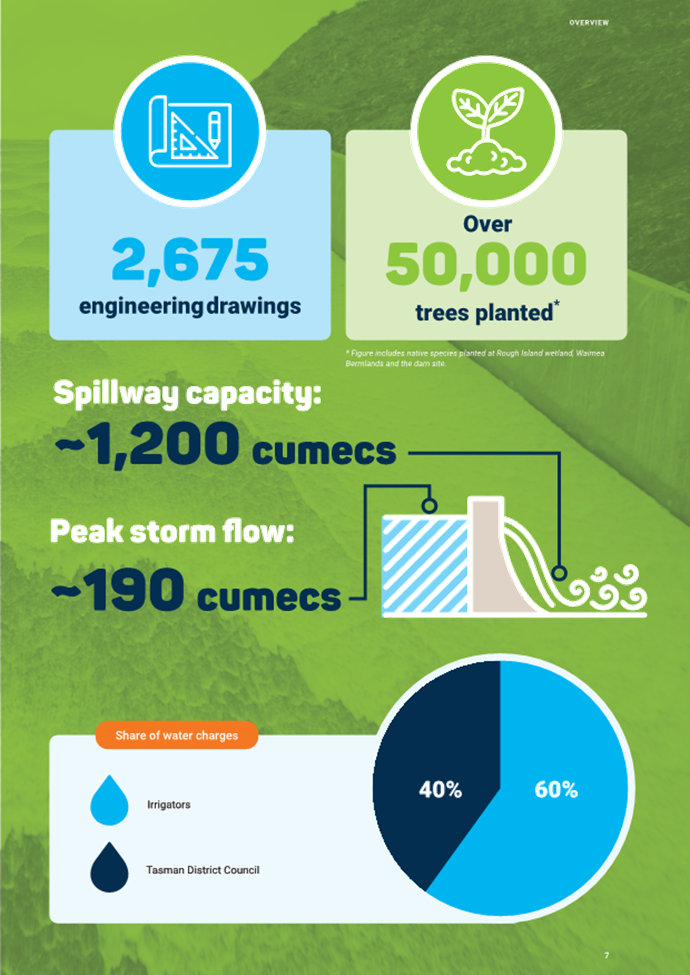
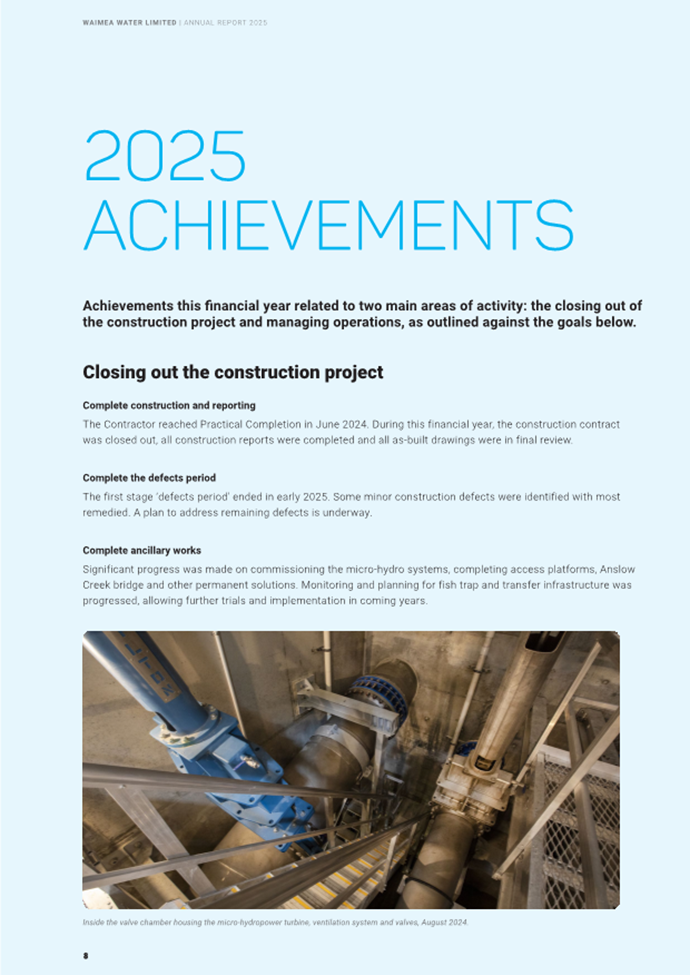
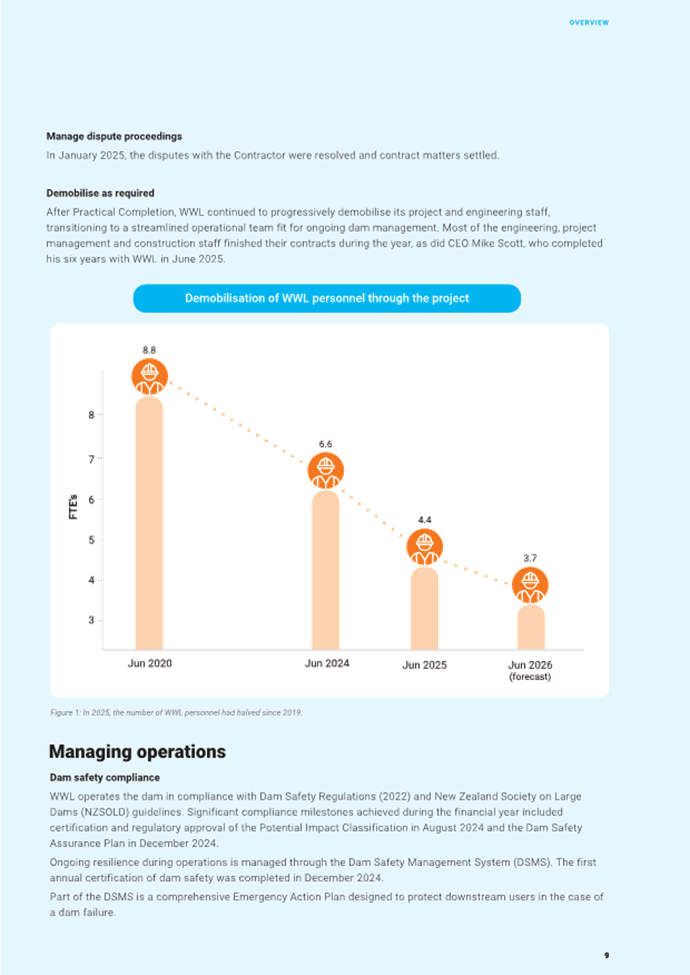
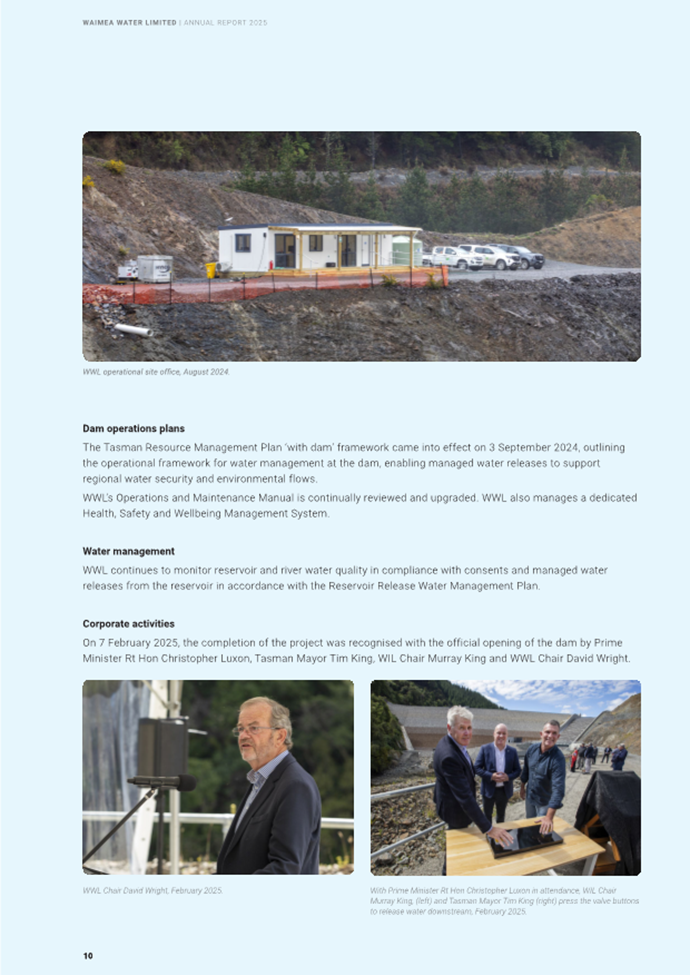
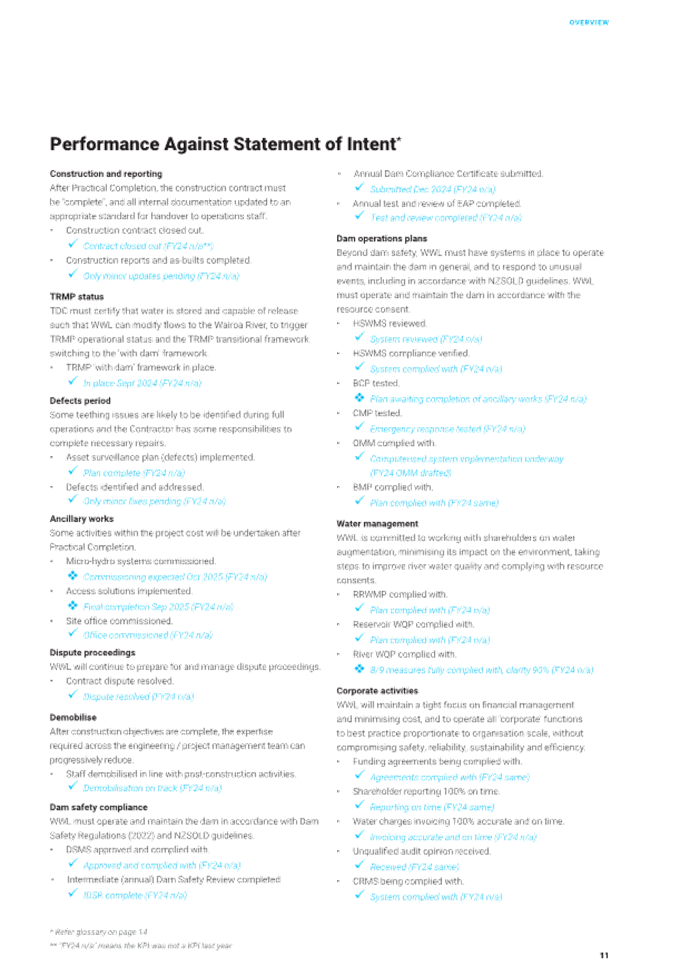
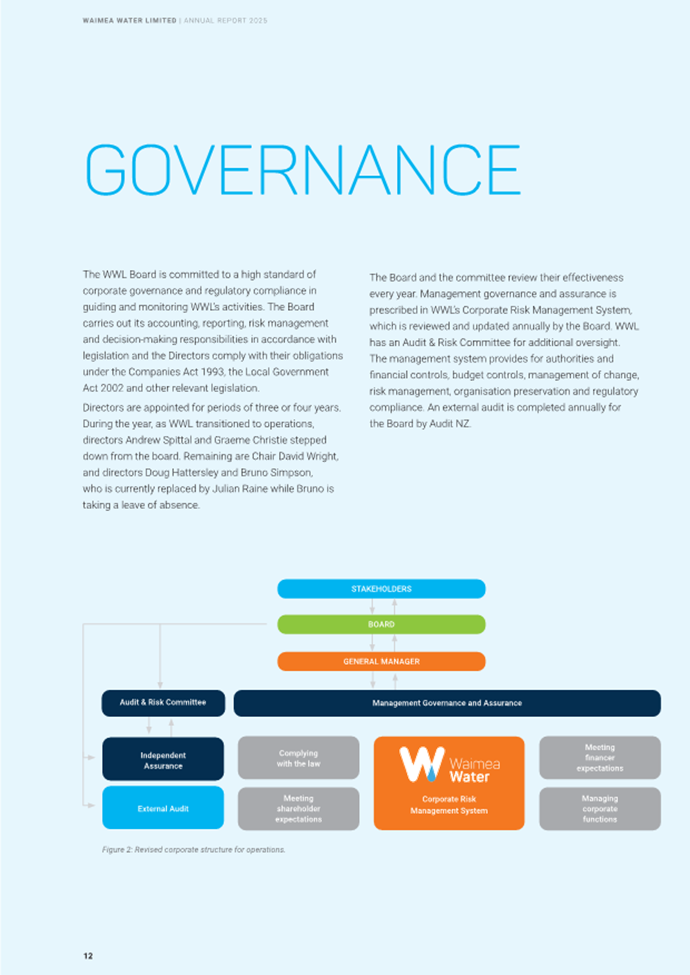

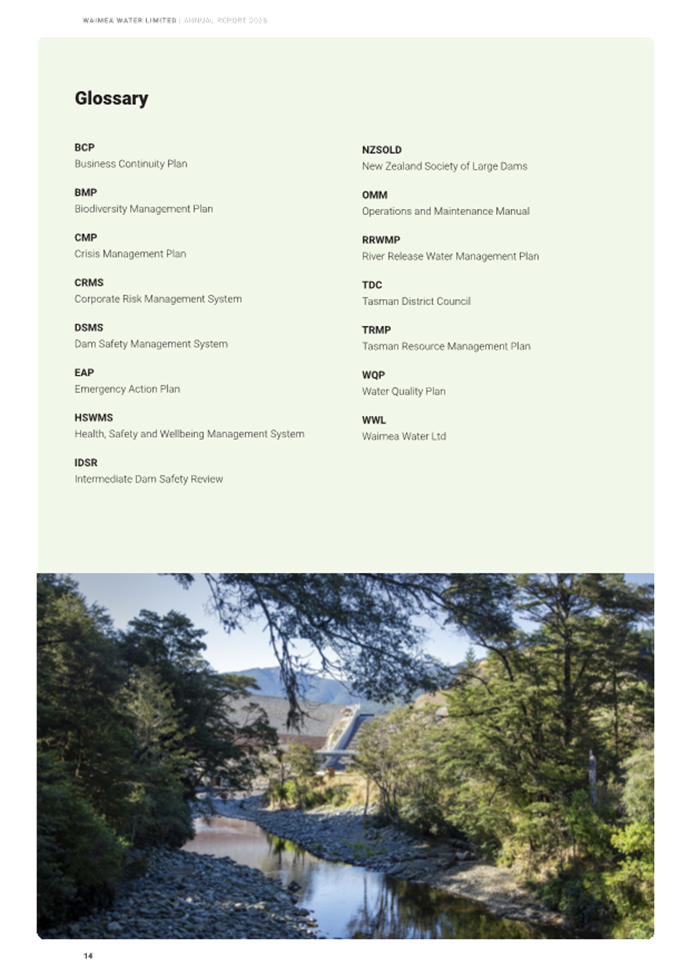
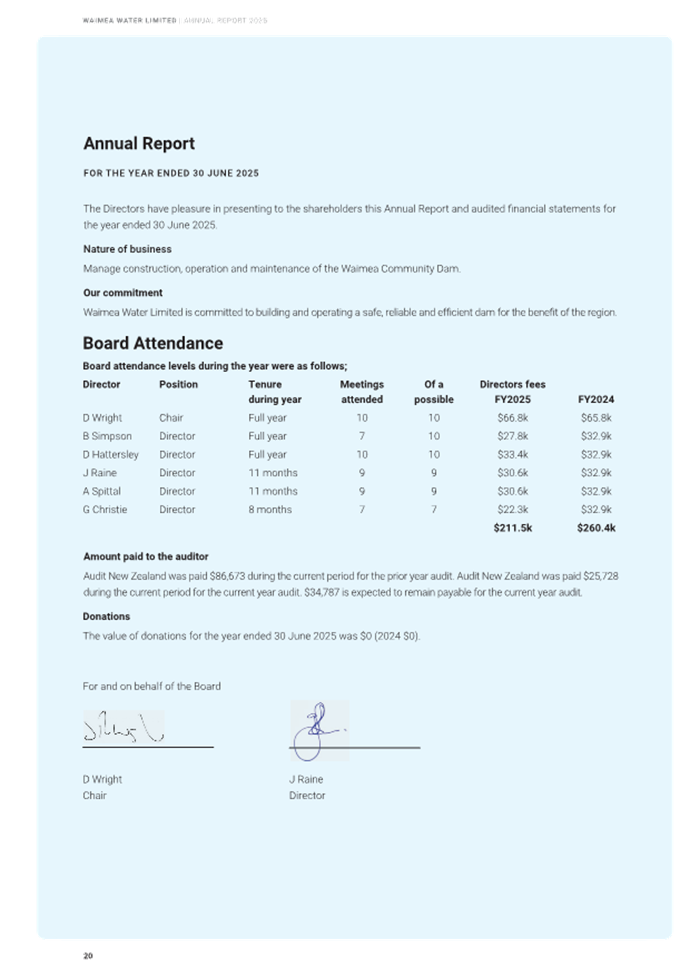
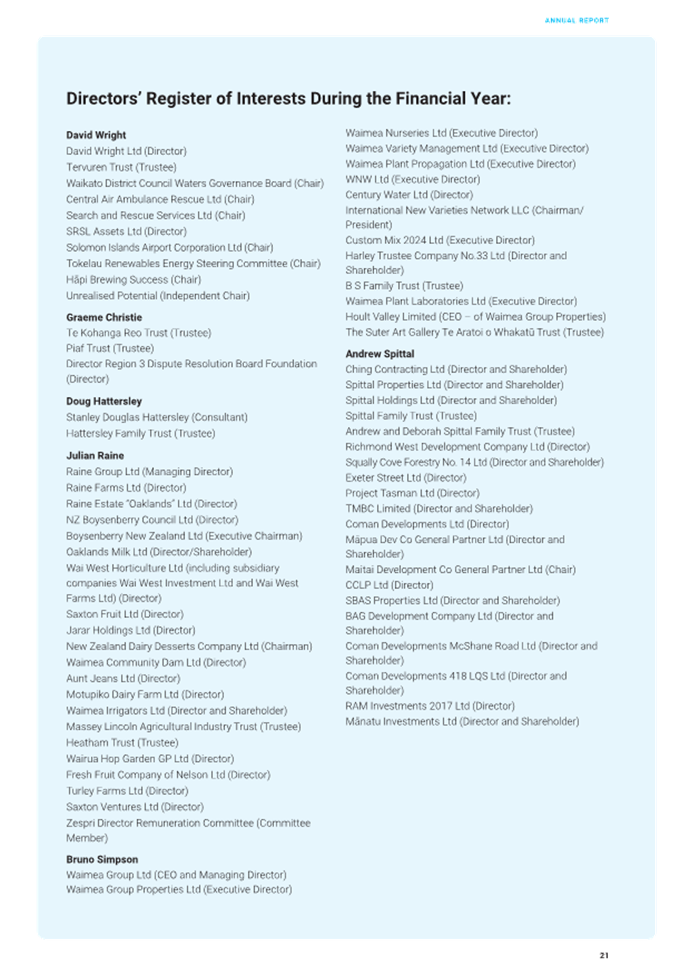
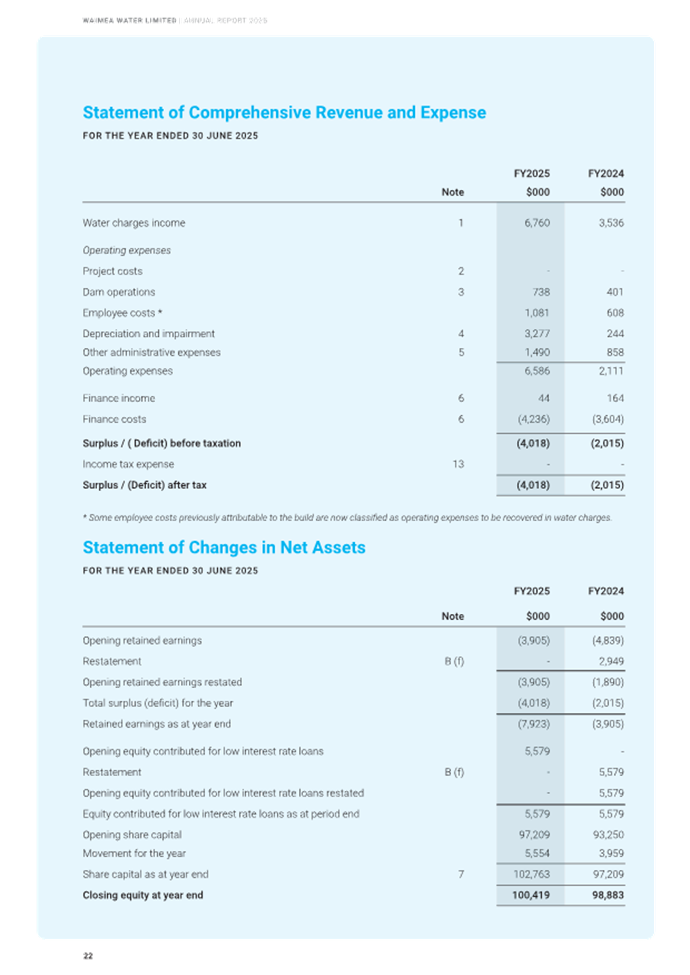
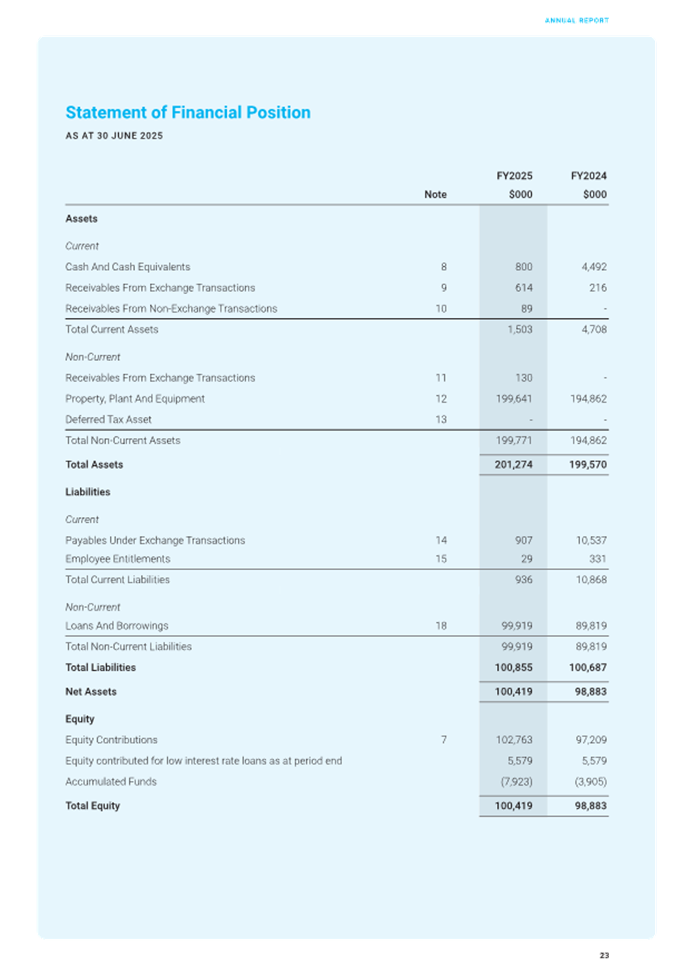
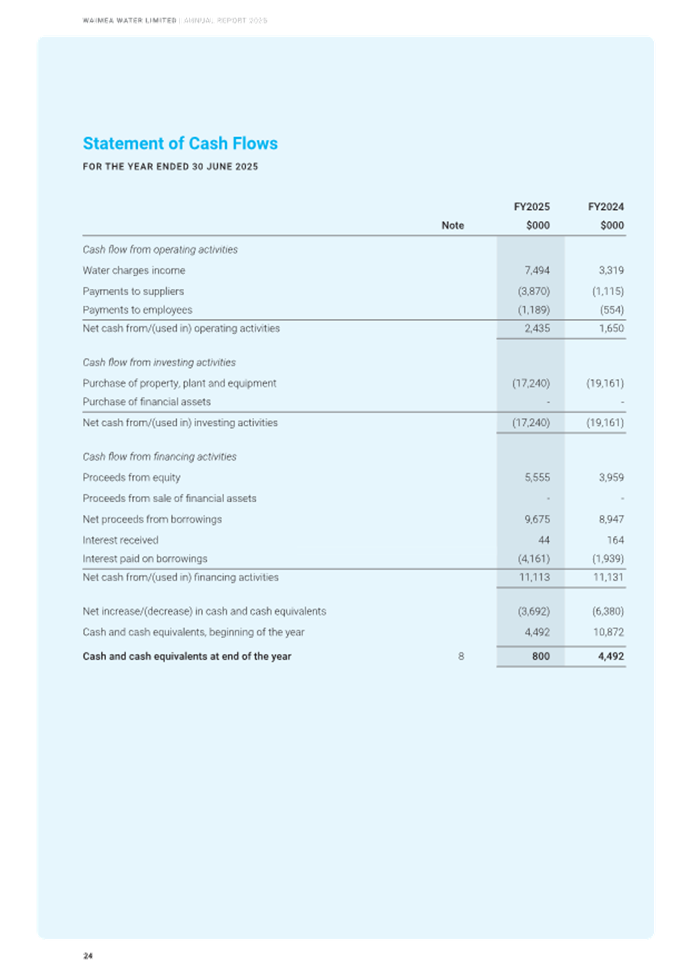
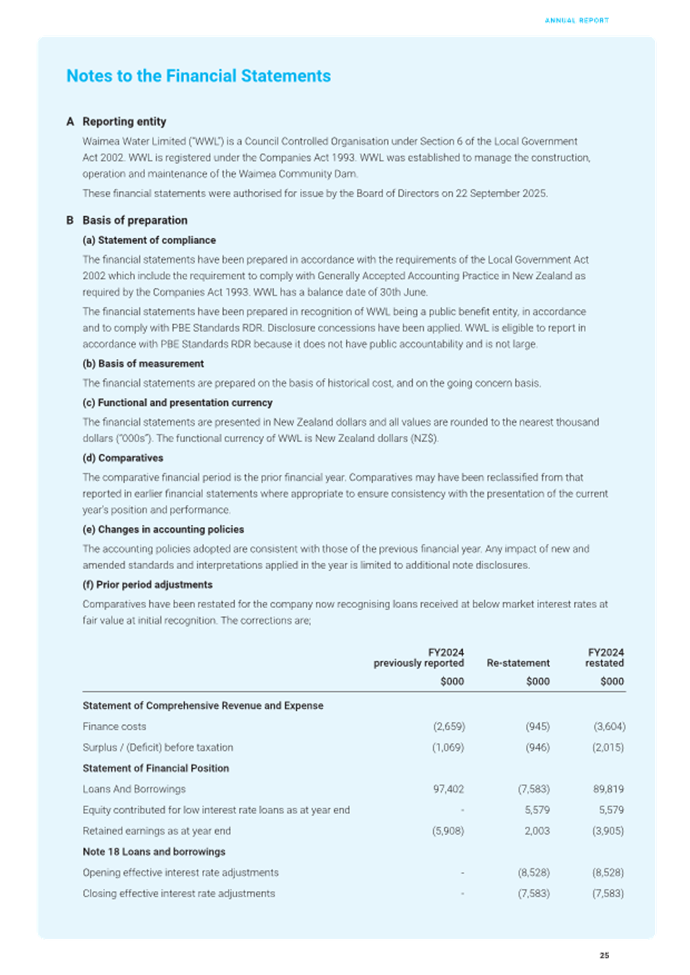
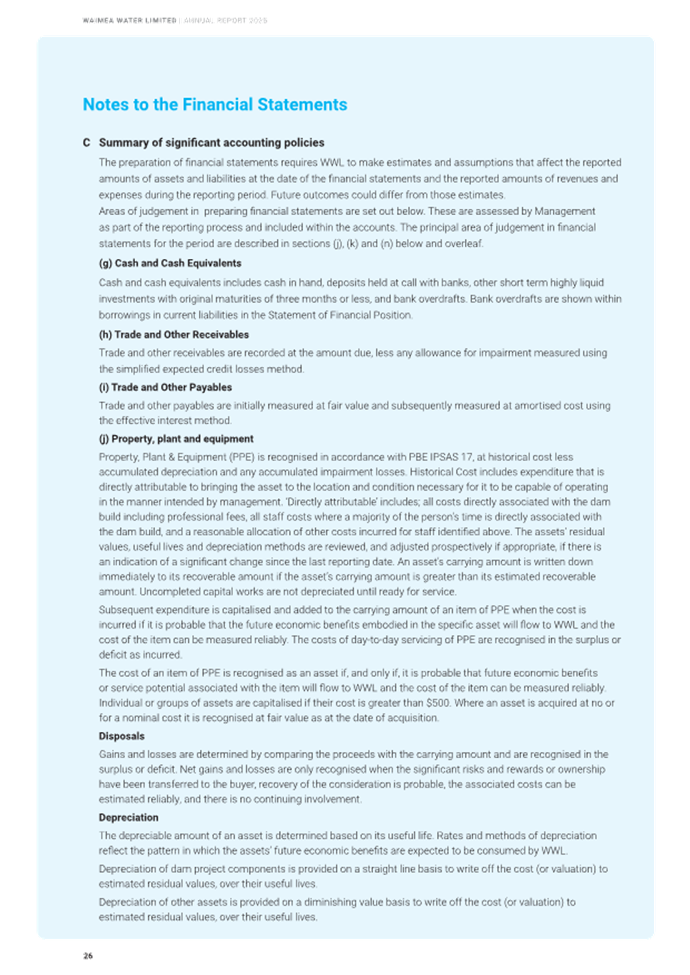
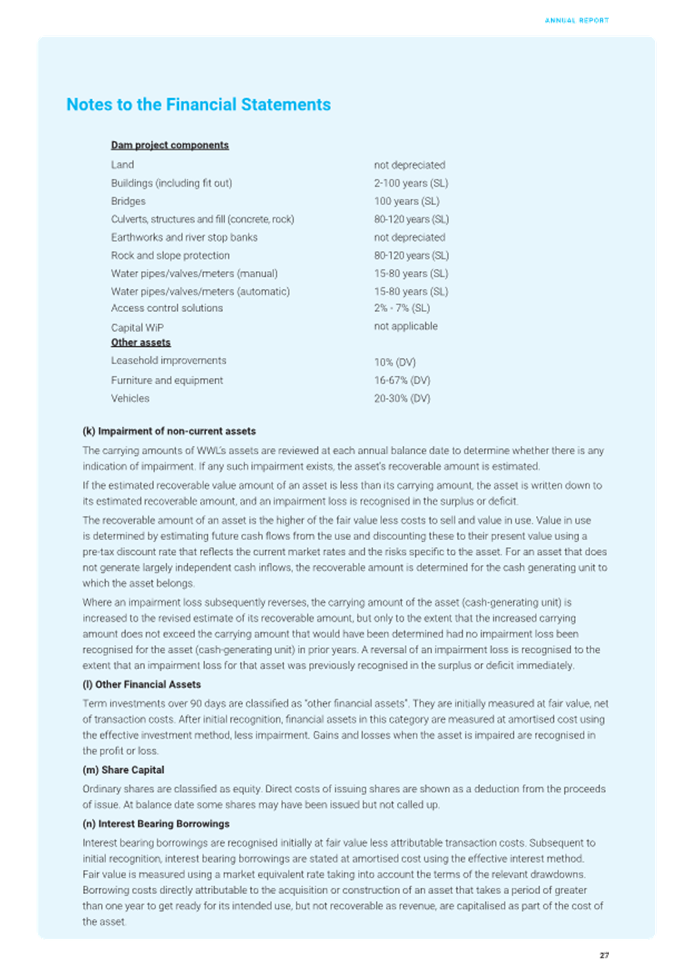
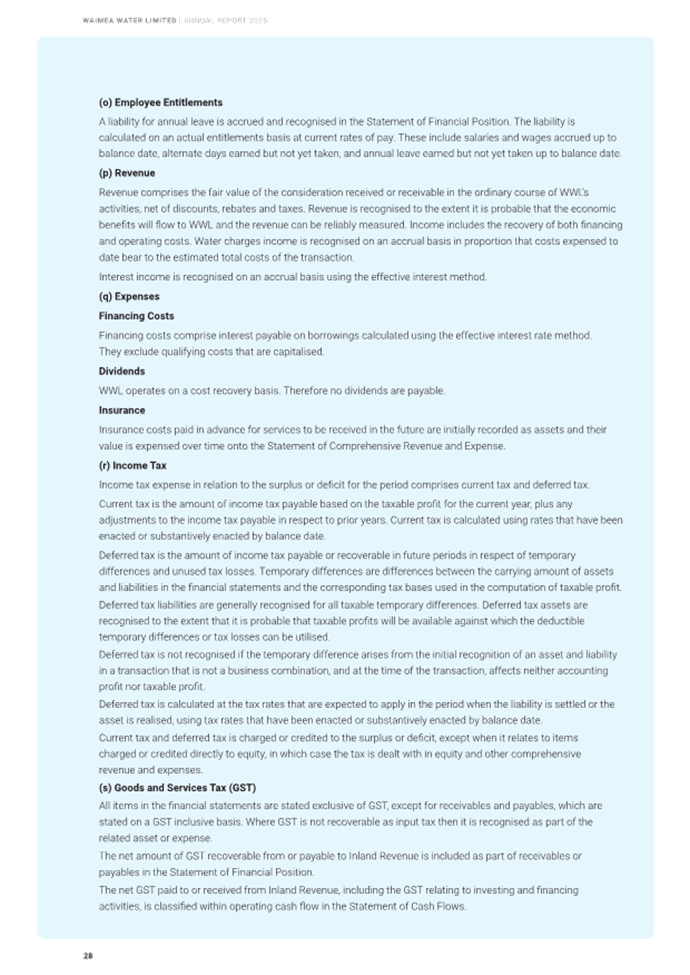
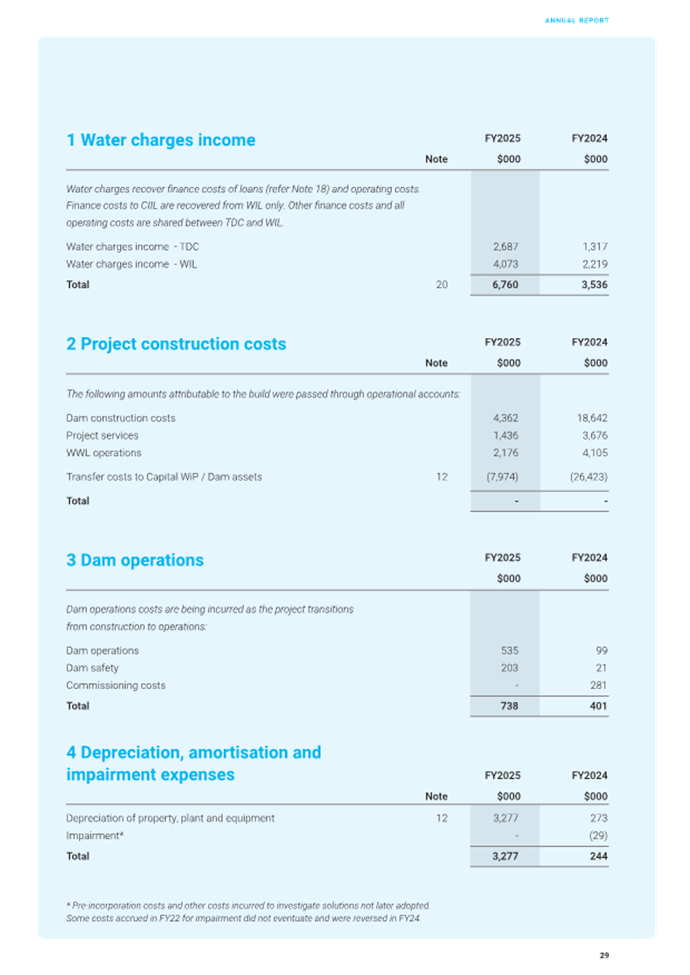
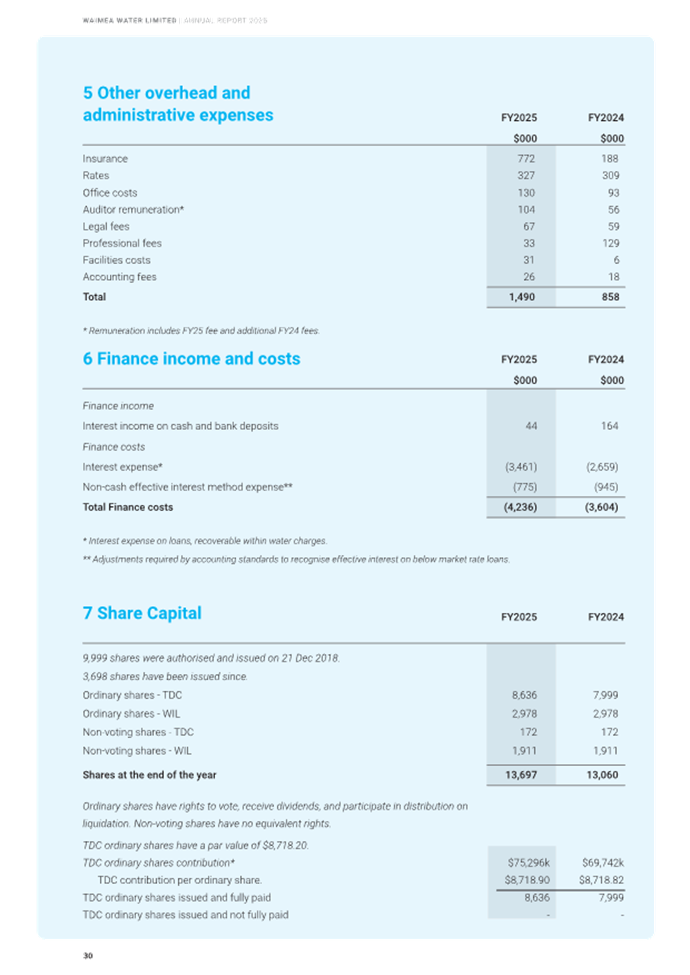
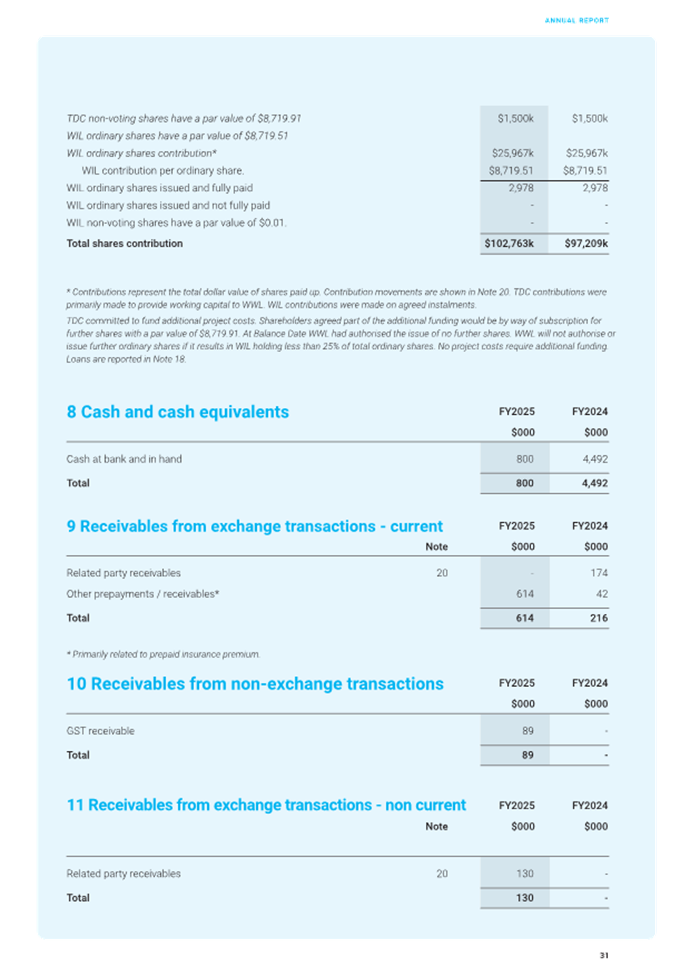
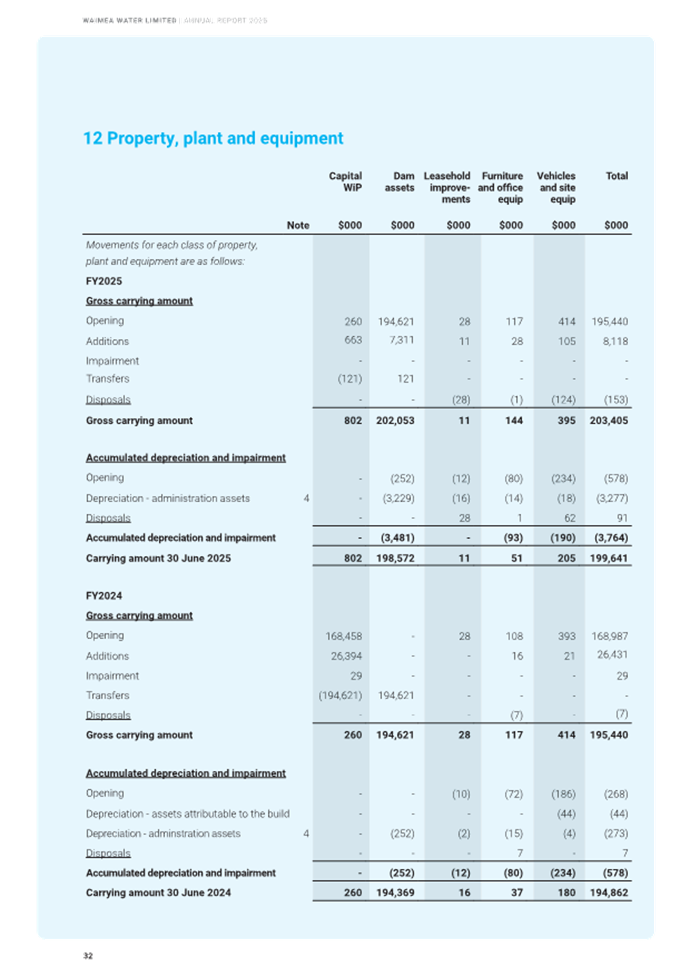
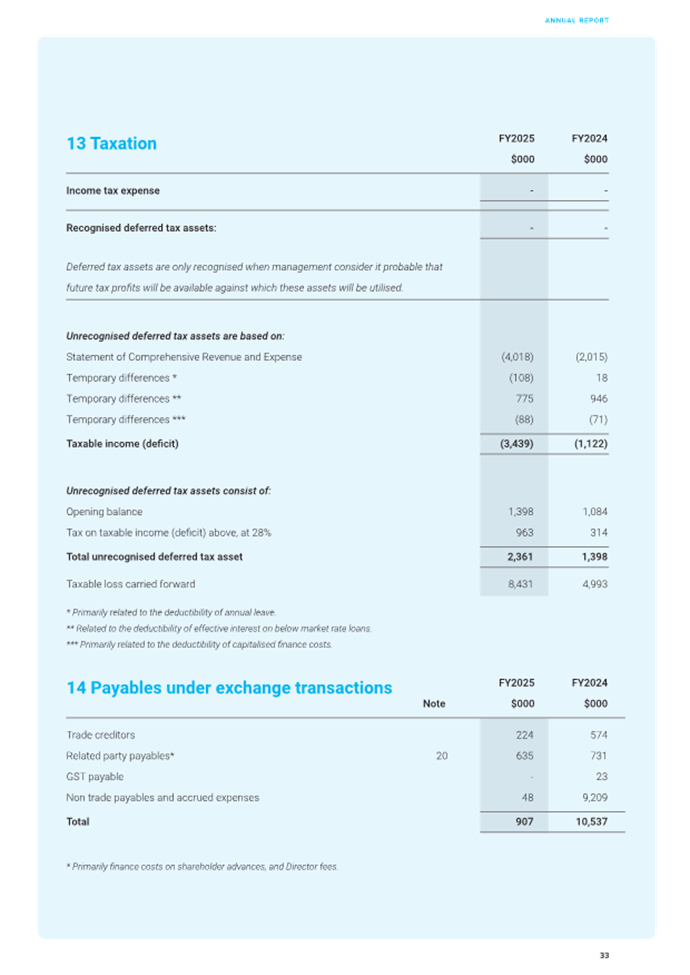
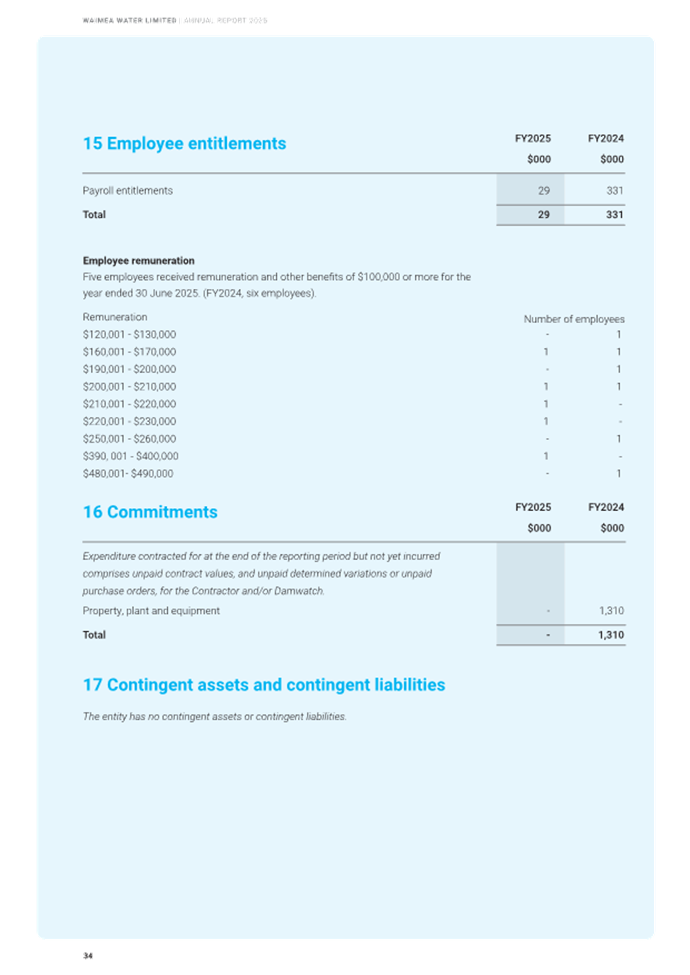
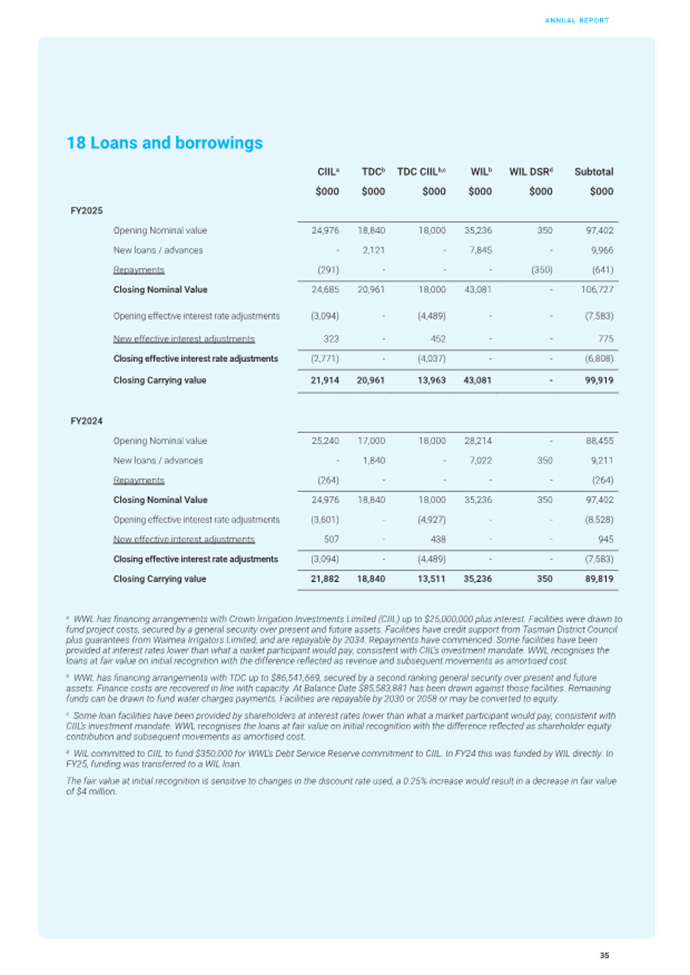
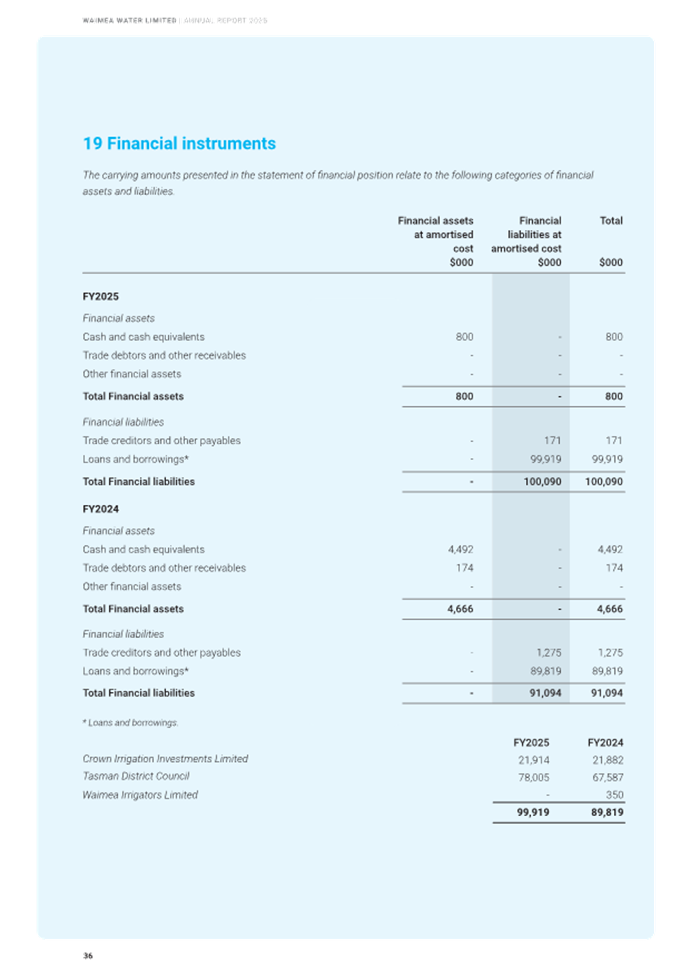
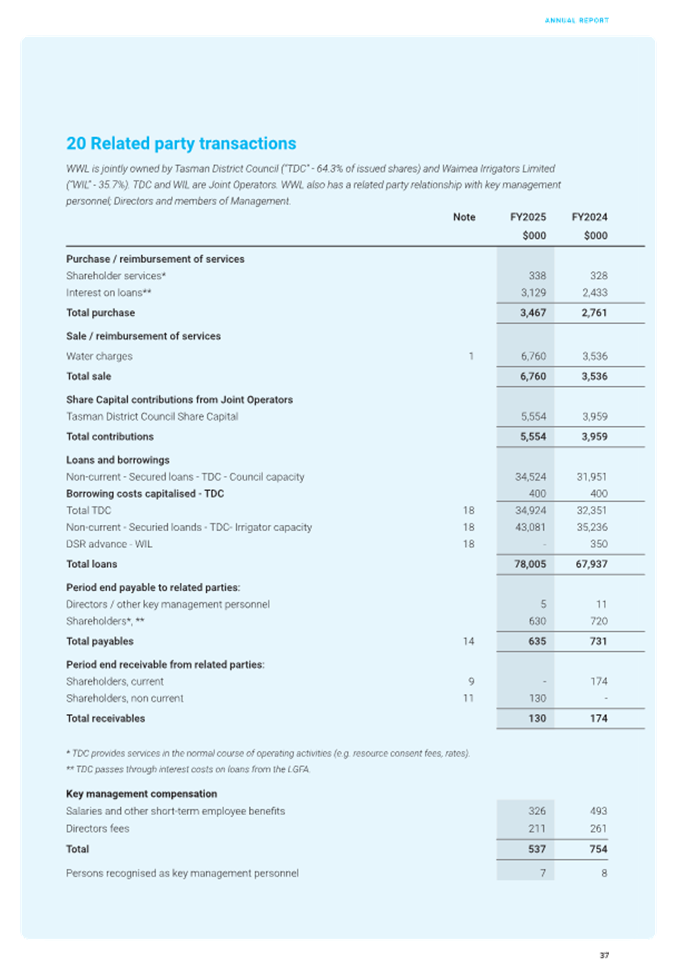
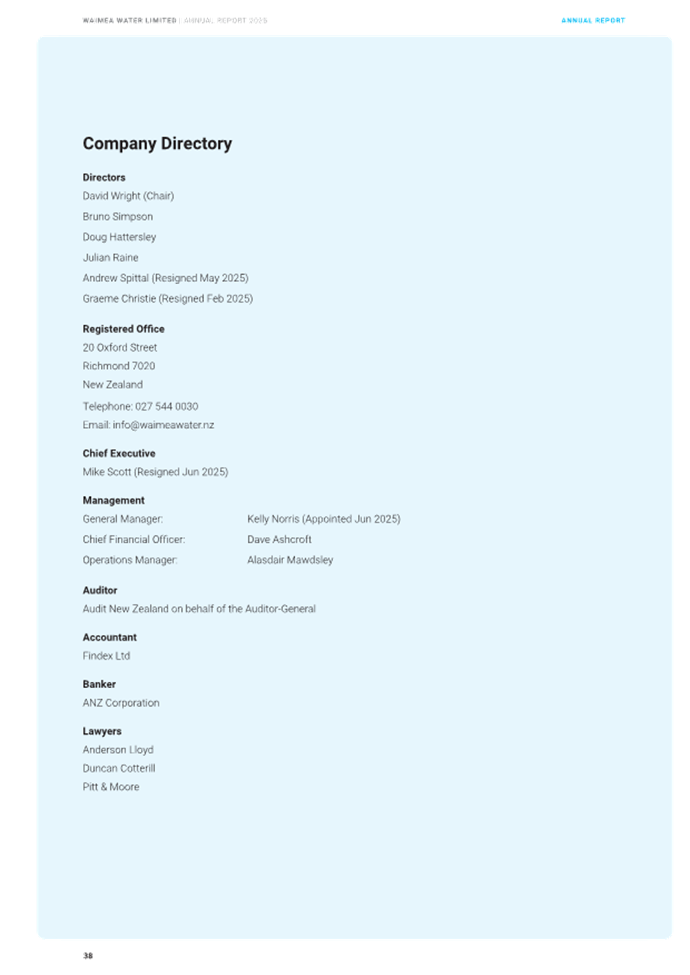


Tasman District Council Agenda – 11 December 2025
8 CONFIDENTIAL SESSION
8.1 Procedural
motion to exclude the public
The following
motion is submitted for consideration:
That the
public be excluded from the following part(s) of the proceedings of this
meeting. The general subject of each matter to be considered while the public
is excluded, the reason for passing this resolution in relation to each matter,
and the specific grounds under section 48(1) of the Local Government Official
Information and Meetings Act 1987 for the passing of this resolution follows.
This resolution is made in reliance on section 48(1)(a) of the Local
Government Official Information and Meetings Act 1987 and the particular
interest or interests protected by section 6 or section 7 of that Act which
would be prejudiced by the holding of the whole or relevant part of the
proceedings of the meeting in public, as follows:
8.2 Waimea Water Limited - Statement of
Expectations
|
Reason for passing this resolution in
relation to each matter
|
Particular interest(s) protected (where
applicable)
|
Ground(s) under section 48(1) for the
passing of this resolution
|
|
The public conduct of the part of the
meeting would be likely to result in the disclosure of information for which
good reason for withholding exists under section 7.
|
s7(2)(i) - The withholding of the
information is necessary to enable the local authority to carry on, without
prejudice or disadvantage, negotiations (including commercial and industrial
negotiations).
|
s48(1)(a)
The public conduct of the part of the
meeting would be likely to result in the disclosure of information for which
good reason for withholding exists under section 7.
|
8.3 Waimea Community Dam - Risk Update
|
Reason for passing this resolution in
relation to each matter
|
Particular interest(s) protected (where
applicable)
|
Ground(s) under section 48(1) for the
passing of this resolution
|
|
The public conduct of the part of the
meeting would be likely to result in the disclosure of information for which
good reason for withholding exists under section 7.
|
s7(2)(b)(ii) - The withholding of the
information is necessary to protect information where the making available of
the information would be likely unreasonably to prejudice the commercial
position of the person who supplied or who is the subject of the information.
s7(2)(g) - The withholding of the
information is necessary to maintain legal professional privilege.
|
s48(1)(a)
The public conduct of the part of the
meeting would be likely to result in the disclosure of information for which
good reason for withholding exists under section 7.
|