Joint Nelson
Tasman Regional Transport Committee Agenda – 24 September 2025
7 Reports
7.1
Public Transport
Review Update
|
Report
To:
|
Joint
Nelson Tasman Regional Transport Committee
|
|
Meeting
Date:
|
24
September 2025
|
|
Report
Author:
|
James
Hills, Senior Transport Planner, Nelson City Council
|
|
Report
Authorisers:
|
John
Ridd, Group Manager - Service and Strategy
|
|
Report
Number:
|
RNTRTC25-09-1
|
1.1 The
purpose of this report is to provide an update on public transport matters
since the August 2025 Joint Nelson Tasman Regional Transport Committee
(JNTRTC), and to seek approval for the proposed service changes put forward in
the report.
1.2 The
report provides, as requested by the JNTRTC, further information on the
proposed service changes, put forward by officers as part of the Public
Transport Review (PT Review), that were not approved at the August 2025 JNTRTC.
That the Joint Nelson Tasman Regional Transport Committee
1. receives
the Public Transport Review Update report RNTRTC25-09-1; and
2. approves
Route 1 and Route 2 – timetable optimisation to better run the existing
service, paragraph 3.7 in the agenda report; and
3. approves
the Late Late Bus – continue with the cancellation of the 3.45am trip and
undertake a six-month trial with reduced fares and additional promotion; and
4. approves
Route 4 - change of frequency to 35 minutes to better operate existing service,
paragraph 3.7 in the agenda report; and
5. notes
officers to consider earlier peak services for Routes 1 and 2 in the
development of the next Regional Public Transport Plan.
3. Background
and Discussion
Regional Public Transport Plan and Public Transport
Review
3.1 The
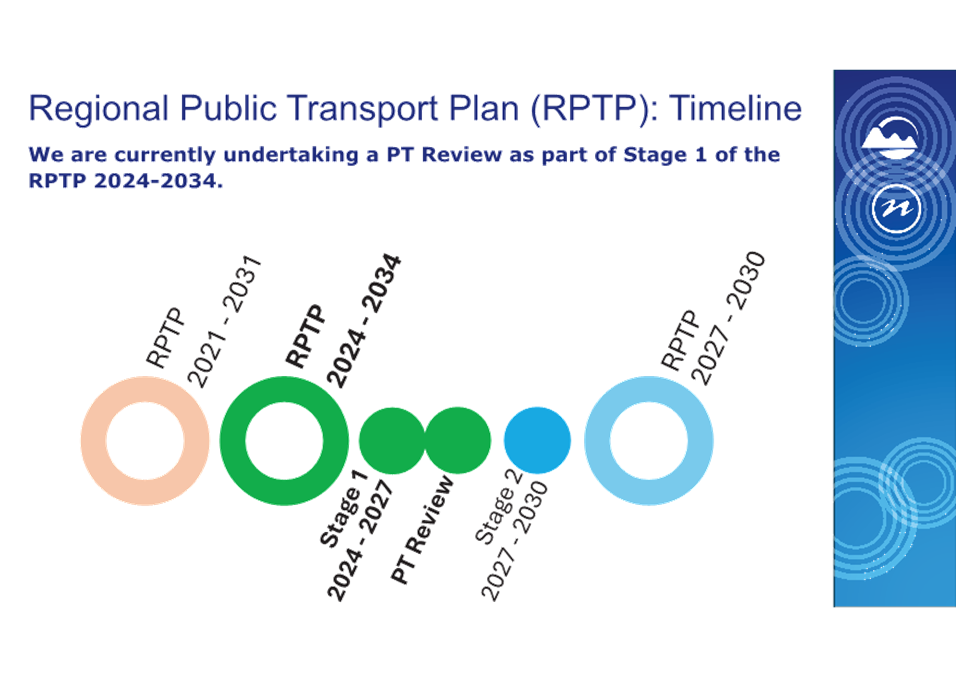
2021-2031 Regional Public Transport Plan (RPTP) established the eBus public
transport service across Nelson and Tasman. This change was a significant
improvement in the level of service for the region’s residents with both
the coverage and the frequency of the service improved.
3.2 The
eBus began operation on 1 August 2023 and as part of the new service a 12-month
PT Review was required and is a condition precedent to New Zealand Transport
Agency Waka Kotahi (NZTA) funding for the 2025/2026 and 2026/2027 financial
years.
3.3 NZTA
confirmed that they are satisfied that Nelson City Council (NCC) and Tasman
District Council (TDC) have met the conditions of the Phase 1 review in
December 2024 and have approved the release of funding for years two and three
of the programme.
3.4 The
PT Review fits within the current RPTP period and, as part of the review, a
number of improvements and optimisations have been developed that can be
implemented in the short term.
Optimisations and improvements
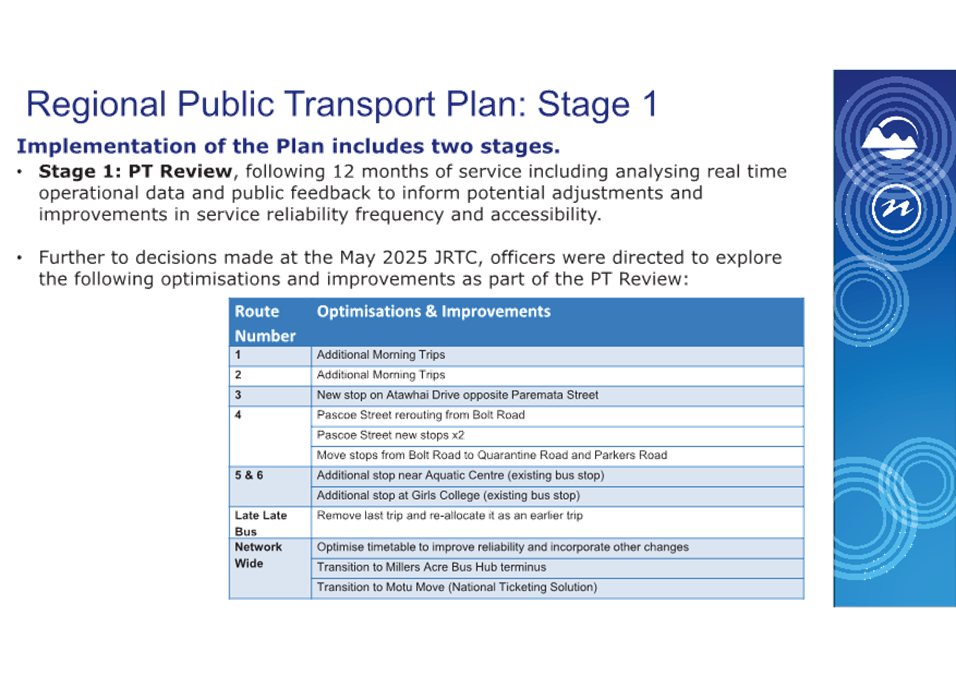
3.5 At
the May 2025 JNTRTC, a number of optimisations and improvements were outlined
for further investigation. Optimisations to the current service will involve
making changes to the existing timetable to reflect actual travel times.
3.6 Proposed
changes were presented to the JNTRTC in August 2025 of which several were
requested to be bought back to JNTRTC for further refinement before approvals
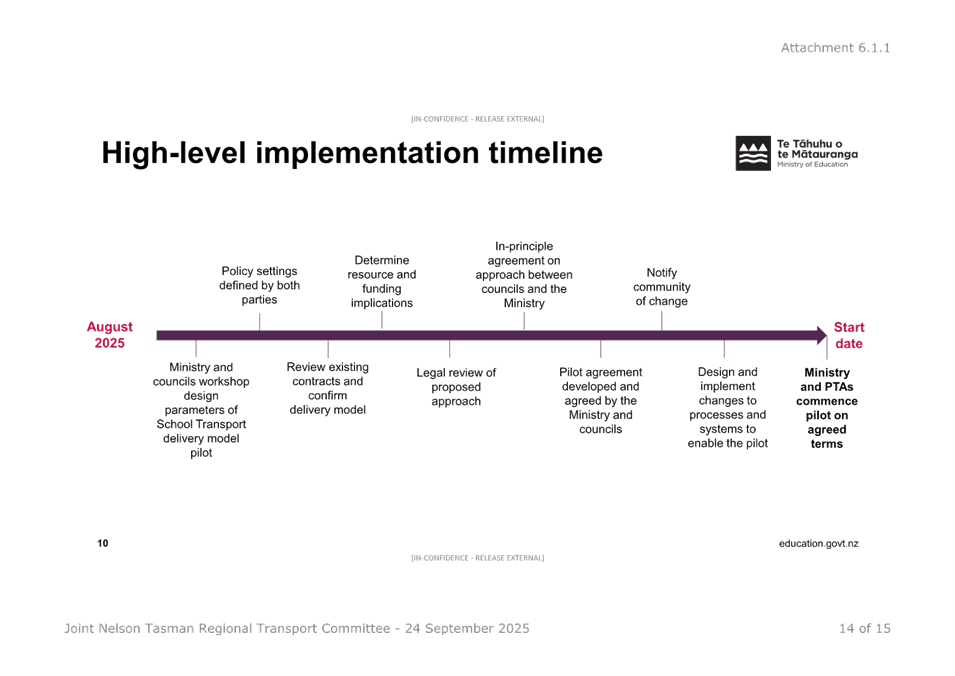
from the JNTRTC. A workshop was held on 10 September 2025 and the workshop
material is attached as Attachment 1 and 2.
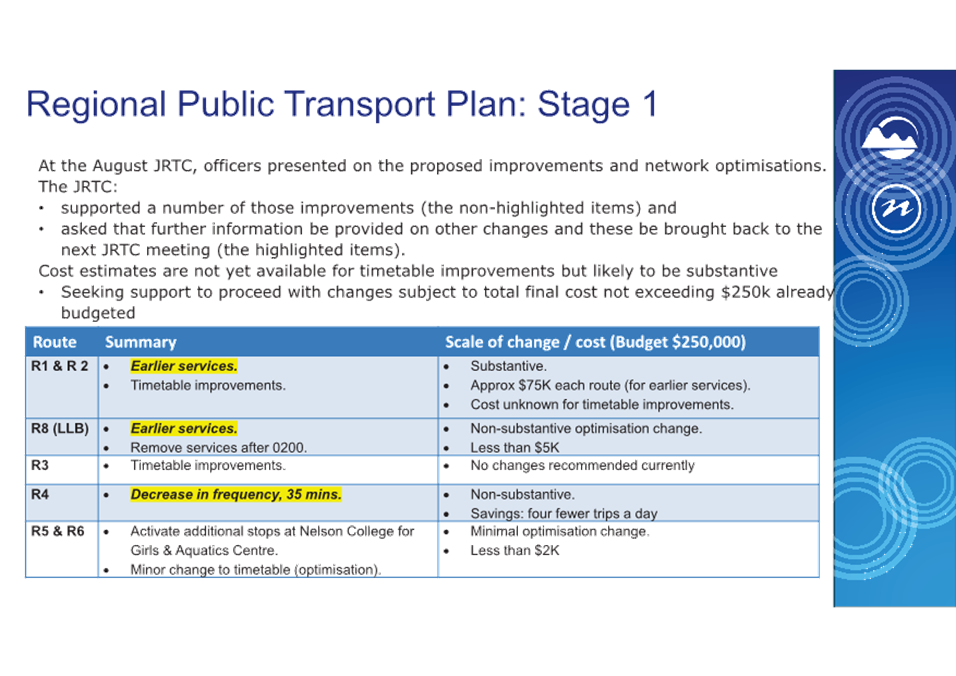
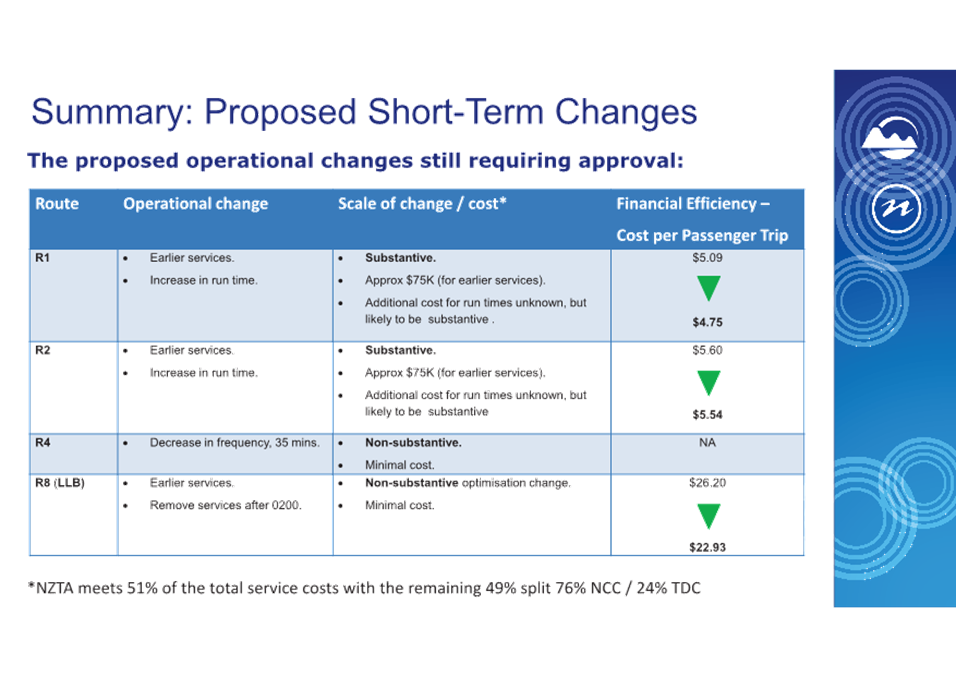
3.7 Table
1 (below) outlines the proposed changes that were asked to be brought back to
the September JNTRTC for further analysis.
|
Route
|
Summary of
optimisation / improvement
|
Scale of change
|
|
R1 & R2
|
· Earlier service
· Timetable improvements
|
· Substantive
· Approx $50k to $75k each route (for earlier services)
· Cost unknown for timetable improvements
|
|
R8 (LLB)
|
· Earlier services
· Remove services after 0200
|
· Non-substantive optimisation change
· Less than $5k
|
|
R4
|
· Decrease frequency to 35 mins
|
· Non-substantive
· Savings: four fewer trips per day
|
Table 1: Table 1: eBus routes with proposed
optimsations requiring further analysis by the JRTC
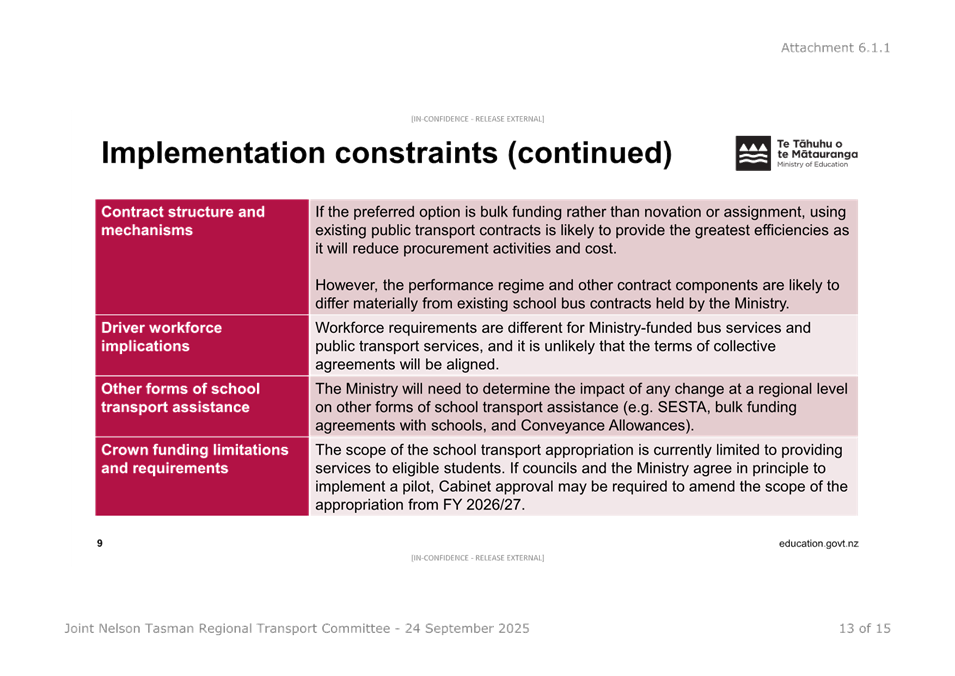
3.8 Where additional services and
significantly longer run time are proposed, this is considered
‘substantive’ and will incur higher costs. Small changes such as
activating existing out of use stops or adding smaller additional run time, are
considered non-substantive and will incur minimal cost.
Remaining optimisation and improvements outstanding
4.1 As
outlined in Table
1 there are three key issues to be considered as part of this
report:
· optimising
the timetable for Routes 1 and 2 so that users experience a reliable service;
· reinstate
earlier services (which were operated prior to the start of the eBus) on Routes
1 and 2;
· timetable
changes on the Late Late Bus (Route 8); and
· decrease in
frequency on Route 4.
Optimising
the timetable on Routes 1 and 2
4.2 The
current eBus service is struggling to operate to the scheduled timetable which
is leading to a number of consistently late running trips. This leads to an
unreliable service and erodes public confidence in the service.
4.3 Officers
therefore recommend optimising the timetable to better run the current service.
This will not lead to any additional services and instead will involve small
timetable changes and additional run time on specific trips to create a
timetable that is able to be met and reflect actual travel times.
4.4 At
the time of writing, costs for small timetable optimisations to better run
Routes 1 and 2 are not yet known, however, based on previous timetable changes
of a similar nature we expect this to be no more than $50,000. SBL are
currently costing this change, and we expect to be able to table it at the
JNTRTC.
Earlier trips on Routes 1 and 2
4.5 Currently,
Route 1 begins early enough in the day to deliver users to work beginning at
8.00 am each day in both Nelson and Richmond. Route 2 delivers users into
Nelson in time for an 8.00 am start to work and to Richmond in time for an 8.30
am start to work. With the shift in bus interchange location to Millers Acre
(Nelson Bus Hub) it is proposed to have the first bus arrive earlier in the
morning to allow more time for walking to places of employment.
4.6 Feedback
received during Stage 1 of the PT Review highlights that there is demand for
additional morning services to deliver commuters to Nelson and Richmond earlier
than the current first bus of the day. The natural work start times for
commuters to arrive into each centre are 7.00 am and 7.30 am.
4.7 To
estimate the potential demand for these services, the old NBus patronage data
for the early trips has been analysed. This data shows that patronage for the
trip delivering workers for a 7.30 am start is around 50% of the patronage on
the trips delivering workers for an 8.00 am start.
4.8 There
is no data from the NBus service to interrogate to determine the likely
patronage levels for a trip that would deliver users to the main centres in
time for a 7.00 am work start. To be able to undertake some level of analysis
it has been assumed that patronage on the 7.00 am service would be in the order
of 25% of that on the 8.00 am service.
4.9 A
key question that has been asked by elected members is how financially
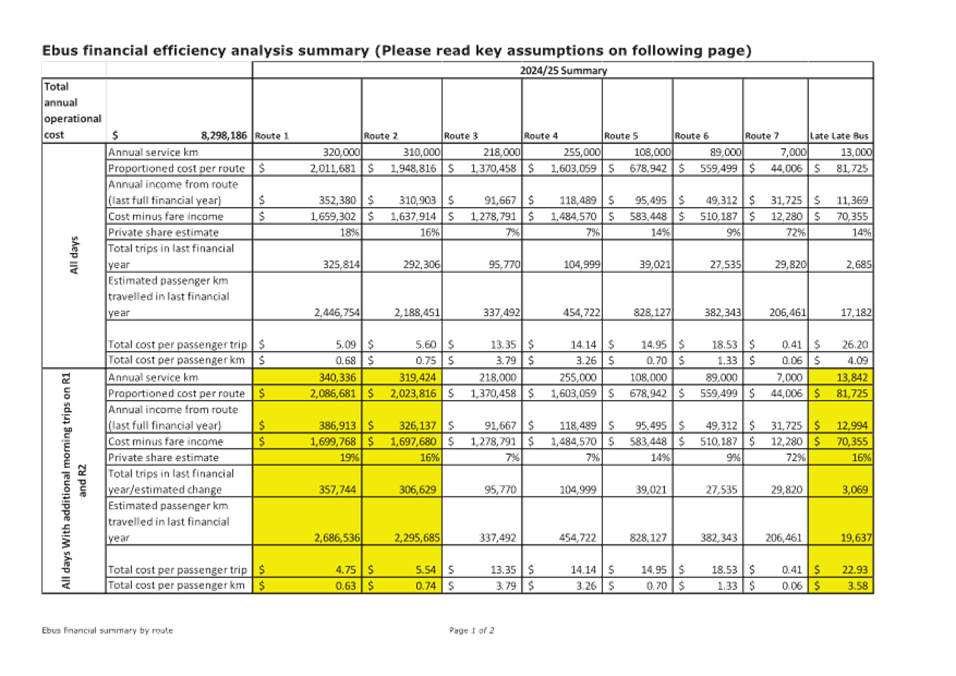
efficient any more significant changes are expected to be. The measure of
subsidy cost per passenger trip is a useful indicator of financial efficiency.
4.10 The
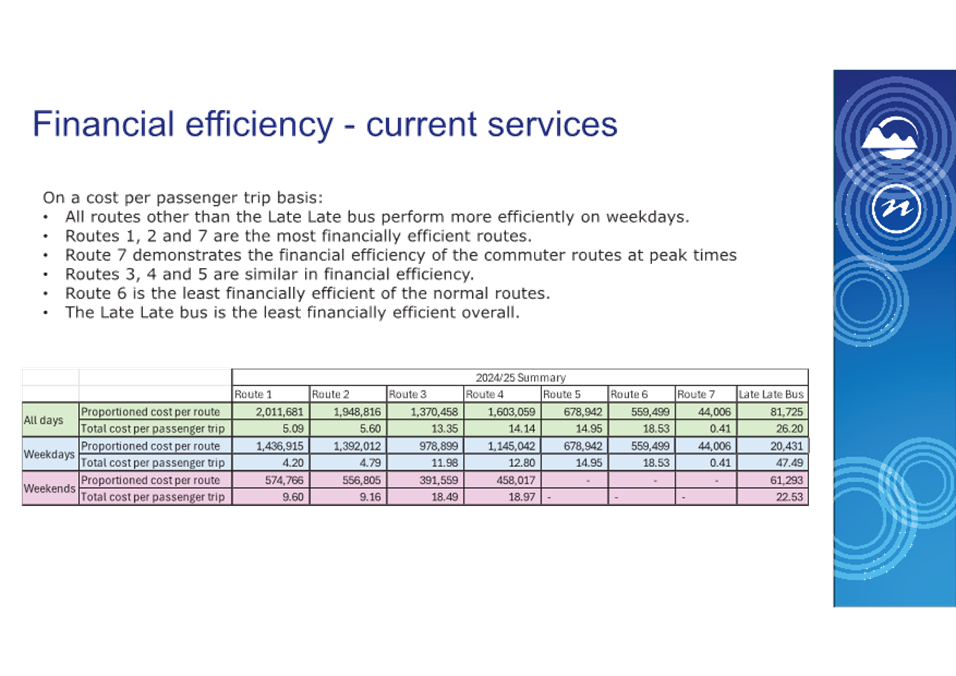
existing subsidy per passenger trip is approximately $5.09 for Route 1 and
$5.60 for Route 2. The difference between the routes is primarily driven by
lower fare income from Route 2.
4.11 It
is important to note that while we have provided cost information there has
been no corresponding calculation of the benefits associated with these trips
being made by public transport, such as reduced peak hour vehicle numbers, and
associated emissions, cost savings for users compared to using private
vehicles, and improved employment opportunities for those without access to
vehicles.
4.12 There
are two options available for Routes 1 and 2 that have come from user feedback
as follows:
Option 1: One additional
trip in each direction on Routes 1 and 2, delivering users to Nelson and
Richmond in time to start work at 7.30 am.
· This option
is estimated to cost approximately an additional $50k to $75k per year for each
route ($100k to $150k total) and estimated to result in a total subsidy per
passenger trip of $4.95 and $5.46 for Routes 1 and 2 respectively.
· However,
actual costs from the contracted service provider have not been finalised at
the time of writing and these estimations could therefore change.
Option 2: Two additional
trips in each direction on Route 1 and one additional trip in each direction on
Route 2.
· This would
allow users starting work at 7.00 am and 7.30 am to use the bus and arrive in
Richmond and Nelson in time for work. The compromise is that this option would
provide the 7.00 am option to users living along Route 1 only.
· This option
is estimated to cost approximately an additional $75,000 per year for Route 1
and $50,000 for Route 2 and estimated to result in a total subsidy per
passenger trip of $4.88 and $5.46 for Routes 1 and 2 respectively.
· However,
actual costs from the contracted service provider have not been finalised at
the time of writing and these estimations could therefore change.
4.13 SBL
are currently costing these changes, and we hope to be able to provide them and
our assessment at the JNTRTC.
4.14 Given
the substantive nature of these changes and the level of uncertainty there may
be value in considering a trial of an additional service to understand actual
usage or considering and consulting on these changes as a part of the
development of the forthcoming 2027-2037 RPTP. Noting that the RPTP
review provides an opportunity to look at the eBus network as a whole and
recommend more substantial changes to the current service.
4.15 If
officers do not have a level of confidence in the costs, officer recommendation
would be to consider additional earlier services on Routes 1 and 2 as part of
the RPTP review.
Late Late Bus (Route 8)
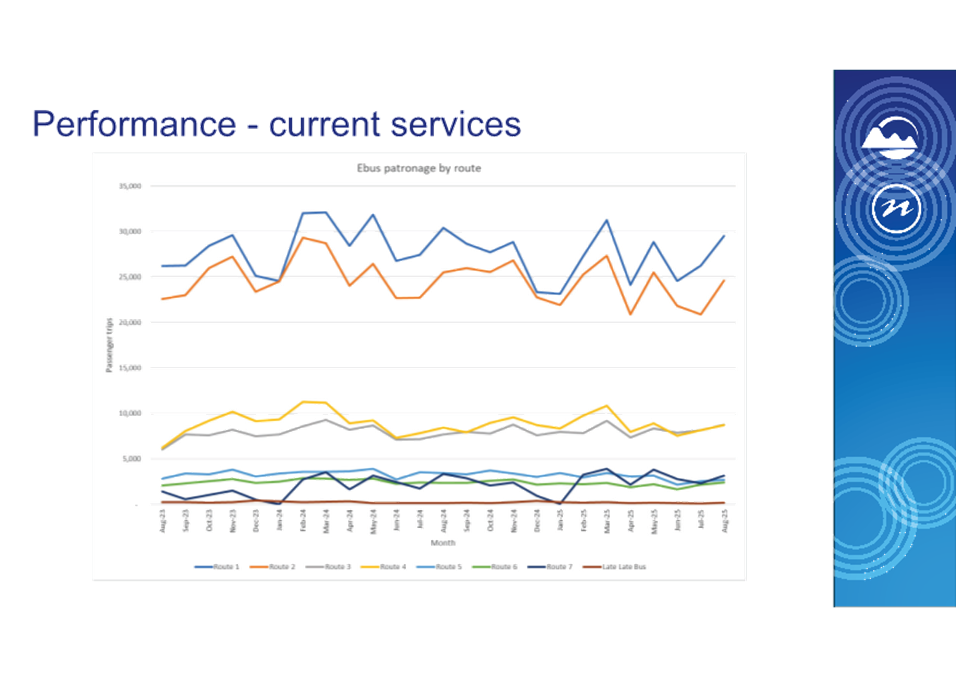
4.16 Monitoring
of the patronage on the Late Late Bus over the last two years has highlighted
that the 2.30 am and 3.45 am Saturday morning trips and the 3.45 am Sunday
morning trips have been very underutilised, with services regularly operating
without passengers.
4.17 Additional
research of the closing times of restaurants, hospitality venues and
establishments in both Nelson and Richmond indicates that there has been a
change to earlier closing times. Earlier this year, officers therefore
instructed SBL to cease operating the 3.45 am service from Nelson to Richmond
in response to this underutilisation.
4.18 Officers
had initially recommended that instead of running the later services, they
could be reallocated to earlier in the evening to provide public transport for
users between 8.00 pm and 10.00 pm. Additionally, it was proposed to extend the
service beyond the Richmond Interchange to serve Berryfields and provide
connections the cinema and restaurants there.
4.19 Further
feedback from elected members has included:
• the
latest services would not be welcomed by residents in Berryfields after
midnight due to the noise of the buses at that time of night and the last
service of the night should therefore not terminate in the residential area
(rather than the current commercial area);
• the
cost of the service to users is high compared to a group choosing to share a
taxi or Uber. Quotes from taxi operators indicate the taxi fare between Nelson
and Richmond is between $45 and $55;
• the
cost to taxpayers and ratepayers per passenger trip is very high;
• the
lack of promotion of the service may be contributing to its low patronage
numbers; and
• to
cater to a wider geographic area, consideration could be given to operating
Routes 1 and 2 later into the evening, rather than operate the Late Late Bus
earlier. This has not been costed but costing may be similar to the costings
given in 4.12.
4.20 In
response to this feedback, it is recommended that the following changes are
made to the Late Late Bus:
• continue
with the existing timetable and 3.45 am trip remains cancelled;
• the
fare for the route be trialled at a reduced rate that matches the fares on the
standard eBus services for six months beginning 1 November 2025; and
• the
service be promoted for the same period.
4.21 The
changes above are assumed to be cost neutral if there is a significant increase
in patronage. The patronage for this route will be monitored closely and
further recommendations brought back to the JNTRTC regarding changes that may
need to be made following the trial period to be included in the RPTP 2027
review.
4.22 Implementing
the above changes in the short-term would allow for analysis before a wider
review of the Late Late Bus as part of the RPTP 2027 review. The RPTP review
will assess the eBus network holistically and asses the best way to serve
patronage beyond the existing timetable.
Route 4
4.23 To
address consistent late running on this route, officers recommend a small
frequency change, with services operating every 35 minutes rather than every 30
minutes at present. This change should have minor impact on users, would
address late running and reliability issues and is expected to result in a
small improvement in cost per passenger and public share (with four less
services operated each day).
5. Regional
Public Transport Plan (RPTP)
RPTP
2027-2037 review
5.1 Through
undertaking the PT review and analysing the first two years of the eBus
service, additional substantive improvements will be considered under the next
stage of the RPTP review to be implemented between 2027–2037.
5.2 These
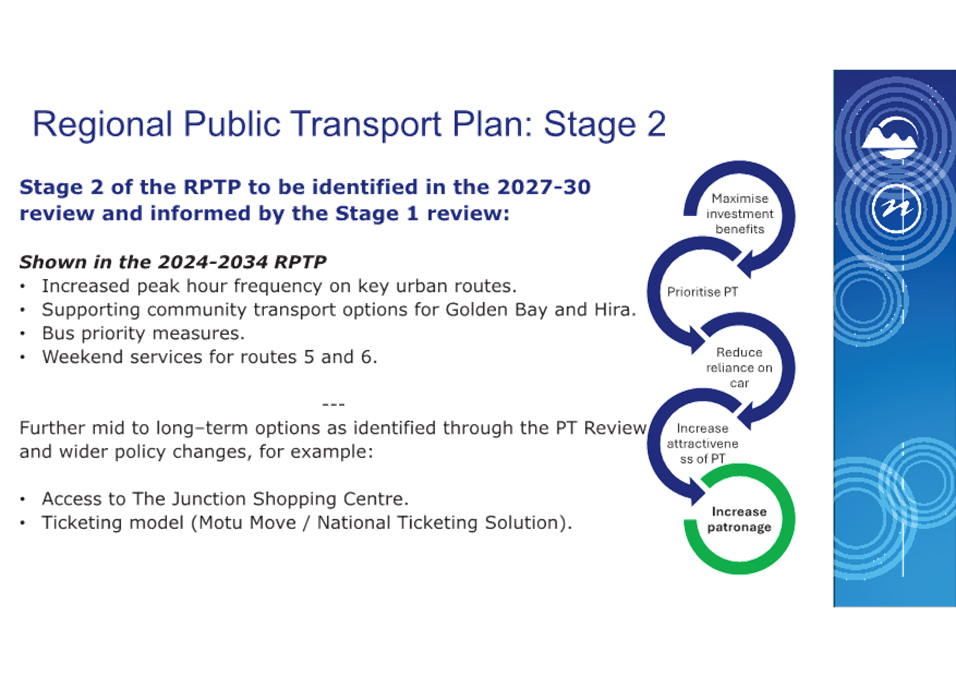
improvements and changes will aim to maximise the benefits and increase the
attractiveness of public transport to increase patronage.
5.3 These
could include but not limited to:
· new public transport
connections to serve The Junction Shopping Centre;
· implementing and
maximising the ticketing model (Motu Move/National Ticketing Solution);
· extending the operating
times of Routes 1 and 2;
· consider the long-term
future of the Late Late Bus;
· increased peak hour
frequency on key urban routes;
· weekend services for
Routes 5 and 6;
· adjustments to service
frequency throughout the day to match current demand;
· bus priority measures;
· supporting community
transport options for Golden Bay and Hira; and
· any items not approved
in the meeting that this report is received at.
6. Important
considerations for decision-making
|
6.1 Fit
with Purpose of Local Government
Providing and giving effect to Regional Land Transport Plan and
Regional Public Transport Plan is a requirement of the Land Transport
Management Act 2003.
NZTA Waka Kotahi through their development guidelines for
developing regional public transport plans, outline that public transport
authorities must undertake annual pricing reviews and six-yearly fare
structure reviews.
|
|
6.2 Consistency
with Community Outcomes and Council Policy
Councils have adopted a joint Regional Land Transport Plan and
joint Regional Public Transport Plan as a requirement of the Land Transport
Management Act 2003. The development and operation of a Public Transport
service contributes to the community outcome “our infrastructure is
efficient, cost effective and meets current and future needs”.
Through the Public Transport Review, transport
officers have developed a number of measures to optimise and improve the eBus
service and grow patronage with the resources available.
|
|
6.3 Risk
Changes in the level are service are likely to reduce transport
choices for some members of the Nelson Tasman communities who have few
transport choices and also discourage other users. This could result in a
reduction in patronage of the services.
|
|
6.4 Financial
impact
All proposed improvements will be funded within existing budgets.
The proposed improvements and optimisations will help grow patronage and
increase revenue.
|
|
6.5 Degree
of significance and level of engagement
Implementing
the proposed changes to the ebus service will improve the public transport
service by offering greater reliability and connectivity.
All changes
will be communicated to the public and new timetables printed to display at
all bus stops.
|
|
6.6 Climate
Impact
Support for growing public transport use and
improving the public transport offering will contribute to reducing transport
emissions.
Increasing patronage leads to mode shift away from the
private car which reduces the environmental impact of land transport and
reduces transport emissions. Greater public transport use also reduces
congestion on the local road network.
|
|
6.7 Inclusion
of Māori in the decision-making process
No engagement
with Māori has been undertaken in preparing this report
|
|
6.8 Delegations
The Joint
Nelson Tasman Regional Transport Committee (JNTRTP) is a joint committee of
the Nelson City and Tasman District Councils, established in accordance with
section 105(9) Land Transport Management Act 2003 (‘the Act’) and
Schedule 7 clauses 30(1)(b) and 30A Local Government Act 2002. The
JNTRTP is governed by a Terms of Reference.
The joint
Nelson Tasman Regional Transport Committee has the following delegations to
consider in relation to the report
Areas of
Responsibilities:
· Provide the relevant councils with any advice and assistance
requested in relation to their transport responsibilities.
Powers and
limitations:
· The Joint Regional Transport Committee is responsible for the
operational oversight of the joint Nelson Tasman Public Transport Operations
Contract and associated public transport activity, including the authority to
make decisions and approve policies that support operations.
· The Joint Regional Transport Committee may approve changes to the
Public Transport Operations unless the change requires:
o A permanent change of route; or
o A permanent change to fares; or
o A permanent change to timetable.
· Other than the powers outlined at clauses 3.1,3.3, 3.4 and 3.5 (in
the Terms of Reference) the Joint Regional Transport Committee may only make
recommendations to:
o The partner councils.
The Joint
Regional Transport Committee has no financial responsibilities or budgets. If
a change to public transport operations requires additional un-budgeted
funding, the Joint Nelson Tasman Regional Transport Committee has the power
to recommend budgets for approval by each Council that is affected
|
|
1.⇩
|
JRTC
Workshop September 2025
|
12
|
|
2.⇩
|
Ebus
financial efficieny summary
|
28
|