Notice
is given that an ordinary meeting of the Tasman District Council will be held
on:
|
Date:
Time:
Meeting
Room:
Venue:
YouTube Link:
|
Thursday 7 May 2026
9.30am
Tasman Council Chamber
189 Queen Street, Richmond
Tasman District Council Meetings - YouTube
|
|
Tasman
District Council
Kaunihera
Katoa
AGENDA
|
MEMBERSHIP
|
Mayor
|
Mayor T King
|
|
|
Deputy Mayor
|
Deputy Mayor B Maru
|
|
|
Councillors
|
Councillor C Butler
|
Councillor M Kininmonth
|
|
|
Councillor J Ellis
|
Councillor K Maling
|
|
|
Councillor K Ferneyhough
|
Councillor D McNamara
|
|
|
Councillor M Greening
|
Councillor P Morgan
|
|
|
Councillor J Gully
|
Councillor T Neubauer
|
|
|
Councillor M Hume
|
Councillor T Walker
|
|
|
|
Councillor D Woods
|
(Quorum 8 members)
|
|
|
Contact Telephone: 03 543 8400
Email: tdc.governance@tasman.govt.nz
Website: www.tasman.govt.nz
|
Tasman District Council Agenda – 07 May 2026
AGENDA
1 Opening, Welcome, KARAKIA
2 Apologies
and Leave of Absence
|
Recommendation
That the apologies be accepted.
|
3 Public
Forum
Nil
4 Declarations
of Interest
5 LATE
ITEMS
6 Confirmation
of minutes
|
That the minutes of
the Tasman District Council meeting held on Thursday, 9 April 2026, be
confirmed as a true and correct record of the meeting.
|
7 Reports
7.1 Use of 79-81 Commercial Street Takaka as
the site for storage of the Anaweka Waka 4
7.2 Three Waters Maintenance Forecast Overspend
- 2025-2026............................ 17
7.3 Mayoral Update...................................................................................................... 28
8 Confidential
Session
8.1 Procedural
motion to exclude the public............................................................... 33
8.2 R26-16 International Cricket - Saxton Field
Outfield Renewal............................. 33
8.3 Iwi Representation Appointments 2025 - 2028
term............................................. 33
8.4 Cornwall Place, Tata Beach - Options.................................................................. 34
8.5 Fuel Price and Supply Impacts.............................................................................. 34
9 CLOSING
KARAKIA
Tasman District Council Agenda – 07 May 2026
7 Reports
7.1
Use of 79-81
Commercial Street Takaka as the site for storage of the Anaweka Waka
Decision Required
|
Report
To:
|
Tasman
District Council
|
|
Meeting
Date:
|
7
May 2026
|
|
Report
Author:
|
Leith
Townshend, General Counsel; Grant Reburn, Reserves and Facilities Manager
|
|
Report
Authorisers:
|
John
Ridd, Group Manager - Customer & Community; Leonie Rae, Chief Executive
Officer
|
|
Report
Number:
|
RCN26-05-4
|
1. Purpose
of the Report / Te Take mō te Pūrongo
1.1 The
purpose of this report is to provide information to the Council on the Anaweka
Waka project and seek their agreement to engage with the community on the
location and ownership of the facility being proposed to house the Anaweka
Waka.
2. Summary
/ Te Tuhinga Whakarāpoto
2.1 On
13 February 2025 the Council received a presentation from the Anaweka Waka
Working Group on the history of the Anaweka Waka and the proposal for a new
facility to accommodate the long-term storage and display of this Waka. The
feedback from the presentation from the Council was positive.
2.2 The
Working Group have previously identified the site next to the current Golden
Bay Museum (79-81 Commercial Street, Tākaka) as the preferred location for
a building to house the Waka.
2.3 Since
1990 this site location has been gazetted as Local Purpose Reserve (site for
museum). It is the opinion of the Working Group and Council staff that the
storage and display of the Anaweka Waka and other taonga is in keeping with
this purpose.
2.4 On
19 June 2025 (RCN25-06-10) the Council resolved the
following:
That the Tasman District
Council:
1. receives
the Use of 79-81 Commercial Street Tākaka
as the site for storage of the Anaweka Wakareport, 0.0; and
2. notes
that legal ownership of the Waka has not been determined by the Māori Land
Court but both claimants have jointly offered support for the approach below;
and
3. agrees
in principle, subject to future consultation, that 79-81 Commercial Street,
Tākaka is an appropriate location for the housing of the Anaweka Waka; and
4. notes
that consultation will be required under the Reserves Act and Local Government
Act to allow for any future use on this site; and
5. notes
that there are a number of options regarding ownership, operation and
governance of any facility built on the site and that these are being explored
by the Working Group before coming back to the Council for approval.
2.5 The
working group have presented to the Golden Bay Community Board on this
proposal, and Councillors have had the opportunity to view the Waka as part of
the induction process They will be attending to provide a presentation..
2.6 This
report now seeks Council approval to gather community feedback on the proposed
site of the Anaweka Waka facility.
3. Recommendation/s
/ Ngā Tūtohunga
That the Tasman District Council
1. Receives
the Use of 79-81 Commercial Street Takaka as the site for storage of the
Anaweka Waka RCN26-05-4; and
2. Agrees to engage with the community on the following
questions before the final decision is made by Council:
2.1 That 79-81 Commercial Street,
Tākaka is a suitable location for a facility to store and display the
Anaweka Waka,
2.2 Whether Council should agree to lease the land during
the construction of the facility,
2.3 Whether Council should enter into a long-term lease
for a facility and/or the ground under the facility depending on final
ownership decisions.
3. Notes that the engagement described above will meet
the requirements to consult under the Local Government Act 2002; and
4. Notes
that a Council decision on the use of the 79-81 Commercial
Street Takaka site is required to give Iwi enough certainty to
investigate and lodge the required consent applications;
5. Notes
that a decision on ultimate ownership of the Anaweka Waka storage facility has
not been made and that this decision will be made as part of the Long-Term Plan
considerations, and subject to further due diligence for all parties;
and
6. Notes that the feedback received during engagement on
the use of 79-81
Commercial Street Takaka will be
made available to Council and the working group once the enagagment period is
closed so that a decision can be made.
4.1 The Anaweka Waka was discovered on the
West Coast approximately 14 years ago and has since been undergoing a
conservation process in Golden Bay.
4.2 The Anaweka Waka is a hugely significant
find. The attached article sets out the scientific significance of this find
– An early sophisticated East Polynesian voyaging canoe discovered on
New Zealand's coast.
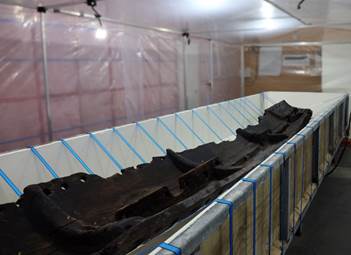

Left: The
waka held within the purpose-built drying facility. Right: Turtle emblem
carving.
Legal
ownership of the waka
4.3 As set out in the Protected Objects Act,
the waka (being taonga tūturu) is currently in the ownership of the Crown
and under the care of the Manatū Taonga (Ministry
of Culture and Heritage) until ownership is determined by the Māori Land
Court.
4.4 There are two claimants for the waka;
Manawhenua ki Mohua on behalf of Ngāti Rārua, Ngāti Tama and Te
Ātiawa, and Ngāti Kuia.
4.5 To settle the claim, the claimants will
need to prove they can care for and protect the integrity of the waka,
including certainty on where and how it will be stored. The claimants are all
represented within the working group and steering group and are collectively
working towards a solution.
4.6 The working group also includes
representation from the Golden Bay Museum and Tasman District Council.
4.7 Until legal ownership is determined, Manatū
Taonga will maintain interim ownership and ultimate
decision-making. However, as far as possible Manatū Taonga want to support
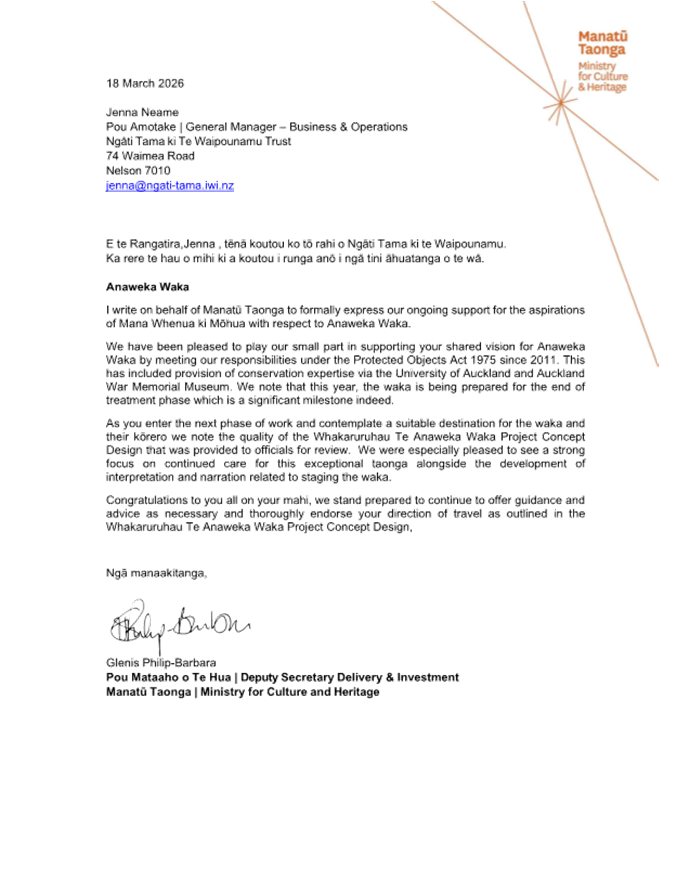
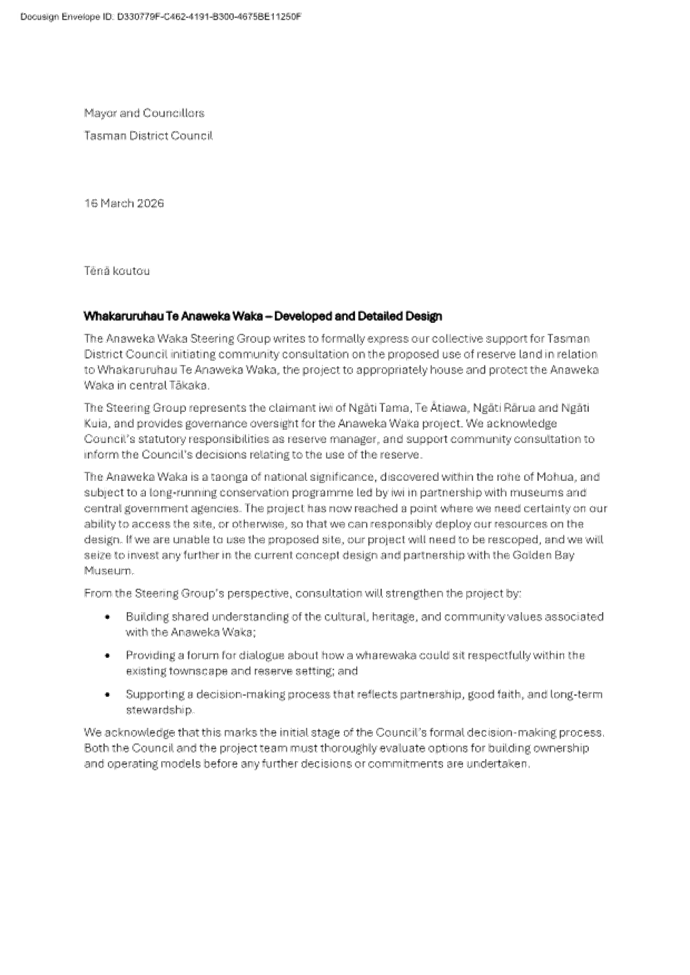
the aspirations of Iwi and support the current proposal. Attachment one is
a letter of support from Manatū Taonga.
4.8 Both potential claimants are involved in
the Anaweka Waka working group and are supportive of the approach to build a
new facility in Golden Bay.
Conservation
4.9 Staff from the Auckland War Memorial
Museum continue to support conservation efforts. This support has been
facilitated and funded by the Manatū Taonga. The
conservator team advise that the waka is dry, stable and being cleaned of any
final residue.
Activities of the Working Group
4.10 The focus of the Working Group is shifting towards
the design and construction of the building alongside the other decisions that
need to be made by Iwi and the Council – such as ownership of the
building and operating models.
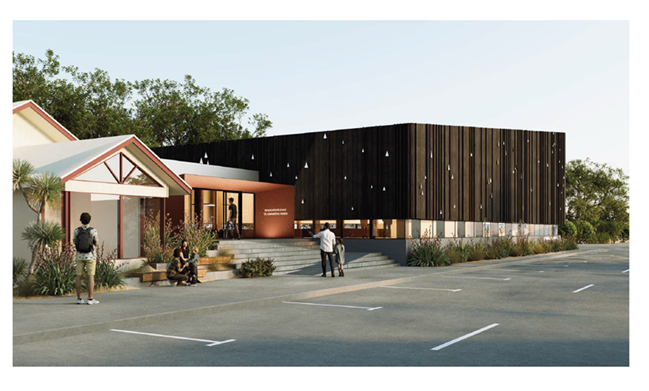
4.11 They have also completed an RFP selecting a project
architect, Fineline Architecture, and are underway with design of the wharewaka
adjoined to the Golden Bay Museum. A pre concept design has been completed
which was previously shared with the Council.
4.12 The concept design is well developed and one of the
designs is below:
4.13 While there is still more work to do on the final
budget and design, including quantity survey, the working group has set a cap
of $5 million capital cost for the construction of the wharewaka inclusive of
the ātea space. Internal alterations required within the Golden Bay Museum
are out of scope of the wharewaka project and are being considered by the
Golden Bay Museum in conjunction with this project.
4.14 The intention is to fundraise externally to fund
this project. To date, the Department of Internal Affairs have funded the
design work through the Lotteries Environment and Heritage Fund and the working
group is preparing a funding application for stage 2 for 1 July 2026 to 30 June
2027 which will include the developed and detailed design; and building consent
application.
5. Analysis
and Advice / Tātaritanga me ngā tohutohu
5.1 Ultimately
the Council will need to make several decisions in relation to this project and
public consultation is required before those decisions can be made. These
decisions and the questions for consultation are outlined below.
The location of the facility to store
the Waka
5.2 Iwi
and the working group have previously explored several different options for
storing the waka. Their preferred site is 79-81 Commercial Street,
Tākaka.
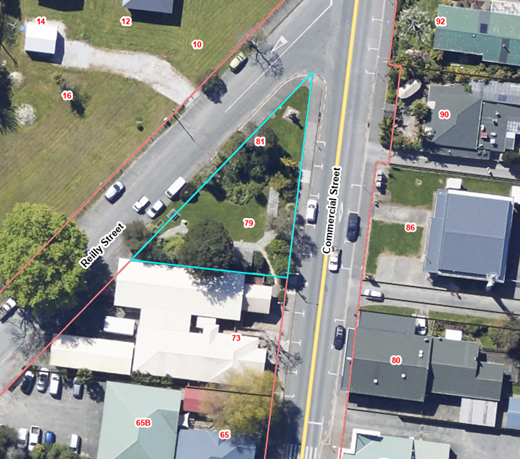
5.3 The
reason that this site is preferred is its central location in Tākaka and
proximity to the Golden Bay Museum which creates efficiencies for the operation
of the facility and adds operational resilience to both the Golden Bay Museum
and the wharewaka.
5.4 Since 19 April 1990, this land
has been designated as a reserve meaning that it is subject to the Reserves Act
1977.
5.5 There are a number of different
‘types’ of reserve under the Reserves Act and this land has been
designated ‘Local Purpose (Site for a museum) Reserve’.
5.6 Staff view is that the storage
and display of the Waka and other taonga is consistent with this purpose.
Council previously decided in principle that the site would be a suitable
location for the waka.
5.7 There
is currently a pioneers memorial at the tip of this site, this has been there
for many years after being relocated there from another part of Tākaka. It
is anticipated that as part of the project the working group will work with the
Golden Bay Community Board to relocate the memorial. This may be within the
museum precinct or elsewhere.
5.8 There
are some large trees currently on the site which will need to be removed as
part of any development. This may need to be addressed in the resource consent
application. The removal of the trees is welcomed by the museum management team
as they create ongoing building maintenance issues for them.
5.9 The
community will be asked whether they consider this site to be suitable for a
facility to store the waka before the decision comes back to Council.
Use of land during the construction
period
5.10 During
the construction phase of this project the site will need to be closed to the
public to allow the construction company to meet their Health and Safety
obligations.
5.11 This
means that the Council will need to enter into a lease with the entity
constructing the facility and restrict public access.
5.12 During
consultation the public would be informed that notice will be given once the
Council has made its final decision. This would restrict access to the site
during the construction phase and going forward once the facility is built.
Ownership of the facility
5.13 Before
the construction begins a decision will need to be made on the ownership of the
building – i.e. whether it is owned by an Iwi entity or by Council, or
other alternatives.
5.14 This
decision will need to be made as part of the long-term plan process as taking
ownership for the building will have several ongoing operational costs for its
eventual owner. The working group considers that it is too premature to
consider this decision now, as further due diligence needs to be undertaken to
better inform all parties.
5.15 An
approval to access the land now will not predetermine or undermine an outcome
on this matter. The working group will not be able to proceed with leases or
construction until this matter is determined, which will happen in due course
when there is more confidence in the final building proposal and costs.
5.16 It
is also noted that depending on the eventual ownership model, the Council will
need to enter into either a ground lease or ground and improvement lease with
the entity managing the facility.
Consultation process
5.17 Once
approval is received staff will create consultation material onto Shape Tasman
and put an advertisement in the Golden Bay Weekly to advise people of the
proposal and let them know how to have their say. Staff will also look to
advertise on Newsline (depending on publishing deadlines).
5.18 The
Golden Bay Community Board and local Iwi representatives will also be
approached and asked to submit and publicise the on-going consultation.
5.19 Members
of the working group will also be encouraged to advertise and publish the
on-going consultation through their networks.
5.20 Depending
on engagement with the community there is an option for the consultation to be
extended to allow for a public meeting to discuss the proposal.
5.21 It
is proposed that the consultation be open for three weeks.
6. Financial
or Budgetary Implications / Ngā Ritenga ā-Pūtea
6.1 There
are minor budgetary implications for consultation which will be on Shape
Tasman, Newsline and advertised in the Golden Bay Weekly. It is anticipated
that these costs will be less than $200, not including staff time.
7.1 The options are outlined in the
following table:
|
Option
|
Advantage
|
Disadvantage
|
|
1.
|
Agree to consult with the community on
the waka project as a stand-alone consultation in the near future.
|
Community views sought on this project in
a timely manner.
|
Minor financial costs and staff time
associated with consultation (e.g. article/public notice in Golden Bay
Weekly).
|
|
2.
|
Agree to consult with the community by
including the proposal within the draft Golden Bay Ward Reserve Management
Plan (RMP), expected to be publicly notified in September 2026. The Local
Purpose Reserve land parcels where the waka is proposed to be housed will be
included within the RMP.
|
Community views on this project can be
captured as part of the wider Golden Bay Ward RMP review project.
|
Timing may not be ideal for the wharewaka
project. Under the Reserves Act, draft RMPs must be open for submissions for
two months, followed by hearings and deliberations. The final RMP will not be
adopted until February 2027 at the earliest.
The wharewaka project may be
‘lost’ among the range of other proposals being consulted on for
the draft RMP project.
|
|
3.
|
Decline to consult and take no further
steps to support the project.
|
No further cost or staff time will be
spent on this project.
|
Detrimental to the Council’s
relationship with its Iwi partners.
The wharewaka project will no longer be
feasible at this site and there will be considerable sunk costs.
The public may not have the opportunity
to see an important cultural artifact.
|
|
4.
|
Seek more information from the working
group.
|
Further information can be provided that
may better inform Council decision making.
|
Delays consultation and additional staff
time associated with producing a further report.
There may be risks to the timing of
funding tranches for the working group.
|
|
5.
|
Decline to consult and make the decision
on the use of site.
|
No consultation costs.
Certainty for the working group on the
way forward.
|
Risks community disengagement and
challenge if not consulted on.
|
7.2 Option one
is recommended.
8.1 Under the Local Government Act 2002 the
Council is required to consult or engage with the Community when making
decisions. The level of consultation required is set out in Council’s
significance and engagement policy. In this case the significance is considered
to be medium, so consultation is required under the Local Government Act 2002.
8.2 The Council is the administering body of
this site under the Reserves Act 1977. Under section 40 of the Reserves Act the
Council is charged with ensuring the use, enjoyment, development, maintenance,
protection, and preservation of the reserve for the purpose for which it is
classified. In this case the reserve has been classified local purpose (site of
a museum).
8.3 Under section 61 of the Reserves Act the
Council may do such things it considers necessary or desirable for the proper
and beneficial management, administration, and control of the reserve and for
the use of the reserve for the purpose specified in its classification.
8.4 Council may also lease the local purpose
reserve to any body or society under the following terms:
8.4.1 the lease shall be for a term not exceeding 33 years,
with or without a right of renewal, perpetual or otherwise; and
8.4.2 the lease shall include a condition that the land leased
shall be used solely for such purposes as are specified in the lease.
8.5 Council
staff’s view is that the use and lease of this site is consistent with
the purpose of the Reserves Act.
9. Iwi
Engagement / Whakawhitiwhiti ā-Hapori Māori
9.1 Iwi are fundamental to this project and
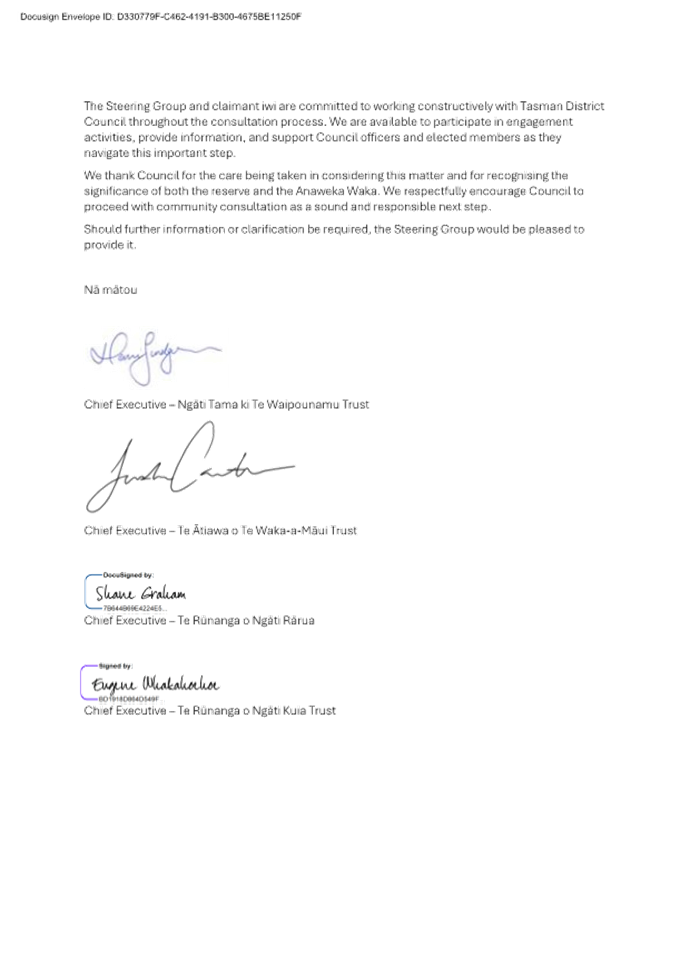
have been working with Council staff since its inception. Included in Attachment
two is a letter of support from the Iwi claimants.
9.2 Wider Iwi engagement will be sought
through consultation.
10. Significance
and Engagement / Hiranga me te Whakawhitiwhiti ā-Hapori Whānui
10.1 This is a decision to consult on a number of
matters. While this decision is of low significance the ultimate decision of
Council is likely to be high.
|
|
Issue
|
Level of
Significance
|
Explanation of
Assessment
|
|
1.
|
Is there a high level
of public interest, or is decision likely to be controversial?
|
Low
|
Decision to consult.
|
|
2.
|
Are there impacts on
the social, economic, environmental or cultural aspects of well-being of the
community in the present or future?
|
Low
|
Decision to consult.
|
|
3.
|
Is there a
significant impact arising from duration of the effects from the decision?
|
Low
|
|
|
4.
|
Does the decision
relate to a strategic asset? (refer Significance and Engagement Policy for
list of strategic assets)
|
No
|
|
|
5.
|
Does the decision
create a substantial change in the level of service provided by Council?
|
No
|
|
|
6.
|
Does the proposal,
activity or decision substantially affect debt, rates or Council finances in
any one year or more of the LTP?
|
No
|
|
|
7.
|
Does the decision
involve the sale of a substantial proportion or controlling interest in a CCO
or CCTO?
|
No
|
|
|
8.
|
Does the
proposal or decision involve entry into a private sector partnership or
contract to carry out the deliver on any Council group of activities?
|
No
|
|
|
9.
|
Does the proposal or
decision involve Council exiting from or entering into a group of
activities?
|
No
|
|
|
10.
|
Does the proposal
require particular consideration of the obligations of Te Mana O Te Wai
(TMOTW) relating to freshwater or particular consideration of current
legislation relating to water supply, wastewater and stormwater
infrastructure and services?
|
No
|
|
11. Communication
/ Whakawhitiwhiti Kōrero
11.1 The
Anaweka Waka working group have engaged with the Golden Bay Community Board and
elected members have had an opportunity to view the waka.
11.2 The
next step will be wider consultation on Shape Tasman and, depending on the
level of interest, some public meetings could be held. Notification will also
be put in Newsline and potentially the local paper.
12.1 This
is a decision to consult so there are limited risks associated with this
decision. Once community feedback has been received a further paper will be
provided outlining any risks of the final decision.
13. Conclusion
/ Kupu Whakatepe
13.1 The
Anaweka Waka is a hugely significant cultural taonga that has particular
significance to Golden Bay and the local Iwi. This decision is the first step
to finding a permanent location to house and display the waka in Tasman.
14. Next
Steps and Timeline / Ngā Mahi Whai Ake
14.1 Consultation
materials will be put on Shape Tasman.
|
1.⇩
|
Attachment
one Letter of support from Manatū Taonga
|
14
|
|
2.⇩
|
Attachment
two - Letter of support from Anaweka Waka Steering Group
|
15
|
Tasman District Council Agenda – 07 May 2026
7.2 Three Waters Maintenance Forecast Overspend -
2025-2026
Decision Required
|
Report
To:
|
Tasman
District Council
|
|
Meeting
Date:
|
7
May 2026
|
|
Report
Author:
|
Mike
Schruer, Waters and Wastes Manager
|
|
Report
Authorisers:
|
Richard
Kirby, Group Manager - Three Waters
|
|
Report
Number:
|
RCN26-05-2
|
1. Purpose
of the Report / Te Take mō te Pūrongo
1.1 To
gain approval for unbudgeted forecast maintenance expenditure in the 2025/26
financial year which is forecast to be $75,000 for stormwater, $714,000 for
Wastewater and $1,065,000 for Water Supply.
2. Summary
/ Te Tuhinga Whakarāpoto
2.1 For
this financial year 2025/2026, the Three Waters Group forecast maintenance
over-expenditure of $75,000 for stormwater, $714,000 for Wastewater and
$1,065,000 for Water Supply. An increase in reactive maintenance costs is
the main driver of the forecasted expenditure overspend.
2.2 Funds
collected via targeted rates and/or fees and charges for one activity cannot be
used in another activity. The only exception is that Council can utilise
funding from the General Rate and the Uniform Annual General Charge (UAGC) for
any activity.
2.3 A process has been undertaken to find maintenance cost savings,
however, there is little room to reduce Three Waters maintenance costs without
impacting on compliance with quality assurance rules and resource consents.
This increased cost of maintenance has been incorporated into the draft Annual
Plan 2026/2027 process. At financial year end there may be other areas
of TDC that could help fund the overspend in this area.
2.4 Systematic
failure of a pipe in Fairfax St, Murchison has required immediate renewal to
retain the water supply service, reduce breakage and ongoing reactive repairs
costs. Funding has been transferred from the Waimea Plains Project for
2025/2026 as it won’t be spent entirely. It is intended that once
the Waimea Plains Project is scoped that should the funding need to be
increased it will be considered at that time.
3. Recommendation/s
/ Ngā Tūtohunga
That the Tasman
District Council
1. receives
the Three Waters Maintenance Forecast Overspend - 2025-2026 report, RCN26-05-2;
and
2. notes the forecast unbudgeted maintenance expenditure
in the following activities:
2.1 Stormwater – up to $75,000
2.2 Wastewater – up to $714,000
2.3 Water supply – up to $1,065,000; and
3. approves
the unbudgeted maintenance over-expenditure of up to:
3.1 $75,000
for stormwater,
3.2 $714,000
for Wastewater,
3.3 $1,065,000
for Water Supply; and
4. notes
that once the end of year accounts for each of the Three Waters activities are
finalised, that Council decide how the deficits, if any, are funded.
4.1 During the development of the 2025/2026
Annual Plan, the budgets for Three Waters Operations and Maintenance were
reduced by Council in the hope that reactive maintenance would reduce compared
to previous years. These reductions were made in the wider context of
reducing the overall increase in rate revenue for 2025/2026. Some routine
maintenance budgets were also reduced.
4.2 However, Council is now three quarters
of the way through the financial year and the reactive maintenance in the water
supply and wastewater activities is continuing to follow the trends of previous
years. Staff are forecasting unbudgeted overspend simply repairing,
maintaining or clearing blockages in our reticulation networks or treatment
plants in addition to the costs of responding to the July 2025 storm event.
4.3 A report on the Three Waters Operations
and Maintenance forecast was presented to the Council on 11 February 2026
advising of the likely unbudgeted over expenditure.
4.4 Much
of the reactive maintenance expenditure is a result of insufficient pipe
renewals undertaken over previous years and an ageing pipe network. The
graphs Figures 1 and 2 indicate the level of deferred renewals in
2026 and looking forward there is a bow wave of renewals expenditure facing the
Council. These are mostly asbestos cement, concrete pipes, and a limited
amount of “Blue Brute” PVC and earthenware.
4.5 The inflow/infiltration budgets have been reduced in recent
years. The intention of these budgets was to identify locations of inflow
from private properties and low cross connections and infiltration through
structural defects allowing groundwater or stormwater into the wastewater
network. Failures do occur unexpectedly and come at significant cost.
This is due to out-of-hours work, disruption to routine work, consequential
damage and inconvenience to customers. Identification and scheduled
repair of these defects are considered cost effective as they minimise further
deterioration, reducing the risk of more significant failures.
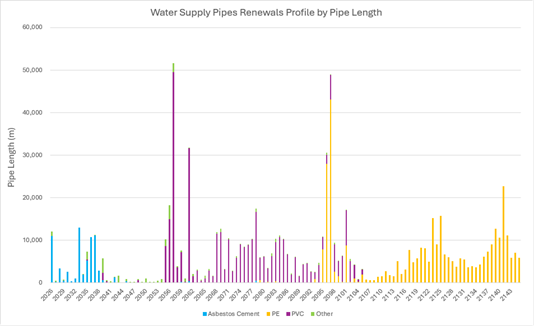
Figure
1: Pipe Renewal Profile Graphs for Water Supply
(based on age)
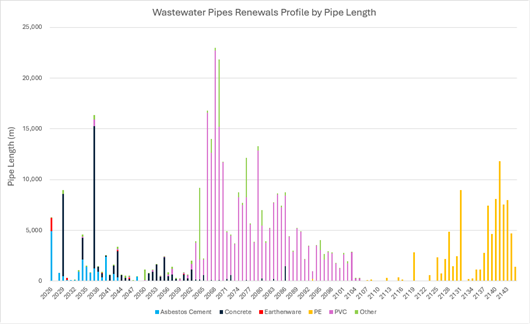
Figure 2: Pipe Renewal Profile Graphs
for Wastewater (based on age)
4.6 The wastewater and stormwater reactive
maintenance is also strongly influenced by weather events, which are difficult
to predict. The two weather events in June/July 2025 are such an example.
4.7 The Total Outturn Cost (TOC) agreed with
the contractor is primarily based on meeting the Council’s levels of
service requirements and its compliance obligations. The TOCs related to
routine operations are slightly higher than budget but not as significant as
the reactive maintenance TOCs.
4.8 If overspends are expected to occur and
there is no offsetting underspend, then staff are required to obtain approval
from Council for unbudgeted expenditure. Noting that this approval is
required prior to the overspend occurring.
4.9 Staff expect the overspend of existing
annual budgets to start in late April 2026. Some reactive maintenance budgets
have already exceeded the budgets set for particular cost centres, such as
wastewater pump stations and Low Pressure Pump Station systems (LPPS) and water
supply reticulation, treatment plant and pump stations.
4.10 The
operations and maintenance forecast for each of the Three Waters compared to
the TOC and the budgets in the Annual Plan 2025/2026 are shown in Table 1 below.
The “other” category is for works undertaken by contractors other
than the Three Water O&M contractor and therefore does not have a TOC
budget. Much of this “other” work has been done by other
contractors also doing reactive maintenance work due to the main contractor not
having the resources due to the high level of reactive maintenance they have
been required to undertake.
4.11 The
detail related to specific over-expenditure is discussed further in section 5
below.
Table 1: Three Waters Maintenance Expenditure
Forecast
|
Activity
|
AP 2025/26
O&M
Budget
|
TOC
2025/26
|
Forecast
2025/26
|
Budget
less Forecast
|
|
Water Supply –
routine
|
$2,162,000
|
$2,216,000
|
$1,913,000
|
$250,000
|
|
Water Supply –
reactive
|
$2,157,000
|
$3,415,000
|
$3,299,000
|
-$1,142,000
|
|
Water Supply - other
|
$275,000
|
|
$448,000
|
-$173,000
|
|
Total Water
Supply
|
|
|
|
-$ 1.065,000
|
|
Wastewater –
routine
|
$1,311,000
|
$1,445,000
|
$ 1,077,000
|
$234,000
|
|
Wastewater –
reactive
|
$919,000
|
$1,147000
|
$ 1,778,000
|
-$859,000
|
|
Wastewater - other
|
$36,000
|
|
$125,000
|
-$89,000
|
|
Total
Wastewater
|
|
|
|
-$ 714,000
|
|
Stormwater –
routine
|
$285,000
|
$330,000
|
$346,000
|
-$61,000
|
|
Stormwater - reactive
|
$226,000
|
$222,000
|
$123,000
|
$102,000
|
|
Stormwater - other
|
$52,000
|
|
$168,000
|
-$116,000
|
|
Total
Stormwater
|
|
|
|
-$ 75,000
|
|
Totals
|
$7,423,000
|
|
$9,277,000
|
-$1,854,000
|
4.12 Staff have made every effort to try and mitigate
the forecast overspend. A process has been undertaken to review levels of
service and find maintenance cost savings. However, there is little room to
reduce Three Waters maintenance costs without impacting on compliance with
water quality assurance rules and conditions of resource consents.
4.13 This increased cost of maintenance has been
incorporated into the budgets in draft Annual Plan 2026/2027 and will be
further reviewed and incorporated in the budgets in the Water Services Strategy
2027/2037.
4.14 Despite
these measures, staff still expect there to be a deficit compared to what the
Long-Term Plan (LTP) predicted for 30 June 2026.
4.15 If
we combined all the revenue and all the expenditure across the three waters
then the overall impact is a net forecast deficit of circa $153,000.
5. Analysis
and Advice / Tātaritanga me ngā tohutohu
5.1 The next part of this report explains what the high-level drivers
are for the overspend at the account level.
5.2 We have excluded the rising cost of fuel and consequential cost
increases from this report as there is so much uncertainty. However,
based on current use, for every $1.00/litre rise in the price of diesel would
result in an additional cost for this financial year 2025/2026 to be around
$30,000 across all three waters.
Stormwater - forecast maintenance
deficit of $75,000
5.3 Although staff forecast a deficit in the
stormwater maintenance costs, this is offset by an underspend in the stormwater
operating expenditure. The operating expenditure is tracking to be
around $99,000 below budget. This is due to lower than budgeted spending
in other operational areas, largely driven by delays in modelling and the
development of catchment management plans.
5.4 Most routine
maintenance and other costs relate to storm clean up and vegetation maintenance
of waterways – with additional focus, they are trending lower than last
year, but still above budget. Reactive maintenance at present remains
below budget, although a significant rainfall event between now and the end of
the year could adversely impact this.
Wastewater - forecast maintenance
deficit of $714,000
5.5 The Wastewater activity maintenance
forecast over-expenditure is primarily due to the increased reactive
maintenance and storm response that has occurred. $236,000 of this is due
to Council’s share of the Nelson Regional Sewerage Business Unit
operational costs and has been included in the event rate that is proposed in
the Annual Plan 2026/2027.
5.6 There have been some cost savings in the
routine maintenance from efficiencies and streamlining of work. Most of
the savings were due to the respective resources being diverted to respond to
the July 2025 storm event. This diverted them away from being able to
carry out the programmed routine operational tasks.
5.7 Under the contract Council is only
funding one wastewater team. This team covers both routine and reactive
maintenance. The staffing capacity is based on having sufficient capacity
to carry out the routine maintenance whilst having some capacity for reactive
maintenance. However, despite this, the reactive maintenance was far
greater than anticipated. The reactive maintenance budget for the Total Outturn
Cost (TOC) had been based on the actual cost trends incurred from previous
years.
5.8 The reduction in routine maintenance
includes frequency or level of cleaning of some assets, such as air valves and
wet wells; detail of checks moving to more visual rather than full strip
down. None of these compromise the level of service nor breach compliance
requirements, but they are short-cuts in maintenance that will ultimately
require attention in the future.
5.9 There has been an upward trend in the
number of low pressure pumpstation callouts as the number of installations have
increased over the years (refer Figure 3 below).
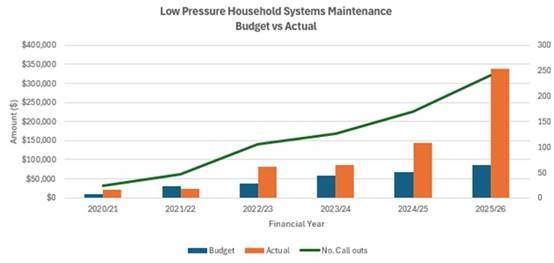
Figure 3: Low pressure pump
systems maintenance
5.10 For the larger wastewater pumpstations, there have
been several reasonably high-cost reactive fixes so far this year. Seven
responses have incurred an overall cost of $113,000. These responses included
replacing carbon for odour control, generator faults, damaged pumps and
replacement of damaged impellors, variable speed drives and biofilter fans.
Water Supply – forecast
maintenance deficit of $1,065,000
5.11 Higher reactive maintenance costs have been
incurred throughout the year. Around 93% of the forecast maintenance
expenditure is primarily because of the increased level of reactive
maintenance. To date, 82% of the reactive maintenance has been spent on
water reticulation.
5.12 However, it should be noted that as at 31 March
2026 the operating revenue for Water Supply is circa $1.3 million above
budgeted revenue. If this trend continues for the last three months of
the year, revenue could be $1.6 million above budget. That being the case
then this would cover the additional reactive maintenance expenditure, and
overall deficit would be covered.
5.13 The routine maintenance budget is underspent
primarily because some planned routine activities were assessed as not required
based on current asset condition. The most significant variance relates
to the Motueka Water Treatment Plant routine maintenance, with an estimated
saving of approximately $70,000. This was due to cartridge filters not
being required as expected. This is because the new product that was
trialled has performed better than anticipated. The remaining underspend reflects smaller savings across multiple
schemes, where works were either deemed unnecessary following inspection or
deferred to the next inspection cycle.
5.14 The reactive maintenance budget for the TOC is
based on the actual cost trends from previous years.
5.15 Ageing infrastructure, because of deferred pipe
renewals over the years (refer Figure 1), has led to an increased number
of pipe failures and water outages and consequent high levels of reactive
maintenance. Most of the reactive maintenance costs are related to pipe
failures.
Water Supply – Renewal Budget for
2026/27
5.16 Frequent failures over recent months in the Fairfax
Street water main, Murchison, meant that its renewal became a priority.
This water main was renewed. The ‘urban water account reticulation
renewals’ budget for 2025/2026 had already been spent on pipe
renewals. So, funding for the Fairfax Street water main renewal was
funded from the Waimea Plains capital project budget. This budget was
considered not likely to be fully spent by 30 June 2026 so was utilised to fund
this renewal.
5.17 Once the detailed scope for the various
sub-projects within the Waimea Plains Project has been completed, we can then
determine whether the remaining funding is still sufficient. If it is not
sufficient, either the scope will be revised to meet budget, or additional
funding will be requested of Council.
5.18 Council is currently up to 25-30 years behind where
it should be with our renewals programme and this is starting to have a
negative effect (increased costs) on our maintenance expenditure in our ongoing
aim to maintain our levels of service.
6. Financial
or Budgetary Implications / Ngā Ritenga ā-Pūtea
6.1 The maintenance expenditure is exceeding
approved budgets for all three water activities. At this stage staff
forecast maintenance expenditure at 30 June 2026 to exceed budget by up to
$75,000 for stormwater, up to $1,065,000 for Water Supply and up to
$714,000 for Wastewater.
6.2 In the interim, staff need Council
approval to spend overspend the current budgets to continue to undertake the
necessary reactive maintenance. It is intended that the impact of the
increase in unbudgeted maintenance expenditure be presented to Council at year
end once all the account balances for the year have been confirmed.
6.3 If there are deficits at year
end, Council could decide to implement what it decided last year which was to
fund any deficits over future years. It could also decide to increase
maintenance budgets in the Water Services Strategy to reduce the risk of
over-expenditure in future years.
6.4 At financial year end there may
be other areas of Council that could help fund the overspend in this area, but
Council will deliberate and make that decision after year end.
7.1 The options are outlined in the
following table:
|
Option
|
Advantage
|
Disadvantage
|
|
1.
|
Approve funding the ongoing unbudgeted
maintenance expenditure and once the end of year financials are completed
decide on how any overall account deficits should be funded.
|
Unbudgeted forecast maintenance
expenditure is approved until 30 June 2026.
Council will continue to deliver its
services to the customers and continue to comply with statutory requirements
and consent conditions.
|
This puts more pressure on future
maintenance budgets which may need to be increased to accommodate the
additional costs of maintenance.
|
|
2.
|
Decline to approve funding the forecast
maintenance expenditure in each of the Three Waters Activities. .
|
There are no advantages with this option.
.
|
This approach is not a realistic option
as Council cannot immediately cease maintenance to its essential services
without potential disruption to consumers and the risk of not meeting its
compliance requirements. This is not a practical option as staff do not
have delegation to spend beyond the approved budgets. At this stage of
the financial year, it would be impossible not to overspend whilst still
providing the required levels of service and still meeting ongoing compliance
requirements.
|
7.2 Option 1 is
recommended.
8.1 The Council has set budgets in the
Annual Plan 2025/2026, and this report highlights that due to the increased
reactive maintenance and the increased costs associated with the July 2025
event, those budgets will be exceeded.
8.2 At year’s end the Council will
need to consider the end of year balances for each of the Three Waters accounts
and determine then how they will be funded should that be required.
8.3 Staff cannot exceed the approved budgets
and need the assurance that funding for ongoing expenditure above current
budgets are approved.
8.4 This report ensures that the unbudgeted
maintenance expenditure is appropriately authorised, and funding approved.
9. Significance
and Engagement / Hiranga me te Whakawhitiwhiti ā-Hapori Whānui
9.1 Staff have assessed the significance of
most of the decisions proposed in this report. The significance of the combined
set of changes including the authorisation of additional unbudgeted expenditure
is considered to be medium.
9.2 No
formal engagement is proposed as the elected members can rely on their
knowledge of the views and preferences of their communities in making a
decision.
|
|
Issue
|
Level of
Significance
|
Explanation of
Assessment
|
|
1.
|
Is there a high level
of public interest, or is decision likely to be controversial?
|
Medium
|
Generally low but
some members of the community with a particular interest in Council finances
will have a higher interest.
|
|
2.
|
Are there impacts on
the social, economic, environmental or cultural aspects of well-being of the
community in the present or future?
|
Medium
|
The Annual Plan for
2026/27 and the following financial years will increase rates to recover the
rates overspend and additional interest payments.
|
|
3.
|
Is there a
significant impact arising from duration of the effects from the decision?
|
Low
|
The Annual Plan for
2026/27 and the following four financial years will increase rates to recover
the rates overspend and additional interest payments.
|
|
4.
|
Does the decision
relate to a strategic asset? (refer Significance and Engagement Policy for
list of strategic assets)
|
Low
|
|
|
5.
|
Does the decision
create a substantial change in the level of service provided by Council?
|
Low
|
|
|
6.
|
Does the proposal,
activity or decision substantially affect debt, rates or Council finances in
any one year or more of the LTP?
|
Medium
|
In the context of the
whole funding envelope for the Three Water activities, the impacts of
repaying the deficit over the following years will have a minor adverse
impact on future fees and charges for the three water activities.
|
|
7.
|
Does the decision
involve the sale of a substantial proportion or controlling interest in a CCO
or CCTO?
|
No
|
|
|
8.
|
Does the
proposal or decision involve entry into a private sector partnership or
contract to carry out the deliver on any Council group of activities?
|
No
|
|
|
9.
|
Does the proposal or
decision involve Council exiting from or entering into a group of
activities?
|
No
|
|
|
10.
|
Does the proposal
require particular consideration of the obligations of Te Mana O Te Wai
(TMOTW) relating to freshwater or particular consideration of current
legislation relating to water supply, wastewater and stormwater
infrastructure and services?
|
No
|
|
10. Communication
/ Whakawhitiwhiti Kōrero
10.1 The Council anticipates communicating this decision
to the community.
11.1 The key risk is that if approval to spend spending
unbudgeted maintenance expenditure is not given, there will be disruptions to
services and potentially major disruptions for longer periods of time until at
least more funding comes available in the Annual Plan 2026/2027 is approved.
11.2 This report has included comments on some routine
maintenance that have been deferred to reduce expenditure. This carries a
risk where the consequences of deferred maintenance may result in much greater
expenditure in the future to restore services. In effect we should still
undertake routine maintenance as “a stitch in time saves
nine”! If Council approves committing unbudgeted maintenance
expenditure, then we will include routine maintenance and no longer defer it.
12. Climate
Change Considerations / Whakaaro
Whakaaweawe Āhuarangi
12.1 The overall impact, if any, on climate resilience
and adaptation is likely to be minor.
13. Alignment
with Policy and Strategic Plans / Te Hangai ki ngā aupapa Here me ngā
Mahere Rautaki Tūraru
13.1 The Council is attempting to deliver on its vision Thriving
and Resilient Tasman Communities and the strategic priorities in the LTP
2024-2034. This approval will ensure it is very transparent around
approving over-expenditure and remain aligned with its Strategic Plans.
14. Conclusion
/ Kupu Whakatepe
14.1 The approved budgets in the Annual Plan 2025/2026
are insufficient to cover the increased costs of undertaking the maintenance
within each of the Three Waters activities. This report requests approval
to fund the forecast unbudgeted maintenance expenditure so that Council
continues delivering the Three Waters services by undertaking the necessary
level of maintenance through to the end of the financial year.
15. Next
Steps and Timeline / Ngā Mahi Whai Ake
15.1 To continue undertaking the necessary and routine
maintenance within each of the Three Waters activities through to the end of
the financial year June 2026.
Nil
7.3 Mayoral Update
Information Only - No Decision
Required
|
Report
To:
|
Tasman
District Council
|
|
Meeting
Date:
|
7
May 2026
|
|
Report
Author:
|
Tim
King, Mayor
|
|
Report
Number:
|
RCN26-05-7
|
1.1 The Middle East conflict remains
front of mind, the Chief Executive, Executive leadership team and Civil Defence
Emergency Management team are continuing to meet weekly to ensure readiness for
any potential business disruption.
1.1 The
Annual Plan consultation closed on Sunday with a strong level of engagement
already evident across the district. A significant number of submissions have
been received to date, alongside a wide range of conversations taking place
with community members.
1.2 This
engagement reflects the community’s interest in the Council’s
direction and priorities and provides valuable feedback to help inform
decision-making.
2. Recommendation/s
/ Ngā Tūtohunga
That the Tasman District Council
1. receives the Mayoral Update report RCN26-05-7.
3.1 Deputy
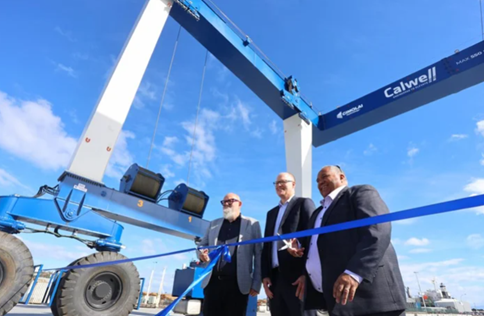
Mayor Maru stepped in for me at the opening for Calwell, Port Nelson’s
marine haul out and maintenance facility. This new facility represents an
important investment in regional infrastructure. While it strengthens Port
Nelson’s role as a key marine and economic hub, its benefits extend well
beyond the city boundary. Improved marine haul-out facilities will support
Tasman’s economy and help create employment and economic
resilience across both districts. This will also support and attract highly
skilled marine engineers within the Nelson-Tasman region.
3.2 Infrastructure
New Zealand held an event at the Trafalgar Centre, which I attended. The focus
was on regional resilience, with discussion centred on how resilience is
defined and maintained while recovery efforts are still in progress.
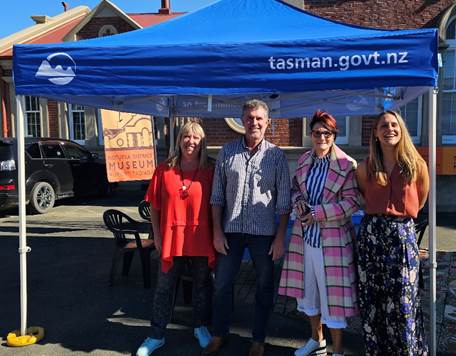
3.3 Motueka
councillors held a well-attended community drop-in event last Friday, with good
engagement and a genuine willingness from attendees to share their ideas. Feedback included requests for more rubbish bins and improved
library sound quality. There was positive support for the Motueka swimming
pool, concerns about additional liquor stores and vehicle hooning, and a
suggestion for covered seating in the CBD.
3.4 Representatives
of the local Marine Farming Association met with me on 17 April 2026 to provide
a sector update.
3.5 The latest Tim Time segment with Fresh FM, covered topics from the
recent issue of Newsline.
3.6 ANZAC
Day ceremonies were held across the Tasman District last Saturday, with strong
community participation and representation from elected members. I attended the
Lake Rotoiti service. Each service was conducted with dignity and respect,
incorporating traditional elements such as the laying of wreaths, the Last
Post, and moments of silence. Community groups, veterans, schools, and
residents all contributed to the success and atmosphere of the events.
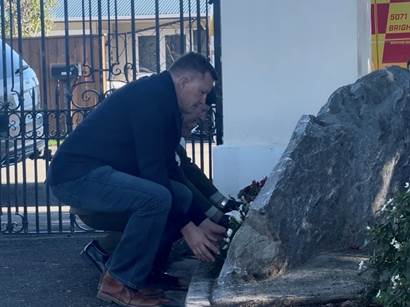
Councillor Neubauer laying a wreath at the Brightwater
ceremony
3.7 A
learning exercise was held over two days at Civil Defence on 29 and 30 April
2026. I supported the exercise on the first day and would like to acknowledge
and thank the Emergency Management staff and staff of the Council for their
time and contribution to strengthening preparedness and response capability
within the region.
3.8 On
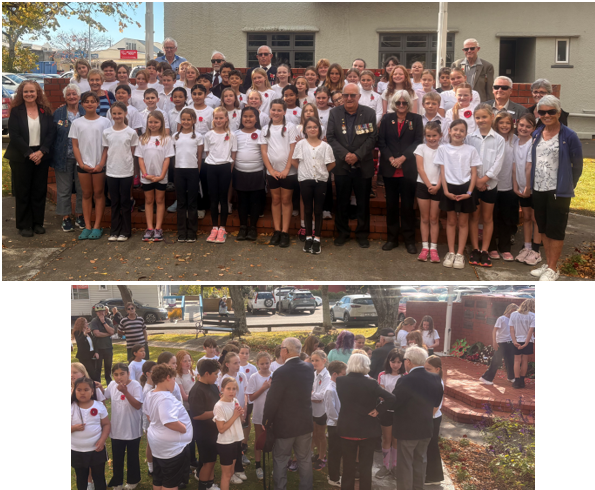
my way to the recent citizenship ceremony, I happened upon an ANZAC event at
Memorial Park on Cambridge Street in Richmond, where Richmond School was
performing songs and sharing stories. Following the performance, it was
heartening to see students and veterans mingling and talking together,
including conversations about medals and service, creating a meaningful
intergenerational connection.
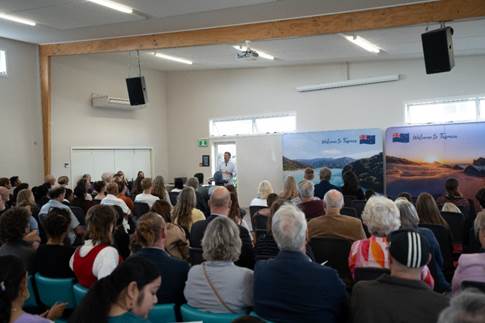
3.9 Another
successful Citizenship Ceremony was held last Wednesday, where we proudly
welcomed 52 new citizens to the district. These new citizens represented more
than 15 different countries, reflecting the diversity and vibrancy of our
community.
3.10 Chief
Executive, Leonie Rae, Councillor Neubauer and I attended an event with Hon
Chris Hipkins. This was a useful opportunity to discuss current issues,
understand broader national perspectives, and strengthen connections between
local government, central government, and the business sector.
Nil
Tasman District Council Agenda – 07 May 2026
8 CONFIDENTIAL SESSION
8.1 Procedural
motion to exclude the public
The following
motion is submitted for consideration:
That the
public be excluded from the following part(s) of the proceedings of this
meeting. The general subject of each matter to be considered while the public
is excluded, the reason for passing this resolution in relation to each matter,
and the specific grounds under section 48(1) of the Local Government Official
Information and Meetings Act 1987 for the passing of this resolution follows.
This resolution is made in reliance on section 48(1)(a) of the Local
Government Official Information and Meetings Act 1987 and the particular
interest or interests protected by section 6 or section 7 of that Act which
would be prejudiced by the holding of the whole or relevant part of the
proceedings of the meeting in public, as follows:
8.2 R26-16 International Cricket - Saxton Field
Outfield Renewal
|
Reason for passing this resolution in
relation to each matter
|
Particular interest(s) protected (where
applicable)
|
Ground(s) under section 48(1) for the
passing of this resolution
|
|
The public conduct of the part of the
meeting would be likely to result in the disclosure of information for which
good reason for withholding exists under section 7.
|
s7(2)(b)(ii) - The withholding of the
information is necessary to protect information where the making available of
the information would be likely unreasonably to prejudice the commercial
position of the person who supplied or who is the subject of the information.
s7(2)(c)(ii) - The withholding of the
information is necessary to protect information which is subject to an
obligation of confidence or which any person has been or could be compelled
to provide under the authority of any enactment, where the making available
of the information would be likely to damage the public interest.
|
s48(1)(a)
The public conduct of the part of the
meeting would be likely to result in the disclosure of information for which
good reason for withholding exists under section 7.
|
8.3 Iwi
Representation Appointments 2025 - 2028 term
|
Reason for passing this resolution in
relation to each matter
|
Particular interest(s) protected (where
applicable)
|
Ground(s) under section 48(1) for the
passing of this resolution
|
|
The public conduct of the part of the
meeting would be likely to result in the disclosure of information for which
good reason for withholding exists under section 7.
|
s7(2)(a) - The withholding of the
information is necessary to protect the privacy of natural persons, including
that of a deceased person.
The information contains personal details
about individuals considered for appointment as iwi representatives,
including their identities, background information, and evaluative material.
The decision will be made publicly available once the appointment process is
complete
|
s48(1)(a)
The public conduct of the part of the
meeting would be likely to result in the disclosure of information for which
good reason for withholding exists under section 7.
|
8.4 29 Cornwall Place, Tata Beach - Disposal
Options
|
Reason for passing this resolution in
relation to each matter
|
Particular interest(s) protected (where
applicable)
|
Ground(s) under section 48(1) for the
passing of this resolution
|
|
The public conduct of the part of the
meeting would be likely to result in the disclosure of information for which
good reason for withholding exists under section 7.
|
s7(2)(h) - The withholding of the
information is necessary to enable the local authority to carry out, without
prejudice or disadvantage, commercial activities.
s7(2)(i) - The withholding of the
information is necessary to enable the local authority to carry on, without
prejudice or disadvantage, negotiations (including commercial and industrial
negotiations).
|
s48(1)(a)
The public conduct of the part of the
meeting would be likely to result in the disclosure of information for which
good reason for withholding exists under section 7.
|
8.5 Fuel Price and Supply Impacts
|
Reason for passing this resolution in
relation to each matter
|
Particular interest(s) protected (where
applicable)
|
Ground(s) under section 48(1) for the
passing of this resolution
|
|
The public conduct of the part of the
meeting would be likely to result in the disclosure of information for which
good reason for withholding exists under section 7.
|
s7(2)(b)(ii) - The withholding of the
information is necessary to protect information where the making available of
the information would be likely unreasonably to prejudice the commercial
position of the person who supplied or who is the subject of the information.
s7(2)(i) - The withholding of the
information is necessary to enable the local authority to carry on, without
prejudice or disadvantage, negotiations (including commercial and industrial
negotiations).
|
s48(1)(a)
The public conduct of the part of the
meeting would be likely to result in the disclosure of information for which
good reason for withholding exists under section 7.
|