Submissions
Hearing
Agenda – 18 September 2024
3 Reports
3.1
Navigation Safety Bylaw
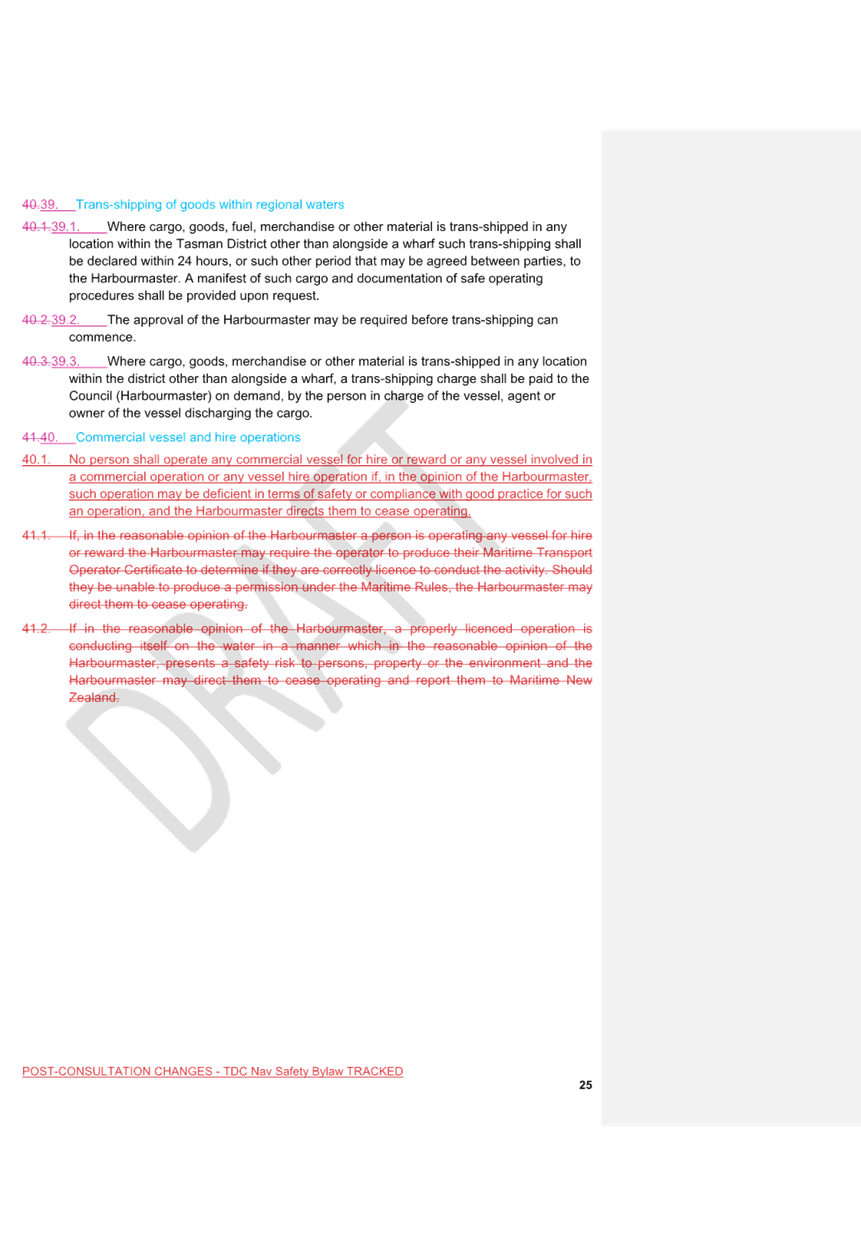
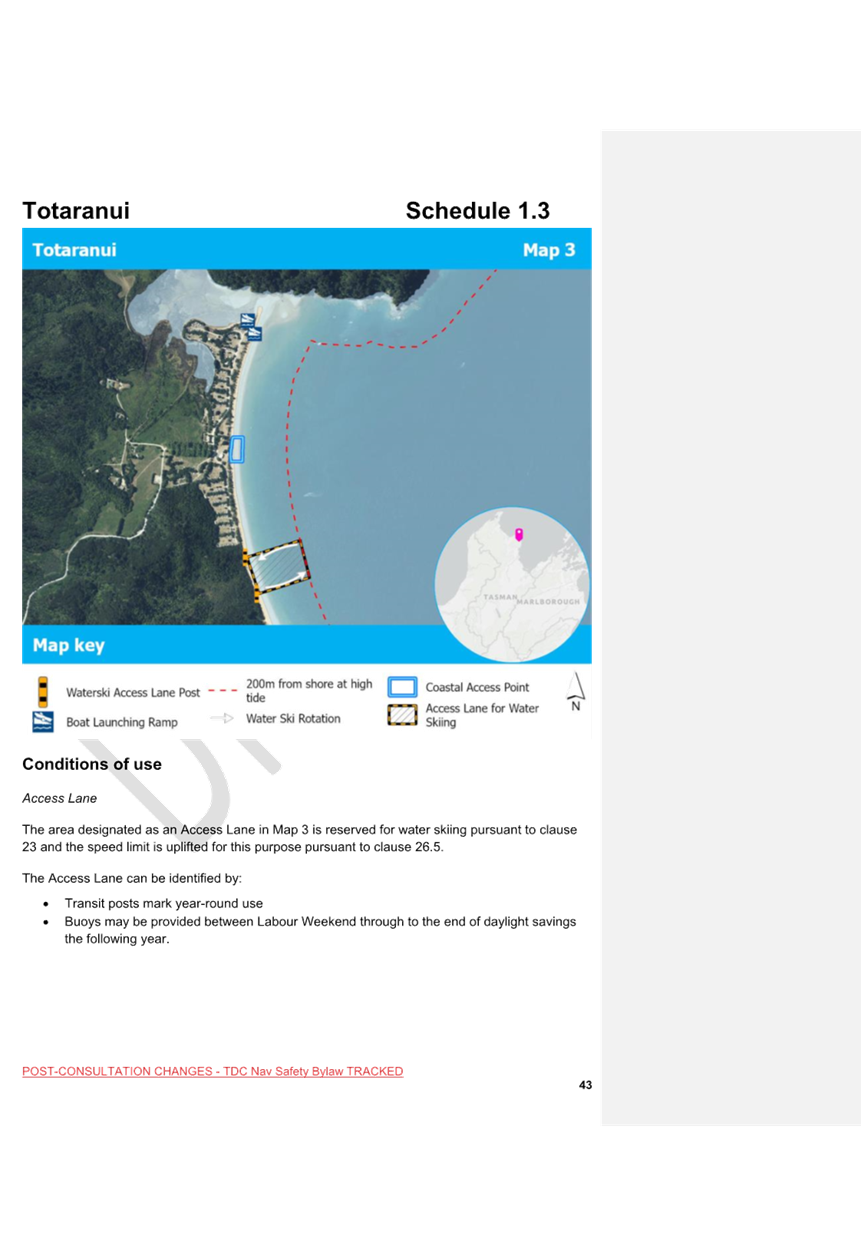
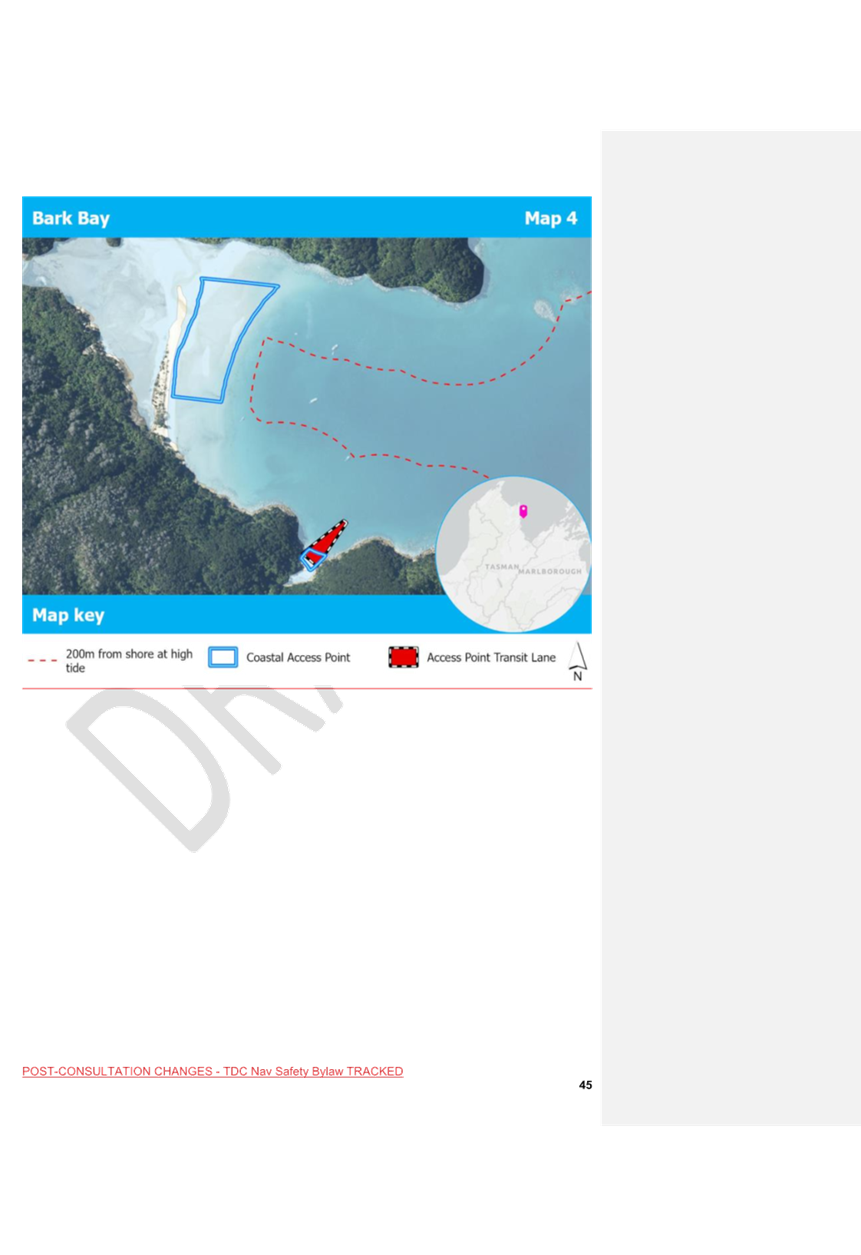
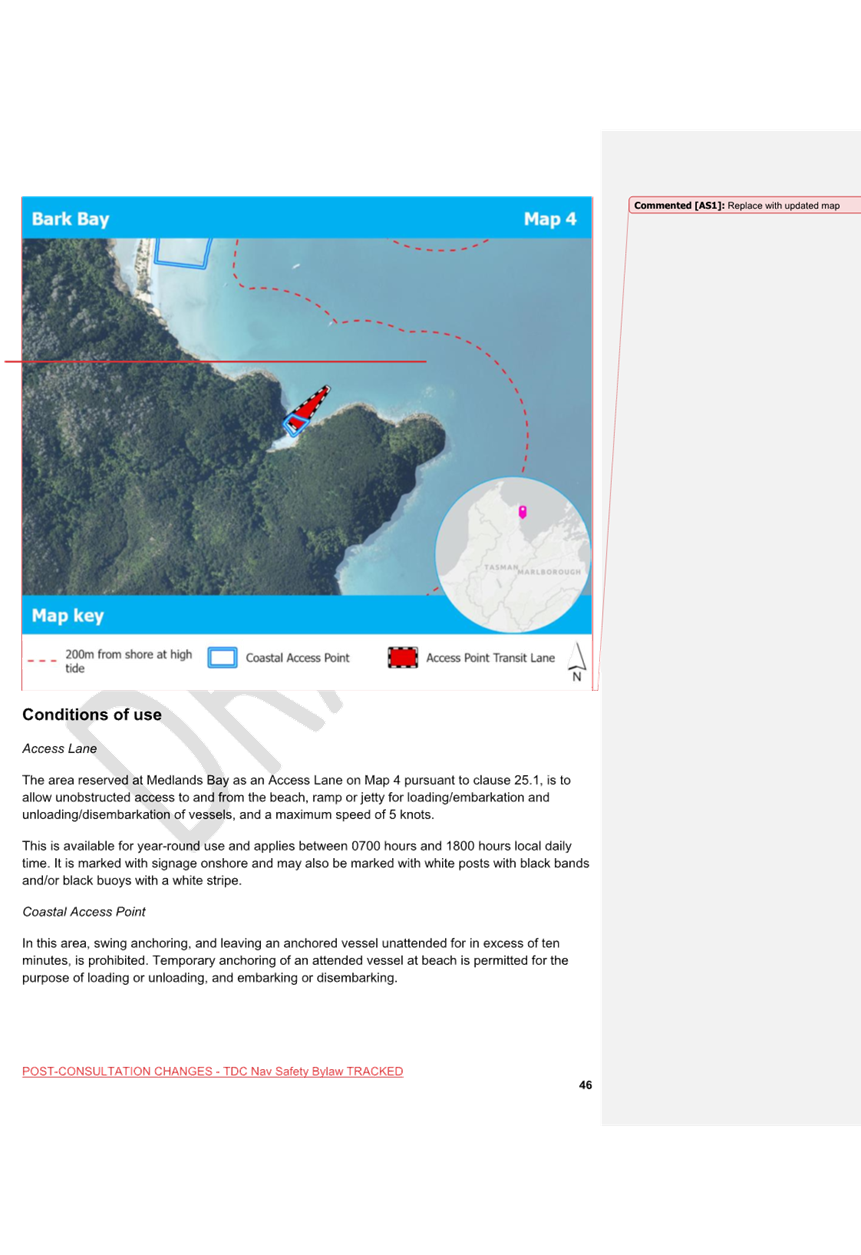
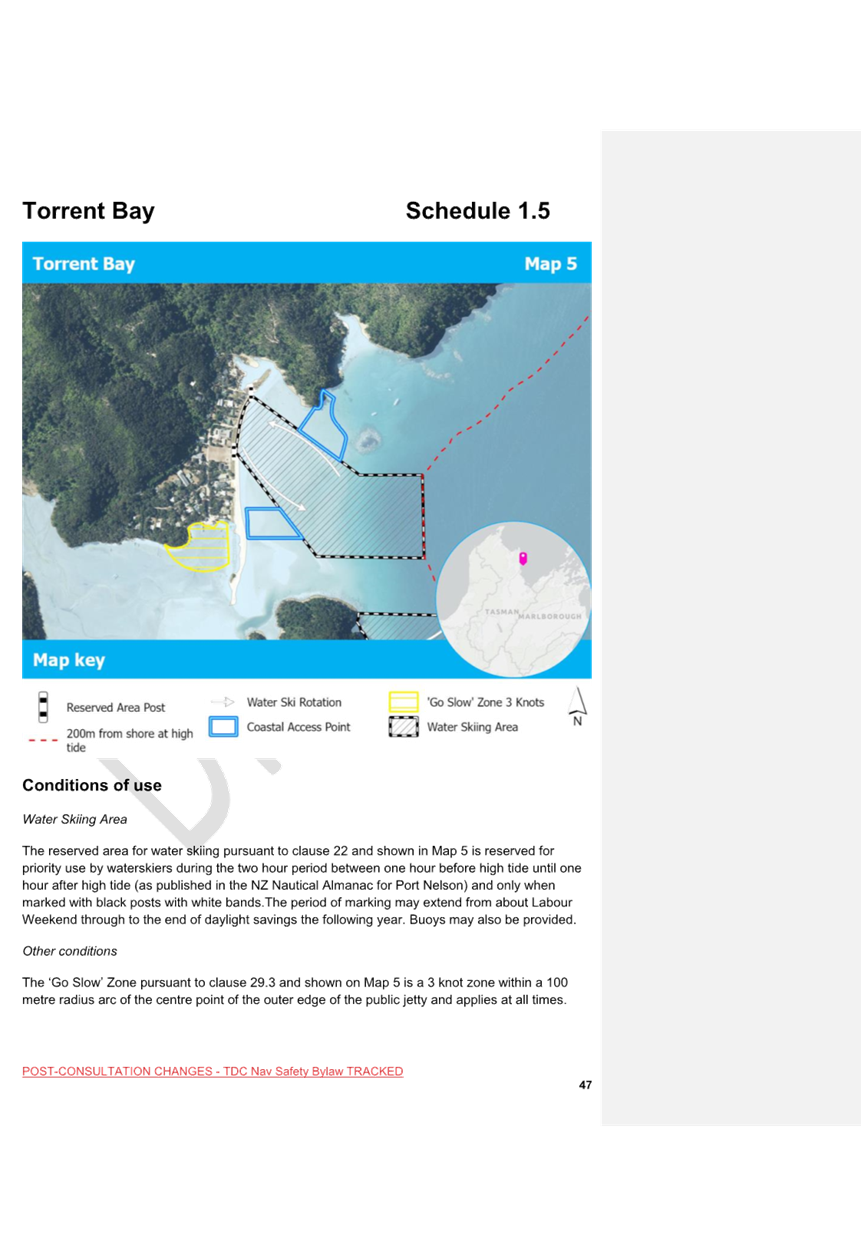
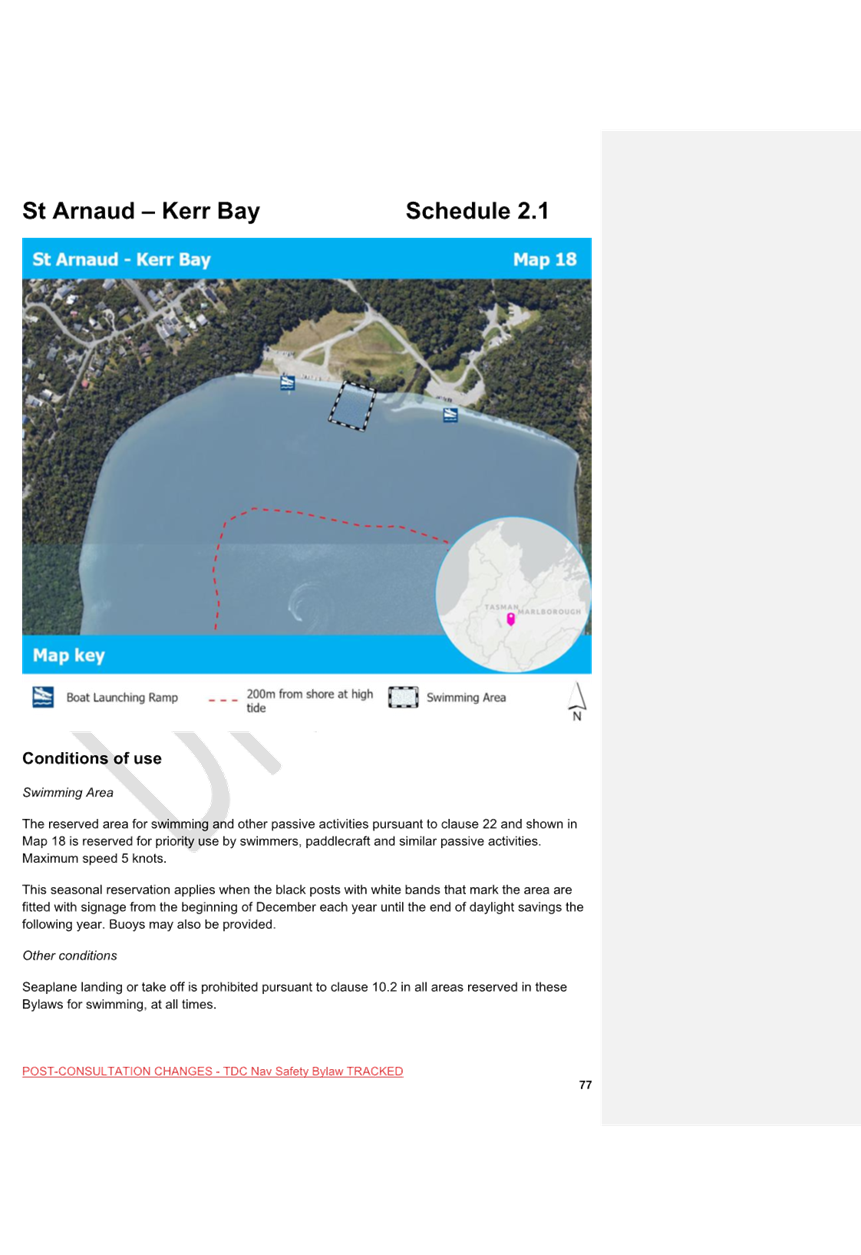
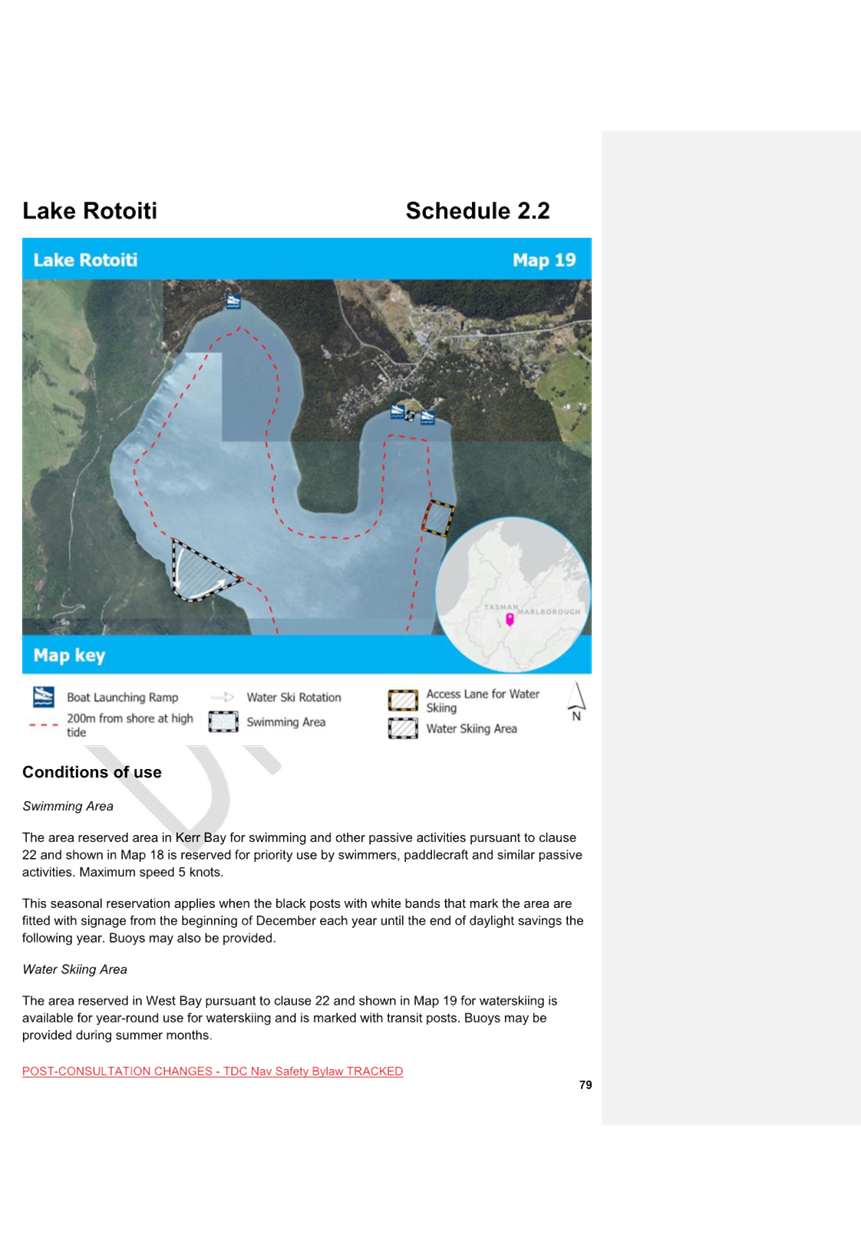
- Hearing and Deliberations
Decision Required
|
Report
To:
|
Submissions
Hearing
|
|
Meeting
Date:
|
18
September 2024
|
|
Report
Author:
|
Amy
Smith, Community Policy Advisor
|
|
Report
Authorisers:
|
Dwayne
Fletcher, Strategic Policy Manager; Kim Drummond, Group Manager -
Environmental Assurance
|
|
Report
Number:
|
RSH24-09-1
|
1. Purpose
of the Report / Te Take mō te Pūrongo
1.1 The
purpose of this report is to:
· accept and hear the submissions received during consultation on the
proposed Navigation Safety Bylaw 2024 (“the Bylaw”);
· summarise the feedback we received on the Bylaw and provide staff
advice on the issues raised in the feedback;
· provide the Submissions Hearing and Deliberations Panel (“the
Panel”) with an opportunity to discuss this feedback;
· seek decisions on any amendments to the Bylaw; and
· seek a recommendation from the Panel on whether the final Bylaw
should be adopted.
1.2 The
final Bylaw is scheduled to be presented to the Council on 24 October 2024,
with the Panel’s recommendation on whether the final Bylaw should be
adopted.
2. Summary
/ Te Tuhinga Whakarāpoto
2.1 This report is to enable the Panel
to accept and hear submissions on the Bylaw and summarises public feedback from
the consultation process.
2.2 Staff
ask the Panel to consider the feedback received and deliberate on the changes
they would like to make to the Bylaw, before making a recommendation to the
Council on whether the final Bylaw should be adopted.
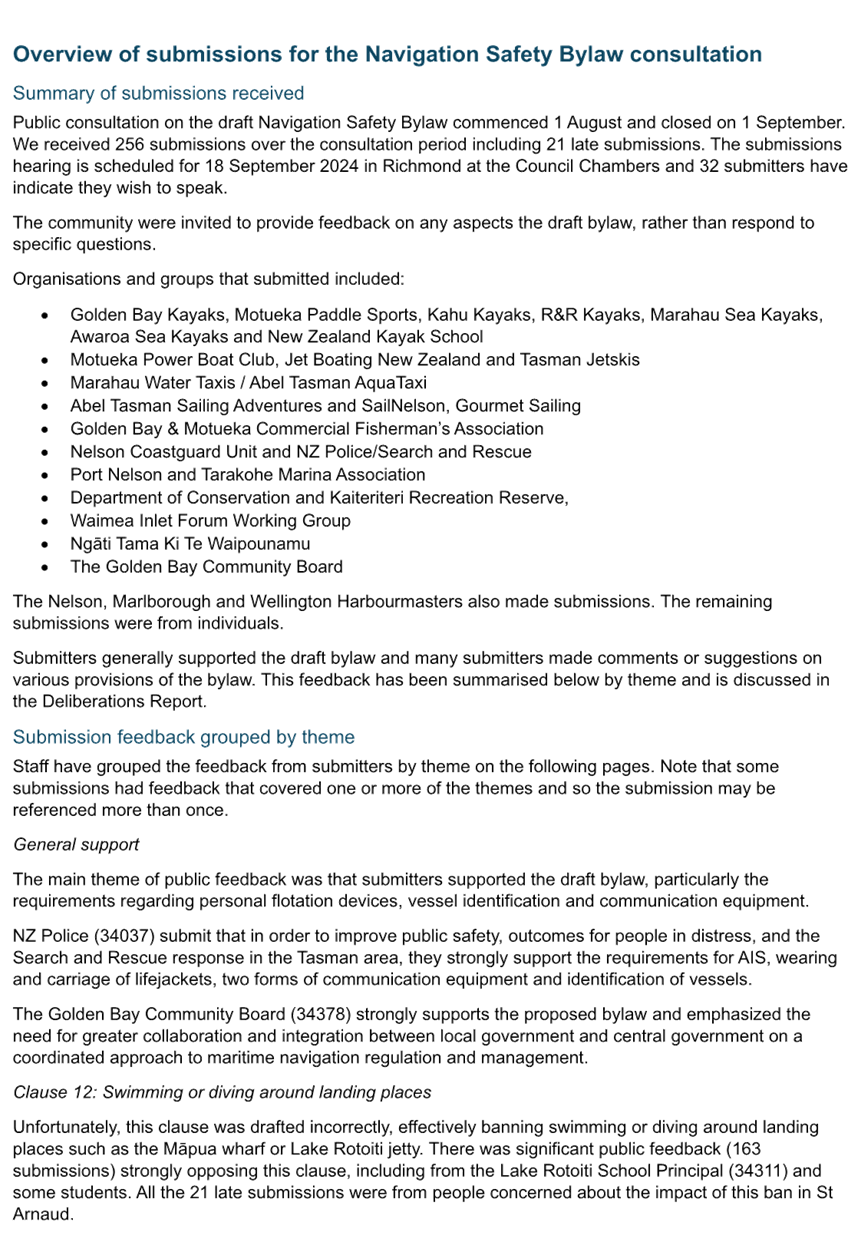
2.3 The
consultation period for the Bylaw closed on 1 September 2024. We received 256
submissions (including 21 late submissions).
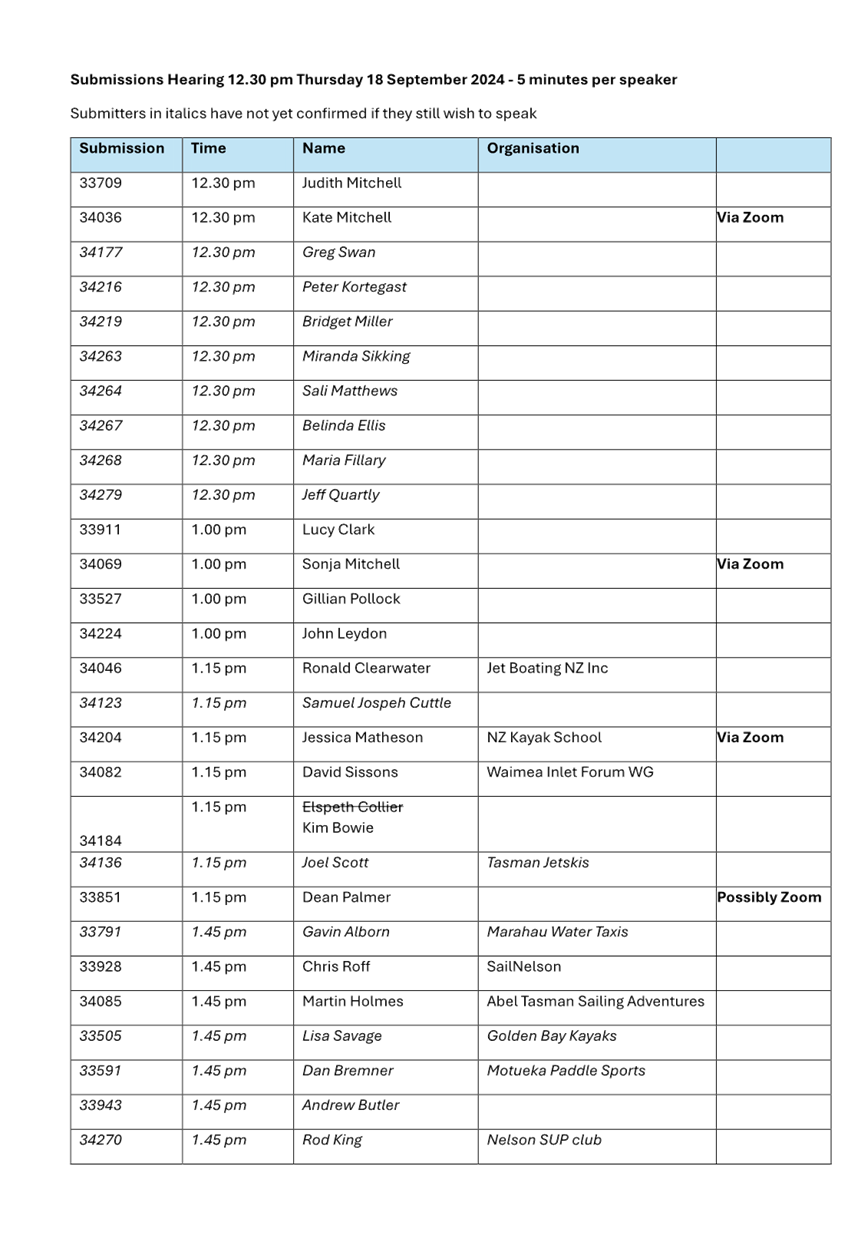
2.4 There
are 32 submitters that indicated they wish to be heard at today’s
hearing, but only 15 have confirmed they can attend.
2.5 The
schedule of presenters for this meeting is provided in Attachment 1.
Subsequent changes to the schedule will be advised before the hearing
commences. A copy of the submissions made by those submitters wishing to be
heard has been circulated to the Panel on LG Hub.
2.6 There
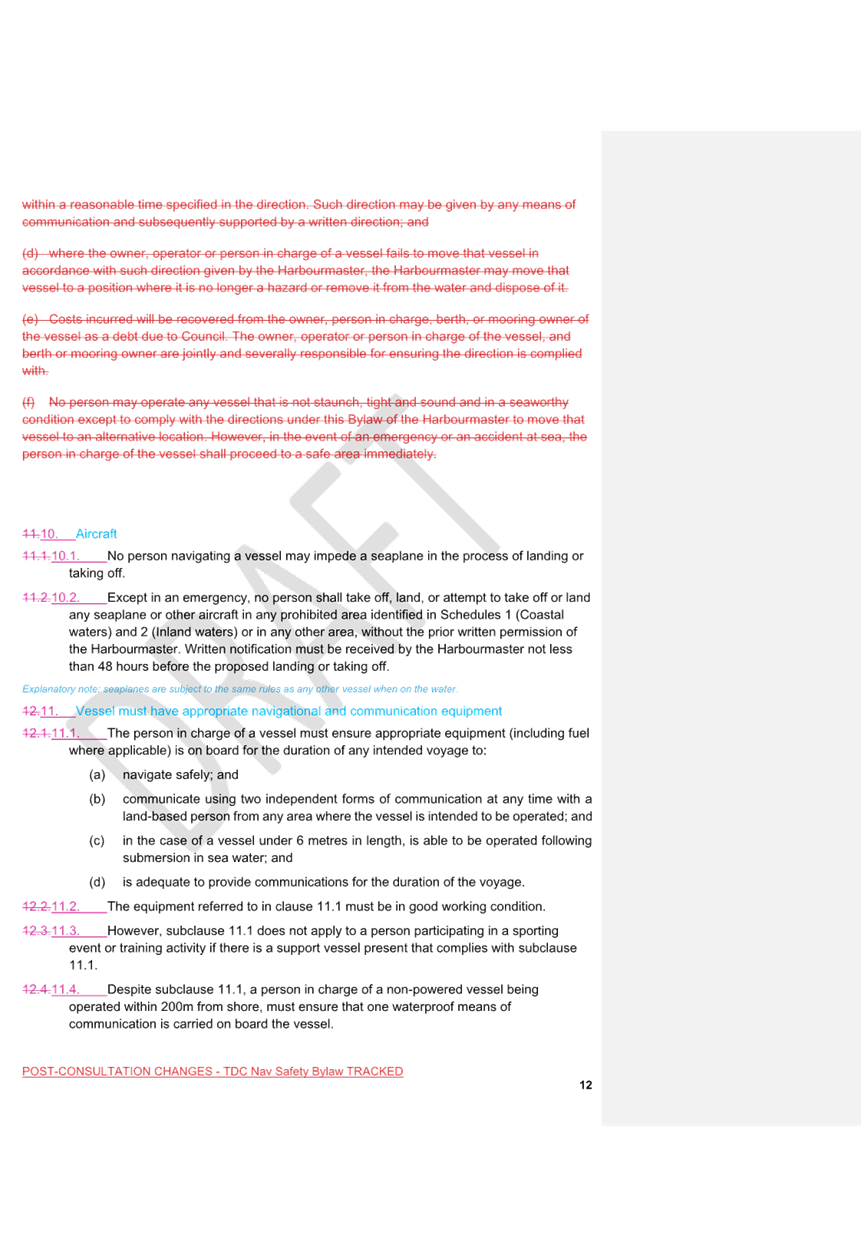
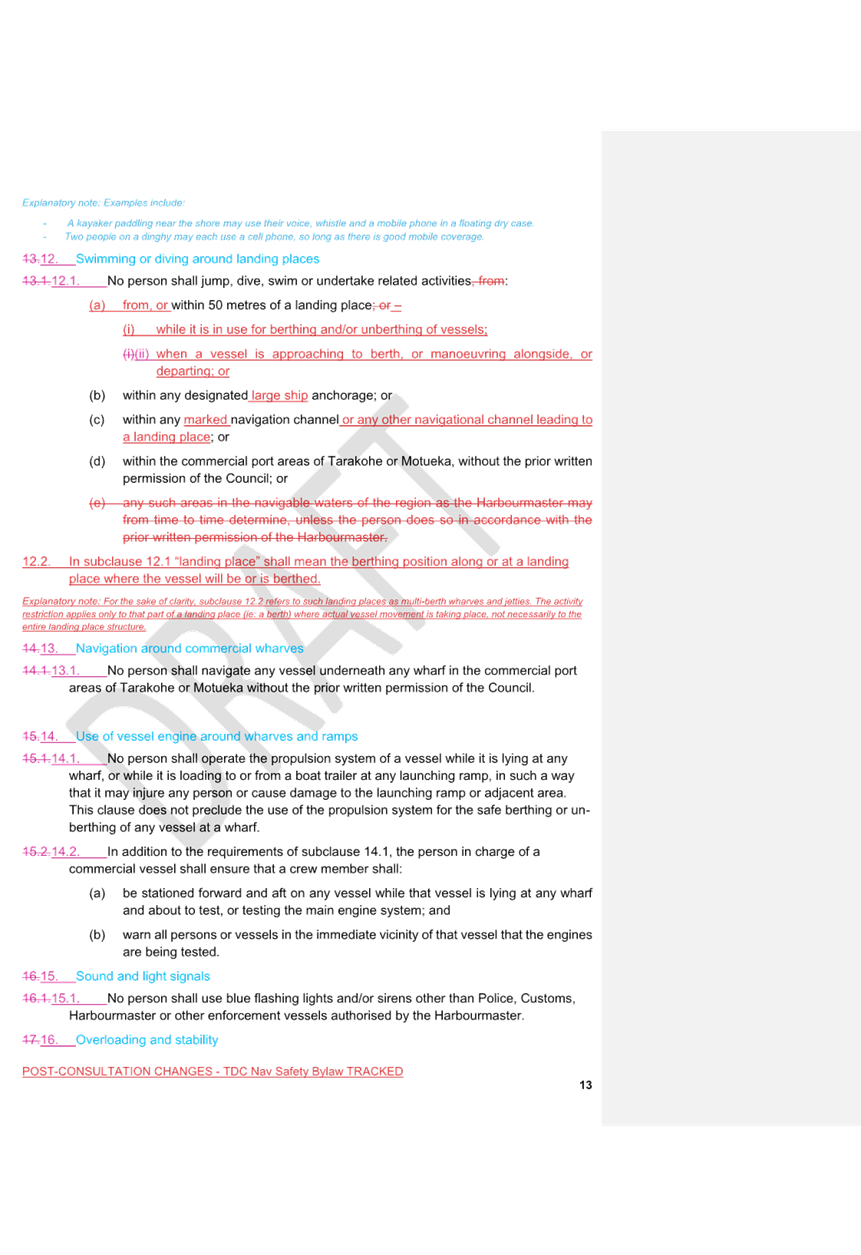
was strong opposition (163 submissions) to clause 12.1 that unintentionally
banned swimming or diving around landing places, such as Māpua wharf or
Lake Rotoiti jetty.
2.7 The
main theme of the rest of public feedback was general support for the Bylaw,
particularly the requirements regarding personal floatation devices, vessel
identification and communication equipment.
2.8 The
other key themes were:
· Support for Automatic Identification System (AIS) tracking, but some
commercial operators raised concerns.
· Strong support for the river speed upliftings provisions, but a
request to remove cumec ratings and an advisory clause.
· Mixed views on the proposed navigation aid levy.
2.9 Staff
have prepared a summary of the submissions received during consultation on the
Bylaw (see Attachment 2). Staff advice on the issues raised in the
feedback and recommended changes to the bylaw are set out in Section 6 of this
report to assist the deliberations, and the changes are detailed in Attachment
3.
2.10 Staff
will incorporate the changes that the Panel request and, if the Panel
recommends, prepare the final Bylaw for consideration by the Council at its 24
October 2024 meeting.
3. Recommendation/s
/ Ngā Tūtohunga
That the Submissions Hearing and
Deliberations Panel:
1. receives
the Navigation Safety Bylaw - Hearing and Deliberations RSH24-09-1; and
2. receives and considers all 256 submissions (including the late submissions) on the proposed
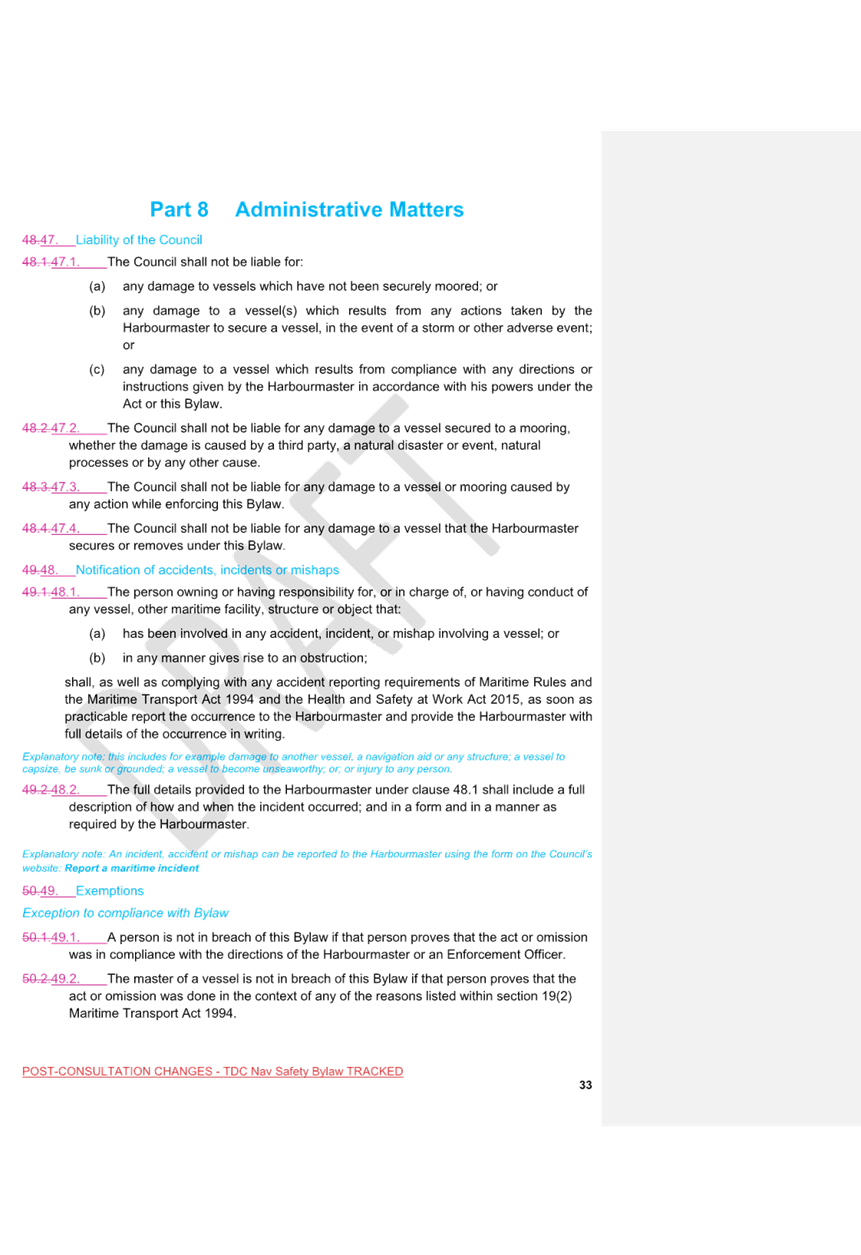
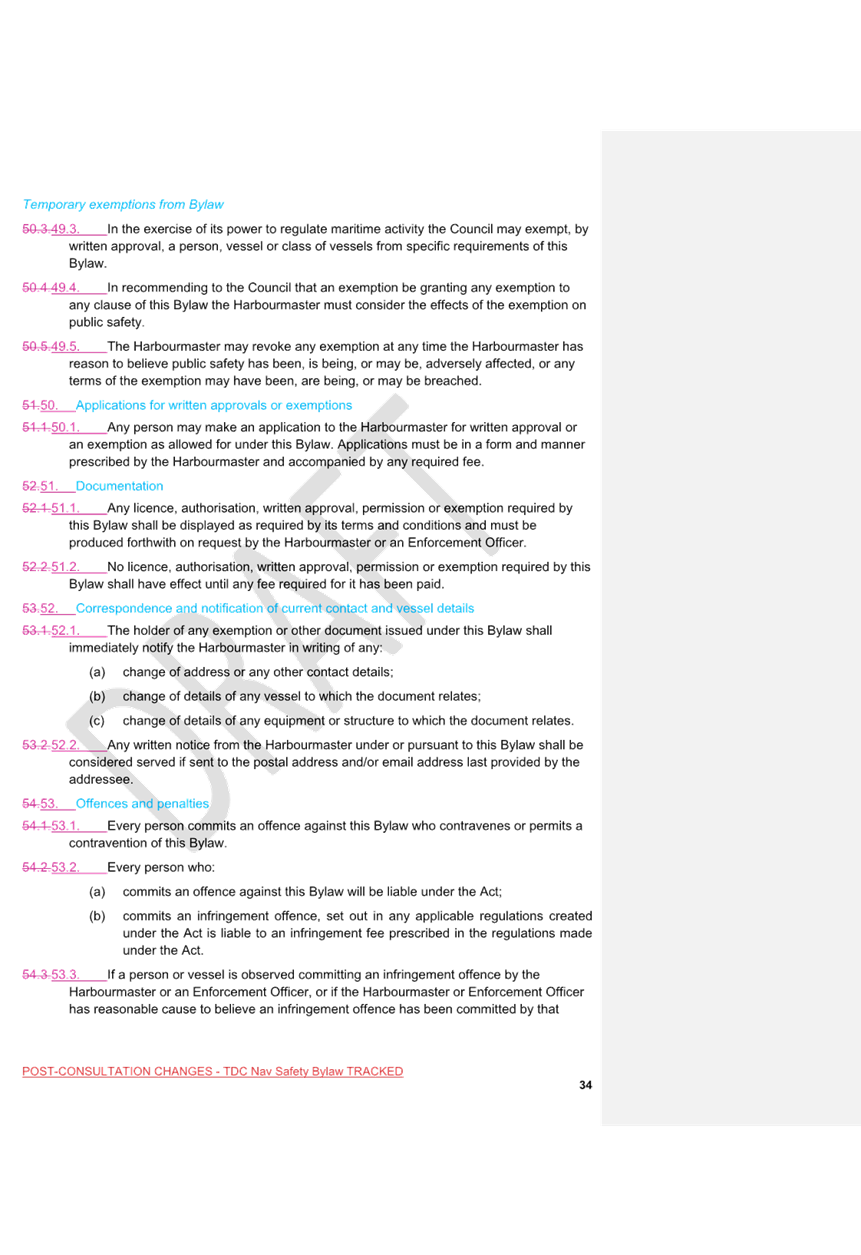
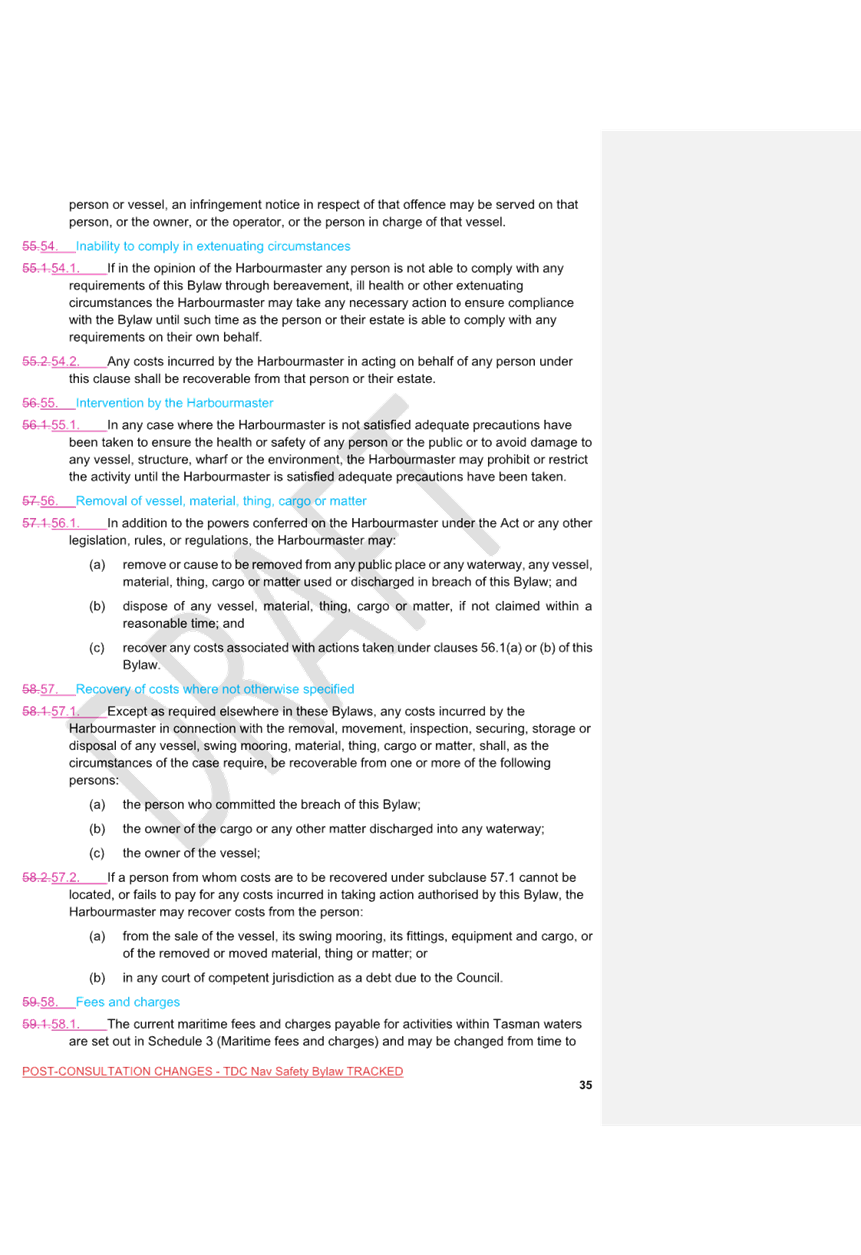
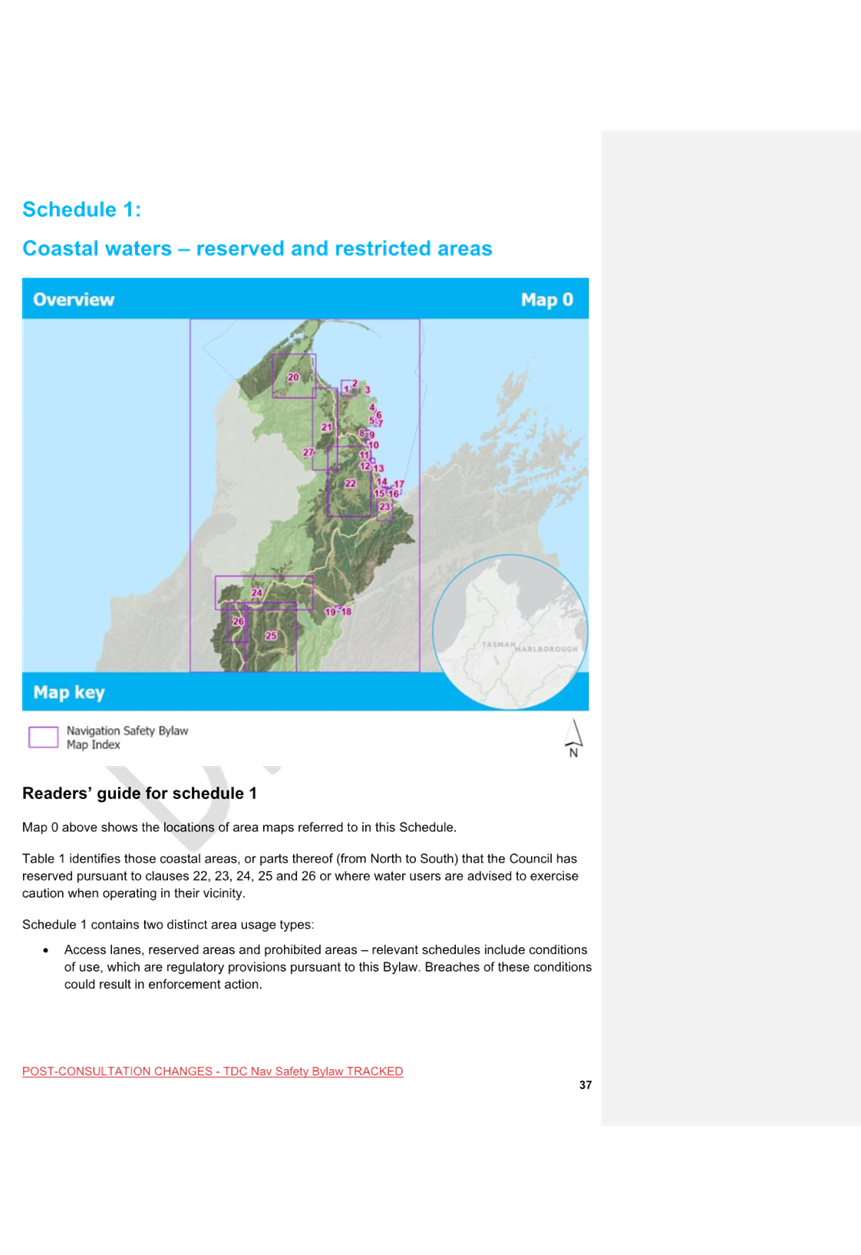
Navigation Safety Bylaw 2024 received by 8:00pm 1 September 2024; and
3. notes that the Council has consulted with the Director
of Maritime New Zealand as required by section 33M of the Maritime Transport
Act 1994; and
4. in accordance with section 155 of the Local Government Act 2002:
4.1 agrees that the proposed Navigation Safety Bylaw 2024 is the most
appropriate form of bylaw for navigation safety matters; and
4.2 notes that the proposed Navigation Safety Bylaw 2024 does not give
rise to any implications under the New Zealand Bill of Rights Act 1990; and
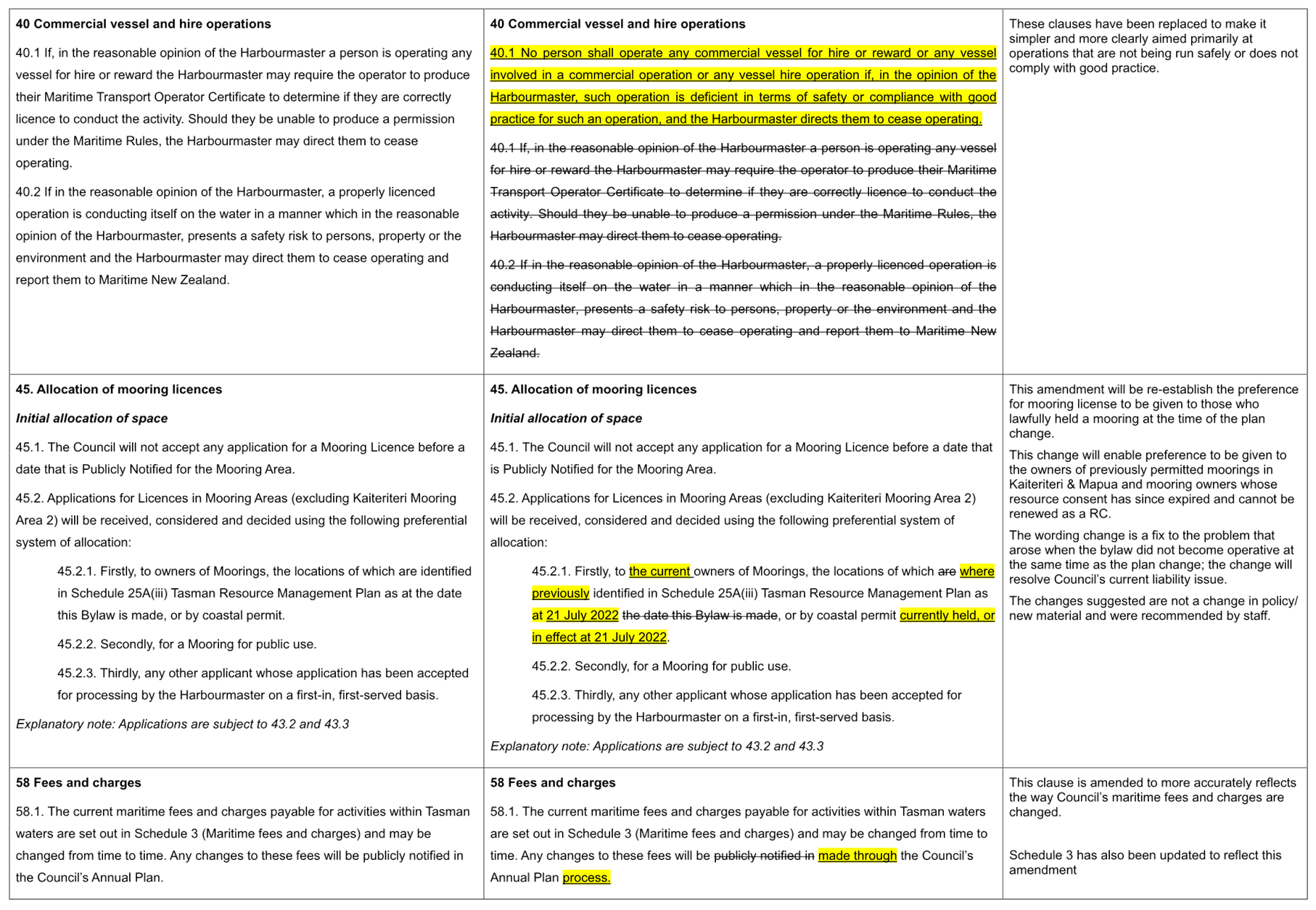
5. for the reasons set out in ‘Table 1: Changes
proposed in response to feedback in submissions’ (Attachment 3 to the
agenda report) agrees to staff amending wording in the following clauses:
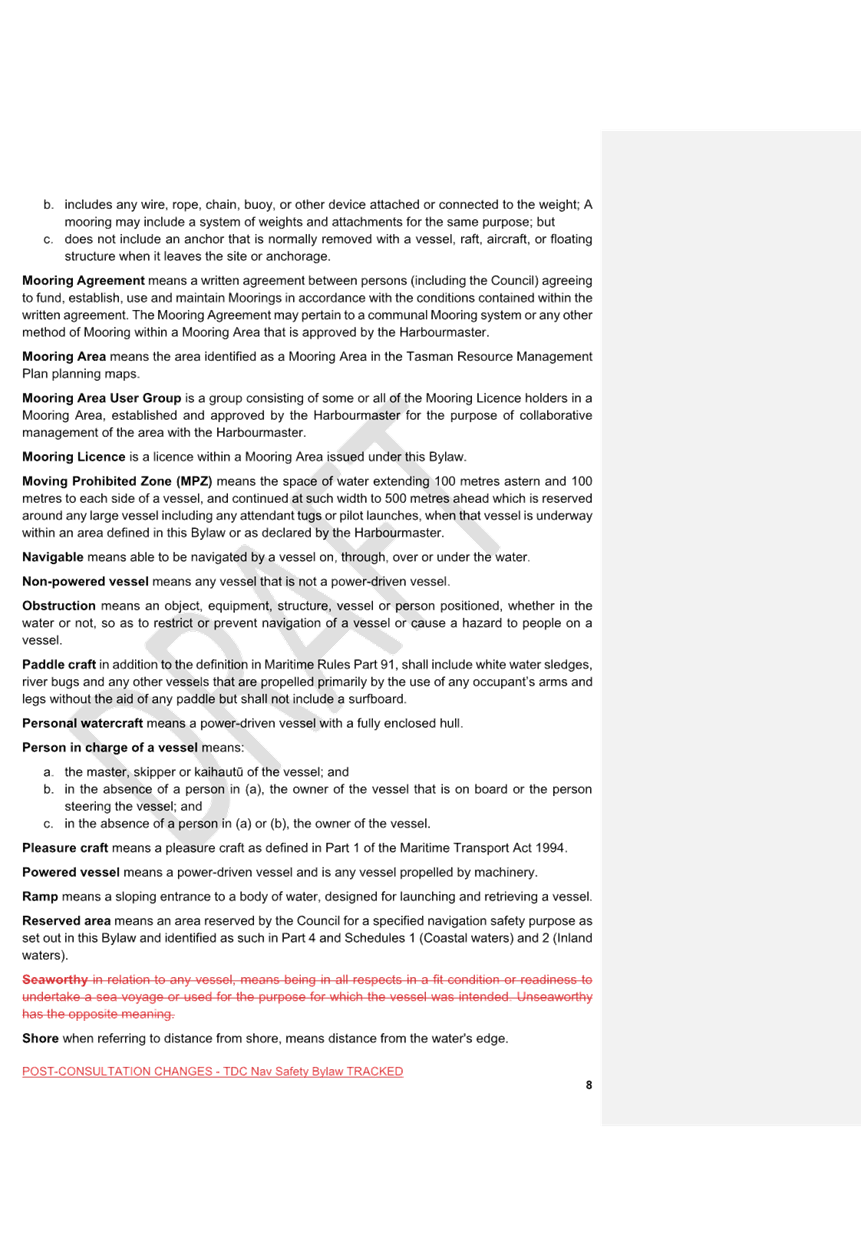
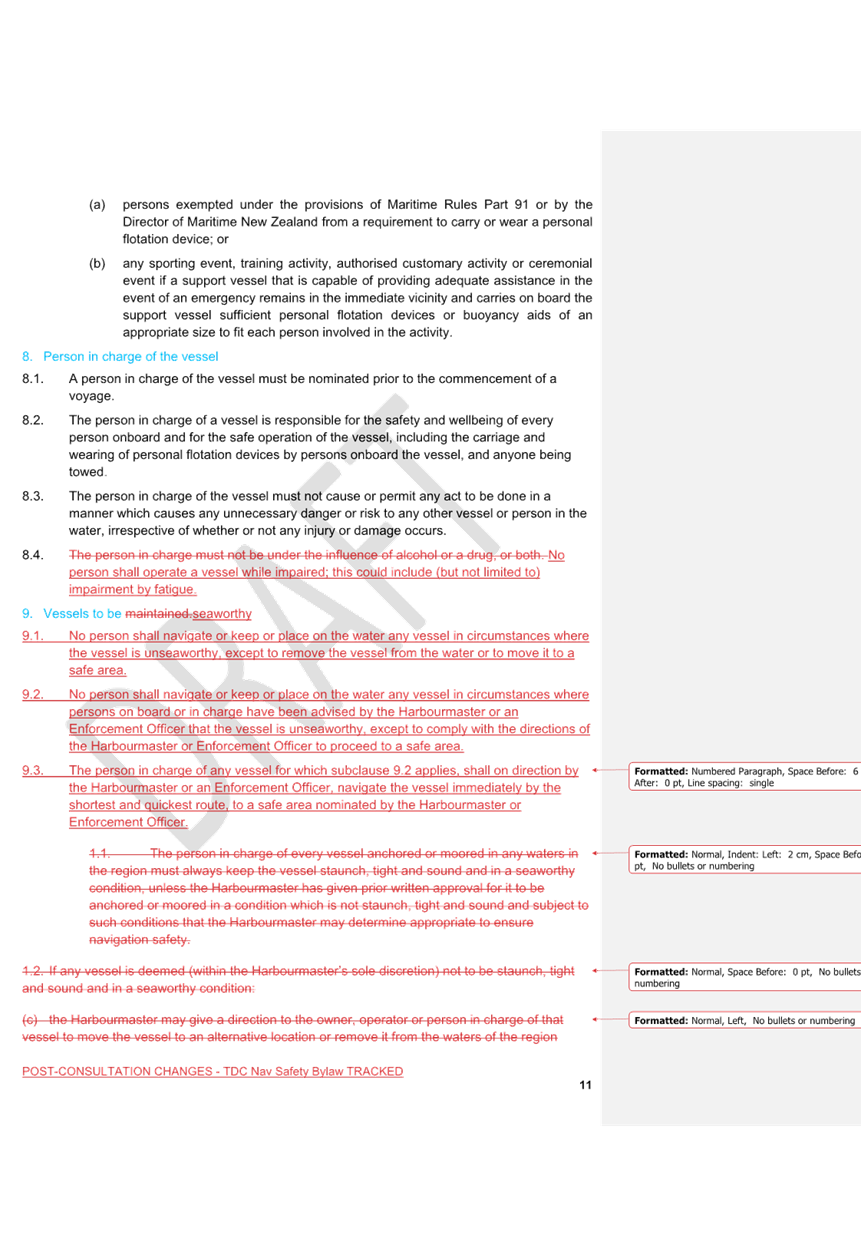
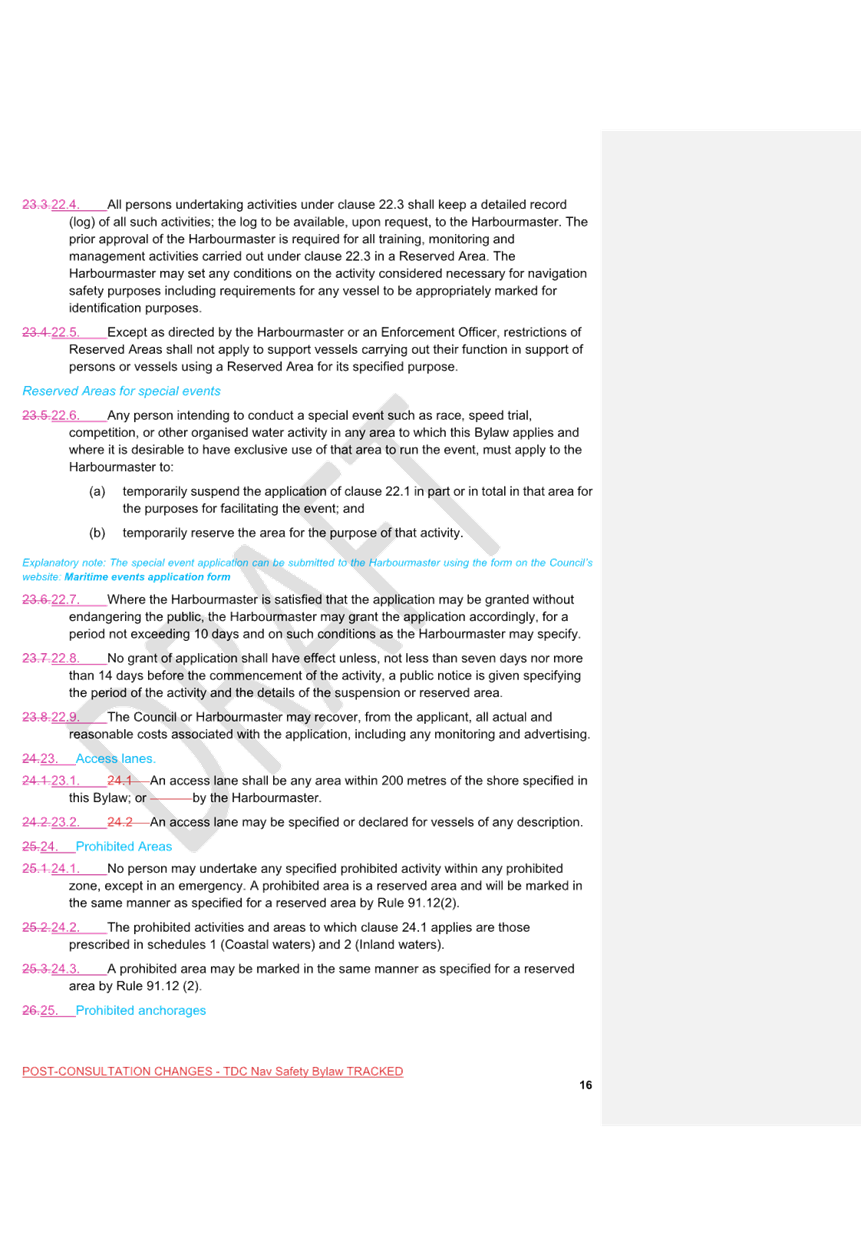
5.3 Clause 8.4 (Person in charge of the vessel),
5.4 Clause 12 (Swimming and diving around landing places),
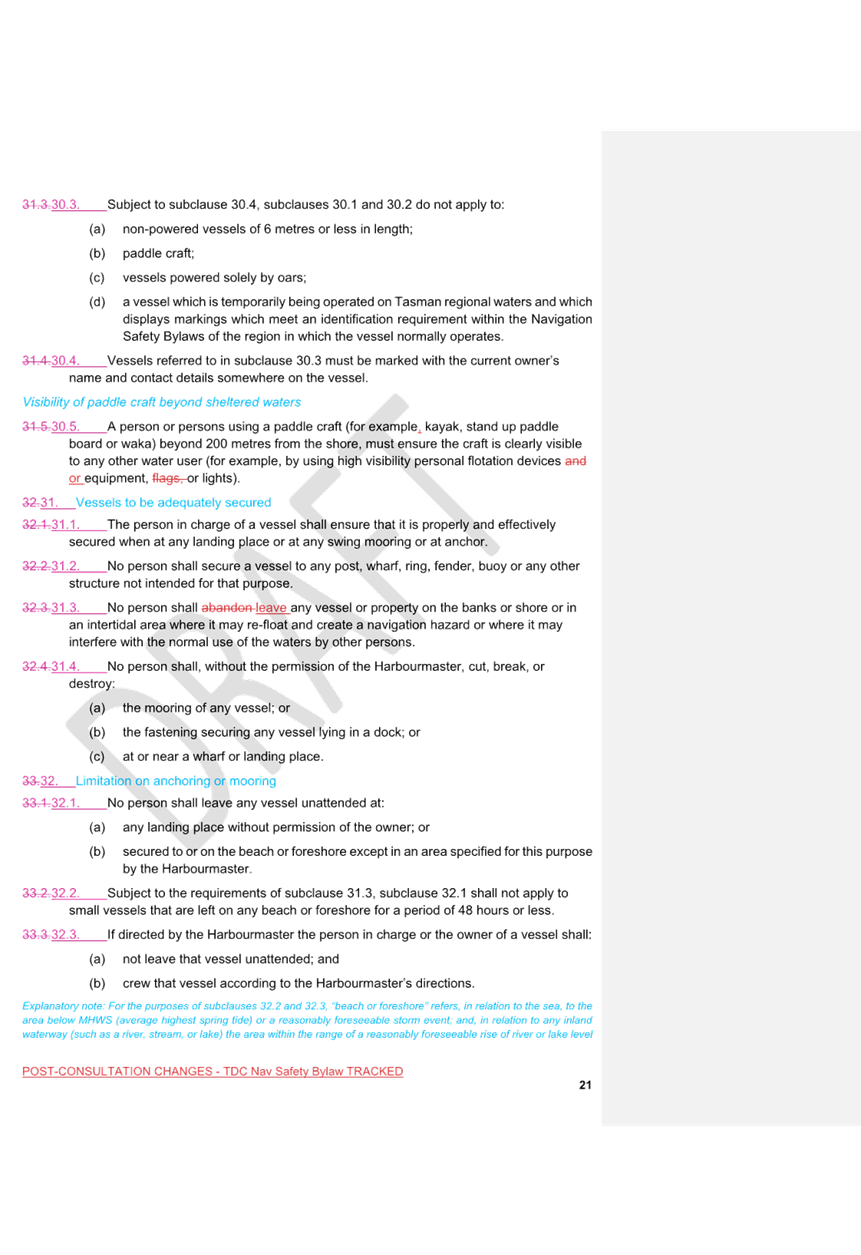
5.5 Clause 30 (Vessels to be identified),
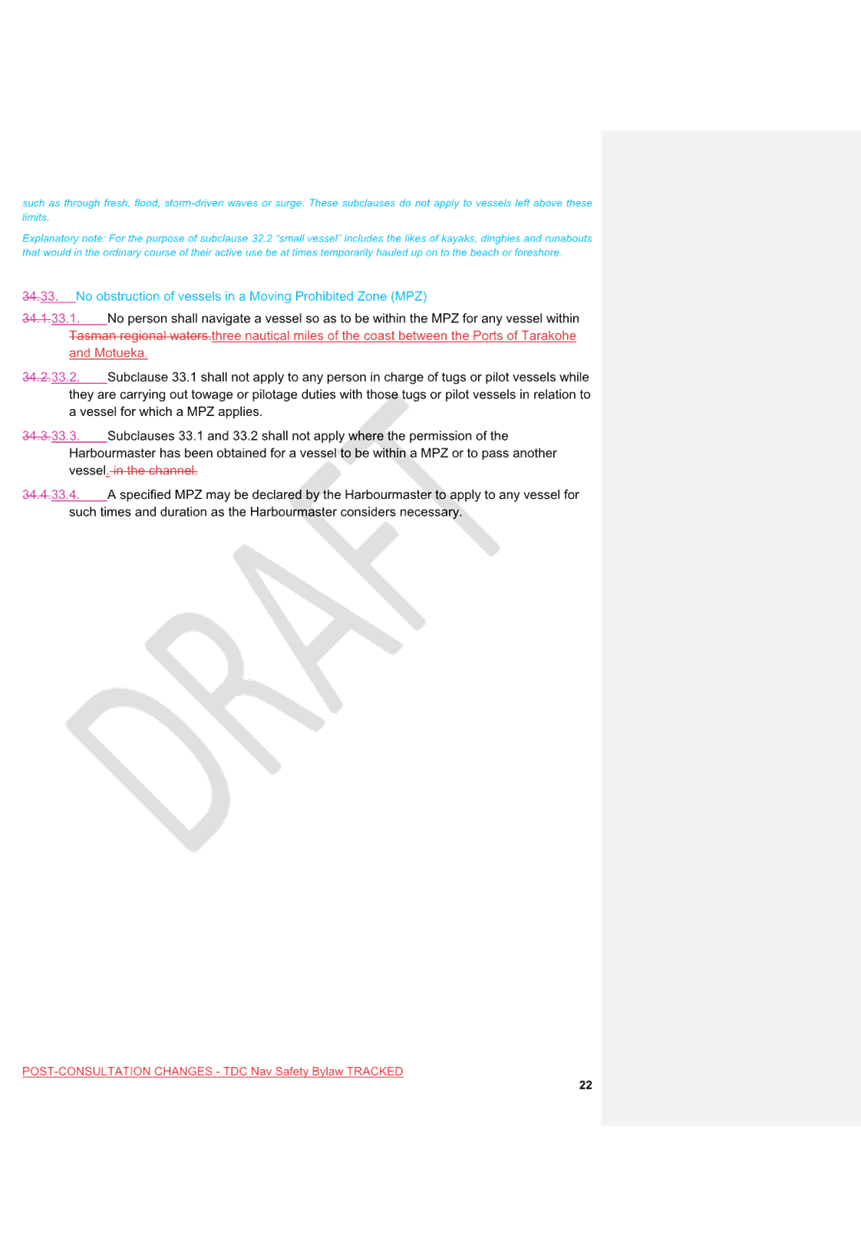
5.6 Clause 33 (No obstruction of vessels in a MPZ),
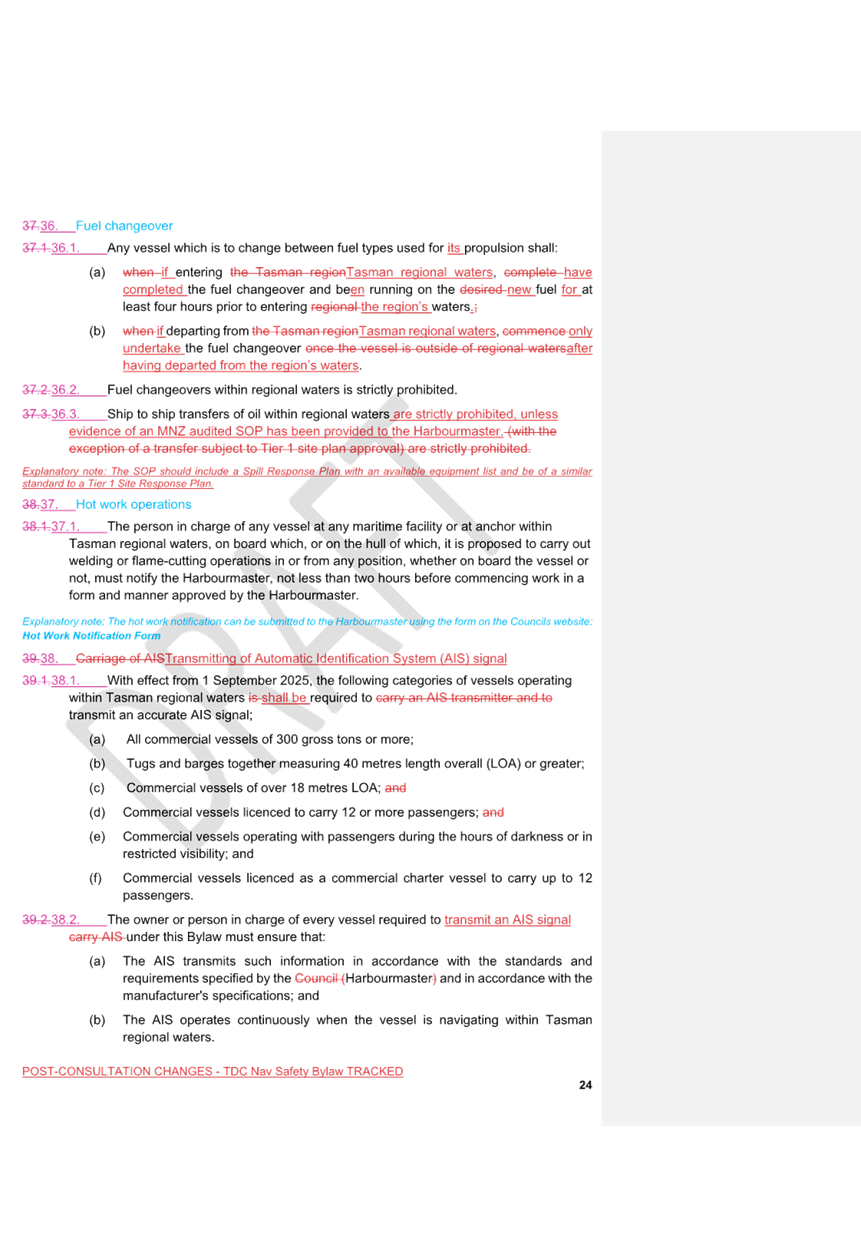
5.7 Clause 36 (Fuel changeover),
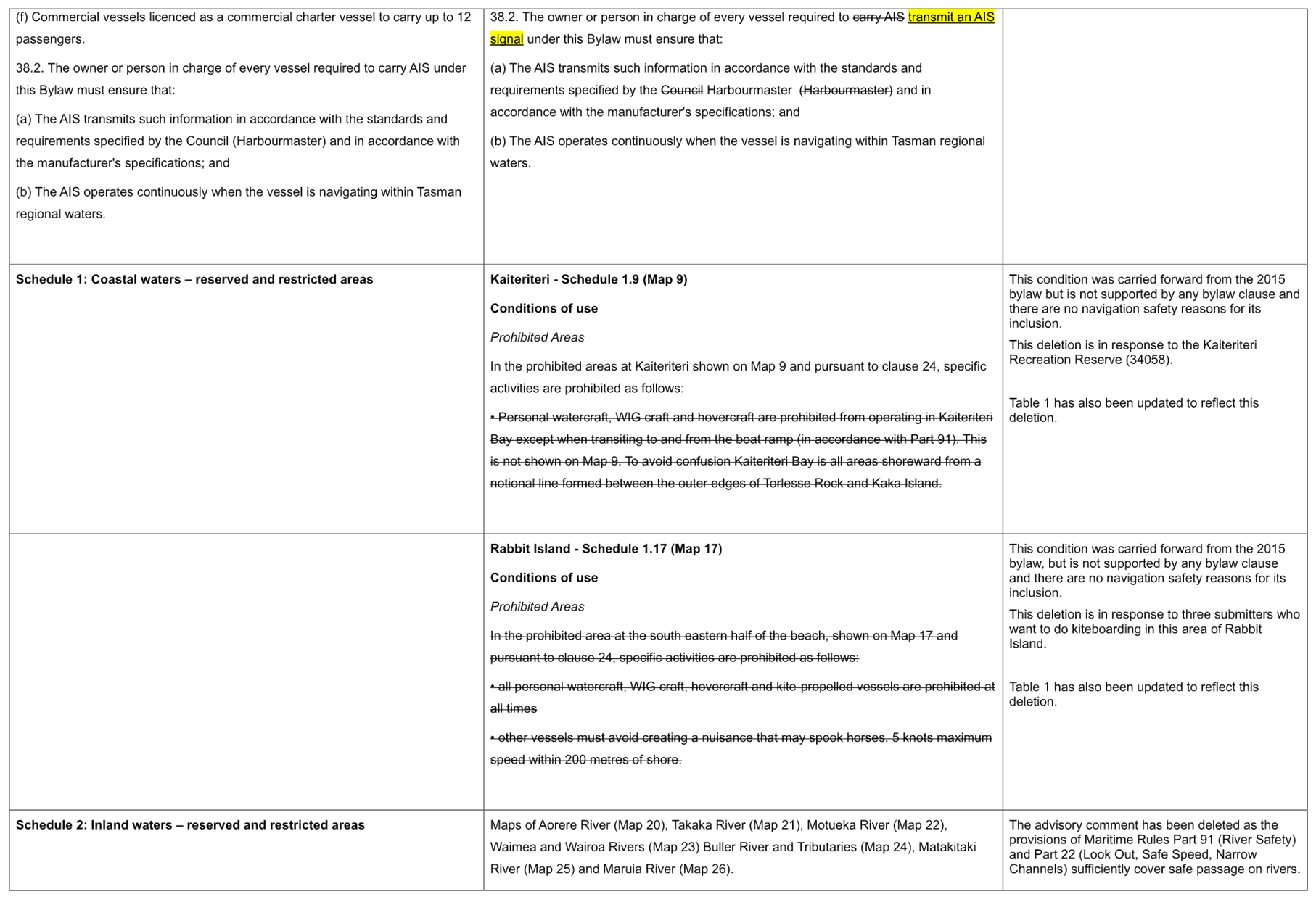
5.8 Clause 38 (Carriage of AIS), and
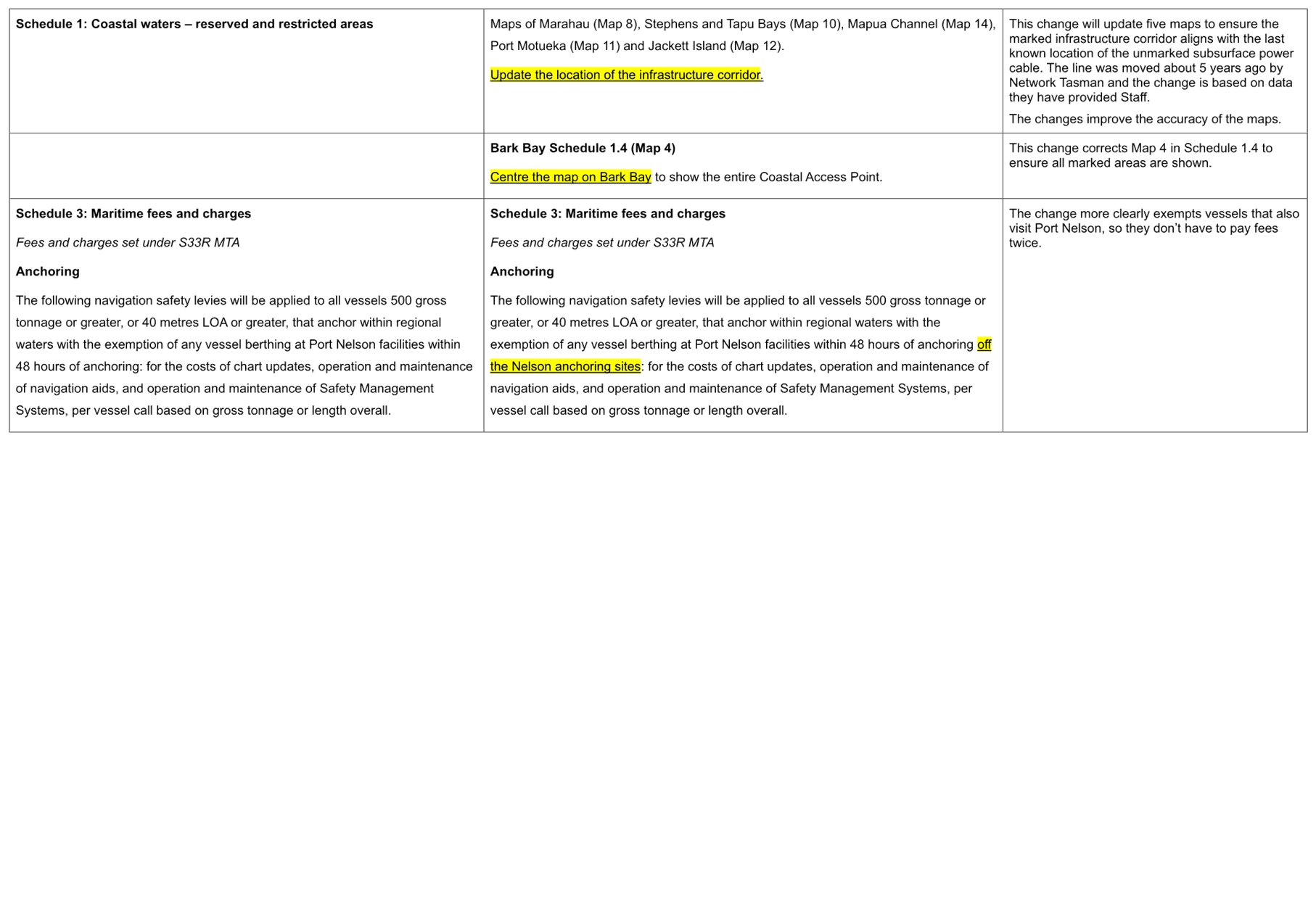
5.9 The proposed changes to Schedules 1 and 2;
6. for the reasons set out in ‘Table 2: Other
changes proposed by staff’ (Attachment 3 to the agenda report) agrees to
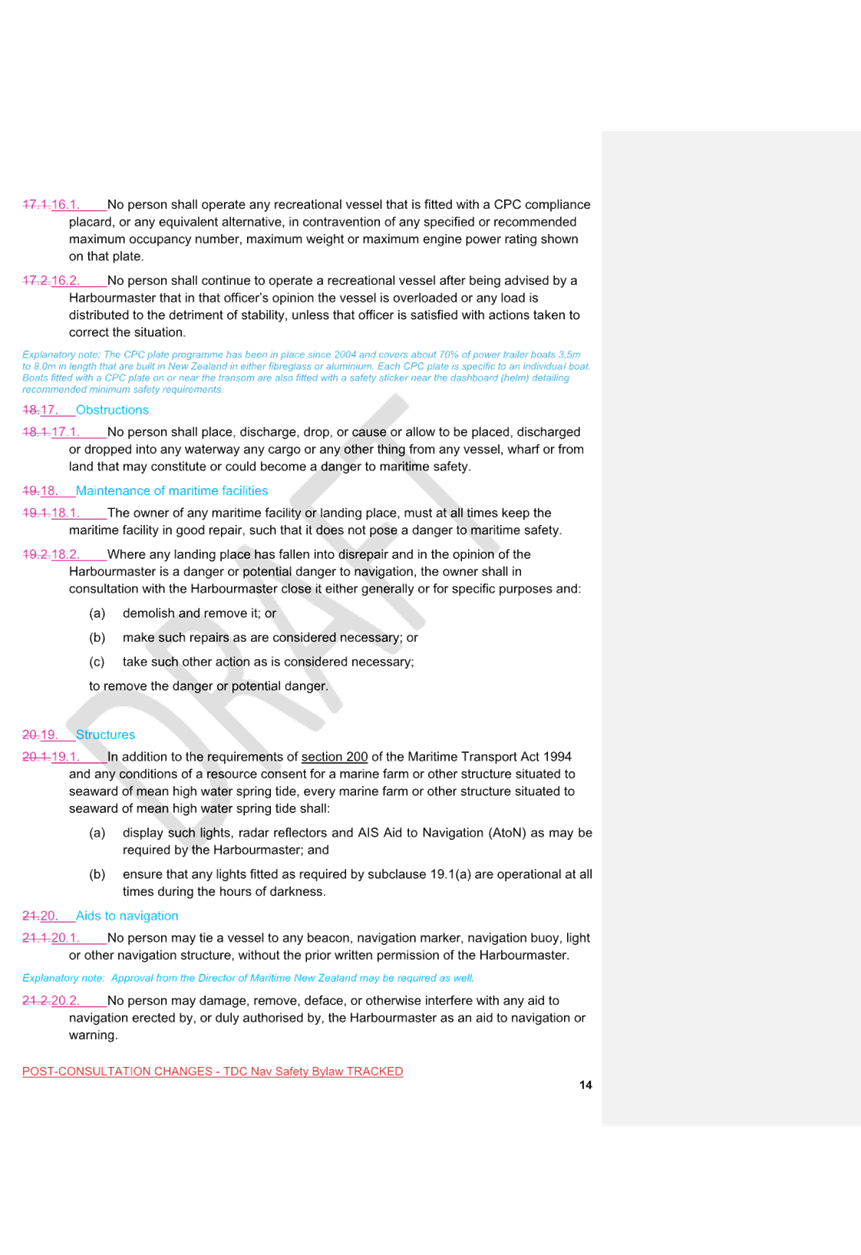
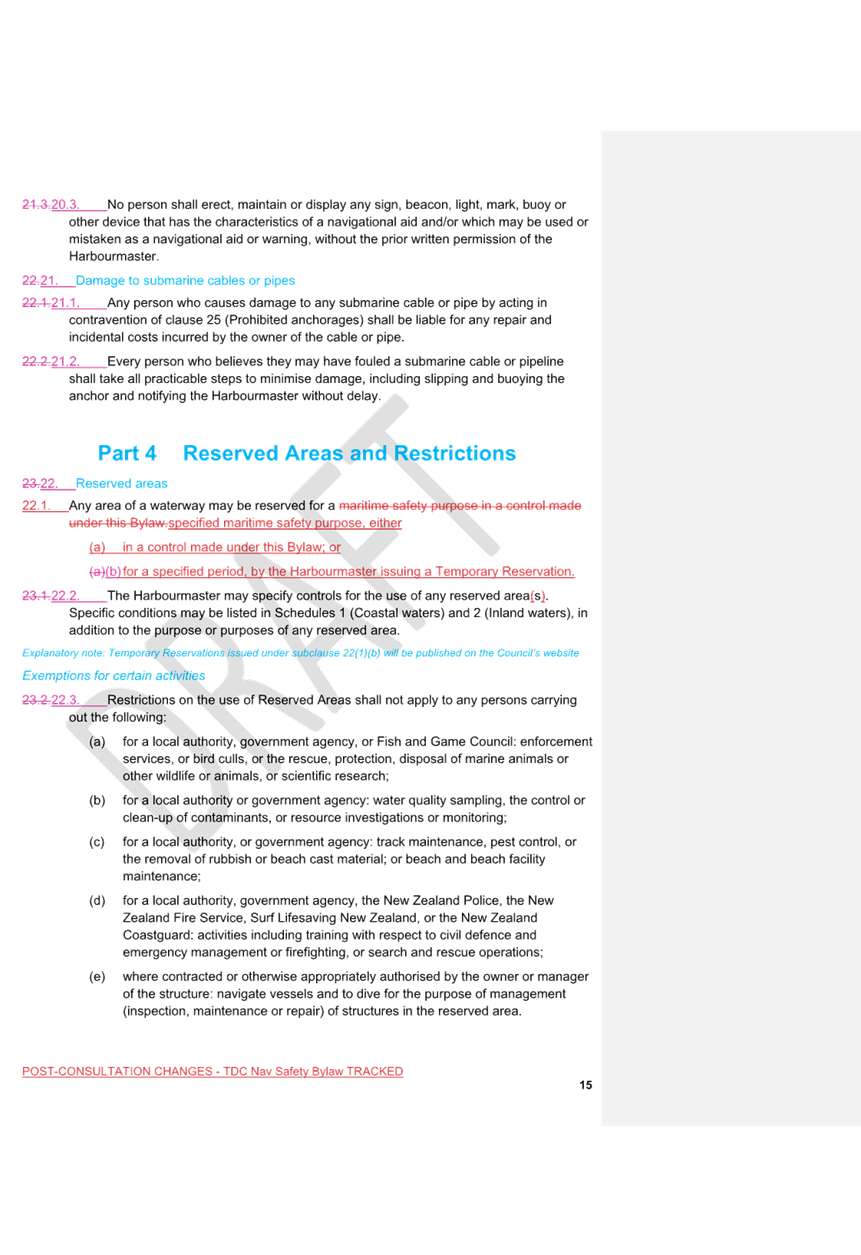
staff amending wording in the following clauses:
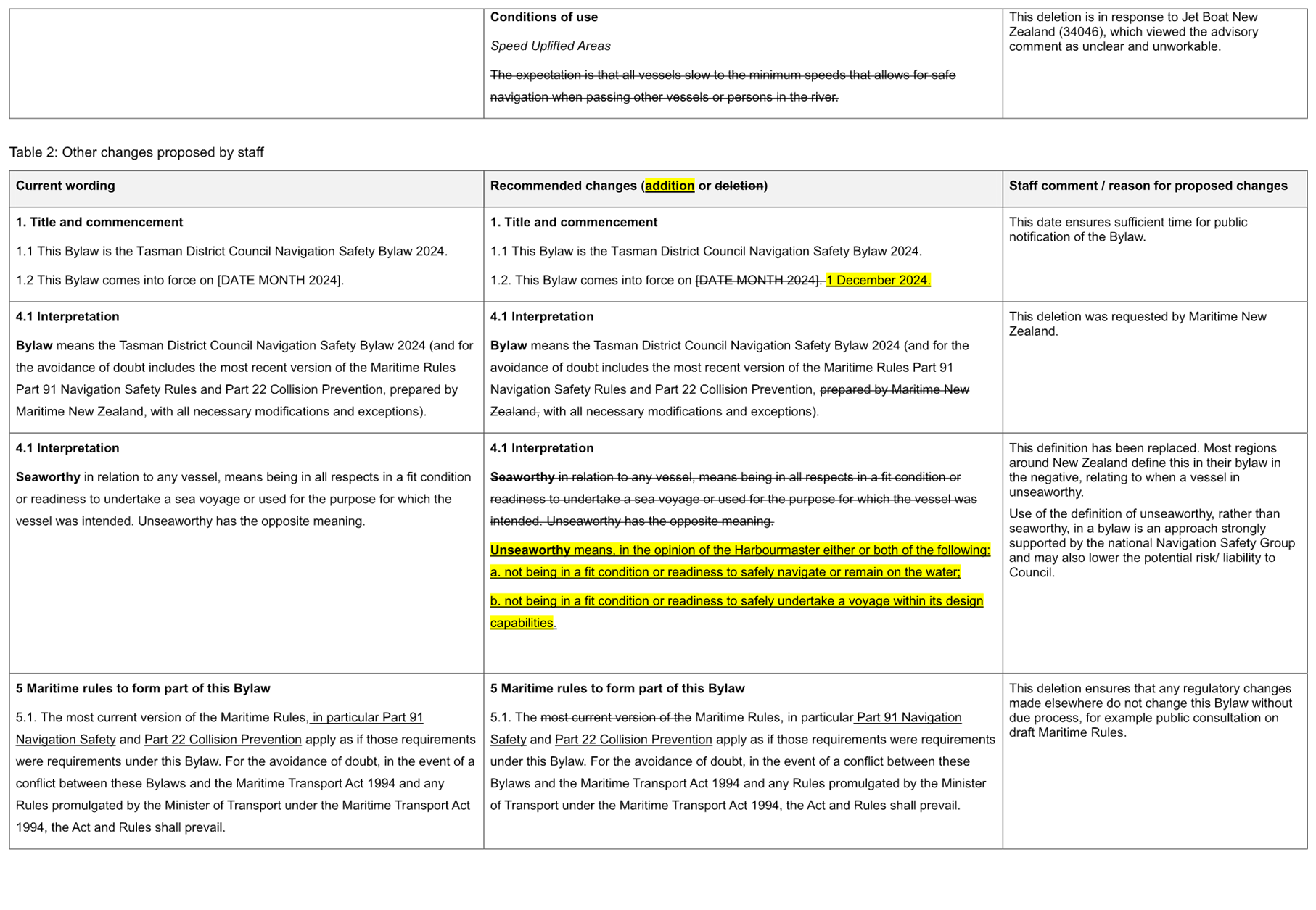
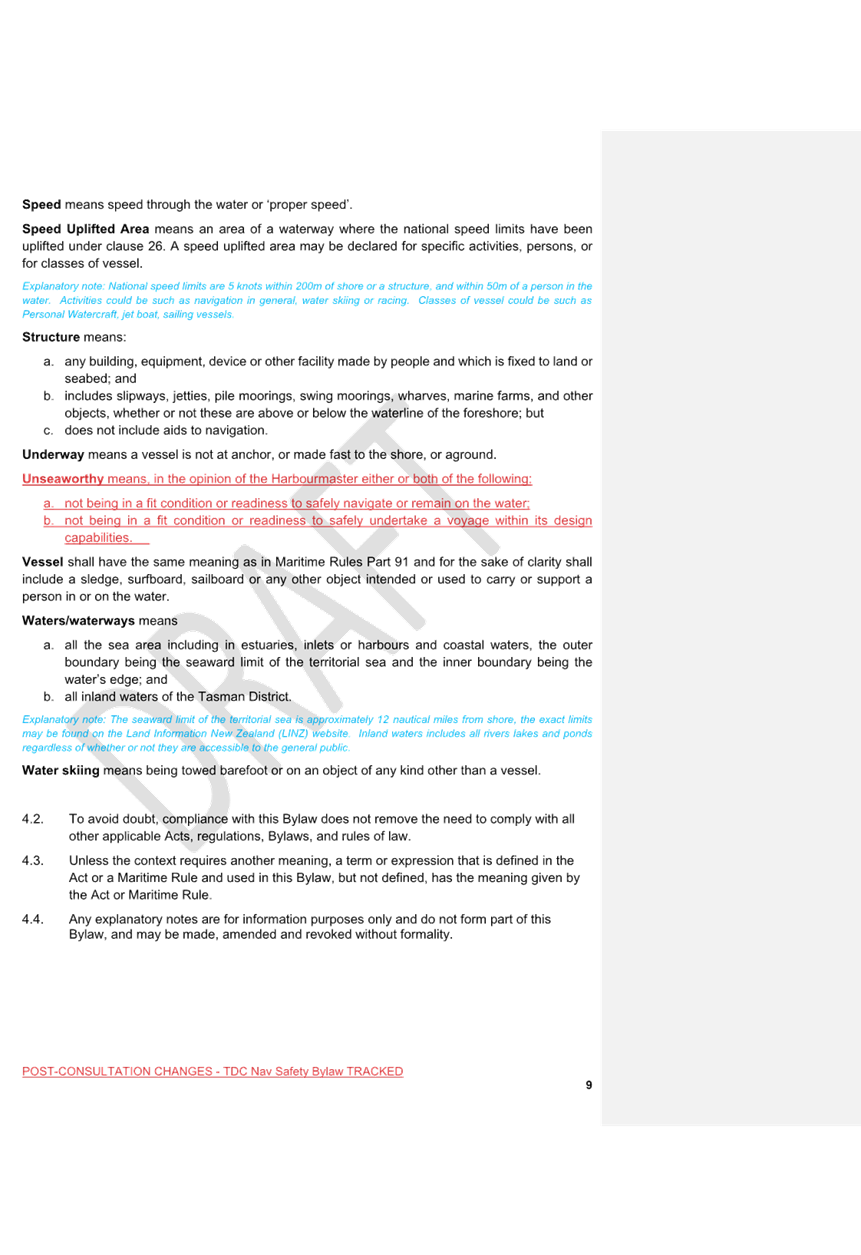
6.10 Clause 1 (Title and commencement),
6.11 Clause 4.1 (Interpretation),
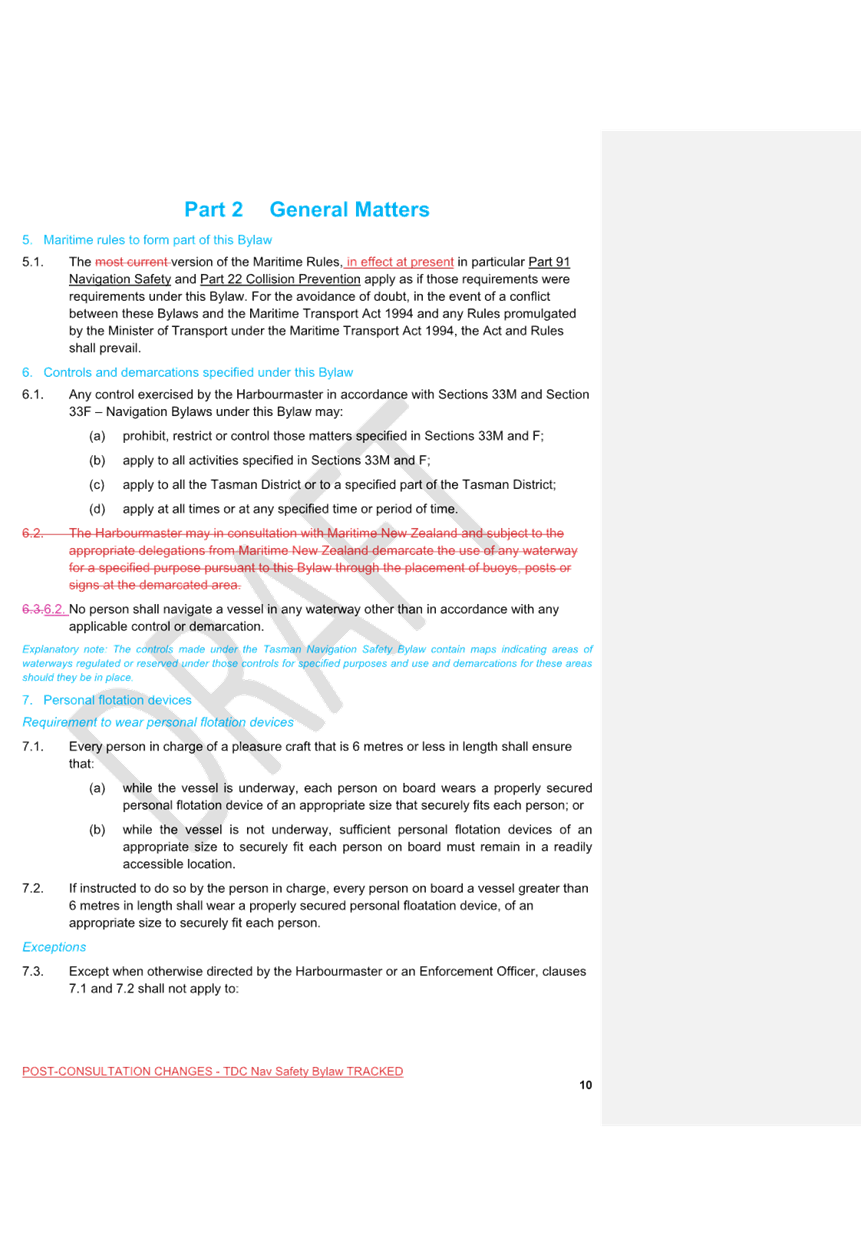
6.12 Clause 5 (Maritime rules to form part of this Bylaw),
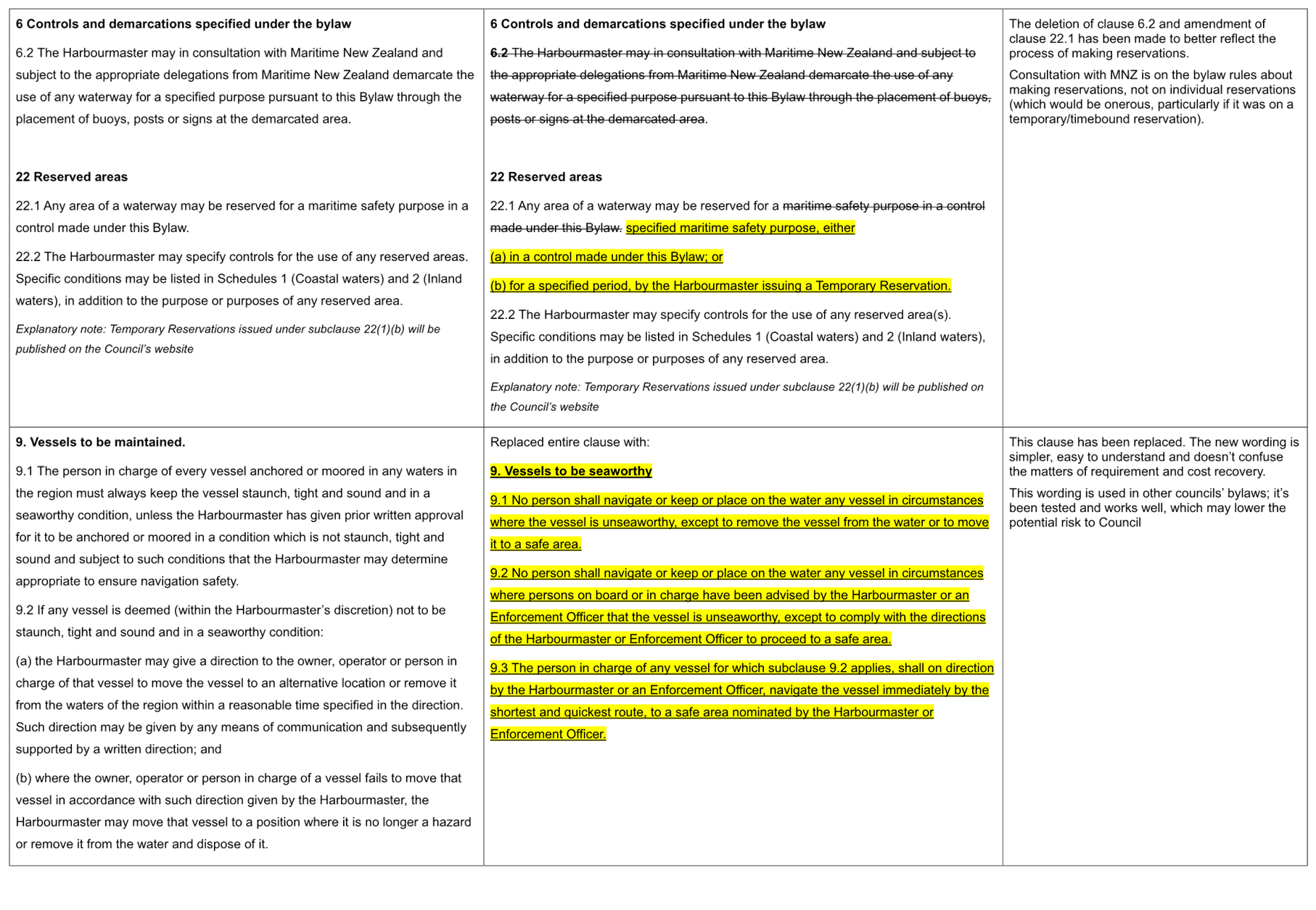
6.13 Clause 6 (Controls and demarcations specified under
the bylaw),
6.14 Clause 9 (Vessels to be maintained),
6.15 Clause 22 (Reserved areas),
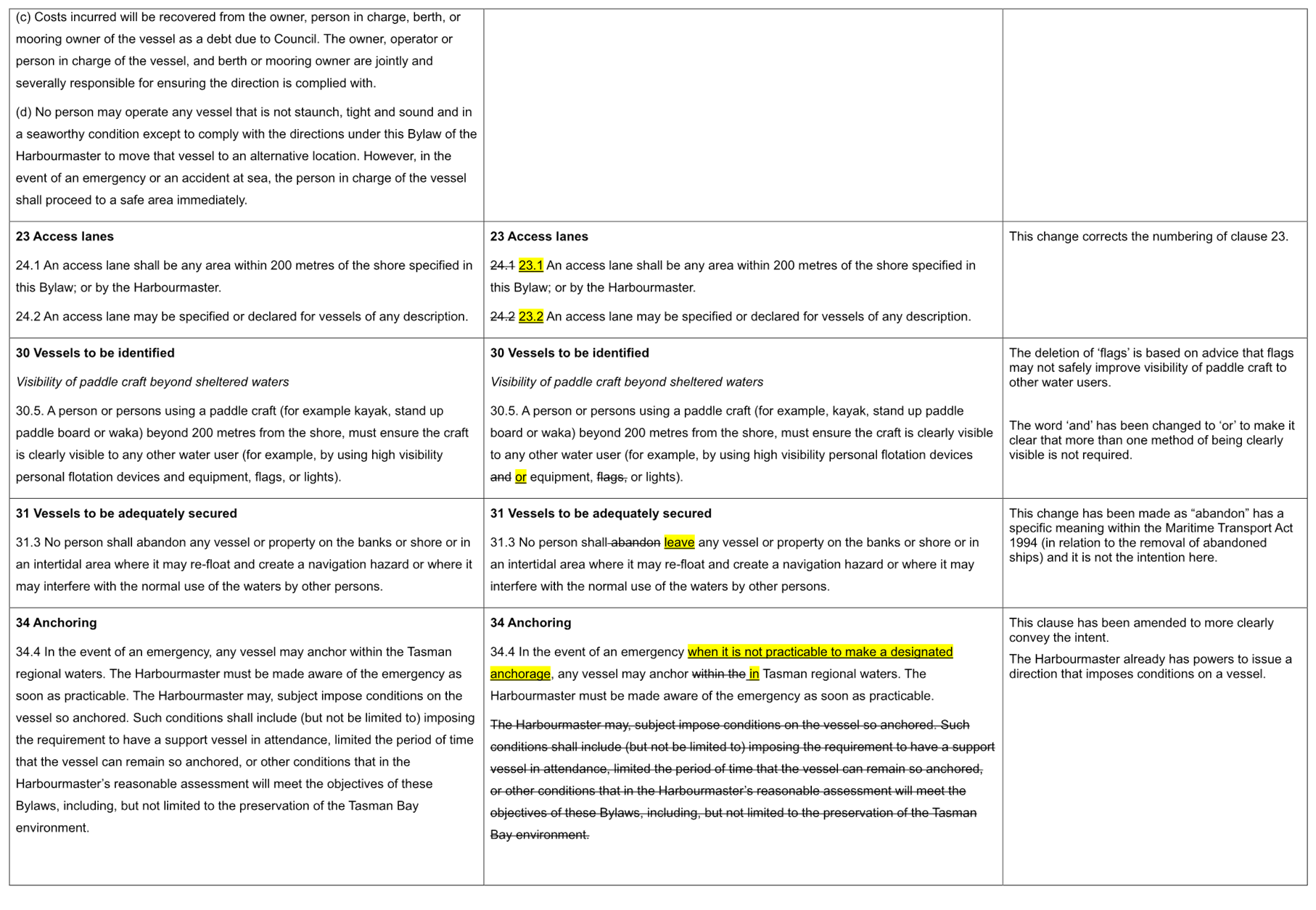
6.16 Clause 23 (Access lanes),
6.17 Clause 30 (Vessels to be identified),
6.18 Clause 31 (Vessels to be adequately secured),
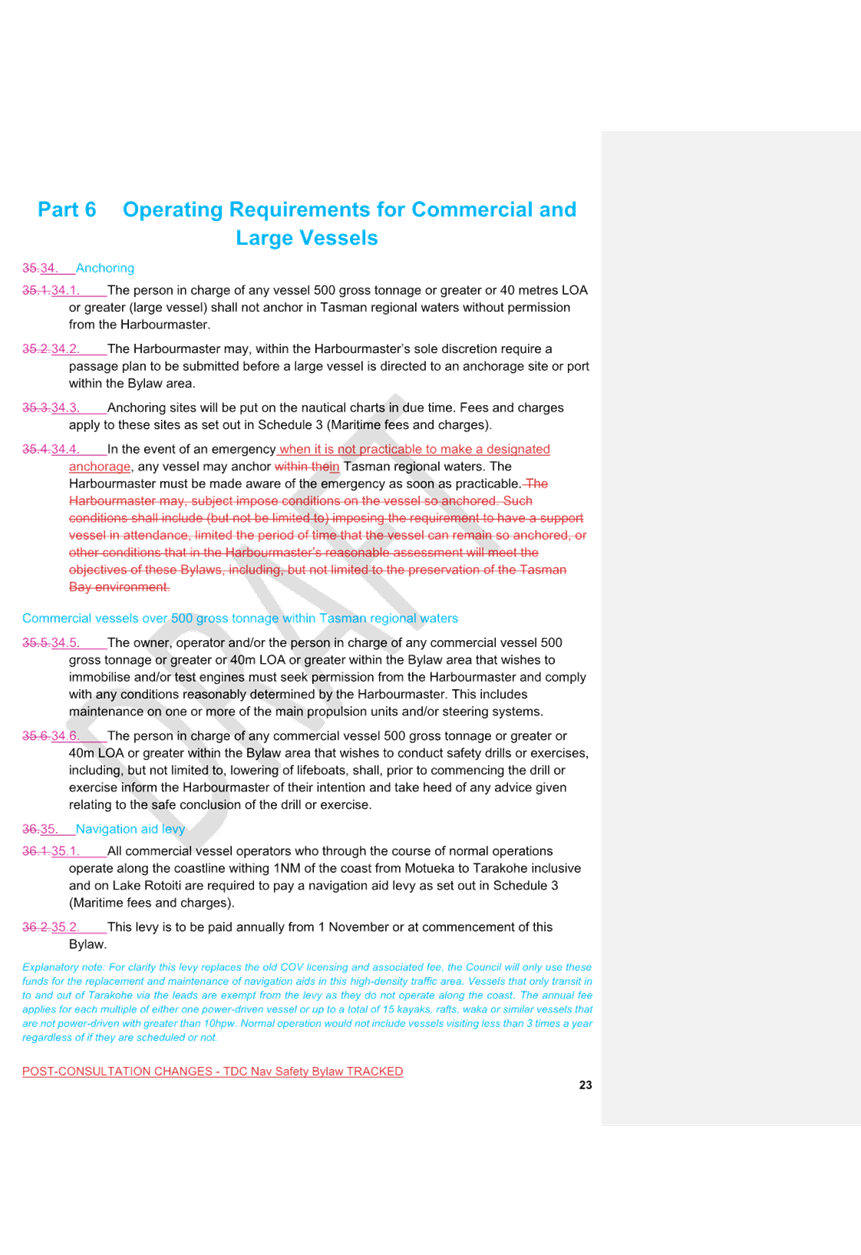
6.19 Clause 34 (Anchoring),
6.20 Clause 40 (Commercial vessel and hire operations),
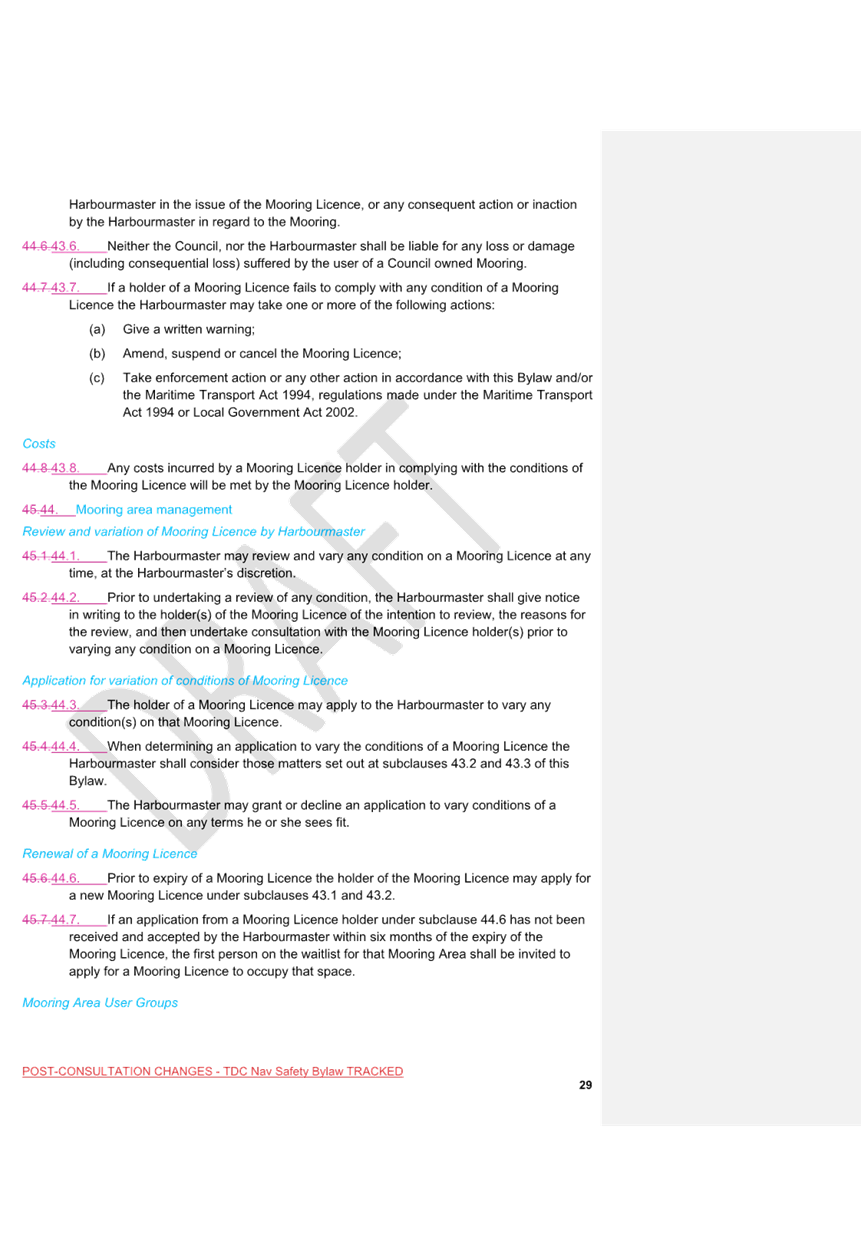
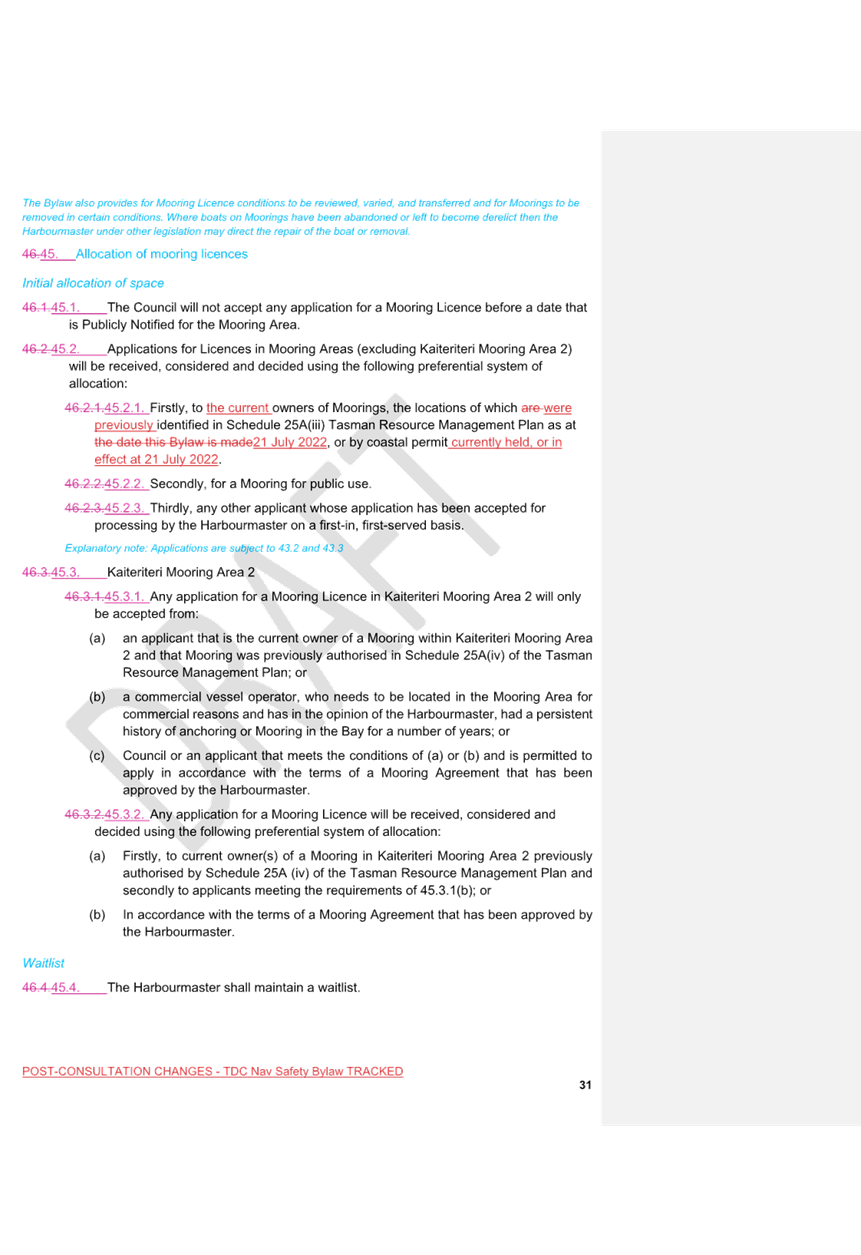
6.21 Clause 45 (Allocation of mooring licences),
6.22 Clause 58 (Fees and charges), and
6.23 The proposed changes to Schedules 1 and 3.
7. delegates authority to the Submissions Hearing and
Deliberation Panel Chair and the Chief Executive Officer to approve any minor
changes or minor editorial amendments to the proposed Navigation Safety Bylaw
2024, prior to being submitted to Tasman District Council; and
recommendation to Tasman
District Council
That the Tasman District Council:
1. notes that the Council has consulted with
the Director of Maritime New Zealand as required by section 33M of the Maritime
Transport Act 1994; and
2. in accordance with section 155 of the Local Government Act 2002:
2.1 agrees that the proposed Navigation Safety Bylaw 2024 is the most
appropriate form of bylaw for navigation safety matters; and
2.2 notes that the proposed Navigation Safety Bylaw 2024 does not give
rise to any implications under the New Zealand Bill of Rights Act 1990; and
3. pursuant to section 145 of the Local Government Act
2022 and section 33M of the Maritime Transport Act 1994, makes the Navigation
Safety Bylaw 2024 (Attachment 1 to the agenda report) that comes into force on
1 December 2024; and
4. authorises staff to publicly notify the Navigation
Safety Bylaw 2024; and
5. notes that once the Navigation Safety Bylaw has been
made, the relevant Maritime Transport Regulations will be updated via an Order
in Council with infringement fees for offences under the Bylaw.
4.1 Tasman District Council (“the
Council”) has responsibilities for making our waters a safe and
enjoyable place for everyone and this role extends out to the 12-nautical-mile
territorial sea limit.
4.2 Section 33M of the Maritime Transport Act (MTA)
1994 enables a regional council to make navigation bylaws, in consultation with
the Director of Maritime New Zealand (MNZ), for the purpose of ensuring
maritime safety in its region.
4.3 The Council’s 2015 Navigation
Safety Bylaw was not reviewed within the required timeframe and is revoked.
4.4 Staff consider a new bylaw to be the
most appropriate means of ensuring navigation safety in Tasman and setting out
the rules for people using the lakes, rivers and seas in our district for all
water activities.
4.5 A
navigation safety bylaw will complement the national rules and improve the
Council’s regulatory and enforcement abilities. The bylaw will help the
Council to manage actual and potential water safety issues and mitigate risk
associated with vessels on the water.
The proposed Navigation Safety Bylaw 2024
4.6 The Bylaw will provide the Council with the regulatory authority to
exercise control over specified maritime safety matters. It allows for either
prosecution or infringements in the form of fines for specified non-compliance
offences.
4.7 The Bylaw has a range of provisions due to new developments in
maritime legislation and navigation management thinking; development of new
uses and technologies; opportunities to improve alignment across national
regulations and safety campaigns; and ongoing issues identified by Council
staff and community members.
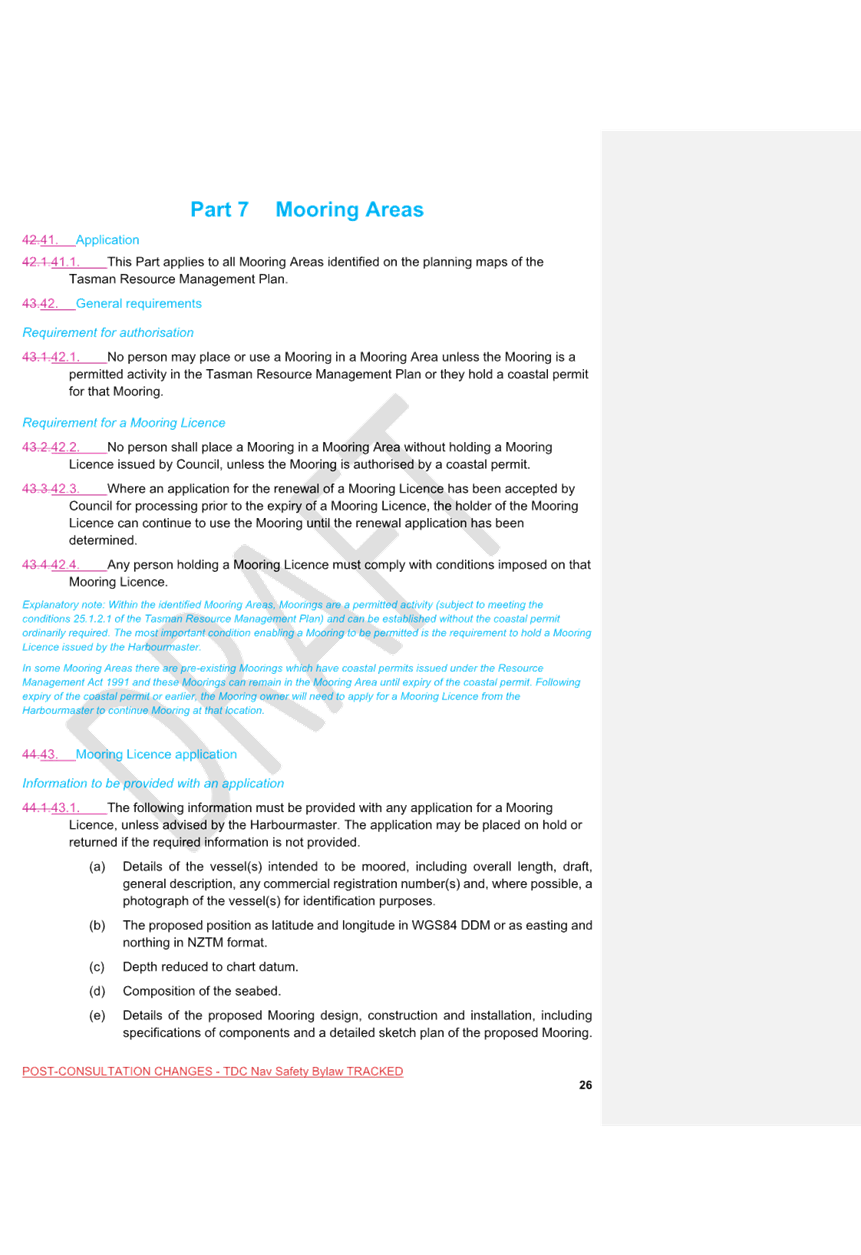
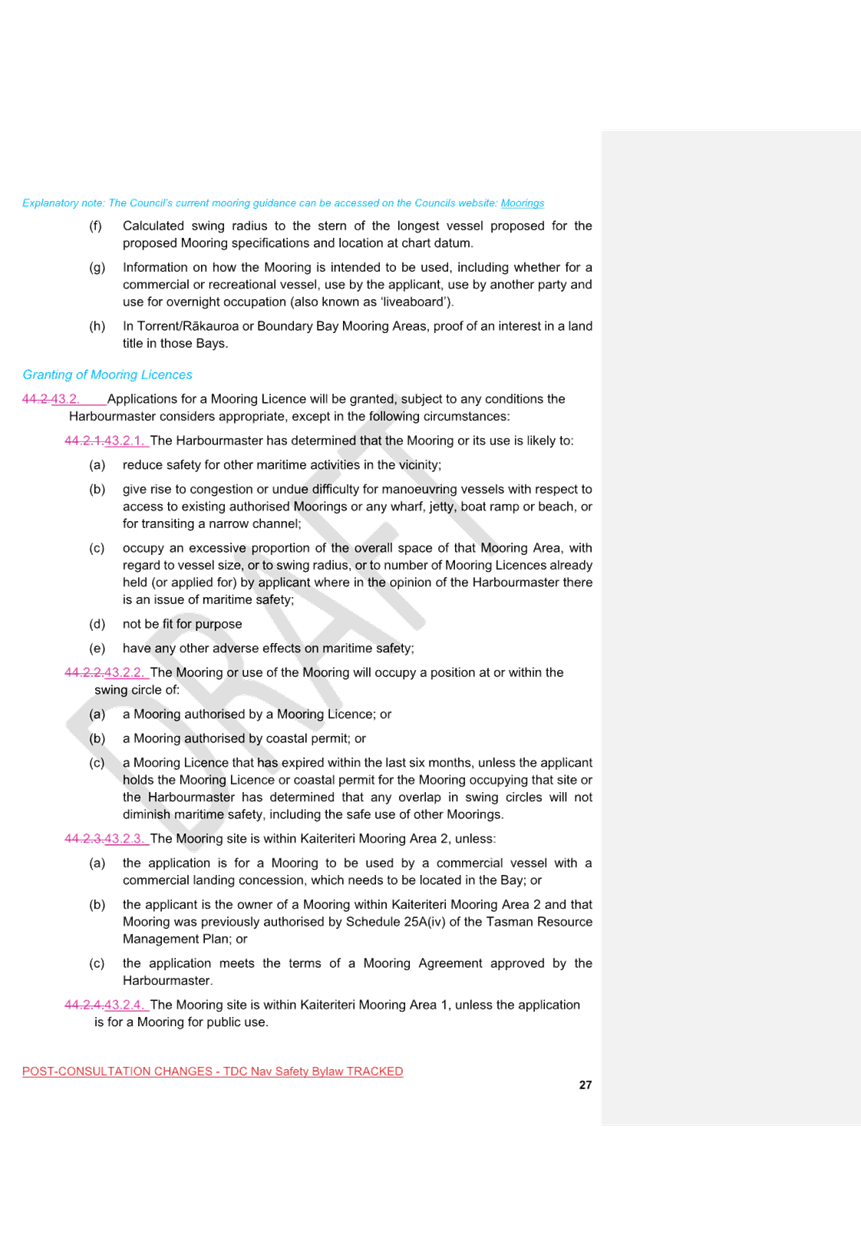
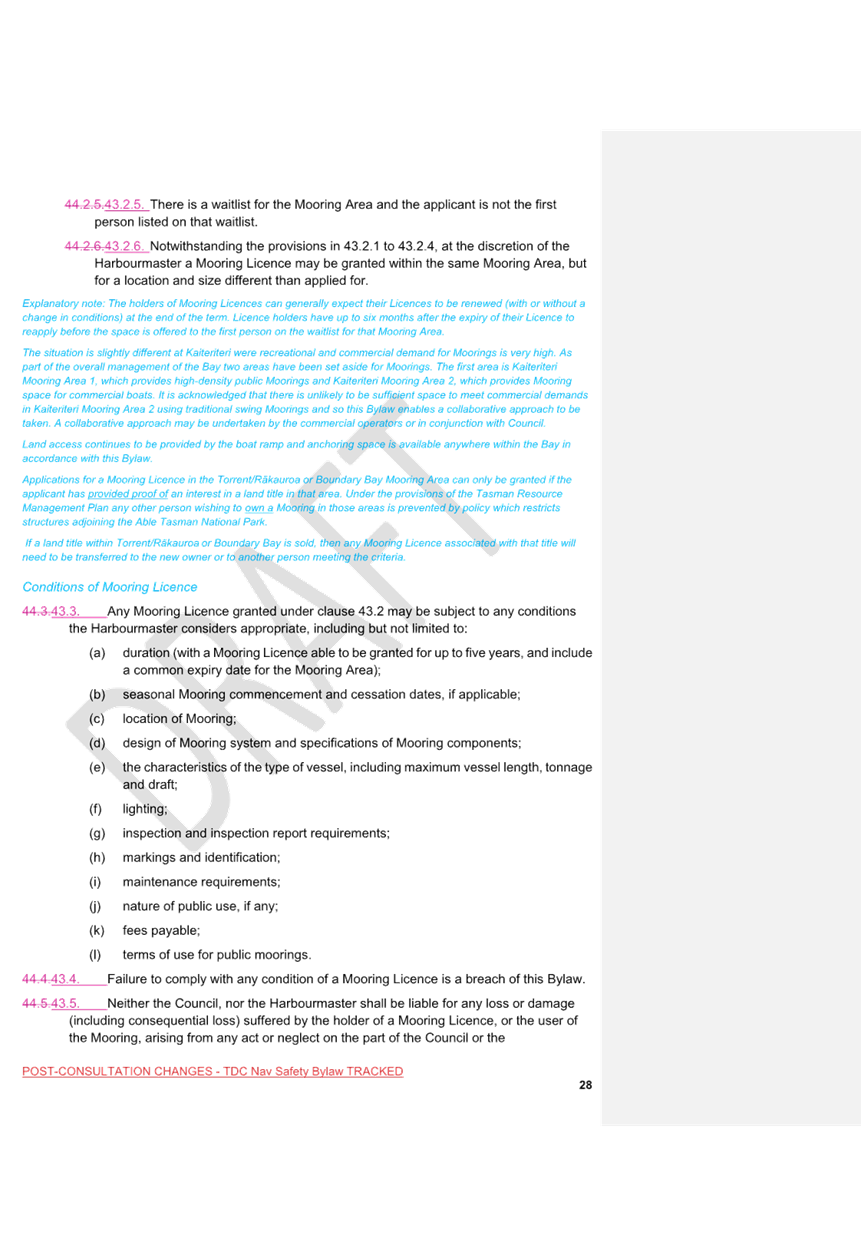
4.8 The Mooring Area Bylaw provisions,
approved by the Council last year but not yet in force, have been included in
the Bylaw as Part 7.
4.9 The Bylaw also has provisions to help address a range of issues
associated with the ongoing safety of the community on the water, including:
· Wearing a lifejacket (personal floatation device).
· Carrying appropriate communication equipment.
· Vessel identification.
· Small watercraft visibility.
· Vessel tracking.
· Anchoring and mooring.
· Hot work notification.
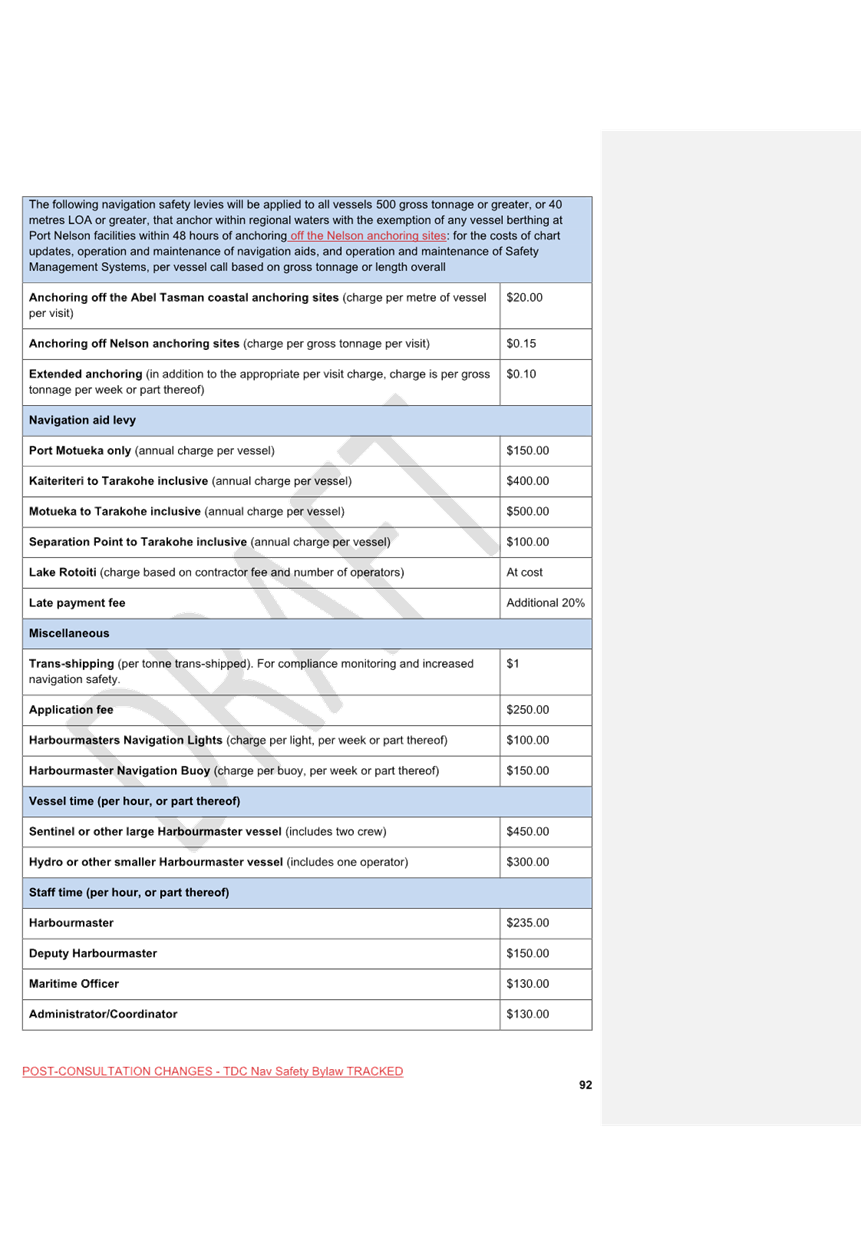
· A navigation aid levy for commercial vessels operating along the
coastline, to be used for the replacement and maintenance of the seasonal
floats.
4.10 Nelson
City Council and Marlborough District Council will shortly be reviewing their
navigation safety bylaws and staff have worked collaboratively with their
respective Harbourmasters on a range of provisions in the Bylaw, particularly
the rules for recreational water users, to aim for consistency across all three
councils.
Maritime NZ
4.11 Section 33M (1) of the MTA 1994 states
that a navigation bylaw must be made in consultation with the Director of MNZ.
4.12 Staff
have worked closely with MNZ throughout the process. The Bylaw has been
reviewed by the bylaw team at MNZ and feedback was received from the Director
of MNZ before the consultation period.
4.13 MNZ
provided further feedback on whether the matters they raised had been addressed
by the changes made for consultation, as set out in Bylaw attached to the
Statement of Proposal. Staff have proposed some further changes to the Bylaw in
response to this feedback, (as set out in Attachment 3) and consider the
outstanding matters to be:
· Incorrectly referring to the bylaw and control making powers
conferred on the Harbourmaster, rather than the regional council.
Staff advise that
referring to the Harbourmaster, rather than the Council, in relation to the
making and alteration of controls (a collective term for reservations, access
lanes and uplifts) and temporary reservations, exemptions etc is deliberate and
intends to make operational use of the delegation (under the LGA) very
transparent.
· A general exemption power for personal flotation devices (PFDs)
rather than limited to specified period, and a broad power for the regional
council to issue an exemption from any of the Bylaw’s requirements.
Staff advise that
the actual use of clause 7.3 regarding PFDs, should be limited to situations
(such as adverse conditions) where a prudent person would not make use of the
exception granted to them and so the Harbourmaster can step in and require a
person normally exempt from wearing a PFD to use one. Clause 50 regarding
exemptions is just a more transparent method of the Council using its LGA
delegation powers and it is implicit that this clause granting powers of
exemptions is limited against doing so for a maritime rule.
· AIS provisions – adding further equipment requirements for
commercial shipping that are not supported in relevant maritime rules, creating
an undesirable precedent and creating additional compliance costs for
commercial operators to comply with.
Staff advise that
the AIS provisions of the Bylaw are necessary given the nature and extent of
commercial passenger carrying activity in the Tasman district. This has been
extensively discussed with MNZ and they appreciate our reasons for the clauses,
but remain of the view that it is problematic.
5. Analysis
and Advice / Tātaritanga me ngā tohutohu
Consultation
5.1 The Council agreed to undertake consultation
on the Bylaw between 1 August and 1 September 2024 at
its meeting on 1 August 2024 (RCN24-08-8), using the
Special Consultative Procedure (SCP) in accordance with sections 83 and 87 of
the Local Government Act 2002.
5.2 A public
communication and consultation process has been carried out, including:
· The Shape Tasman project page with the Statement of Proposal
(including the draft bylaw), a summary of information, background information
and a link to the submission portal was promoted throughout the consultation
· A Newsline article informing the public about how to make a
submission was published on 9 August 2024 and an introductory article was
published before consultation began (12 July 2024)
· The Harbourmaster met with some local interest groups during the
consultation period to present the draft Bylaw and invited them to make a
submission, either as an organisation or individuals.
· Hard copies of the Statement of Proposal and a summary of
information was made available at all Council service centres and public
libraries in Tasman throughout the consultation period.
5.3 The Council received
256 submissions and these are now publicly available on the Council’s website. 32
submitters indicated that they wish to be heard. Hearings and deliberations are scheduled for today’s meeting.
Submission hearing and deliberation purpose
5.4 The Council appointed
a hearing panel for the Bylaw at its meeting on 1 August 2024 (RCN24-08-8). The appointed Hearing Panel
Chair is Councillor, Kit Maling.
5.5 The purpose of the Panel is to:
· consider the views of the submitters (from this hearing and from the
written submissions);
· deliberate and decide on any changes to be made to the Bylaw; and
· decide whether to recommend to the Council that the Bylaw is
adopted.
The hearing
process
5.6 As part of the consultation process on the
Bylaw, submitters have the option of presenting their views to the Council
verbally.
5.7 32 submitters indicated that they wished to be
heard at today’s hearing.
5.8 Staff have organised for these submitters to present their views to the Panel at today's meeting.
Staff have contacted all submitters that wish to be heard and have booked a
time for each submitter to speak. Confirmation has not been received from all
submitters, so it is likely that some submitters may not show up to present.
5.9 The
schedule of this hearing is provided in Attachment 1. A copy of the
submissions made by each speaker can be accessed via LG Hub.
5.10 Each
submitter has been allowed a maximum of five minutes to speak to their
submission. This time includes any points of clarification from the Panel.
Submitters will be present either in person or on Zoom.
5.11 Ian Fox, an external technical specialist, is also
attending today’s meeting via Zoom and is available to answer any
questions from the Panel. Ian is an experienced Harbourmaster and is currently
the Canterbury Regional Harbourmaster. He is a qualified Master Mariner and a
member of the national Navigation Safety Group’s Bylaws and Rules Working
Group. Ian has been assisting staff with submission analysis and forming
recommendations.
6.1 There were 235 submissions received by the closing date, 1
September 2024. A further 21 submissions were received by 3 September 2024.
6.2 The
main theme of public feedback was that submitters generally support the bylaw,
particularly the requirements regarding personal floatation devices, vessel
identification and communication equipment. The other key themes we heard were:
· Strong opposition to clause 12.1 that unintentionally banned
swimming or diving around landing places.
· Support for AIS tracking, but some commercial operators raised
concerns.
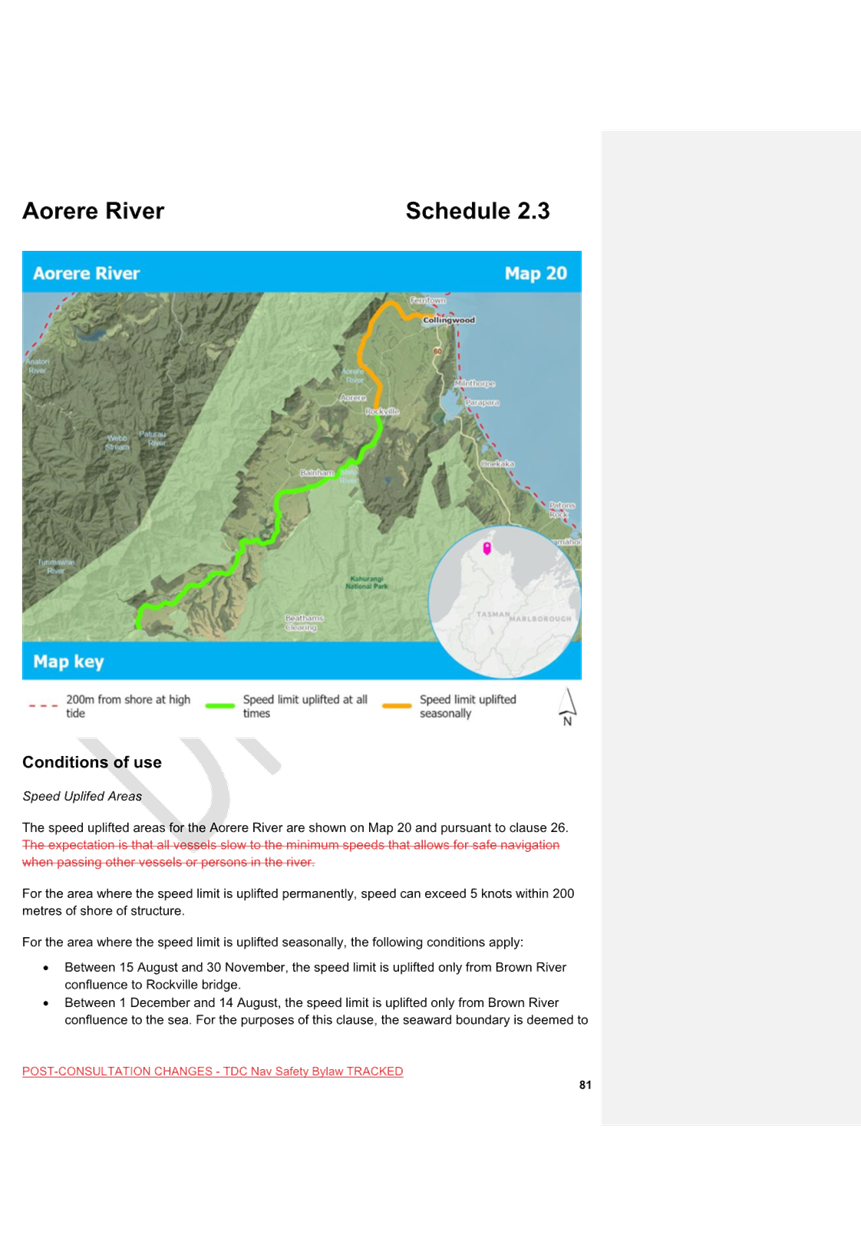
· Strong support for the river speed upliftings provisions, but a
request to remove cumec ratings and an advisory clause.
· Mixed views on the proposed navigation aid levy
6.3 Staff
have prepared an overview of submissions, grouped by theme, to assist the
Panel’s deliberations (see Attachment 2). Staff propose a range of
changes to the Bylaw, largely based on feedback from the submitters. These
changes are set out in Attachment 3 with rationale for the changes, and
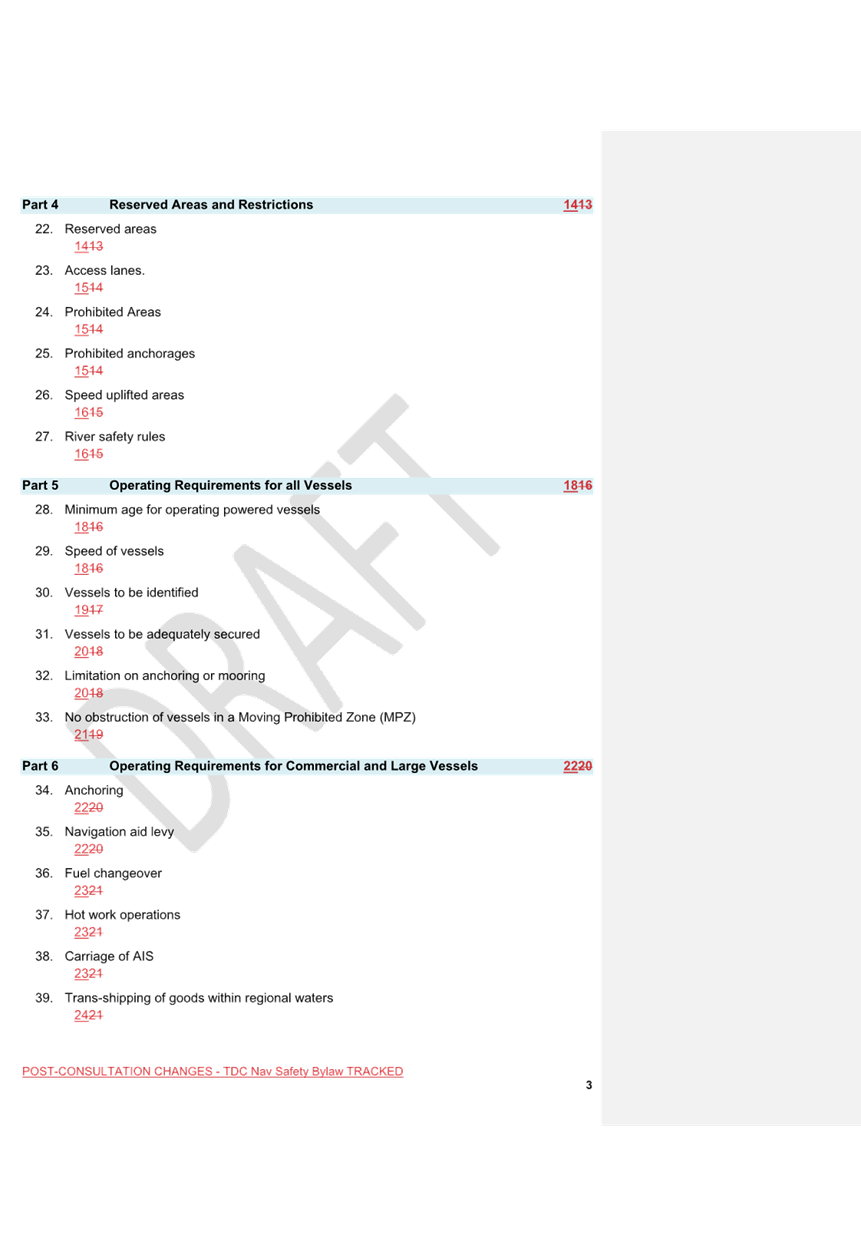
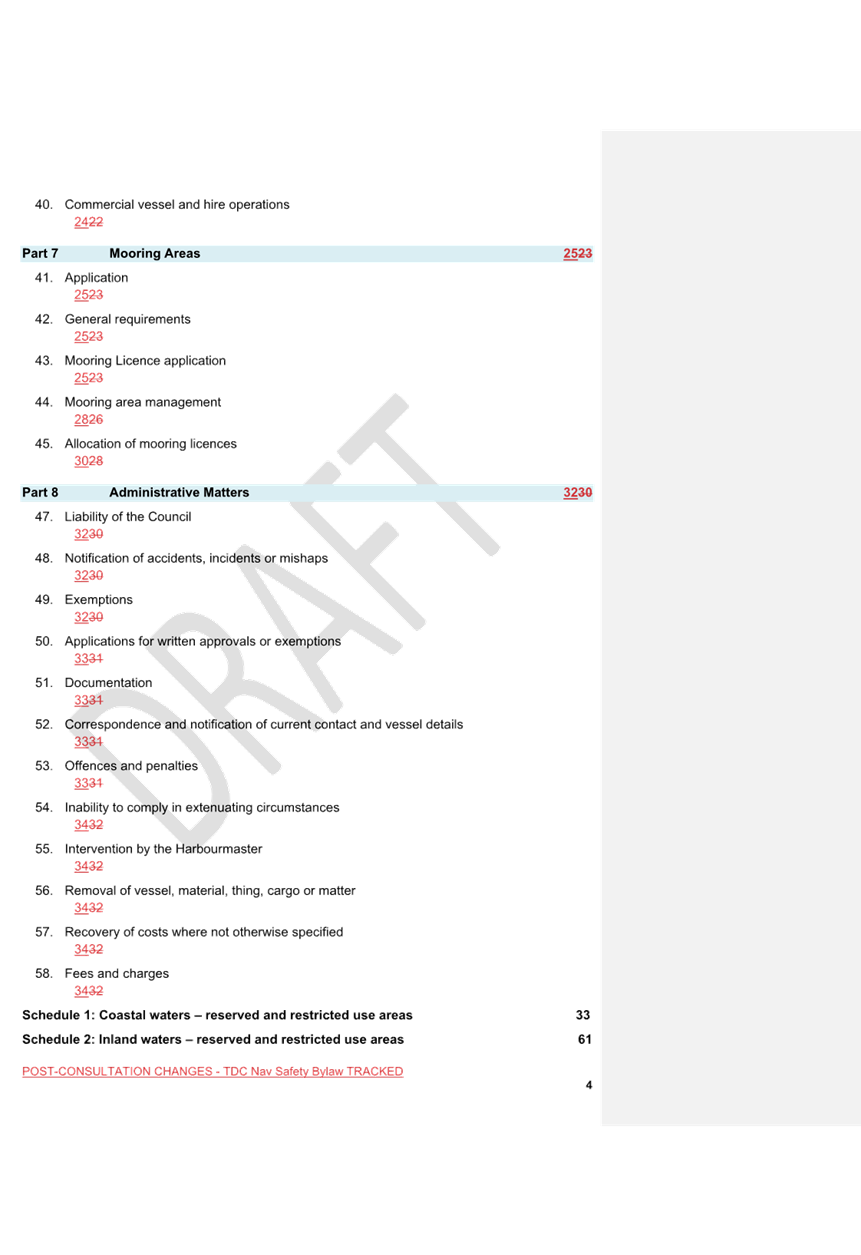
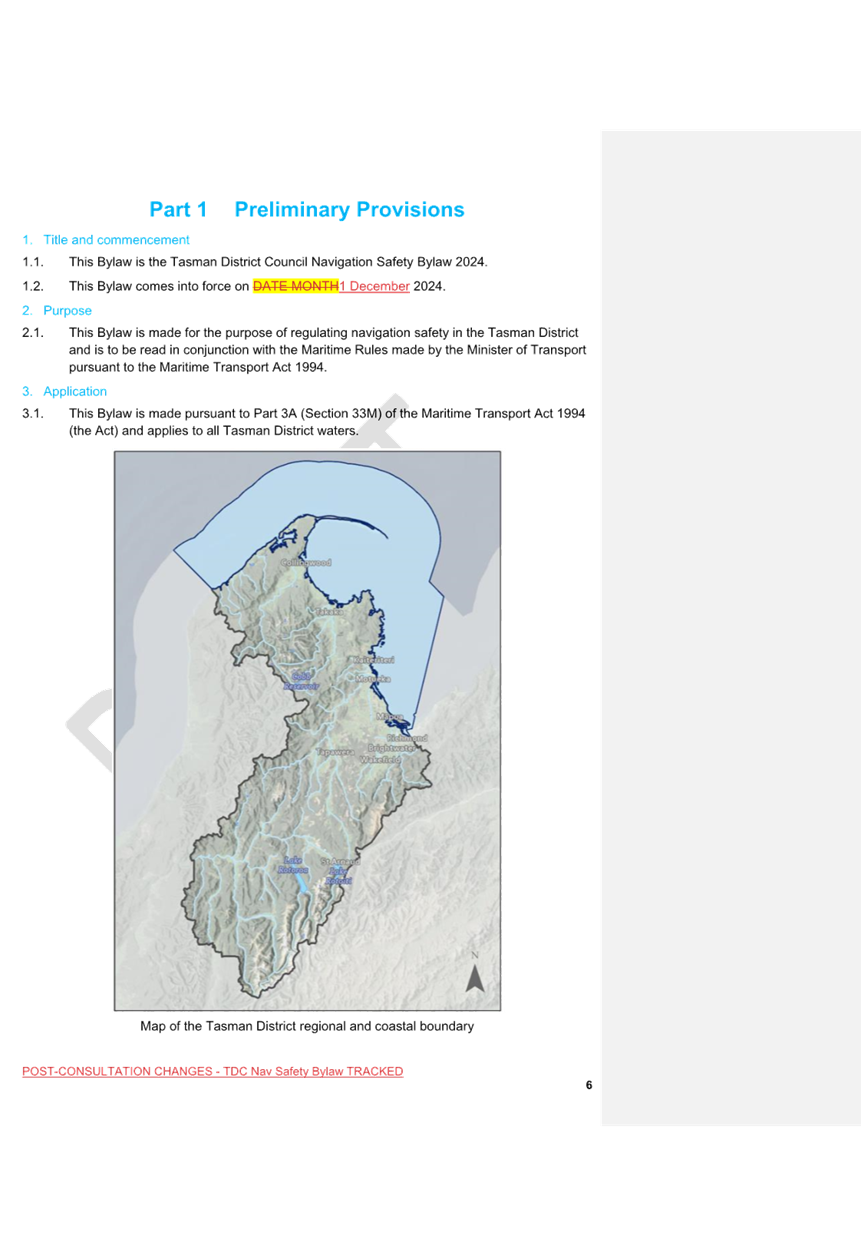
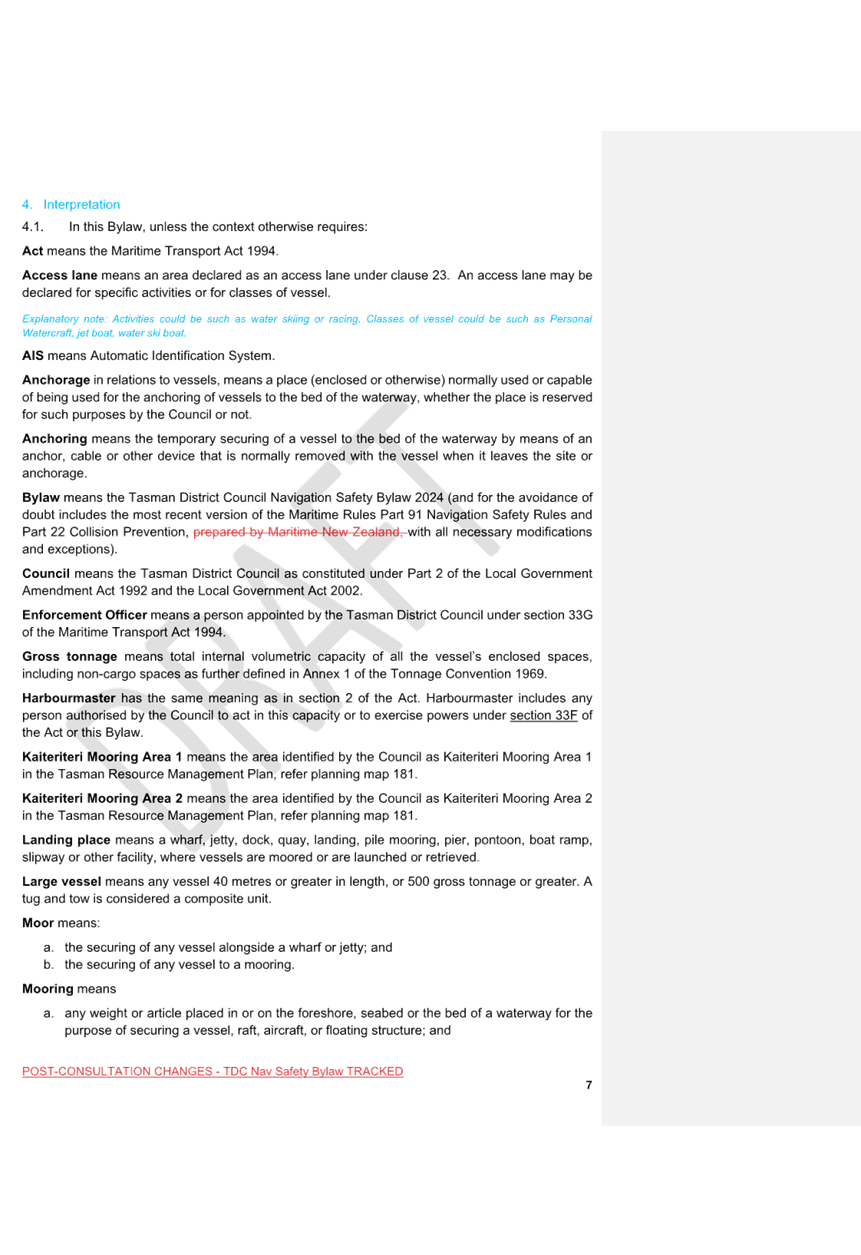
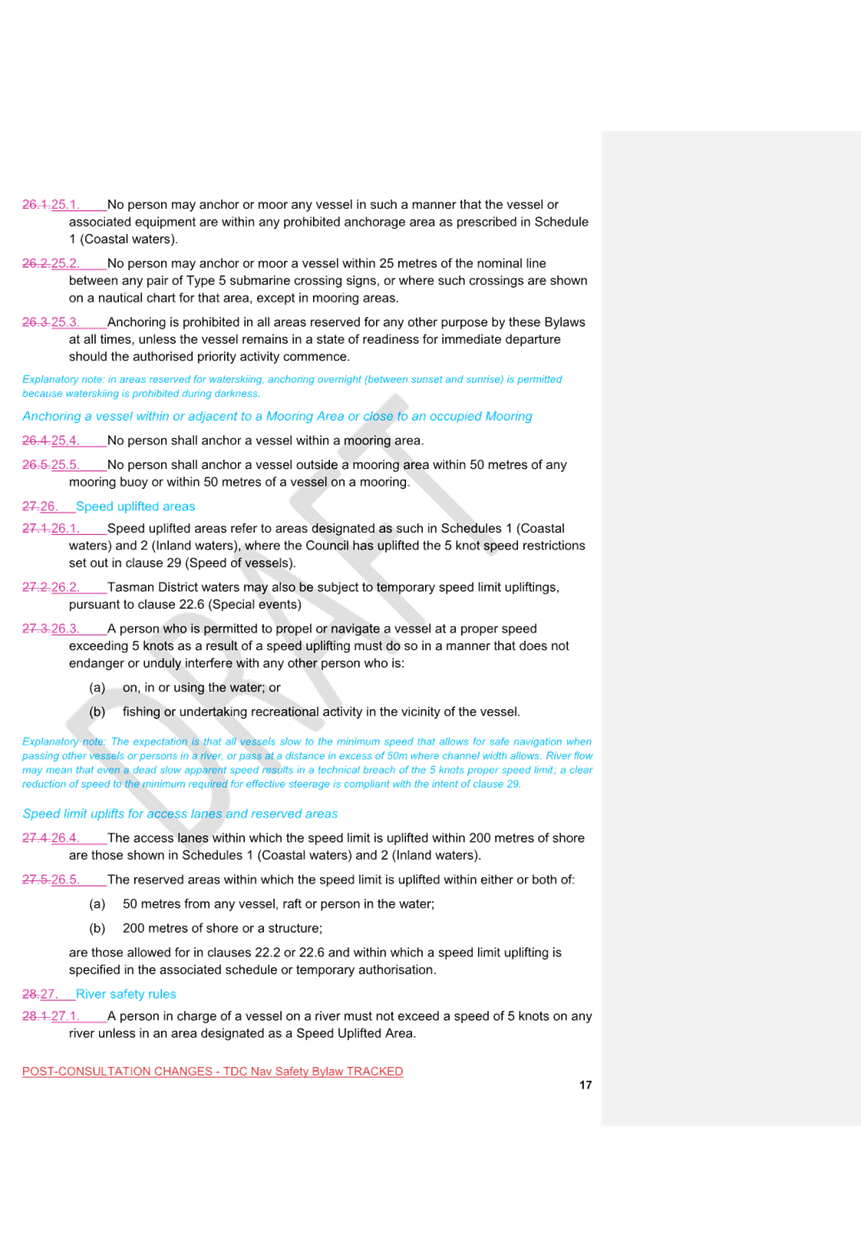
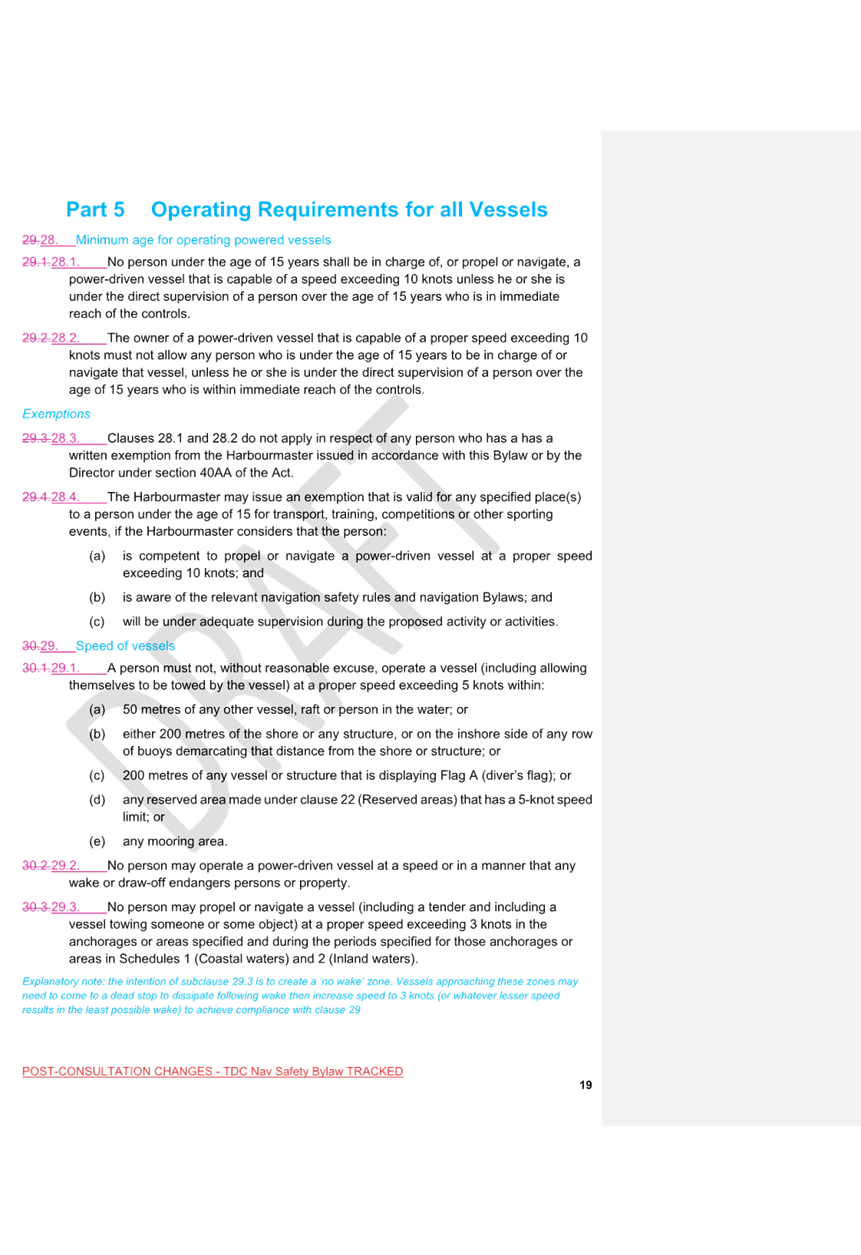
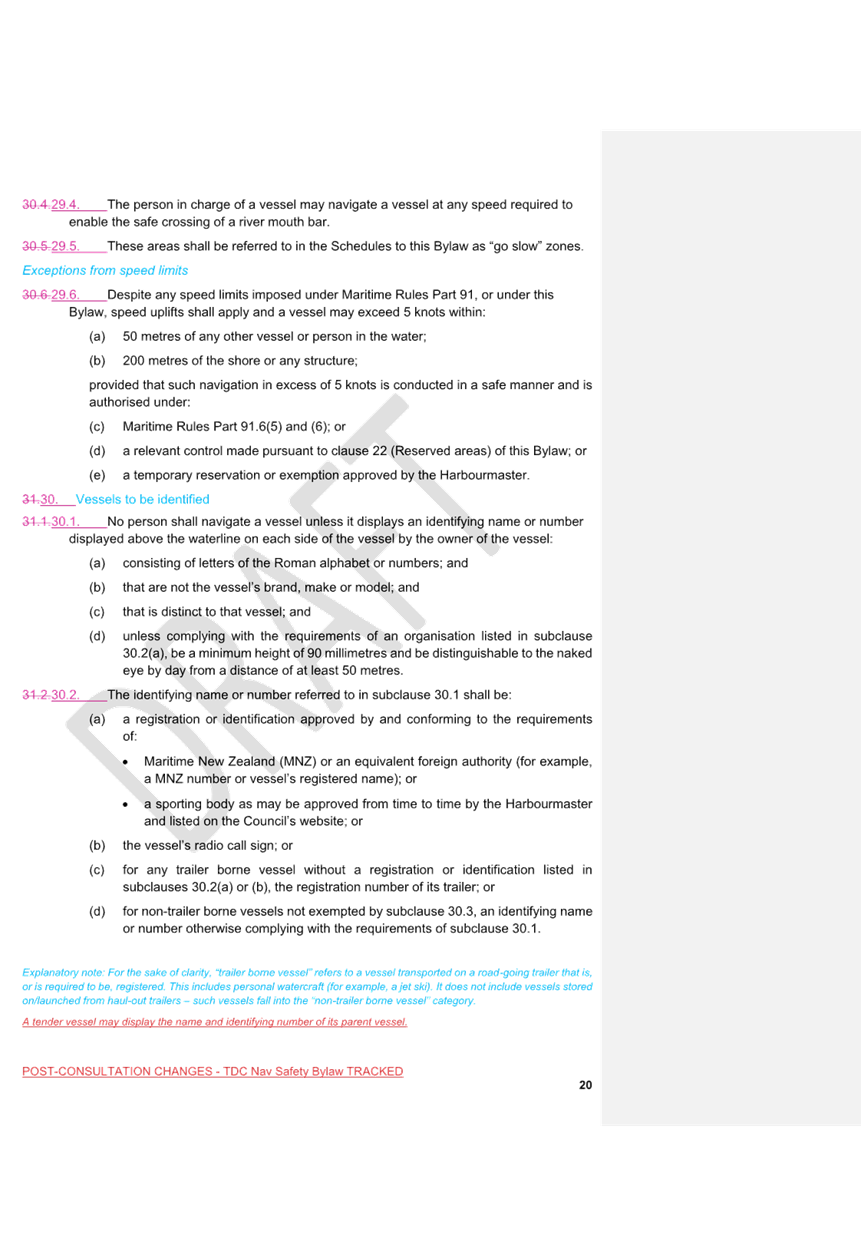
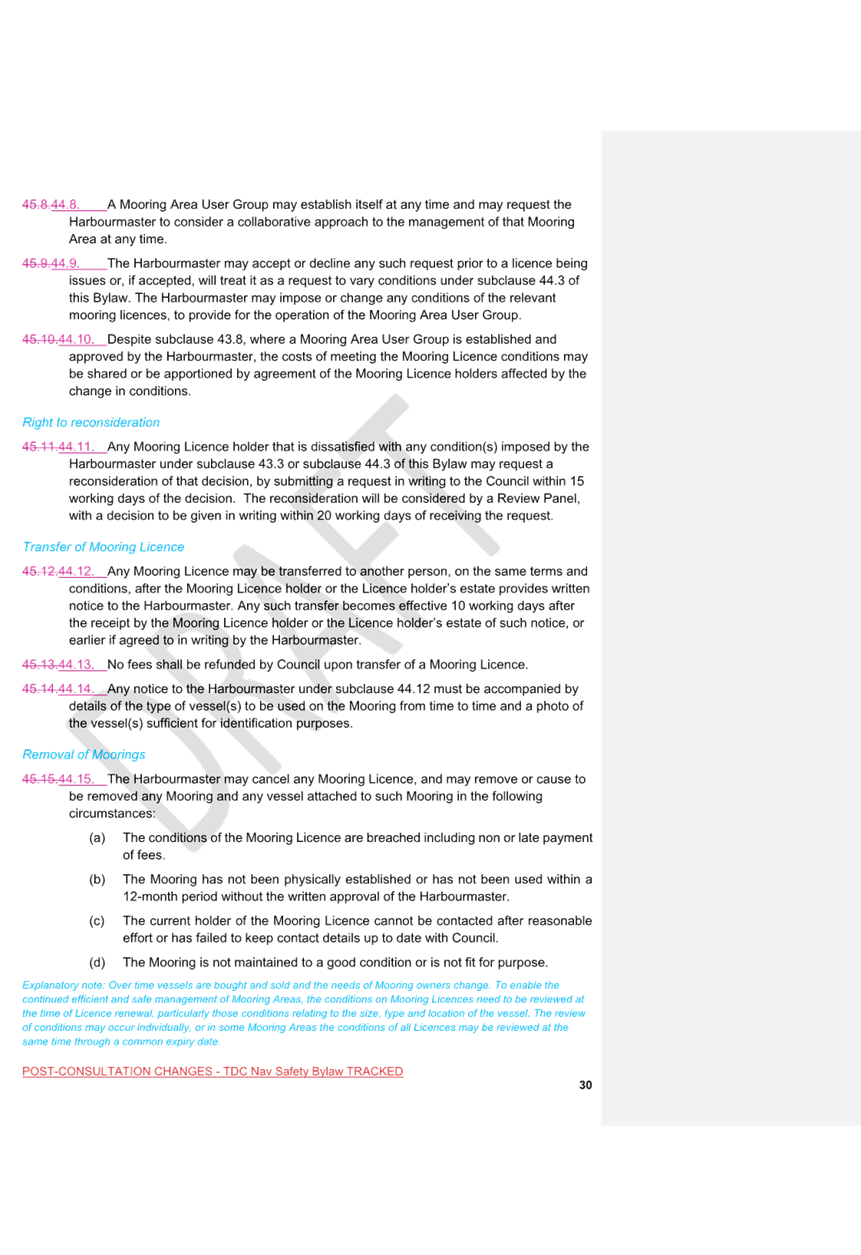
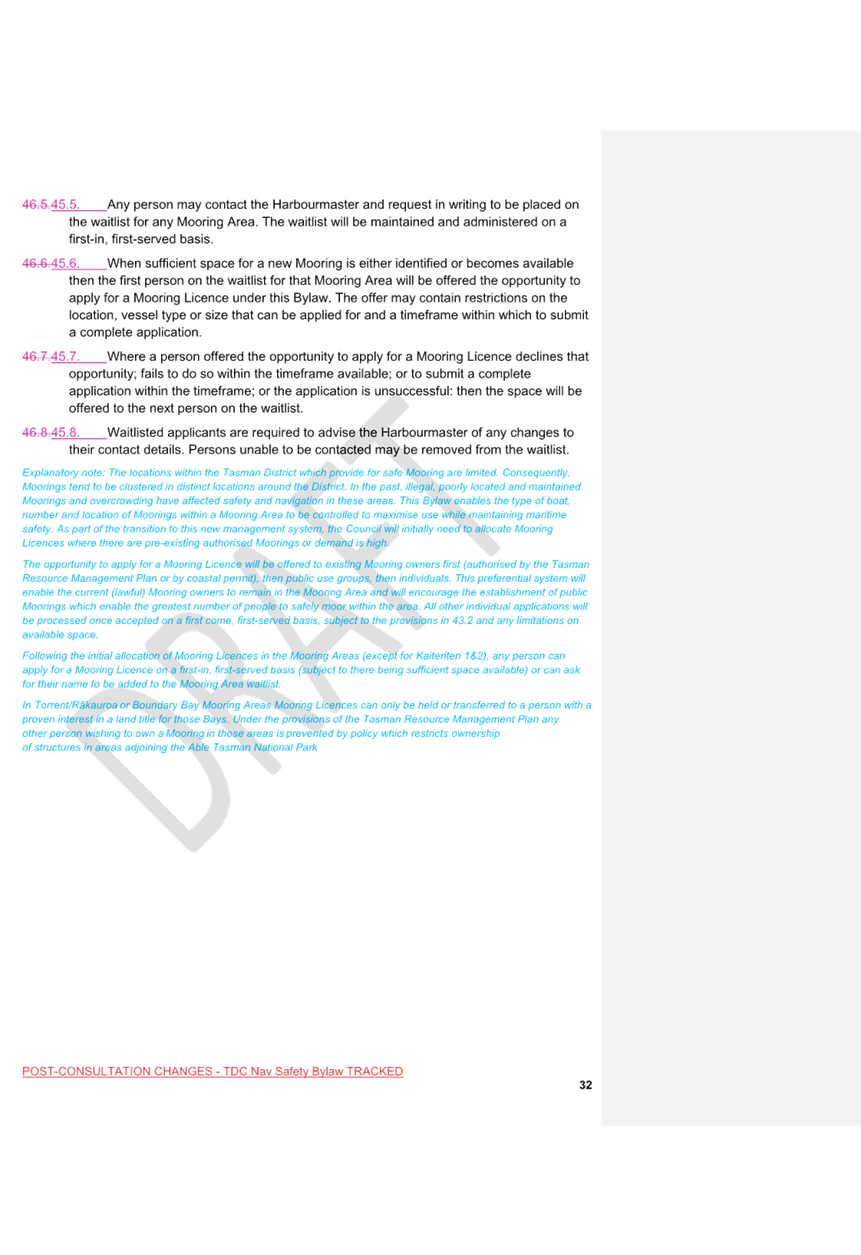
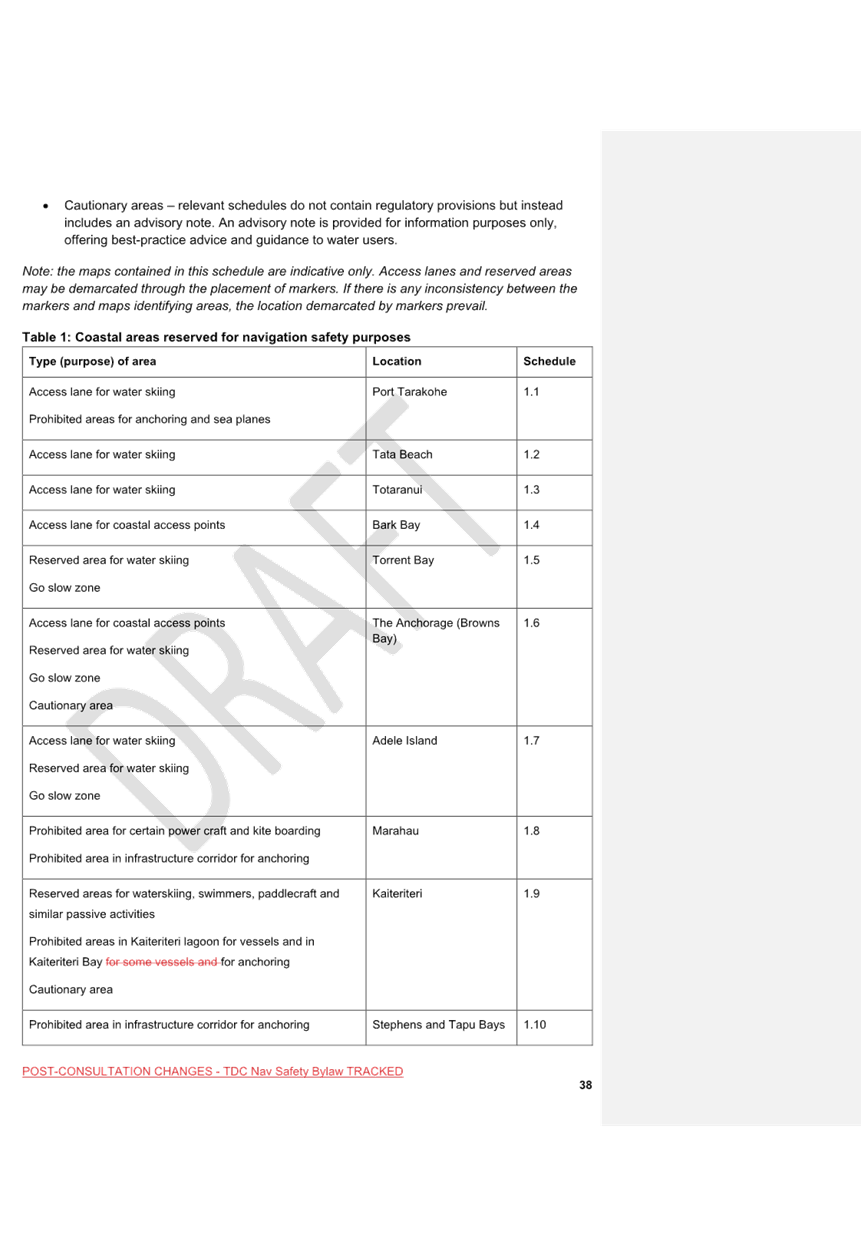
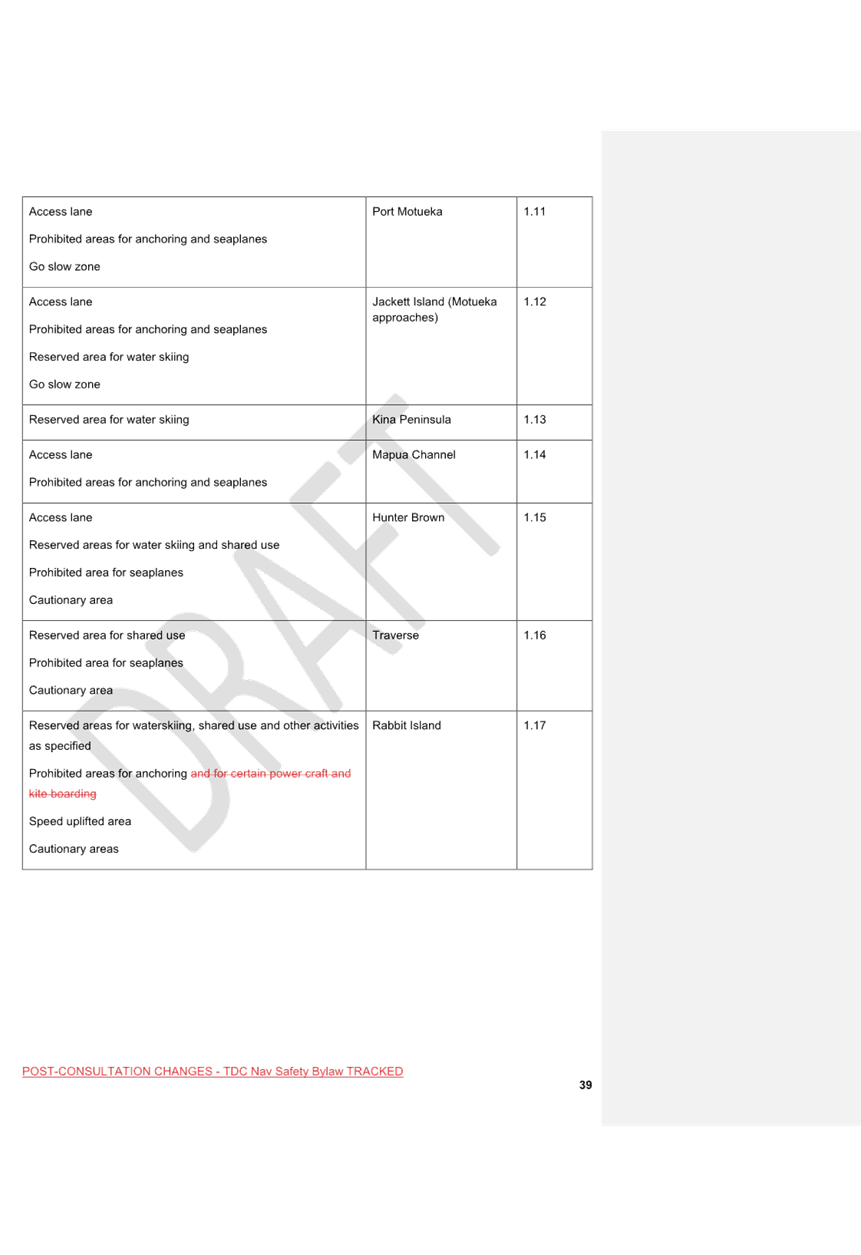
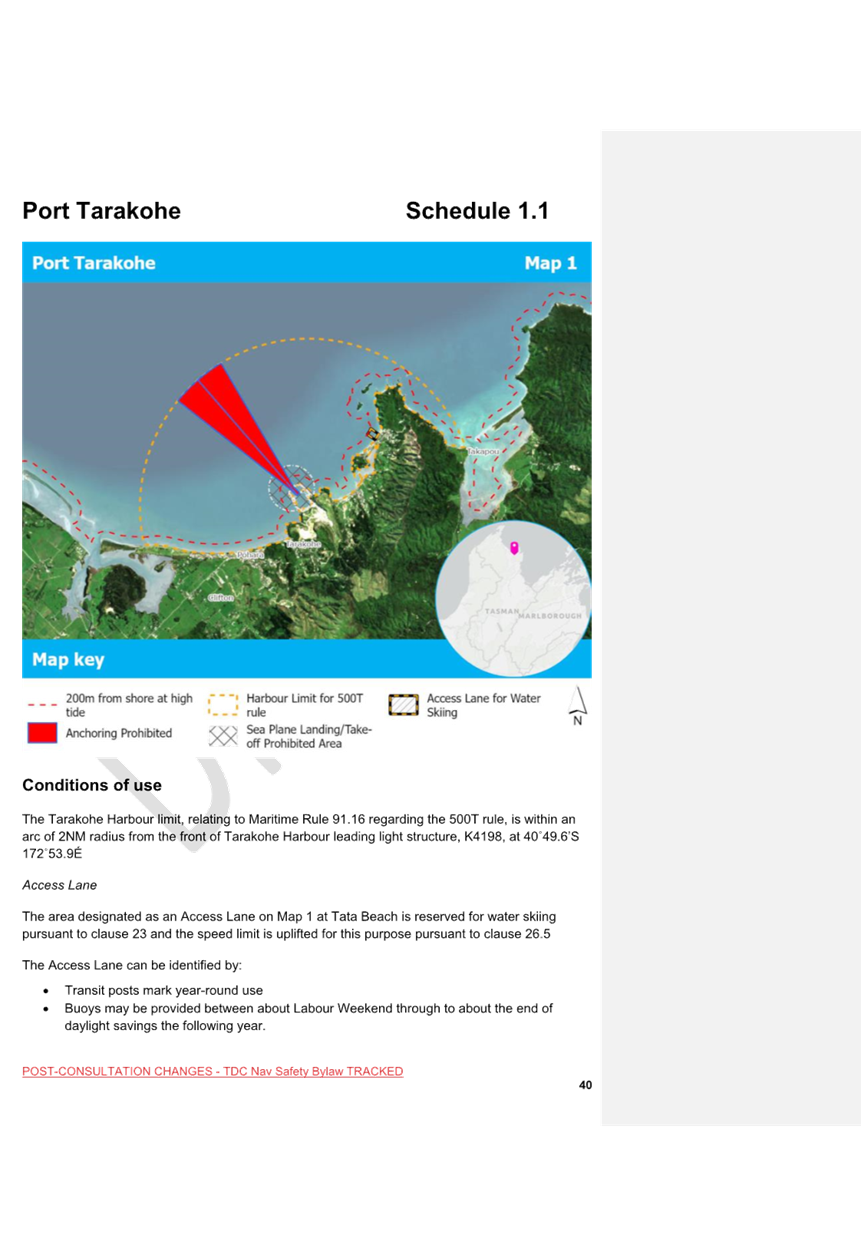
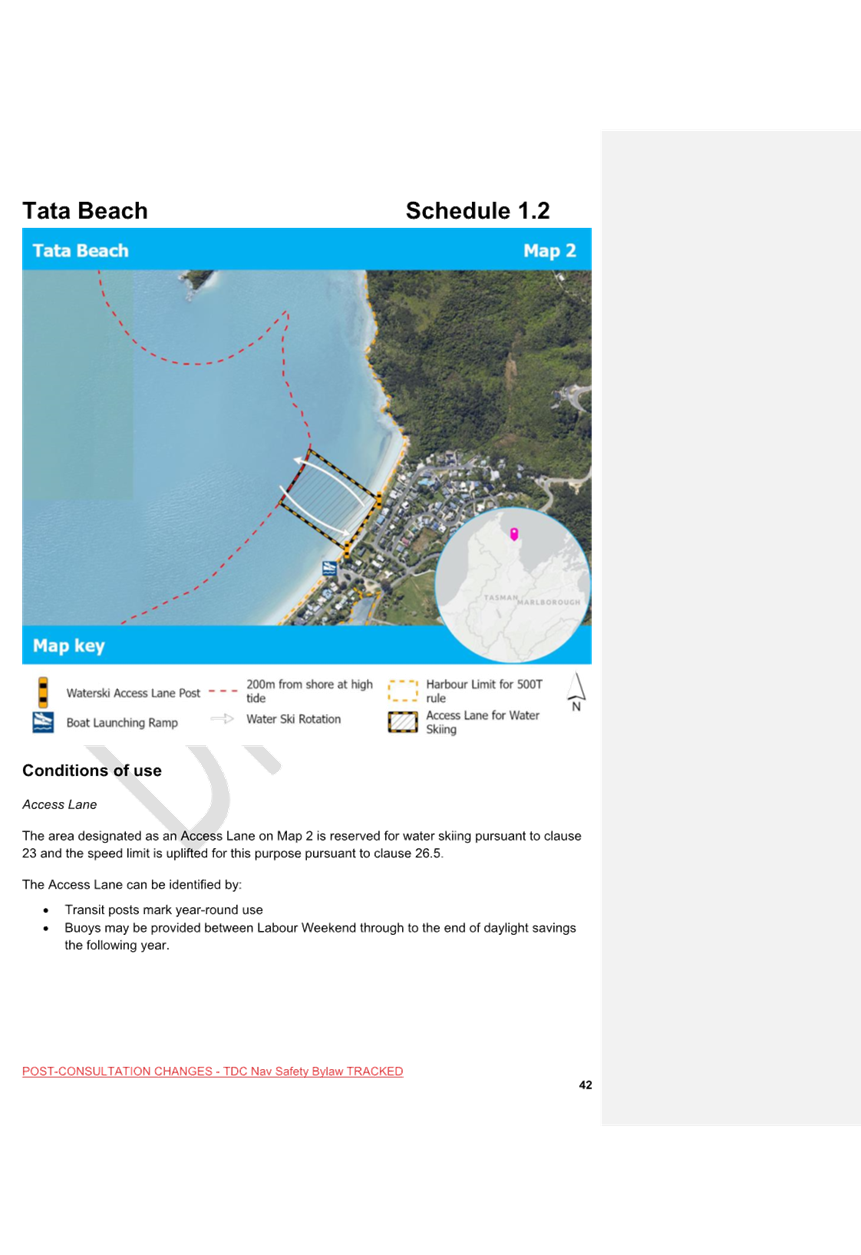
are also tracked into the consultation copy of the Bylaw (see Attachment 4).
6.4 The
submissions and recommended changes are summarised below, with staff advice.
General support
6.5 There was general support from most submitters
for the Bylaw requirements regarding personal floatation devices (PFDs), vessel
identification, and communication equipment.
6.6 NZ Police (34037) strongly support the
requirements for AIS, wearing and carriage of lifejackets, two forms of
communication equipment and identification of vessels, in order to improve
public safety, outcomes for people in distress, and the Search and Rescue
response in the Tasman area.
6.7 Golden Bay Community Board (34378)
strongly supports the proposed bylaw and emphasized the need for greater
collaboration and integration between local government and central government
on a coordinated approach to maritime navigation regulation and management.
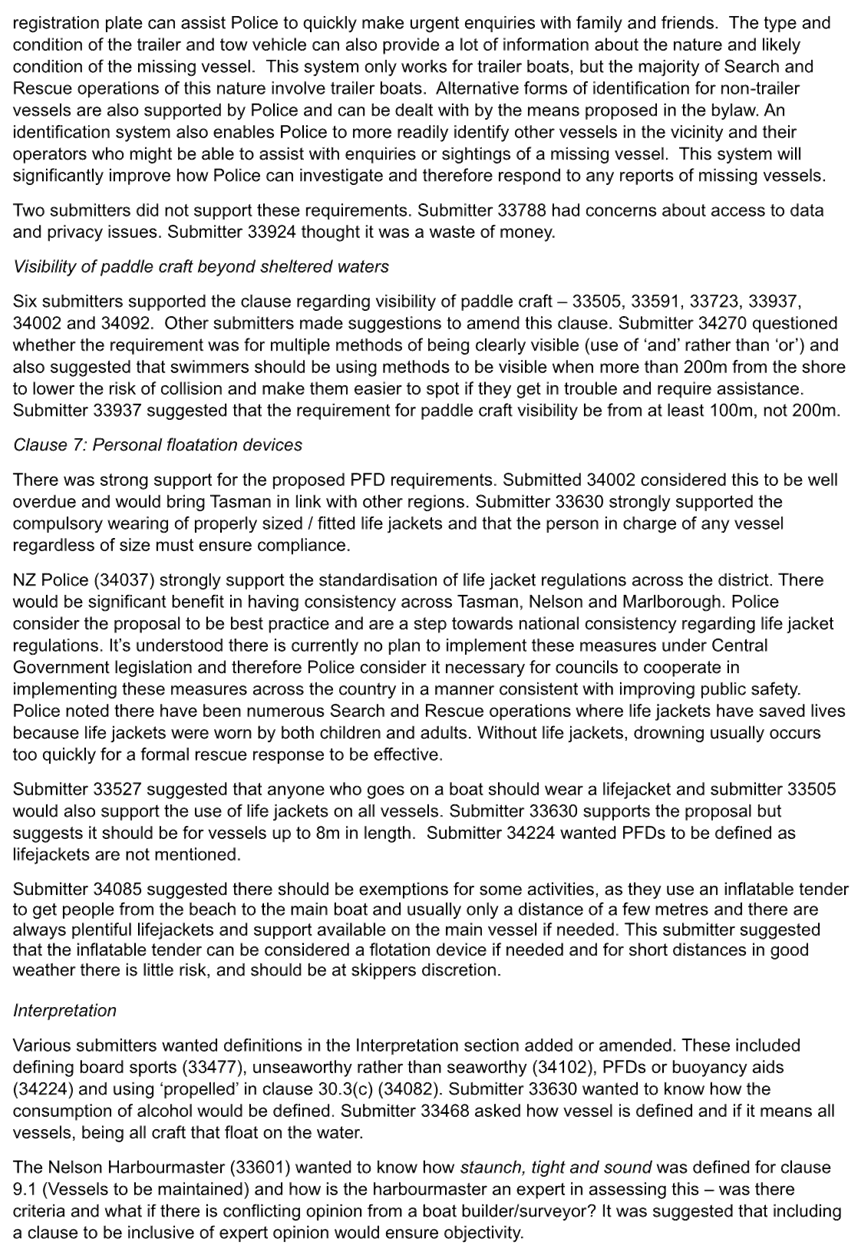
Clause 12.1: Swimming or diving around
landing places
6.8 Unfortunately,
this clause was drafted incorrectly, effectively banning swimming or diving
around landing places such as the Māpua wharf or Lake Rotoiti jetty. There
was significant public feedback (163 submissions) strongly opposing this
clause.
6.9 Feedback
emphasized both visitors and the Māpua community’s enjoyment of
wharf jumping, bringing families and tourists to the wharf area and the shops
and bars. Similarly at Lake Rotoiti, jumping of the jetty is enjoyed by many
people and common sense is exercised by all when boats are also using the
jetty.
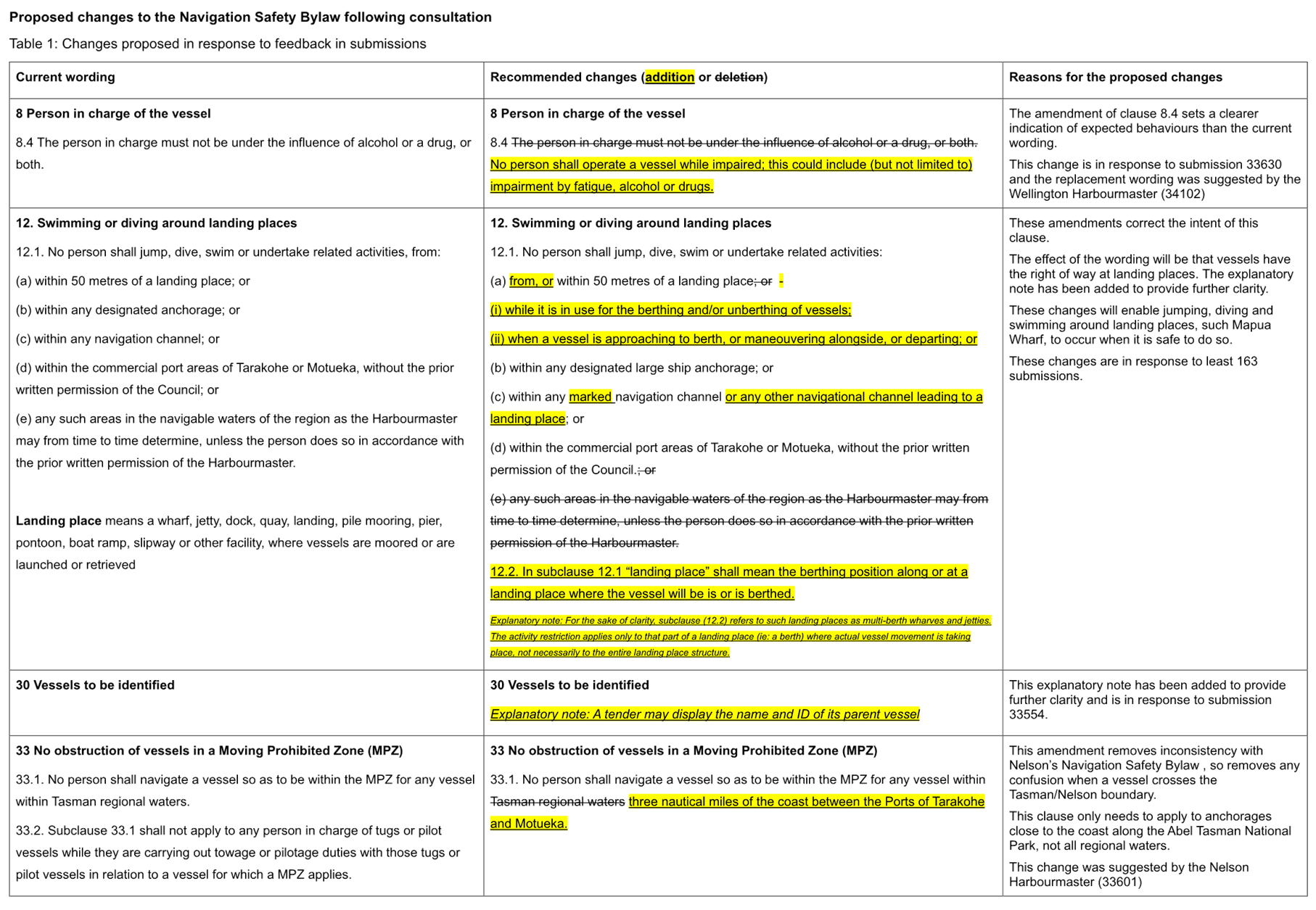
6.10 Staff recommend that this clause be amended to
enable jumping, diving and swimming around landing places and correct the
intent; vessels have the right of way at landing places. Staff also recommend
that an explanatory note is added to make it clear that the activity
restriction only applies to that part of a landing place (e.g. a berth) where
actual vessel movement is taking place, not necessarily to the
entire landing place.
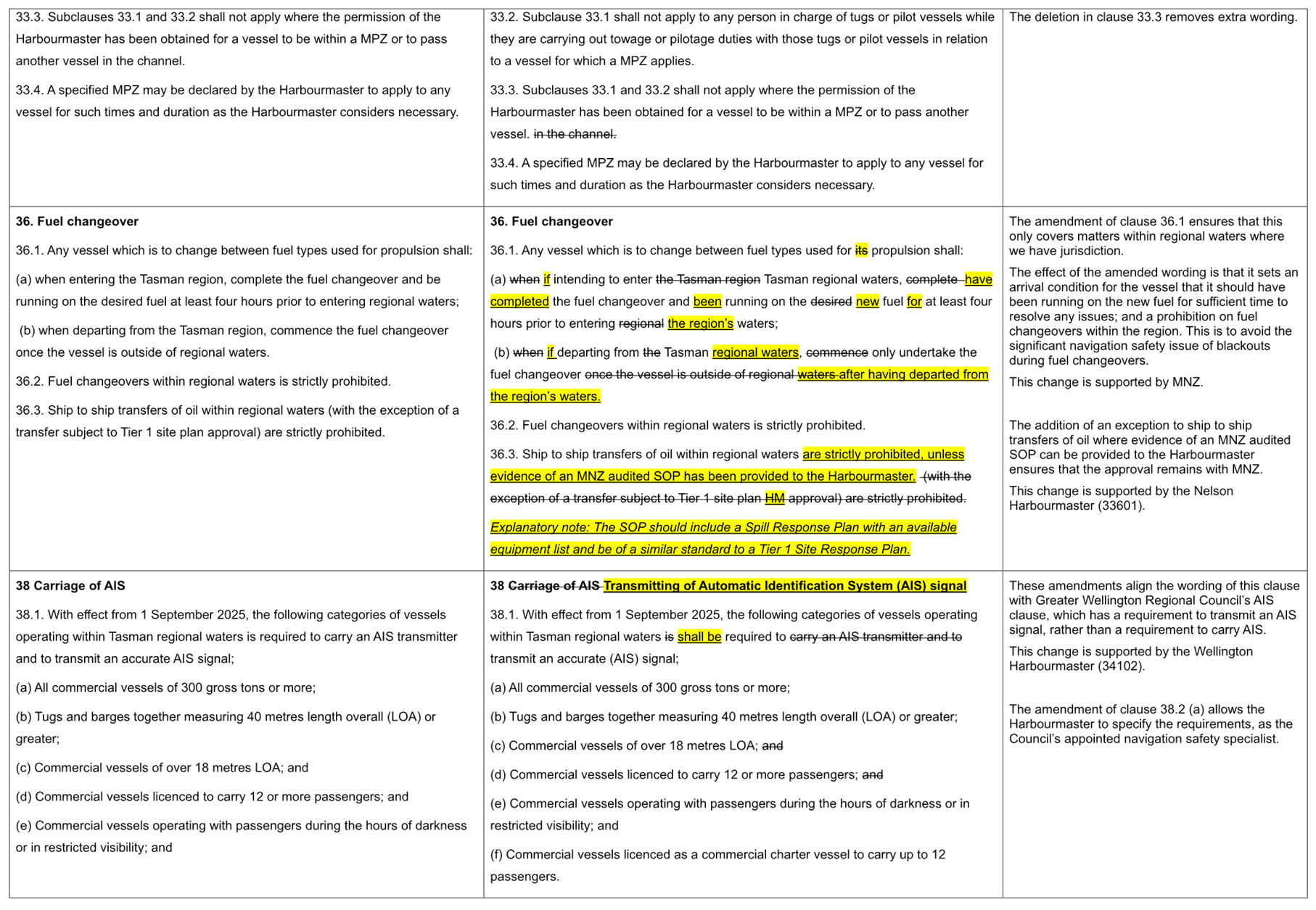
Clause 38: Carriage of AIS
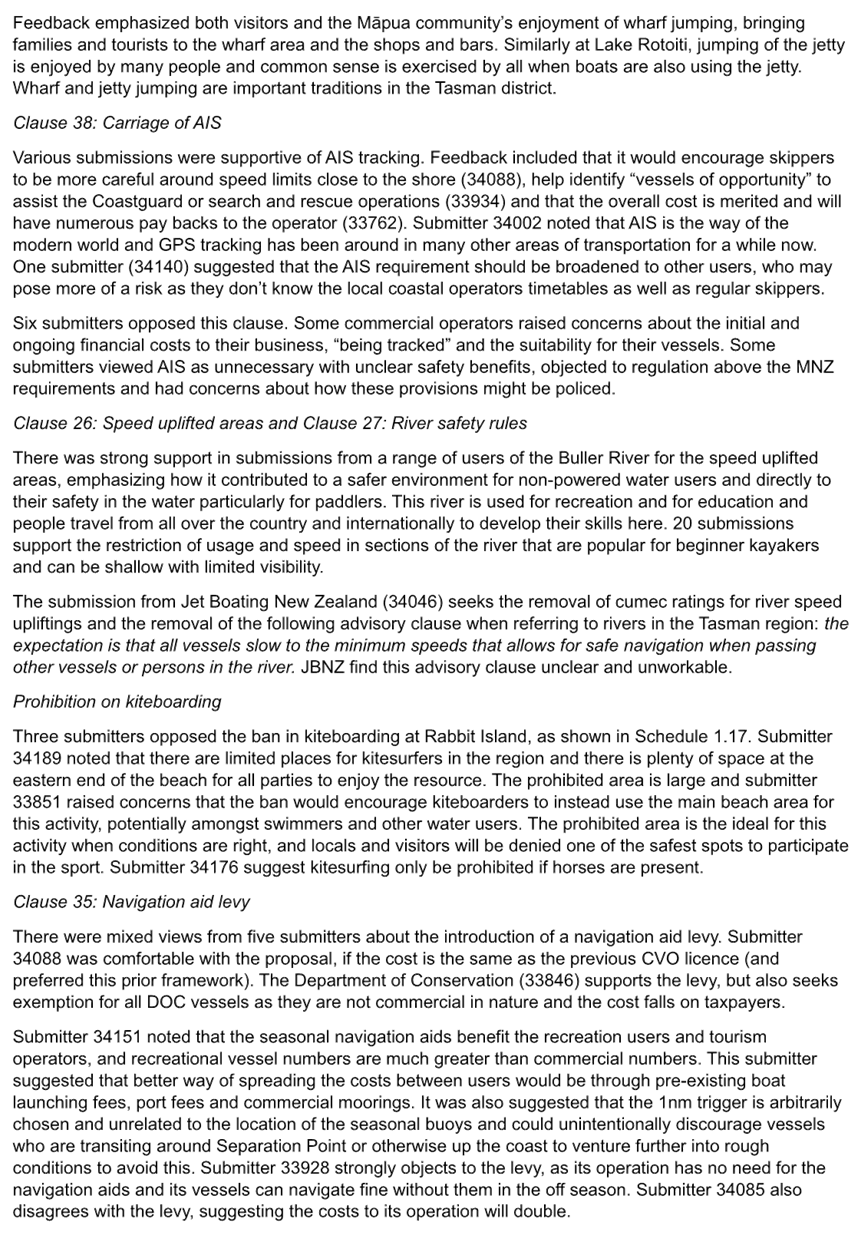
6.11 Various
submissions were supportive of AIS tracking. Feedback included that it would
encourage skippers to be more careful around speed limits close to the shore,
help identify “vessels of opportunity” to assist the Coastguard or
search and rescue operations and that the overall cost is merited and will have
numerous pay backs to the operator. Submitter 34002 noted that AIS is the way
of the modern world and GPS tracking has been around in many other areas of
transportation for a while now.
6.12 Six
submitters opposed this clause. Some commercial operators raised concerns about
the initial and ongoing financial costs to their business, “being
tracked” and the suitability for their vessels. Some submitters viewed
AIS as unnecessary with unclear safety benefits, objected to regulation above
the MNZ requirements and had concerns about how these provisions might be
policed.
6.13 AIS
is an increasingly key device in ensuring safety and compliance and are
suitable for small boats. In the case of a fleet of similar looking vessels,
for example, it would allow any infraction reported against one vessel to be
clearly linked back to which vessel it was. It also allows very clear policing
of exclusion areas, speed zones and similar restrictions. Staff recommend minor
amendments to clause 38 to align the wording with the Greater Wellington
Regional Council’s AIS clause, which has a requirement to transmit an AIS
signal rather than a requirement to carry AIS.
6.14 The
AIS requirements in the Bylaw will not come into effect until 1 September 2025,
as staff acknowledge that the initial cost of installing AIS into their vessels
may be significant for some commercial operators. A local quotation for a
stand-alone AIS Transceiver (transmits and receives AIS data) and antenna was
$2,210.98, plus installation costs if required.
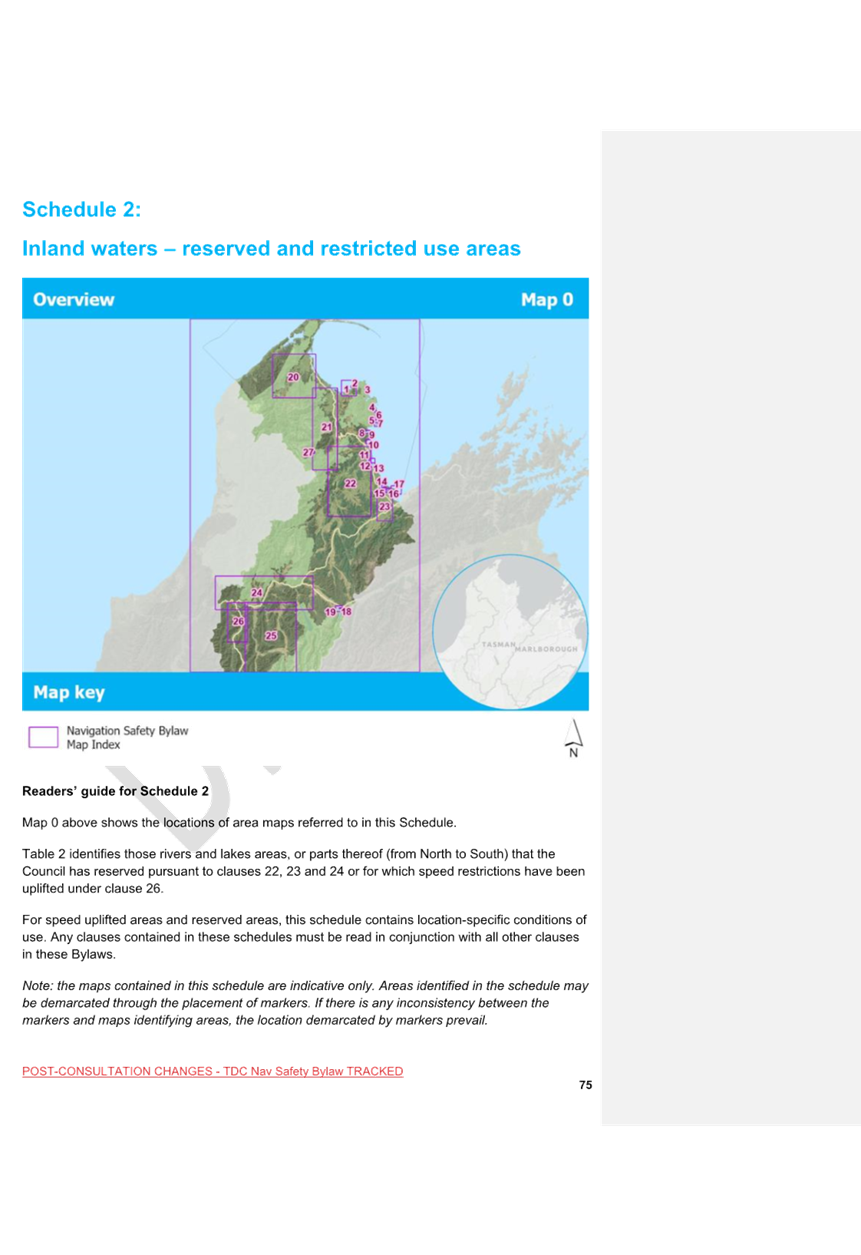
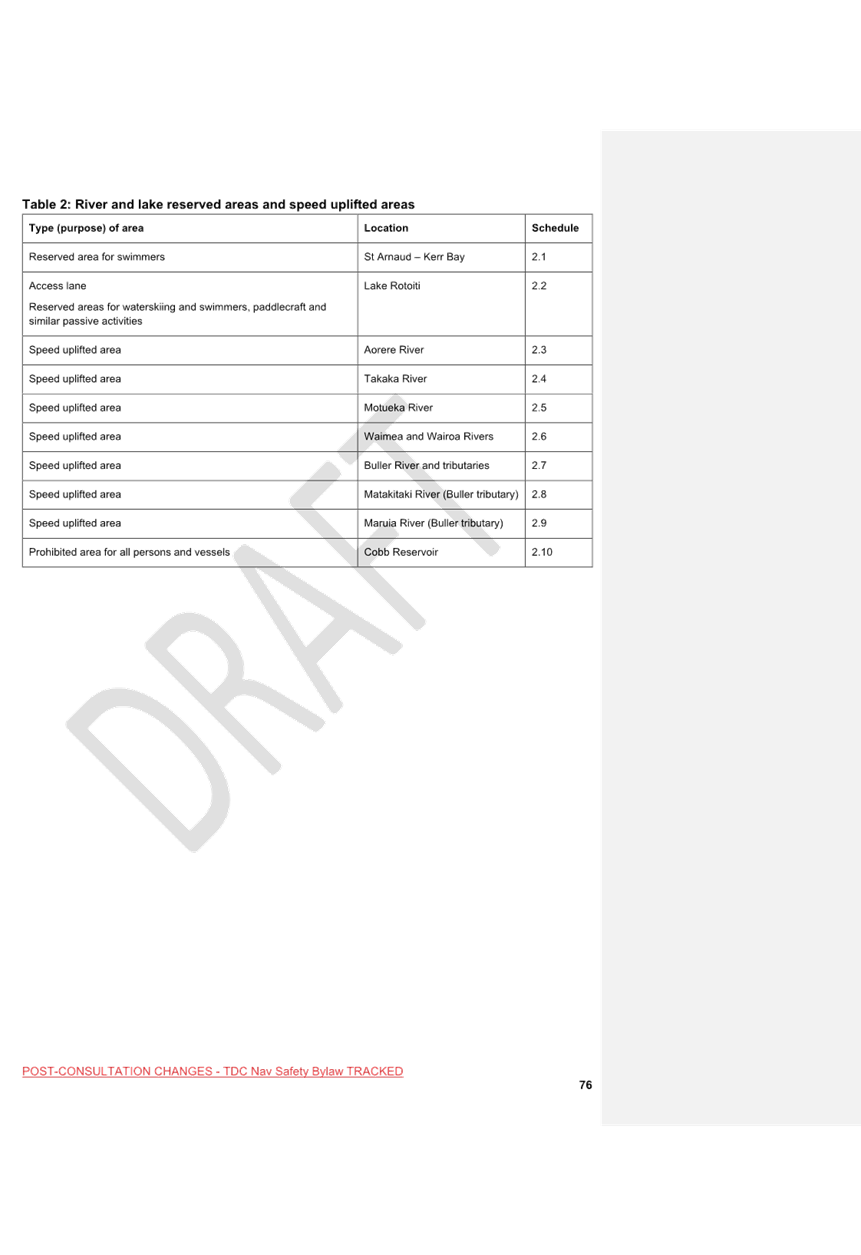
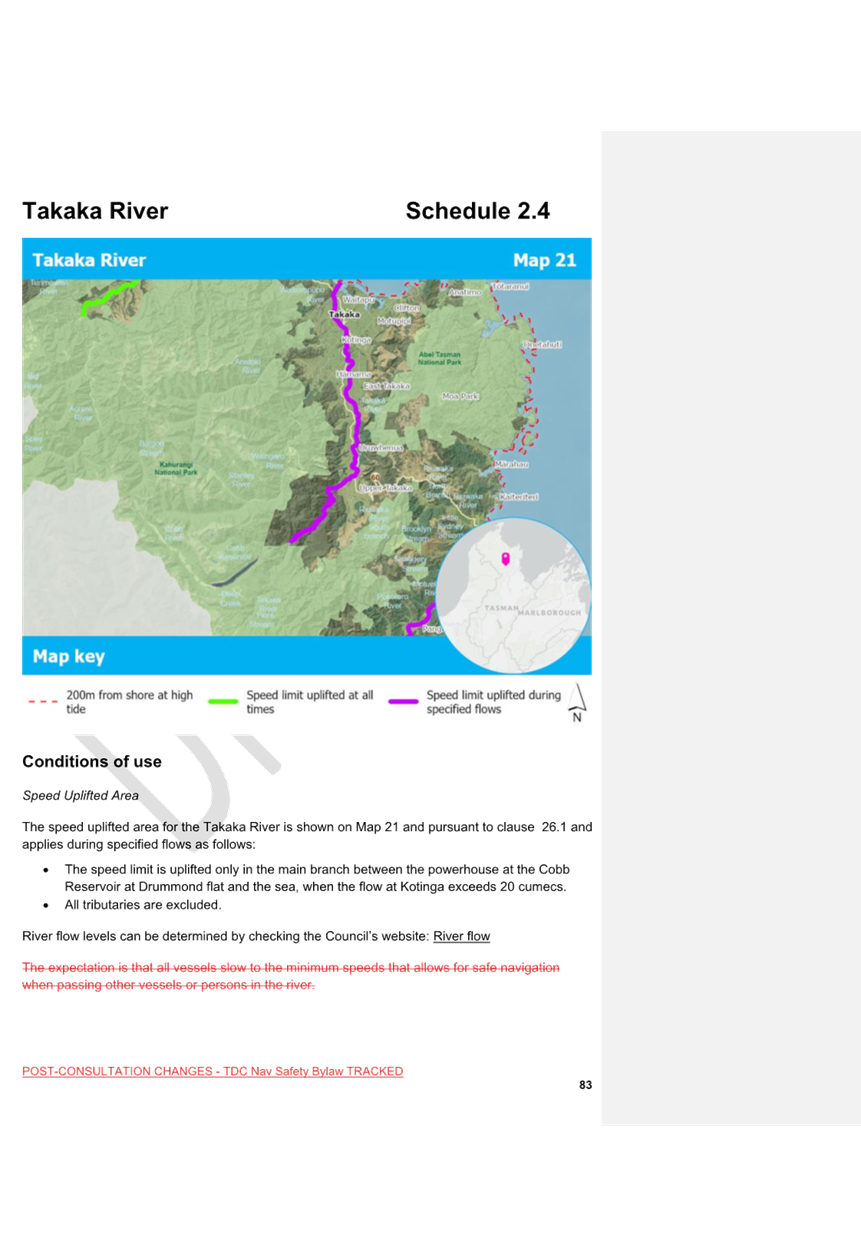
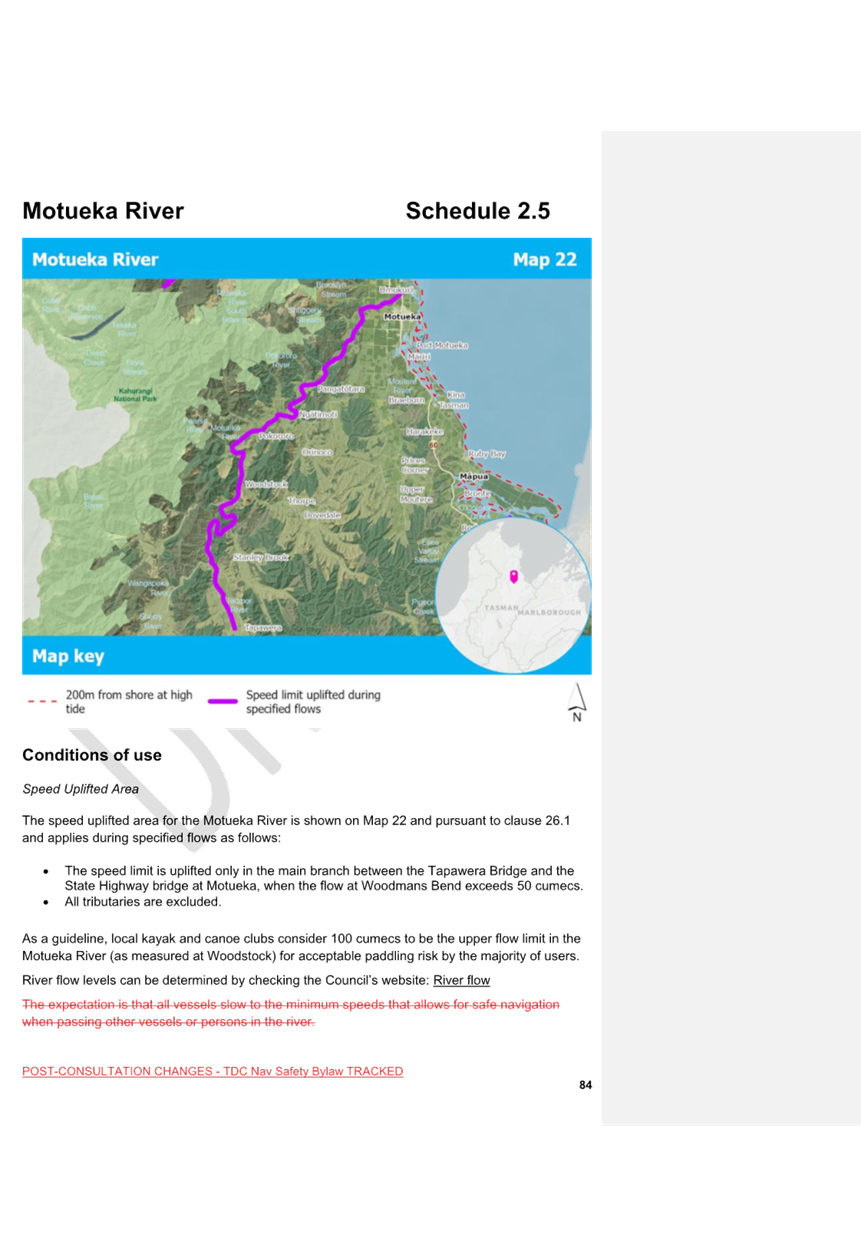
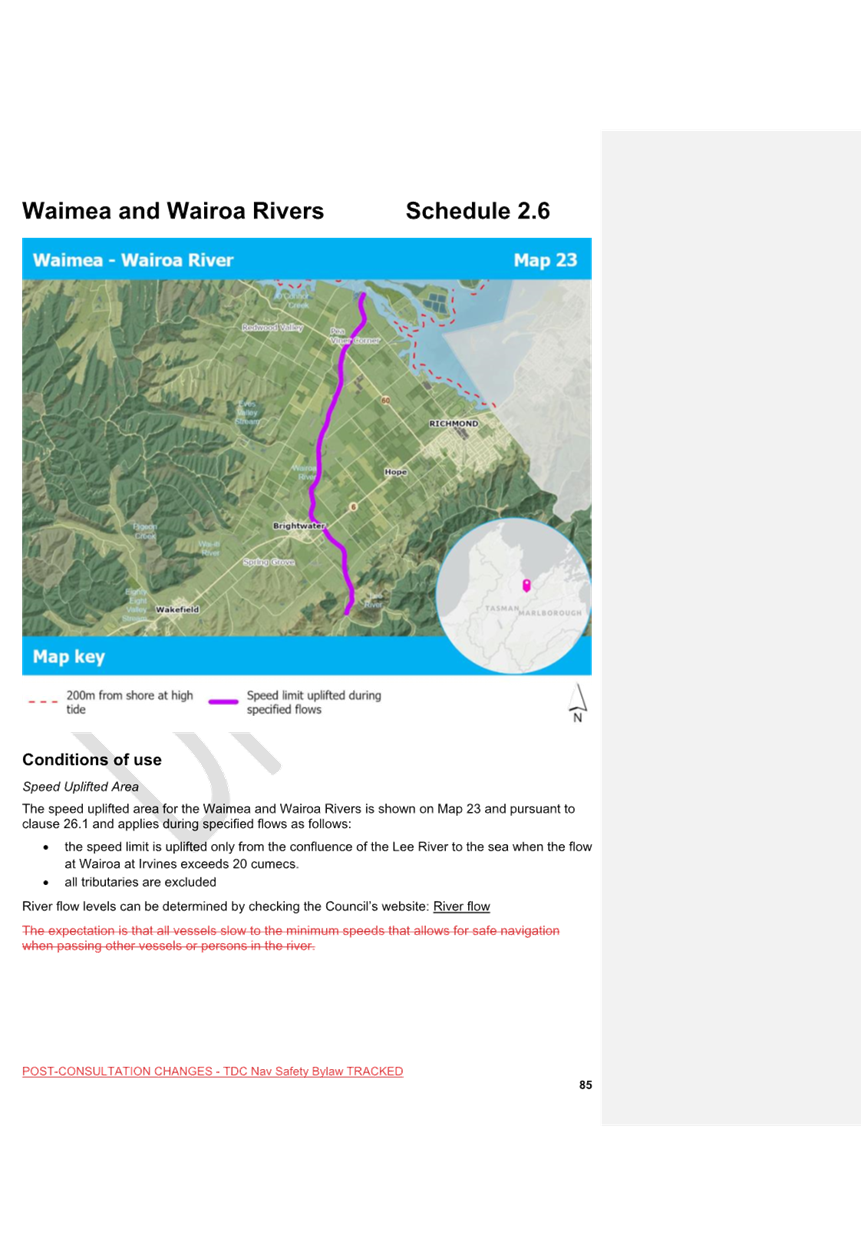
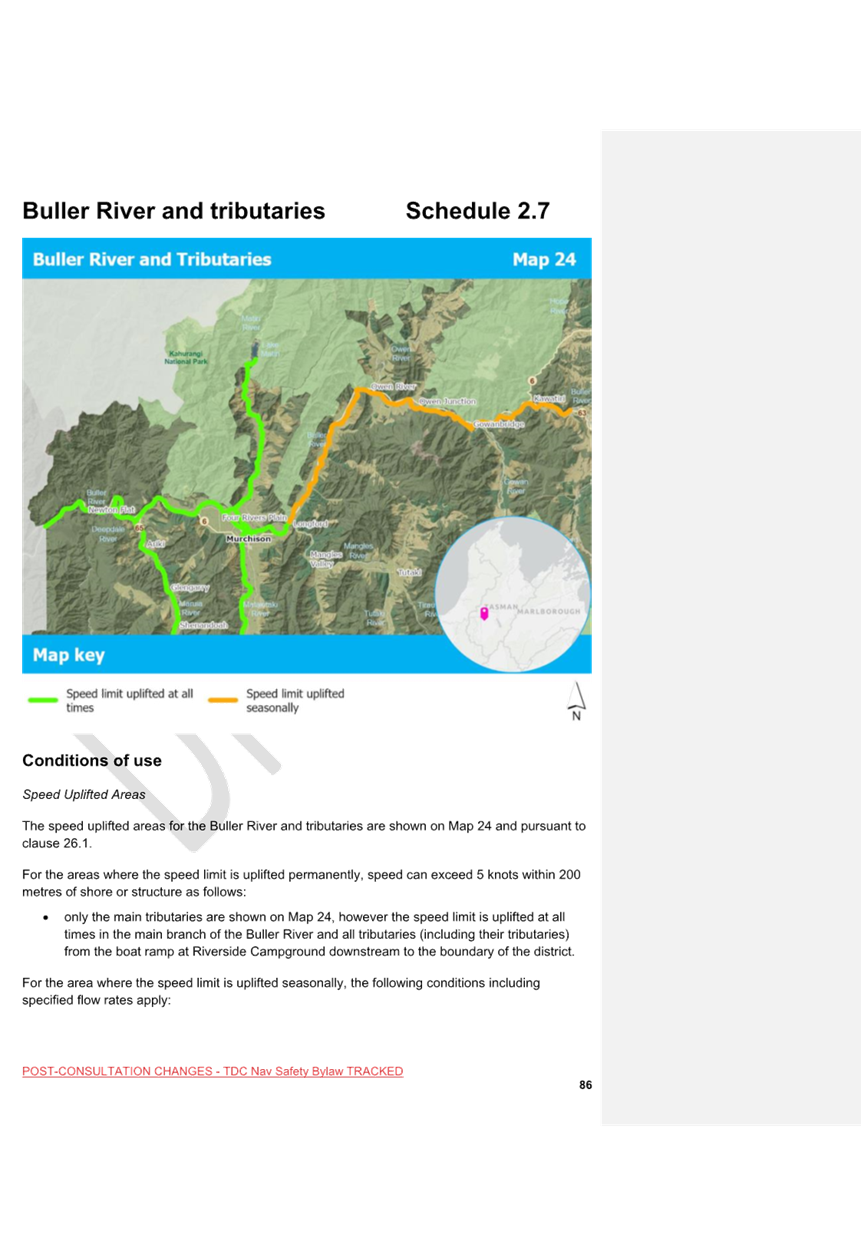
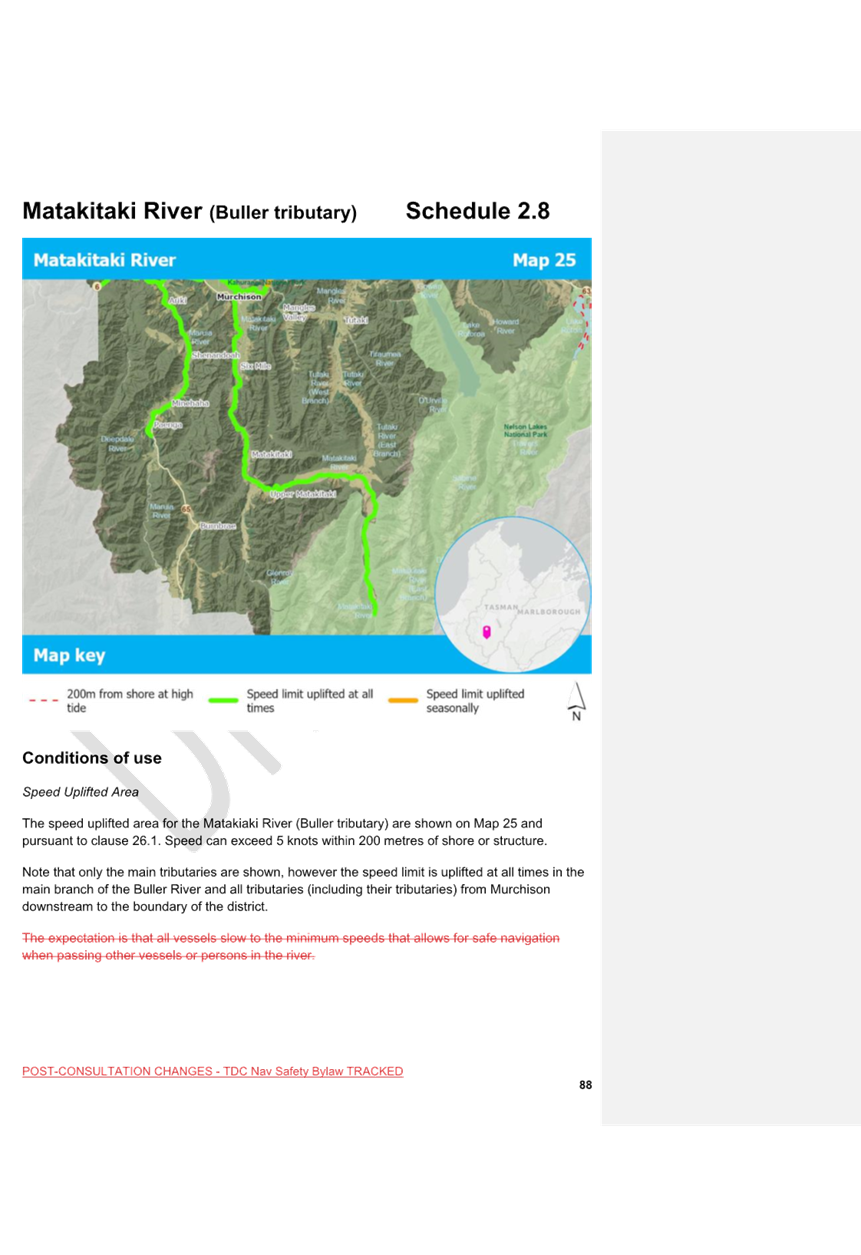
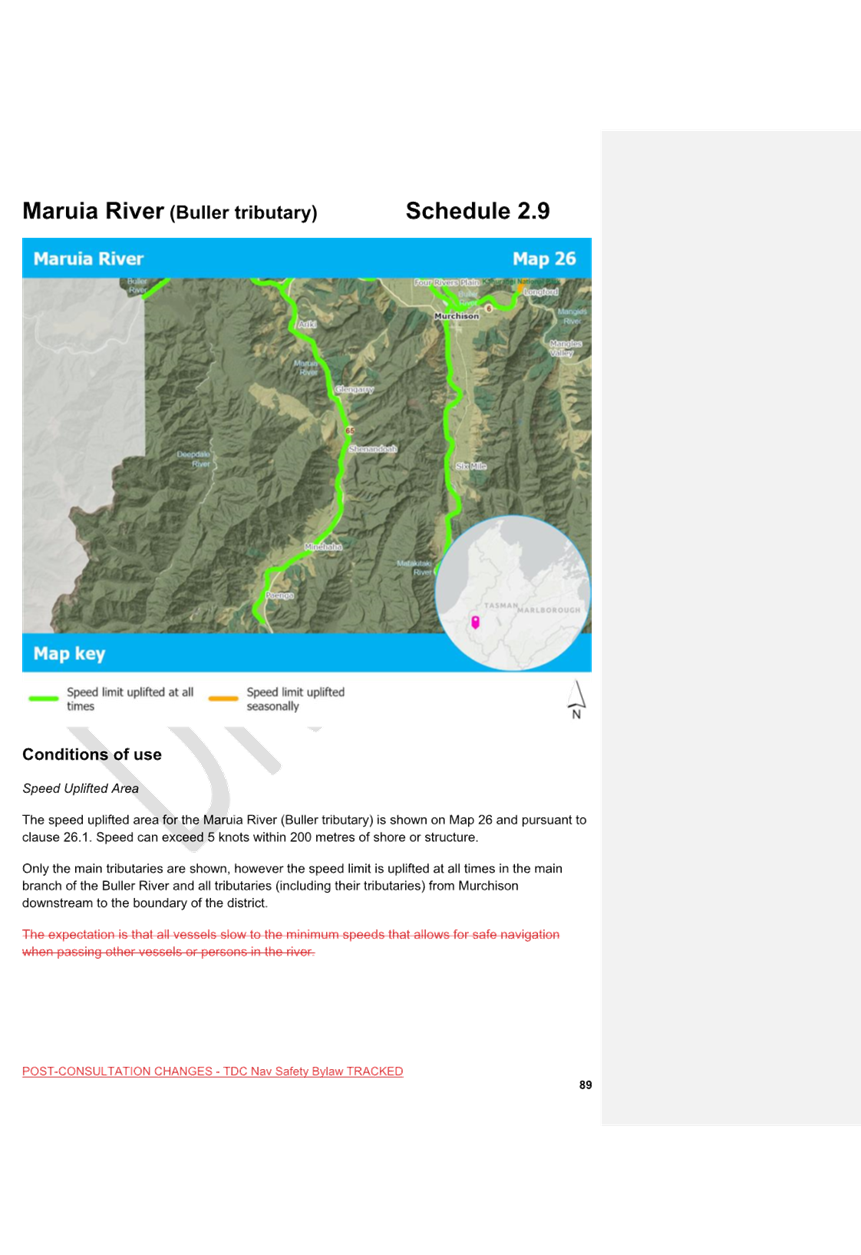
Clause 26: Speed uplifted areas; Clause
27: River safety rules
6.15 There
was support in submissions from a range of users of the Buller River for the
speed uplifted areas, emphasizing how it contributed to a safer environment for
non-powered water users and directly to their safety in the water particularly
for paddlers.
6.16 Jet
Boating New Zealand (34046) requested the removal of cumec ratings for river
speed upliftings and the removal of the advisory clause for some rivers that
sets an expectation for vessels to slow to the minimum speed for safe
navigation when passing other vessels or people. JBNZ find this advisory clause
unclear and unworkable.
6.17 Staff recommend the deletion of the advisory
clause as the provisions of the Maritime Rules Part 91 (River Safety) and Part
22 (Look Out, Safe Speed, Narrow Channels) sufficiently cover safe passage on
rivers. The Harbourmaster met with local JBNZ representatives and proposed to
work with a range of river users to gather data and improve understanding of
seasonal river flows. This work will inform river risk assessments so that the
suitability of the cumec ratings for river speed uplifting can be considered
before the next review of the Bylaw.
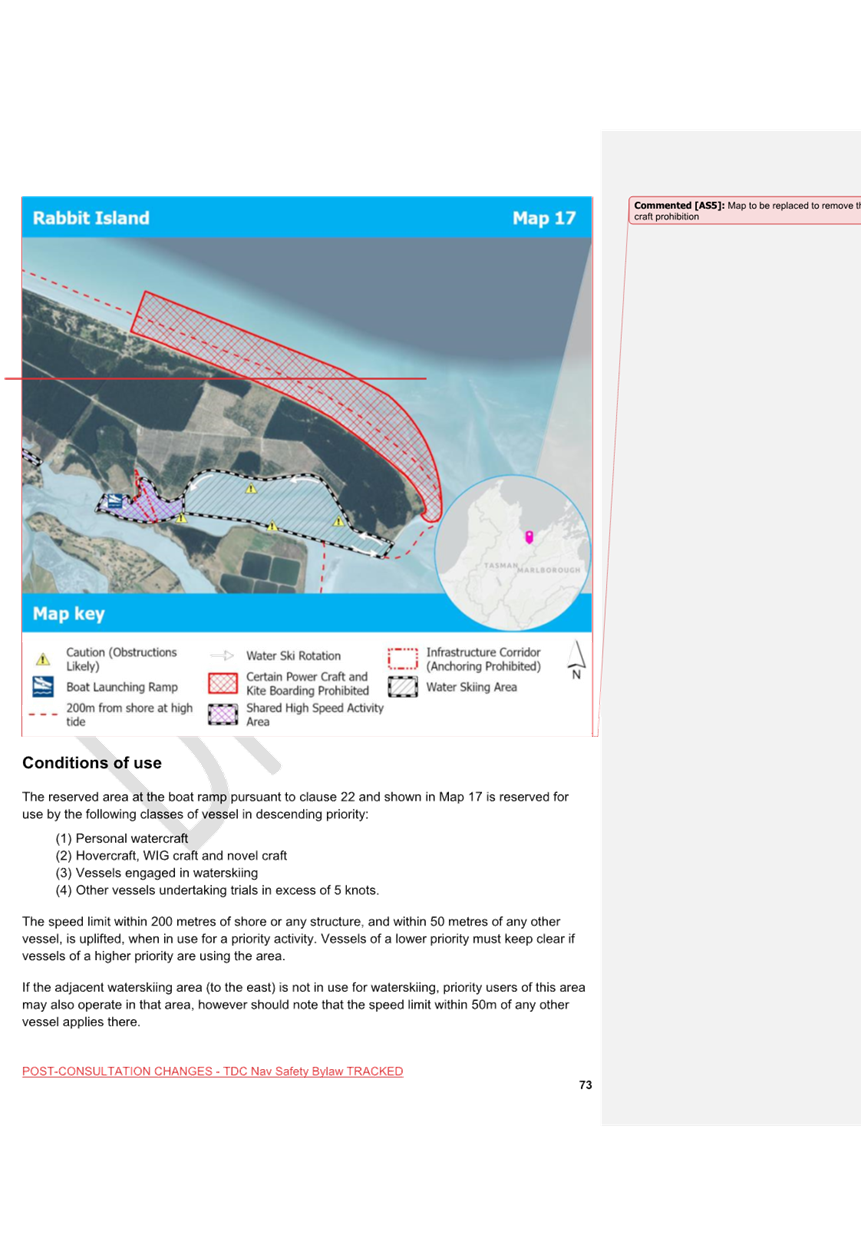
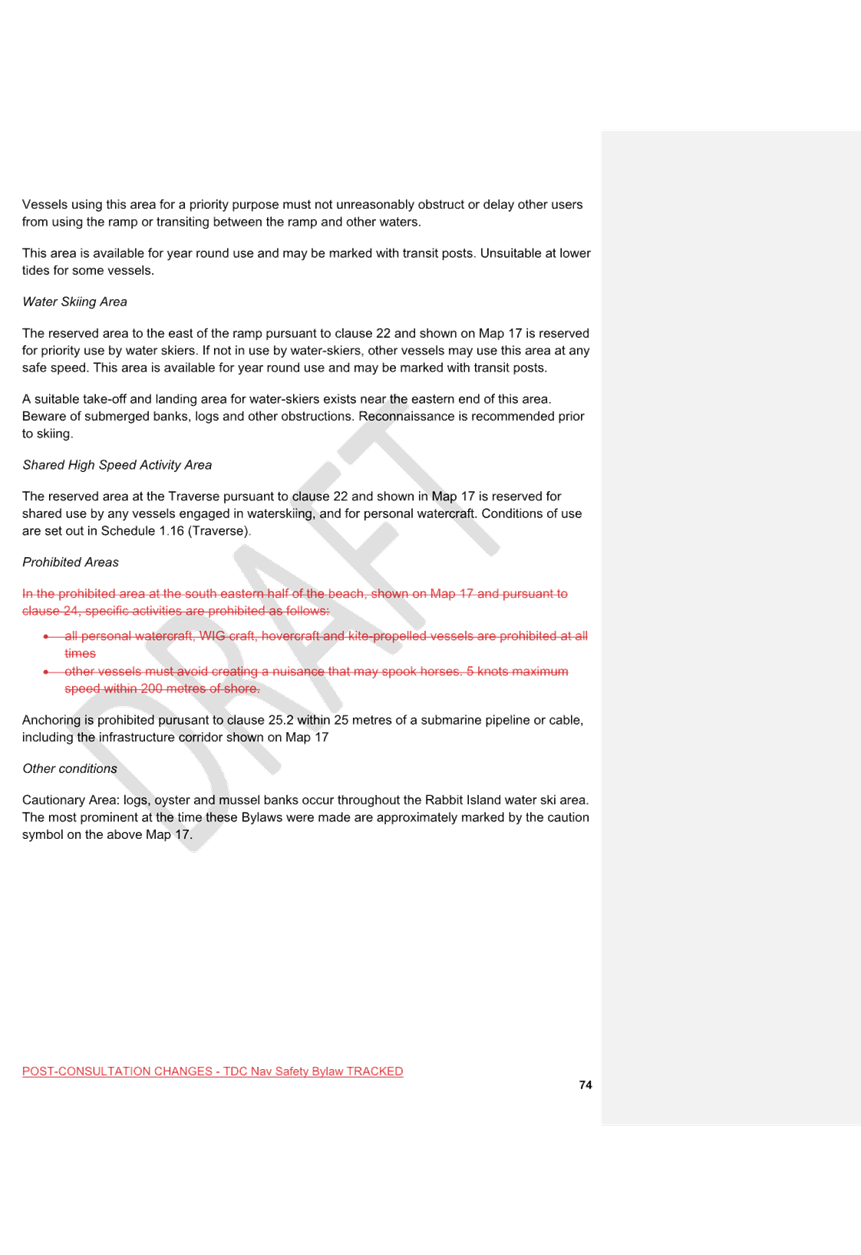
Prohibition on kiteboarding
6.18 Three
submitters opposed the ban on kiteboarding at Rabbit Island, noting there are
limited places for wind sports in the region and can only be carried out when
the conditions are right. The prohibited area is large and submitter 33851 was
concerned that it would encourage kiteboarders to instead use the main beach
area, potentially amongst swimmers and other water users.
6.19 Staff agree with the views of these submitters.
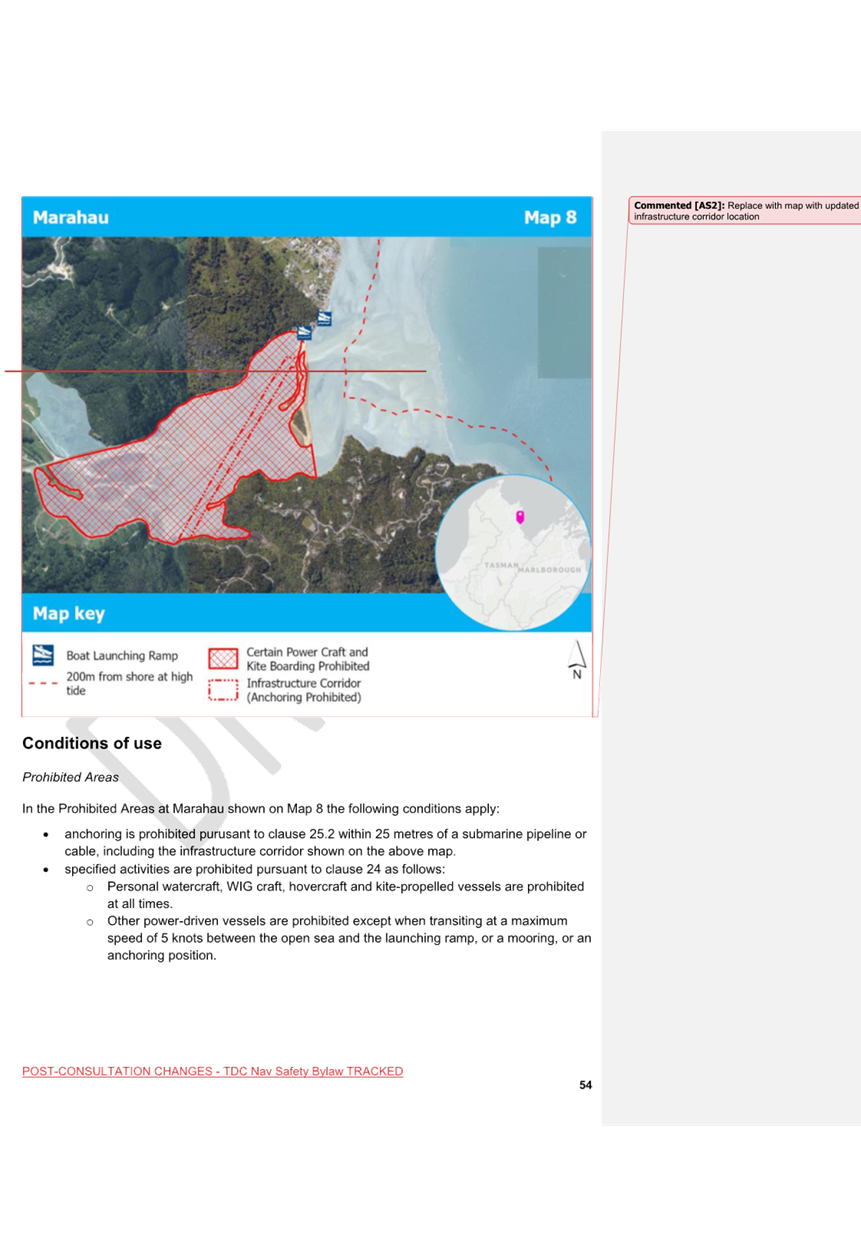
This is not a new ban; it covers PWCs, WIG craft, hovercraft
and kite-propelled vessels and was carried forward from the 2015 bylaw. It is
unclear why it was been included as a prohibited are and is not supported by
any clause within the bylaw. Staff recommend that this prohibition is removed
from the bylaw, as there are no navigation safety reasons for its inclusions.
Clause 35: Navigation aid levy
6.20 There
were mixed views from five submitters regarding the introduction of a
navigation aid levy. One submitter was comfortable with the levy, if the cost
was the same as the previous CVO. The Department of Conservation (33846)
supports the levy, but also seeks an exemption for their vessels. Two
submitters noted the seasonal navigation aids benefit the recreation users and
tourism operators, and that the costs should be spread between users. Two
submitters object to the levy, due to the costs and ability to navigate without
the aids in the off season.
6.21 The proposed levy replaces the previous commercial
vessel operator licensing and associated fee, which can no
longer be included in a bylaw following the 2017 amendments to the MTA. This
levy will be used for replacing and maintaining seasonal navigation floats in
the high traffic density area between Tarakohe and Motueka. The annual charge
for the levy ranges from $100 to $500 depending on their normal area of
operation; the previous CVO licence charges were an initial application fee
($281) and an annual fee ($363). The costs of the seasonal navigation aids will
be shared by commercial vessel operators and ratepayers. No changes are
proposed to this clause.
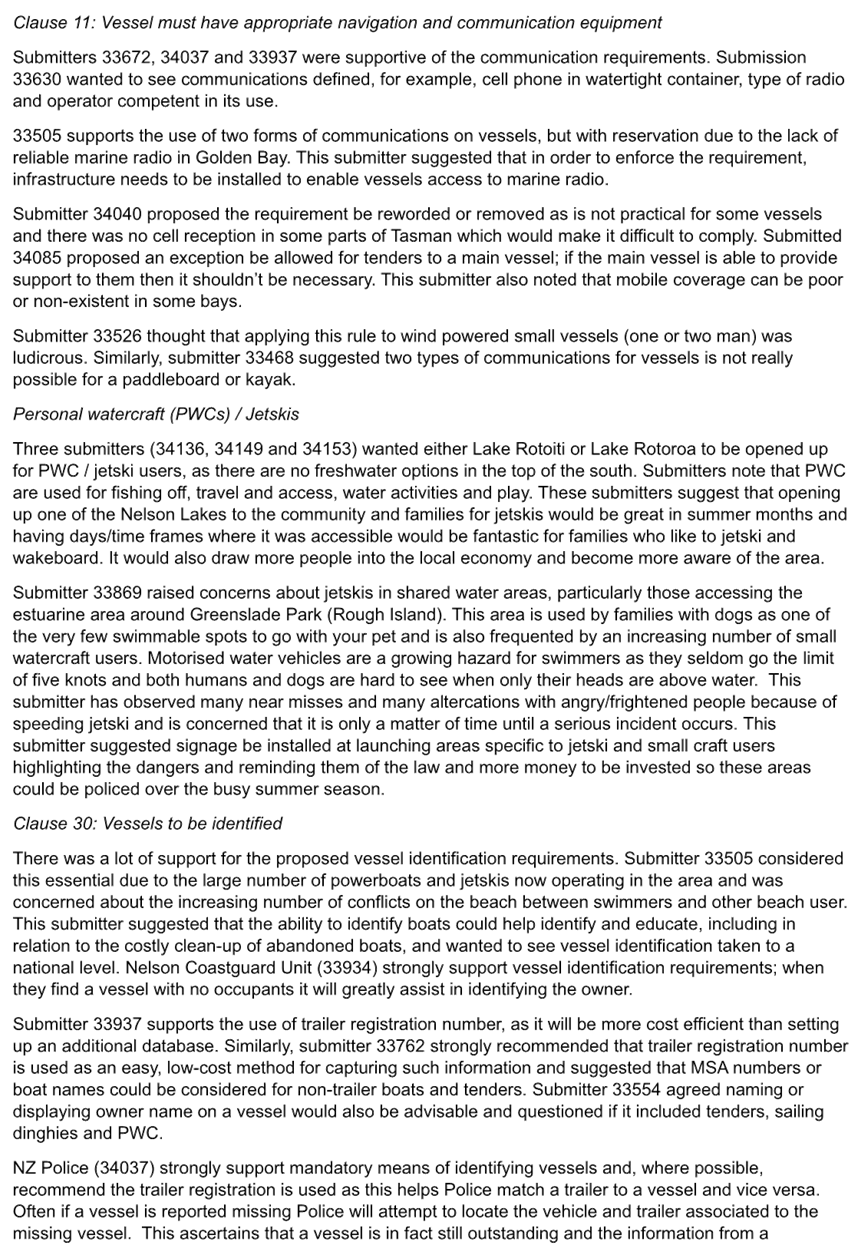
Clause 11: Vessel must have appropriate
navigation and communication equipment
6.22 Four
submitters supported the communication requirements and one submitter requested
communications be defined. Some submitters suggested exceptions including for
wind powered vessels, paddle boards, kayaks and tenders. Concerns were raised
about the lack of mobile coverage and access to marine radio in some coastal
areas, which could make compliance with this clause difficult.
6.23 Tenders must have communications
to the main vessel. Staff acknowledge that providing the public with
information on the appropriate forms for various vessels would be helpful. No
changes are proposed to this clause.
Personal watercraft (PWCs) / Jetskis
6.24 Three
submitters wanted either Lake Rotoiti or Lake Rotoroa to be opened up for PWC /
jetski users, as there are no freshwater options in the top of the south. The
Bylaw does not prohibit PWCs from the Nelson Lakes, but DOC has banned PWC from
both lakes and waterskiing from Lake Rotoroa, as well as power boating on the
rivers in the Nelson Lakes National Park.
6.25 Submitter 33869 raised concerns about jetskis in
shared water areas, particularly those accessing the estuarine area around
Greenslade Park (Rough Island), and suggested signage be installed at launching
ramps and the area be policed over the busy summer season. Staff acknowledge
that this can be a busy area and agree better signage and increased officer
presence is needed.
Clause 30: Vessels to be identified
6.26 There
was a lot of support for the proposed vessel identification requirements.
Feedback was supportive of using trailer registration number as more cost
effective than a new database and that the ability to identify boats would help
identify and educate, particularly in relation to the clean-up of abandoned
boats. Submitter 33554 questioned if the requirements applied to tenders,
sailing dinghies and PWC. Staff recommend including an explanatory note to this
clause regarding tender vessels, which may display the name and ID of their
parent vessel.
6.27 NZ
Police (345037) strongly support mandatory means of identifying vessels and,
where possible, recommend the trailer registration is used as this helps Police
match a trailer to a vessel and vice versa. The alternate forms of
identification for non-trailer vessels are also supported by Police. An
identification system enables Police to more readily identify other vessels in
the vicinity and their operators who might be able to assist with enquiries or
sightings of a missing vessel, significantly improving how Police can
investigate and therefore respond to any reports of missing vessels.
6.28 Two submitters did not support
the requirements; one had concerns about access to data/privacy issues and one
thought it was a waste of money.
Visibility of paddle craft beyond
sheltered waters
6.29 Six submitters supported this clause and other submitters
made some suggestions to amend it. Submitter 34270 questioned whether the
requirement was for multiple forms of being visible as the wording was not
clear and suggested it should also apply to swimmers.
6.30 Staff recommend that ‘flag’ is deleted from
the explanatory note, based on advice that flags may not safely improve
visibility of paddle craft to other water users. Staff also recommend that
‘and’ is changed to ‘or’ in this clause, to make it
clear that more than one method of being visible is not required.
Clause 7: Personal floatation devices
6.31 There was strong support from submitters for the proposed
PFD requirements and two submitters suggested lifejackets should be worn on all
vessels. Submitter 34085 suggested there should be exemptions for some
activities, such as using an inflatable tender for a short distance close to
shore. Staff consider the PFD requirements appropriate and do not propose any
changes to clause 7.
6.32 Interpretation
Various submitters wanted definitions in the Interpretation section of the
Bylaw added or amended. These included defining board sports, unseaworthy
rather than seaworthy, and PFDs or buoyancy aids.
6.33 Submitter 34224 wanted PFDs or buoyancy aids to be
defined. Clause 4.3 covers off all major definitions found in the Act and the
Rules. A definition for PFD has not been included in the Bylaw to avoid the
likelihood of the definition in the Rules changing and thus making the Bylaw
inconsistent.
6.34 The
Nelson Harbourmaster (33601) wanted to know how staunch, tight and sound was
defined for clause 9.1 (Vessels to be maintained) and suggested that including
a clause to be inclusive of expert opinion would ensure objectivity. Staff do
not propose a new definition but agree that the wording is not clear. Staff
recommend that clause 9 is entirely replaced with new wording. The proposed
wording is simpler, easy to understand and is used in other councils’
bylaws so has been tested and works well.
6.35 The
Wellington Harbourmaster suggested defining unseaworthy, rather than seaworthy,
as most regional councils define this in the negative. Harbourmasters have
discussed this at length, and it took some time to settle on this approach. The
national Navigation Safety Group hope this approach will become common across
all the bylaws and it may also lower the potential risk/liability to the
Council. Staff recommend the definition is replaced.
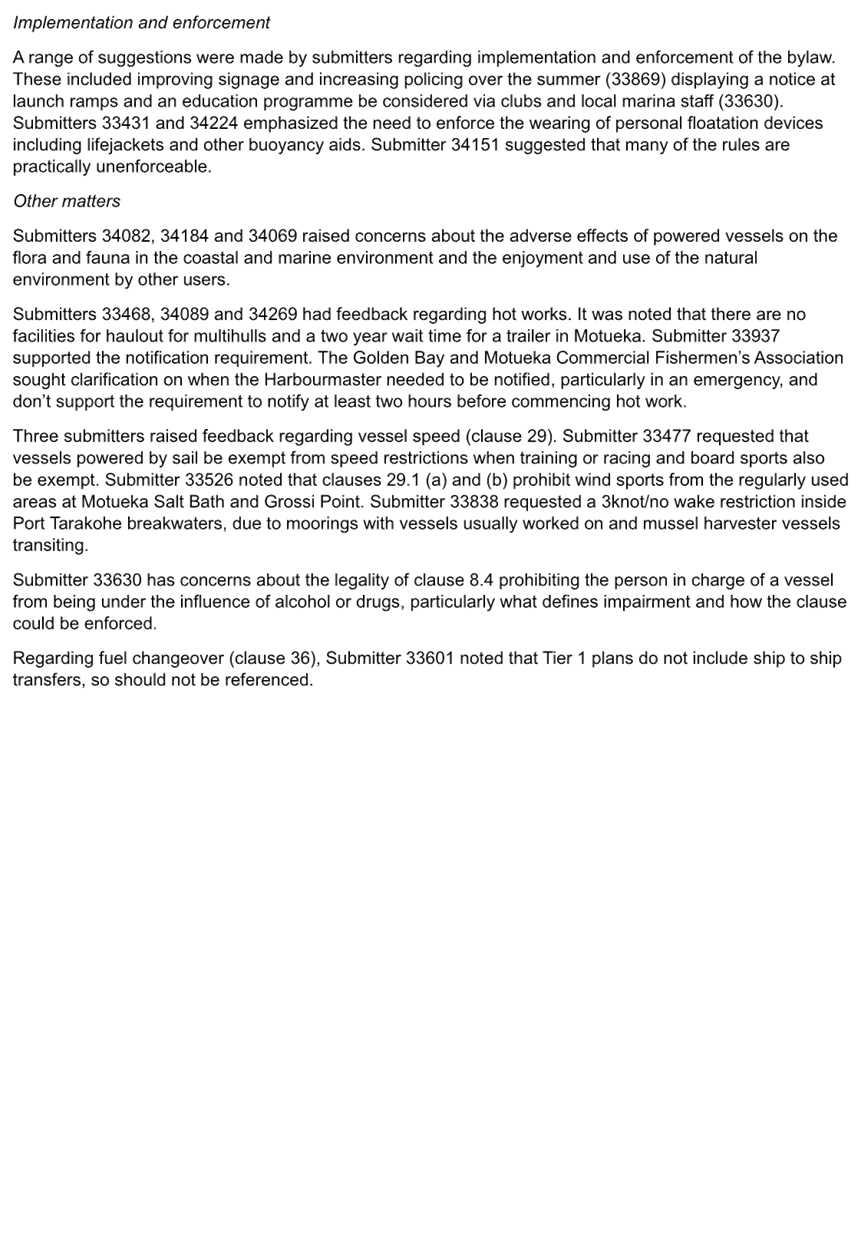
Implementation and enforcement
6.36 A range of suggestions were made by submitters
regarding implementation and enforcement of the bylaw. These included improving
signage and increasing policing over the summer, displaying a notice at launch
ramps and an education programme via clubs and local marina staff. Two
submitters emphasized the need to enforce the wearing of PFDs including
lifejackets and other buoyancy aids. Staff note that enforcement of lifejackets
is not currently an issue.
Other matters
6.37 Three submitters raised concerns about the adverse
effects of powered vessels on the flora and fauna in the coastal and marine
environment and the enjoyment and use of the natural environment by other
users. Matters associated with environmental protections are addressed
elsewhere (for example, under the Resource Management Act 1991 or the Tasman
Resource Management Plan) and remain out of scope of this bylaw.
6.38 Four submitters had feedback regarding hot work
operations (clause 37). It was noted that there are no facilities for haul out
for multihulls and a two year wait time for a trailer in Motueka. The Golden
Bay and Motueka Commercial Fishermen’s Association (34092) sought
clarification on when the Harbourmaster needed to be notified, particularly in
an emergency, and don’t support the requirement to notify at least two
hours before commencing hot work. All hot work should be planned, and the Harbourmaster
notified to ensure awareness of risk. An exception for emergencies is already
provided and no changes are proposed.
6.39 Submitter 33630 has concerns about the legality of clause 8.4
prohibiting the person in charge of a vessel from being under the
influence of alcohol or drugs, particularly what defines impairment and how the
clause could be enforced. Staff recommend that the wording of this clause be
changed to better convey behaviour expectations and acknowledge it may not be
enforced, although it is supported by Police.
6.40 The
Nelson Harbourmaster (33601) noted that, in regard to fuel changeover (clause
36), Tier 1 plans do not include ship to ship transfers and should not be
referenced. Staff recommend this clause is amended to instead include an
exception where evidence of an MNZ audited SOP has been provided to the
Harbourmaster, which ensures the approval remains with MNZ.
7.1 The Panel has the options of accepting the
staff recommendations and/or making other changes in response to matters raised
in submissions.
|
Option
|
Advantage
|
Disadvantage
|
|
1.
|
Recommended option.
Accept staff recommendations to matters
raised in submissions
|
Staff have considered the submissions and
have made recommendations on changes to make to the Bylaw
Enables the Bylaw to be prepared for
adoption before summer.
|
If staff recommendations are not
supported by the Panel, the Bylaw will not reflect the views of elected
representatives.
|
|
2.
|
Make changes to the staff recommendations
on the other matters raised in submissions.
|
The Panel demonstrate they have exercised
their governance responsibilities by critically assessing staff
recommendations.
Other advantages will depend on the
changes the Panel makes.
|
The disadvantages will depend on the
change the Panel makes.
|
7.2 Option 1 is recommended.
8.1 Section 33M of the MTA 1994 allows the
Council to make a bylaw for the purpose of ensuring maritime safety in the
district.
8.2 Section 158(1) of the LGA 2002 requires a bylaw
made under the MTA 1994 to be reviewed no later than five years after the date
on which the bylaw was made. The Council’s 2015 Navigation Safety Bylaw
was not reviewed within this timeframe and is consequently revoked. There is
currently no navigation safety bylaw in force for the Tasman District.
8.3 The MTA 1994 states that a navigation
bylaw must be made in consultation with the Director of MNZ. In practice, this
means MNZ review the draft bylaw and provide feedback, usually before public
consultation. MZN also have the final “sign off,” although cannot
change the bylaw content once it has been approved by the Council.
8.4 Section 156 of the LGA sets out the consultation
requirements when making a new bylaw. Public consultation on the Bylaw was
carried out under the SCP, which satisfies the LGA requirements.
8.5 Section 155(1) of the LGA 2002 requires the
Council to determine whether a bylaw made under the MTA 1994 is the most
appropriate way of addressing a perceived problem. Section 155(2)(b) requires the Council to
determine whether the proposed bylaw is the most appropriate form of bylaw and
gives rise to any implications under the New Zealand Bill of Rights Act (NZ
BORA) 1990.
8.6 Staff have considered the proposed
changes and remain confident that the Bylaw is in the most appropriate form.
Staff advise that the Bylaw does not give rise to any implications or
inconsistencies under the NZ BORA 1990 and are reasonable and justifiable means
to address the identified problems related to navigation safety in Tasman
District.
8.7 Section 33N of the MTA enables
the Governor-General to make regulations by Order in Council prescribing a fine
for offences under the Bylaw. Once the Bylaw is made, the associated Maritime Transport Regulations 2016 will need to
be updated to refer to the new bylaw and specify which
breaches of the bylaw are infringement offences and prescribe the associated
infringement fines. These regulations are administered by the Ministry of
Transport.
9. Iwi
Engagement / Whakawhitiwhiti ā-Hapori Māori
9.1 Iwi were informed of the consultation via the
Council’s Iwi Engagement Portal and encouraged to make a submission. Iwi
that indicated they would like to be involved in this project were also emailed
directly and invited to make a submission.
9.2 Ngāti Tama Ki Te Waipounamu
(33444) explained that rāhui is an iwi imposed tikanga that is practiced
by all Te Tauihu Iwi. This tikanga imposes restrictions or prohibition on an
area and in this instance, it will be on coastal marine areas. The
Harbourmaster Team will engage with iwi to understand how they can support the
rāhui process.
10. Significance
and Engagement / Hiranga me te Whakawhitiwhiti ā-Hapori Whānui
10.1 At the Council meeting on 1
August 2024 (RCN24-08-8), the Council determined that
the provisions of the Bylaw may be of significant interest to some members of
the community and of moderate interest to the wider public.
10.2 A consultation process was carried out under the SCP from
1 August to 1 September 2024, as set out in section 5 of this report.
10.3 The hearing is the next step in the decision-making
process and provide submitters the opportunity to present their submissions
verbally to the Council
10.4 The decisions for the Panel to consider in this report
are to receive all 256 submissions, and to decide whether to make any changes
to the bylaw resulting from this public feedback and recommend to Council that
it makes the Navigation Safety Bylaw 2024, to come into effect from 1 December
2024.
10.5 The significance of these decisions may be significant to
some members of the community and moderately significant to the public.
However, the decisions have been consulted on through an appropriate process
and the deliberations at this meeting are in response to that consultation. The
changes recommended by staff are not substantial departures from what was
proposed in the consultation documents. Therefore, staff consider that the
Panel can make the amendments to the Bylaw without further consultation.
|
|
Issue
|
Level of
Significance
|
Explanation of
Assessment
|
|
1.
|
Is there a high level
of public interest, or is decision likely to be controversial?
|
Moderate
|
The decisions on the
Bylaw may attract significant interest from some members of the community,
but moderately significant to most of the public.
The creation of a
bylaw is a significant action for the Council.
|
|
2.
|
Are there impacts on
the social, economic, environmental or cultural aspects of well-being of the
community in the present or future?
|
Moderate
|
The creation of the
bylaw is intended to improve maritime safety, which will have a positive
effect on the community.
|
|
3.
|
Is there a
significant impact arising from duration of the effects from the decision?
|
Low
|
The LGA 2002 requires
this bylaw to be reviewed within five years.
|
|
4.
|
Does the decision
relate to a strategic asset? (refer Significance and Engagement Policy for
list of strategic assets)
|
No
|
|
|
5.
|
Does the decision
create a substantial change in the level of service provided by Council?
|
Low
|
This proposal expands
the Council’s current enforcement activities.
|
|
6.
|
Does the proposal,
activity or decision substantially affect debt, rates or Council finances in
any one year or more of the LTP?
|
Low
|
Implementation of the
regulatory activities proposed in the Bylaw have been allowed for in the
Environmental Assurance budget
|
|
7.
|
Does the decision
involve the sale of a substantial proportion or controlling interest in a CCO
or CCTO?
|
No
|
|
|
8.
|
Does the
proposal or decision involve entry into a private sector partnership or
contract to carry out the deliver on any Council group of activities?
|
No
|
|
|
9.
|
Does the proposal or
decision involve Council exiting from or entering into a group of
activities?
|
No
|
|
|
10.
|
Does the proposal
require particular consideration of the obligations of Te Mana O Te Wai
(TMOTW) relating to freshwater or particular consideration of current
legislation relating to water supply, wastewater and stormwater
infrastructure and services?
|
No
|
Consideration of
TMOTW obligations is not within the scope of a navigation safety bylaw, as
set out in section 33M of the MTA 1994.
|
11. Communication
/ Whakawhitiwhiti Kōrero
11.1 Public communication and consultation on the Bylaw was
carried out under the SCP, as set out in paragraph 0 of this report.
11.2 If the bylaw is approved for adoption, a public
notice will be issued in Newsline and on the Council’s website that the
bylaw has been adopted. This is sufficient to meet the public notification
requirements for bylaws in section 157 of the LGA 2002.
12.1 Sufficient funding has been
allowed for in the Environmental Assurance budgets to roll out the Bylaw,
including training and public education.
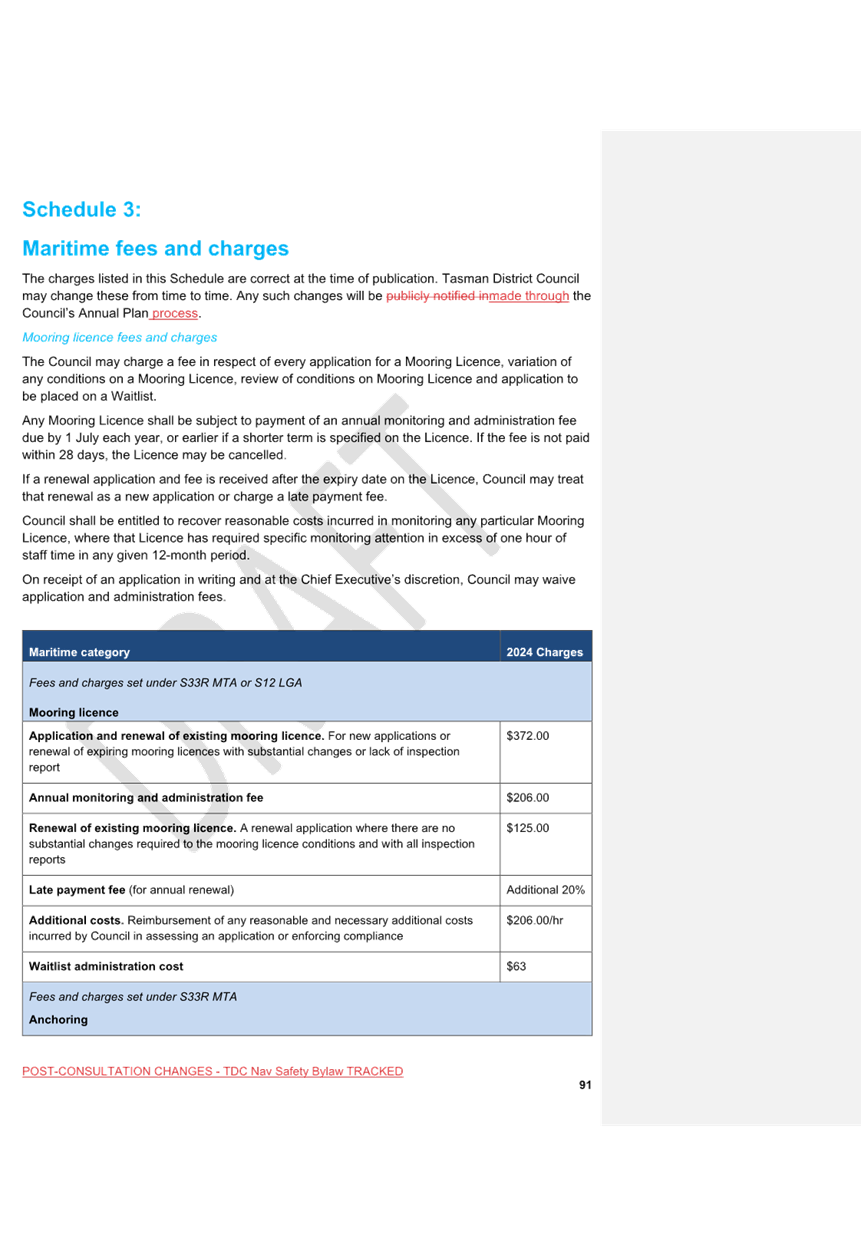
12.2 The Bylaw proposes a range of maritime fees and
charges, including a navigational aid levy. These fees have been set at a level
that covers the cost of the Council administering the Bylaw.
13.1 The key risks are reputational
and litigation risks related to the decisions the Panel is being asked to make.
13.2 A range of community views were received on various
provisions in the Bylaw. The Panel’s role is to
consider the views of the community alongside other advice it received, to make
decisions for the final Bylaw.
13.3 The Council does not have a current Navigation Safety
Bylaw and has relied on general enforcement powers under the MTA 1994,
public education, or the TRMP to manage navigation safety in the Tasman
District. This is a risk that will continue if the Panel does not recommend to
Council that it make the Navigation Safety Bylaw 2024.
13.4 If approved, the new Bylaw would be reviewed
within five years. This will help ensure that the maritime safety provisions
remain fit for purpose in a changing environment.
14. Climate
Change Considerations / Whakaaro
Whakaaweawe Āhuarangi
14.1 The Bylaw is unlikely to have any impact on the Council
or the Tasman District’s carbon footprint. Implementation of the Bylaw is
not likely to be impacted by the effects of climate change.
14.2 The Bylaw neither aligns or detracts from the
Council’s and Government’s plans, policies and legal obligations
relating to climate change.
15. Alignment
with Policy and Strategic Plans / Te Hangai ki ngā aupapa Here me ngā
Mahere Rautaki Tūraru
15.1 The scope of what a local navigation safety bylaw can and
cannot do is set out in section 33M of the MTA 1994.
15.2 The mooring area provisions in the Bylaw will allow TRMP
Plan Change 72 to become fully effective and provide the Council with a
consistent approach to managing moorings in the district.
16. Conclusion
/ Kupu Whakatepe
16.1 The proposed Navigation Safety
Bylaw aims to provide the Council with further regulatory authority over
navigation safety matters for water users in or on the waterways or coastlines
in the Tasman District.
16.2 The main theme of public feedback, other than strong opposition to
clause 12.1, was general support for the Bylaw, particularly the
requirements regarding personal floatation devices, vessel identification and
communication equipment.
16.3 The
other key themes were:
· Support for AIS tracking, but some commercial operators raised
concerns.
· Strong support for the river speed upliftings provisions, but a
request to remove cumec ratings and an advisory clause.
· Mixed views on the proposed navigation aid levy.
16.4 In response to submissions, staff have recommended a
number of changes be made to the Bylaw for the Panel’s consideration.
16.5 Staff
will incorporate the changes that the Panel request and, if the Panel
recommends, prepare the final Bylaw for consideration by the Council at its 24
October 2024 meeting.
16.6 The
Bylaw is a new bylaw and, once adopted, will be reviewed within five years
17. Next
Steps and Timeline / Ngā Mahi Whai Ake
17.1 Staff
will prepare a referral report with the Panel’s recommendations to be
considered by the Council at its meeting on 24 October 2024.
17.2 If
Tasman District Council agree to make the Bylaw, it will be publicly notified
in Newsline and on the Council’s website before coming into force on 1
December 2024. A copy of the Bylaw will also be provided to the Director of
MNZ.
17.3 Once
the Bylaw is made, staff will engage with the Ministry of Transport to update
the associated Maritime Transport Regulations 2016 with infringement fees for
offences under the new Bylaw. This process is likely to run into 2025.
|
1.⇩
|
Navigation
Safety Bylaw 2024 – Draft Hearing Schedule
|
20
|
|
2.⇩
|
Navigation
Safety Bylaw 2024 - Submissions Summary
|
22
|
|
3.⇩
|
Navigation
Safety Bylaw 2024 - Proposed Changes
|
27
|
|
4.⇩
|
Proposed
Navigation Safety Bylaw 2024 (changes tracked)
|
35
|