Tasman District
Council
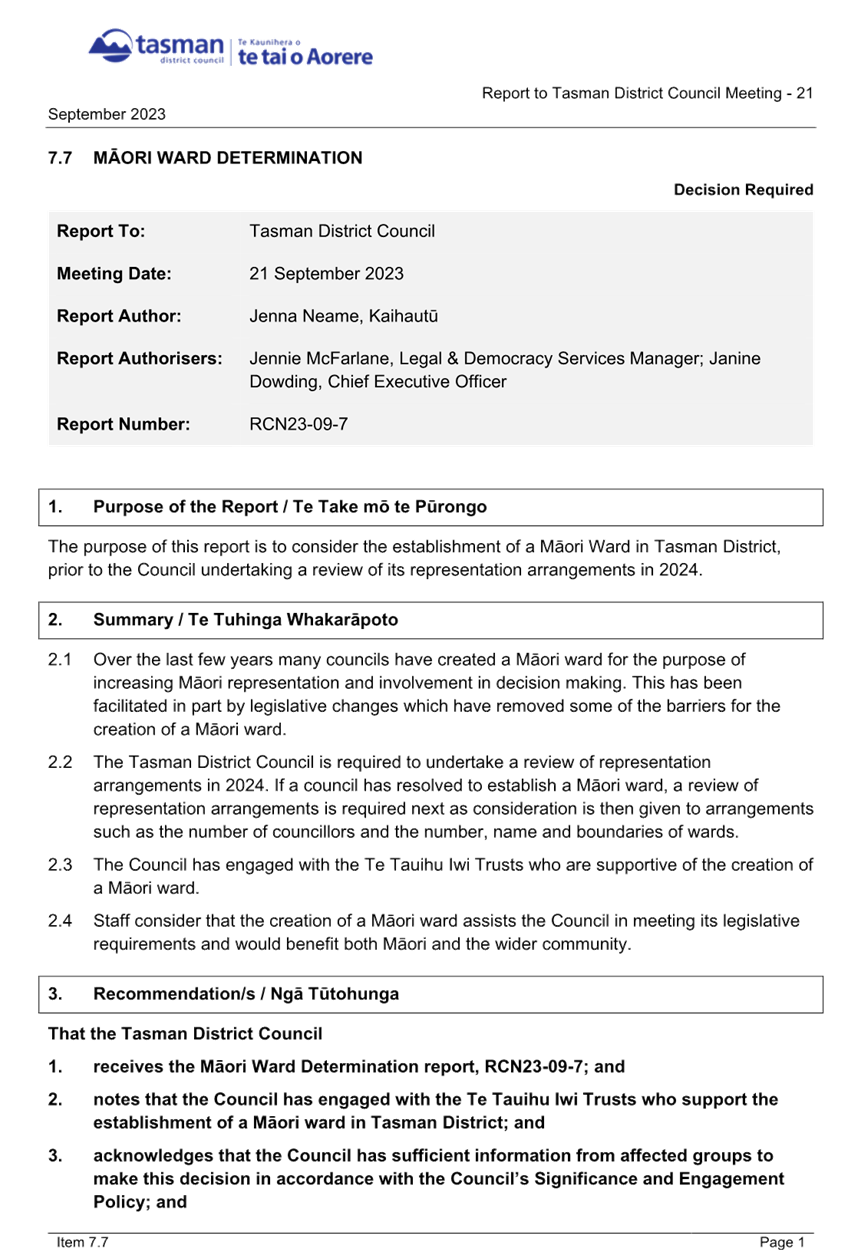
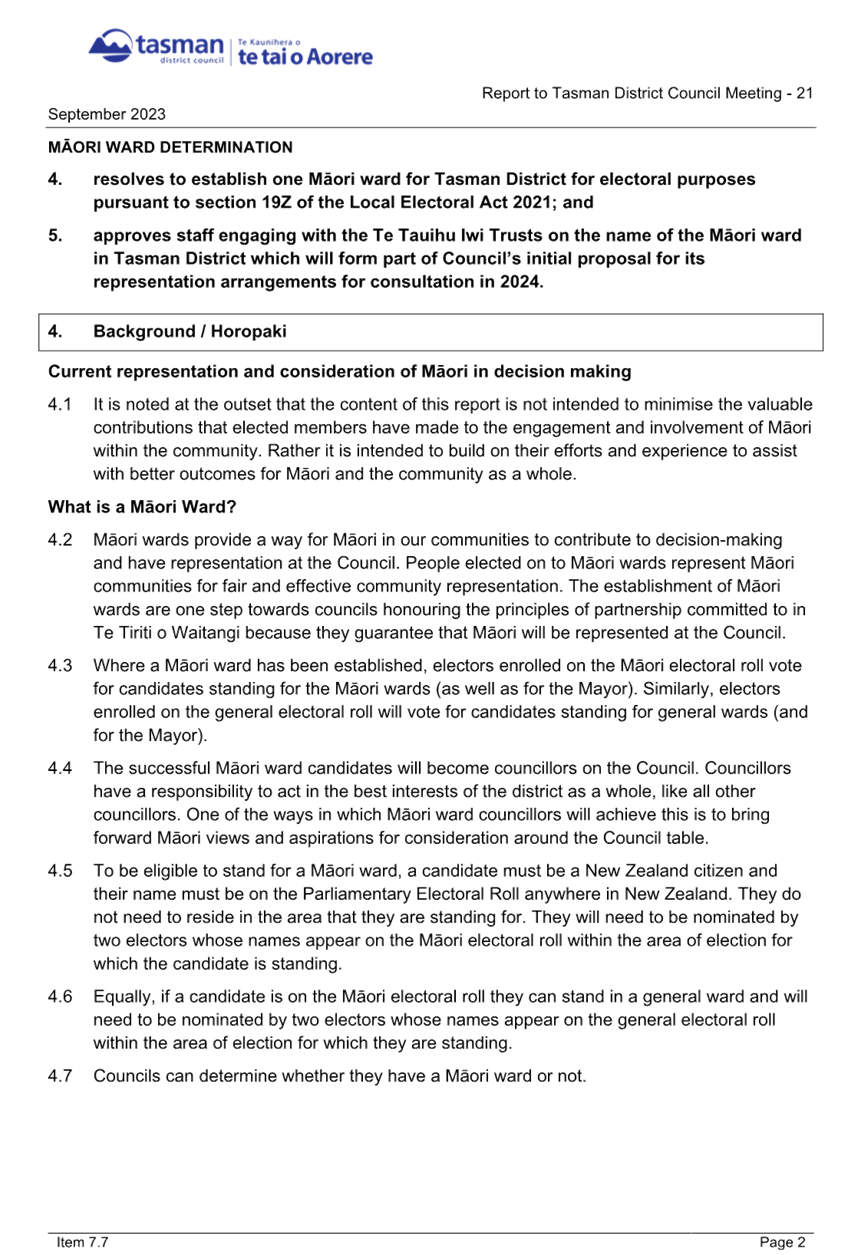
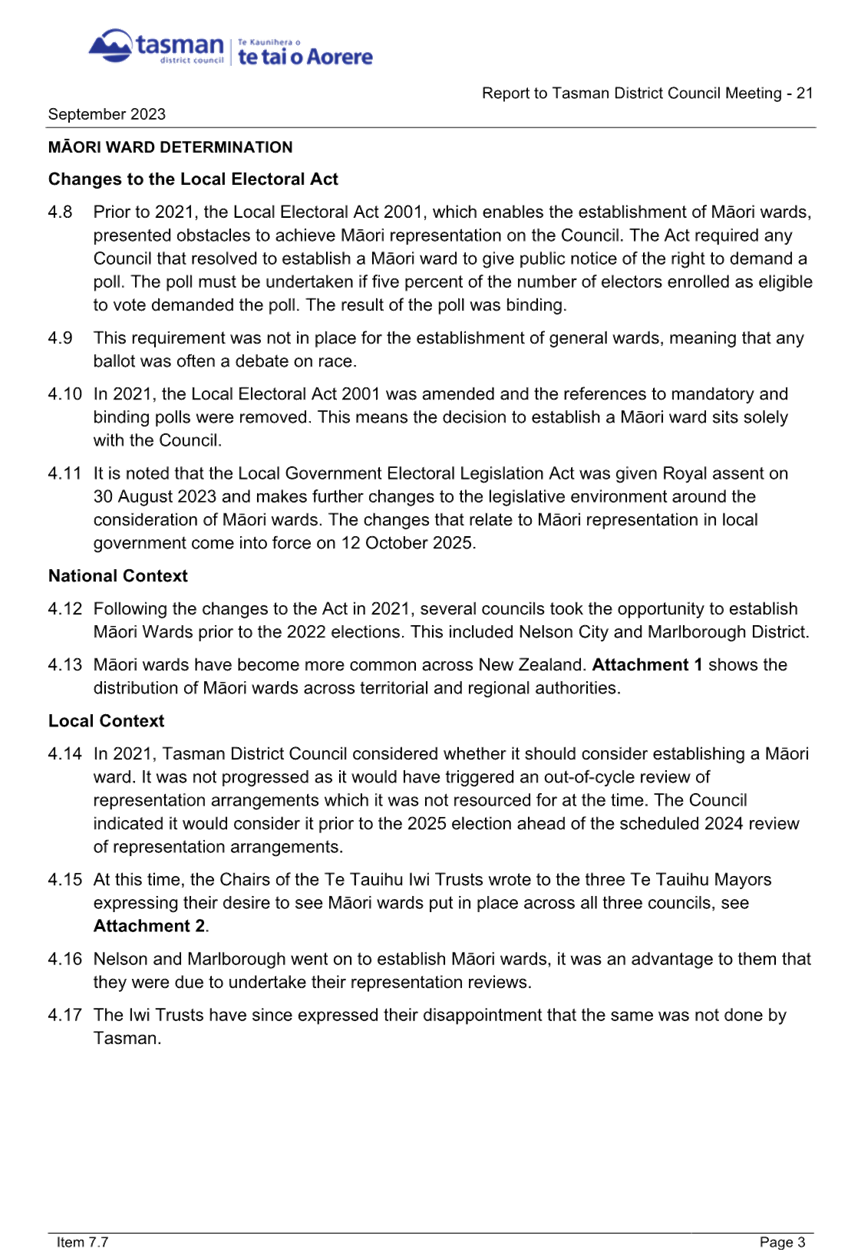
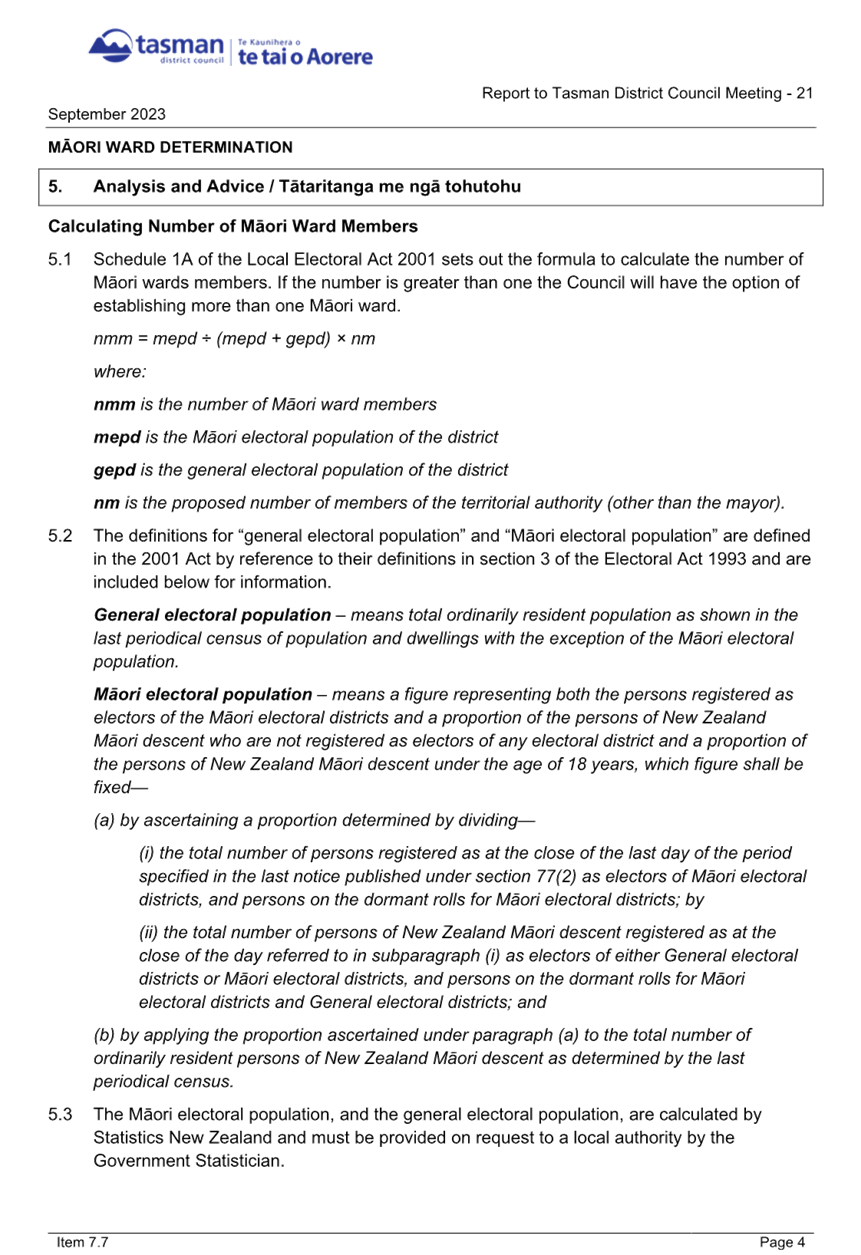
Agenda – 05 September 2024
7 Reports
7.1
Decision on Māori
ward as required under the Local Government (Electoral Legislation and
Māori Wards and Māori Constituencies) Amendment Act 2024
Decision Required
|
Report
To:
|
Tasman
District Council
|
|
Meeting
Date:
|
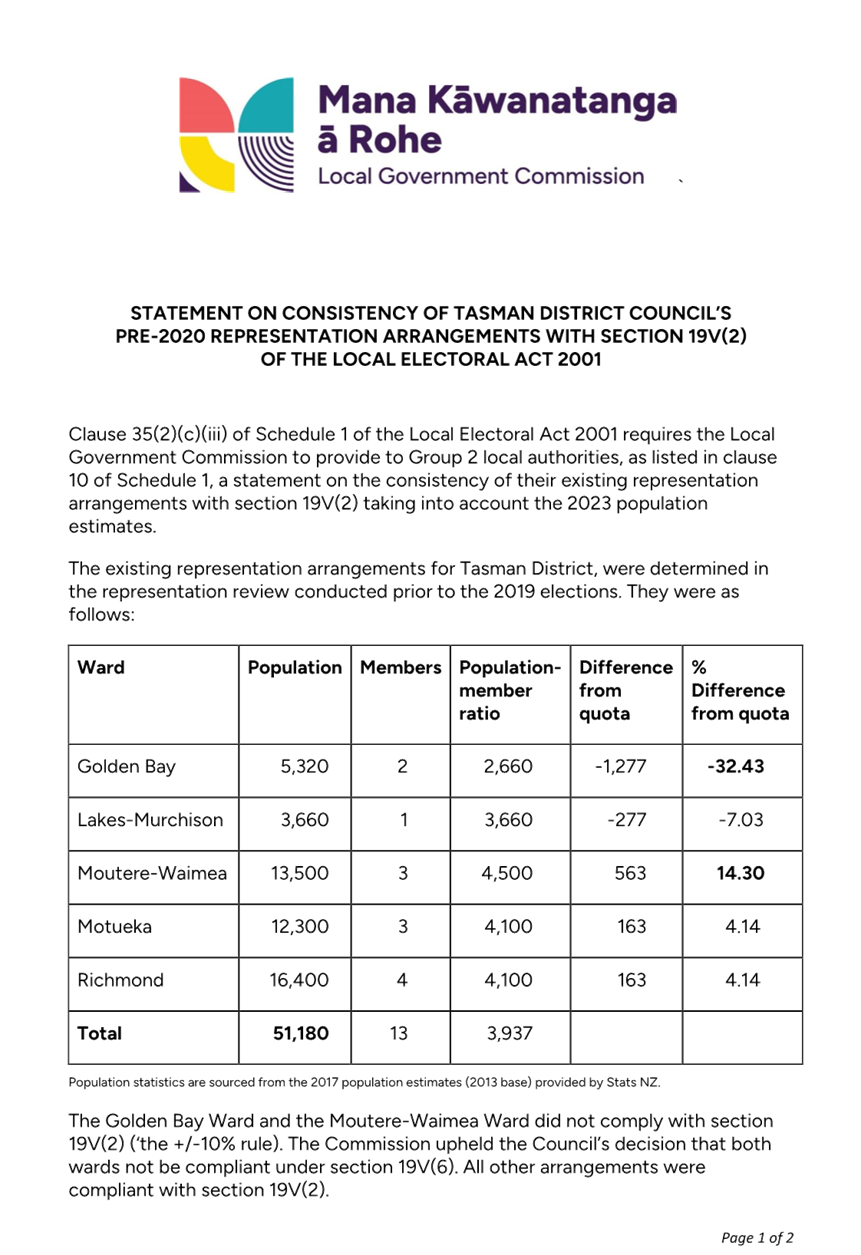
5
September 2024
|
|
Report
Author:
|
Renee
Thomas, Kaihautū - Te Kāhui Hononga; Leith Townshend, General
Counsel
|
|
Report
Authorisers:
|
Leonie
Rae, Chief Executive Officer
|
|
Report
Number:
|
RCN24-09-1
|
1.1 The
purpose of this report is to decide on whether the Council should affirm or
rescind its decision to establish a Māori ward for the 2025 local
elections, in accordance with the Local Government (Electoral Legislation and
Māori Wards and Māori Constituencies) Amendment Act 2024 (the
Amendment Act).
2. Summary
/ Te Tuhinga Whakarāpoto
2.1 On
21 September 2023, the Council resolved to establish a Māori ward for
electoral purposes pursuant to section 19Z of the Local Electoral Act 2001. At
the time of this decision there was no requirement for the Council to hold a
binding poll on whether to have a Māori ward.
2.2 Following
the General Election in 2023, the incoming government signalled its intention
to amend the Local Electoral Act 2001 to restore the requirement for councils
to hold a binding poll when establishing a Māori ward.
2.3 The
Amendment Act came into effect on 31 July 2024.
2.4 For
councils such as Tasman District Council, a decision is required whether to
affirm or rescind the previous decision.
2.5 If
the decision is to affirm the previous decision:
2.5.1 the Council’s current representation review will
continue;
2.5.2 there will be a Māori ward for the 2025 local
government election;
2.5.3 a binding poll will be held concurrently with the 2025
local government election, and
2.5.4 the results of that poll will be applied to the 2028 and
2031 local government elections.
2.6 If
the decision is to rescind the previous decision:
2.6.1 the current representation review process could end;
2.6.2 there will not be a Māori ward for the 2025 local government
election; and
2.6.3 the Council can continue with its existing
representation arrangements (as for the 2019 and 2022 elections) for the 2025
local elections.
2.7 In
the lead up to this legislation being passed, the Council has engaged with
representatives of the eight local iwi. Five iwi have responded, requesting
that the Council affirms its previous decision of September 2023 to establish a
Māori ward.
2.8 Based on this, the officer recommendation is
that the Council affirms the decision to have a Māori ward.
3. Recommendation/s
/ Ngā Tūtohunga
That the Tasman
District Council
1. receives
the ‘Decision on Māori ward as required under the Local Government
(Electoral Legislation and Māori Wards and Māori Constituencies)
Amendment Act 2024’ report; and
2. resolves, pursuant to clause 29, part three of
schedule one of the Local Electoral Act 2001, to affirm the previous decision
of the Council to establish a Māori ward;
3. notes that the effect of this decision is that
the Tasman District will have a Māori ward for electoral purposes for at
least the 2025 local government election; and
4. notes that a binding poll will be held at the
2025 local election with the results of that poll being in place for the 2028
and 2031 local elections; and
5. notes that the holding of a binding poll will
require additional expenditure which will need to be incorporated into the
2025/2026 Annual Plan.
4.1 After
feedback and support from Te Tauihu iwi Chairs, in September 2023 the Tasman
District Council unanimously voted in favour of the following:
4.1.1 establishing one Māori Ward for Tasman District for
electoral purposes pursuant to section 19Z of the Local Electoral Act 2001; and
4.1.2 approving staff engaging with the Te Tauihu Iwi Trusts
on the name of the Māori ward in Tasman District which would form part of
the Council’s initial proposal for its review of representation
arrangements for consultation in 2024.
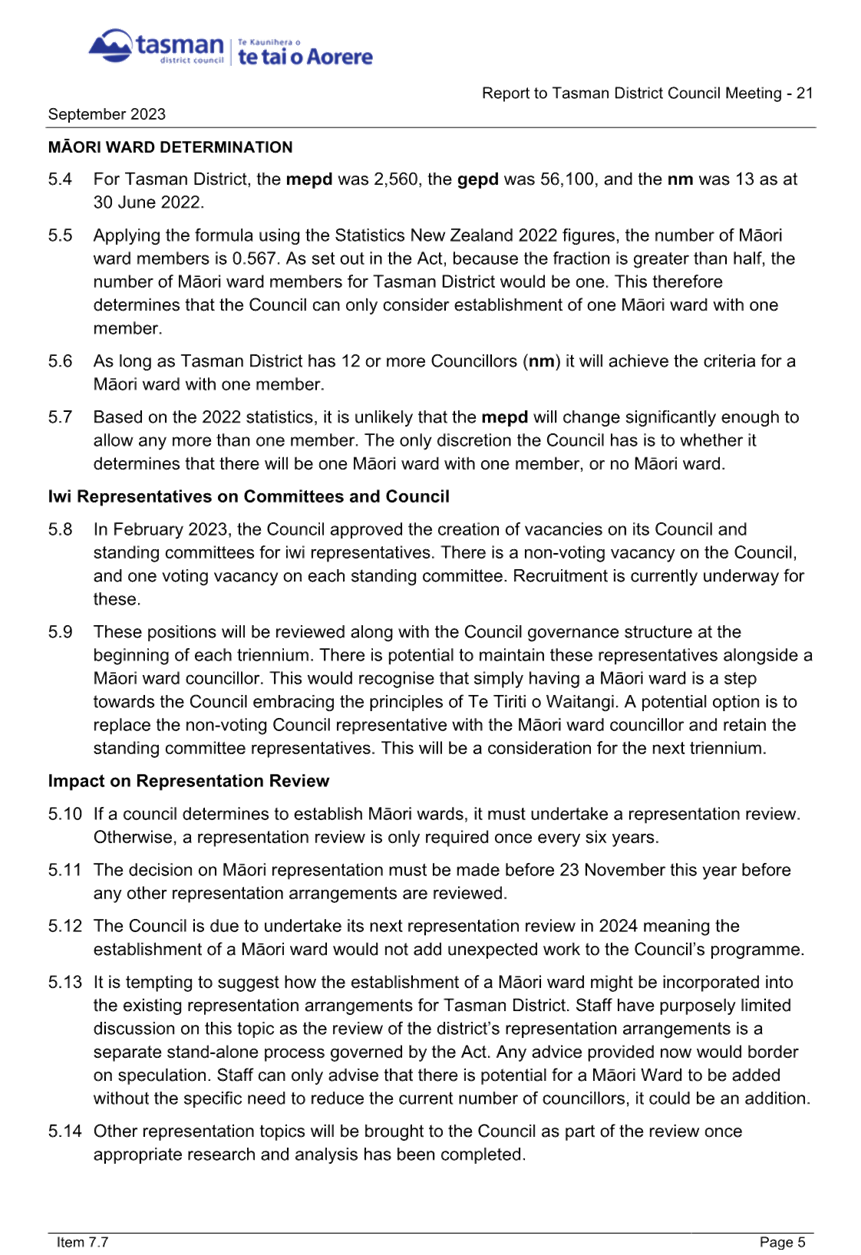
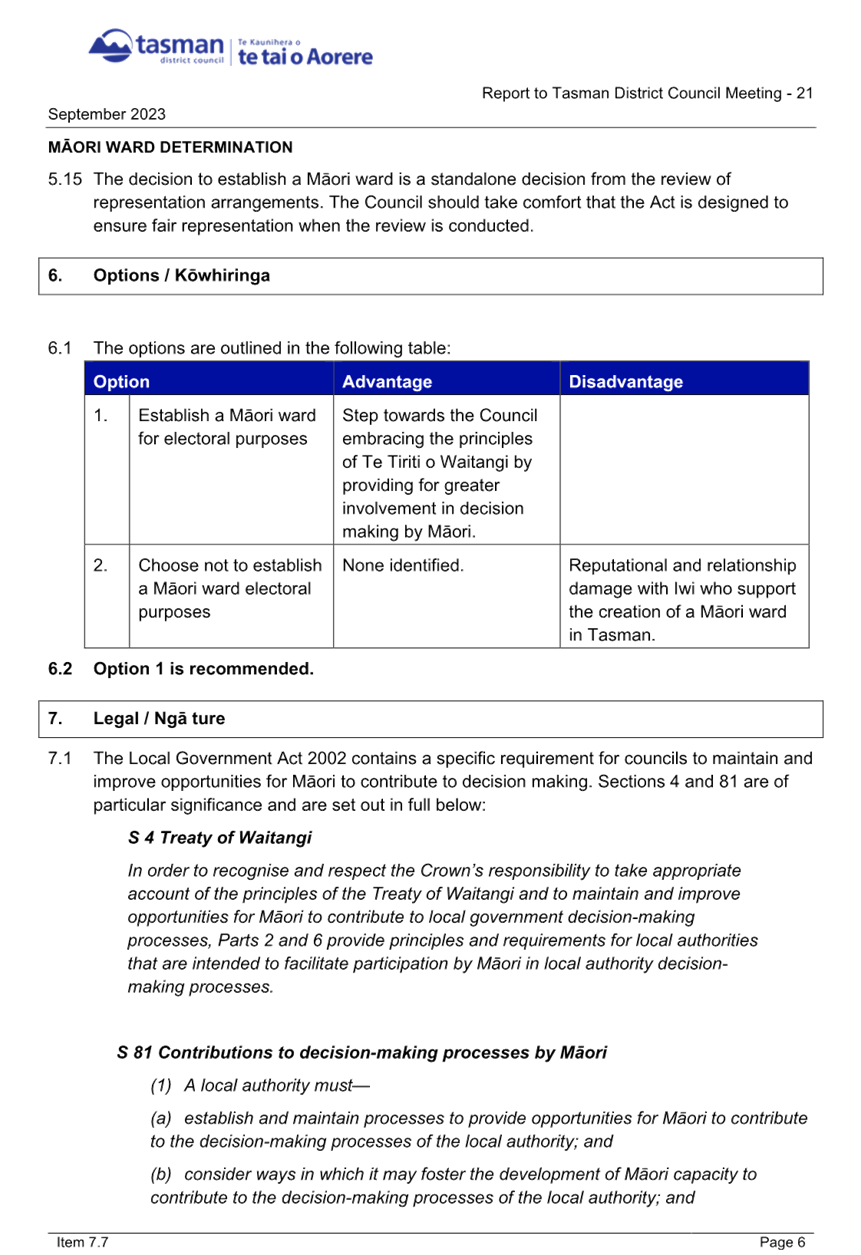
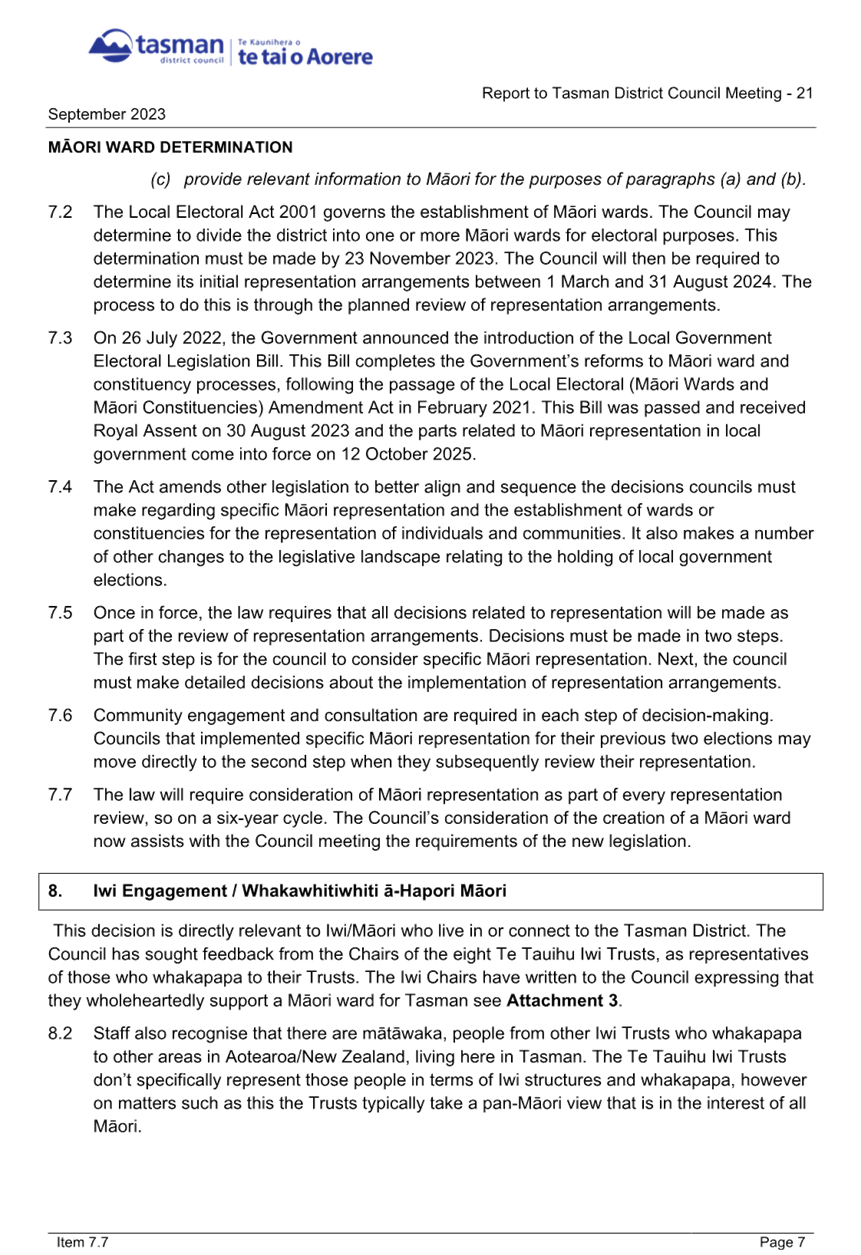
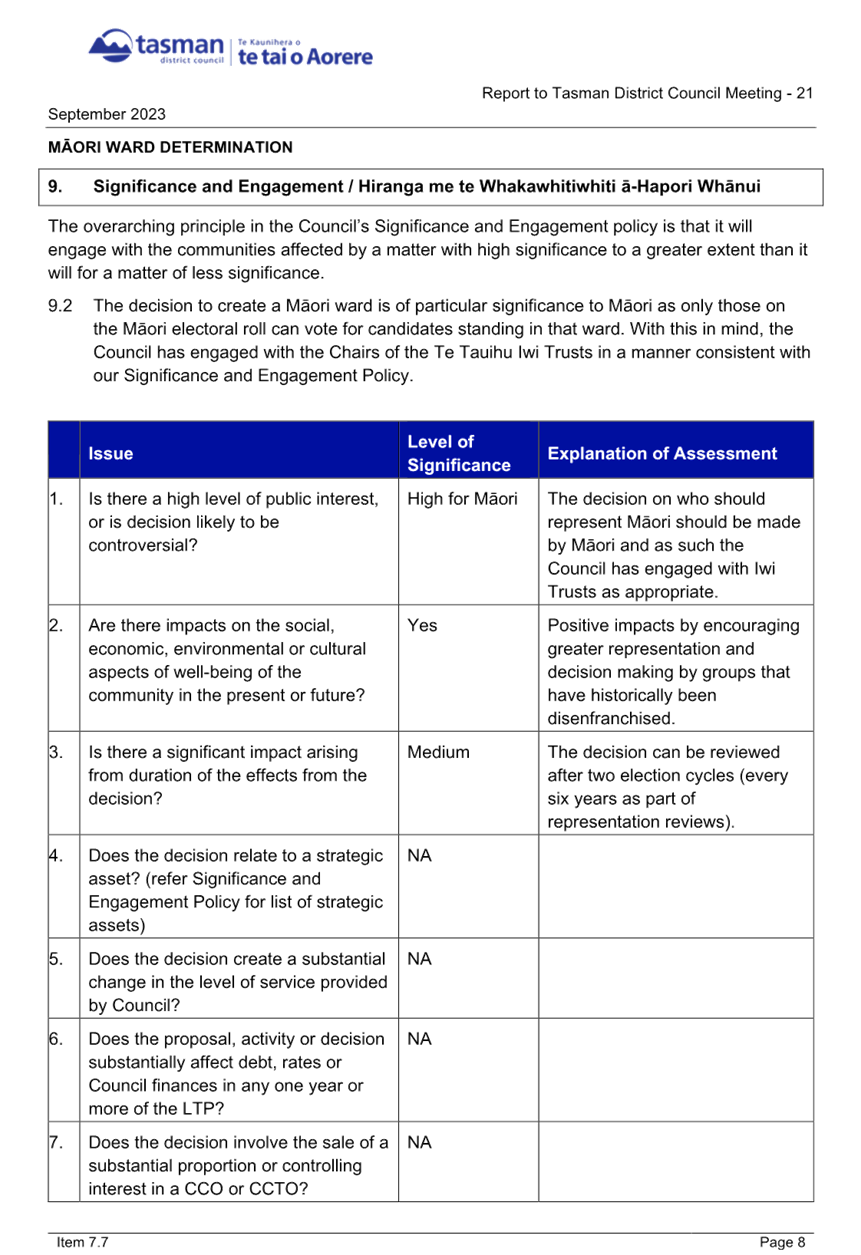
4.2 The
reasons for this decision are set out in the September 2023 report to the
Council which is attached to this report as Attachment 1.
4.3 Under
the legislation at the time of this decision, a binding poll was not required
to establish a Māori ward. Forty-five (45) councils have resolved to
include a Māori ward as part of their representation arrangements without
requiring a binding poll.
4.4 The
name put forward by the iwi chairs is ‘Te Tai o Aorere Māori
ward’. The Local Government Commission (LGC) has confirmed that it
considers the name to be appropriate. This was included in the Council’s
initial proposal which is currently being consulted on.
4.5 In
April 2024, a letter was issued from the Minister of Local Government, Simeon
Brown, outlining the coalition government’s proposed legislation changes
regarding Māori wards.
4.6 The
Local Government (Electoral Legislation and Māori Wards and Māori
Constituencies) Amendment Bill was introduced and went through the Select
Committee process. This Bill, amongst other minor electoral changes, reinstates
the requirements for councils to hold binding polls to establish Māori
wards. This Bill was passed on 30 July 2024 and came into effect on 31 July
2024.
4.7 In
May 2024, 44 Mayors, eight Chairpersons and two members of the LGNZ
Subcommittee of Māori elected members signed a letter opposing the
government’s proposed changes requiring a binding poll for Māori
wards.
4.8 On
29 May 2024, the Council also submitted to the Justice Select Committee
opposing the reintroduction of binding polls being mandated for the creation of
Māori wards. The Council submitted that the changes constitute decisions
being taken away from local government and that they will have negative effects
on encouraging Māori to participate in local government decision
making.
4.9 Of
the 45 councils that resolved to have a Māori ward without holding a poll:
· Thirty-one (31) did so last term and so have current Māori ward
Councillors (group one councils); and
· Thirteen (13) did so this term and so have not yet elected
Māori ward Councillors (group two councils).
4.10 For
Tasman District Council (a group two council) there are two options –
either rescind or affirm the decision to establish a Māori ward.
4.11 The
Council is required to formally resolve a decision on these options by 6
September 2024.
5. Analysis
and Advice / Tātaritanga me ngā tohutohu
Guidance received from the Department of Internal
Affairs (DIA)
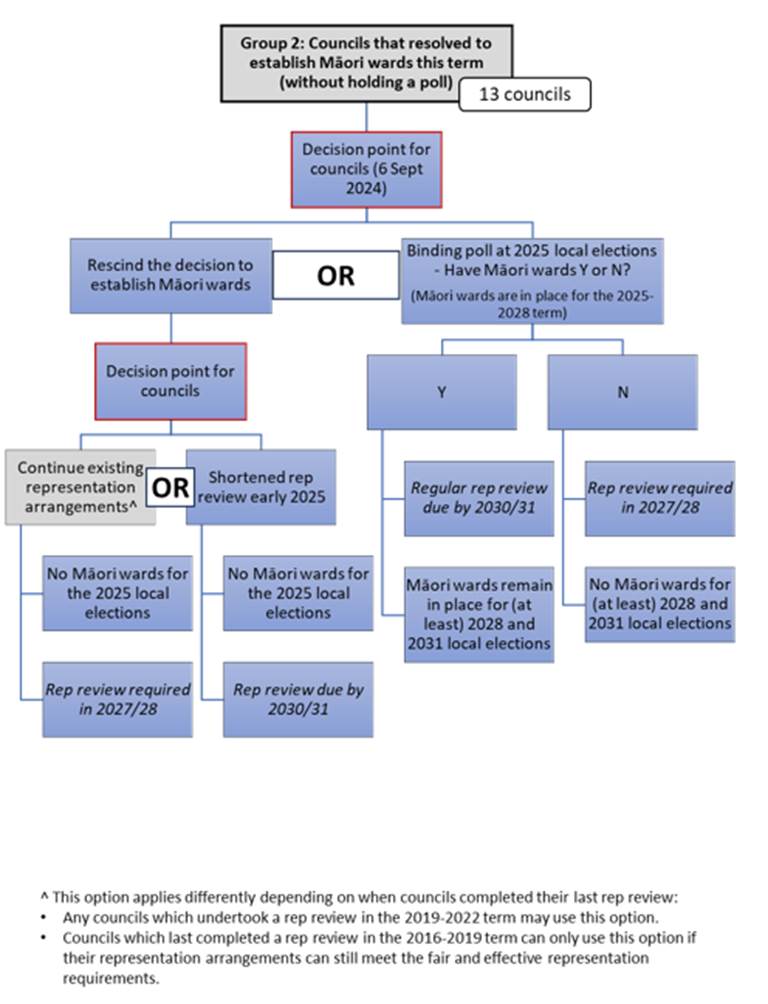
5.1 The DIA has produced the following flow chart
to guide councils through the decision-making process outlined by the Act.
5.2 It is noted that Tasman is a ‘group
two’ council, meaning that it has resolved to establish a Māori ward
from the 2025 elections, without holding a poll.
Decision to affirm a Māori ward for electoral purposes
5.3 The
following outlines the impact of the Council affirming its previous decision to
have a Māori ward for electoral purposes.
5.4 The
Council’s current representation review process will continue and will
contain a Māori ward. As part of the representation review process, the
Council will need to resolve the name of the Māori ward.
5.5 The
local government election in 2025 will contain a Māori ward and candidates
who meet the eligibility criteria will be able to stand for election in that
ward.
5.6 In
conjunction with the local government election in 2025, a binding poll will be
held. This poll will ask whether, from the 2028 election, the District should
include a Māori ward.
5.7 The
holding of this poll with the local government election will incur additional
costs estimated to be $60,000. Additional funds will need to be allocated to
the election budget as part of the Annual Plan 2025/2026.
5.8 If
more than 50% of the votes received support the retention of a Māori ward:
5.8.1 the Council will retain the Māori ward
for at least the 2028 and 2031 local elections; and
5.8.2 the Council will be required to undertake
its next representation review by 2030/31.
5.9 If
more than 50% of the votes received do not support the retention of a
Māori ward:
5.9.1 the Council will retain a Māori ward
for the 2025 triennium;
5.9.2 barring any future law change, the Council
will not have a Māori ward for the 2028 and 2031 local government
elections; and
5.9.3 the Council will be required to undertake a
further representation review in 2027, for the 2028 local government
election.
5.10 In
the lead up to the 2025 local government election the Council will need to
ensure that Council resources are not used to promote any particular position
in relation to the poll.
5.11 The
Council can legitimately help ensure that electors are
informed about the poll and the issues to be determined. However, the Council
must not advocate for a particular outcome.
5.12 It
is noted that this does not prevent any individual elected member from having a
position on the poll so long as they are clear that they are not speaking on
behalf of the Council and are still able to keep an open mind in any subsequent
decision making in relation to Māori wards.
Rescinding Council’s previous decision
5.13 If
the Council decides to rescind its previous decision to establish a Māori
ward, then there will be no Māori ward for the 2025 local government
election.
5.14 It
must also resolve by 6 September 2024 how its representation arrangements for
the 2025 election will be determined.
5.15 Under
the Act the Council can either:
5.15.1 continue with the existing representation arrangements,
but only if the representation arrangements are compliant with the ‘fair
and effective representation’ requirements under the Local Electoral Act
2001; or
5.15.2 complete a shortened representation review in
2025.
5.16 If
an exemption from compliance under section 19V(3) of the Local Electoral Act
2001 has previously been upheld on a determination by the Local Government
Commission (LGC) under section 19V(6) relating to specific wards, that
exception continues to apply.
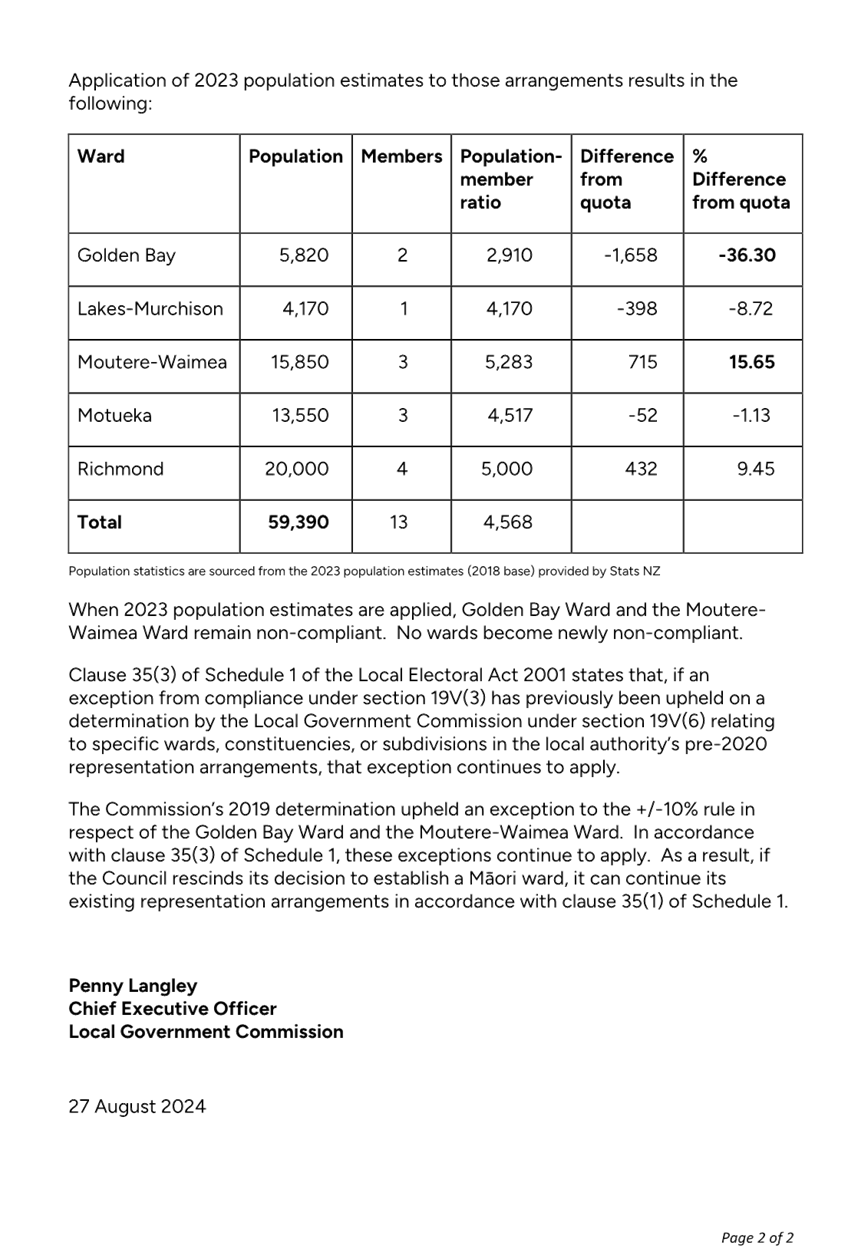
5.17 Below
is a table which sets out the wards that are currently in place, incorporating
updated population estimates (as at June 2023) from Statistics NZ.
|
Ward
|
Population (Estimated resident population at
30 June 2023)
|
Number of Councillors
|
Population per Councillor
|
Difference from quota
|
% difference from quota
|
|
Golden Bay
|
5,820
|
2
|
2,910
|
-1,658
|
-36.30
|
|
Lakes-Murchison
|
4,170
|
1
|
4,170
|
-398
|
-8.72
|
|
Moutere-Waimea
|
15,850
|
3
|
5,283
|
715
|
15.65
|
|
Motueka Ward
|
13,550
|
3
|
4,517
|
-52
|
-1.13
|
|
Richmond
|
20,000
|
4
|
5,000
|
432
|
9.45
|
|
Total (General wards)
|
59,390
|
13
|
4,568
|
|
|
5.18 The
Golden Bay and Moutere-Waimea wards do not comply with the fair representation
requirements under section 19V(2) of the Local Electoral Act. However they were
exempted from compliance by the 2019 determination of the LGC under section 19V(3), in respect of:
5.18.1 Golden Bay Ward, as non-compliance is required for
effective representation of isolated communities of interest within this ward;
and
5.18.2 Moutere-Waimea Ward, as compliance would limit
effective representation by dividing communities of interest between wards.
5.19 Under
the provisions of the Amendment Act, previous exemptions given by the LGC
continue to apply to those wards, so that the Council can continue with its
current representation arrangements.
5.20 The LGC has provided a formal statement confirming the consistency
of the pre-2020 arrangements with section 19V(2) of the Local Electoral Act
2001, taking into account the 2023 population estimates (per clause 35 of
Schedule 1 of the Act). This statement is Attachment 2[1].
5.21 The
Council would be required to undertake a representation review in 2027/28 for
the 2028 elections.
5.22 Continuing
with current electoral arrangements means that the Council’s current
representation review will cease. Much of the work on creating the initial
proposal has already occurred but there will be a cost saving estimated at
$15,000-20,0000 plus freeing up staff and elected member
time.
5.23 Alternatively,
the Council could choose to undertake a shortened representation review. The
timing for the shortened representation review is:
· by 6 September 2024 - resolve how the representation arrangements
for the 2025 election will be set;
· by 13 September 2024 – resolve an initial proposal;
· within seven days of the resolution and not later than 20 September
2024 - local authority gives public notice of initial proposal and invites
submissions;
· submissions close not less than three weeks after public notice;
· if there are no submissions then the proposal becomes final (subject
to confirmation by the LGC);
· within six weeks of the closing date for submissions - local
authority considers submissions and may make a resolution to amend the
proposal;
· within six weeks of the closing date for submissions - local
authority gives public notice of its "final" proposal;
· not less than three weeks after public notice and no later than 13
December 2024 – appeals and objections close.
5.24 Once
objections close, there will be a process with the LGC where it considers resolutions, submissions, appeals and objections and makes
determination.
5.25 The truncated timing is likely to put pressure on staff to complete
the tasks and effectively engage with the community. For this reason of the two
options (should the Council vote to rescind), officers recommend continuing
with our current representation arrangements.
5.26 The next representation review would be required to be held by
2030/2031.
6. Iwi
Engagement / Whakawhitiwhiti ā-Hapori Māori
6.1 The Council is supportive of whānau,
hapū and iwi and embraces the values within the Te Tauihu Together
Partnership Agreement and our obligations under the Local Government Act 2002
to facilitate participation by Māori in local authority decision making.
6.2 Iwi across Aotearoa have been critical
of the legislative change which requires a binding poll for a Māori ward
but does not require the same for the creation of other wards during a
representation process.
6.3 While
the decision is ultimately up to the Council, guidance and direction was sought
from Te Tauihu iwi Chairs. A paper was presented to the Mayors and Chairs forum
on 19 June 2024, outlining the steps taken to date and the
advantages/disadvantages of each option.
6.4 A
quorum of iwi CEO’s has expressed support for the Council continuing to
have a Māori ward.
6.5 In
further kōrero with iwi, some expressed concerns about the divisive nature
of a binding poll. However ultimately the consensus was that a Māori ward,
and therefore having to have a binding poll, was the preferred option.
7.1 Under
the provisions of the Amendment Act there are only two options available for
Tasman District Council as a group 2 council:
7.1.1 resolve by 6 September 2024 to rescind the decision to
create a Māori ward; or
7.1.2 resolve by 6 September 2024 to affirm the decision to
create a Māori ward by Council resolution.
7.2 If
the decision is to rescind, the Council must resolve how its representation
arrangements for the 2025 election will be determined. The options are:
7.2.1 revert to the previous (pre-2020) representation
arrangements; or
7.2.2 undertake a shortened representation review.
7.3 The advantages and disadvantages of these
options are outlined in the following table:
|
Option
|
Advantage
|
Disadvantage
|
|
1.
|
Rescind the decision to create a
Māori ward
|
No binding poll at the 2025 local
government election which will mean the cost of holding a poll is not
incurred.
The Council could reconsider the option
to have a Māori ward sooner than it could if a poll was lost.
The holding of the poll is likely to be a
divisive issue at the 2025 election.
The representation review could cease
creating a cost saving for the Council.
The Council can still appoint non-voting
iwi members to the Council.
|
No Māori ward will be created.
Risk of perception that the Council is
not supportive of Māori participation in the Council.
Reputational damage with local iwi who
support the creation of a Māori ward.
The Council will be required to either
revert to its pre-2020 arrangements or initiate a shortened representation
review process and complete it on a truncated timeframe.
|
|
2.
|
Affirm the decision to create a
Māori ward
|
Democratic process followed.
The Council will have a Māori ward
for at least the 2025 triennium.
Possibility of a Māori ward being
supported by the wider public meaning the ward would remain for the 2028 and
2031 elections.
A Māori ward would supplement the
voting Iwi Representatives on the Council’s standing Committees.
A Māori ward would also improve the
facilitation of Māori in decision making as required by the Local
Government Act.
|
Additional cost of running a binding poll
alongside the general election, estimated at $60,000.
Given the political climate, the outcome
of a poll is not guaranteed and could be divisive.
Risk of community voting against a
Māori ward which would remove the Māori ward for the 2028 and 2031
elections.
|
7.4 Option 2 is recommended.
8.1 Several groups have
expressed concerns about the passing of the Amendment Act and raised concerns
about discrimination against Māori. These include:
· the members of the Labour Party and Green Party on the Justice
Committee who submitted a differing view on whether the Bill should be enacted;
· the Waitangi Tribunal in report WAI3365 which raised concerns about
the passing of the Bill being a breach of Te Triti o Waitangi; and
· the Human Rights Commission which in its submission labelled the
Bill discriminatory.
8.2 The Attorney-General is required to provide a
report on the consistency of the Bill with the New Zealand Bill of Rights Act. That
report (LPA 010124) concluded that the Bill appears to
be consistent with the rights and freedoms affirmed in the Bill of Rights Act
1990. However, it is worth noting that the report did find the following:
“In
practice, binding polls have proven a barrier to the establishment of
Māori wards in local authorities”
8.3 Despite these concerns
being raised, the Bill has been legally passed by Parliament and therefore the
Council is required to follow the process set out by legislation.
8.4 Failure to do so would
expose the Council to the following risks:
8.4.1 statutory intervention by
Ministers;
8.4.2 Council decision-making being
considered invalid and subject to challenge; and
8.4.3 reputational damage in the
community.
8.5 The effect of the legislation is set out in
the analysis section of this report.
9. Significance
and Engagement / Hiranga me te Whakawhitiwhiti ā-Hapori Whānui
9.1 Given the feedback and attention that this
topic has received around Aotearoa it is considered that this decision is of
high significance.
9.2 Due to time constraints, the Council has not
consulted generally on this decision. The Amendment Act is clear that in making
this decision the Council is not required to undertake a special consultative procedure
(SCP) process.
9.3 While the decision to establish a Māori
ward is not within the scope of the current representation review, as of 29
August 2024, 57 individuals have mentioned Māori wards in their
submissions on the initial proposal. Of these 57 submissions:
· 46 clearly support the retention of a Māori ward; and
· 11 are clearly opposed to having a Māori ward.
9.4 In addition, elected members have received 91
identical emails from individuals who oppose the Council voting to affirm its
previous decision on a Māori ward.
9.5 It is noted that these numbers are not
necessarily representative of the community and the submission period has not
yet ended.
|
|
Issue
|
Level of
Significance
|
Explanation of
Assessment
|
|
1.
|
Is there a high level
of public interest, or is decision likely to be controversial?
|
High
|
General feedback has
been either very positive or very negative, this is seen as a polarising
topic.
|
|
2.
|
Are there impacts on
the social, economic, environmental or cultural aspects of well-being of the
community in the present or future?
|
High
|
Positive future
impacts for the community from having a Māori ward in place.
|
|
3.
|
Is there a
significant impact arising from duration of the effects from the decision?
|
Yes
|
Depending on the
decision the impact may last two future election cycles.
|
|
4.
|
Does the decision
relate to a strategic asset? (refer Significance and Engagement Policy for
list of strategic assets)
|
N/A
|
|
|
5.
|
Does the decision
create a substantial change in the level of service provided by Council?
|
NA
|
|
|
6.
|
Does the proposal,
activity or decision substantially affect debt, rates or Council finances in
any one year or more of the LTP?
|
Low
|
$60,000 cost for
binding poll.
|
|
7.
|
Does the decision
involve the sale of a substantial proportion or controlling interest in a CCO
or CCTO?
|
N/A
|
|
|
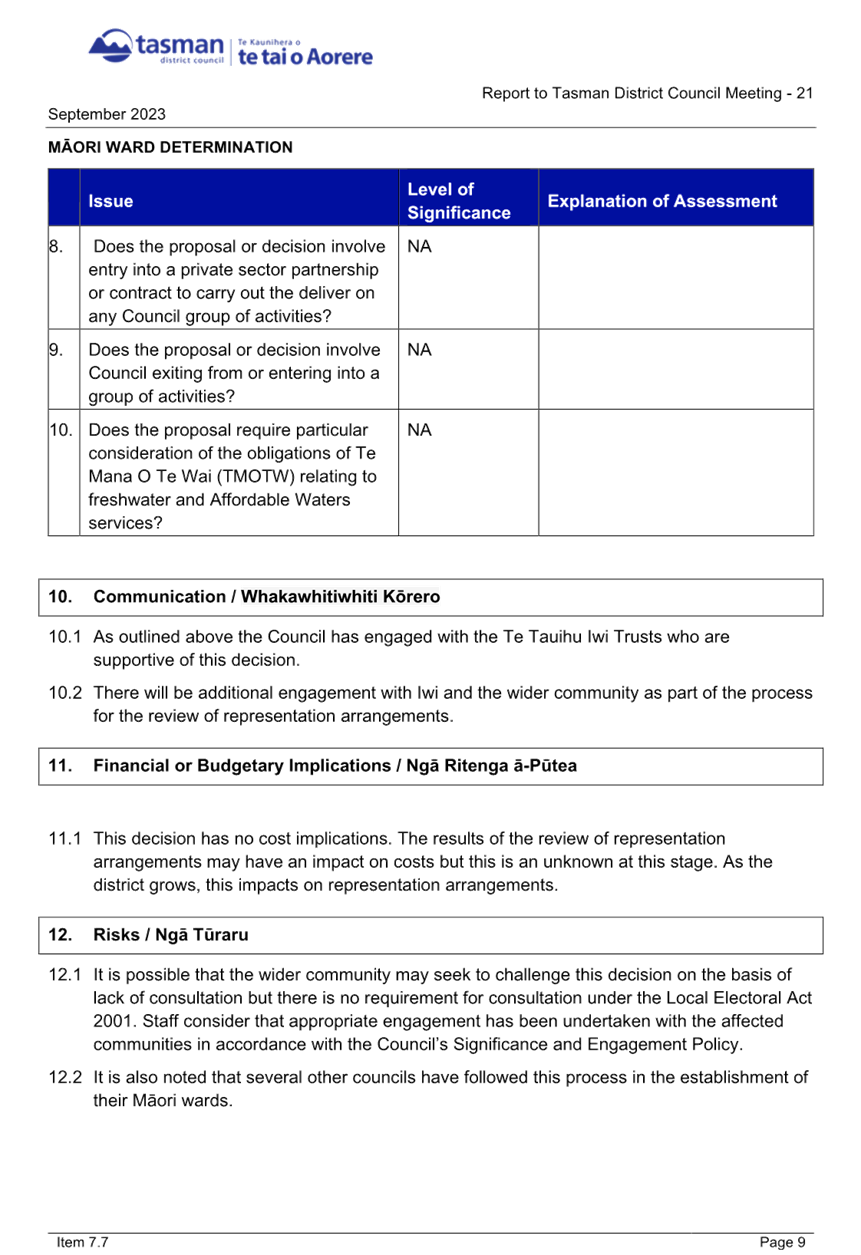
8.
|
Does the
proposal or decision involve entry into a private sector partnership or
contract to carry out the deliver on any Council group of activities?
|
N/A
|
|
|
9.
|
Does the proposal or
decision involve Council exiting from or entering into a group of
activities?
|
N/A
|
|
10. Communication
/ Whakawhitiwhiti Kōrero
10.1 The Council will publicise the outcome of this decision
and what it means for both the ongoing representation review and the 2025 local
government election.
11. Financial
or Budgetary Implications / Ngā Ritenga ā-Pūtea
11.1 If the decision is to affirm the Council’s previous
decision there will be additional costs to the Council to hold a poll at the
2025 election. Initial indications are that the cost of holding a poll in
conjunction with the 2025 election is approximately $60,000. This additional
cost will need to be budgeted for in the Annual Plan 2025/2026.
12.1 If the Council decides to affirm its previous decision
the risks are:
12.1.1 there will be a
binding poll, this could be divisive for our community; and
12.1.2 if the poll is
unsuccessful the Council will not have a Māori ward for the 2028 and 2031
elections.
12.2 If the Council rescinds its decision the risks
are:
12.2.1 reputational risk as the decision to
rescind could be perceived as the Council not supporting whānau, hapū
and iwi; and
12.2.2 there could be less participation by
Māori in decision-making.
13. Alignment
with Policy and Strategic Plans / Te Hangai ki ngā aupapa Here me ngā
Mahere Rautaki Tūraru
13.1 In June 2024, Tasman District Council completed its Long
Term Plan 2024-2034 (LTP) which includes a statement on fostering Māori
participation in Council decision-making through ngā iwi o te Tauihu and
Council partnership “The Council is committed to growing and
strengthening our working relationship and level of engagement with
iwi/Māori” (page 236). The recommendation to re-affirm the Māori
ward confirms this statement within the LTP.
13.2 This recommendation to re-affirm the Māori ward
aligns with the strategic framework for the Council which places iwi
relationships at the forefront of everything that the Council does. In December
2023 the three councils and eight iwi of Te Tauihu signed a Partnership
Agreement which outlines how they will work together. The decision to re-affirm
Māori wards supports the values within this Partnership Agreement:
13.2.1 Kotahitanga – We navigate and paddle
together in unison
13.2.2 Honotanga – We recognise each
other’s autonomy and mandate
13.2.3 Tauritetanga – We work together to
achieve equity in outcomes
13.2.4 Kaupapa Mau Tonu – We are in for the
long-term, for our mokopuna
13.2.5 Tau utu-utu – We foster reciprocity
and mutual benefit.
14. Conclusion
/ Kupu Whakatepe
14.1 The decision on whether to affirm or rescind the
Council’s previous decision to have a Māori ward is a contentious
issue within the community. The limited feedback received by the Council is
clear that there is no universal consensus on the issue.
14.2 Given all the steps taken by the Council and the support
from local iwi, the officer recommendation is that the Council affirm its
previous Māori ward decision.
15. Next
Steps and Timeline / Ngā Mahi Whai Ake
15.1 The decision of the Council and its implications will be made public
as soon as possible.
15.2 If the decision of the Council is to affirm its decision to
establish a Māori ward, the representation review currently in progress
will continue under the applicable statutory timeframe.
15.3 If the decision of the Council is to rescind its decision to
establish a Māori ward, and to continue with its current representation
arrangements for the 2025 election, the Council will publicly notify its
decision to continue with its current representation arrangements and send a
copy of the notice to relevant authorities.
|
1.⇩
|
Attachment
one - RCN23-09-7 - MĀORI WARD DETERMINATION REPORT
|
16
|
|
2.⇩
|
Attachment
Two - Local Government Commission’s statement of consistency for Tasman
District Council
|
26
|