Tasman District Council
Strategy and Policy Committee Agenda – 29 September 2022
9 Reports
9.1
Review of the Joint
Waste Management and Minimisation Plan 2019
Decision Required
|
Report To:
|
Strategy and Policy
Committee
|
|
Meeting Date:
|
29 September 2022
|
|
Report Author:
|
Amy Smith, Community Policy
Advisor
|
|
Report Number:
|
RSPC22-09-1
|
1.1 The
Waste Management Act 2008 requires councils to review their Waste Management
Plans at intervals of not more than six years. The current Joint Waste
Management and Minimisation Plan (the Waste Plan) was adopted by the councils
in September 2019, so must be reviewed before September 2025.
1.2 The
review has been brought forward with the intention of adopting a new or amended
Waste Plan by September 2023. This will allow better integration with both
councils’ Long Term Plans, as well as considering the upcoming
replacement New Zealand Waste Strategy and supporting legislation. This will
also be of benefit for contract renewals.
1.3 The
first step in the review process is to carry out a Waste Assessment to inform
the subsequent review. Nelson City Council (NCC) and Tasman District Council
(TDC) staff, with support from professional advisors, are currently preparing
the Nelson Tasman Joint Waste Assessment 2022 (the Waste Assessment).
1.4 The
initial findings of the Waste Assessment indicate that:
· since
the Waste Plan was adopted in 2019, waste to landfill per capita has slightly
reduced;
· putrescible waste
(green and food waste) continues to be a significant quantity of total waste to
landfill, at just over 15%;
· commercial and
industrial waste continues to be the largest source of waste to landfill; and
· there has been a
significant increase in e-waste diversion.
1.5 Staff anticipate that the
current Waste Plan will require amending or revoking and replacing, due to
significant upcoming changes in waste and climate change legislation as well as
the initial findings in the Waste Assessment.
1.6 Staff
recommend that the Council delegates the review to a Working Party of elected
and/or appointed members from each Council (to be appointed after the upcoming
local government elections). It is also recommended that iwi be invited to
nominate representation to the Working Party.
That the Strategy and Policy
Committee:
1 receives
the report Review of the Joint Waste Management and Minimisation Plan
2019 RSPC22-09-1; and
2 notes
Section 51 of the Waste Management Act 2008 requires the Waste Assessment to be
prepared to inform the review of the Nelson Tasman Waste Minimisation and
Management Plan 2019; and
3 notes
staff from Tasman District Council and Nelson City Council are progressing the
Nelson Tasman Waste Assessment and have provided an update on the initial
findings; and
4 notes
upcoming changes to waste and climate change legislation will be considered as
part of the Waste Assessment work; and
5 agrees
that the review of the Nelson Tasman Waste Management and Minimisation Plan
2019 will be undertaken jointly with Nelson City Council; and
6 agrees
to delegate the review to a joint-Council Working Party; and
7 approves
the Terms of Reference for the Nelson Tasman Joint Waste Review Working Party,
attached to this report (Attachment 1); and
8 notes
that in the new triennium members will be appointed to the Nelson Tasman Joint
Waste Review Working Party; and
9 agrees
that Te Tauihu Iwi Chairs be invited to nominate up to three iwi
representatives to the Nelson Tasman Joint Waste Review Working Party; and
10 requests
that the Nelson Tasman Joint Waste Review Working Party report back to the
appropriate Committee to ensure that a new or amended Waste Management and
Minimisation Plan can be adopted by September 2023.
3.1 The
purpose of this report is to receive an update on a Waste Assessment being
prepared under section 51 of the Waste Minimisation Act 2008, agree to review
with Nelson City Council the Nelson Tasman Waste Management and Minimisation
Plan, and agree to delegate the review to a joint-Council Working Party.
3.2 An
equivalent report was considered at a meeting of the Nelson City Council
Infrastructure Committee on 1 September 2022 and all recommended resolutions
were adopted.
4 Background
and Discussion
4.1 The
Waste Minimisation Act 2008 (the Act) requires all councils to review their
Waste Management and Minimisation Plan at intervals of not more than six years.
The current Waste Plan was adopted by Tasman District Council and Nelson City
Council (the Councils) in 2019.
4.2 The
next review is not due until 2025, but with significant legislative changes
proposed by central government, in partnership with Nelson City Council staff
the review has been brought forward. This will ensure that each council’s
upcoming Long Term Plan incorporates national legislative changes and enable
more effective contract renewals, which are also due within this timeframe.
4.3 Section
51 of the Act requires the Councils to prepare a Waste Assessment before
reviewing the Waste Plan. The following information is required in the
Waste Assessment:
· description of existing services;
· forecast of future demands;
· statement of options to meet forecast demands;
· statement of the Territorial Authority’s role in meeting
forecast demands;
· statement of Territorial Authority’s proposals for meeting
forecast demands;
· statement of how these proposals will protect public health and
promote effective and efficient waste management and minimisation.
4.4 Collaboration
with the Nelson Tasman Regional Landfill Business Unit (NTRLBU) is a key part
of the review, as the Terms of Reference require the NTRLBU to operate in
accordance with the Waste Plan. The longevity and capital requirements of the
York Valley and Eves Valley landfills are directly impacted by future waste
demands.
4.5 A
joint Working Party of elected members from each Council was appointed and
delegated to review the Waste Plan in 2017. The Working Party had
responsibility for oversight of the review process and the power to make
recommendations to both Councils. The final Waste Plan was brought to Council
for approval in 2019.
Nelson-Tasman Waste Assessment 2022
4.6 The
Councils appointed consultants Morrison Low in April 2022 to assist in the
preparation of a Waste Assessment, which is intended to be completed by
December 2022.
4.7 The
Medical Officer of Health (MOoH) must be consulted on the Waste Assessment to
ensure that public health is adequately protected. Dr Stephen Bridgeman, the
local MOoH, has been informed that the Waste Assessment is underway.
4.8 The
2022 Waste Assessment, alongside a significant pre-engagement programme and
collaboration with iwi, will inform the review of the Waste Plan 2019 and the
development of a new or amended Waste Plan.
4.9 The
Act does not currently require consideration of climate change, but the
emissions profile of waste is an integral part of waste management and
minimisation activities. Emissions
result from both the management of waste once it goes to landfill and through
our ‘make, take, waste’ consumer culture, which can be influenced
by the activities in the Waste Plan. Emissions reduction will be a focus of
the review.
4.10 Any
recent or proposed changes to waste and climate change legislation will be
considered in the Waste Assessment and will also be a key focus of the review.
Legislative changes could include licensing of the solid waste sector,
standardising recycling, and a national focus on building a circular economy
and diverting organic and demolition waste from landfill.
4.11 The
initial findings of the Waste Assessment indicate:
4.11.1 since
the Waste Plan was adopted in 2019, waste to landfill per capita has slightly
reduced against the 2017/18 baseline data of 741kg per person. There was a
significant decrease in 2019/20 due to Covid-19, but waste per capita in the
two subsequent years has increased whilst remaining below the 2017/18 baseline;
4.11.2 putrescible
waste continues to represent a significant quantity of waste to landfill at
15%. Proposed government legislation may address this waste stream;
4.11.3 in
the interim report based on the 2020 Solid Waste Analysis Protocol (SWAP)
survey, commercial waste was identified at 46%. The 2022 SWAP data shows that
this trend continues; and
4.11.4 there
has been a significant increase in e-waste diversion, partially attributed to
the primary e-cycling provider receiving government funding to expand the
programme.
Review of the Waste Plan 2019
4.12 Staff
anticipate that a review and update of the Waste Plan will be required, due to
new legislation proposed by the government.
4.13 Staff
recommend that the councils delegate the review of the Waste Plan to a Nelson
Tasman Joint Waste Review Working Party constituting elected and/or appointed
members from each Council, and with iwi representation. Staff recommend
that three elected and/or appointed members from each Council be appointed to
the Working Party and that Te Tauihu Iwi Chairs be invited to nominate their
representative(s).
4.14 The
Working Party will be responsible for the review process and have powers to
make recommendations to both Councils on consultation and adoption of a new or
amended Waste Plan.
4.15 The
respective Councils will retain powers to amend or replace the Waste Plan,
undertake public consultation, and adopt the final Waste Plan.
4.16 The Working
Party will be established to:
4.16.1 review the Waste
Assessment 2022 and Waste Plan 2019;
4.16.2 prepare a new or amended draft Waste Plan,
in accordance with section 44 of the Act;
4.16.3 oversee the public consultation process,
using the special consultative procedure set out in section 83 of the Local
Government Act 2002;
4.16.4 submit a new or amended Waste Plan to both
councils for consideration and adoption by September 2023; and
4.16.5 continue to meet to review implementation of
the adopted Waste Plan as required.
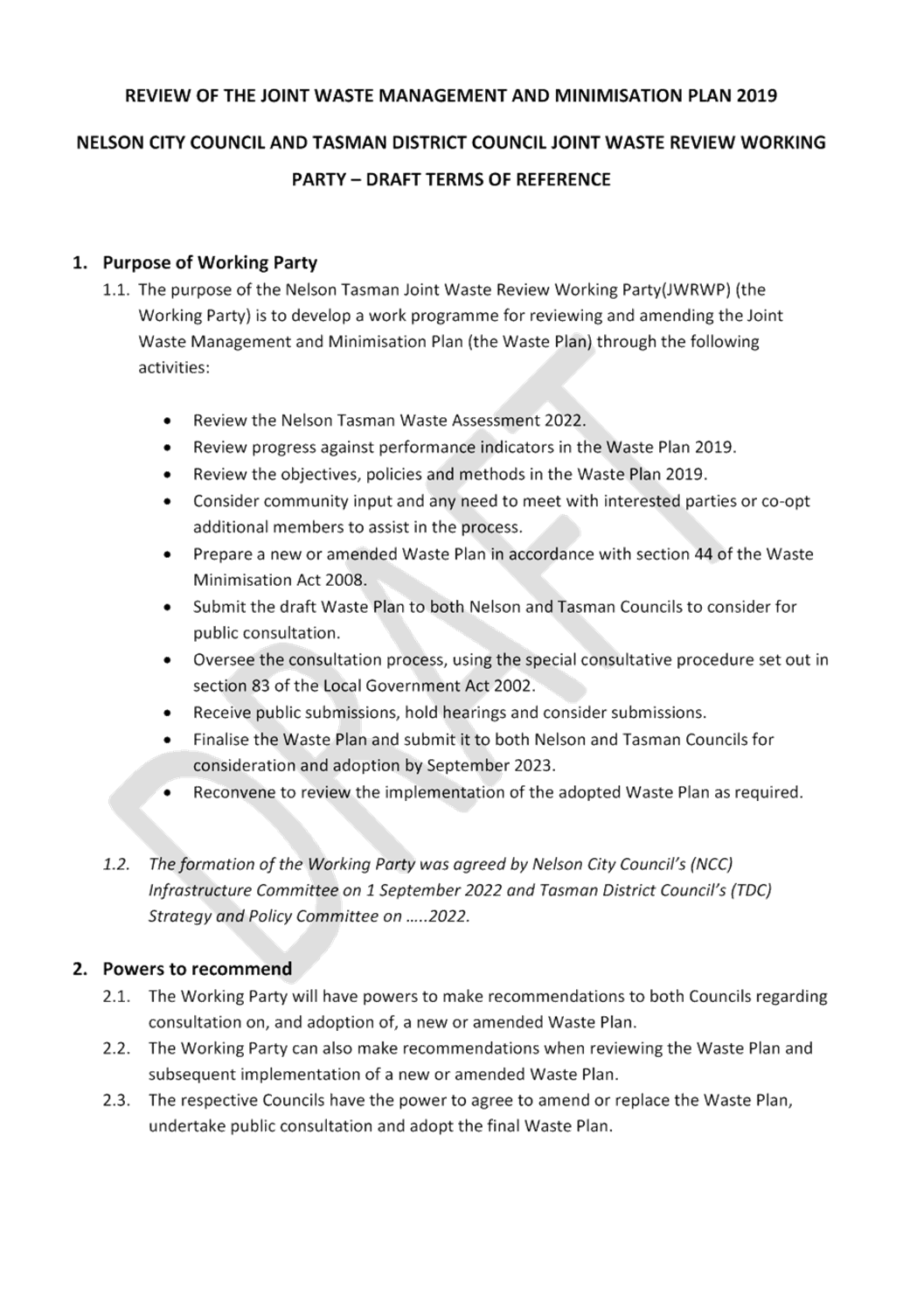
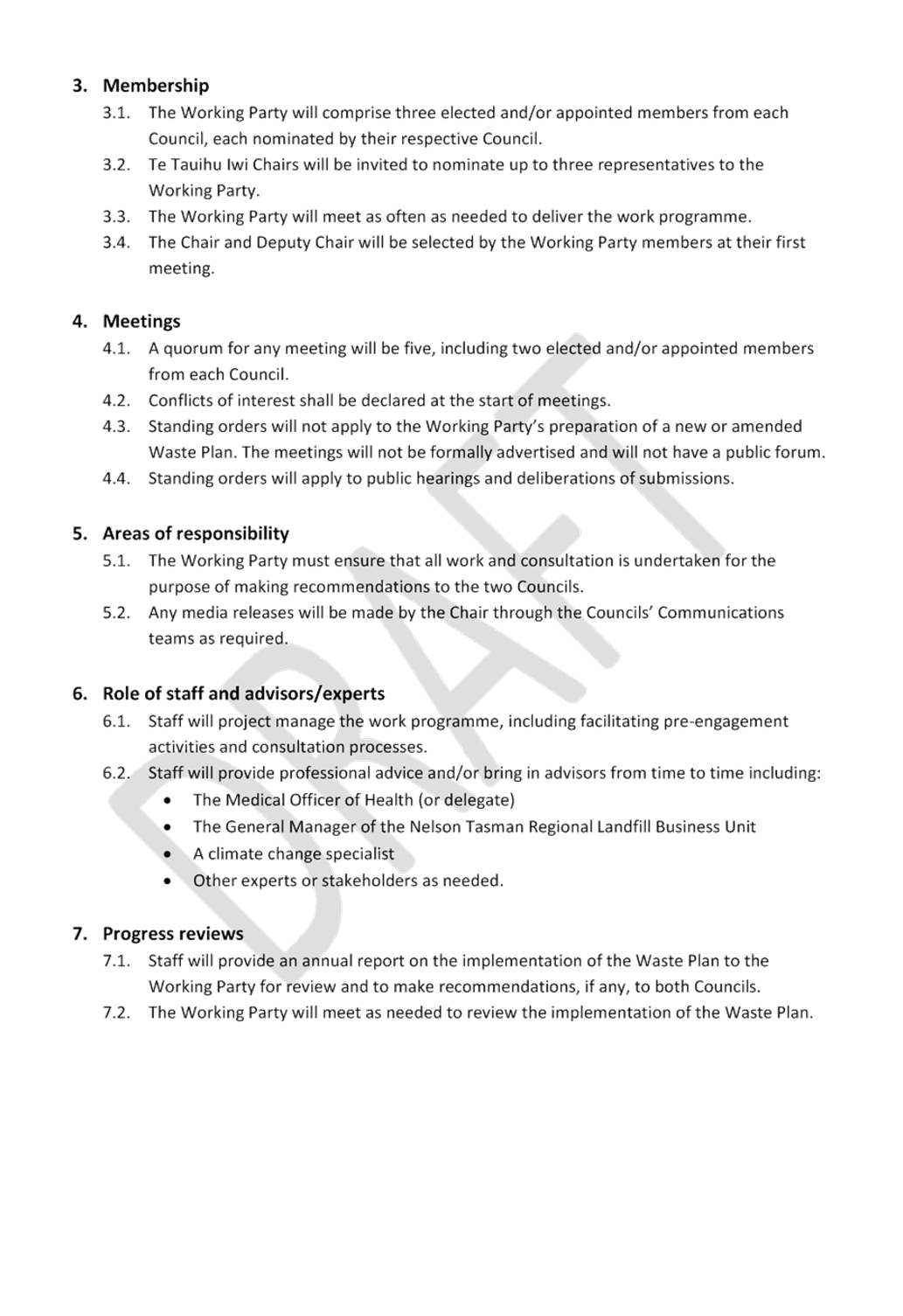
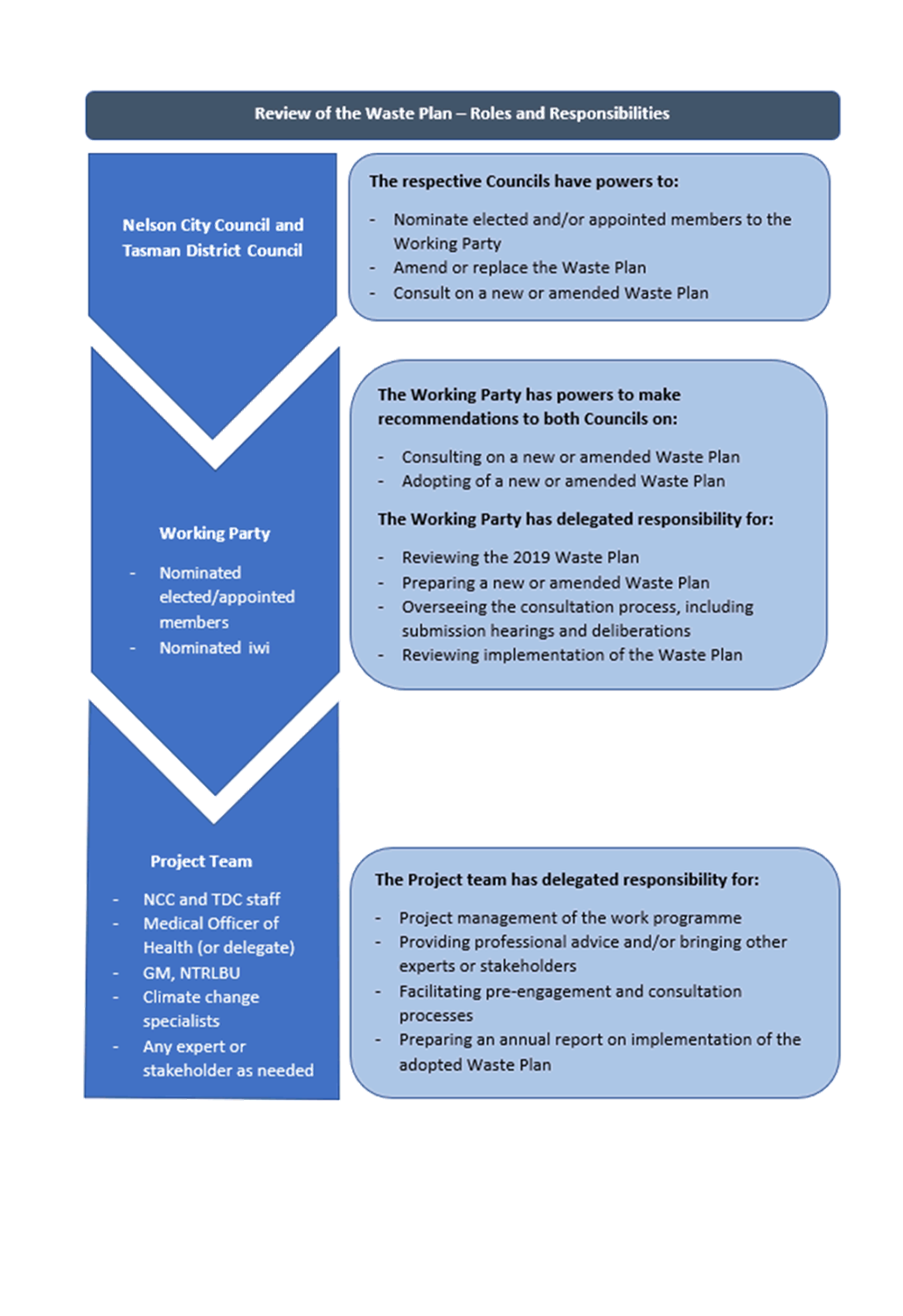
4.17 The draft Terms of Reference for the Working Party are attached.
4.18 A joint-Council
Project Team has been established to coordinate the review and provide
professional advice. Staff will also bring in advisors as required, including:
· the Medical Officer of Health (or their delegate);
· the General Manager of the Nelson Tasman Regional Landfill Business
Unit;
· climate change specialists; and
· other experts or stakeholders as needed.
4.19 Staff have started engaging with iwi to understand how they wish to
participate in the review. Pre-engagement activities will also commence with
key stakeholders, such as the commercial waste sector and the Nelson Tasman
Climate Forum. An engagement plan for the review will be developed with the
Working Party.
5.1 The Council has three options to consider in this report, as
outlined in the following table:
|
Option 1: Receive
the update on the Waste Assessment; resolve to conduct a joint review of the
Waste Plan with Nelson City Council and delegate the review to a
joint-Council Working Party.
|
|
Advantages
|
· This approach was used
successfully in the development of the last two Waste Plans.
· Conducting
a joint review with a joint-Council Working Party supports effective
collaboration with Nelson City Council to deliver regional outcomes.
· More
streamlined decision-making.
· Enables
broad regional engagement.
· The
NTRLBU is required to act in accordance with the Waste Plan, and this
collaborative governance approach provides better support.
|
|
Disadvantages and Risks
|
None.
|
|
Option 2: Receive
the update on the Waste Assessment and resolve to conduct a joint review of
the Waste Plan through officer reports and joint meetings without a Joint
Council Working Party
|
|
Advantages
|
Could reduce governance workload.
|
|
Disadvantages and Risks
|
· Lack
of governance oversight during the review process.
· Lack
of efficiency with duplicate reporting processes within each Council.
· Officer
capacity to meet additional demands could risk the review not being completed
in time for the LTP process.
|
|
Option 3: Receive the update on the
Waste Assessment and develop a separate Waste Plan for TDC
|
|
Advantages
|
Easier decision-making at
individual Council level.
|
|
Disadvantages and Risks
|
· Negatively
impacts economic and social outcomes due to a lack of alignment of regional
solid waste activities.
· Does
not support regional engagement with iwi
· Damage
to the well-established and collaborative relationship with Nelson City Council.
· The
waste industry operates freely across the district-city boundary as a single
market.
· The
NTRLBU is required to act in accordance with the Waste Plan and having two
separate plans could cause conflicting objectives for the business unit.
|
5.2 Option 1 is recommended by staff.
6.1 The Waste Plan is a strategic document for waste management and
minimisation in the region. It affects the management of Council services and
the provision of long-term infrastructure.
6.2 The review of the Waste Plan needs to consider the long-term
objectives and policies for the region. It is a document (but not the only
document) that will guide waste management decisions by the Council.
6.3 Failure to review the Waste Plan puts Council at risk of not meeting
its legislative requirements under the Act. The timing of the proposed review
will reduce risk through improving alignment with climate change action,
service provision alignment with the Long-Term Plan and proposed new
legislation, and in particular significant contract renewals for kerbside
recycling.
7 Policy
/ Legal Requirements / Plan
7.1 The review of the Waste Plan is a mandatory requirement under the
Waste Management Act 2008 (Section 51). Once the review has been completed, the
Council may resolve to amend, revoke and replace, or continue without amendment
the existing Waste Plan. In all options, the Council must use the special
consultative procedure set out in section 83 of the LGA 2002 and, in doing so,
notify the Waste Assessment with the statement of proposal.
7.2 The Act also requires that the Council consult with the Medical
Officer of Health. The Nelson Medical Officer of Health has been informed that
Waste Assessment is underway and will be consulted as part of the review
process.
8 Consideration
of Financial or Budgetary Implications
8.1 The review of this plan will require professional advice which will
be funded from existing budgets.
8.2 Decisions made in the review and the amendment or replacement of the
Waste Plan may have financial or budgetary implications for the Council in the
medium to long term, but these impacts will be ultimately determined through
the Long-Term Plan and Annual Plan processes.
9 Significance
and Engagement
9.1 We have considered the significance of this decision in accordance
with the Council’s Significance and Engagement Policy.
9.2 The decision is on the process to commence the review of the Waste
Plan. We consider the significance of this decision to be Low.
9.3 Waste management and minimisation policy affect most people in our
region every day. Commercial operators and the wider community often show
significant interest in the decisions of the Council. The later decision to
adopt a new or amended Waste Plan will likely be Moderate to High, but it will
follow a period of formal public consultation, as well as ongoing engagement
with iwi and early engagement with key stakeholders.
|
|
Issue
|
Level of Significance
|
Explanation of Assessment
|
|
1.
|
Is there a high level of public interest, or is the
decision likely to be controversial?
|
Low - Moderate
|
The public has a moderately high interest in waste
minimisation, but this decision is on process only
|
|
2.
|
Are there impacts on the social, economic, environmental
or cultural aspects of well-being of the community in the present or future?
|
Low
|
Waste management and minimisation policy affect all
aspects of community well-being, but this decision is on process only. Well-being impacts will
be considered in the review.
|
|
3.
|
Is there a significant impact arising from the duration
of the effects of the decision?
|
No
|
This decision is unlikely to have a significant long-term
impact
|
|
4.
|
Does this activity contribute or detract from one of
the goals in the Tasman Climate Action Plan 2019?
|
No
|
The Waste Plan
has a significant impact on the region’s approach to combatting climate
change, with a particular emphasis on mitigation. The links between
greenhouse gas emissions and behaviours relating to how the community make,
take and waste are strongly connected. A climate change lens will be
applied to this review.
|
|
5.
|
Does the decision relate to a strategic asset? (refer
Significance and Engagement Policy for list of strategic assets)
|
No
|
The Eves Valley and York Valley landfills are not listed
as strategic assets and this decision does not directly affect the landfills.
|
|
6.
|
Does the decision create a substantial change in the
level of service provided by Council?
|
No
|
This decision does not directly affect any levels
of service
|
|
7.
|
Does the proposal, activity or decision substantially
affect debt, rates or Council finances in any one year or more of the LTP?
|
Low
|
This decision does not materially affect debt, rates or
Council finances
|
|
8.
|
Does the decision involve the sale of a substantial
proportion or controlling interest in a CCO or CCTO?
|
No
|
|
|
9.
|
Does the proposal or decision involve entry into a
private sector partnership or contract to carry out the delivery o\f any
Council group of activities?
|
No
|
|
|
10.
|
Does the proposal or decision involve Council exiting
from or entering into a group of activities?
|
Low
|
No, not this decision.
|
|
11.
|
Does the proposal require inclusion of Māori in the
decision making process (consistent with s81 of the LGA)?
|
Yes
|
A separate engagement process with iwi is underway and Te
Tauihu Iwi Chairs will be invited to nominate representation to the Working
Party. Other opportunities to engage with hapouri Māori will also be
explored.
Iwi/Māori will have the opportunity to make
submissions through the special consultative process.
|
10.1 The Council has a statutory
obligation to review the Waste Plan 2019 by September 2025. The review has been
brought forward to enable better integration with the Long-Term Plan process,
expected legislative changes, and contract renewals.
10.2 The Waste Assessment 2022 is
underway and will inform the review of the Waste Plan, along with
pre-engagement activities and input from iwi.
10.3 Staff recommend that the review of
the Waste Plan is delegated to a joint-Council Working Party of elected and/or
appointed members and iwi representation.
10.4 The Working Party will be
responsible for:
10.4.1 reviewing the Waste
Assessment 2022 and Waste Plan 2019;
10.4.2 preparing a new or amended
Waste Plan;
10.4.3 overseeing the public
consultation process;
10.4.4 submitting the new or
amended Waste Plan to both Councils for consideration and adoption by September
2023; and
10.4.5 reviewing implementation of
the adopted Waste Plan as required.
10.5 The reciprocal agreement was provided by
Nelson City Council at its Infrastructure Committee meeting on 1 September
2022.
11.1 Staff will continue progressing the Waste Assessment
2022 and pre-engagement activities to support the review of the Waste Plan.
11.2 The review of the Waste Plan will be informed by the
Waste Assessment 2022
11.3 If both councils agree to the recommendations in this
report, and following the 2022 Local Government elections, the appointments to
the Working Party will be included in the list of new appointments for the new
triennium.
11.4 Te Tauihu Iwi Chairs will also be invited to nominate
representation to the Working Party.
|
1.⇩
|
Review of the Waste Plan 2019 - draft Terms of Reference
for the Working Party
|
13
|
Tasman District Council Strategy and Policy Committee Agenda – 29 September 2022
9.2 Freshwater Planning Update
Information Only - No Decision
Required
|
Report To:
|
Strategy and Policy
Committee
|
|
Meeting Date:
|
29 September 2022
|
|
Report Author:
|
Lisa McGlinchey, Team Leader
- Natural Resources Policy; Erin Hawke, Policy Planner - Natural Resources;
Mirka Langford, Team Leader - Land Use and Soil
|
|
Report Number:
|
RSPC22-09-2
|
1.1 This
report provides an update on the freshwater program work streams related to the
Tasman Environment Plan (TEP) review and several other freshwater related
workstreams that will assist in giving effect to our obligations under the
National Policy Statement for Freshwater Management (NPS-FM). This represents a
significant work programme spanning many staff over several departments and
raises some organisational risks regarding staff resourcing and funding of work
to meet legislative requirements, as well as highlighting important
opportunities for building our partnership with iwi. These risks and
opportunities will be defined further and reported back in the next Group
Manager’s report.
1.2 It
provides an overview of current and anticipated freshwater legislation and
guidance that is likely to influence this process, the actions achieved to date
and the future programme of work.
1.3 The
key freshwater work streams relating to the TEP include:
1.3.1 TEP
freshwater draft plan development and implementation of the National Objective
Framework: Staff are preparing for public engagement scheduled for
late October - December 2022 to discuss Freshwater Management Units (FMU),
visions and values of water with the community. This is the first step in implementing
the National Objective Framework under the NPS-FM.
1.3.2 Te Puna
Kōrero ki Te Tauihu (TPK) collaborative group: Work towards the TEP
freshwater framework has involved Te Tauihu iwi through creation of the new
collaborative group Te Puna Kōrero ki Te Tauihu. Progress updates
will be provided in the Environmental Policy Manager’s reports.
This process highlights the challenge of meeting the RMA deadline for
freshwater plan notification by December 2024.
1.3.3 Takaka
catchments and the Waikoropupū Action Plan: An increasing trend in
nitrate at Te Waikoropupū Springs requires the development of an Action
Plan under the NPS-FM. This work has been delayed, but an initial meeting
with MKM has taken place and is planned with the affected farming community as
farmer capacity allows. The WCO process is still before the Environment Court
with further hearing dates signalled for October and November.
1.3.4 Waimea
Nitrate Project: Progress with HortNZ on the Waimea Nitrate project
continues and we anticipate the revised nitrate modelling and the majority of
Freshwater Farm Plan equivalents to be in place by the end of 2022.
Following completion of nitrate synoptic trend analysis, staff anticipate
seeking a Council resolution to develop an Action Plan for the relevant areas
of the Plains under the NPS-FM.
1.4 The
report also covers other freshwater related workstreams that staff are working
on collaboratively across council including:
· Te Mana o te
Wai (TMOTW) Integrated Implementation Programme to give effect to this
philosophy in a consistent and integrated way across Council;
· Source water
mapping for human drinking water supplies - required by the Water Services
Act 2021;
· Freshwater
Management Unit (FMU) / catchment context summaries to assist in information
sharing with our communities and stakeholders in each FMU.
That
the Strategy and Policy Committee
1. receives
the Freshwater Planning Update report RSPC22-09-2; and
2. notes the planned community engagement
on FMU, Visions and Values in late October-December.
3 National
direction for freshwater
Current legislation and
instruments related to freshwater management
3.1 The
current legal instruments providing national direction specifically related to
freshwater and waterbody management include:
o National Policy Statement for
Freshwater Management (NPS-FM)
o New Zealand Coastal Policy
Statement (NZCPS)
o National Policy Statement for
Renewable Energy Generation (NPS-REG)
o National Environmental
Standard for Freshwater (NES-F)
o National Environmental
Standard for Sources of Human Drinking Water (NES-DW)
o National Environmental
Standard for Plantation Forestry (NES-PF)
o Regulations for Stock Exclusion
(from water bodies) (REG-SE)
o Regulations for Water Metering
(REG-SE)
3.2 In
addition, to the above the Water Services Act 2021 provides new
responsibilities for Council relating to the protection of source water used
for human drinking water and links to obligations to give effect to Te Mana o
te Wai (TMOTW) under the NPS-FM.
3.3 Under
the NPS-FM, Te Mana o te Wai imposes a hierarchy of
obligations by prioritising the health and wellbeing of waterbodies and
freshwater ecosystems first. The second priority is the health needs of people
(such as drinking water) and the third is the ability of people and communities
to provide for their social, economic and cultural wellbeing.
3.4 This
is a significant shift in philosophy from past, effects-based water management
and is anticipated to drive a greater focus on protection and restoration of
waterbodies and their margins, and a need for greater control of land use and
associated discharges, particularly diffuse discharges.
3.5 Furthermore,
the National Adaptation Plan (NAP) sets out the government’s adaptation
work programme for the next six years. Climate change will need to be
integrated into freshwater policy and decision making.
Anticipated new or amended
instruments
3.6 We
are anticipating a revised NES-DW (including linkage to the Water Services Act
and source water protection) and new regulations for Freshwater Farm Plans
(REG-FFP) this calendar year.
3.7 The
NES-F has also undergone recent changes to the wetland provisions to create
consent pathways for quarries, landfills/cleanfills, mining and urban
development, and refine wetland restoration policies. A further amendment
and submission round is underway by MfE. They now propose that the NES-F
only applies to ‘inland natural wetlands’ rather than
‘natural wetlands’ because the latter definition captures wetlands
within the Coastal Marine Area which has unintended consequences and overlaps
with the New Zealand Coastal Policy Statement (NZCPS). This amendment will
align with the NPS-FM so that both documents refer to ‘inland natural
wetlands’. A short Council submission supporting the exclusion of
coastal wetlands from the NES-F was submitted for the 21st September
2022 deadline.
3.8 The
proposed NPS for Indigenous Biodiversity (pNPS-IB) is also anticipated this
year. Council provided feedback (21 July 2022) to MfE in response to
targeted questions on implementation of the pNPS-IB. The feedback noted
that the pNPS-IB excludes water bodies and requested clarity
over whether the NPS-FM or NPS-IB prevails when an activity is located within
the margins.
Resource Management Reform
3.9 Staff
do not anticipate much change through the Resource Management reform to the
fundamental approach to freshwater management – ie the obligation to give
effect to Te Mana o te Wai and the hierarchy of obligations (meeting water
health first, then human health, then all other values and uses of
water).
3.10 We
are hopeful that the proposed National Planning Framework will streamline where
the numerous instruments relating to freshwater apply and address the areas of
overlap, inconsistency and conflict between these instruments and other
instruments Council must also implement.
3.11 The
central government bills for the proposed new acts to replace the Resource
Management Act are anticipated in October this year.
4 Freshwater
Programme Overview
4.1 The
Tasman Freshwater Programme has two main parts:
a) Tasman
Environment Plan (TEP) - Freshwater Review, including implementation of the
NPS-FM and other relevant national policy statements in the new combined
unitary plan – driven by staff in Environmental Policy; and
b) Essential
Freshwater Implementation – implementing and enforcing the various
National Environmental Standards and Regulations relating to freshwater –
driven by staff in Consents, Compliance and Environmental Information.
4.2 This
report focuses largely on the work streams for the TEP Freshwater Review and
several other related workstreams that will assist in giving effect to our
obligations under the NPS-FM.
5.1 The
key objective of the freshwater review is to implement the NPS-FM and other
relevant NPS, including the NPS-REG and the NZCPS.
5.2 RMA
sec 80A(4) directs councils to publicly notify freshwater planning instruments
intended to give effect to the NPS-FM by 31 December 2024.
5.3 The
NPS-FM (3.4) directs councils to involve tangata whenua (to the extent they
wish to be involved) in freshwater management (including decision-making
processes), including in all the following:
a) identifying
the local approach to giving effect to Te Mana o te Wai
b) making
or changing regional policy statements and regional and district plans so far
as they relate to freshwater management
c) implementing
the NOF (National Objective Framework – including Māori
freshwater values)
d) developing
and implementing mātauranga Māori and other monitoring.
5.4 There
is an inherent challenge in providing adequate time for iwi involvement in the
TEP freshwater development and meeting the RMA direction to notify plans by 31
December 2024.
5.5 Given
this, the TEP freshwater review includes two concurrent processes:
1. Collaboration
with Te Tauihu iwi and Nelson and Marlborough councils to define a
consistent approach to give effect to Te Mana o te Wai across Te Tauihu –
through the new collaborative group Te Puna Kōrero ki Te Tauihu; and
2. NOF
implementation and Draft TEP freshwater plan development including:
a) Section
35 review of TRMP efficiency and effectiveness (completed 2020);
b) Community
engagement on TEP review and freshwater topic (completed 2020);
c) Community
engagement on Freshwater Management Units (FMU), visions and values of water
(programmed late October-December 2022);
d) Issues
and Options report (programmed for council review in March 2023);
e) Community
engagement on issues, environmental outcomes and options (programmed for
May-June 2023);
f) Community
engagement on attributes, targets and limits (programmed for October-December
2023);
g) Concurrent
Plan Drafting (programmed for 2022-2023) - utilising the Nelson Draft Plan (Oct
2020) and Takaka FMU recommendations as a basis where appropriate;
h) Community
engagement on draft plan (programmed for early 2024); and
i) Proposed
plan development (programmed for late 2024).
5.6 Environmental
Policy staff have the added challenge of merging the outcomes of these two
processes for the 31 December 2024 deadline.
5.7 Staff
are of the view that working collaboratively with iwi to develop fit for
purpose and enduring plan provisions should take precedent over the arbitrary
compliance date in the RMA. While this may create a tension with central
government, it will be hard for ministers to criticise the process if we are
making good progress and working with iwi rather than risk damaging the
relationship with iwi for the sake of the RMA deadline.
5.8 The
proposed TEP freshwater plan will be a first-generation freshwater planning
instrument under the NPS-FM 2020. While the NPS-FM (1.6) directs councils
to ‘use the best information available at the time’, the Plan is
likely to require placeholders or default provisions where we have insufficient
information in some FMU and subcatchments – including on water quality,
water flows/levels, and attributes for ecosystem health, habitat and cultural
tohu/indicators.
5.9 An
Implementation Plan anticipated to accompany the draft TEP will identify
non-regulatory options to help achieve the freshwater objectives, and will include
further work needed to fill information gaps to inform future amendments to the
TEP to fully implement the NPS-FM and give effect to Te Mana o te Wai over
time.
Next milestone - community
engagement on FMU, Visions and Values
5.10 In
preparation for public engagement on the Freshwater Management Unit boundaries,
Visions and Values of Water a discussion document has been drafted. This
is the first step in implementing the National Objectives Framework under the
NPS-FM. This round of public engagement is scheduled for late October to
mid December 2022 and will accompany engagement on other Tasman Environment
Plan (TEP) topic areas. This engagement round was approved by Council on
7 July 2022.
5.11 The
freshwater component has been combined with similar engagement needed for the
Coastal Environment strategic planning in an integrated discussion document and
online resources that reflect the Ki Uta Ki Tai philosophy underpinning the
TEP. At the time of writing, this integrated discussion document will be
discussed with councillors at a workshop on 21 September 2022.
5.12 Staff
are conscious of significant anxiety within the Tasman community, particularly
rural sectors, around the scope and sheer volume of water and land related
regulation and new requirements. This will be considered in the venue
selection and key staff and information resources made available at engagement
events, covering a range of topical issues related to water and land
management. Local MPI staff and Rural Support will also be invited to
attend the events. This will be particularly important if the Freshwater
Farm Plan regulations, revised NES for Drinking Water and bill on the RM
replacement acts are publicly released by October as indicated by MfE.
6 Te Puna
Kōrero ki Te Tauihu (TPK) collaborative group
6.1 The
TPK group commenced work in December 2021 and is an ongoing collaboration
between the eight iwi and three Te Tauihu councils to progress a freshwater
framework that gives effect to Te Mana o te Wai which can be used to inform
development of the three council freshwater plans. The collaboration is
intended to streamline work across all three councils and iwi resourcing and
create efficiency for implementing the NPS-FM 2020.
6.2 Meetings
are held approximately fortnightly and kanohi ki te kanohi (face to face) hui
are programmed quarterly. Limited funding is available through the
councils’ LTPs for this collaborative work, but includes combined Te
Tauihu Council funding to engage a project manager to oversee the work,
organise and manage all parties involved.
6.3 Te
Tauihu iwi have separately gained funding from MfE’s Te Mana o te Wai
fund to resource their internal capacity building to facilitate their
participation in freshwater management and planning. Further clarity is
required on the extent to which this funding will cover iwi involvement in the
specific work of TPK.
6.4 The
TPK group has made considerable gains in relationship building and a
partnership agreement. Moving forward, the group will produce a work programme
that aims to complete the National Objectives Framework (NOF) discussing FMUs,
visions, values, outcomes, freshwater attributes and limits, including for
Māori freshwater values and applying a Te Ao Māori perspective to the
freshwater framework.
6.5 Updates
on the progress of the TPK will be provided regularly to Council through the
Environmental Policy Manager’s reports.
7 Tākaka
Catchments and Waikoropupū Action Plan
Tākaka
Catchments
7.1 The
Tākaka Catchments relates to the area that will become the Tākaka
Freshwater Management Unit (FMU). This includes catchments of the
Tākaka River and its tributaries and the coastal catchments between Wainui
Bay and Tukurua. Previous work undertaken within the Takaka catchment via the
Freshwater Land and Advisory Group (FLAG) and associated reports, including the
Manawhenua Mātauranga Report continue to inform the development of the
TEP.
Water Conservation Order
7.2 At
the time of writing, the Water Conservation Order process is still before the
Environment Court for its public inquiry and is subject to limitations on
public discussion. There have been two hearing sessions so far and a further
two shorter hearing sessions are signalled in October and November with the court
making its recommendations to the Minister for the Environment following
this. The final WCO that is gazetted through this process will
significantly influence the Tākaka FMU chapter within the TEP. There
will also be learnings from the process that may be applicable to groundwater
management elsewhere in Tasman.
Waikoropupū Action Plan
7.3 Recent
water monitoring assessment for Te Waikoropupū Springs, undertaken during
the WCO process, showed a deteriorating trend in water quality due to an
increase in nitrates over the last five years. This context differed from
data considered during development of the FLAG and Manawhenua ki Mohua
recommendation reports. At the Strategy and Policy Committee meeting on
14 April 2022 Council agreed to commencing an Action Plan under the NPS-FM to
be completed by the third quarter of 2022.
7.4 Work
on the action plan has been delayed by staff illness, the demands on staff time
for the Water Conservation Order hearing, and the recent rainfall event which
have delayed planned consultation with the farming community and iwi within the
Tākaka catchment.
7.5 An
initial discussion with Manawhenua ki Mohua occurred on 12 August 2022 and
further discussions are planned with farmers in the Arthur Marble Aquifer
recharge area and Fish Creek Catchment (as farmer capacity allows given their
current busy period), before a programme for the Action Plan is prepared.
This is consistent with the requirements of the NPS-FM (3.15(5)) which directs
Council to consult with communities and tangata whenua before preparing
an action plan.
Waimea nitrate issues overview
8.1 The
Waimea catchment has four aquifers, a combination of confined, semi-confined
and unconfined. Monitoring has shown high levels of nitrate in some places,
caused from both the current and historic pattern of land use. The biggest
contributor at present being market gardening. The elevated nitrate levels are
of concern from a human health and freshwater ecology perspective – in
particular for surface water quality in the Neimann, Pearl and lower
O’Connor creeks which are connected to the aquifers. Additionally, apple
growers’ crops are being negatively affected from irrigating with aquifer
water with elevated nitrates.
8.2 In
some bores, nitrate levels exceed the New Zealand Drinking Water Standard
(NZDWS), posing a risk to those using these aquifer sources for private
drinking water supplies. Notification went out to several hundred
households this year regarding the potential health risk of the drinking water
quality in the aquifer.
8.3 Council
operated water supply networks are proactively managed to meet the NZDWS.
8.4 There
is continued community concern regarding recent studies associating elevated
nitrate in drinking water with colorectal cancer and premature births.
Council’s approach regarding water supplies is to meet national standards
and we are waiting on advice from the Ministry of Health as to any changes to
the existing Drinking Water Standard or guidance resulting from the ongoing
research.
Nitrate modelling and Freshwater
Farm Plans
8.5 There
is also continued community concern that the potential for increased
intensification of land use enabled by the Waimea Community Dam will pose a
further risk to groundwater quality. Existing water permit holders are
required to provide an irrigation management plan and the TEP will further
encode the need for nutrient management.
8.6 In
the meantime, the aim of the Waimea Nitrate Project has been to encourage all
farmers on the Waimea Plains in the areas influencing or affected by elevated
nitrate to have Farm Environment Plans (FEPs) in place, and that these meet the
anticipated requirements for Freshwater Farm Plans (FFPs) (regulations
anticipated in Oct 2022).
8.7 This
is an opportunity for these farmers to front-foot the nutrient management and
good practice requirements ahead of any requirements in the TEP or in the
national regulations.
8.8 Work
has been ongoing in conjunction with Horticulture New Zealand to progress two
key work streams:
· a review of the
SPASMO modelling for nitrate based on real farm data; and
· update or creation
of FEP/FFP equivalent farm plans for all HortNZ affiliated farms on the plains
(ie NZ GAP or Global GAP FEPs with an Environmental Management System add-on)
8.9 Currently
we are anticipating the modelling output and the majority of sizeable farms to
have FFP equivalents by the end of 2022.
8.10 The
two dairy farms in the catchment already have FFP equivalents under the
Fonterra Tiaki programme. Additional work with other industry organisations is ongoing
to achieve similar outcomes for viticulture, hops and sheep and beef.
8.11 A
further workstream is in progress with Anette Litherland from Landcare Trust to
provide guidance to lifestyle block owners who either trigger the farm
thresholds for FFP requirements or who wish to voluntarily comply with FFPs as
part of good practice management of their properties.
Synoptic survey results
8.12 A
round of synoptic sampling (ie more bores over a wider area) for nitrate was
undertaken this summer (2021-22) and Environment Information staff are
currently completing the analysis of the data and trend comparison with past
synoptic sampling (2016).
8.13 The
outcomes from this analysis will help inform the response under the NPS-FM,
including defining any areas of the plains that should be subject to an Action
Plan (ie were there are deteriorating trends in nitrate) and targeted TEP
policy responses, including informing community discussions on nitrate targets.
Anticipated Waimea Nitrate
Action Plan
8.14 Once
the latest synoptic trend analysis is complete, staff will seek approval from
Council for a formal Action Plan process under the NPS-FM (similar to the Te
Waikoropupū Action Plain process).
8.15 Work
reviewing the nitrate science and options for its management was started in
2019 and staff will be progressing development of a draft nitrate report for
the Waimea Plains which will form the basis of the future Action Plan.
This process will be progressed by staff in conjunction with iwi, landowners
and industry organisations, building off the existing workstreams of the Waimea
Nitrate Project and previous information from the Waimea FLAG process. This
is a long-term project and lag-time for aquifer response to any land use
practice changes will be incorporated into community discussion in development
of the TEP and definition of interim targets and timeframes under the National
Objectives Framework.
9 Other
Freshwater Projects
Te Mana o te Wai Integrated
Implementation Programme
9.1 Council
has a statutory responsibility to “give effect to” Te Mana o te Wai
under the NPS-FM and clause1.3 states: “Te Mana o te Wai is relevant
to all freshwater management and not just to the specific aspects of freshwater
management referred to in this National Policy Statement”. Clause
1.3 identifies it is “the responsibility of those with authority
for making decisions about freshwater to do so in a way that prioritises the
health and well-being of freshwater now and into the future”.
9.2 The
integrated consideration of water management across all catchments from the
mountains to the sea (ki uta ki tai) is also a key obligation under the clause
3.5 and a fundamental expectation from iwi.
9.3 Achieving
integrated management of freshwater and giving effect to TMOTW will require a
coordinated approach across all council functions, including regulatory and
non-regulatory responses (ie Monitoring & Investigation, Education &
Advocacy, Works & Services, Financial Incentives & Assistance and Partnering).
9.4 In
June 2022, staff brought a memo to ELT on the ways that Council, as an
organisation, can give effect to Te Mana o te Wai – in addition to
implementation of this philosophy through the TEP. ELT agreed to the
following actions:
1. including
consideration and discussion on TMOTW in relevant InfoCouncil decision reports
that may affect freshwater to help inform decision making;
2. incorporation
of TMOTW in all relevant strategic documents and Activity Management Plans are
they are revised in the future to ensure council functions give effect to TMOTW
in a consistent and integrated way;
3. high-level
review of relevant works and services contracts and existing resource consents
that have longer than 12 months until expiry (those with less than 12 months to
be reviewed as per normal process) to identify any inconsistencies with TMOTW;
4. training
and education of staff and contractors to raise awareness about the meaning of
TMOTW and our legislative responsibilities (for example staff raising awareness
of duties and obligation to give effect to TMOTW under the Water Services Act).
9.5 The
next steps include staff from Strategic Policy and Environmental Policy:
· developing
guidance documents for staff to ensure consistent embedding of TMOTW in relevant
InfoCouncil decision reports and future review of key documents; and
· identify training
and education opportunities that can be undertaken in-house, including use of
existing resources provided by various government departments, and research and
industry agencies on TMOTW and its implementation (this work has already begun
with awareness training for Community Infrastructure staff).
9.6 This
will be an ongoing programme as this philosophy is embedded throughout the
organisational functions that influence the health of freshwater in Tasman.
Drinking Water - Source Water
Risk Management Areas Mapping
9.7 Clause
41 of the Water Services Act (WSA) 2021 links with the NPS-FM and seeks to
ensure:
a) the
risks and hazards to source water are identified, assessed, managed, and
monitored by drinking water suppliers and local authorities; and
b) information
on source water, and measures to manage risks and hazards to source water, are
published on a regular basis by regional councils
9.8 Under
Clause 43, Council - as a drinking water supplier - is required to develop
‘Source Water Risk Management Plans’ for each Council-operated
water supply. These plans also include the identification and mapping of three
levels of source protection zones for each water supply. The
protection zones are being delineated based on draft MfE guidance and advice
from Joseph Thomas (Senior Resource Scientist - Water & Special Projects)
to meet the 15 November 2022 deadline that Taumata Arowai has
imposed.
9.9 Staff
understand that there are several privately owned water supplies that have
registered with Taumata Arowai who may require assistance from Council to
develop their risk management plans and map the source protection zones to meet
the 15 November deadline. This may create a resourcing challenge for
Council staff if advice is sought close to the deadline.
9.10 Further
source water mapping by Council will be required once other private water
suppliers register with Taumata Arowai over time. The final deadline for
supply registration is in 2025.
9.11 Further
understanding on the implications for protection of mapped source water areas
is anticipated in the amended NES for Sources of Human Drinking Water to be
released this calendar year.
Freshwater Management Unit /
Catchment Context Summaries
9.12 This
work stream aims to have online summaries of what we know about each FMU to
provide a one-stop-shop for catchment information and provide clear stories to
their respective communities. There are five key drivers for this work:
1. providing
an online resource for engagement and information sharing with communities and
iwi about FMU issues and options as part of the TEP freshwater development;
2. meeting
our requirements for online publishing of information and data under the
NPS-FM, including: progress against visions and attributes, water quality and
quantity accounting, ecosystem health scorecards and human health data, and
information on contaminants and environmental pressures in each FMU;
3. providing
“catchment context” summaries to help inform farmers when
developing their Freshwater Farm Plans;
4. providing
a platform to summarise the “ecological and cultural context” in
each FMU (beginning in Mohua/Golden Bay in conjunction with Manawhenua ki
Mohua) to assist iwi and whanau in defining and communicating cultural
tohu/indicators for Māori freshwater values and mātauranga
Māori. These tohu will be incorporated in the water attributes for
assessing progress in relevant FMU (as consistent with the NPS-FM) and
monitored by iwi as part of the Environmental Information monitoring programme;
5. providing
a platform for sharing mapping of source water protection areas for drinking
water supplies in each FMU, and associated catchment information for drinking
water suppliers to assist in their development of Source Water Risk Management
Plans (as required by clause 43(4) and 46 of the WSA 2021), such as land use
activities, potential sources of contamination, water quality and quantity
monitoring and known risks and hazards to water supplies.
9.13 The
next step for this workstream is confirmation of the online platform to be used
(ie Council’s website, Storymap - as used for the Richmond Catchment
Management Plan - or something else), confirmation of development and ongoing
costs, and populating this (or an interim webpage) with existing and priority
information needed for the next 6-12 months.
9.14 These
FMU summaries are intended to be online ‘living documents’ to be
updated as new information becomes available, and over time reflecting the
community feedback received during development of the TEP and other relevant
projects underway in these catchments. This workstream involves staff
from Information, Science & Technology, Environmental Policy, Strategic
Policy and Communications and Change.
10.1 This
report has outlined a number of important freshwater work streams related to
the Tasman Environment Plan (TEP) and implementation of the National Policy
Statement for Freshwater Management. This represents a significant work
program spanning many staff over several departments.
10.2 The
key freshwater work streams relating to the TEP include:
10.3 TEP
freshwater draft plan development and implementation of the National Objective
Framework: Staff are preparing for public engagement scheduled for
late October - December 2022 to discuss Freshwater Management Units (FMU),
visions and values of water with the community. This is the first step in
implementing the National Objective Framework under the NPS-FM.
10.4 Te
Puna Kōrero ki Te Tauihu (TPK) collaborative group: Work towards the
TEP freshwater framework has involved Te Tauihu iwi through creation of the new
collaborative group Te Puna Kōrero ki Te Tauihu. Progress updates
will be provided in the Environmental Policy Manager’s reports.
This process highlights the challenge of meeting the RMA deadline for
freshwater plan notification by December 2024.
10.5 Takaka
catchments and the Waikoropupū Action Plan: An increasing trend in
nitrate at Te Waikoropupū Springs requires the development of an Action
Plan under the NPS-FM. This work has been delayed, but an initial meeting
with MKM has taken place and is planned with the affected farming community as
farmer capacity allows. The WCO process is still before the Environment Court
with further hearing dates signalled for October and November.
10.6 Waimea
Nitrate Project: Progress with HortNZ on the Waimea Nitrate project
continues and we anticipate the revised nitrate modelling and the majority of
Freshwater Farm Plan equivalents to be in place by the end of 2022.
Following completion of nitrate synoptic trend analysis, staff anticipate
seeking a Council resolution to develop an Action Plan for the relevant areas
of the Plains under the NPS-FM.
10.7 Staff
are also working collaboratively across Council to progress work on giving
effect to Te Mana o te Wai in an integrated way, to map Source Water Protection
Areas for human drinking water, and to develop online FMU/catchment context
summaries to assist in information sharing with our communities and
stakeholders in each FMU.
Staff leads for work streams
10.8 For
any questions, lead staff contacts for these workstreams are:
· TEP freshwater and TPK
collaboration: Erin Hawke and Lisa McGlinchey
· Takaka Catchments,
Waikoropupū WCO and Action Plan: Lisa McGlinchey
· Waimea Nitrate Project:
Mirka Langford and Lisa McGlinchey
· Te Mana o te Wai
Integrated Implementation Programme: Helen Lane and Lisa McGlinchey
· Drinking Water -
Source Water Mapping: Evan McKenzie, Helen Lane and Joseph Thomas
· FMU / catchment
context summaries: Lisa McGlinchey and Mirka Langford
· Freshwater
instrument submissions: Erin Hawke (NES-F/NPS-FM) and Pauline Webby (NPS-IB)
Nil
Tasman District Council
Strategy and Policy Committee Agenda – 29 September 2022
9.3 Strategic Policy and Environmental Policy Activity Report
Information Only - No
Decision Required
|
Report To:
|
Strategy and
Policy Committee
|
|
Meeting Date:
|
29 September 2022
|
|
Report Author:
|
Barry Johnson,
Environmental Policy Manager; Dwayne Fletcher, Strategic Policy Manager; Alan
Bywater, Team Leader - Community Policy; Wouter Woortman, Team Leader -
Infrastructure Planning
|
|
Report Number:
|
RSPC22-09-3
|
1.1 This
report provides the Committee with an update on some of the key highlights of
the Service and Strategy Group’s Strategic Policy and Environmental
Policy work.
That the Strategy and Policy Committee receives the Strategic Policy
and Environmental Policy Activity Report RSPC22-09-3
3 Strategic
Policy Update – Dwayne Fletcher
3.1 The following tables contain an update of the key projects
and activities that the Strategic Policy Team either manages or is involved in.
Community
Policy
|
Project
|
Description
|
Status
|
Comments
|
|
Corporate Planning
|
|
Three waters Better
Off funding
|
$2b fund to
enable local councils and communities to be better off after three water
responsibilities are transferred to new entities.
DIA’s guidance
can be found here:
Three-Waters-Reform-Better-Off-Support-Package-Guidance-April-2022.pdf
(dia.govt.nz)
|
On track
|
Target
completion date: by 30 September 2022
Council has been
allocated $22.54m across two tranches. Tranche One ($5.64m) is open now for
applications (funding proposals).
Staff
facilitated a third workshop with Councillors on 15 September 2022 to discuss
projects for inclusion in our funding proposal, which were then agreed by
Full Council on 22 September.
We have engaged
further with Te Tauihu iwi general managers and are finalising the funding
proposal for submission to the DIA by 30 September.
|
|
Annual Report
2021/2022
|
Preparation of
the Council’s Annual Report for the 2021/2022 year.
|
On track
|
Target date:
31 December 2022
The
non-financial sections of the Annual Report 2022 were reviewed by the Audit
and Risk Committee on 16 September 2022.
Work on the
financial aspects of the Annual Report is well underway and the audit is
planned to commence on 3 October 2022.
The Annual
Report is expected to be adopted at the Council meeting on 15 December 2022.
|
|
Annual Plan
2022/2023
|
Preparation of
the Council’s Annual Plan for the 2023/2024 year.
|
On track
|
Target date:
30 June 2023
Project planning
for the Annual Plan 2023/2024 process has been carried out.
Initial budget
information collection is underway and workshop time has been booked prior to
Christmas to gain Councillors’ direction.
|
|
Long-Term Plan
2024-2034
|
Preparation of
the Long-Term Plan 2024-2034.
|
On track
|
Target
completion date: 30 June 2024
Staff have
commenced project planning for the LTP 2024-2034 process.
|
|
Reserves and community facilities
|
|
Classification
of existing reserves in Richmond and Lakes-Murchison Wards
|
Project to
classify existing reserves in two Wards (this step is required before Council
can consult on draft Reserve Management Plans for the Wards).
|
On track
|
Target completion date: mid-2023
Staff have almost finished collating
information about all the parks and reserves in Richmond and Lakes-Murchison
Wards. Once this inventory is complete, we will contract DOC to confirm which
reserves are already classified and which still need to be. We will work with
iwi to prepare proposals for classifying reserves. Staff are also preparing
maps to show the location of all parks and reserves in both Wards.
In December 2022 we will present a report to
Council outlining the proposed process for classifying reserves and reviewing
the two Reserve Management Plans for these Wards.
|
|
Community
Leasing and Licensing Policy
|
Development of a
new internal policy to guide operational decision-making around entering into
and reviewing leases of Council owned land
|
On track
|
Target completion date: mid-2023
Staff have finished the early engagement
process. We are analysing feedback from groups and developing the draft
policy in the next few months.
|
|
Climate change and environmental
|
|
Tasman Climate
Action Plan
|
Council adopted
the Tasman Climate Action Plan (TCAP) in September 2019. The Plan is
available online at www.tasman.govt.nz/link/climate-action
|
On track
|
Target completion date: Ongoing
Quarterly Progress Report:
Staff have included updates on TCAP initiatives in the
‘Climate Change Update’ report to alternate Strategy and Policy
Committee meetings. A detailed annual report on progress implementing the
TCAP is expected to be presented to the Committee’s November 2022
meeting.
A third workshop with elected members on the TCAP review is
scheduled for early December.
|
|
Corporate
emissions reduction plan
|
Development of
emissions reduction for internal Council operations – TCAP sub-project
|
On track
|
Target completion date: November 2022
Staff have completed a draft plan and associated
modelling work. We will continue to work on this plan as part of the TCAP
review.
|
|
Waimea Inlet
Action Plan
|
Council adopted
the ‘Waimea Inlet Action Plan’ in March 2019. The action plan was
developed to implement the ‘Waimea Inlet Management Strategy
2010’. Both are available online at:
https://www.tasman.govt.nz/my-council/key-documents/more/environment-reserves-and-open-space/waimea-inlet-management-strategy/
|
On track
|
Target completion date for document review: June 2023
A review of both
the Management Strategy and Action Plan documents is underway, led by a
contractor who reports to George Daly. Staff anticipate that both documents
will be reviewed by June 2023.
Updates on the Ministry for the Environment funded projects
relating to Waimea Inlet are included in the Environmental Information report
to Council’s Operations Committee.
|
Infrastructure Planning and Policy
3.2 Much
of the Infrastructure Planning and Policy team have been engaged with
developing the 2024-2054 three waters capital works and operational programmes
for Tasman for consideration by the Entity C transition team. This work is
similar to some of the planning we would ordinarily undertake for the Long Term
Plan and Infrastructure Strategy, but is several months earlier. This has
slowed progress on some of our other work programmes.
|
General
|
|
Kāinga Ora Housing and Communities Infrastructure Acceleration
Fund (IAF)
|
Kāinga Ora has shortlisted proposals that are eligible for
funding to support infrastructure and accelerate housing developments.
Council’s funding application in partnership with Wakatū
Incorporation for the Motueka West Phase 1 proposal has progressed to the
negotiation phase of the process.
|
At risk
|
Target Completion Date: September
2022
Staff
from the IAF team along with representatives from Council and Wakatū
have been working through the details of the funding agreements. Council
signed the Funding Agreement in July 2022. It remains unclear whether
Wakatū and Kāinga Ora will agree
on the
terms and conditions of the Housing Outcomes Agreement.
|
|
Transport
and Coastal
|
|
Stock Control and Droving Bylaw
|
Revise and update
Stock Control Bylaw
|
On track
|
Target completion date:
September 22
On 1 September 2022 the Hearings Panel deliberated on the Bylaw
and made several changes in response to public feedback. The Hearing
Panel has recommended approval of the revised Bylaw to Full Council.
Full Council will consider the
Bylaw for adoption at the 22 September Full Council meeting.
|
|
Transport Choices and
Streets for People funding applications
|
Develop programmes to
seek Transport Choices and Streets for People funding for. Transport Choices
is a $350m+ fund to support transport initiatives to reduce vehicle
kilometers travelled and greenhouse gas emissions from transport.
Streets for People is
a much smaller fund for quick walking and cycling improvement
‘wins’
|
New
|
An application made for
a $19m Transport Choices programme of active transport and public transport
works – subject to confirmation from Council of a local share funding
source.
A $4.5m Streets for
People programme has been approved by Waka Kotahi, subject to confirmation
from Council of a local share funding source.
At the 22 September
Full Council meeting, Council agreed to local share for both programmes being
funded from Better Off funding.
|
|
Speed Management Plan
|
Undertake a review of
speeds across the district and develop a plan to have safe and appropriate
speeds on all our streets.
|
Delayed
|
There is no targeted
completion date.
September staff
departures mean this will not be able to progress in the timeframe previously
targeted. The timeframe will be revised when a replacement staff member
is available.
|
Stormwater
& Rivers
|
|
Richmond South stormwater planning
|
Development of a stormwater
management plan for existing and future development areas in Richmond South,
including cross-section designs for planned drain upgrades.
Stormwater Management Plan will
feed into a structure plan for the area.
|
On track
|
Target completion date:
December 2023
Staff have updated the
model with new lidar and updated hydrology. The model provides flows and
flood extents for current and future development scenarios, including climate
change effects. We are using this information to design green stormwater
corridors in Richmond South in accordance with the objectives for the
Richmond South Waterways programme as adopted by Council on 18 September
2022.
|
|
Māpua, Ruby Bay, and Coastal
Tasman stormwater modelling
|
A stormwater model for Māpua,
Ruby Bay, and Coastal Tasman to identify locations that are at risk of
stormwater flooding in 1% and 10% AEP events.
Following completion of modelling,
the Catchment Management Plan will be developed with an intended public
consultation date in March 2023 and Council adoption in Q2-Q3 2023.
|
On track
|
Target completion date:
October 2022
Staff are currently
using the Māpua/Ruby Bay stormwater model to identify and test
high-level solutions for future growth and key areas of concern. Baseline
modelling is complete. Staff presented the study to the Mapua and District
Community Association on 12 September and have begun receiving valuable
community input into issues and challenges in Māpua/Ruby Bay.
|
|
Richmond stormwater monitoring
programme
|
Under the conditions of consent,
the Council is required to develop a stormwater monitoring plan for Richmond.
|
On track
|
Target completion date:
October 2022
Staff have completed a
draft monitoring plan. We will consult with relevant Te Tau Ihu iwi on the
draft plan and submit it to the Council’s Team Leader –
Monitoring and enforcement for certification. We will start
implementing the monitoring plan in the new financial year 2022/2023.
|
|
Richmond Central Stormwater
Business Case
|
Business case to assess the
management of stormwater in the Richmond CBD catchment
|
On track
|
Target completion date:
Q2 2023
Staff are currently
working to engage consultants to prepare the options report and business
case. This work will involve additional flood modelling to quantify the
benefits of proposed options. Following the consultant’s work,
staff will develop the business case for proposed system improvements.
|
|
Floor level survey – new
area(s)
|
Floor level survey of buildings to
determine how many habitable floors are at risk of flooding (as estimated
from the flood modelling)
|
On track
|
Target completion date:
Q2 2023
Staff are currently
working to identify the next vulnerable area to be surveyed, which will
depend on outcomes of parallel Mapua, Richmond and Motueka studies. Current
target is Reservoir Creek catchment in Richmond in the wake of August flood
event.
|
|
River Management Plan(s)
|
Development of Council’s
first River Management Plan, as required under the Rivers Activity Management
Plan, to help us meet strategic long-term goals for multiple issues and
values on Council’s X and Y rated rivers.
|
On track
|
Target completion date:
Q3 2023
Staff are working to
scope an appropriate brief for this work and then engage a suitable
consultant. One of the five main X/Y rated rivers will be added and addressed
in 2023, currently intended to be the Upper Motueka River, with a further two
rivers likely to proceed in 2024.
|
|
Water and
Wastewater
|
|
Water Risk Register
|
Water Supply Activity Risk Register
in line with the Enterprise Risk Management Framework 2019
|
Delayed
|
Target completion date: Q1-2 2023
Staff have developed a high-level
risk register for the Water Supply Activity. Strategic Policy staff
will liaise with the Legal & Governance Services team to finalise and
complete this.
The register lists enterprise and
activity level risks that have the potential to affect the delivery of
services and the mitigation in place. Finalising the risk register has been
delayed due to resource challenges and understanding the implications of the
Water Services Act.
|
|
Wastewater modelling
|
Modelling of Waimea Wastewater
network
Network monitoring, data analysis
and model outputs will inform the timing of specific capital works projects
that are planned as part of the Waimea Wastewater Network Strategy.
|
Delayed
|
Target completion date: To be
confirmed (weather dependent)
Staff have engaged consultants to
undertake a four-staged modelling project for the Waimea wastewater trunk
main. Consultants have recommended the collection of additional flow data
before building and calibrating the model. The planned installation of flow
gauges has been delayed due to resourcing challenges, supply chain issues and
recent wet weather.
|
|
Motueka Wastewater Strategy
|
Development of a long-term
wastewater network strategy for Motueka, including the relocation of the
Wastewater Treatment Plant (WWTP).
|
On Track
|
Target completion date: Q4 2022
The project has been integrated
with the Te Tai o Aorere Regional Wastewater Philosophy project (see below).
Staff are working with iwi and subject matter experts to finalise the scoring
framework for potential WWTP sites. Staff have engaged consultants to
determine treatment and discharge options.
|
|
Te Tai o Aorere Regional Wastewater
Philosophy
|
An initiative between Council,
NRSBU and potentially NCC to develop a blueprint of iwi and community
aspirations for future wastewater networks. The plan will
identify values, objectives and outcomes.
|
On track
|
Target completion date: July 2024
Early engagement with iwi commenced
in July and a pōwhiri and hui were held at Te Awhina Marae.
Iwi have indicated that this
project is a key priority for them.
A fourth hui is scheduled for 6
October.
|
|
Water and Wastewater Connections
Policy
|
This is a new Policy for water and
wastewater connections for properties in areas not appropriately zoned for
water or wastewater servicing
|
On track
|
Target Completion Date: September
2022
The policy has been
approved by the Strategy and Policy Committee in March 2022 and is also now
publicly available on Council’s website. Zone maps are being produced
to support the Policy.
|
Waste
Management and Minimisation
|
|
Waste assessment
|
Conduct a waste
assessment, prior to a review of the Joint Waste Minimisation and Management
Plan (Waste Plan), as required under the Waste Minimisation Act 2008.
|
On track
|
Target completion date: September
2022
Staff from Council, Nelson City
Council (NCC) and the Nelson Tasman Regional Landfill Business Unit have
formed a project team and are undertaking the waste assessment with support
from consultants Morrison Low.
We have prepared a report for
today’s meeting, updating you on the waste assessment and seeking
agreement to undertake the review of the Waste Plan jointly with NCC.
|
4 Environmental
Policy Update – Barry Johnson
Nelson Tasman Future Development Strategy (FDS)
4.1 The 2022-52 Nelson Tasman Future Development Strategy (FDS) came
into effect on 19 September and replaces the 2019-49 FDS. This is a significant
milestone for both Nelson and Tasman councils.
4.2 Next steps include staff briefings on the FDS and starting on the
FDS implementation plan. The FDS is a key input into the Long Term Plan
(LTP) process and the outputs from the FDS are now being entered into
Tasman’s growth model as part of developing the next LTP.
Growth Plan
Changes
4.3 The proposed plan changes for Murchison, St Arnaud, Wakefield, and
Brightwater were notified on 16 September and submissions opened on 19
September. Notification includes a 20 working day submission period, followed
by a round of further submissions and a hearing, if required. Each
change has been notified as a separate plan change. This has the advantage that
if a particular change attracts submissions and potentially an appeal, it will
not hold up the other changes.
Mapua
Structure Plan
4.4 The Mapua Structure plan project is in full swing with several
meetings occurring with landowners, business owners and the community
association. Staff have also released a survey online and hard copy. At the
time of writing this report, the team had received 165 survey responses in the
first week the survey was open. A third of respondents are under 45 years
old. Most responses (75%) have been submitted through mobile or tablet.
Two thirds of respondents are from Māpua and 20% from Ruby Bay.
4.5 To promote the survey, posters were put up across the area and the
team reached out to the school (including the school newsletter). The survey
was also advertised through social media, local newspapers including the
Coastal News, and Newsline.
4.6 Hard copy surveys are available at the Māpua library. A Council
planner was available there on three consecutive Wednesdays to assist people
with questions.
4.7 The survey closed on 26 September. The team is currently reviewing
the feedback received. The next steps will involve revising the current structure
plan in accordance with the feedback, relevant technical information, and other
Council plans and government direction.
4.8 The revised plan will then be released for community feedback.
Further information is available here: Māpua Structure Plan 2023
Richmond South
4.9 Further work on Richmond South continues internally. However,
the third round of engagement on planning for Richmond South has been pushed
back to allow time for direction from the new FDS to inform the more
detailed planning for growth in the area. This responds to feedback
received from members of the community.
Te
Waikoropupū Water Conservation Order
4.10 The Environment Court inquiry into the Te Waikoropupū Water
Conservation Order (WCO) had a third week of hearings in the week starting 1
August, this followed a one week hearing in late May and a second in
June. The third week of hearings concluded with evidence from technical
experts covering water quality, modelling and monitoring.
4.11 At the time of writing, the Court had indicated its intent to issue
a draft WCO ahead of a further hearing in the week commencing 10 October. The
Court has indicated that a final day or days of hearing will occur in Golden
Bay in November to wrap things up and formally close the hearing. A
report to the Minister for the Environment on the inquiry and a recommended WCO
is likely to be released in the new year.
Tasman Environment
Plan
4.12 The Tasman Environment Plan (TEP) project is continuing alongside
all the projects outlined above. Staff are starting to plan for community
consultation in late 2022. A discussion document is being developed that
will cover all the TEP material workshopped so far. The final consultation
material and a schedule of community events will be workshopped with the new
Council in October ahead of the launch of the community consultation.
Places of
Significance to Māori
4.13 As part of the project to identify and map
Places of Significance to Māori (POSM) in the Tasman District (as
required by the Resource Management Act) an initial pilot project was
undertaken within the area defined as Abel Tasman Wāhi. The aim of the
pilot was to develop and test a methodology for determining and collating
Māori placename data. The methodology was developed using kaupapa
Māori and Action Research Methods. The methodology was co-designed
(iteratively tested and refined) with the Tasman Environment Plan Iwi Working
Group (TEPPWG) members. The final methodology has met with general approval by
TEPPWG members and will continue to be used for identifying places and their
spatial extent for the remainder of the District, subject to refinement.
4.14 A literature review provided a list of POSM, their location and
spatial extent. To date, 114 references are likely to contain relevant place
name data with additional references added to the list as they come to light.
Nineteen fields will populate the POSM database.
4.15 These fields align with the New Zealand Geographic Board, Heritage
New Zealand Pouhere Taonga Act, New Zealand Archaeological Association
frameworks.
4.16 Forty three POSM were identified within the Abel Tasman Wāhi
with each of these places assigned one or more of the site categories -
Wāhi Tīpuna / Tūpuna, Wāhi Taonga, Wāhi Mahinga Kai,
Wāhi Kāinga, Wāhi Taiao, Wāhi Tapu, or Ngā Ara
Tawhito. As site visits to ground truth, all sites are not practical, Google
Earth is being used to verify boundaries. It is expected TEPPWG members will
contribute further to the POSM database particularly the traditional
association, cultural narratives and cultural values fields. An MOU between
Tasman District Council and the participating iwi is being developed to ensure
intellectual property is protected. The TEPPWG has requested that spatial
planning controls (rules etc) in relation to the development of POSM are
developed concurrently with the mapping exercise. This will feed directly into
drafting of the Tasman Environment Plan.
4.17 The following table gives a brief update on the major environmental
policy work streams, including Tasman Environment Plan work streams.
|
Project
|
Description
|
Status
|
Comments
|
|
Whole of Plan review
|
Review of the Tasman Regional Policy Statement and Tasman Resource
Management Plan
|
On track – but future unclear
|
The team is continuing to develop issues and options on outstanding
topics. A discussion document on plan topics to date in development.
Consultation scheduled for November 2022.
Resource Management legislation review has created uncertainty. Risks
are being managed.
|
|
E-Plan
|
Procurement and implementation of an electronic plan to replace
paper-based planning documents
|
In progress
|
Procurement in progress. Conversations with supplier underway.
|
|
Future Development Strategy
|
Nelson Tasman Future Development Strategy to replace the FDS 2019.
|
Completed 
|
See item above.
2022-52 FDS now operative. Implementation underway.
|
|
Growth – Richmond South
|
Development of a potential structure plan for Richmond South FDS
growth area and consideration of possible re-zoning for growth
|
On track
|
Two rounds of community engagement completed; further progress paused
until after FDS is completed
|
|
Growth plan changes
|
Draft plan changes to enable higher density housing on residential
zoned land and some re-zoning of rural land to residential in Murchison,
Wakefield, Brightwater, Māpua and Motueka.
|
On track
|
Proposed plan changes for notification approval at this meeting. Māpua and Motueka now on slower timeframes.
|
|
Tākaka & coastal catchments water management (Tākaka
FLAG)
|
Development of an action plan to address recent water quality trends.
|
On track
|
Council agreed to the development of an action plan to address
information gaps on 14 April 2022. The WCO process is providing valuable
information that will inform the action plan process. Initial hui with iwi
held. See separate paper on freshwater update this meeting.
|
|
Waimea Plains water quality management
(Waimea FLAG)
|
Project to activate nutrient management plan requirements in Tasman
Resource Management Plan.
|
On track
|
Staff are working with stakeholders, past Waimea FLAG members and
industry bodies to develop an issues and options paper. See separate
paper on freshwater update this meeting.
|
|
Freshwater – NPS-FM implementation
|
Project to implement the NPS-FM through the Tasman Environment Plan
|
In progress
|
Staff are working with iwi, Nelson, and Marlborough Councils to
develop a Te Tau Ihu wide plan for implementing new NPS requirements. Te Puna
Kōrero ki Te Tauihu is a Te Tauihu pan council, pan iwi collaborative
project to implement the NPS-FM.
|
|
Coastal Hazards
|
Project to identify and manage coastal hazards in Tasman.
|
On track
|
Community engagement on high level options recently completed.
|
|
Omnibus 2 plan change
|
Omnibus to tidy up several minor errors and anomalies in the TRMP
|
On track
|
Decision of hearing panel notified 16 September. Open for appeals.
|
|
Te Waikoropupū WCO
(Note: not a Council process)
|
Application for a Water Conservation Order over Te Waikoropupū
and the supporting aquifer.
|
In progress
|
Hearing in progress – see item earlier in this report.
|
Nil