Notice is given that an ordinary meeting of the Regulatory
Committee will be held on:
MEMBERSHIP
|
Chairperson
|
Cr C Hill
|
|
|
Deputy Chairperson
|
Cr D Ogilvie
|
|
|
Members
|
Mayor T King
|
|
|
|
Deputy Mayor S Bryant
|
|
|
|
Cr C Butler
|
Cr D McNamara
|
|
|
Cr M Greening
|
Cr T Tuffnell
|
|
|
Cr B Dowler
|
Cr A Turley
|
|
|
Cr C Mackenzie
|
Cr T Walker
|
(Quorum 7 members)
|
|
|
Contact
Telephone: 03 543 8455
Email: linda.atkins@tasman.govt.nz
Website: www.tasman.govt.nz
|
Tasman District Council
Regulatory Committee Agenda – 16 June 2022
AGENDA
1 Opening, Welcome, KARAKIA
2 Apologies
and Leave of Absence
|
Recommendation
That apologies be
accepted.
|
3 Public
Forum
4 Declarations
of Interest
5 LATE
ITEMS
6 Confirmation
of minutes
ACtions
|
That the minutes of the Regulatory Committee meeting
held on Thursday, 5 May 2022, be confirmed as a true and correct record of
the meeting.
|
7 Presentations
Nil
8 Reports
8.1 Chair's
Report.......................................................................................................... 4
8.2 Environmental
Assurance Group Manager's Report.............................................. 7
8.3 Proposed
Temporary Road Closure - Matariki on Queen Street.......................... 12
8.4 Draft
Stock Control and Droving Bylaw................................................................. 39
8.5 Building
Assurance Manager's Report.................................................................. 64
9 Confidential
Session
Nil
8 CLOSING
KARAKIA
Tasman District Council
Regulatory Committee Agenda – 16 June 2022
8 Reports
8.1
Chair's Report
Information Only - No Decision
Required
|
Report To:
|
Regulatory
Committee
|
|
Meeting
Date:
|
16 June
2022
|
|
Report
Author:
|
Chris
Hill, Chair - Regulatory Committee
|
|
Report
Number:
|
RRC22-06-1
|
1.1 Welcome to this
Regulatory Committee meeting. There are a number of firsts at this meeting as
Kim Drummond takes up the Environmental Assurance Group Manager role and Matt
Feely the Building Assurance role, and this is my first as Chair. We have
two further Regulatory meetings before the end of the triennium.
1.2 I want to
acknowledge the departure of the previous Chair Dana Wensley who
conscientiously applied her noteworthy qualifications and experience to the
role previously. Dana had a clear commitment to supporting a high standard of
assurance. She resigned from her role as Richmond Ward Councillor on 5 May to
take up work for the Child Poverty Action Group. I am surewe
all wish her well as she embarks on these new endeavours.
1.3 A warm welcome to
Kim Drummond who has joined the Environmental Assurance team as Group Manager
following Denis Bush-King’s retirement. Kim began in the role on 23 May
and had a two-week handover period with Dennis.
1.4 Kim joins us from Te
Ohu Kaimoana (the Māori Fisheries Trust) where he has been the
Kūrae Moana (Policy Manager - Fisheries and Aquaculture) for the last
five years. Prior to that he held roles within the former Ministry of
Agriculture of Fisheries and then the Ministry of Fisheries while based in
Nelson, before joining the Executive Team at Environment Canterbury in 2008.
1.5 He initially moved
to Wellington in 2016 to set up a Regulatory Stewardship Programme for the
Department of Internal Affairs, before joining Te Ohu Kaimoana the following
year. He brings considerable experience in environmental management and
associated regulatory systems. He hails from Motueka and is therefore very
familiar with both our region and the communities within it.
1.6 Matt Feely has taken over the
role of Building Assurance Manager on a six-month secondment and is enjoying
the challenge. Matt started his career as an apprentice carpenter in 1986 and
continued with his carpentry working in the Nelson/Tasman district and the UK
through until 2007. A vacancy for a Building inspector arose at Tasman District
Council and was successful in his application.
1.7 Matt has now been at Tasman
District Council for 15 years in the Building Assurance Team. In that time a
new role was created as Building Inspector Commercial Compliance Inspections.
Matt is listed in the Building Consent Authority (BCA) as technical
expert in Commercial Building and inspecting.
1.8 This led to gaining the role of
Senior Building Compliance officer and gave Matt the broader overview of BCA,
Territorial Authority functions and management of staff.
1.9 In 2017 Matt took on the role
as Team Leader – Building Inspectors. Over the years Matt has frequently
covered for the Building Manager in their absence.
That
the Regulatory Committee
1. receives
the Chair's Report RC2022-06-01
Nil
Tasman District Council
Regulatory Committee Agenda – 16 June 2022
8.2 Environmental Assurance Group Manager's Report
Information Only - No Decision
Required
|
Report To:
|
Regulatory Committee
|
|
Meeting Date:
|
16 June 2022
|
|
Report Author:
|
Kim Drummond, Group Manager
- Environmental Assurance
|
|
Report Number:
|
RRC22-06-2
|
1.1 This
report serves as an update on activities since the previous Manager’s
report on 5 May 2022.
That
the Regulatory Committee
1. receives
the Environmental Assurance Group Manager's Report RC2022-06-02
3.1 As
noted in the Chair’s report, I have worked across Central and Regional
Government and most recently worked for Te Ohu Kaimoana, the Māori Fisheries Trust, established under the Maori Fisheries Act
and both accountable to, and funded by, 58 mandated iwi organisations
throughout New Zealand. I have a background in natural resource management and
am a graduate of the Executive Masters of Public Administration programme
operated by the Australian and New Zealand School of Government. A key focus of
that programme was improving the quality of regulation across both Central and
Local Government.
4 Essential Freshwater
Package
4.1 The Essential Freshwater Package was announced
in 2020 and is made up of several policy documents and regulations that
ultimately requires landowners, farmers and communities to put the health of
our waterways first. At the heart of this package is the concept and framework
of Te Mana o te Wai. Te Mana o te Wai recognises the vital importance of New
Zealand’s freshwater, whose health is integral to the social, cultural
and economic wellbeing of communities.
4.2 The Resource
Management Act provides for National Policy Statements (NPSs) and National
Environment Standards (NESs). The NPSs enable central government to prescribe
objectives and policies for matters of national significance deemed relevent to
achieving the sustainable management purpose of the Act. The NESs are
essentially national regulations that set out planning requirements and
technical standards on a variety of specified activities that affect the
environment.
4.3 Most recently, the
Ministry for the Environment (MfE) has released its exposure drafts of proposed
changes to the National Policy Statement for Freshwater Management 2020
(NPS-FM) and the Resource Management (National Environmental Standards for
Freshwater) Regulations 2020 (NES-F).
4.4 The NPS-FM and
NES-F came into force on 3 September 2020, and these exposure drafts follow on
from MfE's consultation on proposed amendments to the wetland provisions in
late 2021 and hopefully a few recent Court cases which are causing issues.
4.5 MfE states that
the proposed amendments aim to provide clarity, reduce complexity, and correct
some errors, without changing the underlying policy. The proposed changes
include:
· Clarifying the definition of 'natural wetland'
· Providing further direction on using 'best
information' and 'transparent decision-making'
· Simplifying direction on 'special provisions
for attributes affected by nutrients'
· Introducing new consent pathways for certain
activities.
4.4 The proposed changes are open for submission until 10 July 2022
and staff will assess whether or not to make a response, and if so circulate a
draft to Councillors if requested.
5 Update on
Earthquake Prone Buildings
5.1 The
national earthquake-prone building system came took effect under the Building
Act 2004 on 1 July 2017. This system required all councils to identify
potentially earthquake-prone buildings within their respective districts
relevant to the seismicity area and building category.
5.2 It
is not the intention of the legislation to make buildings earthquake-proof, but
to help ensure the building will perform in a moderate earthquake.
Earthquake intensity is represented on a scale of 1 (unnoticeable) to 12
(extreme), with moderate being a 5.
5.3 The
effect of an earthquake with an intensity of five is described by GEONET a can
be described as generally felt outside and by almost everyone indoors. Most
sleepers are awakened, and a few people are alarmed. Small objects are
shifted or overturned, and pictures knock against the wall. Some glassware and
crockery may break, and loosely secured doors may swing open and shut.
5.4 The
earthquake-prone building provisions apply to non-residential buildings and
some larger residential buildings – those that are at least two storeys
and either contain three or more household units, or are used as a hostel,
boarding house, or other specialised accommodation.
5.5 Some
buildings are specifically excluded, including farm buildings, retaining walls,
fences, certain monuments, wharves, bridges, tunnels and storage tanks.
5.6 Significant
economies have been gained with the implementation of processes and systems
which allow for the recording of information, and template generation.
5.7 Currently,
the Motueka assessments have been carried out. Property file entries are being
made accordingly, with letters to be generated and sent. The Motueka assessment
was inclusive of all buildings, not only priority buildings on essential
transport and pedestrian routes. Murchison is complete as are Brightwater
priority buildings, Wakefield, and Tapawera also.
5.8 The focus now is
to complete an assessment of the remaining priority buildings in the district.
5.9 We have another
five years to assess non-priority buildings.
5.10 Single residential dwellings
are outside the scope of our EPB assessment obligations.
6 Subject
Harbour Master’s update
6.1 A 180-metre bulk carrier
“La Richardais” cannot self-propel as a seal has broken on its
propellor driveshaft. This can only be repaired in dry dock and the ship is
awaiting an ocean-going tug from Singapore to facilitate this.
6.2 The master asked for
permission to anchor in Tasman Bay until able to move to Wellington where it
can go alongside. It anchored in Tasman Bay for one day and is now 13Nm off
Farewell Spit (Friday) with tug attached and en route to Wellington.
Outcome of
prosecution: Tasman District Council versus Aaron J Dunlop &
Bruiser Inc Partnership Limited
7.1 The
defendant’s property in Lower Moutere is approximately 1.47 hectares in
area and is used as a home and business place. On 17 July 2020 the
Council served Mr Dunlop and Bruiser Inc with an Abatement Notice, which
directed them to cease burning any plastic or plastic products, rubber products
including tyres, bitumen containing materials, batteries, waste oils, asbestos
products, treated timber or any particle or fibre board. This came about
as a result of previous complaints and site investigations.
7.2 On
the 18 and 20 January 2021 the Council received further complaints from
residents near the Property regarding a fire on the defendant’s
property. A Compliance officer visited the site and found a burn pile
located in the middle of the Property which was at least 1.8m high and 40m
across. It predominantly contained soil and vegetation and was
discharging a plume of grey blue smoke across the boundary. Upon further
inspection it was found that the burn pile also had various items and materials
prohibited by the abatement notice and breaching rules 36.3.2.3 and 36.3.7.1 of
the Tasman Resource Management
Plan (TRMP) which prohibits the burning of those
materials.
7.3 A prosecution case
was then commenced which resulted in charges being filed in the Nelson District
Court.
7.4 The defendants,
Aaron J Dunlop and Bruiser Inc Partnership Limited (Bruiser Inc), having
pleaded guilty in December 2021, appeared for sentencing on the 5 May 2022 on
four charges laid under the Resource Management Act 1991 (RMA). The
charges related to the burning of contaminated material in breach of the TRMP
rules and the contravention of an abatement notice that forbid the burning of
contaminated material.
7.5 The discharge
occurred in the context of a burn pile at the defendant’s property of 374
Main Road Lower Moutere where household waste and other prohibited materials
such as treated timber, tyres and plastics were found alight and causing
noxious smoke effects in the local area.
7.6 The defendant was
subsequently sentenced to 150 hours community service. The company having
no value and been delisted was not sentenced as a result.
7.7 The Council is now
to follow up with the outstanding land use breaches that have been occurring on
this property in recent months.
Charges laid
against two companies and an individual as director for offences associated
with outdoor burning
7.8 Charges
now before the court relate to activities on a 6.1 hectare bare block of land
in Motueka. This land is registered to a company who is one of the
defendants as is its sole director. This director also has responsibility
for another company active on this site and is also facing these charges as a
result of its role in this offending. On 13 October 2020, compliance
staff attended an outdoor burn at the site where prohibited items were found
being burnt and excessive smoke discharged over the property boundary in breach
of TRMP rules. An abatement notice was subsequently served directing the
company and its director to cease all further discharge of contaminants to air
in contravention of TRMP rules 36.3.2.3 (outdoor burning) and 36.3.7.1
(prohibited items). They were also issued with an infringement for the
breach of TRMP rules.
7.9 On 14 May 2021 additional house demolition waste
was found stockpiled on the site and Council staff reminded the director of his
obligations under the abatement notice and the rules of the TRMP. On the
2 June 2021 a large fire was reported on the property and a site visit the
following morning found a large fire going consisting of mixed demolition
material and green waste. Excessive smoke was discharging over the
property boundary and this smoke was evident throughout Riwaka Township.
South facing camera imagery from the Kaiteriteri hill captured the effects of
this smoke plume on the local area and the Motueka air quality monitoring site
at Riwaka School recorded a spike in PM10 levels over the period.
7.10 On the 25 May 2022 Tasman
District Council laid five charges against two companies and an individual as
the director of both companies in the Nelson District Court. These
charges relate to a large outdoor fire in the Motueka area in June 2021 where
the subsequent smoke effects breached Section 15 of the Resource Management
Act. At the time of the offence, the director and one of the
companies were already under abatement notice due to previous poor burning
practices.
7.11 The director and one company
as landowner now face two charges each. The first is committing an
offence by contravening or permitting the contravention of, section 15(2A) of
the Resource Management Act by discharging a contaminant into the air by
outdoor burning in a manner that contravened Rule 36.3.2.3 of the Tasman
Resource Management Plan when the discharge was not expressly allowed by a
National Environment Standard or other regulations, a resource consent, or by
section 20A of the Act. The second is committing an offence against
section 338(1)(c) of the Resource Management Act 1991 by contravening or
permitting the contravention of an abatement notice by discharging contaminants
into air by outdoor burning in a manner that contravened an Abatement Notice.
7.12 The other company as a
contractor on site is facing a sole charge of discharging a contaminant into
air by outdoor burning.
7.13 The defendants are now
scheduled to appear in the Nelson District Court on 6 July to have charges
read.
Nil
Tasman District Council
Regulatory Committee Agenda – 16 June 2022
8.3 Proposed Temporary Road Closure - Matariki on
Queen Street
Decision Required
|
Report To:
|
Regulatory
Committee
|
|
Meeting Date:
|
16 June 2022
|
|
Report Author:
|
Megan Bell, Road
Safety Co-ordinator
|
|
Report Number:
|
RRC22-06-3
|
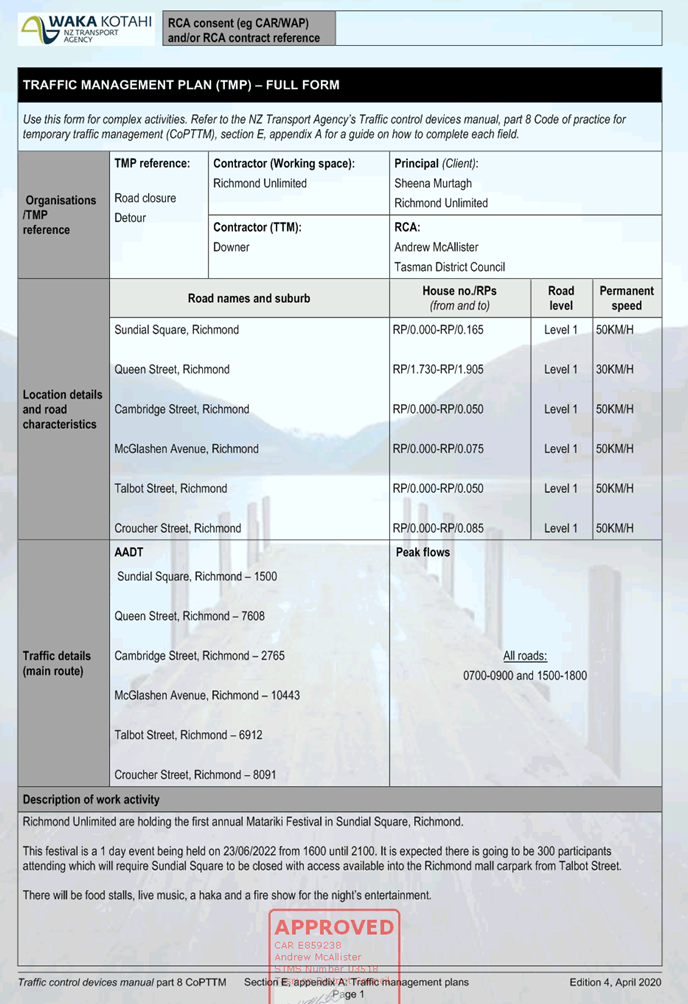
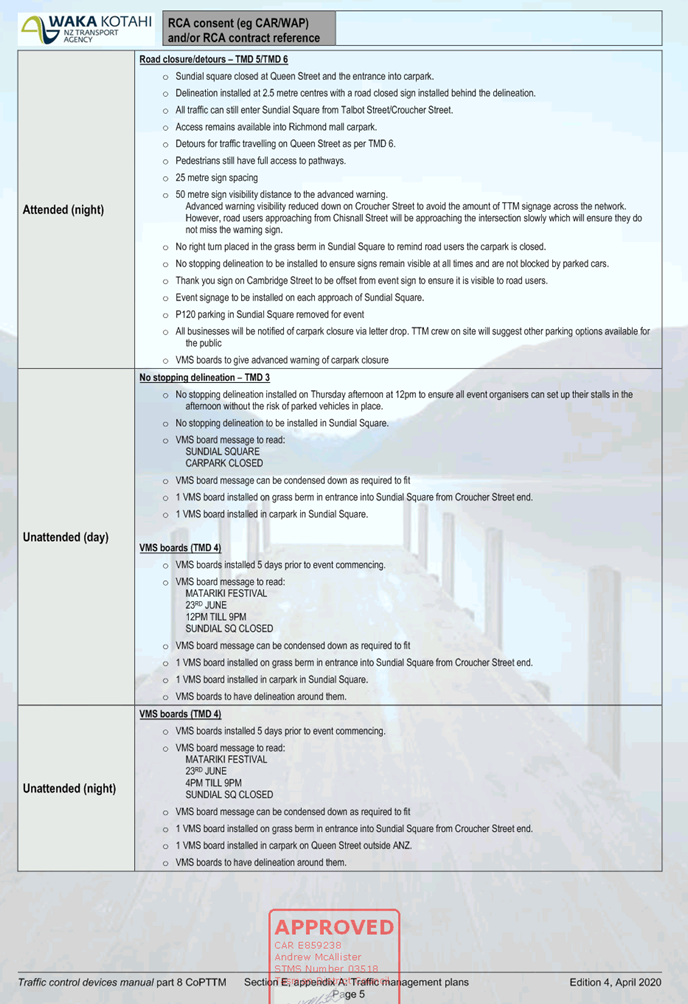
1.1 This
report seeks the Council’s approval for the temporary road closure of
Sundial Square for the upcoming ‘Matariki on Queen Street’ event in
Richmond.
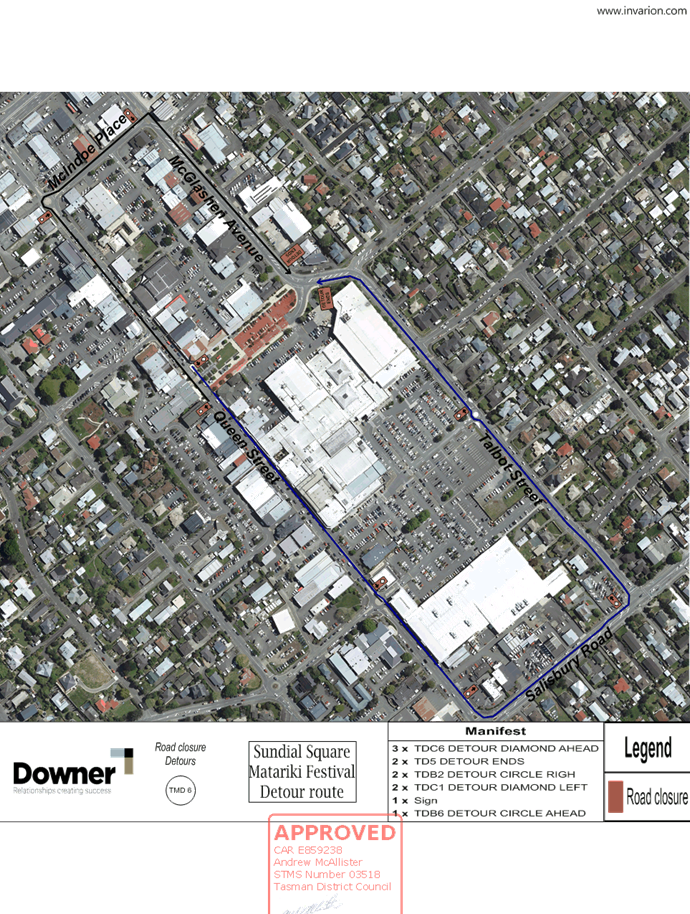
1.2 It
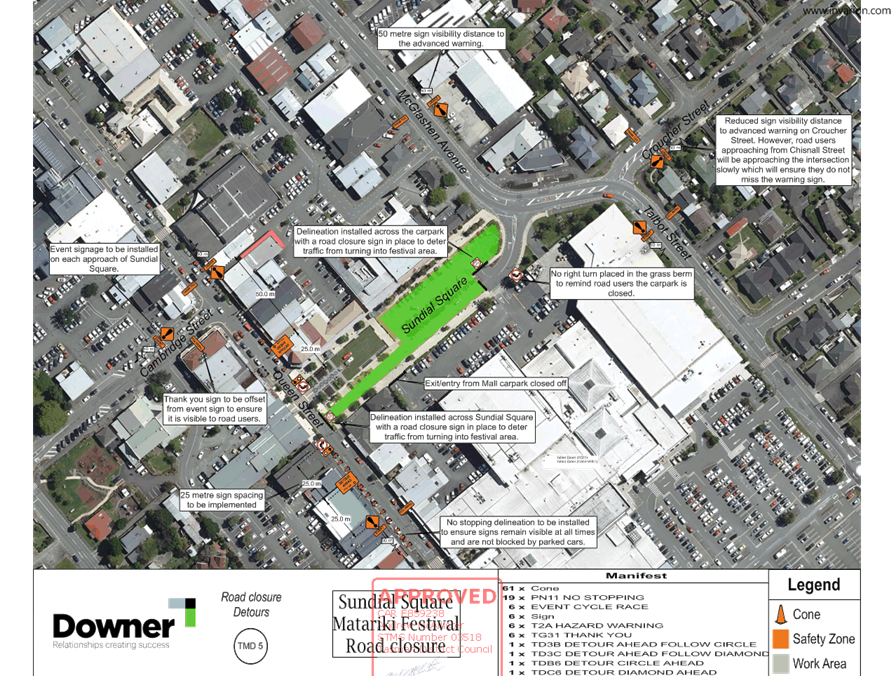
is proposed that Sundial Square will be closed to vehicular traffic from the
Queen Street entrance to the Richmond Mall entrance closest to McGlashen
Avenue, on Thursday 23 June 2022 from 4.00 pm until 9.00 pm.
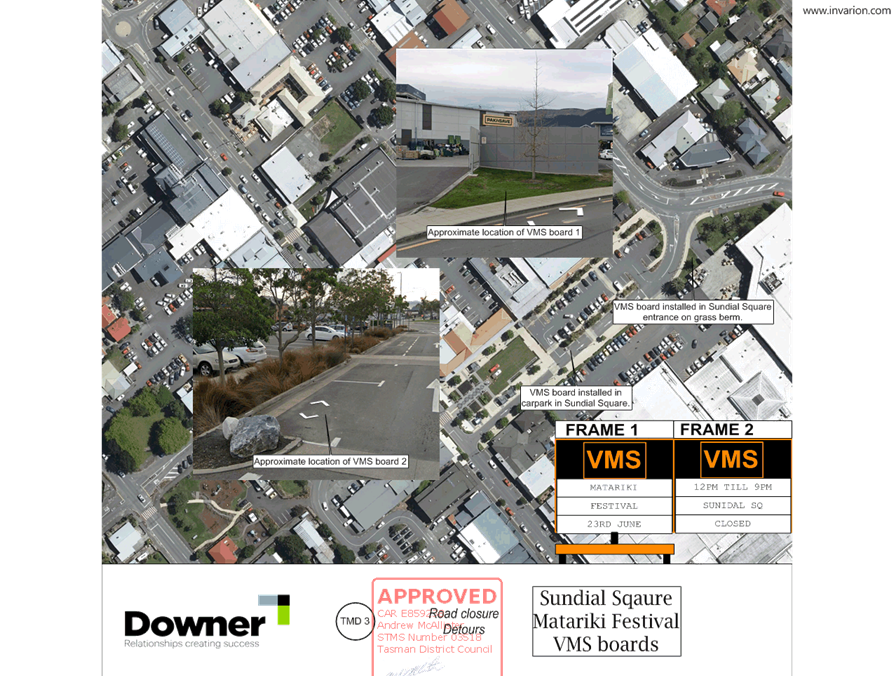
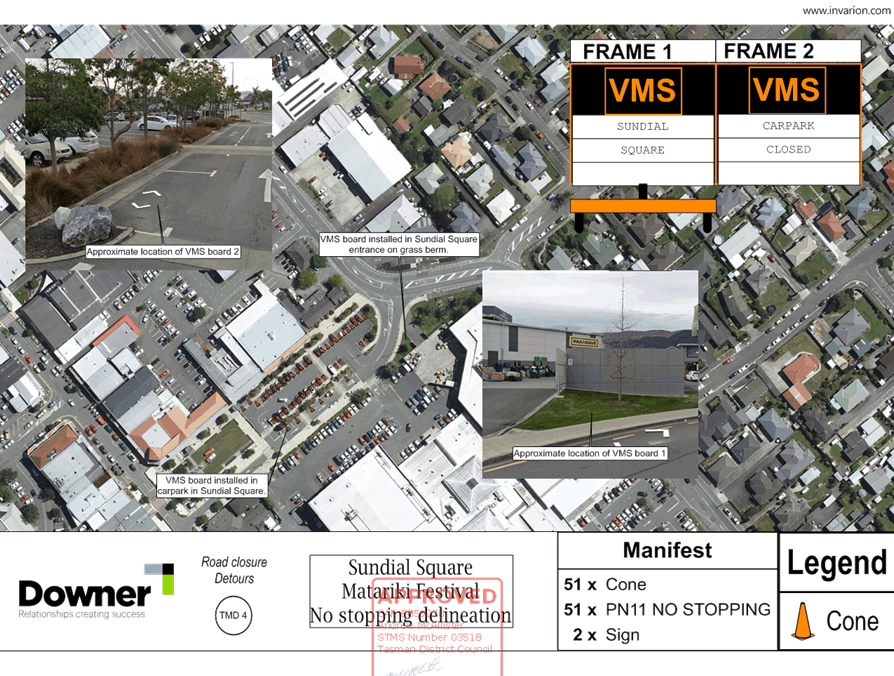
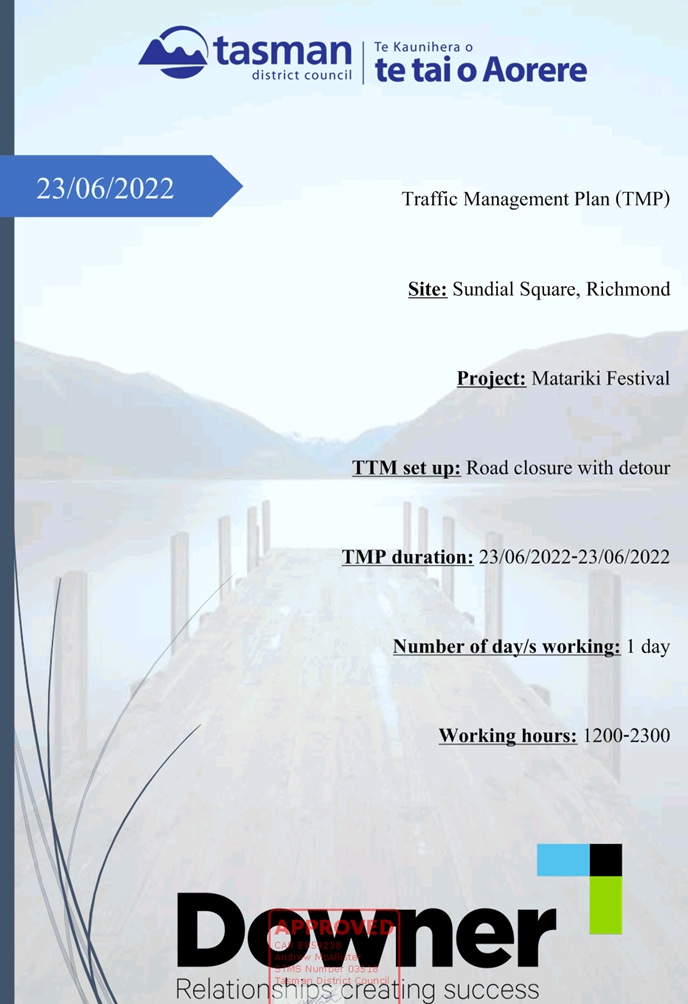
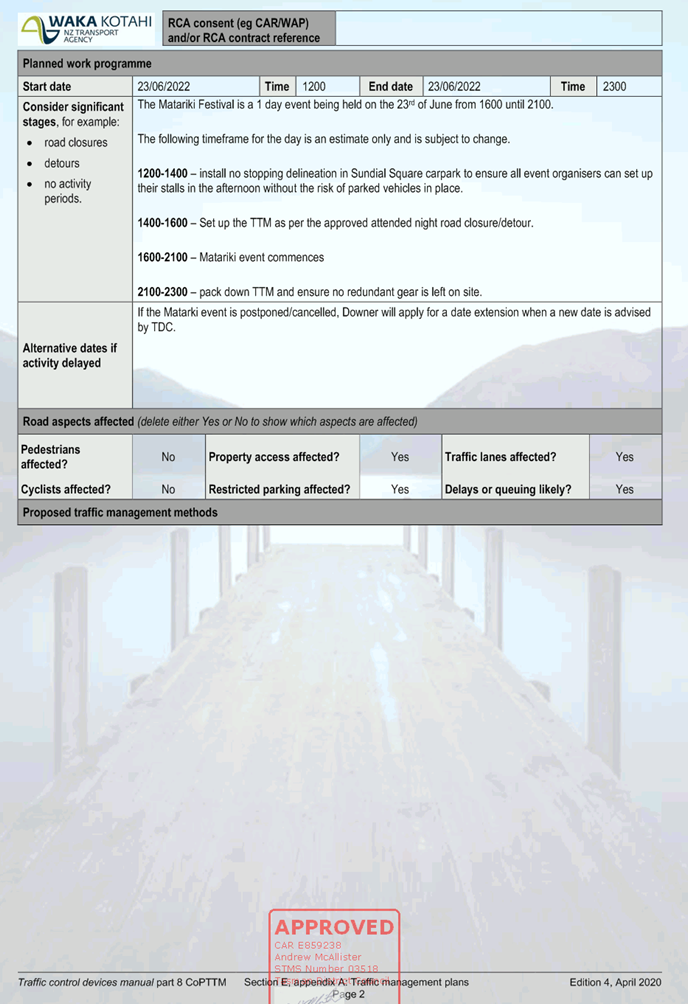
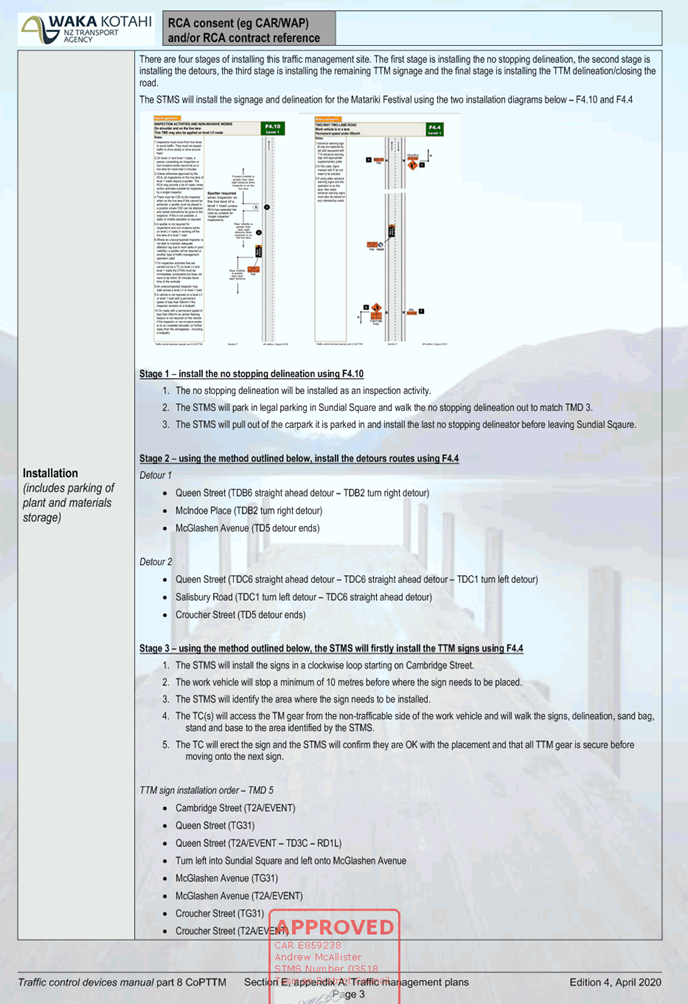
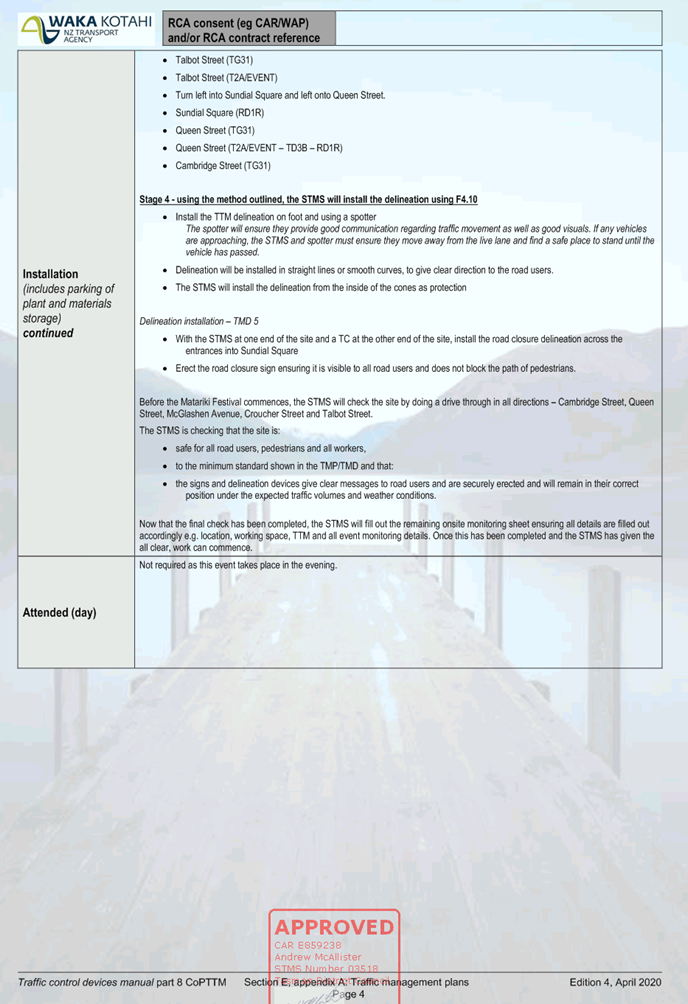
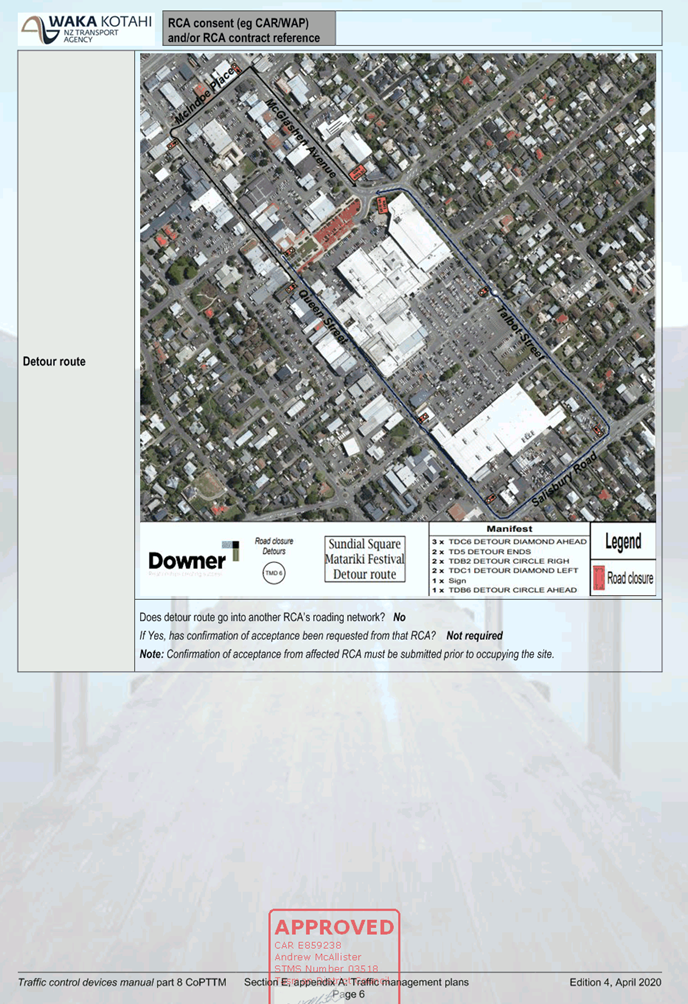
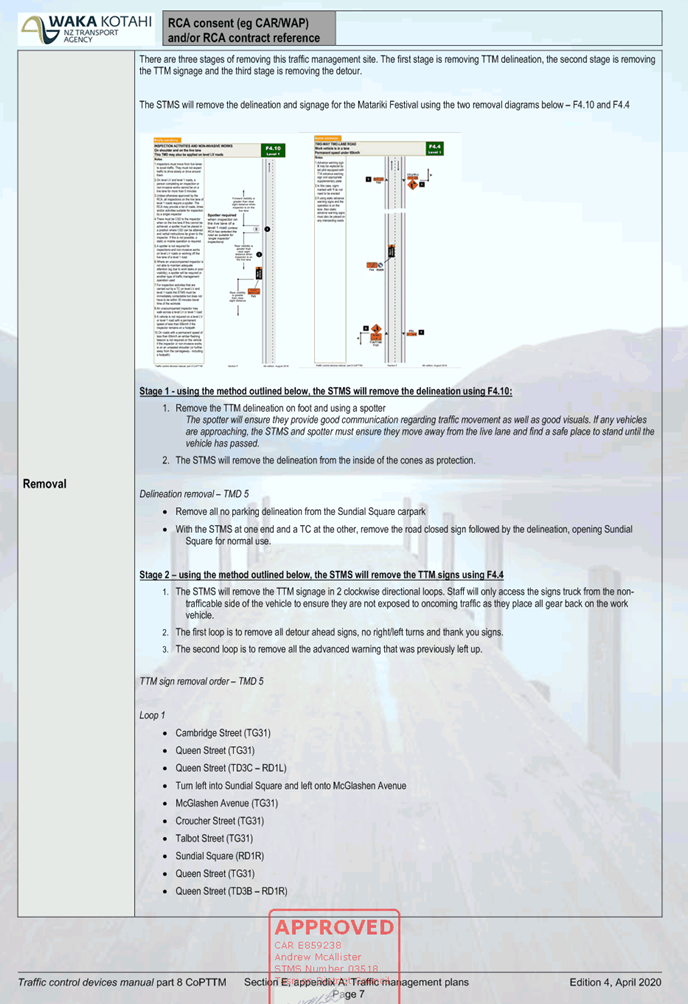
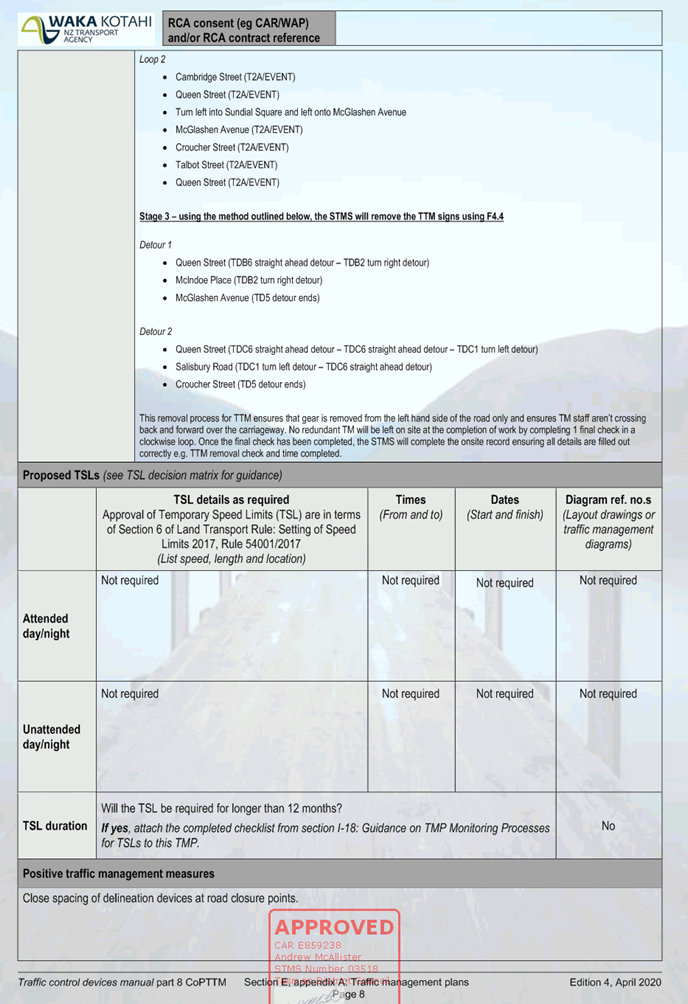
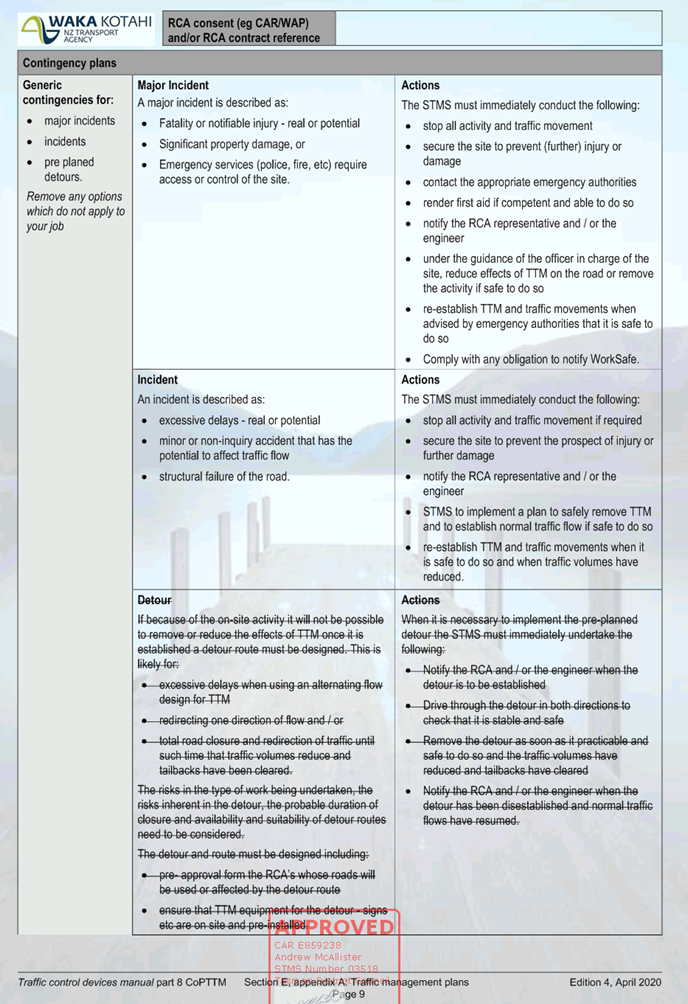
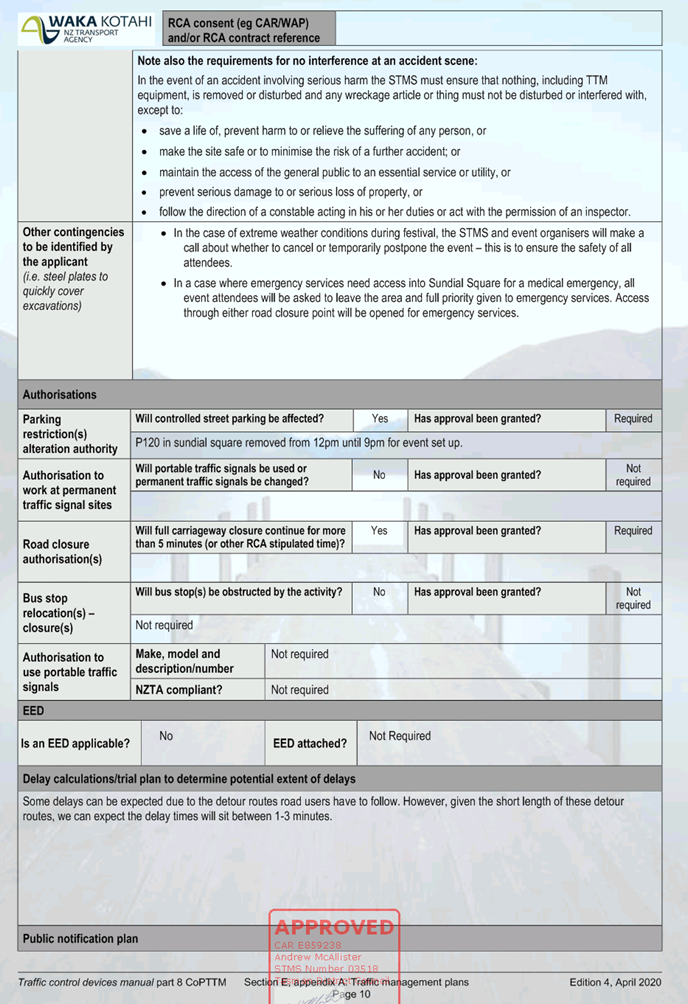
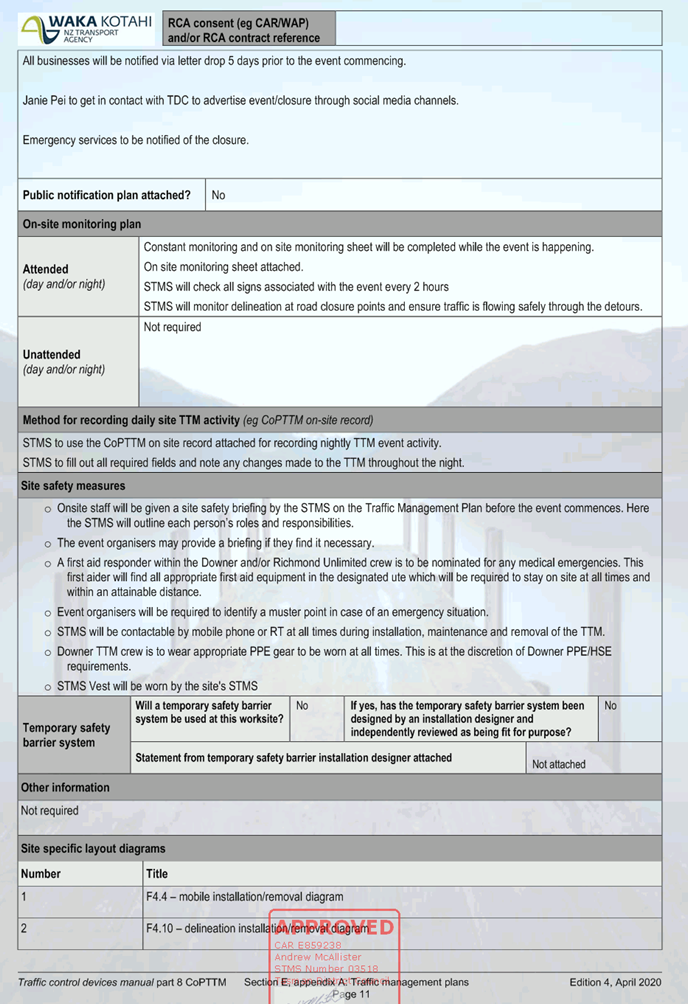
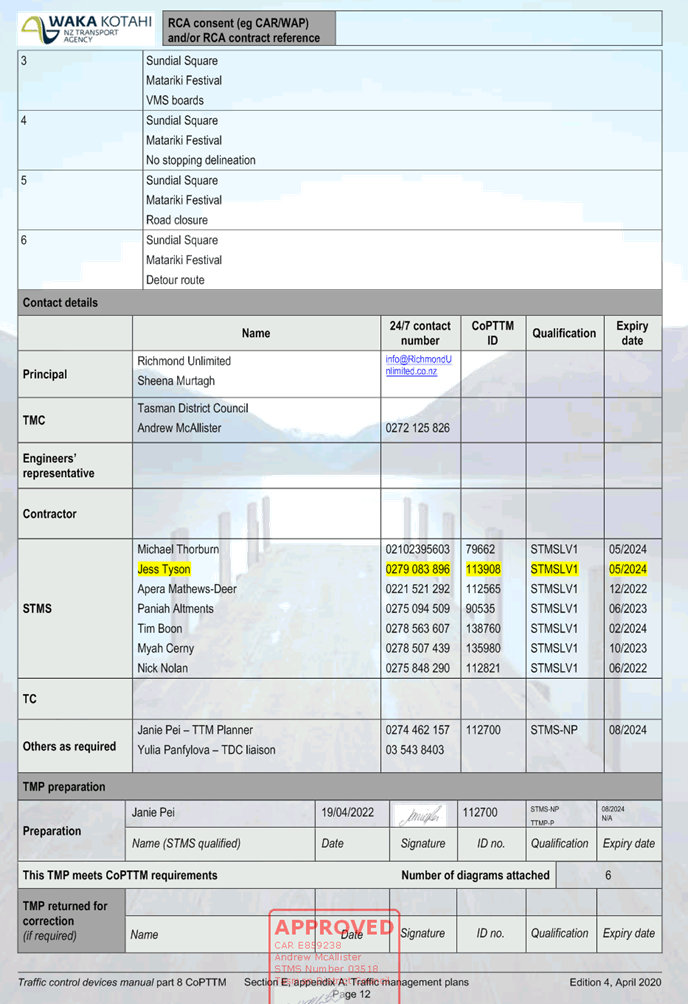
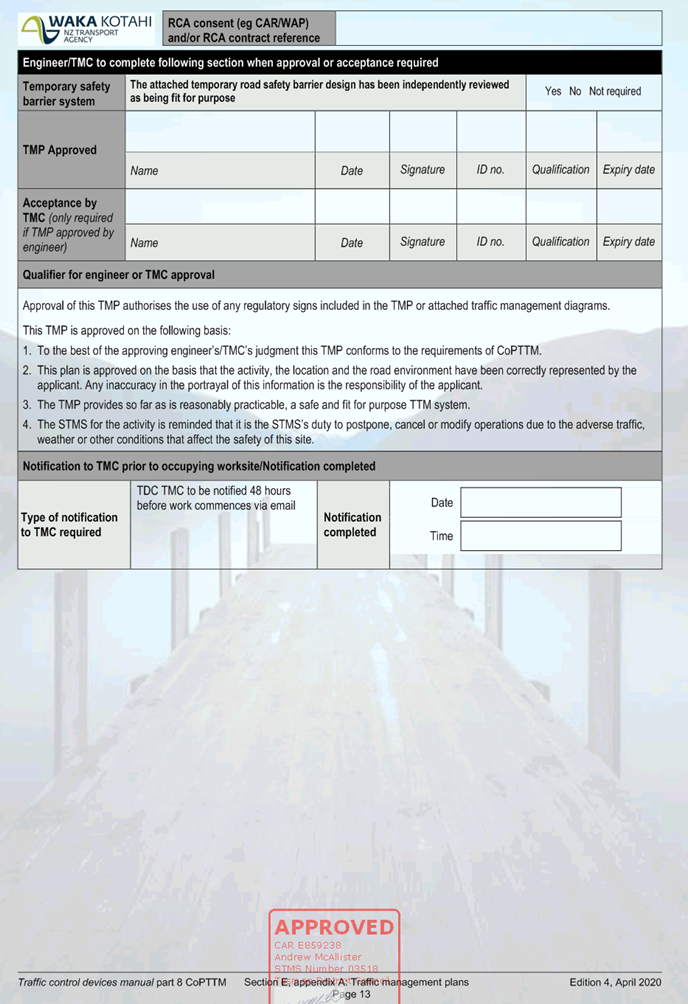
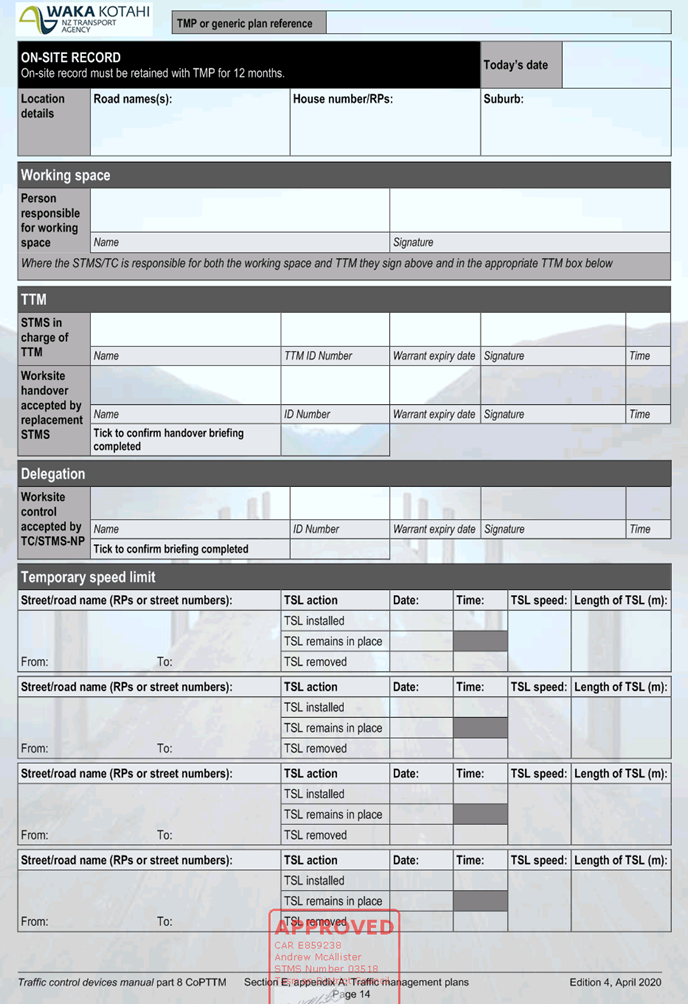
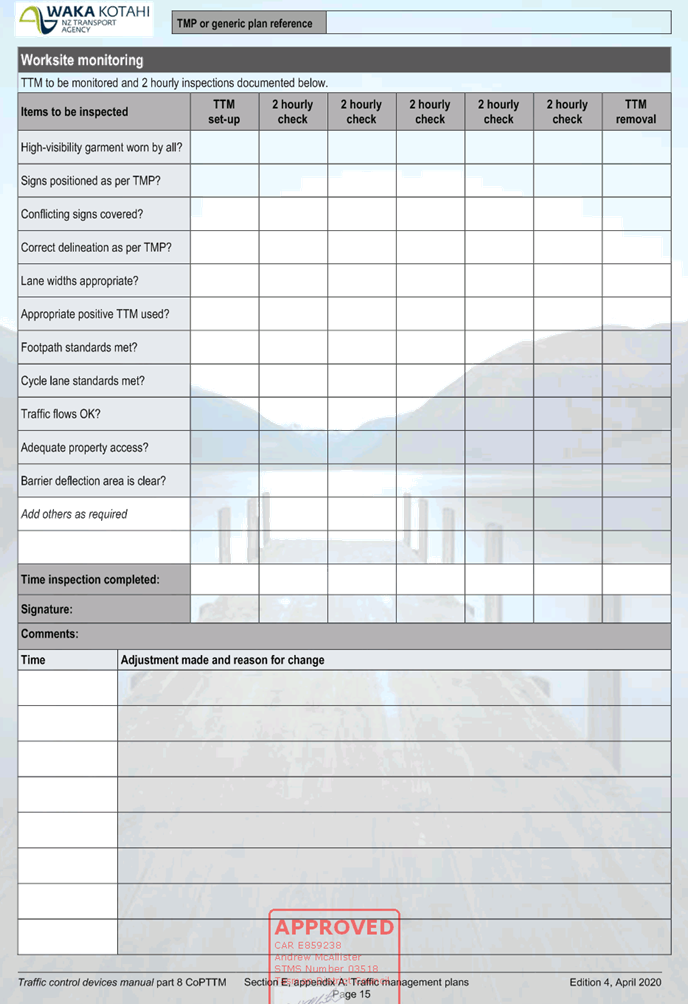
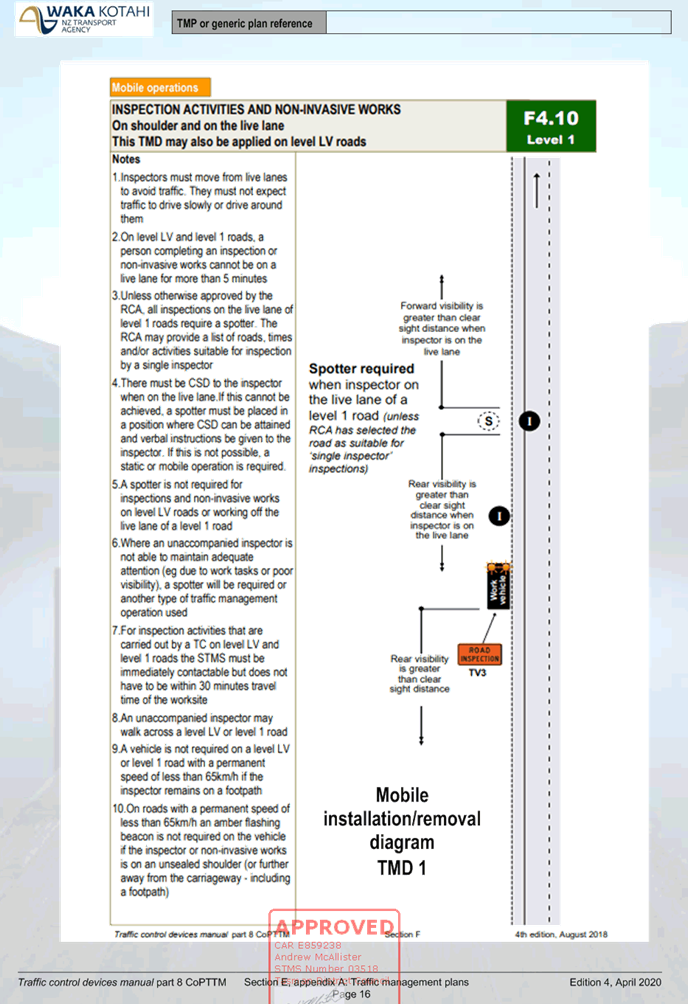
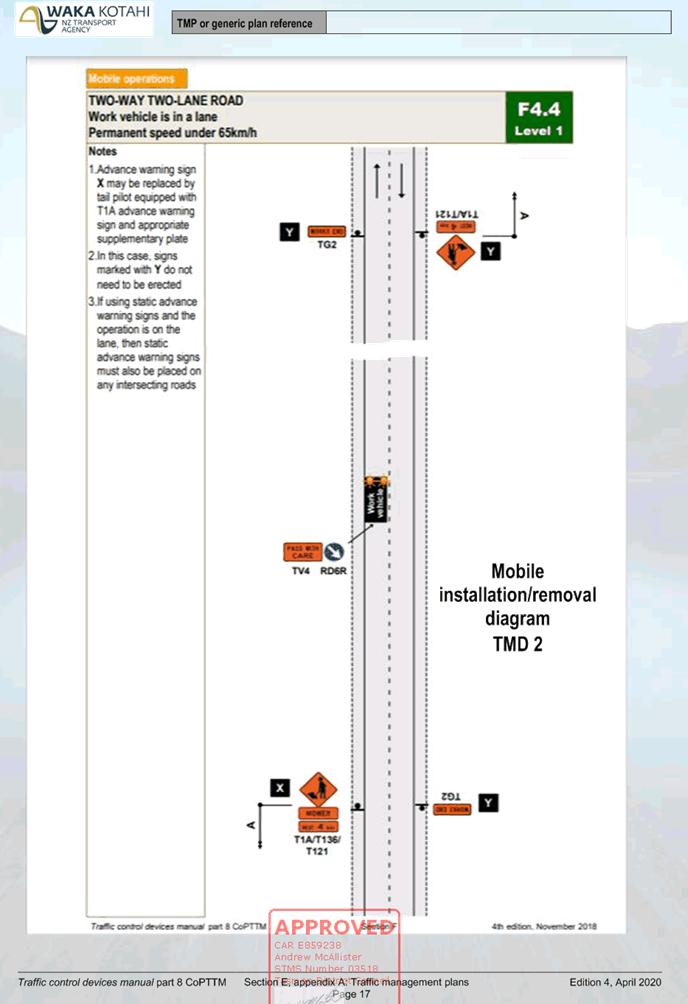
1.3 The
location and draft traffic management plan can be seen in Attachment One.
1.4 There
is an alternate event date of Thursday 30 June 2022 which also needs approval.
That the Regulatory Committee
1. receives the Proposed Temporary Road Closure - Matariki on
Queen Street RRC22-06-03;
and
2. approves the temporary closure of Sundial Square Road
from the Queen Street entrance to the Richmond Mall entrance closest to
McGlashen Avenue, on Thursday 23 June 2022 from 4.00 pm until 9.00 pm (with an
alternate date of Thursday 30 June 2022) for the ‘Matariki on Queen
Street’ event.
3.1 This
report seeks the Council’s approval for the temporary road closure of
Sundial Square for the upcoming ‘Matariki on Queen Street’ event in
Richmond.
4 Background
and Discussion
4.1 As
specified in the Local Government Act 1974 section 342 and schedule 10,
temporary road closures for events can only be approved by the Council or a
delegated Committee of the Council.
Matariki on
Queen Street
4.2 The
Tasman District Council has applied to temporarily close Sundial Square to
vehicular traffic from the Queen Street entrance to the Richmond Mall entrance
closest to McGlashen Avenue, on Thursday 23 June 2022 from 4.00 pm until 9.00
pm (with an alternate date of Thursday 30 June 2022) for the ‘Matariki on
Queen Street’ event.
4.3 Access
to the Richmond Mall carpark will still be available via the McGlashen Avenue
entrance.
4.4 Timeframes
for approving the temporary road closure for this event have been compressed,
however all relevant advertising and consultation has taken place.
4.5 Staff
recommend that this temporary road closure be approved.
5.1 The
options are outlined in the following table.
|
|
Option
|
Advantage
|
Disadvantage
|
|
1.
|
Approve the
proposed temporary road closure described in this report.
|
The Richmond
Matariki event can proceed as planned.
|
Some business
owners, residents and road users may be temporarily inconvenienced.
|
|
2.
|
Decline the
proposed temporary road closure described in this report.
|
No effect on
road users or residents.
|
The event will
not be able to proceed as planned and may cause some safety issues for those
in attendance.
|
5.2 Option
1 is recommended.
6.1 Some
people will be temporarily inconvenienced by the temporary road closure. However,
the closure will be in place to keep residents safe, is supported by local
businesses, and will be the start of a new tradition of Matariki events to be
enjoyed by our community.
7 Policy
/ Legal Requirements / Plan
.7.1 It is a requirement that temporary road
closures for certain types of events made under Schedule 10 Clause 11(e) of the
Local Government Act 1974 come to the Council (or delegated Committee of
Council) for approval. Approval for temporary closures for certain events
cannot be delegated to Council staff.
7.2 As
per clause 11 of Schedule 10 of the Local Government Act 1974, consultation
with the Police and the New Zealand Transport Agency has been undertaken for
the proposed temporary road closure.
7.3 As
per clause 11(e) of Schedule 10 of the Local Government Act 1974, the road
closure will not exceed the aggregate of 31 days for any year.
7.4 As
per clause 11A of Schedule 10 of the Local Government Act 1974, and clause 5 of
the Transport (Vehicular Traffic Road Closure) Regulations 1965, Council staff
have advertised the proposed temporary road closure in Newsline and on the
Council’s website
8 Consideration
of Financial or Budgetary Implications
8.1 The
management of temporary road closures is a normal part of the Council’s
daily business and there are no financial or budgetary implications.
Administrative costs for road closures are covered by the application fee.
9 Significance
and Engagement
9.1 The
proposed closure was advertised in Newsline edition 12 May 2022.
9.2 The
proposed closure was also sent to Richmond Unlimited on the 3 May 2022 to pass
onto local businesses that may be affected. The closure and the event is being
organised in conjunction with Richmond Unlimited.
9.3 The
New Zealand Police and Waka Kotahi (the New Zealand Transport Agency) have been
advised of the proposed closure and have no objections or concerns.
9.4 At
the time of writing, no objections have been received in regard to the proposed
closure.
9.5 Emergency
services will be advised of the closure and provided full access as needed.
9.6 The
following table describes the level of significance of the decision. Overall,
the significance is considered low as the effects of the closures are minor.
|
|
Issue
|
Level of Significance
|
Explanation of Assessment
|
|
1.
|
Is there a high level of public interest, or is decision
likely to be controversial?
|
Moderate
|
The Matariki event will form part of local tradition that
is intended to be well attended and supported by the community.
|
|
2.
|
Are there impacts on the social, economic, environmental
or cultural aspects of well-being of the community in the present or future?
|
Low
|
|
|
3.
|
Is there a significant impact arising from duration of
the effects from the decision?
|
Low
|
The Matariki event is a short-term community event and
will have no lasting effects on the roading network.
|
|
4.
|
Does this activity contribute or detract from one of
the goals in the Tasman Climate Action Plan 2019?
|
No
|
|
|
5.
|
Does the decision relate to a strategic asset? (refer
Significance and Engagement Policy for list of strategic assets)
|
Low
|
The Council’s roading network is considered a
strategic asset but this decision only relates to the temporary closure of a
small section of the network for short duration.
|
|
6.
|
Does the decision create a substantial change in the
level of service provided by Council?
|
No
|
|
|
7.
|
Does the proposal, activity or decision substantially
affect debt, rates or Council finances in any one year or more of the LTP?
|
No
|
The cost for the closures is part of the Council’s
daily business and there are no financial of budgetary implications.
|
|
8.
|
Does the decision involve the sale of a substantial
proportion or controlling interest in a CCO or CCTO?
|
No
|
|
|
9.
|
Does the proposal or decision involve entry into a
private sector partnership or contract to carry out the deliver on any
Council group of activities?
|
No
|
|
|
10.
|
Does the proposal or decision involve Council exiting
from or entering into a group of activities?
|
No
|
|
|
11.
|
Does the proposal require inclusion of Māori in the
decision making process (consistent with s81 of the LGA)?
|
No
|
Temporary road closures are a standard operational
process under the Local Government Act 1974.
|
10.1 The
‘Matariki on Queen Street’ will be a positive community event with
hopefully good attendance by residents.
10.2 Temporary
road closures for these types of events require the Council’s approval.
10.3 For
this event, a temporary closure of Sundial Square, from Queen Street to the
Richmond Mall entrance closest to McGlashen Ave, to vehicular traffic is
proposed.
10.4 Staff
recommend that the Council approve the temporary road closure in accordance
with the Local Government Act 1974 section 374 and Schedule 10.
10.5 The
proposed road closure is also in accordance with the Transport (Vehicular
Traffic Road Closure) Regulations 1965.
11.1 If
the Council approves the temporary road closure:
11.1.1 Staff will advertise the closures on Antenno and on the
Council website and social media channels.
11.1.2 Richmond Unlimited will liaise with affected business
owners regarding the closure details.
|
1.⇩
|
Draft traffic management design
plan for Matariki on Queen event
|
17
|
Tasman District Council
Regulatory Committee Agenda – 16 June 2022
8.4 Draft Stock Control and Droving Bylaw
Decision Required
|
Report To:
|
Regulatory Committee
|
|
Meeting Date:
|
16 June 2022
|
|
Report Author:
|
Clare Scott, Transportation
Planning Officer
|
|
Report Number:
|
RRC22-05-4
|
1.1 The
purpose of this report is to seek approval from the Council to consult the
public on the draft Stock Control and Droving Bylaw 2022 (Bylaw) (included
in Attachment 1).
1.2 The
last Tasman District Council Stock Control Bylaw came into effect in 2005 and
expired in 2017. There is currently no active bylaw regulating the activity of
stock crossing and droving.
1.3 The
draft Bylaw provides the regulatory authority for the Council to exercise
control over stock crossings and droving in the road reserve to:
· protect the safety of road users; and
· ensure stock effluent and mud does not cause a nuisance on the road
and does not impact on the health of waterways.
1.4 The
draft Bylaw 2022 improves upon the 2005 Bylaw by:
· clarifying legal language and details around which activities are
permitted
· incorporating more detail around safety requirements, including best
practice stopping distances
· including visual guidance to help increase comprehension and
compliance with these regulations; and
· aligning with recent freshwater regulations, such as the National
Policy Statement on Freshwater and underlying concept of Te Mana o te Wai.
1.5 Because
the 2005 Stock Control Bylaw has expired, the draft Stock Control Bylaw 2022 is
a new, separate bylaw. The 2005 Bylaw is only relevant as it was used as a
template for the draft 2022 Bylaw.
1.6 Staff
have engaged with Federated Farmers through the process of developing the draft
Bylaw. Iwi have not been consulted on the draft Bylaw to date but will be
specifically notified when it is available for public consultation.
1.7 The
process of making a bylaw requires use of the special consultative procedure
under the Local Government Act 2002 to consult on this draft Bylaw. This
requires a Statement of Proposal to be adopted, including the draft Bylaw (Attachment
1).
1.8 Consultation
is proposed for 1 July 2022 to 1 August 2022, followed by hearings and
deliberations in December 2022. The final Bylaw is expected to be adopted early
in 2023.
1.9 Staff
anticipate a low level of interest from the general public, but a medium to
high level of interest from farmers. Staff propose a public webinar, in
collaboration with Federated Farmers, to allow those interested to ask
questions and seek clarification during the consultation period.
1.10 Consultation
on the draft Bylaw will be advertised through the Council’s social media
channels, emails to stakeholders, and Newsline. Copies of the Statement of
Proposal will be available at Council offices and on the Council’s
website.
That
the Regulatory Committee:
1. receives
the Draft Stock Control and
Droving Bylaw RRC22-06-04 report; and
2. notes
that sections 145 (a) and (b) of the Local Government Act 2002 (LGA) grant the
Council the power to make bylaws in order to protect the public from nuisance,
and to protect, promote and maintain public health and safety; and
3. in
accordance with section 155 of the Local Government Act 2002:
i. agrees
that the proposed Stock Control Bylaw 2022 contained in Attachment 1 is the most
appropriate way of addressing issues arising from the activity of droving and
crossing of stock on roads; and
ii. agrees
that the proposed Stock Control Bylaw 2022 bylaw does not give rise to any
implications under the New Zealand Bill of Rights Act 1990; and
4. approves
the Statement of Proposal (Attachment 1) which includes the proposed Stock
Control Bylaw 2022 for public consultation using the Special Consultative
Procedure as outlined in sections 83 and 86 of the Local Government Act 2002;
and
5. agrees
that the Statement of Proposal is sufficient to enable public understanding of
the proposal and that a separate Summary of Information is not required;
6. agrees
to consult the public on the proposed Bylaw 2022 from 1 July to 1 August 2022;
and
7. agrees
to advertise consultation on the proposed Bylaw through social media, emails to
iwi and stakeholders, and Tasman District Council’s Newsline; and
8. agrees
that staff hold a public webinar on the proposed Bylaw during consultation; and
9. agrees
to make the Statement of Proposal available on Council’s website site and
at the Council’s office and libraries; and
10. authorises
the Chair of the Regulatory Committee to make minor edits to the Statement of
Proposal before consultation begins; and
11. recommends
that the incoming Council appoint a hearings panel to hear and deliberate on
submissions on the proposed Bylaw and make recommendations back to Full
Council.
3.1 The
purpose of this report is to request approval from the Council to consult the
public on the draft Stock Control Bylaw 2022 (included in Attachment 1).
4 Background
and Discussion
4.1 The
expired Tasman District Council Stock Control Bylaw came into effect in 2005
and expired in 2017, after a two-year grace period to renew. There has not been
an active Stock Control Bylaw since 2017.
4.2 Until
a new bylaw is approved, there will be no active bylaw regulating the activity
of stock crossing and droving, which is reasonably common in rural parts of the
District.
4.3 This
presents a risk to public safety and environmental health. Without clear
regulations and safety requirements, it is less likely that good road
management practice is being followed, and consequently more likely that an
accident will occur. It is also more likely that the impact on waterways is not
being minimised.
4.4 Accidents
have occurred on the road because of failure to follow best practice safety
when crossing stock. These accidents can cause serious injuries and raise the
priority and urgency of this bylaw review.
4.5 The
draft Bylaw provides the regulatory authority for the Council to exercise
control over stock crossings and droving in the road reserve to:
· protect the safety of road users; and
· ensure stock effluent and mud does not cause a nuisance on the road
and does not impact on the health of waterways.
4.6 The
draft Bylaw brings our regulation of stock crossings and droving into line with
best practice standards in terms of road safety, legal clarity and freshwater
standards. The expired 2005 Bylaw was used as a template for the writing of the
draft 2022 Bylaw. Other key sources of guidance were the Selwyn and Gisborne
District Council Stock Bylaws, and Waka Kotahi and the Road Controlling
Forum’s best practice road safety guidance.
4.7 In
order to gain a better understanding of the activity and the perspective of
farmers, staff engaged the local branch of Federated Farmers and asked for
their feedback on an early draft of the Bylaw. The feedback from Federated
Farmers, from an in-person meeting as well as a review by their policy advisor,
has been taken into account in the draft Bylaw.
4.8 The
draft Bylaw underwent an external legal review in March 2022, as well as an
internal legal edit.
4.9 Staff
workshopped the key proposed changes to the draft Bylaw compared to the 2005
Bylaw with Councilors on 8 June 2022.
5.1 The
draft Bylaw regulates the movement of stock crossing roads and droving along
roads with the intention to:
· Protect road users from potential accidents caused by collisions
with stock or fences; and
· Protect fresh waterways from pollution by stock effluent or mud that
runs off the road; and
· Avoid nuisance to the public from stock effluent or mud on the
roadway.
5.2 To
ensure the above intentions are understood and complied with, the draft Bylaw
lays out regulations concerning:
· Fencing
and signage
· Times
of day crossing is allowed
· The
number of stock allowed to cross
· Responsibilities
of those controlling stock
· Damage
to property
· Effluent
and mud clean-up.
5.3 Failure
to comply with the requirements is a breach of the Bylaw. The Council can
require action from farmers that do not keep the road areas free from effluent
and mud after droving/crossing/grazing. Continued failure to comply can
expose a farmer to prosecution for a breach of the bylaw.
5.4 There
are some key changes from the expired 2005 Bylaw in the draft 2022 Bylaw. Some
of these involve new, or clearer, requirements for farmers. These are detailed
in the table below:
|
|
2005 Bylaw
|
Draft 2022 Bylaw
|
Why the change?
|
|
Signage requirements
|
Sign placement requirements are only
specified for 100 kmph and 70 kmph speed zones.
|
Sign placement is clear. Signs must be
placed at a distance of 3 x the speed limit from the crossing point.
|
Requiring a stopping distance of 3x the
speed limit is current best practice road safety.
|
|
Effluent requirements
|
The road must be kept clear of stock
effluent.
|
The road must be kept clear, but also the
way in which effluent is cleaned off the road must ensure that waterways are
protected from effluent runoff.
|
The health of freshwater needs to be
considered to align with current Freshwater guidance and legislation.
|
|
Legal wording is strengthened
throughout
|
E.g. Consideration shall be given
to holding stock back 50 m before crossing.
|
E.g. Drovers must hold stock back
50 m from the road exit point.
|
The wording in the 2005 Bylaw meant that
some clauses read as guidance rather than law.
|
6.1 The
options are outlined in the following table.
|
|
Option
|
Advantage
|
Disadvantage
|
|
1.
|
Approve the Statement of
Proposal, including the draft Bylaw for public consultation. (Attachment
1)
|
Helps ensure safety of road users
and mitigates risks to waterways.
Takes prompt action to engage
with the public and shorten the timeframe before the Council has an active
Stock Crossing Bylaw.
|
Does not provide Council with the
opportunity to make changes to the Bylaw before engaging with the public.
|
|
2.
|
Approve the Statement of
Proposal, including the draft Bylaw for consultation with amendments
|
Helps ensure safety of road users
and mitigates risks to waterways.
Offers the Council opportunity to
make changes to the draft Bylaw prior to engaging with the public.
|
Depending on the required
changes, may cause delays to the Final Bylaw coming into force.
|
|
3.
|
Not approve the Statement of
Proposal, including the draft Bylaw for public consultation
|
None.
|
Council does not take action to
mitigate the environmental and safety risks that this activity poses.
|
6.2 Option
1 is recommended. This will give the public a chance to submit on the Statement
of Proposal and draft Bylaw, which will mean that a final Stock Control Bylaw
regulating the use of roads for stock crossing and droving is expected to be
active by the first quarter of 2023.
7.1 It
is a risk to the Council if there continues to be no active Stock Control
Bylaw. Further accidents could occur due to farmers failing to remove temporary
fences or collision with livestock. This would mean that the Council would not
be able to demonstrate having taken precautions to regulate the activity in an
effort to keep all road users safe.
7.2 Freshwater
is also at risk of being polluted by stock effluent. Without an active Bylaw,
the Council does not have the have regulations in place as a road controlling
authority to control the safety of this activity or require compensation for
damages.
8 Policy
/ Legal Requirements / Plan
.8.1 The 2005 Stock Control bylaw expired in 2017.
The draft 2022 Bylaw would be a new Bylaw as it does not replace a currently
active bylaw. Once the Final Bylaw is adopted, there is no existing Bylaw in
place that needs to be revoked before the new Bylaw coming into force.
8.2 The
Local Government Act 2002 section 145 give territorial authorities the power to
make bylaws in order to protect the public from nuisances or to maintain public
health and safety. The draft Stock Control Bylaw 2022 is being made under this
purpose.
9 In
order to make such bylaws, section 155 of the LGA requires that the Council
must determine that the proposed bylaw:
· is the most
appropriate way and form for addressing the potential issues arising from the
activity of droving and crossing stock over roads; and
· does not
give rise to any implications under the New Zealand Bill of
Rights Act 1990; and
· is not
inconsistent with the New Zealand Bill of
Rights Act 1990;
9.1 Some
elements of the Bylaw could potentially be adopted in other ways, for example,
through various plans, policies, guidelines, or standards. However, the Bylaw
is considered to provide a more comprehensive set of requirements and certainty
regarding the Council’s authority to set or enforce such requirements,
minimising the risk of litigation for the Council.
9.2 There
are no implications under the New Zealand Bill of Rights Act 1990. The proposed
draft Stock Control Bylaw does not place any limits on freedom of movement,
expression, or association, and does not isolate any particular social group in
terms of the Act. In addition, any offences under the Bylaw will require a
judicial process through the Courts.
10 Consideration
of Financial or Budgetary Implications
10.1 This
draft Bylaw does not have any material financial or budgetary implications for
the Council.
10.2 In
accordance with section 150 of the LGA, the Council may prescribe fees or
charges to cover assessing and granting permits, monitoring, and inspections
required by or authorised through a bylaw. Council can set these fees in the
draft Bylaw or through another process that complies with the consultation
requirements of section 82 of the LGA. In this case, staff propose that the
Council set any fees though the annual fees and charges schedule. The costs and
revenue from this activity is expected to be modest.
10.3 There
may be additional work for enforcement and permit-processing as part of the
monitoring of this activity once the draft Bylaw is adopted.
11 Significance
and Engagement
11.1 Staff
believe that the level of significance of this draft Bylaw is low to the
general public as they are unlikely to be impacted significantly by this Bylaw,
except by not being exposed to hazards and risk. The draft Bylaw is likely to
be of medium to high interest for farmers, some of whom may consider aspects of
the proposal controversial, such as the requirement to align with Waka Kotahi
new best practice signage guidelines.
11.2 Consequently,
staff consider that using the special consultative procedure is appropriate as
contemplated in section 156 of the LGA.
11.3 Sections
83 and 86 of the LGA outline the use and procedural requirements of the special
consultative procedure in relation to making bylaws. This includes ensuring
that the following is publicly available:
· A Statement of Proposal which includes the draft
Bylaw, the reasons for the proposal and a statement on Council’s
determinations under section 155 of the LGA
· A description of how people interested in the
proposal can present their views to the Council
· The period within which views on the proposal
may be provided to the Council.
11.4 The
Statement of Proposal in Attachment 1 also contains a summary of the
draft Bylaw. Consequently, staff do not think that a separate Summary of
Information is necessary.
11.5 Consultation
on the Statement of Proposal must be for at least one month under section 83 of
the LGA. Staff propose it is advertised through the Council’s social
media channels, emails to stakeholders, and Newsline. Copies of the Statement
of Proposal will be available at Council offices and on the Council’s
website. Staff also propose a public webinar, in collaboration with Federated
Farmers, to allow those interested to ask questions and seek clarification
during the consultation period.
|
|
Issue
|
Level of Significance
|
Explanation of Assessment
|
|
1.
|
Is there a high level of public interest, or is decision
likely to be controversial?
|
Low
|
An early draft version of the Bylaw was shared with
Federated Farmers, which represents the key group of people likely to be
interested in this Bylaw. Their early feedback has been incorporated into the
draft Bylaw.
|
|
2.
|
Are there impacts on the social, economic, environmental
or cultural aspects of well-being of the community in the present or future?
|
Yes
|
Low to medium impact on safety the community generally,
but potentially medium-high impacts to individual farmers and road users.
|
|
3.
|
Is there a significant impact arising from duration of
the effects from the decision?
|
No
|
The Bylaw can be amended or revoked by Council at any
time.
|
|
4.
|
Does this activity contribute or detract from one of
the goals in the Tasman Climate Action Plan 2019?
|
No
|
|
|
5.
|
Does the decision relate to a strategic asset? (refer
Significance and Engagement Policy for list of strategic assets)
|
Low
|
The regulations in this Bylaw impact on the safety and
quality of the road network. However, the impact of the road network is
considered of low significance.
|
|
6.
|
Does the decision create a substantial change in the
level of service provided by Council?
|
No
|
|
|
7.
|
Does the proposal, activity or decision substantially
affect debt, rates or Council finances in any one year or more of the LTP?
|
No
|
|
|
8.
|
Does the decision involve the sale of a substantial
proportion or controlling interest in a CCO or CCTO?
|
No
|
|
|
9.
|
Does the proposal or decision involve entry into a
private sector partnership or contract to carry out the deliver on any
Council group of activities?
|
No
|
|
|
10.
|
Does the proposal or decision involve Council exiting
from or entering into a group of activities?
|
No
|
|
|
11.
|
Does the proposal require inclusion of Māori in the
decision-making process (consistent with s81 of the LGA)?
|
No
|
Iwi will be provided the opportunity to provide feedback
on the Statement of Proposal and draft Bylaw through the consultation
process.
|
12.1 Currently,
Council does not have an active Stock Control Bylaw, which poses a risk to
Council as there is no way to enforce safety requirements. Council may also
appear remiss by not providing best practice regulations to control this
potentially hazardous activity.
12.2 The
draft Stock Control Bylaw 2022 makes changes to the 2005 Bylaw by improving
clarity around legal requirements and permits, best practice road safety, and
farmers’ obligations for protecting freshwater quality when using the
road reserve for stock movements.
12.3 Staff
are requesting approval to consult on the draft Bylaw, before seeking final
approval of the Bylaw in early 2023.
13.1 If
approved, the draft Stock Control Bylaw 2022 will go out for public consultation
in July 2022.
13.2 A
hearing panel will be appointed to hear and deliberate on submissions following
election of a new Council in October 2022. They will make recommendations to
Full Council on adoption of a final bylaw, expected in early 2023.
13.3 The
draft Bylaw is expected to be taken to Full Council in the new year and be
active in early 2023.
|
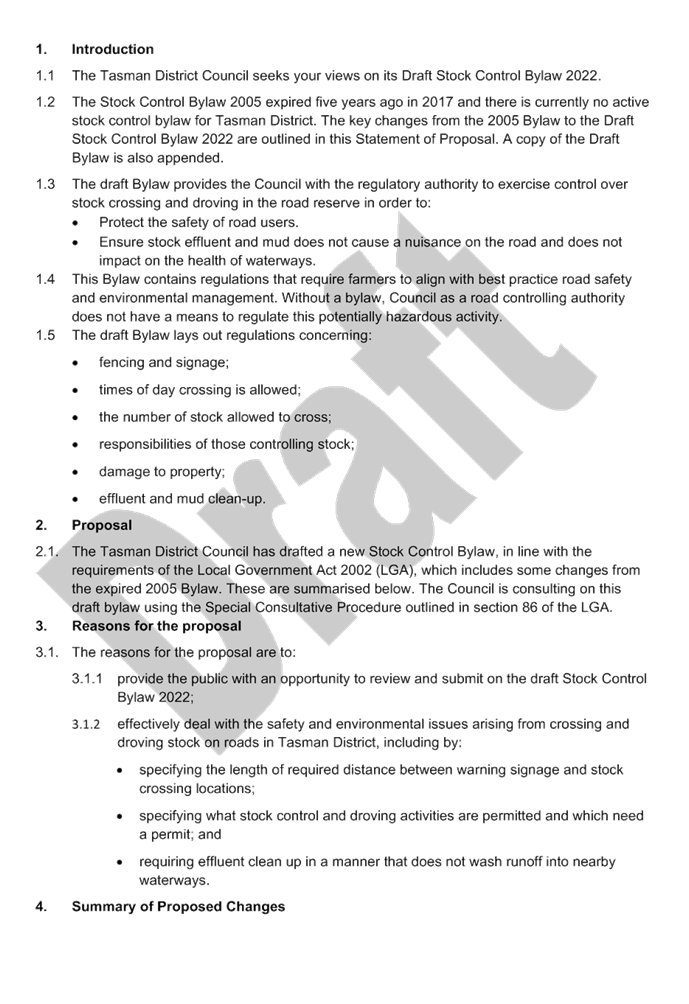
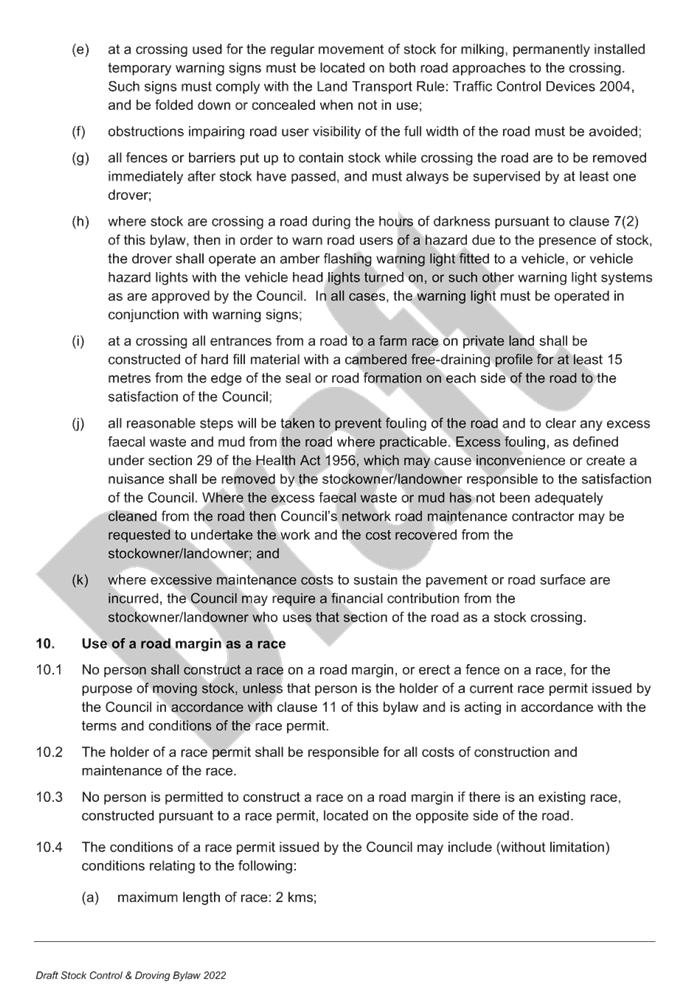
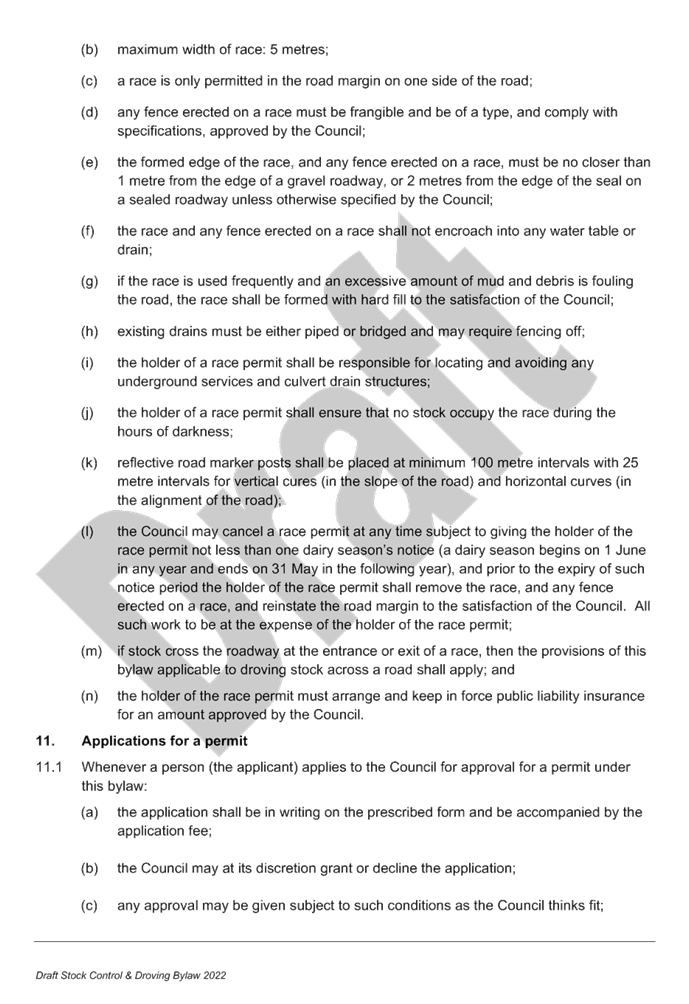
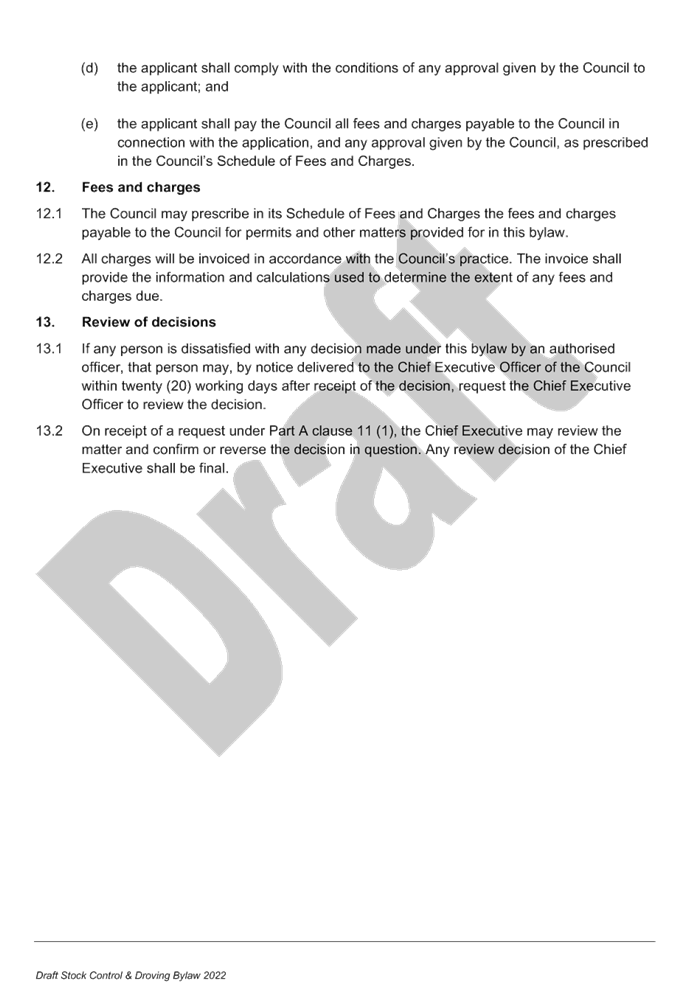
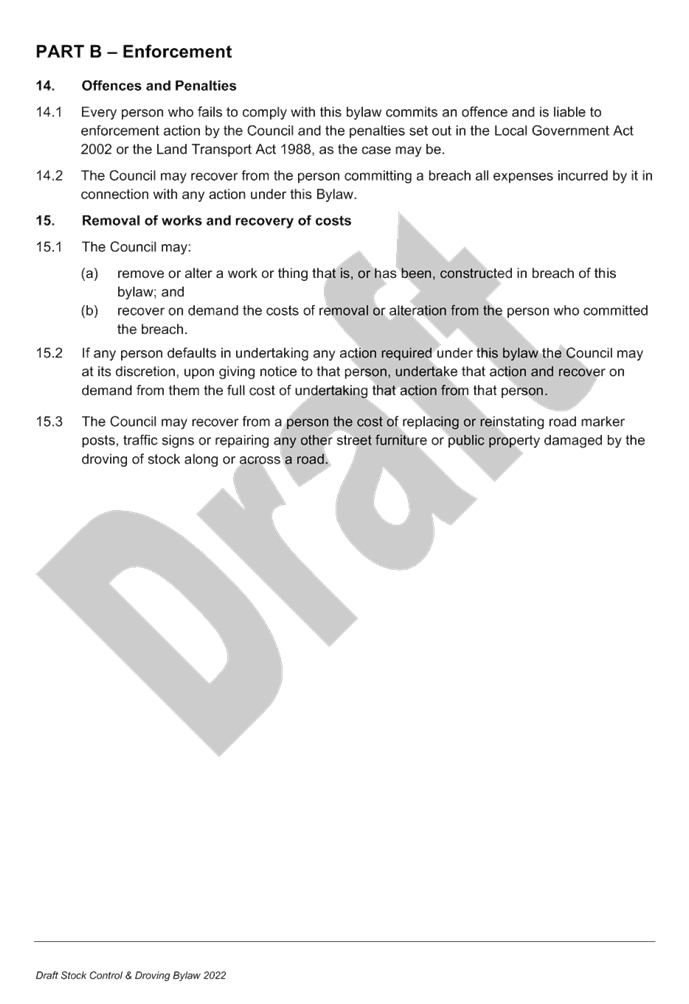
1.⇩
|
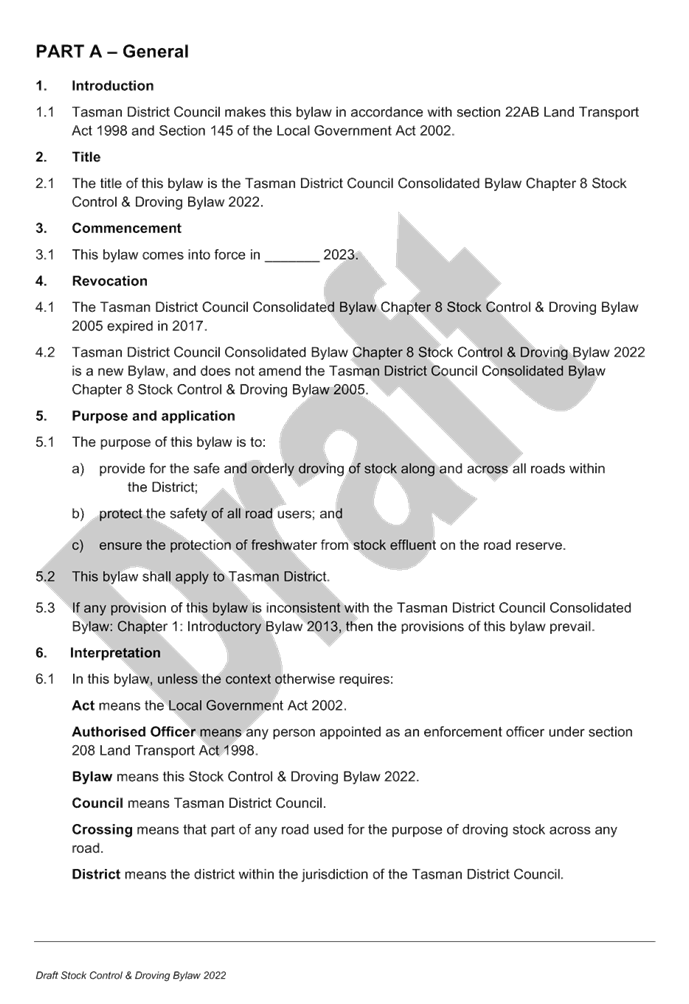
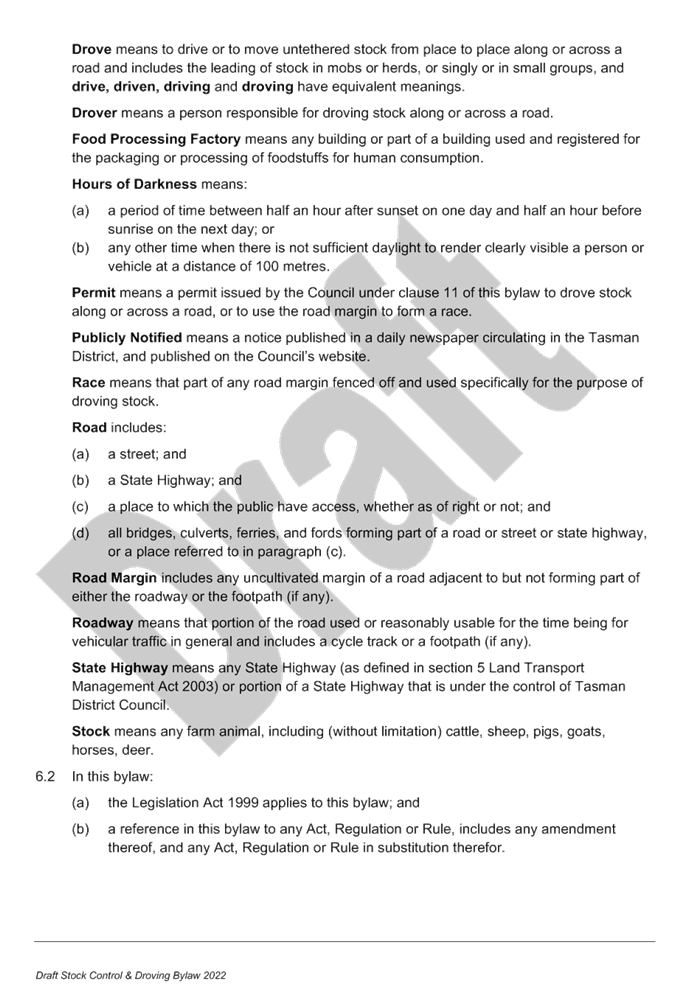
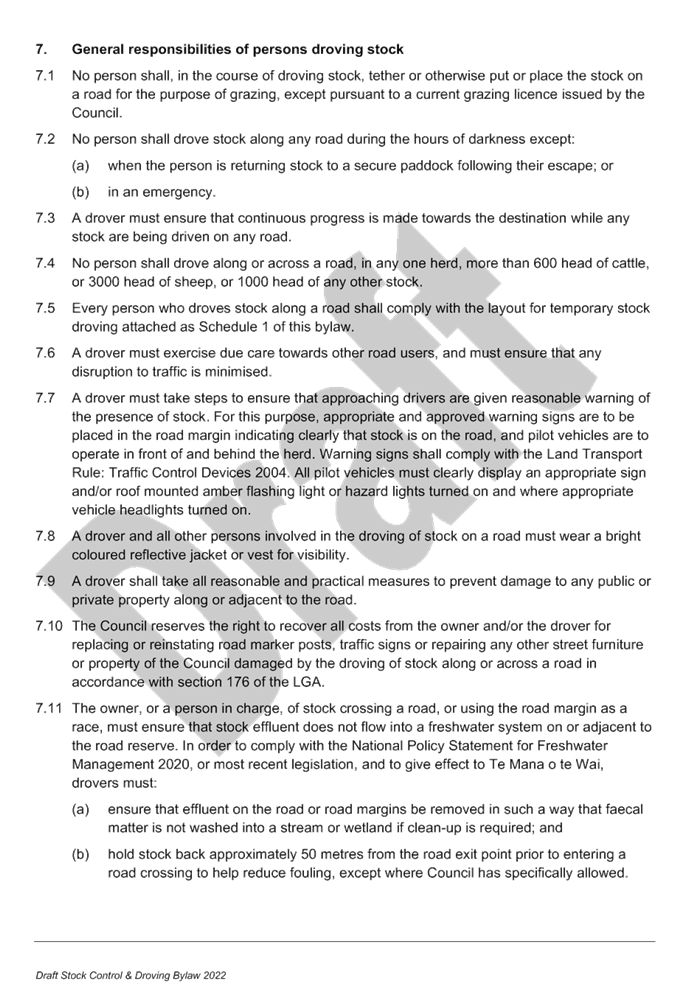
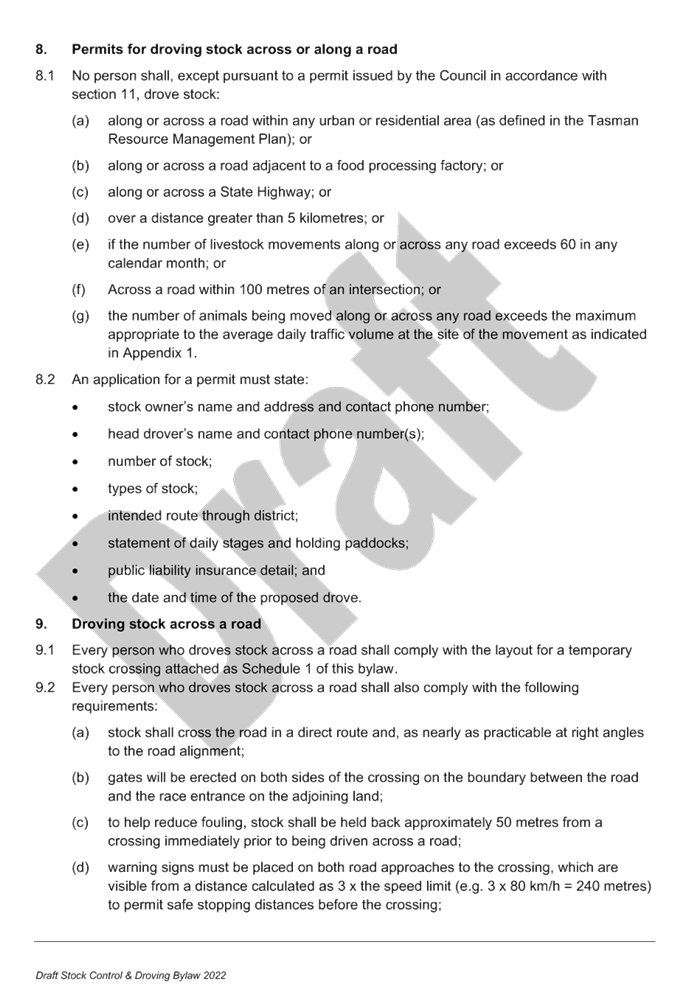
Draft Stock Control and Droving Bylaw 2022
|
48
|
Tasman District Council
Regulatory Committee Agenda – 16 June 2022


Tasman District Council Regulatory Committee Agenda – 16
June 2022
8.5 Building Assurance Manager's Report
Information Only - No Decision
Required
|
Report To:
|
Regulatory Committee
|
|
Meeting Date:
|
16 June 2022
|
|
Report Author:
|
Matt Feely, Building
Assurance Manager
|
|
Report Number:
|
RRC22-06-5
|
1.1 This
information report updates the Committee on activities of the Building
Assurance section over the six-month period since the last report issued 2
December 2021
1.2 Tasman District Council is legally required under the Building Act
2004 to perform the functions of a Building Consent Authority and must maintain
Accreditation under the Building Regulations 2006. We have one remaining
non-compliance to resolve from the International Accreditation NZ (IANZ) Audit
for re-accreditation.
1.3 The
last six months’ building consent applications remain steady. There have
been minor staff changes and challenges, specifically in the consent processing
team.
1.4 In
March 2020, the Ministry of Business, Innovation and Employment (MBIE)
conducted an audit of the territorial authority functions under the Building
Act, focusing specifically on pool inspection obligations and Building Warrants
of Fitness (BWOF’s). MBIE are now satisfied with the work completed on
swimming pool audits and our focus has now moved to BWOF auditing.
That
the Regulatory Committee receives the Building Assurance Manager's Report RRC-22-06-05.
3.1 This report informs the Council of the activities of the Building
Assurance Section since the last report issued on 2 December 2021.
4 Building
Control Functions and Delivery
Regulation 18 Diploma
4.1 Successful
completion of the Regulation 18 Diploma for six technical staff in December
2021 with two being recognized in the top five throughout New Zealand. Five
more technical staff started this diploma in February 2022.
4.2 Service
delivery has been maintained at 98% within statutory timeframes for building
consents and 99% within statutory timeframes for code compliance certificates.
4.3 Continuation
of the multi-proof consenting approval process for developments such as Golden
Bay Mohua Affordable Housing Project, Ruru Buildings, lower Queen Street group
home companies and currently in discussions with Te Āwhina Marae.
Stakeholder
engagement
4.4 Customer
engagements have been adapted due to the ongoing pandemic and we attended the
Master and Certified Builders Meeting 7th April 2022 via Zoom and
continued our quarterly Building Assurance newsletter, which informs our key
customers of important updates, legislation changes, and any other relevant
matters.
5 Compliance
Team Function and Service Delivery
5.1 The Compliance section of Building Assurance undertake all the
territorial authority responsibilities under the Building Act other than those
functions of the building consents team, and includes: Inspections of Pool
Fencing, Processing Building Warrants of Fitness (BWOF), Audits of
BWOF’s, Processing
building consent exemptions, Processing Certificates of Acceptance
(COA’s),Complaints, Compliance Investigation/ Enforcement, Issuing
Notices (NTF, Dangerous and Insanitary, Infringement, CPU etc.)
Status and work of the Compliance Team
5.2 From
significant staff changes in 2021 the new compliance staff have settled well
and continues gaining experience and training for the various tasks.
5.3 We
have achieved good results and managed to inspect all known outstanding pools.
This also include a review to ensure all pools mentioned within all building
consent applications are property recorded and registered. We have further
identified a number of pools that are not on our register. Exact numbers are to
be confirmed.
|
Status
|
As of May 2022
|
|
Total Pool
licenses
|
1551
|
|
Total Pools
non-compliant
|
156
|
|
Notices to fix
issued
|
09
|
|
Pools
removed/decommissioned
|
191
|
|
Average monthly
inspections
|
40
|
5.4 The
team is preparing an audit plan for BWOFS.
5.5 Building
consent exemptions and certificates of acceptance (COA) processing is
continuing.
6 Determinations/
Practitioner Complaints
6.1 We
currently have nine determinations with MBIE, most of which are long overdue
for finalising by MBIE.
6.2 A
Practitioner complaint was formally lodged with ENGNZ against two
Chartered Professional Engineers and accepted for independent expert technical
review and mediation. This is to be treated confidentially until resolved.
7.1 Comparative
statistics are shown by the following three columns in the table below.
The comparisons are three 12-month periods between 1 June to 31 May.
7.2 We
have seen an increase of consent applications for multiple dwellings e.g. Three
new dwellings on one consent, this has decreased the number of dwelling
consents.
7.3 Lower Queen Street development is still ongoing.
7.4 The
BCA has maintained its statutory timeframes for both issuing building consents
and code compliance certificates. The average days for issuing these are also
at 10 for consents and six for Code Compliance certificates (CCCs), which is
also meeting our Activity Management Plan performance measures.
7.5 Building
Inspections are maintaining the 2 working days’ notice for bookings in
most cases.
|
Building Assurance Results
|
1 June 2019 to 31 May 2020
|
1 June 2020 to 31 May 2021
|
1 June 2021 to 31 May 2022
|
|
Building Consents Issued
|
555
|
789
|
724
|
|
New Dwelling Consents
Issued (excluding Amendments)
|
433
|
585
|
520
|
|
Average Processing Days
|
12
|
11
|
10
|
|
Building Consents
Processed within time %
|
97%
|
99%
|
98%
|
|
CCC Applications
|
1039
|
1257
|
1102
|
|
CCC Issued
|
1037
|
1272
|
1100
|
|
CCC Issued within time %
|
100%
|
99%
|
99%
|
|
CCC Average Processing
days
|
2
|
5
|
6
|
|
Inspections
|
7452
|
8610
|
7639
|
|
Failed Inspections %
|
43%
|
63%
|
67%
|
8 Resourcing
Considerations
8.1 During
2021, and within the last six months, the BCA unfortunately lost some
experienced technical processors. This put significant constraints on the team
because they were fully competent, productive processors. While we are very
pleased to have filled these positions, the training and supervision
requirements before the new staff are productive is intensive and demanding for
12-18 months.
8.2 We
continue to lose trained and competent technical staff who move to contractors
or BCAs who offer better renumeration and flexibility. This issue is being
mirrored across the mainland cluster.
8.3 We
do have reliable contracts in place to assist as required until we build up our
internal capacity again.
8.4 Although the constraints are significant due to the new processing
staff, the team is managing well, and despite their regular assignments for
their Building Surveyor Diploma throughout the year, we maintained good
performance statistics.
8.5 The inspections team is one full time equivalent (FTE) short due to
internal secondments which will be in place until October 2022. We are managing
inspections with the use of contractors where required.
9.1 Building
assurance risks have been assessed and added to the Council’s risk
register. Consequences and controls have been listed and categorised. Building
Assurance’s main risk mitigation continues to be ensuring that all
technical staff are competent to assess building consent applications and issue
these only when compliance with the building code is demonstrated. Inspectors
must in turn only issue Code Compliance certificates when the building work is
completed in accordance with the building consent.
9.2 IANZ
accreditation helps provide the Council with a level of assurance that our
Quality Management System (QMS) is working. This QMS includes training toward
competence, evidence of effectiveness of training, internal audits, and
continuous improvement which all assist in mitigating risk to the Council. The
IANZ audit result completed October 2021 has confirmed in the report that the
building consent authority functions continue to present a low risk to the
Council.
10 Tasman
District Council Building Consent Authority Accreditation Audit
10.1 IANZ
undertook its biannual audit which ran over a five-day period concluding on
Tuesday, 2 November. This Audit is required to measure the performance and
compliance of the BCA functions against the Building Regulations 2006.
10.2 The
Auditors were generally complimentary of the work of the BCA and particularly
commented that our statutory timeframes. They recognised this was achieved
despite considerable constraints imposed with considerable technical staff
undergoing Diploma training, loss of some key staff and consistently high
consent application numbers.
10.3 To
date there is still one outstanding General Non-Compliance (GNC).
11 Building
Act/ Code changes
11.1 MBIE is consulting on a
proposal to extend the transition period for Acceptable Solution H1/AS1 and
Verification Method H1/VM1 Fifth Editions (first issued on 29 November 2021)
for housing. However the building sector is currently under significant
pressure and there are concerns that more time is required to prepare for the
change, and its impacts. As a result of this MBIE are proposing a six-month
extension of the transition period for the insulation requirements in new
housing. The proposed transition period will last to 1 May 2023.
12 Earthquake
Prone Buildings
Progress
12.1 Currently,
the Motueka assessments have been carried out. Property file entries are being
made accordingly with letters to be generated and sent. The Motueka assessment
was inclusive of all buildings, not only priority buildings on essential
transport and pedestrian routes. Murchison is complete as are
Brightwater, Wakefield, and Tapawera also.
12.2 The
focus now is to complete an assessment of the remaining priority buildings in
the district, we have another five years to assess non-priority buildings.
12.3 Please
note, that single residential dwellings are outside the scope of our Earthquake
Prone Building (EPB) assessment obligations, mailouts, website information, and
FAQ’s. Any further enquiries that follow can be addressed on a
case-by-case basis.
13.1 Completion
of Priority Earthquake Prone Building Assessments 1 July 2022
13.2 Begin
to carry out BWOF audits
13.3 Increase
Competency within Building Assurance Team
13.4 Increase
stakeholder engagements
Nil