Notice of the Ordinary meeting
of
Nelson Regional
Sewerage Business Unit
Agenda | Rārangi take
|
Date:
|
10
September 2025
|
|
Time:
|
9:30 AM
|
|
Location:
|
Council Chamber, Floor 2A, Civic House,
110 Trafalgar Street, Nelson
|
Chairperson Tasman District
Councillor Kit Maling
Deputy
Chairperson
Nelson City Councillor Tim
Skinner
Members Nelson City Council:
Cr Kahu Paki Paki
Iwi Representative:
Aneika Young
Independent Member:
Tallat Mehmood
Tasman District
Council:
Cr Barry
Dowler
Industry Representative (Non-voting)
Philip Wilson
Quorum 3 Nigel Philpott
Chief Executive
governance.advisers@ncc.govt.nz
www.nelson.govt.nz
Nelson City Council Disclaimer
Please note that the contents
of these Council
and Committee agendas
have yet to be considered by Council and staff
recommendations may be altered or changed by the Council
in the process of making
the formal Council
decision. For enquiries call
(03) 5460436.
Nelson Regional Sewerage
Business Unit Delegations Areas of Responsibility:
To manage
and operate the wastewater treatment facilities at Bells
Island and the associated reticulation network efficiently and in
accordance with resource consent conditions to meet the needs of its customers.
Powers to
Decide:
The Councils
are agreed that the responsibility for all management and administrative matters
associated with the NRSBU operation shall be with the Board, and in
particular the Board shall without the need to seek any further authority from
the Councils:
Operate a bank account
for the Business Unit;
Comply with the Procurement Policy of the Administering Council;
Enter into all contracts
necessary for the operation and management of the Business
Unit in accordance with the
approved budgets and intent of the Business Plan;
Authorise all payments necessary for the operation and management of the Business
Unit within the approved
budgets and intent of the Business Plan;
Do all other things,
other than those things explicitly prohibited by this Memorandum of
Understanding or relevant
statutes, that are necessary to achieve the objectives as stated in the
Strategic Plan, Asset Management Plan or Business Plan approved by the
Councils;
Comply with the Health
and Safety Policy
and requirements of the administering Council Contribute to the sanitary services assessment process
of the Councils
Contribute to and
comply with the waste
management plans of the
Councils
Contribute to the development of the Councils’ Development and Financial
Contribution policies
Contribute to the Councils’ Regional Policy Statement and Regional Plan
Reviews
Develop and keep under
review an appropriate contract for the delivery of waste collection and disposal
services with each of its customers
Follow generally accepted accounting practices Follow good employment
practices
Powers to Recommend to Councils:
Any other matters under the areas of responsibility of the Business
Unit and detailed
in the Memorandum of Understanding.
All recommendations to Council will be subject
to adoption of an equivalent resolution by the other
Council, unless it is a matter specific to one Council only.
Quorum:
The Memorandum of Understanding governing the NRSBU allows
for either six or seven members to be
appointed. The quorum at a meeting is
either three (if six members are appointed), or four (if seven members are
appointed), including at least one from each local authority.
Procedure:
The Standing
Orders of the Council providing
administration to the committee will be applied
at each meeting.
The Chairperson will not have a casting
vote.Copies of minutes of meetings of the Joint
Committee will be retained by each Council
for record keeping purposes.
1
Apologies
No apologies have been received
at this time.
2
Confirmation Of Order Of Business
3
Interests
Members are reminded of their obligation to declare any conflicts of interest they might have in respect to
the items on this agenda.
4
Public Forum
No
requests for public forum have been received.
5
Confirmation Of Minutes
5.1 14 May 2025 -
Minutes
That the Nelson Regional
Sewerage Business Unit
1. Confirms the minutes of the meeting of the
Nelson Regional Sewerage Business
Unit, held on 14 May 2025, as a true and correct record.


Minutes
of a meeting of the Nelson Regional Sewerage Business Unit held in the Council
Chamber, Floor 2A, Civic House, 110 Trafalgar Street, Nelson on 14 May 2025,
commencing at 9:30 AM.
Present: Tasman
District Councillor K Maling (Chairperson), Tasman District Councillor
B Dowler, Nelson City Councillor T Skinner (Deputy Chairperson), Nelson City
Councillor K Paki Paki, Independent Member T Mehmood, Industry Representative
(non-voting) P Wilson and Iwi Representative A Young
In Attendance: Deputy Chief
Executive/Group Manager Infrastructure (A Louverdis), General Manager Regional
Services (N Clarke), Governance Adviser (A Bryce) and Assistant Governance Adviser (M Taylor)
Apologies: Nil
1
Apologies
There were no apologies received.
2
Confirmation Of Order Of Business
There were no changes to the order of business.
3
Interests
There were no updates to the Interests Register, no interests with items on the agenda were declared.
4
Public Forum
There was no public forum.
5
Confirmation Of Minutes
5.1
12 February
2025 - Minutes
The minutes
were amended to include Ms Young in attendance.
Resolved RSBU/2025/6
That the Nelson Regional Sewerage Business Unit
1. Confirms
the amended minutes of the meeting of the Nelson Regional Sewerage
Business Unit, held on 12 February 2025, as a true and correct record.
TDC Cr Dowler/Aneika Young Carried
6
Reports
6.1 NRSBU General Manager Update Report May 2025
General Manager Regional Services, Nathan Clarke and
Operations Manager Regional Services, Brad Nixon presented the report and
answered questions on NRSBU's accountability of breaches, the role of Council vs Taumata Arowai's
role, balance of cost vs best practice and iwi Māori consultation
on developing the standards around a regional wastewater philosophy.
In reply to a question
Deputy Chief Executive/Group Manager Infrastructure, Alec Louverdis noted that all new Nelson
pumpstations require on site storage.
The Chair proposed that a letter be sent to the relevant
Minister relating to the proposed standards consultation.
Resolved RSBU/2025/7
That the Nelson Regional Sewerage Business Unit
1.
Receives
the NRSBU General Manager Update Report May 2025; and
2.
Approves
retrospectively the submission made to Taumata Arowai on behalf of NRSBU
regarding consultation on proposed wastewater environmental performance standards.
Cr Skinner/TDC Cr Dowler Carried
There being no further
business the meeting
ended at 10:24 am.
Confirmed as a correct
record of proceedings by resolution on (confirmation date). Insert Resolution here (remove
bold please):
Nelson Regional Sewerage
Business Unit - 14 May 2025 2 of 2
Business Unit 10
September 2025
Report Title: R25-420 General
Managers Update Report Report Author: Nathan Clarke
(General Manager Regional
Services)
Report Authoriser: Alec Louverdis (Deputy Chief Executive
/ Group
Manager Infrastructure)
1
Purpose
of Report
1.1
To update the Nelson Regional
Sewerage Business Unit (NRSBU) Joint Committee on activities undertaken
to 30 June 2025 by the NRSBU.
2
Recommendation
That
the Nelson Regional
Sewerage Business Unit
1. Receives the Report R25-420
General Managers Update
Report August 2025.
3
Health
and Safety
3.1
H&S for the operations contract
is being managed
well, and no significant
safety issues are currently outstanding.
3.2
No significant incidents occurred during this period, the table below outlines incidents:
|
Event Type
|
Date
|
Event Details
|
Summary Findings
|
|
Injury/Illness
(Accident)
|
19/05/2025
|
Cut finger
on lip of unit
while cleaning out auger.
|
Minor cut to finger, cleaned and dressing applied.
Gloves worn, but
difficult to balance cut resistance with biological
protection.
|
|
Close Call
(Near Miss)
|
11/06/2025
|
The DN 600 air bag
bung that was the primary isolation device
for the rising main burst.
|
Secondary isolation in place prevented any leak.
Cause of bag failure unable to be identified.
|
|
|
|
|
Bag replaced, and additional equipment
to prevent over pressuring added to system.
|
|
Injury/Illness
(Accident)
|
17/06/2025
|
Small stone
flicked up under visor broke skin on chin while weed eating.
|
No further action
|
|
Injury/Illness
(Accident)
|
28/06/2025
|
Thumb caught in
door frame; injured person closed door while their hand was on frame.
Leaning over some
flooding to look through door.
|
Cleaned wound, and sterilized/dressed.
|
4
Operations and maintenance
4.1
Operational performance of the Nelson
Regional Sewerage Scheme (NRSS) continues at a high level.
4.2
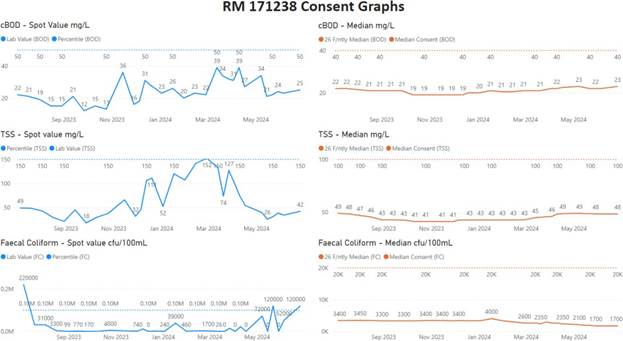
The dashboard of compliance data is shown below, with no non- compliance issues occurring during
the year to date.
4.3
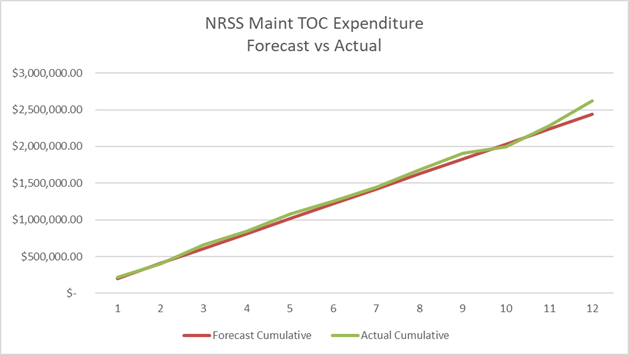
The operating & maintenance costs against the Target Outturn
Cost (TOC) for the 2024/25
year ended the year slightly above the NRSBU 2024/25 Business Plan forecast
budget. The increased costs were related to a higher maintenance program at the
start of the fiscal year, along with abnormal pond conditions over summer and
unexpected maintenance requirements to the primary clarifier and biosolids
pipeline.
4.4
The chart below
shows the NRSS Maintenance contract
costs against TOC. The spike at the end of the year
represents recoding of jobs completed during the year, rather than a
significant increase in spend in June
4.5
Odour
4.5.1
There were no odour notifications during the last quarter.
4.6
Wastewater
overflows:
4.6.1
There was three wastewater and one biosolid
overflow during the period.
4.6.2
There were a series of extreme weather events
that occurred during the period. These events caused issues within the
wastewater network and resulted in overflows at several pump stations.
4.6.3
One overflow occurred
during May from the Songer St because of very high inflows.
·
During the same event the Saxton Rd pumpstation
had a short overflow. This occurred because the pumpstation capacity was
limited by the connection works integrating the new rising main
upgrade.
4.6.4 During the June extreme rainfall event that resulted in the Civil
Defence State of Emergency for the region, the duplicated rising main was in service,
and the system pumped around
820 litres per second during the peak of the event
(nearly double the previous capacity). This flowrate is the maximum flow
capacity for the upgraded wastewater pipework, and this level of flow was only
expected to be reached around 2050.
4.6.5
Despite this significantly higher flowrate being available there
was a short period where the NRSBU operations contractor needed to reset
controller setpoints in the pumpstation electrical controls, and this short
reset caused an overflow.
4.6.6
The number of wastewater overflows that occurred
during the quarter is the most that have occurred
in any quarter for many years.
4.6.7
The fact that NRSBU managed to convey around 820
litres a second from Beach Rd pumpstation and the maximum
daily flow ever record for
the Bell Island facility shows that despite the overflows that NRSBU is in a
better position with wastewater conveyance capacity than we have been for many
years.
4.7
Biosolids Spill
4.7.1
A discharge occurred during the end of June in
the biosolids pipeline. The discharge resulted from a failed connection joint
in the biosolids pipeline. The issue was repaired the issue during the
state of emergency event at the end of June.
4.7.2
During the investigation NRSBU took the opportunity to inspect the pipe
upstream and downstream of the failure
and identified several connection joints that we also
corroded. These joints were removed and replaced during the repair.
4.7.3
The Biosolids pipe has had two failures
during the last year and is
close to the end of its life. NRSBUs renewal program includes the replacement
of approximately 20% of the pipe length during the 2025/26 financial year,
which should replace the worst condition sections, and further renewals are
scheduled for future years.
4.8
Beneficial reuse of resources:
4.8.1
No treated effluent
was applied to land during
the report period.
A total of 46,300m3 was applied during the irrigation season.
4.8.2
11,660m3 of treated
effluent has been processed through
the
ultra-filtration (UF) plant for re-use onsite
during the report
period.
4.8.3
No UF treated
water was provided
to Green Acres Golf Course during the report period.
4.8.4 NRSBU applied 7,926m3
of Biosolids between
April and June 2025.
This equates to 17.4 tonnes of Nitrogen for fertiliser to the Moturoa/Rabbit
Island pine forests.
5
Compliance with Trade Waste
Agreements
5.1
NRSBU provides services
to its customers under Trade Waste Agreements (TWAs).
5.2
The TWAs confirm
the flows and loads NRSBU
is contracted to convey and treat for each customer.
5.3
As part of the new network reporting
requirements implemented by Taumata Arowai, NRSBU is required
to report annually
on compliance with TWAs along with actions taken in
response to breaches.
5.4
The table below
outlines the contracted flow and load breaches for the
2024/25 financial year:
|
Contracted Parameter Number of breaches
|
|
Average daily
volume
|
4
|
|
Peak ½ hour flow
|
10
|
|
BOD (Biochemical Oxygen
Demand)
|
1
|
|
COD (Chemical Oxygen
Demand)
|
1
|
|
SS (Suspended Solids)
|
7
|
|
TN (Total Nitrogen)
|
0
|
|
TP (Total Phosphorus)
|
0
|
5.5
There were 16 additional noncompliance events during the period.
5.6
Two of these events, where the customers
flow exceeded the contracted
capacity to the pumpstations, resulted in overflows from the system.
5.7
Both these exceedances occurred during extreme
weather events.
5.8
These capacity issues are being discussed with
the customers, and consideration is being given to what future demand should be
accommodated within the wastewater network.
No penalties are proposed
at this time, although moving forward the NRSBU will recover costs associated
with overflows due to contracted capacity breaches from the customer that
caused the breach.
6.1
General projects underway
at present include:
6.1.1
Moturoa/Rabbit
Island biosolids discharge consent finalisation
(awaiting TDC action of minor amendments).
6.1.2
Condition assessment of the concrete
rising main between
Monaco and Bell Island.
6.1.3
Pump replacement at Beach Rd and Wakatu
pump stations.
6.1.4
Pump and non-return valve replacement at Airport pump
station.
6.1.5
Emission management plan development.
6.1.6
Biosolids application facility
tank odour extraction & treatment,
flow actuation.
6.1.7
Update Moturoa/Rabbit Island
biosolids application consent
to better manage stormwater discharge from the facility.
6.2
Bell Island projects
currently underway include:
6.2.1
Installation
of isolation valves
to rising mains at the treatment
plant inlet structure.
6.2.2
Biosolids tank renewal.
6.2.3
Biosolids pipe renewal
6.3
Secondary treatment system upgrade concept
design works – this is completed, with refinement of the concept
to ensure ease of any future
expansions. Progression to detailed design will be delayed awaiting the
outcomes from the Taumata Arowai wastewater standards.
6.4
Bell Island High Flow distribution design
– work has commenced on this design, however the scope of this work has broadened
slightly to consider integration of the project with
the renewals required on the Bell Island gravity pipelines, to check if cost
savings are possible.
6.5
NRSS Rising Main Duplication:
6.5.1
The duplicate rising main from Beach Rd to
Martins Point was commissioned during the report period,
following connection works at the Beach Rd pumpstation. This
has significantly increased the capacity of the Regional Rising main
infrastructure.
6.5.2
The only work still needed
is the resurfacing of the pumpstations
sites.
6.6
Bell Island site designation:
6.6.1
Approval of the revised Designation conditions for the Bell Island site are the subject
of a separate report on this meeting
agenda.
7
Risks
7.1
NTRLBU has an ongoing process
on managing risks and criticality at various levels within the Business Unit process,
7.2
Site Power constraints
7.2.1
NRSBU has a programme of works to increase the
treatment capacity at the Bell Island
facility, and this programme will result
in additional electricity supply capacity being required at the facility.
7.2.2
The Bell Island facility is located at the end
of a power supply system with only one supply line. This supply line passes under the
Waimea estuary between Best Island and Bell Island. This supply line is approximately 45 years old, has a limited
capacity and its condition is unknown.
7.2.3 There is a risk to both NRSBU
and the power supply authority that this supply system could fail and that NRSBU could therefore have no
power for a significant duration, while repairs are
implemented by the power supply authority.
7.2.4
NRSBU has previously identified power supply
issues as a risk to the business unit, and in 2022 NRSBU began the installation
of emergency generators to allow the facility to continue to operate
during an emergency event.
7.2.5
This work was undertaken to manage emergencies power failure. It was
not intended to replace good asset and risk management practices.
7.2.6
NRSBU believe that a proactive approach should
be taken to managing this known risk and has sought to liaise
with the power supply authority firstly to increase
the power supply available at the Bell Island facility, and secondly to
identify options for mitigating this power failure risk.
7.2.7
Currently NRSBU has been unable to get effective engagement with the power supply authority.
7.2.8
Currently power supply failure remains
a risk to NRSBU, and this
risk could have material financial and environmental impacts if failure of the
power supply were to occur.
7.3
Bell Island causeway
access:
7.3.1
The only vehicle access to the Bell Island WWTP
is over the causeway from Best Island to Bell Island.
This access way is tidal and is inundated during any tide
height over 3.5m.
7.3.2
The causeway was installed in 1980 when the treatment plant was
constructed and has performed well over the 45 year the facility has been
operating, and as part of its asset management processes, NRSBU has
investigated the condition of the causeway and have undertaken maintenance to
ensure that the facility remains serviceable.
7.3.3
As part of the investigation NRSBU sought expert
review of the load bearing capacity
of the box culvert that forms the centre of the causeway.
7.3.4
The initial engineering review reported a load
capacity that was significantly lower than NRSBU was expecting, (and not consistent with historic uses).
7.3.5
Due to the concerns this review raised NRSBU
implemented restrictions on the causeway to ensure that the structure
was not overloaded.
7.3.6
NRSBU then sought
alternative advice to corroborate the initial
assessment, and this second loading review reported higher capacity than the
initial assessment.
7.3.7
NRSBU is therefore cautiously optimistic that
the causeway is appropriately rate for the vehicles
that access the facility, however there is a risk that this
structure will need urgent temporary remedial strengthening to allow
appropriate traffic to access Bell Island.
7.3.8 If remedial strengthening is required, then it is anticipated that the
culvert structure will need to be completely replaced in the short to medium term.
7.4
Bell Island discharge capacity:
7.4.1
The Bell Island
discharge consent allows
for the treatment plant to discharge for 3 hours after high tide,
at an average daily limit of 20,000m3, or to a maximum daily limit of 25,000m3.
7.4.2
Since the current
consent was issued the Bell Island treatment plant has exceeded the discharge
limits on five occasions to mitigate or avoid uncontrolled overflows from the
ponds.
7.4.3 During the recent
extreme weather events
in June and July 2025 the Bell Island wastewater treatment
plant received the largest flow ever (106,000m3 in a single day) and during the
weather events the inflow exceeded the maximum discharge consent capacity for
19 out of 21 days.
7.4.4
The consequence of these flows was that the Bell
Island WWTP could not discharge sufficient wastewater, and the facility
overflowed from the treatment ponds into the farmland next to the plant.
7.4.5
Officers are working to vary the consent
conditions to allow increased discharge limits in response to conditions
outside of NRSBUs control (e.g. extreme or extended rainfall)
and may need to seek a further increase
in the normal maximum daily discharge
consent limits.
8
Finance
8.1
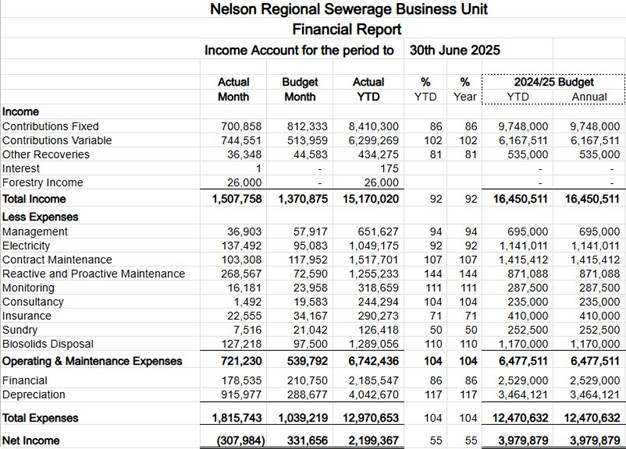
Income:
8.1.1
Fixed recoveries year to date under budget
by $1,337,700.
8.1.2
The variable income for the year ended above budget by $131,758 which was a significant
improvement compared to the previous
quarter and resulted
from increased rainfall
within the Nelson Tasman region.
8.1.3
Other recoveries income
is under budget
by $100,725.
8.2
Expenditure:
8.2.1
Total Operating and Maintenance expenses ended
the year over budget by $264,925, which was a deterioration from previous the
previous quarter. This change resulted from repairs and maintenance to the biosolids pipeline, and end of year adjustments
associated with the asset valuation which required some recoding of repair
costs that had been incorrectly capitalised.
8.2.2
Maintenance costs ended the year above budget
due to a range of activities including heavy maintenance activities, repair of biosolids pipes and purchase of pond
emergency response chemicals during the first quarter.
8.2.3
Financial and depreciation expenses ended the year above
budget by $235,096 due to higher depreciation than budgeted.
8.3
Overall Finances
8.3.1 NRSBU had surplus
of $2.2 million which was lower than the
budget surplus.
8.3.2 The variable contributions were close to budget despite the first
quarter result being behind budget.
Overall, the variable
income was within 2% of budget.
9
Conclusion
9.1
The NRSBU is operating well, with Operations and Health and Safety being managed to an appropriate level.
9.2
The wastewater treatment
performance was good during the quarter, and the facility received the highest
flows ever received.
9.3
The treatment plant overflowed because
of the extreme flows, but no
significant issues occurred because of these events.
9.4
Overall, the facility
showed its robustness and ability to cope with extreme
events, and despite the magnitude of the events very few overflows occurred
within the reticulation network and very few issues were experienced at the
treatment plant.
Attachments
Nil
Nelson
Regional Sewerage
Business Unit 10
September 2025

Report Title: R25-422 Annual
Report Summary - 2024/25
Report Author: Nathan
Clarke (General Manager Regional
Services)
Report Authoriser: Alec Louverdis (Deputy Chief Executive
/ Group
Manager Infrastructure)
1
Purpose
1.1
To present the Nelson Regional
Sewerage Business Unit (NRSBU) Annual Report for the 2024/25 financial
year.
2
Recommendation
That the Nelson Regional
Sewerage Business Unit
1. Approves the Nelson Regional Sewerage
Business Unit Annual Report 2024/25 and Nelson Regional Sewerage Business Unit
Financial Statements 2024/25 for presentation to Nelson City Council and Tasman District
Council with delegation of all minor amendments to the Nelson Regional
Sewerage Business Unit Chairperson and General Manager.
Recommendation to Nelson
City and Tasman
District Councils
That the Nelson City and Tasman
District Councils
1. Receives the Nelson Regional Sewerage
Business Unit Annual Report 2024/25 and Nelson Regional Sewerage Business Unit
Financial Statements 2024/25.
3
Background
3.1
The annual report
outlines what has been achieved
by the NRSBU in the 2024/25 financial year and its level
of performance against Key Performance Indicators.
3.2
The full annual
report is attached
to this summary report. A brief
discussion is included in this report for information.
4
Discussion
4.1
The NRSBU had a successful year, with treatment quality from the treatment plant meeting all required
quality standards.
4.2
The net income was
below budget for the year.
4.3
There were 6 overflows, and 2 leaks from conveyance systems during the year
4.3.1 2 of the overflows related to equipment failure, while the remainder were a result
of contracted and pump capacity exceedances due to high inflows.
4.3.2
The leaks were from the biosolids pipeline, one pipe failure
near to the Best – Bell
causeway, and a fitting failure between Bell and Moturoa/Rabbit Island.
4.4
The regional rising main duplication project was
substantially completed during the year, with full capacity being
brought online in late June – just ahead of the first storm event. This
upgrade significantly improved the NRSS capacity from Richmond.
4.5
Health and Safety
4.5.1
The operation and maintenance contractor maintained a high level
of health and safety vigilance.
4.5.2
A number of safety system improvements occurred
during the year following hazard identification
notifications and near miss incidents.
4.5.3
There were no lost time injuries during
the year.
4.6
Capital Projects
4.6.1
Capital expenditure for the year totalled $9,572,919 and included:
·
Completion of a replacement sludge
storage tank.
·
Commencement
of refurbishment of the biosolids storage tank.
·
Completion of the new workshop/facilities building.
·
Songer pump station
riser replacement.
·
Installation of isolation valve to rising mains
at the Bell Island inlet works.
·
Replacement of one of the screen drums at the
Bell Island inlet works.
·
Design of high inflow distribution system at Bell
Island.
·
Commencement
of resource consent
applications for Bell and
Best Island irrigation and sludge application.
·
Design of the Airport PS storm pump upgrade, including procurement of long lead time
items.
·
Procurement of land adjacent to Saxton PS for wastewater storage facility.
·
Design of control
and odour treatment
upgrades at the biosolids
facility on Moturoa/Rabbit Island.
·
The completion of the regional
rising main upgrade.
4.7
Environmental
Performance
4.7.1
The effluent discharge
quality has met the consent
conditions for the year.
4.7.2
The sludge treated
at Bell Island
consistently met the requirements for A Grade biosolids.
4.7.3
Odour generation from the WWTP has generally
been less than minor, with no notifications received
that were deemed to exceed consent parameters. Feedback from
Best Island residents confirmed significant improvements in odour.
4.7.4
Odour patrols carried out by an independent
contractor have demonstrated that the residual odours
at the treatment plant have been significantly reduced, with
remaining occasional odours generally related to pond health, rather than other
processes.
4.7.5
There were several odour reports received
relating to biosolids application. An independent odour auditor was engaged to
verify some of these reports. As a result
of four confirmed odour reports the biosolids application was
relocated to mitigate odour generation.
5
Performance Measured Against Business
Objectives and Performance
Measures
5.1
The annual report
includes a review
of performance against
the objectives described in
the NRSBU Business Plan 2024/25.
5.2
Performance measure targets
and dates are set annually
in the Business Plan, along with performance measures for projects
identified in the Activity Management Plan.
5.3
Performance is reported
to the Joint Committee and to the shareholding
councils annually.
6
Key Successes
6.1
The duplicate rising main project was
substantially completed in 2024/25, with full capacity
coming online in June 2025.
This project proved
its worth during the June
storm events, conveying over 800L/s away from the Richmond pump station
(previous capacity 420L/s).
6.2
The sludge storage
tank replacement was completed and brought online, with the old storage tank removed.
6.3
The new workshop
and amenities building
was completed.
7.1
The NRSBU achieved
a surplus of $2,198,905 compared
to a budget surplus of $3,979,879.
7.2
The principal driver
for the variation was the decrease in income to
$15,169,558 (budget $16,450,511) and the increases
in costs to
$12,970,653 (budget $12,470,632).
7.3
Total revenue was $1,280,953 under budget principally due to lower
fixed revenue from the major customers
resulting from lower interest rate used
in the recovery model and higher than budgeted operational costs.
7.4
The load capacity
surrendered when ENZA left the scheme was not
acquired by any customers during the year.
7.5
Total Expenses were $500,021 over budget with depreciation being
$578,549 over
budget due to higher than forecast network value. In addition, the following
items were over budget: operations and maintenance costs ($486,000); biosolid
disposal ($119,000); monitoring ($31,159); and Consultancy ($9,294). These costs were partially
offset by lower than budgeted costs for: interest
(-$343,453); sundry (-$126,082); insurance (-$119,727)
electricity (-$91,836) and management (-
$43,373).
8
Conclusion
8.1
The NRSBU has had a successful year with a number of successful
outcomes.
Attachments
1.
NRSBU Annual Report 2024-25
2.
NRSBU Annual Financial
Statements 2024-25

Nelson Regional
Sewerage Business Unit Annual Report 2024/25 Rev 1
1080325921-1204
Page 1 of 26
Rev
0 July 2024
Draft
for Review - prepared by:
Brad
Nixon - Operations Manager NRSBU
Approved by: Nathan Clarke
– General Manager
NRSBU
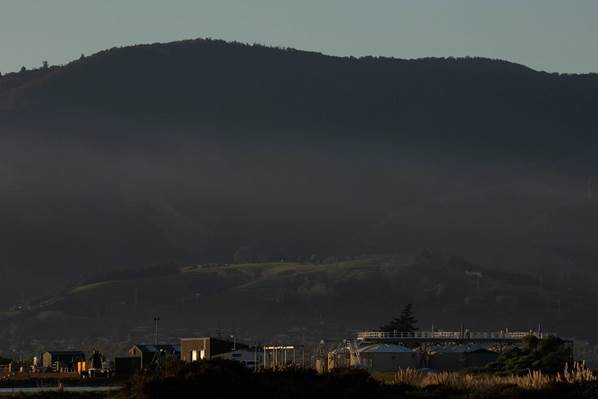
Cover
Image Bell Island office, GBT building and ATADs, looking
southeast towards the Richmond Hills.
Nelson Regional
Sewerage Business Unit Annual Report 2024/25 Rev 1
1080325921-1204
Page 2 of 26
This
report is to provide a summary of the annual
performance of the Nelson Regional Sewerage
Business Unit (NRSBU) for the 2024/25 financial year.
2.
MEMORANDUM OF UNDERSTANDING REQUIREMENTS
The Memorandum of Understanding states that the NRSBU
Board shall prepare an Annual
Report at the end of each financial year which shall include reporting against the performance targets and financial
forecasts in the approved Business Plan.
The annual accounts and financial statements, included in the Annual Report, shall fairly show the operating and financial position of the NRSBU
for the financial year, including a statement of financial performance, a
statement of financial position, a statement of cash flows, and all information necessary
to enable an informed assessment of the operation
of the Business Unit. The
financial statements must be prepared in accordance with generally accepted
accounting practice.
The Annual Report
and Accounts will be presented
to councils by 30 September
in each year.
3.
INTRODUCTION
This
Annual Report for the 2024/25
financial year sets out the performance of the business
unit. Performance measures are assessed against targets set out in the
2024/25 Business Plan.
The
NRSBU achieved a surplus of $2,198,905 compared
to a budget surplus of $3,979,879. The principal
driver for the variation was the significant change in fixed income, and the
increases in O&M costs, biosolids disposal costs and depreciation.
Odour
patrols carried out by an independent contractor have demonstrated that the residual
odours at the treatment plant continue to be
minimal.
The effluent discharge quality
has met the consent conditions for the year.
The sludge treated at Bell Island
consistently met the requirements for A Grade biosolids.
The
operation and maintenance contractor maintained a high level of Health
and Safety vigilance. There were no lost time injuries this year.
Nelson Regional
Sewerage Business Unit Annual Report 2024/25 Rev 1
1080325921-1204
Page 3 of 26
The
NRSBU’s mission statement is:
Resilient, reliable, and effective
infrastructure that supports
and protects our community and environment.
|
Area
|
Goal
|
|
Our approach
|
Implement and
operate infrastructure considering the needs of our community. Our priorities for this are
protection of public
health, the environment, and cultural values.
|
|
Our Vision/Ambition/Aspiration
|
We will
work towards the beneficial reuse
of resources.
|
|
Our conduct
|
We will undertake our activities transparently, fairly, respectfully, in a timely
manner and we will provide regional infrastructure leadership.
|
5.
Performance against Business Plan Strategic Goals
The strategic goals of the NRSBU set
the basis for performance measurement and long-term strategies. These
strategies are the outlined performance targets in the 2024/25 Business
plan.
The
following tables outline
the performance objectives, key performance measures
and what was achieved:
|
Strategic Goal
|
Objective
(This is what it
looks like)
|
Level of Service (This
is how we do it)
|
Performance
|
|
We will implement and
operate infrastructure considering the
needs of our community. Our priorities for this are protection of public health, the environment and cultural values.
|
Containment and conveyance that is resilient and minimises adverse impacts on the
health of the environment and community
|
We have sufficient capacity in our network
to cope with
peak flows
|
Partially
achieved NRSBU has insufficient
capacity
to accommodate the
flows from TDC and NCC networks. Despite having
agreed contracted flows
from our customers, NRSBU received flows in excess of the contract
from both Councils, which resulted in overflows during the year.
The Regional Rising main duplication upgrade was
completed late in the report period.
|
|
We are resilient to mechanical
and electrical failures and natural hazards
|
Partially achieved (electrical resilience)
New generators are installed and are integrated into
the regional pumpstations, however at Beach
Rd, Saxton and Airport pumpstations
the existing hardware requires renewal to accommodate the full generator
output and run storm pumps at full output.
|
|
|
|
|
Achieved (mechanical resilience)
|
Nelson Regional
Sewerage Business Unit Annual Report 2024/25 Rev 11080325921-1204
Page 4 of 26
|
Strategic Goal
|
Objective
(This is what it
looks like)
|
Level of Service (This
is how we do it)
|
Performance
|
|
|
|
We can readily maintain the network
|
Partially achieved
The completion of the rising main duplication project
allows the removal from service of rising mains between Beach Rd and Saxton
PS and also allows Saxton PS to be isolated and dry weather operation to be
maintained. The next
stage of works involves
alternate network flow paths
for Songer and Airport PSs
|
|
Resilient wastewater treatment
that minimises the impact on the
environment and community
|
The treatment plant
can reliably accept (N+1
for critical assets) all peak flows from the
network
|
Not achieved
Capacity insufficient with inlet
screens and secondary clarifier capacity. This has been exacerbated since the
pipework upgrades were completed. Upgrades are planned and included in the
Activity Management Plan (AMP) to resolve this issue.
|
|
The treatment plant can fully treat all dry weather flows
|
Partially achieved
All dry weather flows can be treated through the
inlet screens, grit removal, primary clarifier and ponds, but limited capacity in the secondary treatment system means diurnal peaks
partially bypass secondary treatment. Upgrades included in the AMP
resolve this.
|
|
The treatment plant
does not create odour issues
for the community
|
Achieved
The major odour upgrades are completed with the ATAD
odour upgrade finished.
|
Nelson Regional
Sewerage Business Unit Annual Report 2024/25 Rev 1
1080325921-1204
Page 5 of 26
|
Strategic Goal
|
Objective
(This is what it
looks like)
|
Level of Service (This
is how we do it)
|
Performance
|
|
|
|
Effluent Quality meets or exceeds required discharge requirements
|
Achieved
|
|
Long term vision that considers the future needs
of the community
|
Our ongoing business is safeguarded through
engagement with council planning processes
|
Achieved
|
|
We have long
term plans for our
activities and their impacts
|
Achieved
A Draft Master
Plan 2024- 2075 has been
issued for consultation to outline the long term future for the NRSBU
assets.
|
|
Have systems in place for
the ongoing monitoring and reporting of emissions
|
Achieved
Further development is in progress, and the emission reduction plan preparation has
been commenced.
|
|
Alternative methods of biosolids disposal that protect public health and the
environment and are sensitive to
cultural values
|
Have a backstop for issues with biosolids disposal
|
Not achieved.
No backstop is currently
available for biosolids disposal.
|
|
We will work towards
the beneficial reuse of resources
|
Use of ongoing improvement processes to identify, implement and operate
feasible biosolids reuse
|
Treatment to maintain 100% reuse of biosolids
|
Achieved
|
|
Increase reuse value
|
Not achieved
No work has been undertaken this year to improve reuse
value due to staff capacity limitations.
|
|
Maintain 100% diversion of biosolids from disposal to landfill
|
Achieved
|
|
Identified implement
and operate feasible systems
and infrastructure for the reuse of wastewater
|
We minimise the amount of effluent we discharge to water
|
Achieved
Irrigation of treated wastewater to Bell Island
was undertaken during appropriate conditions, along with supply of
ultra-filtered wastewater to Greenacres for irrigation.
A water reuse plan is being drafted and water reuse
actions are included in the NRSBU Activity Management Plan 2024-2033
|
Nelson Regional
Sewerage Business Unit Annual Report 2024/25 Rev 1
1080325921-1204
Page 6 of 26
6.
BUSINESS OBJECTIVES AND PERFORMANCE MEASURES
The
objectives below describe
the long-term aims of the Business Unit. Progress on achieving the aims is provided in the right hand
column, as at the end of the 2024/25 financial year.
|
Performance Measure
(This is how we know we’re doing it)
|
Target
|
Update
(As at end of 2024/25 FY)
|
|
Number of overflows per
year (all networks) due to NRSBU
network capacity constraints, or mechanical or electrical failures.
|
Zero
|
Not achieved. See section 9.1
|
|
Number of pump stations with redundant pumps
and power supply.
|
All by June 2023**
|
Partially achieved.
Airport PS additional storm
pump is yet to be installed,
the pump has been ordered with installation scheduled for late - 2025.
Further work is
required to upgrade the pump
station infrastructure to be able
to accept the full generation capacity of standby generators. This is programmed to start in 2025/26.
|
|
Pump stations are to a level 3 importance level
standard.
|
All by 2023
|
Work programme has
been deferred due to staff
workloads. Assessment of pump stations to be completed in
2025/26
|
|
Number of pump stations where able to carry out routine
PS maintenance works while managing ADWF.
|
All by 2031
|
Ongoing,
significantly improved with completion of the duplicate rising main. Airport PS bypass ability to be completed with
storm pump replacement.
|
|
Number of times PWWF
flows exceed inlet
works capacity.
|
Zero by
2031
|
No occurrences during 2024/25.
|
|
Number of times diurnal
flows bypass the mechanical system
annually.
OR
Treatment capacity of mechanical plant.
|
Zero
OR
500L/s by 2029
|
NRSBU had a
significant period during the
2024/25 year where insufficient capacity was available within the mechanical treatment plant to treat the entirety of the incoming average dry weather diurnal flow. Bypasses occurred for more than 60 days during the year.
An additional 200 litres per second
capacity is required by 2029 to
achieve this target. A concept
design for the secondary treatment upgrade is now completed, however work is on hold subject to Taumata Arowai environmental performance standards.
|
Nelson Regional
Sewerage Business Unit Annual Report 2024/25 Rev 1
1080325921-1204
Page 7 of 26
|
Performance Measure
(This is how we know we’re doing it)
|
Target
|
Update
(As at end of 2024/25 FY)
|
|
Number of odour complaint events annually.
|
Zero by
2025
|
Not achieved, NRSBU received
5 notifications relating to 5
events during the year, from a
variety of locations. Ongoing work
is being implemented to reduce the frequency and intensity of odours associated with the operation.
|
|
Pond free
water above sludge
layer.
|
>1m in all ponds
by June 2023
|
Completed for ponds F1 & F2, however
there is no further capacity in the sludge
bund to dispose of sludge from F3.
Alternative disposal options have been identified for F3, and a resource consent application for these works is being prepared.
|
|
Chemical parameters comply with consents for discharge to
water when discharge occurs.
|
Ongoing consent
compliance for all parameters
|
Compliance achieved in 2024/25
|
|
Effluent quality appropriate for safe
and sustainable use with land irrigation systems.
|
Pathogens, nitrogen defined for land application requirements by 2023
|
NRSBU irrigation on
Bell Island has been ongoing, Work commenced on additional Bell Island and Best Island Irrigation planning, and concept design
and testing of the soil
and wastewater has commenced. The resource consent application is being prepared.
|
|
Obtain reuse
consents for appropriate land areas for Reuse Water.
|
Demonstrated quality performance and consents in place for reuse for dust suppression by June 2024
|
Target has moved to
land application, away from dust
suppression.
Irrigation to Greenacres golf
course is underway.
RC process commenced
for additional application areas on Bell Island, and application to Best Island.
Investigations
commenced for the reuse
of water in industrial facilities rather than dust suppression.
|
Nelson Regional
Sewerage Business Unit Annual Report 2024/25 Rev 1
1080325921-1204
Page 8 of 26
|
Performance Measure
(This is how we know we’re doing it)
|
Target
|
Update
(As at end of 2024/25 FY)
|
|
We have
up to date plans as follows: Master plan (50 years focus)
Activity Plan
(10 years Focus)
Business plan
(1 year focus,
but also with
tentative three-year actions)
|
Master plan developed by June 2023
Activity and Business Plans
are reviewed annually
|
Master
Plan draft approved for consultation by Joint Committee. Activity Management Plan
2024-
2034 adopted by Joint
Committee during
2024.
|
|
The number
of alternate methods/options for biosolids
disposal.
|
One by 2035
|
No significant
progress was achieved on this target
during the year
|
|
Increase in quality of biosolids.
|
Biosolids Reuse
Development Plan Draft by June 2023
|
Not achieved.
No significant progress made on the
biosolids reuse plan.
|
|
Percentage of biosolids that
is reused.
|
100%
|
Achieved for 2024/25
|
|
Annual volume
of biosolids sold.
|
Biosolids Reuse
Development Plan Draft by June 2023
|
Not achieved.
No significant progress made on the
biosolids reuse plan.
|
|
Proportion of biosolids to land or reuse/sale
|
100%
|
Achieved –
100% of biosolids reused on Moturoa/Rabbit Island
|
|
Number of days effluent is discharged to water in summer
period (1 Dec to 31 March).
|
Draft Wastewater reuse plan developed by June 2023,
with a goal to reaching zero by 2035
|
Wastewater
reuse plan delayed. AMP includes provision towards meeting
strategic goal for
reduction in discharge to water.
|
|
Volume of high-value water-reuse we achieve.
|
Draft Wastewater reuse plan developed by June 2023
|
Not Achieved
Wastewater reuse has
been commenced but completion of the reuse plan
has been delayed.
The NRSBU AMP
includes provision towards meeting strategic goal for reduction in discharge to water, including additional irrigation on Bell Island, Best Island, and at Greenacres Golf Course. It also includes provision for reuse of wastewater in industrial facilities.
|
|
Amount of total flow we can divert from
discharge to water during summer period.
|
At least 75th percentile by 2040
|
AMP includes provision towards meeting strategic goal for reduction in discharge to water.
|
** Redundant pumps may include Duty / Assist
with a Shelf Spare until pumpstation upgrades
are complete
Nelson Regional
Sewerage Business Unit Annual Report 2024/25 Rev 1
1080325921-1204
Page 9 of 26
7.
Additional Performance Measures
Table 2 outlines
performance measures to compare performance against previous years.
|
Level
of Service
|
Function
|
Target Technical Level of Service
|
Compliance
|
|
2022/23
|
2023/24
|
2024/25
|
|
Environmental Impacts
|
Treatment and Disposal
|
RMA Consent - Discharge to water
|
Yes
|
Yes
|
Yes
|
|
RMA Consent - Discharge Volume
|
No
|
Yes
|
No
|
|
RMA Consent - Discharge to Air
|
Yes
|
Yes
|
Yes
|
|
RMA Consent - Discharge to Land
|
Yes
|
Yes
|
Yes
|
|
Pump stations
|
RMA Consent -
Aberrational Discharge
|
Yes
|
Yes
|
Yes
|
|
No Odour Complaints
from Pump stations
|
Yes
|
Yes
|
Yes
|
|
No Pumpstation Overflows
|
No
|
No
|
No
|
|
No Reticulation Breaks/
Issues
|
Yes
|
No
|
Yes
|
|
No Air Valve Malfunctions
|
Yes
|
Yes
|
Yes
|
|
Capacity
|
Treatment and Disposal
System
|
System Capacity - Load
|
Yes
|
Yes
|
Yes
|
|
System Capacity - Flow
|
No
|
No
|
No1
|
|
Pump Stations
|
Overloading system capacity Note 2
|
Yes
|
Yes 3
|
Yes 3
|
|
Reliability
|
Treatment and Disposal
|
|
Yes
|
Yes
|
Yes
|
elson Regional
Sewerage Business Unit Annual Report 2024/25 Rev 1
1080325921-1204
Page 10 of 26
|
|
Pump stations
|
No equipment failures
that could lead to noncompliance with Resource Consents
|
Yes
|
Yes
|
Yes
|
|
Pipelines
|
Yes
|
Yes
|
Yes
|
|
Biosolids
|
Yes
|
Yes
|
Yes
|
|
Responsiveness
|
Speed of Response to Emergency and urgent
maintenance works
|
Achievement of response
times specified within Operations and Maintenance Contract
|
Yes
|
Yes
|
Yes
|
|
Speed of Response to
routine and programmed works
|
Achievement of response
times specified within Operations and Maintenance Contract
|
Yes
|
Yes
|
Yes
|
|
Key Contributor Relationships
|
Treatment and Disposal
|
Overall Satisfaction
|
Yes
|
Yes
|
Yes
|
|
Pumpstations
|
Yes
|
Yes
|
Yes
|
|
Pipelines
|
Yes
|
Yes
|
Yes
|
|
Biosolids
|
Yes
|
Yes
|
Yes
|
|
Notes
|
1. System capacity issue resolved at the end
of 2024/25 with the rising
main duplication works
completed.
|
|
2. Compliance relates to provision of capacity to TDC. NRSBU
has sold capacity to Tasman District Council, and any overflows from Beach Road pumpstation exceed
this capacity so remain the responsibility of TDC.
|
|
3. Compliance with the
pumpstation capacity relates to the fact that NRSBU can deliver its contracted capacity. Overflows occurred from
the pumpstations as a result of the Nelson City and Tasman
District Councils discharging flows in excess
of their agreed
contracted capacity.
|
elson Regional
Sewerage Business Unit Annual Report 2024/25 Rev 1
1080325921-1204
Page 11 of 26
8.
Discharge Characteristics
8.1
Bell Island
Discharge
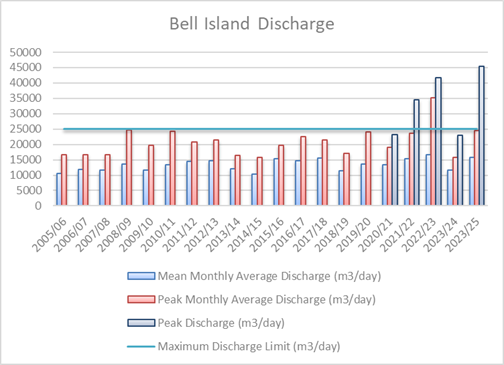
2024/25 was a mixed year, with rainfall below average for the first half of the year and
higher than average rainfall
over the final 3 months to June 2025. This is reflected in the Bell Island discharge volumes shown, with both mean monthly
average discharge and peak monthly
average discharge in the
vicinity of recent historical norms.
Due to significant rain event at the
very end of the 2024/25 period the peak daily discharge was above consented
limits. Three of the last 4 years have resulted in exceedances of the consented
peak daily discharge. NRSBU is working to vary the Bell Island
WWTP discharge consent
to permit this as a result of
rainfall.
Nelson Regional
Sewerage Business Unit Annual Report 2024/25 Rev 1
1080325921-1204
Page 12 of 26
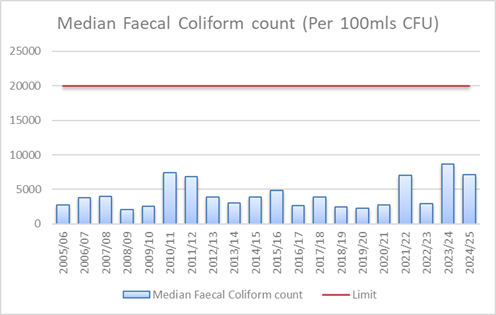
The data in the faecal coliform graph
above shows that the Bell Island facility discharge remained well under the discharge consent
faecal coliform limit, although the median was elevated from typical levels.
Nelson Regional
Sewerage Business Unit Annual Report 2024/25 Rev 1
1080325921-1204
Page 13 of 26
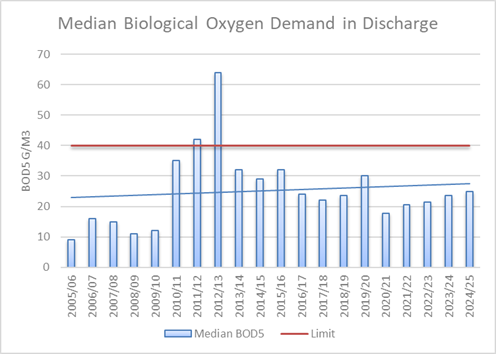
The
Bell Island facility
met the discharge permit criteria for five day Biochemical Oxygen Demand (BOD5)
for the year. The trend line shows a continuing increase in BOD5, which may
require future improvements in plant processes to ensure the discharge remains
compliant.
Nelson Regional
Sewerage Business Unit Annual Report 2024/25 Rev 1
1080325921-1204
Page 14 of 26
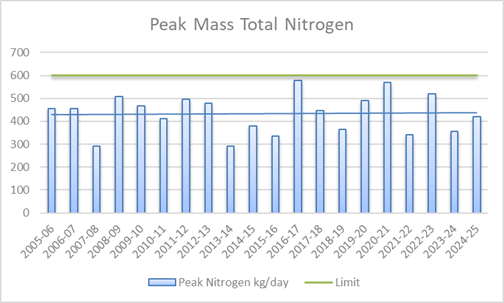
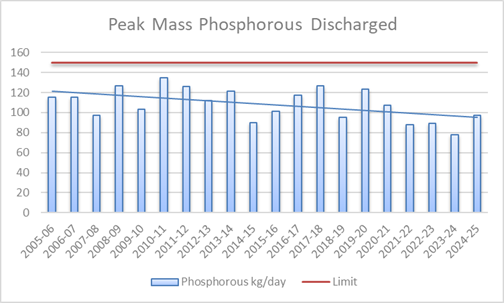
Peak nitrogen and phosphorus mass in
the Bell Island discharge continues to be within the permitted criteria, with the trend for nitrogen
remaining stable and phosphorous continuing to decline.
Nelson Regional
Sewerage Business Unit Annual Report 2024/25 Rev 1
1080325921-1204
Page 15 of 26
9.1
Pump Stations
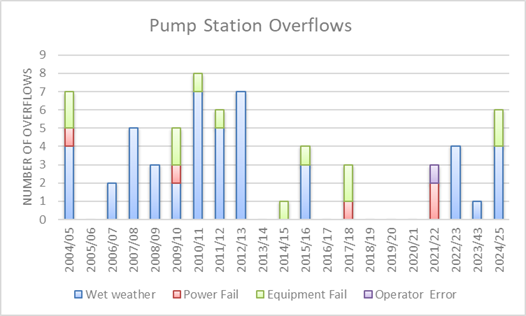
During 2024/25 there was 6 overflows
from NRSBU pump stations. The 4 wet weather overflows were a direct result
of inflows exceeding
contracted (and pump) capacities.
The overflows resulting from equipment failures were a failed
bypass pumping hose at Beach Rd in February 2025,
and a brief mechanical failure
at Saxton in May 2025.
9.2
Treatment Plant
There
were no breaches of consent
discharge duration or volumes from the Bell Island WWTP during
2024/25.
9.3
Rising Mains
There
were no failures to wastewater rising mains during 2024/25.
The
biosolids line to Moturoa/Rabbit Island
had two failures resulting in leaks during
the 2024/25 year:
·
Adjacent to the causeway,
which resulted from external corrosion on the concrete lined ductile iron pipe
·
Between Bell & Moturoa/Rabbit Island a fitting
on the HDPE pipe developed
a leak.
Nelson Regional
Sewerage Business Unit Annual Report 2024/25 Rev 1
1080325921-1204
Page 16 of 26
A total of 5 odour notifications were
received during 2024/25, all of which were confirmed as relating to NRSBU activities. The notifications related
to 5 events, 4 of which were determined to result from biosolids
application on Moturoa/Rabbit Island with the 5th relating to poor WWTP pond conditions in January.
No resource consent
breaches for odour were notified.
11.
Health and Safety
NRSBU
Contractors have continued
with high levels
of Health & Safety performance over 2024/25, with no
lost time injury incidents. All injuries were classified as medical treatment
or lower.
Addition of hazard identification reporting to the NRSS
contractors’ health and safety system
has provided a useful lead indicator, and staff have
been utilising this tool as a proactive means of reporting improved hazard
management.
The
table below details
the NRSS operations & maintenance contractors health & safety statistics for 2024/25.
Nelson Regional
Sewerage Business Unit Annual Report 2024/25 Rev 1
1080325921-1204
Page 17 of 26
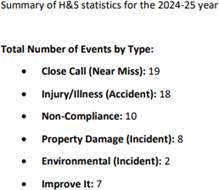
Of the injury/illness category 2 of the incidents were non work related, from the remaining
16 there were 8 first aid incidents (all very minor
injuries), 7 no treatment incidents, and one MTI. The MTI related to a worker
getting a foreign object (eg sand/grit) in their eye, and the eye subsequently
getting a minor infection.
12.
Capital Expenditure and Carryover
An amount of $9.57 million
was spent during
2024/25 on capital and renewals projects, compared to the budget
of the $14.02 million – this budget included carry over from 2023/24.
|
|
Full Budget
2024/25
|
Total Spend
2024/25
|
Carryover
|
|
Renewals
|
|
|
|
|
Total Renewals
|
$3,902,418
|
$ 3,029,801
|
$872,617
|
|
Capital
|
|
|
|
|
Regional Pipeline
|
$ 5,008,507
|
$ 4,885,656
|
$ 122,851
|
|
Other
|
$ 5,105,479
|
$ 1,657,462
|
$,3,448,017
|
|
Total Capital
|
$ 10,113,986
|
$ 6,543,118
|
$ 3,570,868
|
Nelson Regional
Sewerage Business Unit Annual Report 2024/25 Rev 1
1080325921-1204
Page 18 of 26
13.
Capital Expenditure - Renewal and Upgrade Project
Details:
Capital expenditure for the year
totalled $6,543,118 and included completion of the regional rising main
duplication, sludge storage tank, workshop/amenities building, design work for
WWTP high inflow distribution, design work for the secondary treatment
upgrade and purchase
of land adjacent to Saxton
PS
|
|
Full Budget
2024/25
|
Total Spend
2024/25
|
Carryover
|
|
Renewals
|
|
|
|
|
Renewal: Pump
Stations & Rising
Mains
|
$ 572,402
|
$ 365,095
|
$ 207,307
|
|
Carryover - Aerators
|
$ 665,311
|
$ -
|
$ 665,311
|
|
Capital
|
|
|
|
|
Regional Pipeline Duplication
|
$ 5,008,507
|
$ 4,885,656
|
$ 122,851
|
|
Sludge Management in Ponds at
Bell
|
$ 207,741
|
$ 90,326
|
$ 117,415
|
|
Hydraulic Capacity Upgrades at
WWTP
|
$ 1,912,880
|
$ 214,7908
|
$ 1,698,172
|
|
Best Island
Irrigation
|
$ -
|
$ 74,503
|
-$ 74,503
|
|
Secondary Treatment System
Upgrade
|
$ 150,831
|
$ 37,456
|
$ 113,375
|
|
Discharge Pump
Duplication +
Metering
|
$ 111,726
|
$ -
|
$ 111,726
|
|
Recycled Water
Supply (Export)
|
-$ 197,971
|
$ 36,909
|
-$ 234,880
|
|
Land Purchase
|
$ 1,775,498
|
$ 231,259
|
$ 1,544,239
|
Nelson Regional
Sewerage Business Unit Annual Report 2024/25 Rev 1
1080325921-1204
Page 19 of 26
14.
Scheme Capacity Trends
Bell Island Wastewater Treatment
Plant Capacity
Bells
Island inflow figures
are trending consistently upwards. The increasing mean monthly average
inflow trend could be attributed to population growth within the
contributory catchments, but the divergence between mean and peak monthly
average inflows may also represent the effects of increasing rainfall intensity.
Analysis of the average
vs peak inflow
trendlines indicates that any reduction in inflow & infiltration within the contributory catchments has not
offset increases in rainfall.
Total inflow at Bell Island for the
2024/25 period was 6.8M m3. This compares to a total of 5.4M m3 for 2023/24 and 7.2M m3 for 2022/23. The maximum
daily inflow for 2024/25 was 106,175m3, which is the highest inflow received at Bell Island,
and equates to an average
inflow rate of 1,228L/s over the 24 hour
period.
elson Regional
Sewerage Business Unit Annual Report 2024/25 Rev 1
1080325921-1204
Page 20 of 26
15.
Influent characteristics
The Biochemical Oxygen Demand (BOD)
figures all increased in 2024/25, following the general trend increases since 2018/19. Average
BOD has remained
reasonably constant although
is slightly increasing over time.
elson Regional
Sewerage Business Unit Annual Report 2024/25 Rev 1
1080325921-1204
Page 21 of 26
The average Chemical Oxygen
Demand (COD) trend has continued a slight decrease over the last ten years,
although the annual average COD has increase slightly since last year. This
demonstrates that the trade waste agreements continue to provide an incentive
for industrial customers to maintain or improve on site treatment of
wastewater. The higher 95th percentile figures over the last 2 years have caused the convergence of
average and 95th percentile trendlines, the
recent spike in peak 2 day average COD continues to move the peak trendline
away from the others. Whilst COD loadings from the industrial contributors
remains steady there appears to be a correlation between the profile of the
peak COD line and the mean average
monthly inflow volumes,
which may signify
peak COD demand is driven
by wet years and the
resultant increase in inflow.
Nelson Regional
Sewerage Business Unit Annual Report 2024/25 Rev 1
1080325921-1204
Page 22 of 26
The Total Nitrogen (TN) inflow lifted for 2024/25,
which continues the trend of increasing daily average TN inflow. Peak inflow trends continue
downwards. Discharge TN trend remains static.
The
peak inflow phosphorus level trend remains
static, whilst the peak outlet & average discharge
levels demonstrate consistent phosphorus removal through the WWTP, with
peak discharge levels trending downwards.
Nelson Regional
Sewerage Business Unit Annual Report 2024/25 Rev 1
1080325921-1204
Page 23 of 26
16.
Nitrogen application via biosolids
The
graph below shows that the application of nitrogen at Moturoa/Rabbit Island through biosolids
disposal is within the capacity of these areas to receive nitrogen.
Nelson Regional
Sewerage Business Unit Annual Report 2024/25 Rev 1
1080325921-1204
Page 24 of 26
17.
WWTP Performance Conclusion
The assessment of environmental
effects and ongoing analytical testing, undertaken as part of the operations and maintenance of the facility, continues to demonstrate the effectiveness of the Bell Island
Wastewater Treatment Plant to treat wastewater so that the discharge from Bell Island
has only a minor
effect on the receiving environment.
The
treatment facility achieved
high level of pathogen reduction, with indicator bacterial concentrations consistently significantly below the allowable
discharge criteria.
The
Moturoa/Rabbit Island biosolids
application facility also performed well,
with over 36,000 m3 of
biosolids being reused as fertiliser.
Monitoring of both facilities found no issues
with treatment performance or environmental effects.
Analysis of the scheme capacity trends
shows that loads to the plant have not increased significantly, although
changes to inflow have resulted in a significant increase in discharge volumes
in recent years. Discharge volume has now exceeded
the allowable discharge
quantity four times over the last 3 years and
work is underway to accommodate this style of event within the Bell Island
resource consent. It is unclear at this time whether this reflects an ongoing
trend or is an unusual event.
The
plant is well placed
to continue to operate effectively but does require improvements to overcome flow related capacity issues, particularly in regard to the secondary
treatment capacity of the plant, with concept designs for the upgrade completed.
Further progress on this work is being held until the implications of Taumata
Arowai’s environmental performance standards for wastewater are
confirmed.
Analysis of the scheme capacity shows
that flows to the plant continue to increase, and no improvement is being observed in PWWFs. Completion of the duplicate rising
main at the end of the year resulted in a significant lift in the flow able to
be conveyed from the Richmond PS. Flows conveyed significantly exceeded
forecasts, with the capacity of the new system fully utilised. This may require
acceleration of future capacity upgrades.
Plant capacity is now constrained by volumetric flows,
and it is expected that this will become significantly worse during rainfall events
once the upgraded pipelines have been implemented.
Volumetric capacity improvements
include additional secondary treatment capacity (concept design completed), and additional bypass
capacity from the treatment plant inlet to the facultative oxidation ponds
(detailed design underway). Design work is underway to increase the discharge
flow capacity, to allow increased volumes (eg as a result of wet weather) to be
discharged within the first 3 hours of outgoing tides.
Analysis of the trends demonstrates
that the quality of the discharge meets the required standards. Sampling undertaken for virus contaminants has not detected
significant virus contaminants in the plant discharge.
Nelson Regional
Sewerage Business Unit Annual Report 2024/25 Rev 1
1080325921-1204
Page 25 of 26
18.
Financial Performance
Explanations for major variations from the Nelson Regional Sewerage
Business Unit's 2023/24
Business Plan are as follows:
Statement of Comprehensive Revenue
and Expenses
Total revenue is $1,281,000 less than budget.
The sales shortfall on budget is due to the capital charge being $1,338,000 less than budget due to a lower valuation and rate of return than used in the budget.
The operational recovery was $131,000 more budget.
Total
expenses are $585,000
more than budget
due to higher operations and maintenance costs of
$466,000, abandoned
assets of $411,000 due to the pipeline
duplication project and the renewal
program, depreciation of $168,000,
biosolid disposal of $119,000 and management costs of $132,000
partially offset by lower
interest of $343,000, insurance of $120,000 and sundry expenditure of $126,000.
|
NELSON REGIONAL SEWERAGE BUSINESS UNIT
|
|
Statement of Comprehensive Revenue
and Expense
|
|
For the year
ended 30 June 2025
|
|
|
|
|
|
|
|
|
|
|
Notes
|
Actual
|
Budget
|
Actual
|
|
|
|
|
2024/25
|
2024/25
|
2023/24
|
|
Revenue
|
|
$
|
$
|
$
|
|
|
Sales
|
|
14,709,108
|
15,915,511
|
13,416,181
|
|
|
Other Recoveries
|
|
434,275
|
535,000
|
355,693
|
|
|
Interest
|
|
175
|
-
|
353
|
|
|
Gain in Fair Value of Forestry
|
5
|
26,000
|
-
|
7,000
|
|
Total Revenue
|
|
15,169,558
|
16,450,511
|
13,779,227
|
|
Less Expenses
|
|
|
|
|
|
|
Management
|
|
827,462
|
695,000
|
729,010
|
|
|
Interest Paid
|
|
2,185,545
|
2,529,000
|
2,056,687
|
|
|
Insurance
|
|
290,273
|
410,000
|
125,669
|
|
|
Depreciation
|
6
|
3,631,993
|
3,464,121
|
3,019,857
|
|
|
Abandoned
Assets
|
|
410,677
|
-
|
249,054
|
|
|
Electricity
|
|
1,049,175
|
1,141,011
|
992,163
|
|
|
Operations & Maintenance
|
|
2,772,934
|
2,306,500
|
2,406,814
|
|
|
Monitoring
|
|
318,659
|
287,500
|
378,759
|
|
|
Biosolids
Disposal
|
|
1,289,056
|
1,170,000
|
1,309,226
|
|
|
Consultancy
|
|
68,459
|
150,000
|
38,479
|
|
|
Sundry
|
|
126,419
|
232,500
|
187,399
|
|
Total Expenses
|
|
12,970,653
|
12,385,632
|
11,493,118
|
|
Net Surplus
|
|
2,198,905
|
4,064,879
|
2,286,110
|
|
Other Comprehensive Revenue
and Expense
|
|
|
|
|
|
|
Gain on revaluation of Fixed Assets
|
1(b)
|
4,079,197
|
-
|
(1,345,112)
|
|
Total Comprehensive Revenue
and Expense
|
|
6,278,102
|
4,064,879
|
940,996
|
Nelson Regional
Sewerage Business Unit Annual Report 2024/25 Rev 1
1080325921-1204
Page 26 of 26
The
2024/25 year has been a successful year with the continuation of the collaborative O&M contract for the Nelson Regional Sewerage System
(NRSS) and the completion of a number of new capital works.
The large rising main duplication project was brought
online near the end of the financial year and quickly proved its worth in some
significant rain events.
Some
performance targets were not achieved, however
in reviewing these areas, it needs to be noted that
in most cases the targets were either very minor or resulted from activities
outside the control or staffing capacity of NRSBU.
Capital project delivery performance was similar to 2023/24,
with a similar value of carryover
– although it is
worth noting a significant portion of the carryover related to land purchase
beside Saxton PS, which will settle early in the second
quarter of 2025/26.
The capital workload
volumes are considered to have peaked, following a large upgrade
requirement to improve the condition and performance of the scheme to
acceptable levels, and are anticipated to start reducing to more sustainable
workloads over the next 2 years.
The
Regional Services team structure is now
in place and positions filled.
The structure allows
for 2 dedicated personnel for
NRSBU activities. The roles allow increased focus on environmental and sustainability
performance, as well as reducing the need for external
resource for activities such as
compliance reporting.
Appendix A: Financial Statements
Nelson Regional
Sewerage Business Unit Annual Report 2024/25 Rev 1
1080325921-1204
Page 27 of 26
NELSON REGIONAL
SEWERAGE BUSINESS UNIT
ANNUAL FINANCIAL STATEMENTS
For the Year ended 30
June 2025
Nelson Regional
Sewerage Business Unit Annual Financial
Statements 2024/25
1080325921-1205
Page 1 of 18
NELSON REGIONAL SEWERAGE BUSINESS
UNIT
Representatives for year ended 30
June 2024
Representing Tasman
District Council Cr K Maling
(Chairperson)
Cr B Dowler
Representing Nelson
City Council Cr T Skinner
(Deputy Chair)
Cr
K Paki Paki
Iwi
Representative
Aneika Young from 19April 2024
Independent member Tallat Mehood
Principal Administration Office
C/- Nelson City Council 110 Trafalgar St Nelson
Bankers
Westpac New Zealand Ltd Queen St
Richmond
Solicitors
Duncan Cotterill 197 Bridge St
Nelson Regional
Sewerage Business Unit Annual Financial
Statements 2024/25
1080325921-1205
Page 2 of 18
NELSON REGIONAL
SEWERAGE BUSINESS UNIT
Statement of Comprehensive Revenue
and Expense For the year
ended 30 June 2025
|
|
Notes
|
Actual
|
Budget
|
Actual
|
|
|
2024/25
|
2024/25
|
2023/24
|
|
Revenue
|
|
$
|
$
|
$
|
|
Sales
|
|
14,709,108
|
15,915,511
|
13,416,181
|
|
Other Recoveries
|
|
434,275
|
535,000
|
355,693
|
|
Interest
|
|
175
|
-
|
353
|
|
Gain in Fair
Value of Forestry
|
5
|
26,000
|
-
|
7,000
|
|
Total Revenue
|
|
15,169,558
|
16,450,511
|
13,779,227
|
|
Less Expenses
|
|
|
|
|
|
Management
|
|
827,462
|
695,000
|
729,010
|
|
Interest
Paid
|
|
2,185,545
|
2,529,000
|
2,056,687
|
|
Insurance
|
|
290,273
|
410,000
|
125,669
|
|
Depreciation
|
6
|
3,631,993
|
3,464,121
|
3,019,857
|
|
Abandoned
Assets
|
|
410,677
|
-
|
249,054
|
|
Electricity
|
|
1,049,175
|
1,141,011
|
992,163
|
|
Operations & Maintenance
|
|
2,772,934
|
2,306,500
|
2,406,814
|
|
Monitoring
|
|
318,659
|
287,500
|
378,759
|
|
Biosolids
Disposal
|
|
1,289,056
|
1,170,000
|
1,309,226
|
|
Consultancy
|
|
68,459
|
150,000
|
38,479
|
|
Sundry
|
|
126,419
|
232,500
|
187,399
|
|
Total Expenses
Net
Surplus
|
|
12,970,653
2,198,905
|
12,385,632
4,064,879
|
11,493,118
2,286,110
|
|
Other Comprehensive Revenue and Expense
|
|
|
|
|
|
Gain on revaluation of Fixed Assets
|
1(b)
|
4,079,197
|
-
|
(1,345,112)
|
|
Total Comprehensive Revenue and Expense
|
|
6,278,102
|
4,064,879
|
940,996
|
Statement of Changes in Equity For the year ended 30 June 2025
|
|
Actual
|
|
Actual
|
|
2024/25
|
|
2023/24
|
|
Equity at the start of Year
Opening Equity
|
$ 69,092,473
|
|
$ 70,686,641
|
|
Plus Total Comprehensive Revenue and Expense for the year
|
6,278,102
|
|
940,996
|
|
Less Owners Distribution
|
2,609,582
|
|
2,535,164
|
|
Equity at the end of Year
|
72,760,993
|
|
69,092,473
|
Explanations of
major variances against
budget are found in note 12.
The
attached notes form part of and
should be read in conjunction with these financial
statements.
Nelson Regional
Sewerage Business Unit Annual Financial
Statements 2024/25
1080325921-1205
Page 3 of 18
NELSON REGIONAL
SEWERAGE BUSINESS UNIT
Statement of Financial Position as at 30 June 2025
|
|
Notes
|
Actual
|
|
Actual
|
|
|
2025
|
|
2024
|
|
Equity
|
|
$
|
|
$
|
|
Accumulated Funds
|
1(a)
|
15,159,323
|
|
15,570,000
|
|
Contingency reserve
|
|
100,000
|
|
100,000
|
|
Revaluation reserve
|
1(b)
|
57,501,670
|
|
53,422,473
|
|
Total Equity
|
|
72,760,993
|
|
69,092,473
|
|
This was represented by:
|
|
|
|
|
|
Current
Assets
|
|
|
|
|
|
Cash and cash
equivalents
|
|
15,813
|
|
13,162
|
|
Trade receivables from exchange transactions
|
|
360,720
|
|
582,281
|
|
Inter-entity receivables from exchange transactions
|
|
658,145
|
|
853,312
|
|
Total Current Assets
|
|
1,034,677
|
|
1,448,755
|
|
Current
Liabilities
|
|
|
|
|
|
Trade Payables from
exchange transations
|
812,672
|
757,760
|
|
Sundry
Creditors and other
payables from exchange transactions
|
36,955
|
246,202
|
|
Inter-entity payables from exchange transactions 4
|
1,599,367
|
972,183
|
|
Current
portion Inter-Entity Borrowings 2 2,210,000 3,130,000
|
|
Total Current Liabilities
|
|
4,658,994
|
|
5,106,145
|
|
Net Working Capital
|
|
(3,624,316)
|
|
(3,657,390)
|
|
Non Current Assets
|
|
|
|
|
|
Property,
plant and equipment
|
6
|
121,920,224
|
|
112,333,080
|
|
Intangible Assets
|
|
204,086
|
|
181,784
|
|
Forestry
assets
|
5
|
261,000
|
|
235,000
|
|
Total Non Current Assets
|
|
122,385,309
|
|
112,749,863
|
|
Non Current Liabilities
|
|
|
|
|
|
Borrowings
|
2
|
46,000,000
|
|
40,000,000
|
|
Total Non Current Liabilities
|
|
46,000,000
|
|
40,000,000
|
|
Net Assets
|
|
72,760,993
|
|
69,092,473
|
For
and on behalf of the Nelson Regional
Sewerage Business Unit
Chairman General Manager
Date
10th September 2025
The
attached notes form part of these
financial statements
Nelson Regional
Sewerage Business Unit Annual Financial
Statements 2024/25
1080325921-1205
Page 4 of 18
ELSON REGIONAL
SEWERAGE BUSINESS UNIT
Statement of
Cash Flows For the year ended
30 June 2025
2024/25 2023/24
Notes $ $
Cash
Flows from Operating
Activities
Receipts from customers 15,560,110 13,248,420
|
Interest
received
|
175 353
|
|
|
15,560,285 13,248,773
|
|
Payments
to suppliers
|
(6,062,278) (9,928,097)
|
|
Interest paid
|
(2,185,545) (1,810,485)
|
|
|
(8,247,823) (11,738,582)
|
|
Net Cash Flows from Operating Activities
|
3
|
 7,312,462 7,312,462
|
1,510,191
|
Cash
Flows from Investing
Activities
Purchase
of property, plant and equipment (9,854,648) (13,856,491)
|
Net Cash from Investing Activities
|
(9,854,648)
|
(13,856,491)
|
|
Cash Flows from Financing Activities
|
|
|
|
Owners Distribution
|
(2,535,164)
|
(2,407,590)
|
|
Loan repayment
|
0
|
0
|
|
Loan raised 5,080,000 14,760,000
|
|
Net Cash from
Financing Activities
|
2,544,836
|
12,352,410
|
|
Net Increase/(Decrease) in cash and cash equivalents
|
2,650
|
6,110
|
|
Cash and cash equivalents at beginning of the year
|
13,162
|
7,052
|
|
Cash and cash equivalents at the end of year
|
15,813
|
14,669
|
The
attached notes form part of these financial statements
Nelson Regional
Sewerage Business Unit Annual Financial
Statements 2024/25
1080325921-1205
Page 5 of 18
NELSON REGIONAL SEWERAGE BUSINESS
UNIT
Statement of Accounting policies For the year ended 30 June 2025
Reporting Entity
The Nelson
Regional Sewerage Business Unit (the Business Unit) is a Joint Committee of Nelson City Council and Tasman District
Council, under Section 48 of the Local Government Act 2002.
The primary purpose of the
Business Unit is to manage the treatment facilities and network in a cost efficient
and environmentally sustainable
manner rather than making a financial return. Accordingly, the Business Unit
has designated itself as a public benefit entity for the purposes of financial
reporting.
The financial
statements of the Business Unit are
for the year ended 30 June
2025. The financial statements were
authorised for issue by the
Committee on the 10th September 2025.
Basis of
Preparation
The financial
statements have been prepared on the going concern basis, and the accounting
policies set out below have been consistently applied to all periods presented
in the financial statements.
Statement of compliance
The financial
statements of the Business Unit have been prepared in accordance with the
requirements of the Local Government
Act 2002, which includes the requirement to comply with New Zealand generally
accepted accounting practice (NZ GAAP).
The financial
statements of the Business Unit have
been prepared in accordance with Tier 2 PBE standards on
the basis that the Business Unit does not have public accountability (as
defined) and has total annual expenditure of less than $30 million.
These financial
statements comply with Tier 2 PBE standards.
Measurement base
The financial statements have been prepared
on a historical cost basis, modified
by the revaluation of land,
infrastructural assets and biological assets.
Functional and presentation currency
The financial statements
have been prepared in New Zealand
dollars and all values are rounded to the nearest dollar.
The functional currency of the Business Unit is New Zealand dollars.
Nelson Regional
Sewerage Business Unit Annual Financial
Statements 2024/25
1080325921-1205
Page 6 of 18
Accounting Policies
The following particular accounting policies which materially affect the measurement of results and financial position have been applied:
a) Revenue
Revenue is measured at the fair value.
Interest income is recognised using the effective
value method.
Exchange and non-exchange transactions
An exchange transaction is one in which Business
Unit receives assets
or services, or has
liabilities extinguished, and directly gives approximately equal value in
exchange. Non- exchange transactions are where
Business Unit receives value from another
entity without giving
approximately equal value in exchange
Sales and provision of services
Revenue from the rendering
of services is recognised by reference to the stage of completion of the
transaction at balance date, based on the actual service provided as a
percentage of the total services to be provided. These are exchange
transactions and include charges to the two owner Councils, three large
industrial customers and Septage tank operators, and rentals. The contracts with the two Councils and three large industrial
customers provide for a capital
charge for access to treatment and
an operational charge based on
actual useage and actual operating costs.
b) Borrowing Costs
Borrowing costs
are recognised as an expense
in the period in which
they are incurred.
c) Cash and Cash equivalents
Cash and Cash equivalents
includes cash on hand, deposits held at call with banks and other short term highly liquid investments
with orginal maturities of three months or less.
d) Trade and other receivables
Trade and other receivables are initially recorded at face value less any provision for uncollectability.
A provision for impairment of receivables is established when there is objective evidence that the Business unit will not
be able to collect all amounts due according to the original terms of the
receivables. The amount that is uncollectable is the difference between the
amount due and the present value of the amount expected to be collected.
e) Trade and other payables
Short
term creditors and other
payables are recorded at their face value.
Nelson Regional
Sewerage Business Unit Annual Financial
Statements 2024/25
1080325921-1205
Page 7 of 18
f) Borrowings
Borrowings are initially recognised at their face value
plus transaction costs.
After initial recognition,
all borrowings are measured at amortised cost using the effective interest method.
Borrowings are classified
as current liabilities unless the Council or group has an unconditional right to
defer settlement of the liability for at
least 12 months after balance date.
g) Income tax
As a Joint Committee of Nelson City Council
and Tasman District Council the Business Unit's surplus is
incorporated into the accounts of the two councils. The Business operations are
a non-taxable activity for each Council.
h) Goods and Services
Tax
The financial statements
have been prepared exclusive of goods and services tax (GST) with the exception of trade receivables and
payables, which are stated with GST included.
i) Distribution Policy
Any Net Surplus
Income before extraordinary items over budget, as decided by the Committee, is returned to the Councils on an equal
share basis. These are exchange transactions.
j) Property,
Plant and Equipment
There are three categories of Property, Plant and
Equipment:
- Freehold land
-
The
Infrastructural Network – incorporates pipelines, pump stations, ponds,
aerators, clarifiers, odour control unit, power supply and buildings
- Work in Progress
Revaluation of property plant and Equipment
-
Land is
reviewed annually and revalued at market value every three years or if there is a material movement. The latest
valuation was conducted as at 30 June 2024 by QV Valuations.
-
Infrastructural
assets are valued annually at depreciated replacement cost. The latest valuation was conducted at 30 June
2025 by Council staff and peer reviewed by WSP Ltd. Work in progress is
recognised at cost less impairment and is not depreciated.
The results of
revaluing land and infrastructural assets are credited or debited to other
comprehensive revenue and expense and are accumulated to an asset revaluation reserve in equity for that class of asset.
Where this results in a debit balance in the asset revaluation reserve for any
class of asset, this is
expensed in the Surplus or Deficit. To the extent that increases in value
offset previous decreases debited to the Surplus or Deficit, the increase is
credited to the Surplus or Deficit.
Nelson Regional
Sewerage Business Unit Annual Financial
Statements 2024/25
1080325921-1205
Page 8 of 18
Additions
The cost of an item of property, plant and equipment is recognised as an asset if, and only if, it is probable that future
economic benefits will flow to the Business Unit and the cost can be measured reliably.
Vested
infrastructure assets have been valued at the time of vesting based on the
actual quantities of infrastructure components vested and the current 'in the
ground' cost of providing identical services.
Work in progress is measured at cost
less impairment and is not depreciated.
New Business Unit assets
are added between valuations are recorded at cost except when acuired through a non-exchange
transaction. Where as asset is acquired through a non-exchange
transaction, such as vested assets it is recognised at fair value as at the
date of acquisition.
k) Depreciation
Depreciation is
provided on a straight line basis on all PPE
other than Land at rates which will
write off the cost/valuation of the assets over their useful lives. The useful
lives of the major classes of infrastructural assets have been estimated as
follows:
Sewerage Network 10 - 999 years
Buildings 50 years
Plant & Equipment 5 - 50 Years
The Business
Unit has implemented an activity management plan for the continuing replacement
and refurbishment of components to ensure that conveying, treatment and
disposal systems are maintained to provide a satisfactory service on an ongoing
basis.
iii) Work in progress is valued at
cost of construction. Depreciation is applied at time of commissioning.
l) Biological
Assets
Forestry consisting of 18 hectares planted on Bell Island adjacent to the ponds is revalued
annually by P F Olsen and Company Ltd
to Market Value. The latest valuation
available is at 30 June 2025.
The movement
in the Forestry valuation
is recorded in the
Surplus or Deficit as income if a
credit and as an expense if a debit.
m) Budget figures
The budget figures are those
approved by the Committee at the beginning of
the year in the Business Plan. The budget figures have been using
accounting policies that are consistent with those adopted by the Committee for
the preparation of financial statements.
Nelson Regional
Sewerage Business Unit Annual Financial
Statements 2024/25
1080325921-1205
Page 9 of 18
n) Critical accounting estimates
and assumptions
In preparing
these financial statements the Business Unit has made estimates and assumptions
concerning the future. The key assumptions relate to the valuation of the
Business Unit's property, plant and equipment. These estimates and assumptions may differ from the subsequent actual
results. Estimates and assumptions are continually evaluated and are based on
historical experience and other factors, including estimates and expectations
of future events that are believed to be reasonable under the circumstances.
Nelson Regional
Sewerage Business Unit Annual Financial
Statements 2024/25
1080325921-1205
Page 10 of 18
NELSON REGIONAL
SEWERAGE BUSINESS UNIT
Notes to and forming
part of the Financial Statements for the year ended 30 June 2025
2024/25 2023/24
$ $
1 Equity
The
Business Unit is jointly owned
by the Nelson City Council
and the Tasman
District Council.
|
1(a) Accumulated Funds
|
|
|
Opening Balance
|
15,570,000
|
15,819,055
|
|
Net Surplus
|
2,198,905
|
2,286,109
|
Distribution to Owners (2,609,582) (2,535,164)
Closing Balance 15,159,324 15,570,000
|
1(b) Revaluation Reserve
|
|
|
Opening
Balance
|
53,422,473
|
54,767,585
|
|
Revaluation Movements
Land revaluation
|
0
|
681,500
|
|
Buildings revaluation
|
(39,187)
|
0
|
|
Sewerage network
revaluation
|
539,045
|
(2,026,612)
|
|
Plant &
Equipment revaluation
|
(26,140)
|
0
|
|
Total Revaluation Movement
|
473,718 (1,345,112)
|
|
Closing Balance
|
53,896,191 53,422,473
|
|
Balance
held as follows:-
|
|
|
Land
|
3,419,857
|
3,419,857
|
|
Buildings
|
331,093
|
370,280
|
|
Sewerage
network
|
49,937,638
|
49,398,593
|
|
Plant & Equipment
|
207,603
|
233,743
|
|
Total Revaluation
Reserve
|
53,896,191
|
53,422,473
|
Nelson Regional
Sewerage Business Unit Annual Financial
Statements 2024/25
1080325921-1205
Page 11 of 18
2 Term
Loans
A core funding facility
exists with Tasman District and Nelson City for 110% of the current funding
with a constant maturity of no less than five years.
Interest rates payable range was 5.77% to 4.56% with a
weighted average of 4.86%. (For 2023/24
the range was 6.57% to 5.42% with a weighted average of 5.9%).
|
|
2024/25
|
2023/24
|
|
Total Loans
|
48,210,000
|
43,130,000
|
|
Less Current Portion
|
2,210,000
|
3,130,000
|
|
Term Portion
|
46,000,000
|
40,000,000
|
|
1 to 2 years
|
-
|
-
|
|
2 to 5 years
|
46,000,000
|
40,000,000
|
|
|
46,000,000
|
40,000,000
|
A working capital facilty
exists with Nelson City with interest rates payable on the same rate as the core funding
facility. At 30 June 2025 $2,210,000 was drawn down (2024
$3,130,000).
The interest rate on the
borrowings from the two Councils is set at the three year swap rate plus a
margin equivalent to the rate charged
by Westpac bank to Nelson City Council.
As at 30 June 2025 this rate was 4.41% which will be used to calculate
the Capital Charge in the Trade Waste charges to customers for 2025/26. (June
2024 5.77%)
3
Related party transactions
Related party
disclosures have not been made for transactions with related parties that are
within a normal supplier or client/recipient relationship on terms and
conditions no more or less favourable that those it is reasonable to expect the
Business Unit would have adopted in
dealing with the party at arm's length in the same circumstances.
4
Inter-entity payables from exchange transactions
Inter-entity payables
from exchange transactions is the amount
owing to the two Council owners in regard to the unpaid
owners distribution.
5 Forestry
Assets
The Biological Assets are valued
at Fair Value less cost to sell.
Any movement in the
valuation is recorded in the Profit and Loss Account.
|
|
2025
$
|
2024
$
|
|
Opening
Balance
|
235,000
|
228,000
|
|
Current
increase (decrease) in Market
Value
|
26,000
|
7,000
|
|
Closing
balance
|
261,000
|
235,000
|
Nelson Regional
Sewerage Business Unit Annual Financial
Statements 2024/25
1080325921-1205
Page 12 of 18
6 Property,
plant and equipment
continued - further
disclosures
There are a number of
Estimates and Assumptions exercised when valuing the infrastructural assets
using the depreciated replacement cost method. These include:
- Estimating any obsolescence or surplus capacity of the asset.
- Estimating the replacement
cost of the assets.
- Estimating the remaining
useful life over which assets are depreciated. To minimise this risk,
infrastructural assets useful lives have been determined with reference to the
NZ Infrastructural Asset Valuation and Depreciation Guidelines and have been
adjusted for local conditions based
on past experience. Asset inspections, deterioration, and condition modelling
are also carried out regularly as part
of the asset management planning activities, which provides
further assurance over useful life estimates.
There are no restrictions on the Business Units' Property, plant and equipment.
Nelson Regional
Sewerage Business Unit Annual Financial
Statements 2024/25
1080325921-1205
Page 13 of 18
|
6 Property, plant
and equipment
Valuation
/ Cost
|
Land
|
Sewerage Network
|
Buildings
|
Plant & Equipment
|
|
Balance
June 2023
|
6,526,000
|
96,175,892
|
1,005,646
|
236,641
|
|
Additions
2024
|
41,002
|
11,631,603
|
1,269,535
|
8,506
|
|
Impairment 2024
|
- -
|
249,054
|
-
|
-
|
|
Revaluation 2024
|
681,500
|
(2,075,751)
|
27,365
|
21,774
|
|
Revaluation transfer 2024
|
-
|
(2,949,590)
|
(27,365)
|
(21,774)
|
|
Balance
June 2024
|
7,248,502
|
102,533,100
|
2,275,181
|
245,147
|
|
Additions
2025
|
231,259
|
8,836,781
|
405,046
|
55,467
|
|
Transfers
2025
|
-
|
415,148
|
384,157
|
30,991
|
|
Impairment 2025
|
-
|
(410,677)
|
-
|
-
|
|
Revaluation 2025
|
0
|
4,076,792
|
10,897 -
|
8,492
|
|
Revaluation transfer 2025
|
-
|
(3,537,747)
|
(50,084)
|
(17,648)
|
|
Balance
June 2025
|
7,479,761
|
111,083,100
|
3,025,197
|
305,465
|
|
Accumulated Depreciation
|
|
|
|
|
|
Balance
June 2023
|
- -
|
- -
|
|
Depreciation charge 2024
|
-
|
2,949,590
|
|
27,365
|
21,774
|
|
Revaluation transfer 2024
|
- -
|
2,949,590
|
-
|
27,365 -
|
21,774
|
|
Balance
June 2024
|
-
|
-
|
|
-
|
-
|
|
Depreciation charge 2025
|
- 3,537,747
|
50,084 17,648
|
|
Revaluation transfer 2025
|
- (3,537,747)
|
(50,084) (17,648)
|
|
Balance
June 2025
|
- -
|
- -
|
|
Carrying
amounts
|
|
|
Balance
June 2024
|
7,248,502
|
102,533,100
|
2,275,181
|
245,147
|
|
Balance
June 2025
|
7,479,761
|
111,083,100
|
3,025,197
|
305,465
|
Work
in Progress (Included above)
Property, plant and equipment in the course
of construction by class of assets is detailed below
|
Balance
June 2024
|
-
|
17,111,654
|
1,279,489
|
-
|
|
Balance
June 2025
|
231,259
|
1,615,479
|
-
|
|
There are a number
of Estimates and Assumptions exercised
when valuing the infrastructural assets using the dep
include:
- Estimating any obsolescence or surplus capacity
of the asset.
- Estimating the replacement cost of the assets.
-
Estimating the remaining
useful life over which assets
are depreciated. To minimise this risk, infrastructural asse reference to the NZ Infrastructural Asset Valuation and Depreciation Guidelines and have been adjusted for local c Asset
inspections, deterioration, and condition modelling
are also carried
out regularly as part of the asset manage
further assurance over useful life estimates.
Nelson Regional
Sewerage Business Unit Annual Financial
Statements 2024/25
1080325921-1205
Page 14 of 18
Vehicles Software Total
|
44,501
|
|
103,988,680
|
|
-
|
|
12,950,646
|
|
-
|
-
|
249,054
|
|
-
|
|
(1,345,112)
|
|
-
|
(2,998,729)
|
|
44,501
|
112,346,431
|
|
-
|
9,528,553
|
|
|
|
-
|
|
-
|
(410,677)
|
|
-
|
4,079,197
|
|
-
|
(3,605,479)
|
|
 44,501 44,501
|
 121,938,025 121,938,025
|
|
8,901
|
8,901
|
|
4,450
|
3,003,179
|
|
-
|
(2,998,729)
|
|
13,351
|
13,351
|
|
4,450
|
3,609,929
|
|
-
|
(3,605,479)
|
|
17,801
|
17,801
|
|
31,150
|
-
|
112,333,080
|
|
26,700
|
-
|
121,920,224
|
- 18,391,143
1,846,738
reciated replacement cost method. These
ts useful lives have been determined with onditions based on past experience. ment planning activities, which provides
Nelson Regional
Sewerage Business Unit Annual Financial
Statements 2024/25
1080325921-1205
Page 15 of 18
NELSON REGIONAL
SEWERAGE BUSINESS UNIT
Notes to and forming
part of the Financial Statements for the year ended 30 June 2025
7
Intangible Assets Computer Software Cost
2024/25 2023/24
$ $
Opening balance 198,462 135,104
Additions 44,366 63,357

Closing balance 242,828 198,462
Accumulated amortisation
Opening balance 16,678 -
Depreciation 22,064 16,678
Closing balance 38,742 16,678
Carrying Value
Balance 204,086 181,784

8 Financial
Instruments
The Business
Unit is party to financial instrument arrangements as part of its everyday
operations. These financial instruments include cash and cash equivalents,
accounts receivable and payable, investments, and loans which have all been
recognised in the financial statements. Revenues and expenses in relation to
all financial instruments are recognised in the Statement of Comprehensive
Revenue and Expense.
a) Credit Risk
Financial instruments which are
potentially subject to credit risk consist of bank balances, accounts
receivable and short term deposits.
|
|
2025
$
|
2024
$
|
|
Bank Balances
|
15,813
|
13,162
|
|
Accounts
Receivable
|
1,018,865
|
1,435,592
|
|
No collateral is held
on the above accounts
b) Concentration
|
|
|
Concentrations
of credit risk with respect to accounts receivable are high, with Nelson City
Council, Tasman District Council and two private users as major customers.
However, all are considered high
credit quality entities.
c)
Currency Risk
Nelson Regional
Sewerage Business Unit has no currency risk
as any financial instruments it deals
with are all in New Zealand dollars.
d)
Fair value interest rate risk
The Business
Unit is exposed to interest rate risk and seeks to minimse this exposure
through the adopted treasury policy which provides for an interest rate based
on a 3-year market swap rate on the
facilities with the two owner councils.
9 Statement
of Contingent Assets
and Contingent Liabilities
The
Business Unit has no contingent
asset or contingent liabilities as at 30 June 2025
Nelson Regional
Sewerage Business Unit Annual Financial
Statements 2024/25
1080325921-1205
Page 16 of 18
(2024
Nil).
Nelson Regional
Sewerage Business Unit Annual Financial
Statements 2024/25
1080325921-1205
Page 17 of 18
10 Statement
of Commitments
The
Business Unit has capital commitments of $2,280,000 as at
30 June 2024. (2024
$3,495,000).
11 Subsequent
events
There
are no material adjusting events after balance date.
12
Explanation
of major variances against budget Statement
of Comprehensive Revenue
and Expense
Total revenue is $1,281,000
less than budget. The sales shortfall on budget is due to the capital charge being $1,338,000 less than budget
due to a lower valuation
and rate of return than used in the
budget. The operational recovery was $131,000 more budget.
Total expenses are $585,000
more than budget due to higher operations and maintenance costs of
$466,000, abandoned assets of $411,000 due to the pipeline duplication project
and the renewal program, depreciation of $168,000, biosolid disposal of
$119,000 and management costs of $132,000 partially offset by lower interest of
$343,000, insurance of
$120,000 and sundry
expenditure of $126,000.
Nelson Regional
Sewerage Business Unit Annual Financial
Statements 2024/25
1080325921-1205
Page 18 of 18
Nelson Regional
Sewerage
Business Unit
10 September 2025
Report Title: R25-423 Capital
and Renewal Works
Update and
Carryover 2024/25
Report Author: Brad Nixon
(Operations Manager Regional
Services)
Report Authoriser: Alec Louverdis (Deputy Chief Executive
/ Group
Manager Infrastructure)
Purpose of Report
1.
To consider and approve the Nelson Regional
Sewerage Business Unit (NRSBU) 2024/25 financial year capital carryover
requirements to 2025/26.
Summary
2.
A significant amount of renewal and capital
upgrading work has commenced but has not been completed during
the 2024/25 financial year. This work is necessary, and it is therefore important to
carry over unspent capital from 2024/25 to 2025/26 to allow this work to be
undertaken.
Recommendation
That
the Nelson Regional
Sewerage Business Unit
1. Approves the carryover of capital ($3,570,868) and renewals budgets
($872,617) from the 2024/25 financial year to the 2025/26 financial year, to ensure
continuation of urgent
and planned works.
Background and Discussion
3.
NRSBU has continued
a challenging renewals
and capital programme
during the 2024/25 financial year. Many keystone projects have been
completed during the year, with overall capital funding spend similar to the
previous year.
4.
The following table details overall
renewals and capital
expenditure to the end of June 2024, along with the
proposed carryover.
|
|
Full Budget
2024/25
|
Total Spend
2024/25
|
Carryover
|
|
Renewals
|
|
|
|
|
Total Renewals
|
$3,902,418
|
$ 3,029,801
|
$872,617
|
|
Capital
|
|
|
|
|
Regional Pipeline
|
$
5,008,507
|
$
4,885,656
|
$
122,851
|
|
Other
|
$
5,105,479
|
$
1,657,462
|
$,3,448,017
|
|
Total Capital
|
$ 10,113,986
|
$ 6,543,118
|
$ 3,570,868
|
Table 1: Overall
2024/25 Carryover
5.
The table below
details renewals and capital works with carryover
values above $50,000.
|
|
Full Budget
2024/25
|
Total Spend
2024/25
|
Carryover
|
|
Renewals
|
|
|
|
|
Renewal: Pump Stations &
Rising Mains
|
$
572,402
|
$
365,095
|
$
207,307
|
|
Carryover - Aerators
|
$ 665,311
|
$ -
|
$ 665,311
|
|
Capital
|
|
|
|
|
Regional Pipeline Duplication
|
$ 5,008,507
|
$ 4,885,656
|
$ 122,851
|
|
Sludge Management in Ponds at Bell
|
$
207,741
|
$ 90,326
|
$
117,415
|
|
Hydraulic Capacity Upgrades at WWTP
|
$
1,912,880
|
$
214,7908
|
$
1,698,172
|
|
Best Island
Irrigation
|
$ -
|
$ 74,503
|
-$
74,503
|
|
Secondary Treatment System Upgrade
|
$
150,831
|
$ 37,456
|
$
113,375
|
|
Discharge Pump
Duplication + Metering
|
$
111,726
|
$
-
|
$
111,726
|
|
Recycled Water
Supply (Export)
|
-$ 197,971
|
$ 36,909
|
-$ 234,880
|
|
Land Purchase
|
$ 1,775,498
|
$ 231,259
|
$ 1,544,239
|
Table 2: Specific
2024/25 Carryover Details
6.
Specifics of proposed
renewal carryovers are as follows:
a.
Pump Stations and Rising Mains:
·
The Airport pump station storm pump has been
procured, along with major fittings, and detailed design for replacement works is completed.
Physical works are expected to start in early 2026
·
Detailed designs of the Wakatu PS upgrade are
substantially complete. A contractor for the works is expected
to be procured in late 2025, with works anticipated to start in 2026.
·
The Beach Rd storm pump replacement has been ordered
and is expected to be
installed in late spring 2025.
7.
Aerators: There is a significant renewals
project for the aeration basin with options review work commencing during 2021/22. With funding for a major secondary treatment upgrade
available from 2024/25 officers are now considering a holistic approach to the
secondary system, including alteration of the aeration basin function as part
of this review, this work has been delayed while NRSBU seek clarity on the
Taumata Arowai environmental performance standards for wastewater, and their
impact on the Bell Island facility.
8.
Specifics of proposed
capital carryovers are as follows:
a.
Regional pipeline duplication: Physical works are now completed on the duplicate rising
main, with only minor surfacing
works at Beach and Saxton pumpstations to be
completed. As-built drawings and updated to systems records and management
plans will be completed in 2025/26.
b.
Sludge management:
9.
Pond desludging has been completed in ponds F1 and F2. The sludge
bags in the bund are now full and have been capped.
10. Desludging is still to be completed in F3. A consent is being
prepared for disposal via beneficial land application on Bell and Best Islands.
Desludging work on F3 is expected to commence in 2026.
11.
This work is a condition
of the Bell Island WWTP consent.
a.
Hydraulic capacity upgrades
at the WWTP: Concept design
work on managing high inflows
to the WWTP commenced in 2024/25, however the initial outcomes did not meet
budgetary or power supply constraints. An alternative approach of upsizing the
gravity convenance system at the WWTP (which is due for renewal) was considered
which achieved project objectives within budget and power constraints. This has
now moved to detailed design, with works anticipated to commence in 2026.
12. Best island irrigation: the
NRSBU Joint Committee agreed to utilise some of the funding allocated
against other deferred projects to advance the consent application for land application of treated wastewater and sludge to Best Island. This funding stream will
be met through AMP funding committed in future years.
13. Secondary treatment upgrade: Concept
design for the secondary treatment upgrade has been completed, however the work stream has been placed
on hold whilst the Taumata Arowai environmental performance standards
for wastewater are finalised. The new standards are expected to have a
significant impact on the operation of the Bell Island WWTP, and ensuring the
upgrade aligns with the standards is critical. Detailed design is
expected to commence
at some point in 2026, however physical
works are unlikely to commence
until 2027 at the earliest.
14. Discharge pump duplication and metering: Whilst assessment of the
Bell Island diffuser capacity has been completed, design of the pump duplication and metering has been delayed. Officers have been focused on consent variations which affect the scale of the discharge
rate required, and therefore the work being undertaken to
design the discharge upgrade has been delayed. Work has now recommenced on the
pump duplication and metering design.
a.
Recycled water supply
(export): This work is the finalisation of the
project to supply recycled water to Greenacres for irrigation. The Joint
Committee agreed to commence these works early, utilising funding from other
delayed/deferred projects, with future funds allocated in the AMP.
b.
Land purchase: the purchase of land beside
the Saxton pumpstation progressed slower than planned
during the 2024/25 year due to delays in completing some of the conditions of
the Sale and Purchase Agreement for the land. The purchase is now
unconditional, with settlement expected in spring 2025.
Options
15. Two options have been considered for the carryover – Approving
the carryover and not approving the carryover. These are outlined
in the table below.
|
Option 1: Approve the
carryover
|
|
Advantages
|
·
The capital projects will be able to
continue.
·
Upgrades
will be possible to reduce environmental and performance issues.
·
Compliance with resource consents
|
|
Risks and Disadvantages
|
·
Regional services staff will be subjected to higher workload delivering the
capital projects (although this is mitigated somewhat now the Regional
Services structure is fully staffed, and through support from consultants
where needed)
·
More capital money will be spent, which
will increase the financing costs to contributors.
|
|
Option 2: Do not approve the
carryover
|
|
Advantages
|
·
Less money
will be spent,
resulting in lower financing costs to contributors.
·
Reduced workload for Regional Service
staff due to fewer capital and renewal projects
|
|
Risks and Disadvantages
|
·
The
capital upgrade works will not be undertaken
resulting in environmental and performance issues.
·
Non-compliance with resource consent conditions
·
Increased workload for Regional Service staff because of increased
maintenance requirements, along with managing environmental and performance
issues
|
16. Officers support Option
1 – approving
the carryover.
|
Important considerations for decision making
|
|
Fit with Purpose of Local Government
The NRSBU is a joint committee
constituted pursuant to the provisions of Schedule 7 to the Local Government Act 2002 and
contributes to the four Local Government well-beings of social,
economic, environmental, and cultural.
|
|
Consistency with
Community Outcomes and
Council Policy
Our
infrastructure is efficient, cost effective and meets current
and future needs.
|
|
Risk
The risk of not approving the
carry-overs is that contracts awarded and equipment ordered will not
be able to be completed, and that urgent
and planned works will not be able to be undertaken.
|
|
Financial impact
This report has considered funding
approved by the Councils and transfers capital funding to allow
the delivery of the required capital upgrades as outlined
in the annual and long term plans.
|
|
Degree of significance and level of engagement
The NRSBU is a Joint Committee of
the two Councils and its activities are included in the Long-term Plans and Annual
Plans of each
Council. Consultation is
undertaken by both Councils in the preparation and adoption of these plans
|
|
Climate Impact
A
key feature of the capital
programme is the ability to implement systems to reduce greenhouse gas emissions and environmental and cultural
issues.
Carryover of funds allows these programmes to continue.
|
|
Inclusion of Māori in the decision making process
No
engagement with Māori has been undertaken in preparing this
report but iwi have representation on the Joint
Committee.
|
|
Delegations
The Councils are agreed that the
responsibility for all management and administrative matters associated with
the NRSBU operation shall be with the
Board, and in particular the Board shall without the need to seek any further
authority from the Councils:
Enter into all contracts necessary for the operations and management of the
Business Unit in accordance with approved Budgets and the intent of the
Business Plan.
Authorise all payments necessary for
the operations and management of the business unit within the approve budgets
and the intent
of the Business Plan.
Do all other things,
other than those things explicitly prohibited by this MOU or relevant statutes, that are necessary to achieve the objectives as stated in the strategic Plan, Asset Management
Plan or Business Plan approved by the Councils.
Powers to Recommend to
Councils:
Any other
matters under the areas of responsibility of the Business Unit and detailed
in the Memorandum of Understanding.
All recommendations to Council will
be subject to adoption of an equivalent resolution by the
other Council, unless it is a matter specific to one Council only.
|
Conclusion and next steps
17. It is recommended that $3,570,868 of capital and $872,617 of renewal
funds be carried forward into 2025/26. Of these figures
$2.28M has already been committed either via
standalone projects or the operations and maintenance contract.
Attachments
Nil
Nelson Regional
Sewerage
Business Unit 10
September 2025
Report Title: R25-421
Draft Business Plan 2026/27 Report Author: Nathan Clarke
(General Manager Regional
Services)
Report Authoriser: Alec Louverdis (Deputy Chief Executive
/ Group
Manager Infrastructure)
1.
Purpose
of Report
1.1.
To provide the Nelson Regional Sewerage Business
Unit (NRSBU) draft Business Plan 2026/27 to the Committee and to seek approval
for circulation to Nelson
City Council (NCC) and Tasman
District Council (TDC) for review and feedback.
2.
Summary
2.1.
The draft Business Plan (BP) is attached for
approval to be presented to the two Councils
for feedback. The draft BP has been developed based on
year 3 of the NRSBU Activity Management Plan (AMP) 2024-34
3.
Recommendation
That the Nelson Regional
Sewerage Business Unit
1. Approves the Nelson Regional Sewerage
Business Unit draft Business Plan 2026/27 for submission to Nelson City Council
and Tasman District Council for their consideration and feedback, with
delegation of all minor amendments to the Nelson Regional Sewerage Business
Unit Chairperson and General Manager
Recommendation to Nelson
City and Tasman
District Councils
That the Nelson City and Tasman District Councils
1. Receive the Nelson Regional Sewerage
Business Unit draft Business Plan 2026/27
for review and provide feedback
to the Nelson Regional
Sewerage Business Unit, if required.
4.
Background and Discussion
4.1.
The NRSBU Memorandum of Understanding (MOU)
outlines several activities required by the NRSBU along with specified timing for these activities.
4.2.
The MOU requires
that the NRSBU
prepare a draft
Business Plan and that
this be presented to the councils by 31 December each year.
4.3.
A draft BP has been prepared to reflect the activities proposed
in the third year of the draft NRSBU Activity Management Plan 2024
– 2034 (AMP).
5.
Operational Costs
5.1.
The costs to run the NRSBU during 2026/27
increased compared to 2025/26 reflecting inflationary cost increases incurred
since the 2025/26 budget was set.
5.2.
The draft BP is based on assumptions and data
associated with costs incurred during the 2024/25 financial
year and projected costs for the 2025/26 financial year.
5.3.
The operational costs for 2026/27
also include additional costs associated with
longer cycle consent requirements, including monitoring and technology review
reports along with discharge consent benthic surveys.
5.4.
The 2026/27 budget for electricity incorporated
savings to the NRSBU following the construction of the solar farm on Bell Island.
The completion of the solar farm may now be later than NRSBU
anticipated (noting this is
not an NRSBU project but provides benefit to NRSBU) and therefore the budget
has been adjusted to reflect later realisation of the savings.
6.
Capital
Works Programme
6.1.
The draft BP outlines the expected expenditure over the 2026/27
financial period based on the third year of the NRSBU AMP.
6.2.
Due to uncertainty around the proposed
Environmental Performance Standards for Wastewater proposed by Taumata Arowai
the work to upgrade the secondary treatment system has been deferred
by one year, with physical works expected to commence in 2027/28,
instead of 2026/27 as indicated in the AMP.
6.3.
The funding not being spent on the secondary
treatment upgrade has allowed the acceleration of work to facilitate treated
wastewater irrigation to Best
Island, which has been brought forward to allow earthworks to start in 2026/27.
6.4.
The net result
of these changes
is a reduction in planned
capital spend for 2026/27.
6.5. Other capital expenditure included in the BP matches
values incorporated in the AMP
but escalated to reflect inflationary cost increases since the AMP was
generated.
6.6.
Key aspects of this draft BP include:
6.6.1.
Investment in additional secondary treatment capacity
to increase peak flow
treatment ability and to allow treatment of additional volume for reuse.
6.6.2.
Expansion of land disposal capacity
on Bell Island
6.6.3.
Continuation of desludging of ponds at the WWTP to meet consent
requirements.
6.6.4.
Duplication of the discharge pump and upgrades
to the discharge metering system.
6.6.5.
Reconnection
of secondary rising
mains.
7.
Options
7.1.
The following table outlines three options for the NRSBU draft Business Plan 2025/26. Officers support
option 3.
|
Option 1: Do not adopt the draft Business Plan
|
|
Advantages
|
·
There are no
advantages
|
|
Risks and Disadvantages
|
·
NRSBU will not be meeting the requirements
of the MoU adopted by Nelson City and Tasman District councils.
·
NRSBU will
not have approval to continue its works programme.
·
NRSBU
will not meet its legal requirements, capital works
programme, health and safety
obligations or performance targets.
·
System
improvements to meet consent requirements and levels
of service would
not be carried out – this could result in consent condition
breaches and subsequent infringements.
|
|
Option 2: Request amendments to the draft
Business Plan prior
to submission to NCC and TDC for feedback.
|
|
Advantages
|
·
Allows
the NRSBU board to consider and modify the scope of proposed capital works or the timing of the proposed capital works.
|
|
Risks and Disadvantages
|
·
If
significant changes are made, the revised Business Plan will not
be available in time to
|
|
|
meet the
31 December due date required by both Councils in the NRSBU MoU.
·
May require rework of the plan and
approval of the revised plan if significant changes are made to the
scope or timing of the capital works.
·
Regional services staff capacity will be
stretched.
|
|
Option 3: Adopt the draft Business Plan and submit
to NCC and TDC for feedback – recommended
option.
|
|
Advantages
|
·
Allows continuation of existing capital programmes.
·
Allows ongoing renewal and upgrade
of the scheme.
·
Allows NCC
and TDC to include this
in their consultation
process.
·
Allows NCC
and TDC to provide feedback in a timely manner
for NRSBU consideration
|
|
Risks and Disadvantages
|
·
Would not include any alterations to the
works programme required by the Joint Committee.
|
|
8. Important considerations for decision making
|
|
8.1. Fit with Purpose of Local Government
The
NRSBU is a joint committee constituted pursuant
to the provisions of Schedule 7 to the Local Government Act 2002 and
contributes to the four
Local Government well-beings of social, economic, environmental, and cultural.
|
|
8.2. Consistency with
Community Outcomes and Council Policy
The
NRSBU Business Plan feeds into
the NCC and
TDC Annual Plans
and the Business Plan has been prepared based on the NRSBU 2024 -2034
Activity Management Plan.
|
|
8.3. Risk
This report includes allowance or mitigation of environmental and business
continuity risks. The business plan
will be submitted to TDC and NCC for feedback, this feedback will be considered
by the Board. The risk of not approving the business plan is that this could
delay the NRSBU implementing the works outlined and could result in
significant adverse
|
|
effect environmentally, financially and
to the sustainability of wastewater in
the Nelson Tasman Region.
|
|
8.4. Financial impact
The NRSBU draft Business Plan
2026/27 incorporates the capital and operational costs set out in the NRSBU Activity Management Plan 2024- 34, with some minor amendments
due to inflation.
|
|
8.5. Degree of significance and
level of engagement
The
NRSBU is a Joint Committee of the two
Councils and its
activities are included in
the Long-term Plans and Annual Plans of each Council.
Consultation is undertaken by both Councils in the preparation and adoption of these plans.
|
|
8.6. Climate Impact
A key feature of the capital
programme is the ability to implement systems
to reduce greenhouse gas emissions and environmental and cultural issues.
Furthermore, the impacts
of climate change
are considered significantly
in the NRSBU AMP, upon which this Business Plan is based.
|
|
8.7. Inclusion of Māori in the decision making process
No
engagement with Māori has been undertaken in preparing this
report but iwi have representation on the Joint Committee.
|
|
8.8. Delegations
The Councils are agreed
that the responsibility for all management and administrative matters associated with the
NRSBU operation shall
be with the Board, and in
particular the Board shall without the need to seek any further authority
from the Councils:
Enter into
all contracts necessary for the operations and management of
the Business Unit in accordance with approved Budgets and the intent of the
Business Plan.
Authorise all
payments necessary for the operations and management of
the business unit within the approve budgets and the intent of the Business
Plan
Do all other things,
other than those
things explicitly prohibited by this MOU or relevant statutes, that are necessary to achieve the objectives as stated in the strategic
Plan, Asset Management Plan or Business Plan approved by the councils.
Powers to Recommend to
Councils:
Any other
matters under the
areas of responsibility of the Business Unit and detailed in the
Memorandum of Understanding
|
|
All recommendations to
Council will be subject to adoption of an equivalent resolution by the other Council, unless it is a matter
specific to one Council only
|
9.
Conclusion and next steps
9.1.
The draft NRSBU
Business Plan sets out the goals and expenditure for the
business unit for 2025/26.
9.2.
Following adoption of the draft Business Plan it will be presented
to Nelson City Council and
Tasman District Council for feedback.
Attachments
1.
NRSBU Bus Plan 2026-27 Aug 25 Draft V
0
Rev
0 Draft Aug 2025
Final for Joint Committee adoption
- prepared by:
Approved by:
Brad
Nixon - Operations Manager NRSBU with
input from
Nathan Clarke –
General Manager NRSBU
Cover Image Bell Island office, GBT building and ATADs, looking
southeast towards the Richmond
hills.
Nelson Regional
Sewerage Business Unit Business Plan
2026/27 Rev 0 Draft 10803252921-1206
Page 2 of 15
The purpose of the Nelson
Regional Sewerage Business Unit Business Plan 2026/27 is to summarise management goals and objectives to deliver wastewater collection and treatment
services to the region; and to improve
the effectiveness and efficiency in the delivery
of those services.
2.
MEMORANDUM OF UNDERSTANDING REQUIREMENTS
The
Memorandum of Understanding states that the NRSBU Board shall by 31 December each year supply to the Councils
(Nelson City and Tasman District Councils) a copy of its Business Plan. The Business Plan outlines the management of the Nelson
Regional Sewerage Business Unit and the assets for the
ensuing year, together with any variations to the charges proposed for that
financial year.
The
Memorandum of Understanding (MoU) commenced on 1 July 2015 and shall terminate on 30 June 2025. The MoU was
extended in 2025 and now terminates on 30 June 2030
The Nelson Regional Sewerage
Business Unit was established in July 2000, replacing the former
Nelson Regional Sewerage Authority established in the
1970s.
3.
INTRODUCTION
This
Business Plan 2026/27
outlines the projects
and initiatives to be implemented during the year. It
also outlines the associated funding required and the details of the
performance targets and measures.
The Business Plan is aligned with the
NRSBU Activity Management Plan 2024-2034 (AMP) and relates to year 3 of the
AMP. It includes business objectives and performance targets (Section 7) and
the three-year financial renewal forecasts (Section 8) and the three-year
capital plan (Section 9). The following key pieces of information from those other documents
are included in the appendices of this business plan:
APPENDIX B: Business
Improvement Plan APPENDIX C: Bell Island Treatment
Schematic
APPENDIX D: Focus on Community and Environmental Benefits APPENDIX E: Draft 10 Year
Capital Expenditure Diagram
4.
MISSION STATEMENT
The NRSBU’s mission statement
is:
Resilient, reliable, and effective
infrastructure that supports
and protects our community and environment.
|
Area
|
Goal
|
|
Our approach
|
Implement and
operate infrastructure considering the needs of our community. Our priorities for this are
protection of public
health, the environment, and cultural values.
|
|
Our Vision/Ambition/Aspiration
|
We will
work towards the beneficial reuse
of resources.
|
|
Our conduct
|
We will undertake our activities transparently, fairly, respectfully, in a timely
manner and we will provide regional infrastructure leadership.
|
5.
6.
STRATEGIC GOALS AND PEFORMANCE OBJECTIVES
The NRSBU aspires to achieve the following goals:
|
Strategic Goal
|
Objective
(This is what it looks like)
|
Level of Service
(This is how we do it)
|
|
We will implement
and operate infrastructure considering the
needs of our community. Our priorities for this are protection of public health,
the environment, and cultural values.
|
Containment and conveyance that
is resilient and minimises adverse impacts
on the health of the environment
and community
|
We have
sufficient capacity in our network to cope with peak flows
|
|
We are resilient to
mechanical and electrical failures and natural hazards
|
|
We can readily maintain the network
|
|
Resilient wastewater
treatment that minimises the impact on the environment and community
|
The treatment plant can reliably accept (N+1 for
critical assets) all peak flows from
the network
|
|
The treatment plant can fully
treat all dry weather flows
|
|
The treatment plant does not create odour issues for the community
|
|
Effluent Quality
meets or exceeds
required discharge requirements
|
|
Long term
vision that considers the future needs of
the community
|
Our ongoing
business is safeguarded through engagement with council planning processes,
|
|
We have
long term plans
for our activities and their impacts and update of the NRSBU Masterplan occurs in the year prior to the AMP
|
|
Have systems in
place for the ongoing monitoring and reporting of emissions, and a plan for emission activities including timing and cost estimates.
|
|
Alternative methods
of biosolids disposal that protect public
health and the environment
and are sensitive to cultural
values
|
Have a backstop for issues with
biosolids disposal
|
|
We will work towards the beneficial reuse
of resources
|
Use of ongoing
improvement processes to identify, implement, and operate feasible biosolids reuse
|
Treatment to maintain 100%
reuse of biosolids
|
|
Increase reuse
value
|
|
Maintain 100% diversion of biosolids from disposal to landfill
|
|
Identify implement
and operate feasible systems
and infrastructure for the reuse of wastewater
|
We minimise the
amount of effluent we discharge to water (working towards zero days discharge to water during summer)
|
The NRSBU functional
activities are managed by the Nelson City Council and therefore the NRSBU functional activities shall comply
with the requirements of the Nelson
City Council Health and Safety Policy and fully
subscribe to the vision for a Zero Harm Culture.
All strategic goals are important and no one goal will be pursued
at the expense of another.
It is important to note that following the reversal of the 3 Waters legislative changes, Central
Government are now
proposing regionally led changes to the delivery of water services in New
Zealand, via the Local Waters
Done Well strategy. These changes may have a significant influence on NRSBU, however at this time
NRSBU is unable to confirm the any outcomes of this work and therefore will
continue with Business as Usual.
In 2025 Taumata Arowai
issued its proposed Environmental Performance Standards for Wastewater. These
standards intend to apply set consent conditions for wastewater operations,
which would be implemented on the renewal of any existing consents. The proposed
standards indicated significant impact to the operation of Bell Island WWTP if
implemented as proposed. At the time of preparation of this Business Plan final
standards had not been issued by Taumata Arowai. Whilst these standards will
have an effect on the strategic and operational plans for NRSBU, the scale of
these effects is not yet known. This uncertainty has impacted some capital
plans, with deferral of secondary
treatment upgrades for the WWTP until final standards are known.
It is necessary for NRSBU to maintain an understanding of these issues so
that an appropriate response can be made if required.
7.
NRSBU STRUCTURE
The current structure of the Nelson
Regional Sewerage Business
Unit is as follows:
The
Regional Services staffing
structure is shown below. This structure has a dedicated Operations Manager for each
Business Unit, and one additional staff member for each business unit. This
revised structure adds some additional capacity and removes the Activity
Manager roles as a dedicated role. The structure is currently fully staffed.
8.
BUSINESS OBJECTIVES
AND
PERFORMANCE MEASURES
The objectives outlined below describe
the long-term aims of the business unit. Performance measure targets
and dates (where
they are not specified below)
are set annually
in the Business Plan along with performance measures for projects
identified in the Activity Management Plan. Performance will be reported
quarterly to the Board and annually to the shareholding councils.
|
Performance Measure
(This is how we know we’re doing it)
|
Target
|
|
Number
of overflows per year (all networks) due to NRSBU network capacity constraints, or mechanical or electrical
failures.
|
Zero
|
|
Number of pump stations
with redundant pumps and power supply.
|
All by June 2023*
|
|
Pump
stations are assessed for structural integrity to a level 3 importance level standard.
|
All by 2025
|
|
Number
of pump stations where able to carry out routine PS maintenance works while managing ADWF.
|
All by 2031
|
|
Number of times PWWF flows exceed
inlet works capacity.
|
Zero by 2031
|
|
Number
of times dry weather diurnal flows bypass the mechanical system annually.
OR
Treatment capacity of mechanical plant.
|
Zero
OR
500L/s by 2029
|
|
Number
of odour consent breaches annually. AND
Number of odour events
notification annually
|
Zero AND
Zero
by 2035 (following implementation of
anaerobic digestion)
|
|
Performance Measure
(This is how we know we’re doing it)
|
Target
|
|
Pond free water above sludge layer.
|
>1m in all ponds by June 2026
|
|
Chemical
parameters comply with consents for discharge to water when discharge occurs.
|
Ongoing
consent compliance for all parameters.
|
|
Effluent
quality appropriate for safe and sustainable use with land irrigation systems.
|
Pathogens,
Nitrogen defined for land application
requirements by 2025
|
|
Obtain reuse consents for appropriate land areas for Reuse Water.
|
Consents
for expansion of Bell Island irrigation
and implementation of Best Island irrigation in place by June 2027
|
|
We have up to date plans as follows:
Master plan (50 years focus)
Activity Management Plan (10 years Focus)
Business Plan (1 year focus, but also with tentative three-year actions)
|
Master plan adopted by June 2025
Activity
Management and Business Plans are
reviewed annually
|
|
The number
of alternate methods/options for biosolids disposal.
|
One by 2035
|
|
Increase in quality of biosolids.
|
Biosolids
Reuse Development Plan update Draft
by June 2025
|
|
Percentage of biosolids that is reused.
|
100%
|
|
Annual volume
of biosolids sold.
|
Biosolids
Reuse Development Plan update Draft
by June 2023
|
|
Proportion of biosolids to land or reuse/sale
|
100%
|
|
Volume of high-value water-reuse we achieve.
|
Draft
Wastewater reuse plan developed by
June 2025
|
|
Amount
of total flow we can divert from discharge to water during summer period (1 Dec to 31 Mar)
AND
Number
of days effluent is discharged to water in summer period (excluding significant rainfall event) by managing
buffer storage in ponds
|
At least 10,000m3/day
by 2040 AND
Zero by 2040
|
* Redundant pumps may include Duty / Assist with a Shelf Spare until pumpstation upgrades
are complete
9.
THREE YEAR RENEWAL EXPENDITURE FORECAST ($’000)
|
Renewal Plan ($,000)
|
2025/26
|
2026/27
|
2027/28
|
2028/29
|
|
Pump Stations and Rising Mains
|
583
|
2,685
|
1,667
|
856
|
|
Inlet, Aeration Basin,
Clarifier and Ponds
|
949
|
|
1,706
|
1,872
|
|
Solids Handling and Biosolids
pipelines.
|
1,376
|
|
256
|
360
|
|
Rabbit Island
|
66
|
31
|
31
|
65
|
|
Facilities and Roads
|
80
|
63
|
52
|
52
|
|
General
|
205
|
213
|
213
|
213
|
|
Total
|
3,259
|
2,992
|
3,925
|
3,418
|
Note: 2025/26 renewals budget includes
carryover from 2024/25.
2026/27 renewals budgets
do not include carry overs from
the 2025/26 financial year
The
renewal programme of the NRSBU
assets is developed
around lifecycle and condition
assessment.
An iterative process is followed whereby
the renewal programme
is considered annually
with inputs from the Operation
and Maintenance operator and a review of remaining useful
life of assets.
Condition assessment reports may be commissioned where additional information is required to ensure optimal spend on renewals.
One key renewal item that is currently
unquantified is any repair works arising following the inspection work in
2025/26 for the existing 600mm diameter concrete pipe between Monaco and Bell
Island. Whilst renewal funds are allocated in 2026/27 this work may necessitate reprioritisation of the Capital
and Renewal plans if
more significant repairs
are required.
The
2027/28 year includes
funding for renewal
of the concrete gravity pipelines
within the Bell Island Wastewater Treatment Plant,
however recent condition assessments indicate these pipes are deteriorating and
renewal works may need to be accelerated as further investigations are
completed.
General items are at the discretion of the General
Manager.
10. THREE YEAR CAPITAL
UPGRADE PLAN
The
following table outlines
the capital upgrades
proposed over the next three
years.
|
|
Value ($k)
|
|
Activity
|
25/26
|
26/27
|
27/28
|
|
Bell Island
Reuse
|
271
|
271
|
271
|
|
Best Island
irrigation
|
1,944
|
542
|
1,983
|
|
Biosolids Pipeline and Equipment
|
884
|
|
|
|
Desludging ponds
|
542
|
|
|
|
Electrical upgrades
|
|
325
|
1,082
|
|
New plant
and equipment
|
22
|
2,185
|
914
|
|
Reconnection of secondary rising mains
|
1,498
|
|
|
|
Secondary treatment system Upgrade
|
|
2,163
|
2,163
|
|
WWTP access
and security
|
55
|
542
|
|
|
Total Per FY ($k)
|
5,216
|
6,665
|
7,490
|
Commentary on Upgrades for 2026/27
The
new NRSBU Activity
Management Plan (AMP) sets out a significant work programme to improve the performance of the NRSS.
With the rising main duplication works completed the focus moves to improving
the conveyance and treatment of the increased flows through the WWTP.
The
2026/27 programme includes
upgrade works for the following:
·
Continuation of pond desludging (to meet resource
consents).
·
Bell Island
effluent reuse expansion.
·
Earthworks and power relocation for Best Island irrigation.
·
Design works for WWTP access improvements.
·
Reconnection of secondary rising
mains.
·
Biosolids pipeline
and equipment improvements.
Values are as per figures included in
year 3 of the AMP and escalated to match inflation. The draft Business Plan 2026/27 also defers funding
for the secondary system upgrade,
whilst outcomes of the
Taumata Arowai environmental performance standards for wastewater proposal is
finalised.
Programmed work for
the irrigation of treated
wastewater on Best Island has been accelerated, along with
improvements to the WWTP access.
Planned CAPEX expenditure for 2026/27 is reduced slightly from the AMP.
|
Nelson
Regional Sewerage Business Unit
|
|
|
|
Budget
Summary
|
|
|
|
|
|
2026/27 to 2028/29
|
|
|
|
|
|
|
|
Forecast
|
1
|
2
|
3
|
|
|
|
25/26
|
26/27
|
27/28
|
28/29
|
|
Income
|
|
|
|
|
|
|
Contributors
|
17,798
|
16,750
|
17,805
|
18,465
|
|
|
Interest
|
0
|
0
|
0
|
0
|
|
|
Other Recoveries
|
535
|
535
|
535
|
535
|
|
|
|
|
|
|
|
|
Total Income
|
18,333
|
17,285
|
18,340
|
19,000
|
|
|
|
|
|
|
|
|
Expenditure
|
|
|
|
|
|
|
Operations & Maintenance
|
5,947
|
5,727
|
5,934
|
5,902
|
|
|
Management
|
765
|
781
|
781
|
781
|
|
|
Interest
|
2,844
|
2,563
|
3,073
|
3,680
|
|
|
Insurance
|
537
|
547
|
562
|
574
|
|
|
Depreciation
|
4,300
|
4,385
|
4,462
|
4,554
|
|
|
|
|
|
|
|
|
Total Operating Cost
|
14,392
|
14,002
|
14,811
|
15,490
|
|
|
|
|
|
|
|
|
Surplus/Deficit
|
3,941
|
3,283
|
3,528
|
3,510
|
|
|
|
|
|
|
|
|
|
|
|
|
|
|
|
Use of Funds
|
|
|
|
|
|
|
Loan Repayment
|
1,908
|
1,393
|
537
|
1,136
|
|
|
Renewals
|
2,392
|
2,992
|
3,925
|
3,418
|
|
|
Owners Distribution
|
3,941
|
3,283
|
3,528
|
3,510
|
|
|
Upgrades
|
6,802
|
5,216
|
6,665
|
7,725
|
|
|
Land Purchase
|
0
|
0
|
0
|
0
|
|
|
|
15,043
|
12,884
|
14,655
|
15,789
|
|
|
|
|
|
|
|
|
Sources of Funds
|
|
|
|
|
|
|
Surplus/Deficit
|
3,941
|
3,283
|
3,528
|
3,510
|
|
|
Depreciation
|
4,300
|
4,385
|
4,462
|
4,554
|
|
|
New Loans
|
6,802
|
5,216
|
6,665
|
7,725
|
|
|
|
15,043
|
12,884
|
14,655
|
15,789
|
APPENDIX A: Nelson Regional
Sewerage Business Unit Committee Activity
Schedule 2026-2027
|
Date
|
Activity
|
Papers
required
|
|
By 30 September 2026
|
Deliver annual report
financial statement to Councils.
|
Annual Report and Financial Statement.
|
|
By 31 December 2026
|
Review board planning/meeting timetable.
Adopt draft
business plan for presentation to TDC and NCC.
Review and update Interests Register.
Adopt business continuity plan.
|
Planning/meeting
timetable. 2027/28 draft Business Plan. Interests Register.
Draft business continuity plan.
|
|
By 20 March
2027
|
Adopt final Business Plan for presentation to Tasman District Council and Nelson
City Council.
|
2027/28 Business Plan.
|
|
By 30 June
2027
|
Review board performance
Review governance policy.
Review Demand Management Plan.
Receive report on Contingency Plan review by customer representatives.
Receive report on Risk Management review by customer representatives.
Review customer satisfaction survey results. Annual review of Strategic
Plan.
Adopt Energy Conservation Plan.
Review Audit Management Report. Annual Carbon Emission Review.
|
Checklist for committee effectiveness. Governance Policy.
Draft Demand Management Plan.
Report on Contingency Plan review by customer
representatives.
Report on Risk
Management review by customer
representatives.
Customer survey
report. Strategic plan.
Energy Conservation Programme.
Carbon Mission Measurement System development
|
APPENDIX B: Business Improvement Plan
This section describes initiatives to
improve the efficiency and effectiveness of the Business Unit and is based on the Nelson Regional Sewerage
Business Unit Strategic
Plan and referenced to the 2024 Asset
Management Plan.
|
IP
|
Description
|
Resource Requirements
|
Progress
|
|
IP-1
|
Consolidate all data and
information; review and develop access method.
Continue adding detail to the GIS system, and continue
to try to get NCC
to host the GIS pages with the increased detail. Ideally this will
include links from this system to dashboards, asset information system (AWM) that will have been implemented.
|
In-house and
consultants
External consultants will need to work with NCC IT and GIS
to host the new
system
Mainenance and
development for the GIS and Asset Management system will remain by
consultants.
|
July 23- 25 progress is expected to include all
non-critical but significant assets to have specific assets with data and maintenance information accessible
through this single system.
Progress to the
start of 2026/27
is that all critical and high importance assets
should have been included in the AWM (Asset Works Manager) and GIS systems,
and 2026/27 this will progress to less important assets
|
|
IP-2
|
Continue sludge removal
programme (to be complete during
early 27/28).
|
In-house and
Contractor
|
On-going, Sludge Bund Consent
granted 2019/20.
Sludge containment area complete
2020/21
Desludging commenced – Pond F1 and F2
completed.
|
|
|
|
|
Sludge containment area full. Alternative disposal option for F3 desludging required.
|
|
|
|
|
Continue the development of alternative biosolids treatment and
Disposal options, including pilot trials with a biosolids solar dryer.
|
|
IP-3
|
Review the long-term strategy (Master Plan) prior to the AMP process.
|
In-house and
consultants
|
Draft submitted to the Joint
Committee and consulted with iwi. Awaiting feedback from NCC and TDC.
Have workshop with
NRSBU Joint Committee on
the Master Plan.
Discuss the major issues, constraints, and the current thoughts on how these might be managed. Discuss the
adaptive management process.
|
|
IP-4
|
Continue Gas measurement and Management and
greenhouse gas minimisation works
|
In-house and
consultants
|
Measure both CH4 and nitrous oxide emissions from the
Bell Island WWTP treatment processes, to develop better
understanding of real emissions compared to theoretical emissions.
|
|
IP5
|
Electrical Supply to Bell Island
|
In-house and
Consultants.
|
Investigation and implementation of mitigation measures.
Progress 2022/23 Generators installed, final
connection to pumpstations & WWTP
required
2022/23 Solar array
licence and options
agreement signed.
Investigations underway
Additional power cable
options review and consent application depending on the solar array and implementation timeframes.
Continue to proactively work with Network Tasman to
ensure a large enough and n+1 resilient supply
to the
Bell Island facility.
|
APPENDIX C: Bell Island
Treatment Schematic
APPENDIX D: Focus on Community and Environmental Benefits
The
NRSBU intends to:
·
have facilities that are robust and resilient
– focusing on collection and conveyance system,
followed by Bell Island
volumetric treatment capacity.
·
reduce overflows
into the coastal
marine environment and Tasman Bay beyond
·
have a greater focus on the immediate coastal
marine environment and impacts
on the ecology of Tasman Bay
·
Develop a water reuse
strategy and implement
initial reuse actions
using existing reuse water and expand as financial constraints allow reuse water volume and
infrastructure.
·
reduce the volume of wastewater discharged to Waimea Inlet
over time
·
Maintain focus
on biodiversity and estuary health as priorities over the next two years.
·
increase attention to facilitating cultural
and recreational and educational activates
where these don’t adversely affect core
business activities.
To implement this vision, the NRSBU will:
·
develop a programme of work to investigate and implement ways to reduce overflows from the
sewerage pump stations to the estuary
·
implement the conditions associated with the pump stations Aberrational Discharge resource consent
·
further
develop investigations into the potential re-use (by others) of treated wastewater and install additional pipework
to convey treated
wastewater to locations
where it can be
reused by others in the community (including use for
irrigation and industrial processes.)
·
investigate potential
tree and vegetation planting around the perimeter of Bell Island,
and where suitable undertake in conjunction with
community groups such as Battle for the Banded Rail
·
continue to operate the treatment plant well and achieve high quality effluent
·
commission a high-level report
into alternative wastewater treatment systems (that would avoid or
significantly reduce the discharge of treated wastewater to the Waimea Inlet).
APPENDIX E: 10 Year Capital Expenditure Diagram 2024-34 AMP
Notes: 1. Expenditure indicated above does not take into account
any requirements resulting
from any structural changes to the delivery of the water
and wastewater services in the region.
2. The plan above does not currently
incorporate any allowance for relocation of treatment components due to
cultural or climate change considerations. Indicative changes
to expenditure could include items such as land purchase,
and relocation of anaerobic digestion to a remote site.
Nelson Regional
Sewerag Business Unit 10 September
2025
Report Title: R25-419 Bell Island Designation
Report Author: Brad Nixon
(Operations Manager Regional
Services)
Report Authoriser: Alec Louverdis (Deputy Chief Executive
/ Group
 Manager Infrastructure)
Purpose of Report
1.
To review and accept the recommended conditions for the designation of Bell Island.
Summary
2.
The Nelson Regional
Sewerage Business Unit (NRSBU) has issued a Notification of Requirement for the
Designation of Bell Island.
3.
Tasman District Council
(TDC) - as the Territorial Authority for the Designation - has issued a set of
recommended conditions.
4.
Officers have worked with TDC to reach a set of agreeable
conditions, these are
presented in this report for acceptance by the NRSBU.
Recommendation
That
the Nelson Regional
Sewerage Business Unit
1.
Confirms the Notification of Requirement
for Bell Island, subject to the recommended condition set out in the Tasman
District Council RM240388
Recommendation and addendum,
as attached to Report R25-419.
Background and Discussion
5.
NRSBU has been working to designate its facilities under the Resource Management Act (RMA), starting
with the Bell Island Wastewater Treatment Plant (BIWWTP).
6.
On the 3rd of May 2024 the NRSBU Joint
Committee resolved to issue a Notification of Requirement (NOR) for
Designation of the BIWWTP.
7.
This NOR was sent to Tasman District
Council (TDC), as the Territorial Authority.
8.
The TDC provided
a recommended condition
to the Designation.
9.
Officers did not agree with the recommendation, which would have resulted
in the imposition of additional administrative burden and subsequent cost for
completing works around the existing infrastructure at the BIWWTP.
10. Officers subsequently worked
with TDC regulatory staff to resolve
the issue and have agreed on a
revised condition which ensures that appropriate environmental protections are put in place when working closer
to sensitive areas around Bell
Island but still permiting works to be effectively undertaken around existing
infrastructure and heavily modified environments.The Designation recommendation
is attached to this report and should be read in conjunction with the addendum
which modifies condition 1 (see section 5.1 of the recommendation report).
Options
11. NRSBU can either accept the recommendation and addendum from TDC or
reject the recommendation and addendum.
Should the recommendation be rejected the NOR will form the basis of the Designation, and
TDC (as the Territorial Authority) would need to appeal this to the Environment
Court if it wished to impose the conditions included in the recommendation.
12.
Officers support accepting the recommendation and addendum (option
1)
|
Option 1: Accept the recommendation and addendum from
TDC
|
|
Advantages
|
·
The designation process for Bell
Island is completed.
·
NRSBU is able to undertake most activities
with no increase to administrative requirements from the NOR conditions.
·
There is no risk
of further procedural actions to resolve the Designation.
|
|
Risks and Disadvantages
|
·
There
is some administrative burden and cost increase to activities close to the
Mean High Water Springs (MHWS) line, and activities with an earthworks area exceeding
1000m2, outside of the existing WWTP infrastructure.
|
|
Option 2: Reject the recommendation and addendum from TDC
|
|
Advantages
|
·
The conditions included in the NOR
stand.
·
The
administrative burden and cost is reduced
for activities close
to MHWS, or with
an earthworks area exceeding 1000m2.
|
|
Risks and Disadvantages
|
·
TDC
could elect to appeal the NRSBUs decision to reject
the recommendation to the Environment Court.
|
|
Important considerations for decision making
|
|
Fit with Purpose of Local Government
The NRSBU is a joint committee
constituted pursuant to the provisions of Schedule 7 to the Local Government Act 2002 and
contributes to the four Local Government well-beings of social,
economic, environmental, and cultural.
|
|
Consistency with
Community Outcomes and
Council Policy
Designation of Council infrastructure is a common
practice, and helps
provide certainty for service delivery to meet the goals of Long Term
Plans.
|
|
Risk
It
is considered likely
that designation of NRSBU sites
and land supporting NRSBU infrastructure will be
successful.
In
the event of an adverse
outcome (i.e. designation is not successful) there will be no
change from the current situation
|
|
Financial impact
With the exception of the immediate cost of preparation of the applications for designation, the outcome will be a reduction in the future
costs of delivering capital improvements at the Bell Island WWTP.
|
|
Degree of significance and level of engagement
This matter is of low significance because designation of infrastructure sites
is common practice. Engagement was undertaken with iwi as interested parties.
|
|
Climate Impact
Climate impact has not directly been
accounted for in the preparation of this report, however there is no direct
impact obviously associated with designation of
sites. Future NRSS works which reduce climate impacts will benefit from
reduced development costs, increasing feasibility and affordability.
|
|
Inclusion of Māori in the decision making process
No engagement with Māori has
been undertaken in preparing this report, however Te Tau Ihu iwi have
been consulted with
during the development of the designation
application for Bells Island. Iwi also have representation on the NRSBU Joint
Committee.
|
|
Delegations
The Councils are agreed
that the responsibility for all management and administrative matters
associated with the NRSBU operation shall be with the
Board, and in particular the Board shall without the need to seek any further
authority from the Councils:
Enter into
all contracts necessary for the operations and management of the
Business Unit in accordance with approved Budgets and the intent of the
Business Plan.
Authorise all payments
necessary for the operations and management of the business unit
within the approve
budgets and the intent of the Business Plan.
Do all other things,
other than those
things explicitly prohibited by this MOU or relevant statutes, that are
necessary to achieve the objectives as stated in the strategic Plan, Asset
Management Plan or Business Plan approved by the councils.
Powers to Recommend to
Councils:
Any other
matters under the areas of responsibility of the Business Unit and detailed
in the Memorandum of Understanding.
All recommendations to Council will
be subject to adoption of an equivalent resolution by the other
Council unless it is a matter specific to one Council only.
|
Conclusion and next steps
13.
The Designation will come into effect under the Tasman
District Plan.
Attachments
1.
R M 240388 S 171 Recommendation to Requiring Authority Nelson City Council
2.
R M 240388 S 171 Recommendation to Requiring Authority Nelson City Council
Addendum
To Requiring Authority
– Nelson City Council Recommendation from Territorial Authority
Notice of Requirement applied for:
RM240388 Joint Notice of Requirement to
designate the Bell Island Wastewater Treatment Plant for ‘wastewater
treatment’ purposes.
Notification:
This joint notice of
requirement (NOR) with Tasman District Council was issued on 24 June 2024.
A Tasman District Council
staff report, prepared in accordance with the Resource Management Act 1991,
recommended this NOR proceed without public notification
or limited notification. The recommendation was accepted by an accredited and
independent commissioner on 8 October 2024.
Purpose of Report:
This recommendation report
is not the decision on the Notice of Requirement; it contains advice and
recommendations from Katrina O’Conner, a planning consultant, and Leif
Pigott, Team Leader – Natural Resources Consents, supported by Council specialists,
having regard to the relevant provisions of Section 171(1) the Resource
Management Act 1991.
It has been approved for
release by Katrina Lee, Resource Consents Manager for Tasman District Council.
Action Required:
Under Section 171(2) of
the Resource Management Act 1991, the Territorial Authority (in this case
Tasman District Council) may recommend to the requiring authority that it:
(a) confirm the requirement:
(b) modify the requirement:
(c) impose conditions:
(d) withdraw the requirement.
In this case, the recommendation is to confirm the requirement with a condition.
Under Section 172 of the Act,
the Requiring Authority shall decide whether it accepts or rejects the
recommendation and shall advise the Territorial Authority of its decision.
RM240388 Bell Island WTP NOR Recommendation to Nelson City Council 11 November 2024

1
BELL ISLAND
WASTEWATER TREATMENT PLANT NOTICE OF REQUIREMENT RECOMMENDATION REPORT
1
Purpose
1.1
The
purpose of this report is to recommend that the Requiring Authority Nelson City
Council confirm the joint NOR with conditions imposed, which will result in a
Designation being added to the Tasman Resource Management Plan (TRMP).
2
Summary
2.1
The Nelson City Council (NCC) and Tasman District
Council (TDC) have issued
a NOR, pursuant to Sections 168 and 168A of the RMA, for a proposed designation of the site of the Bell Island Wastewater Treatment
Plant (WTP). This WTP is
operated on behalf of the two Councils by the Nelson Regional Sewerage Business
Unit (NRSBU). Bell Island lies within Tasman
District. Nelson city Council (NCC) is a “Requiring
Authority” pursuant to section 166 of the
RMA and is able to issue a Requirement pursuant to Section 168 of the RMA for
public works.
2.2 The purpose of the proposed
designation is given on the NOR as:
Wastewater treatment plant.
Wastewater treatment includes but is not limited to:
·
Clarifiers
·
Sludge basins
·
Handling tanks
·
Oxidation ponds
·
Track / road formation
·
Reticulation networks
·
Energy harvesting
for NRSBU use (e.g. solar power)
·
Irrigation facilities
·
Ancillary buildings
and structures
·
Maintenance and upgrades.
2.3
It is
noted that a designation is only relevant to district plan matters and any
regional matters such as discharge to air and water will still require the
relevant resource consent.
RM240388 Bell Island WTP NOR Recommendation to Nelson City Council 11 November 2024
 2
2
2.4
The
notification decision for this NOR was delegated to an accredited independent
commissioner, Craig Welsh. The
notification decision was signed off on 8 October 2024 for the Requirement to
proceed on a non-notified basis.
2.5
A
decision is now required on the NOR. The
Operations Committee of Tasman District Council has the delegated authority to
make this decision, and on 7 November 2024 it confirmed the NOR with a
condition imposed.
2.6
It is
recommended that NCC confirm the designation, subject to the recommended
condition in Section 5 of this report, for the reasons outlined below.
3
Recommendation
3.1
That Nelson City Council as Requiring
Authority:
1) confirms this Notice of Requirement
under section 172 of the Resource Management Act 1991, subject to the
recommended condition contained in Section 5 of this report.
4
Notice of Requirement Summary
4.1
Nelson
City Council and Tasman District Council (the Requiring Authority) have
submitted a joint Notice of Requirement for a designation for “Wastewater
Treatment Plant” at Bell Island. Both
Councils are “Requiring Authorities” pursuant to section 166 of the
RMA. This WTP is operated on behalf
of the two Councils by the Nelson Regional Sewerage Business Unit (NRSBU).
4.2
The
public work on this site is existing and this application is for a designation
for the existing wastewater treatment plant.
4.3
The
property is currently zoned Rural Industrial under the TRMP, and is within Land
Disturbance Area 1, the Coastal Environment Overlay and the Natural Ecosystem
Values (Waimea Inlet).
4.4 Currently
permitted activities under the Rural Industrial Zone are:
The land use is any one or
more of the following activities on the land shown on the planning maps as the
Bell Island Rural Industrial Zone:
(i) Sewage treatment plants,
oxidation ponds, settlement ponds.
(ii)
Land
disposal of liquid and solid waste originating from the permitted activities
stated in item (i) of this condition. (Subject to other statutory rights and applications.)
(iii) One single unit dwelling for a plant operator’s residence.
(iv)
Buildings
(excluding dwellings other than specified in item (iii) of this condition) and
structures ancillary to any permitted activity.
RM240388 Bell Island WTP NOR Recommendation to Nelson City Council 11 November 2024

3
(v)
Farming,
provided that the efficient and effective operation of the oxidation ponds is
not threatened.
(vi) Telecommunication and radio-communication facilities.
4.5
In addition, various rules in Chapters 16 and
18 in Part 2 of the TRMP apply to the
site, in particular rule 16.13.6 cultural heritage sites, rule 18.5.2 Land Disturbance
Area 1 (earthworks, recontouring, land disturbance) and rule 18.11 coast
environment area (buildings). The latter two of these rules have required the land use consents noted above. The
site is identified as a HAIL site due to its use as a WTP. The NOR seeks to
continue this use via designation.
Notification
4.6
A
decision on notification was made on 8 October 2024 under delegated authority
by an accredited independent commissioner. This
decision was to process the NOR on a non-notified basis.
Requiring Authority Status
4.7
Nelson
City Council has the legal status of a Requiring Authority and is able to issue
a Requirement pursuant to Section 168A of the Resource Management Act 1991 for
its proposed.
Section 171 Considerations
(1A) When considering a requirement and any submissions received, a territorial authority must not have
regard to trade competition or the effects of trade competition.
(1) When considering a requirement and any submissions received, a territorial authority must, subject to Part 2, consider
the effects on the environment of allowing the requirement, having particular regard to—
(a) any relevant provisions of—
(i)
a national
policy statement:
(ii) a New Zealand
coastal policy statement:
(iii) a regional policy
statement or proposed
regional policy statement:
(iv) a plan or proposed plan; and
(b)
whether adequate
consideration has been given to alternative sites,
routes, or methods of
undertaking the work if—
(i)
the requiring
authority does not have an interest in the land sufficient for undertaking the work; or
(ii)
it is likely that the work will have a significant adverse effect on the environment; and
(c)
whether the work and designation are reasonably necessary for achieving the objectives of the requiring authority
for which the designation is sought; and
(d)
any other matter the territorial authority
considers reasonably necessary in order to make a
decision on the requirement.
RM240388 Bell Island WTP NOR Recommendation to Nelson City Council 11 November 2024
4
(1A) The effects to be considered under subsection (3) may include
any positive effects on the environment to offset or
compensate for any adverse effects on the environment that will or may result
from the activity
enabled by the requirement, as long
as those effects
result from measures
proposed or agreed
to by the requiring authority.
4.8
The
Notice of Requirement has been assessed against Section 171 of the Act and the
above recommendation is made for the following reasons:
Effects on the
Environment
Activities Currently
Permitted under the TRMP
4.9
The
permitted rules of the subject site are noted above, and any effects of these
permitted activities will not be taken into account in this assessment as these
activities can happen now without a resource consent. The proposed designation
would include a range of activities that are currently permitted under the
TRMP. The possible exception to this is the activity noted as ‘energy
harvesting’ which is discussed below. The NOR has referenced
correspondence that energy harvesting
is to be ancillary to the existing activity and has included the example of solar power for buildings. The current
permitted activities include ancillary buildings and structures. Solar panels
are ancillary structures. It could be argued that the proposed energy
harvesting structures were ancillary to the permitted activity of the WTP
currently. Nonetheless the effects of the energy harvesting structures are
discussed further below.
4.10
The
NOR notes solar energy harvesting as part of the designation to provide power
to the treatment plant. It is understood that there is a further proposal for a
solar farm on this property
but that is a separate
application and is not ancillary to the WTP. The designation would cover only energy harvesting to
provide power for the treatment plant
(i.e. solar panels).
4.11
The
Requiring Authorities’ representative notes that solar panels will likely
be either on the roof of the existing buildings or floating on the ponds or in
buildings that would be similar to permitted buildings on site. Current
permitted activities on this site
include “buildings and structures ancillary to any permitted
activity.” This means that solar panels and other structures to operate
the WTP and/or managers residence could be placed on site as a permitted
activity currently.
4.12
Discussions
with NRSBU staff have bought up the possibility of wastewater processing
changing to anaerobic processes and capturing and using methane gas to power
the plant. This would require a discharge to air permit and further assessment
beyond the application for this designation. To ensure that the designation is
clear in terms of what energy harvesting means a condition could be placed on
the designation defining this. The NOR itself does not mention methane gas use.
RM240388 Bell Island WTP NOR Recommendation to Nelson City Council 11 November 2024
5
Visual Effects
4.13
The
application for the NOR includes the following visual assessment in the AEE:
The Bell Island WWTP is
located in a coastal environment and is surrounded by the Waimea Estuary. The
island is highly modified having been adapted for wastewater treatment purposes
in the early 1980s. The site has long been used for wastewater treatment
purposes and the WWTP is now an established part of the landscape. A
combination of flat topography, intervening foreshore vegetation and restricted public access mean that visibility of
the facility from public viewpoints is extremely limited.
The visual catchment for
the treatment plant is largely limited to a residential enclave on the southern
tip of Best Island which lies approximately 750m south- west of the plant.
Dwellings located on the eastern fringe of that settlement have seaward views
which look across the estuary towards the treatment plant. The treatment plant
is now an accepted part of those coastal views, with its visual impact
mitigated in part by a combination of intervening distance, foreshore
vegetation (on both islands) and generally low-lying development, such as the
treatment ponds.
Beyond Best Island, the
treatment plant is only publicly visible from the estuary itself or from
distant locations on the Tasman / Nelson coast. At those distances, it would be difficult to distinguish Bell
Island from the backdrop of other islands within the Waimea Estuary and
visibility of plant equipment would be difficult to the naked eye.
4.14
This
assessment is accepted. For the above-listed reasons, the designation will
maintain the status quo with respect to landscape and visual amenity values.
Noise Effects
4.15
The
nearest dwelling is over 750m from the site and no noise complaints have been
received regarding the operation at the site. The NOR notes that activities
associated with wastewater treatment do not generate high levels of noise. In
addition, the relevant noise levels in the TRMP will continue to be applicable
to this site. Any new activities proposed on the site in the future would be
subject to an Outline Plan process in accordance with s176A of the RMA, and
this would detail how any potential noise effects from that activity would be
managed to be within the permitted noise limits. The NOR notes that the
designation will maintain the status
quo.
Traffic Effects
4.16
The
access to Bell Island is through a gated entrance with no public access. The
access onto the island is via a causeway that can be submerged
at high tide. The NOR notes
that there is currently an average of 28 vehicle movements per day, including
around 2 heavy commercial. Because of the causeway trip
RM240388 Bell Island WTP NOR Recommendation to Nelson City Council 11 November 2024
6
movements are limited and
are on a as needs basis. The NOR notes that “trip generation to and
from the site is limited due to the automated nature of the site and the
inundation of the causeway at high tides. Contractors and staff visit the site
on an as-needs basis for maintenance, operation and monitoring. Trip generation
from the WWTP is well within the operational capacity of the network and is not
expected to change as a result of designating the site. No persons are
considered to be adversely affected by traffic or access effects.”
4.17 The assessment of traffic effects is accepted.
Natural Hazards
4.18
The site is an island surrounded
by the Waimea Inlet and is low lying in parts. It is noted that a resource consent has
been granted in 2020 for the construction of
a bund to protect some low-lying areas of the site with the view to
protect the facilities for the predicted sea level rise in
this area. The site is currently subject to the effects of sea level and any work required to avoid effects on the assets will be the subject of a separate
resource consent process or outline plan process. The proposed designation will not cause or
exacerbate any natural hazards beyond what could happen as a permitted activity
in the current zone.
Archaeological Effects
4.19
There are several archaeological sites on the island that have been identified
and marked, and they are listed in the TMRP. The NOR notes that the middle part of the island is highly
modified due to the development of the ponds and associated facilities. Any further development would be subject
to the Heritage New Zealand Pouhere Taonga Act 2014 (HNZPT), which requires
specific protocols around the discovery of archaeological sites. The designation of Bell Island has no
effect on the requiring authority’s obligations under the HNZPT. Under a
designation, additional sludge, oxidation or clarification ponds would, be able
to be installed by way of an Outline Plan for the works (per Section 176A of
the RMA). This is like what is
permitted under the current zoning. With
a designation the Requiring Authority would need to submit an Outline Plan for
proposed works which would allow the opportunity for assessment and
requirements for mitigation or
avoidance of adverse effects. The designation does not affect the
requiring authorities’ obligations under other acts such as the HNZPT. A recommended condition of this NOR is
that any works in the Coastal Environment Area include a construction
management plan that takes into account
the effects on archaeological heritage discoveries to ensure future works
include measures to mitigate any adverse effects on archaeological sites (known
or unknown).
4.20
Given
this, the effects on archaeological features and values are considered to be
less than minor.
RM240388 Bell Island WTP NOR Recommendation to Nelson City Council 11 November 2024
7
Effects on Cultural Values
4.21
In
terms of cultural values these include archaeological sites and the effects on
those have been discussed above. The
applicant has consulted with iwi in regard to this proposal and the main issue
raised by iwi in terms of cultural significance is that the wastewater plant
discharges to the sea. The proposed
designation will not change any discharge permits with the existing discharge
consents and conditions still having to be adhered to and to be reapplied for when they expire. The effects from energy harvesting are also unlikely to affect
cultural values to an extent that is minor or more than minor as this is likely
to be solar panels and other such equipment built within the existing developed
site. As the designation is mostly covering
things that are already permitted by the zoning the effects (as discussed
above), is still subject to the HNZPT for archaeological sites, has a condition
that any works in the Coastal Environment Area include a construction
management plan that takes into account the effects on cultural heritage and
does not make any change in terms of discharge.
4.22 The effects in terms of cultural values are considered to be less than minor.
Land Disturbance Effects
4.23
The
proposed designation includes road and track formations and reticulation
networks (piping) that could include land disturbance. The majority of these
facilities have already been established to run the WTP. Any further
development of these facilities on land under the designation will have less
than minor effects as the site is
already highly modified.
4.24
It is understood that construction of these
facilities within the coastal marine area
would require a regional consent under the TRMP. The site currently has a
resource consent for the construction of a bund from waste materials which
includes an earthworks component.
Ecological effects
4.25
Waimea
Inlet, including part of the Site, is a large (3,462 hectare), shallow, well-
flushed, tidal lagoon type estuary with high ecological and human use values. The inlet receives freshwater inputs from
Waimea River and several smaller tributaries and discharges to Tasman Bay via
tidal entrances at either end of Rabbit Island.
4.26
The Inlet plays a significant role in the integration of terrestrial and coastal
marine ecosystems by, for example, providing critical habitat for a variety of
plant and animal species, maintaining coastal productivity, and nourishing the
marine food web. High value is placed
on the Inlet’s terrestrial-wetland coastal aquatic continuum as habitat
for wildlife, fish and invertebrates, and its complex, heterogeneous physical
and biological structure. The inlet has also been
RM240388 Bell Island WTP NOR Recommendation to Nelson City Council 11 November 2024
8
assessed by the Department
of Conservation as meeting the criteria for a wetland of international
importance.
4.27
The
Inlet is listed in Schedule 25D of the TRMP as an area with nationally
significant natural ecosystem values. These
values include the Inlet’s status as the largest barrier enclosed estuary
in the South Island, and one of only two sites where the endangered peppercress
plant has been recorded. The Inlet is
considered to be of outstanding importance for waders and provides habitat for the endangered grey saltbush, white heron,
royal spoonbill, Australasian bittern and banded rail.
4.28
Key
issue is the wording “avoid adverse effects” in Policy 11 of the
NZCPS 2010. This is a high test, but given the wastewater treatment plant is
existing and that occupying the island effectively provides a haven for bird
life by limiting public access and the subsequent interactions with dogs etc.
4.29
A
condition is recommended on the NOR to ensure any works in the more vulnerable
coastal area that is not already occupied by wastewater assets includes a
construction management plan that takes into account the effects on estuarine
wildlife to ensure future works mitigate any adverse effects. Given this the NOR will not create
additional effects from those that currently exist through the permitted
activities in this zone.
Positive Effects
4.30
Section
4.1 of the Assessment of the Effects on the Environment (AEE) to support the NOR outlines the positive
effects of designating the site. I accept this assessment and adopt it in my
recommendation.
Trade Competition
4.31
In
accordance with Section 168A(2A) of the Act, neither trade competition nor the
effects of trade competition were had regard to in this assessment.
Policy
Statements and Plan Provisions
4.32 Regard was had to the relevant provisions of the following
planning documents:
(a) National Environmental Standard: Contaminated Soil (NESCS);
(b) the New Zealand
Coastal Policy Statement (NZCPS);
(c) the Tasman Regional
Policy Statement (TRPS);
(d) the Tasman Resource
Management Plan (TRMP).
4.33 The Requirement is not contrary to any National Policy Statement.
RM240388 Bell Island WTP NOR Recommendation to Nelson City Council 11 November 2024
9
4.34
The
wastewater plant has existing discharge consents, and the proposed designation
will not change these consents, or the conditions that must be met under these
discharge consents.
4.35
The
site is not considered Highly Productive Land, and the National Policy
Statement for Highly Productive Land is not relevant to the proposal.
4.36
The
proposal is within the coastal environment and therefore is subject to the
NZCPS. The key objectives and
policies in the New Zealand Coastal Policy Statement (NZCPS) that are relevant
to this application are Objectives 1,2,5 and
6 and Policies 2, 4, 6, 11, 14, 15, 24, 25 and 27. The proposal is to create a designation
over an existing wastewater facility, and it recognises the natural
characteristics of the area by proposing the designation over the existing
zoning of Rural Industrial. This enables the community to provide for
their wellbeing through the continued use of an existing facility with existing
rural industrial characteristics. The
proposal does not change discharge consents that are in place and the
requirements of these consents will continue to need to be
met. To provide for integrated management of
the coastal area a condition is recommended for this designation that requires
a construction management plan when works are within the Coastal Environment
Area. This is taking a precautionary
approach to managing the coastal area of the site. This decision takes into consideration the rate at which built
development, and the associated public infrastructure should be enabled to
provide for the reasonably foreseeable needs of population growth without
compromising the other values of the coastal environment. Given the above the application is not inconsistent with the NZCPS 2010.
4.37
The
proposal is consistent with the existing rural industrial use of the site and
providing for the continued use of a regional asset. It recognises the needs to provide for the wastewater plant which is already operating in an area zoned
Rural Industrial in the TMRP. The
proposal takes into account the effects on the surrounding area and the
proposed condition will add an extra layer of caution for the coastal
area. The proposal
is therefore considered to be consistent with these objectives and policies of the TRMP.
4.38
The
site is a Hail site, as such the NESCS will apply to this site. Section 43D of the RMA considers the
relationship between national environmental standards and designations. Section 43D(4) states “a national
environmental standard that exists when a designation is made prevails over the
designation”. Any
significant earthworks will require assessing under this NESCS and may require
a consent that will refer to a site management plan. These site management plans are generally detailed construction
management type plans and should minimise the effects of earthworks on the
environment.
RM240388 Bell Island WTP NOR Recommendation to Nelson City Council 11 November 2024
10
Alternatives
4.39
The
RMA requires consideration of alternatives where the Requiring Authority (in
this case the Tasman District Council) does not have an interest in the land,
or where the effects are significant (Section 168A(3)(b).
4.40
In
this proposal, the wastewater plant is existing and has existed in this
location for a number of years, and the effects of the proposal have been
assessed as being less than minor. The
Requiring Authority is therefore not required to assess alternatives.
Positive effects
for offsetting or compensation
4.41
The
nature of the effects associated with the activity are such that offsetting and
compensation are not required, and this section is not relevant.
Objectives of the Requiring
Authority
4.42
The
NRSBU is a requiring authority under section 166 of the RMA being an
operational business unit of the Tasman District Council (TDC) and Nelson City
Council (NCC). The NRSBU has financial responsibility for operating,
maintaining, and upgrading Nelson and Tasman’s wastewater infrastructure,
as well as the ability to designate for such works. The objectives with respect to wastewater are detailed in the
NRSBU’s 2024-2034 Wastewater Activity Management Plan. The strategic
objectives include:
•
Containment
and conveyance that is resilient and minimises adverse impacts on the health of
the environment and community.
•
Resilient
wastewater treatment that minimises the impact on the environment and
community.
• Long term vision that considers
the future needs of the community.
•
Alternative
methods of biosolids disposal that protect public health and the environment
and are sensitive to cultural values.
•
Use of
ongoing improvement processes to identify, implement, and operate feasible
biosolids reuse.
•
Identify
implement and operate feasible systems and infrastructure for the reuse of
wastewater.
4.43
Designating
the Bell Island WWTP will provide the NRSBU (and therefore TDC and NCC) with certainty with respect to being able to undertake land use activities
which are essential for the purpose of wastewater management. In addition to
supporting a long-term vision for the NRSBU and protecting a critical community
asset, the designation will also mean that the NRSBU is appropriately consulted
if third party development has the potential to affect designation activities or infrastructure. The proposed
designation supports the above listed
RM240388 Bell Island WTP NOR Recommendation to Nelson City Council 11 November 2024
11
objectives by enabling the future
wastewater needs of the community to be more appropriately and efficiently accommodated.
Other Matters
4.44
There
are no other matters that are reasonably necessary to make a recommendation or
decision.
Part II Matters
4.45
In
considering this Notice of Requirement, I have taken into account the relevant
principles outlined in Sections 6, 7, and 8 of the Act, as well as the overall
purpose of the Act as presented in Section 5. The sustainable management of
natural and physical resources will be achieved.
Lapse Period
4.46
The
Requiring Authority has considered the standard lapse period of 5 years
adequate for this designation.
5
Recommended Condition
5.1 It is recommended that the following
condition be imposed:
1.
Any
works within areas currently not occupied by wastewater assets (undisturbed
areas) within the coastal environment area (CEA), shall be undertaken in
accordance with a construction management plan (CMP) prepared by a suitably
qualified professional. The CMP must include, but is not limited to, measures
to specifically manage (ie. Avoid where possible, minimise, or offset) adverse
effects on/from:
a) Estuarine
wildlife.
b) Archaeological or cultural heritage
discoveries.
c) Erosion and sedimentation.
Advice note:
The site is a hail site
and the National Environmental Standard for Assessing and Managing Contaminants
in Soil to Protect Human Health (NESCS) applies to any earthworks.
6 Land Requirement
6.1 The land requirement is shown on the aerial photo image below (on page 13).
RM240388 Bell Island WTP NOR Recommendation to Nelson City Council 11 November 2024
12
RM240388 Bell Island WTP – NOR Recommendation to Nelson City Counci 11 November
2024

13
ADDENDUM to Report:
RM240388 S171 Recommendation to Requiring Authority
Nelson City Council
dated 11 November 2024
Re Bell Island Wastewater Treatment Plant - Notice of Requirement
Acceptance of Modifications to Recommended Condition
We have considered your alternative proposed wording for the condition on this designation
and accept the modified condition wording as follows,
to be accompanied with the image you supplied on 12 June for the existing
footprint (see snip below).
Modified Condition
on Designation RM240388
1.
A Construction Management Plan (CMP) shall be
prepared by a suitably qualified person for earthworks:
a. Outside
of the footprint (both above and below ground) of the existing wastewater
treatment plant and onsite infrastructure (as depicted on the attached image);
and
b. If within 10m from the line of MHWS and exceeding
10m2; or
c.
If more than 10m from the line of MHWS and exceeding 1000m2
2.
The CMP must include, but is not limited to,
measures to address any identified adverse effects
of the earthworks identified in condition [1] on
indigenous estuarine wildlife,
archaeological or cultural heritage discoveries, or erosion and
sedimentation.
3.
Earthworks captured by condition [1] must be undertaken in accordance with the CMP.
Advice note:
The site is a HAIL site and the National Environmental Standard for Assessing and Managing Contaminants in Soil to Protect Human Health (NESCS)
prevails over this
designation and applies to the site. Refer
to resource consent RM220331.
Reason: The 1000m2 limit is one of the conditions
in the TRMP Permitted Activity
rules for earthworks within
200m from the coastal marine
area (MHWS), so it is an accepted
trigger and will be similar
in this context re the scale of the potential effects that the required CMP is
intended to manage.
The advice note has also been amended to include the explanation that the NESCS prevails
over the designation, which is why we consider this advice note is necessary
for future
reference.
When
Nelson City Council issues its decision under Section 172 RMA, we will modify
the condition in the Tasman District
Council decision by way of a minor amendment, so that the wording matches in both decisions for
this joint designation.
Nelson Regional
Sewerage Business Unit Agenda – 10 September 2025
Attachment 6.5.2