Notice is given that an ordinary meeting of the Regulatory Committee
will be held on:
MEMBERSHIP
|
Chairperson
|
Cr D Wensley
|
|
|
Deputy Chairperson
|
Cr D Ogilvie
|
|
|
Members
|
Mayor T King
|
Cr K Maling
|
|
|
Deputy Mayor S Bryant
|
Cr C Mackenzie
|
|
|
Cr C Butler
|
Cr D McNamara
|
|
|
Cr M Greening
|
Cr T Tuffnell
|
|
|
Cr C Hill
|
Cr A Turley
|
|
|
Cr B Dowler
|
Cr T Walker
|
(Quorum 7 members)
Tasman District Council
Regulatory Committee Agenda – 02 December 2021
AGENDA
1 Opening, Welcome, KARAKIA
2 Apologies
and Leave of Absence
|
Recommendation
That apologies be accepted.
|
3 Public Forum
4 Declarations
of Interest
5 LATE ITEMS
6 Confirmation
of minutes
|
That the minutes of the Regulatory Committee meeting
held on Thursday, 21 October 2021, be confirmed as a true and correct record of
the meeting.
|
7 Presentations
Nil
8 Reports
8.1 Proposed
Cat Bylaw................................................................................................ 4
8.2 Annual
Biosecurity Report..................................................................................... 45
8.3 Exchange
of Unformed Road - 93 Richmond Road Pōhara............................... 110
8.4 Exchange
of Unformed Road - Moutere Highway - Merc Developments Ltd..... 120
8.5 Annual
Air Quality Report.................................................................................... 128
8.6 Building
Assurance Manager's Report................................................................ 162
8.7 Regulatory
Managers Six Monthly Report
1 March to 30 September 2021........................................................................... 170
8.8 Road
Naming Policy............................................................................................ 179
8.9 Chair's
Report...................................................................................................... 194
8.10 Environmental
Assurance Manager's Report...................................................... 197
9 Confidential
Session
9.1 Procedural
motion to exclude the public............................................................. 235
9.2 Manager's
Report - Legal Matters....................................................................... 235
8 CLOSING
KARAKIA
Tasman District Council
Regulatory Committee Agenda – 02 December 2021
8 Reports
8.1
Proposed Cat Bylaw
Decision Required
|
Report To:
|
Regulatory Committee
|
|
Meeting Date:
|
2 December 2021
|
|
Report Author:
|
Paul Sheldon, Special Projects
Analyst - Biosecurity
|
|
Report Number:
|
RRC21-12-1
|
1.1 The
Council has previously received representations that a bylaw requiring the microchipping
of cats would assist in managing cat trespass, cat-transferred diseases, domestic
cats being attacked by feral cats and threats to native birds. There have been hearings
and workshops which culminated in the request for staff to bring a report to the
Council with a recommended bylaw.
1.2 This
report provides a Statement of Proposal, the proposed Bylaw and a Summary of Information
to allow the Council to embark on a public engagement process using the Special
Consultative Procedure as required under the Local Government Act 2002.
That the Regulatory Committee:
2.1 receives
the Proposed Cat Bylaw report RRC21-12-1; and
2.2 acknowledges
that a bylaw is the most appropriate way of addressing the cat management issues
raised; and
2.3 acknowledges
the proposed Cat Management Bylaw does not give rise to any implications under the
New Zealand Bill of Rights Act; and
2.4 agrees
to commence a Special Consultative Procedure
to propose the Cat Bylaw as indicated in this report RC21-12-1, and
2.5 approves
the Statement of Proposal and Summary of Information, Attachments 2 and 3 of this
Report RC21-12-1 respectively, as the basis of seeking community feedback on a proposed
Cat Management Bylaw; and
2.6 agrees to the consultation documents being made available
on the Council website and at all Council offices and libraries. Notices will also
be posted in Newsline and local Newspapers; and
2.7 agrees
to establish a subcommittee to hear any submission comprising Councillor ………
as Chair and Councillors ……….., ……………,
………….., …………, as members with the
Chair having authority to co-opt in the event of any unavailability; and
2.8 notes
that consultation will take place from 17 January 2022 to 25 February 2022.
3.1 To
give effect to the Regulatory Committee instruction for staff to develop a proposed
Tasman Cat Management Bylaw for consultation.
4 Background
and Discussion
4.1 During
the development of the now operative Tasman-Nelson Regional Pest Management Plan
2019-2029 (RPMP), the Regional Pest Management Joint Committee received several
submissions seeking more responsibility around cat management (e.g., domestic, stray/unowned,
and feral cats) within the Tasman-Nelson areas.
4.2 The
Joint Regional Pest Management Committee agreed that there was a case for intervention,
however resolved that management of domestic and unowned cats was outside the provisions
of the Biosecurity Act 1993 and could be better achieved through a bylaw type approach,
similar to that adopted by Wellington City Council. Their bylaw has been operative
for over three years (from February 2018) and involves a requirement for all cats
over 12 weeks old to be microchipped. It is the best way to differentiate between
owned cats and other cats. Other approaches may also be appropriate.
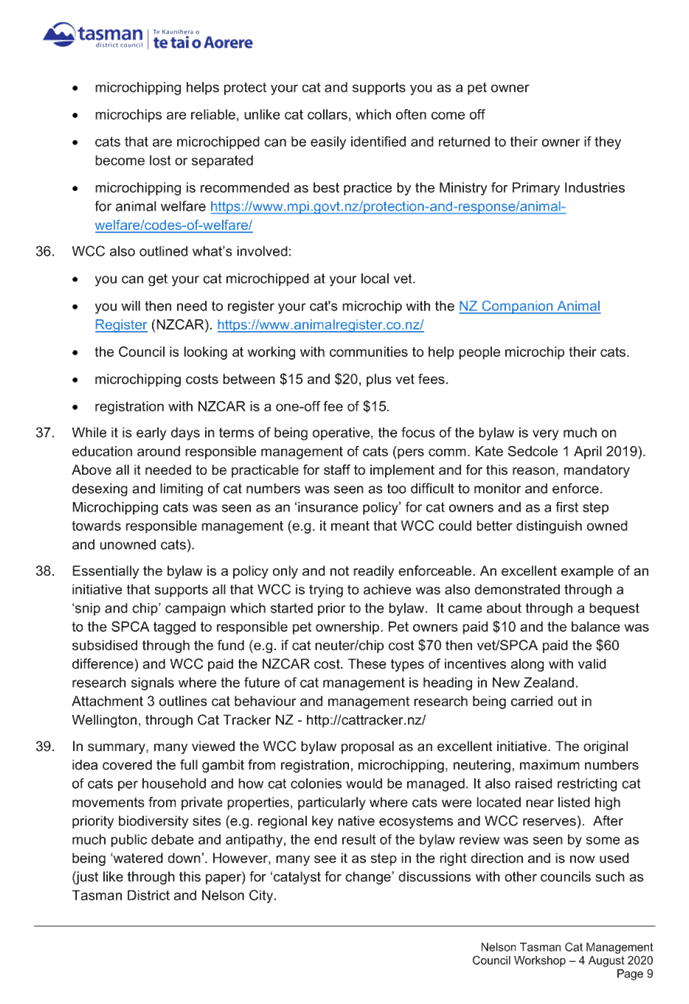
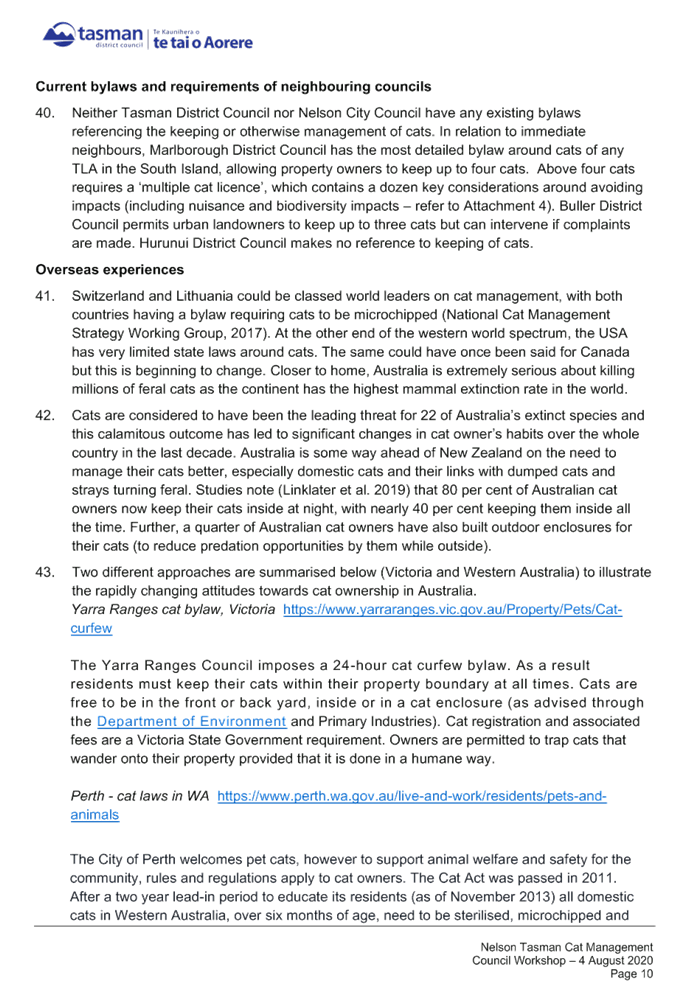
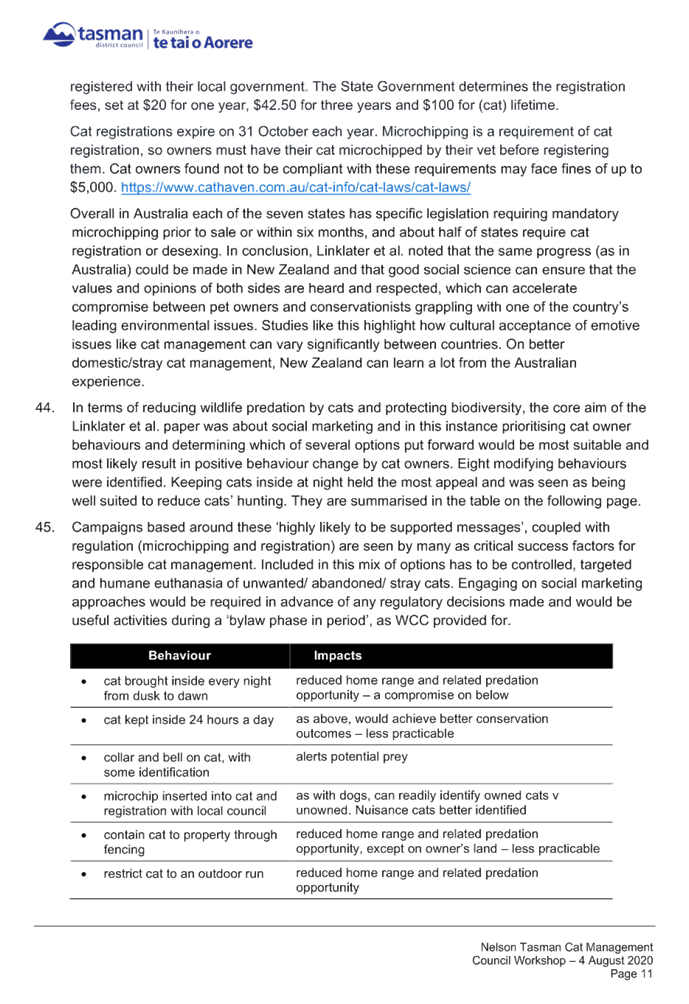
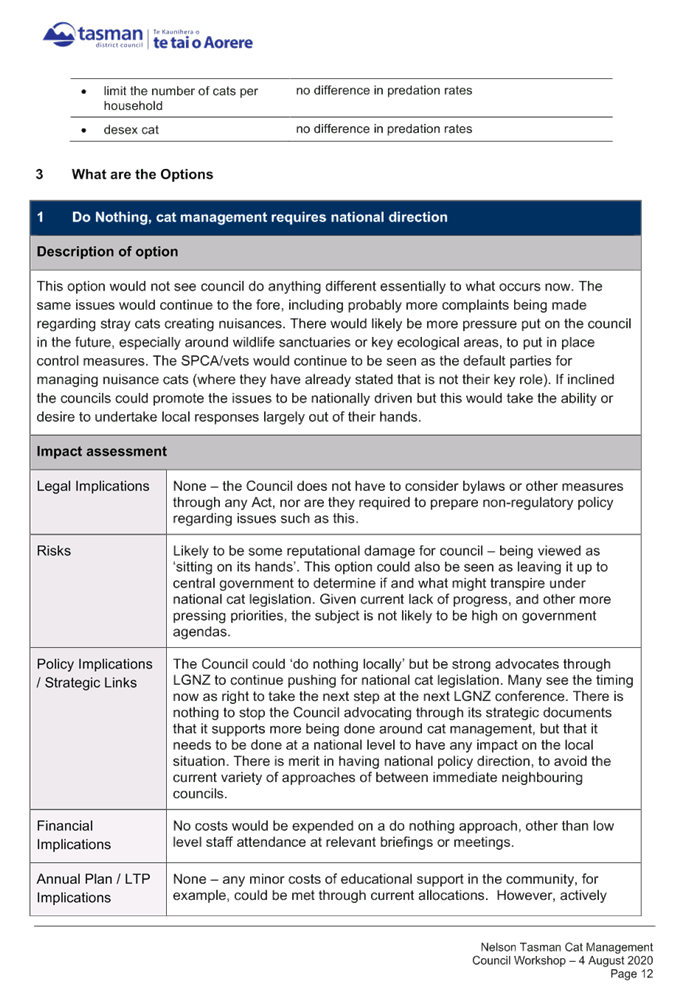
4.3 The
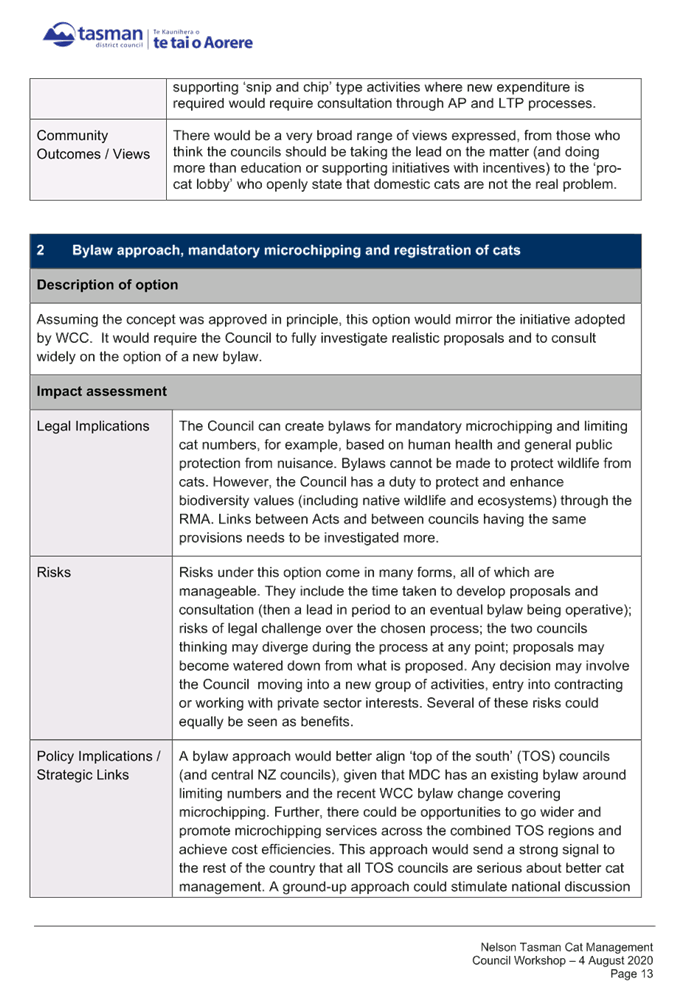
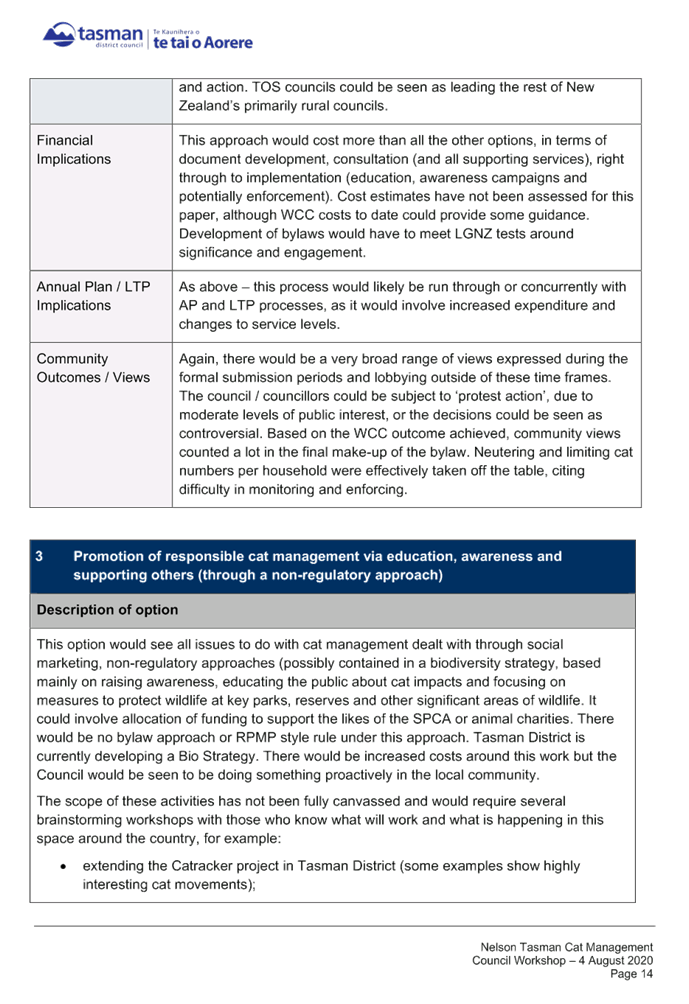
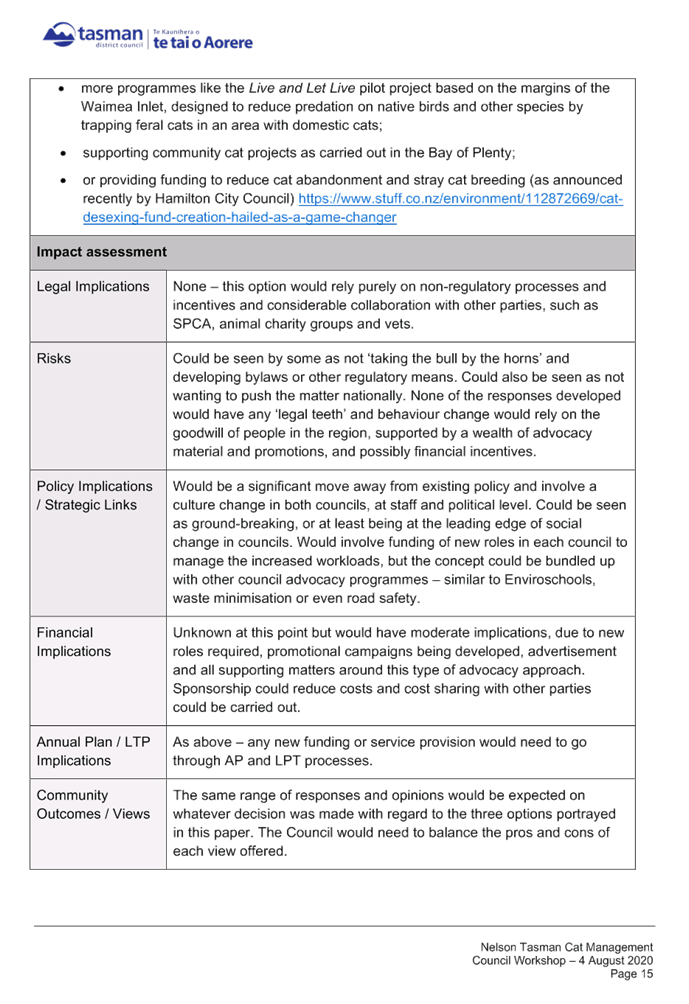
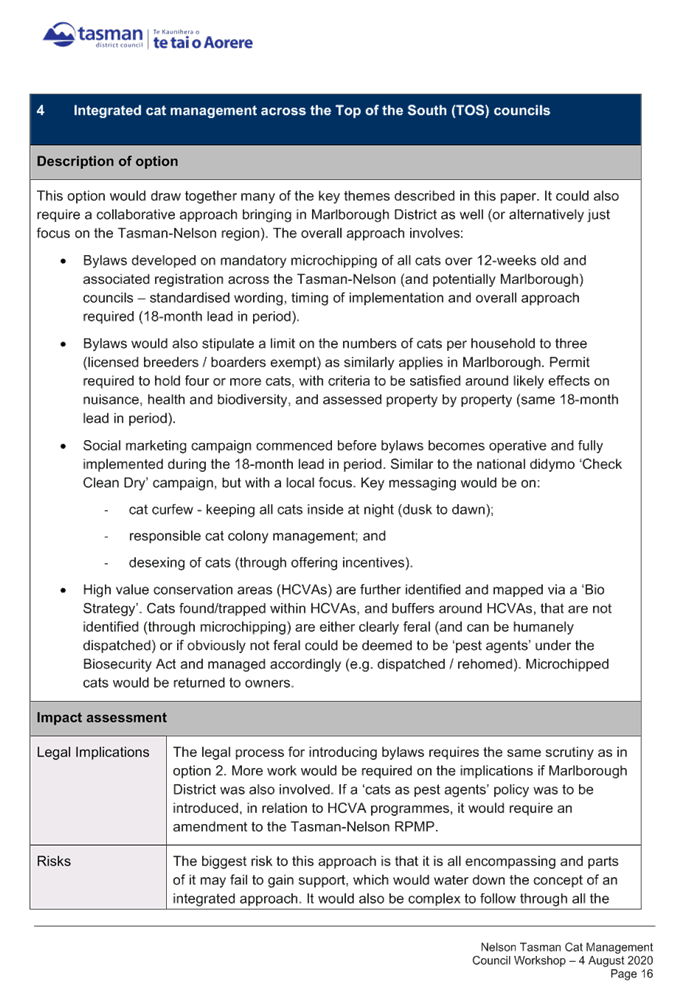
Council considered a report (Attachment 1) outlining a range of options to
address cat management at a workshop on 4 August 2020. The report summarised:
4.3.1 cat
impacts (beneficial and negative)
4.3.2 RPMP
submissions received and recommendations made
4.3.3 the
National Cat Management Strategy
4.3.4 what
is happening in the region, noting distinctions between Nelson (mainly city environs)
and Tasman (mainly rural environs) regarding approaches
4.3.5 what
other councils have done regarding cat management
4.3.6 relevant
overseas cat management (e.g., European, Australian experiences)
4.3.7 advocating
for national laws requiring cat management, noting that in 2018 Local Government
New Zealand resolved to promote the development of national cat control laws.
4.4 Several
options that are available include:
4.4.1 do nothing
4.4.2 develop
a bylaw similar to Wellington City Council
4.4.3 include
non-regulatory advocacy programmes
4.4.4 integrate
a mix of all the above options.
4.5 At
the Regulatory Committee meeting on 26 November 2020, Councillors directed staff
to contact Local Government New Zealand for an update on the National Cat Management
Strategy and associated national cat legislation and to commence development of
a Cat Management Bylaw under the provisions of the Local Government Act 2002.
4.6 Local
Government New Zealand advise that there has been no progress with the National
Cat Management Strategy which is still in draft form and that they have been unable
to get interest from the Government to promulgate national cat legislation.
4.7 This
year the Ministry for Primary Industries has revised the “Code of Welfare:
Companion Cats” (May 2021) which is issued under the provisions of the Animal
Welfare Act 1999 and places fundamental obligations related to the care of animals
by setting minimum standards and recommending best practice in the care and management
of animals.
4.8 The
Code of Welfare: Companion Cats largely deals with minimum requirement for housing,
feeding and caring for cats at all stages of their life but also includes Part 8
(Methods of Identification) where it states:
4.9 “It
is strongly recommended that cats are able to be accurately identified in case of
loss, or being held in boarding accommodation. Cats are likely to spend some of
their time outside of their owner’s legal property boundary. For the purposes
of control, it is necessary to be able to identify whether a cat has an owner or
not. Methods of identification include the wearing of a collar and tag, tattooing
or microchipping” and recommended best practice is that …a) Cats should
be identified with a microchip”.
4.10 In the absence
of other action at the central government level, the Local Government Act 2002 (LGA)
provides powers, scope, and the tests for councils to make bylaws, if that is accepted
as an appropriate way to manage the public health and nuisance risks that cats can
pose.
4.11 Section
145 of the LGA outlines the general powers for making bylaws and includes protecting
the public from nuisance and protecting, promoting, and maintaining public health
and safety.
4.12 Section
146 of the LGA describes specific bylaw making powers which includes regulating
the keeping of animals without limiting the provisions of Section 145 outlined above.
Therefore, the Council has the power to regulate animals where this protects the
public from nuisance and/or public health issues. Biosecurity and biodiversity matters
are not normally managed via the LGA bylaw process but may be a collateral benefit.
4.13 Section
155 of the LGA requires that the Council must determine whether a bylaw is the most
appropriate way of addressing the perceived problem and, if so, whether the proposed
bylaw is the most appropriate from of the bylaw and that it will not be inconsistent
with the New Zealand Bill of Rights Act 1990.
4.14 Once the
Council has determined that a bylaw is the most appropriate method, it must decide
on its consultation approach in accordance with Section 156 of the LGA. For a matter
of wide interest such as cat management, a submission and hearing process via the
Special Consultative Procedure would be expected. As part of this process, a Statement
of Proposal (Attachment 2) is required that outlines the options for cat
management. These matters were also addressed in the report to the Council workshop
on 4 August 2020, which outlined a range of options for dealing with the perceived
problem. This is attached as Attachment 1 to this report. The preferred option
was directed by the Council Regulatory Committee at its meeting of 26 November 2020.
4.15 The perceived
problem was defined as how cats are best managed to address their positive and negative
impacts.
|
Positive Impacts – Pet Cats
|
Negative Impacts – Pet Cats
|
|
Companion animals
for many people including the elderly, especially those living alone.
|
Community amenity
and health threats – nuisance and disease vector including cat trespass,
wildlife predation in gardens, transmission of disease through contact, and cat
bites and scratches.
|
|
Developing nurturing
and social skills for a child’s development.
|
Economic and environmental
threats for pastoral farming and marine environments including grazing animals,
Hector’s dolphins and the wider marine food chain.
|
|
Rodent and rabbit
control.
|
Predation on valued
species such as birds and reptiles.
|
4.16 As noted,
the focus for LGA bylaws is limited by the powers under Section 145 of the LGA to:
4.16.1 protect the public from nuisance
4.16.2 protect, promote, and maintain public health
and safety
4.16.3 minimise the potential for offensive behavior
in public places.
Section 146(a)(v) provides
that the Council may make bylaws for the purpose of regulating the keeping of animals.
4.17 On this
basis, a bylaw is still an appropriate method for addressing the health, amenity
and nuisance aspects of the perceived problem. Biosecurity and biodiversity issues
are matters more appropriately dealt with under the Biosecurity Act or Resource
Management Act processes, but there may be some collateral benefit of a bylaw.
4.18 The proposed Bylaw enclosed in the Statement of Proposal has been developed
by looking at various options currently being used elsewhere in New Zealand. Consideration
has been given to whether these options are the most appropriate way of addressing
the perceived problem outlined above. In particular, the Bylaw needs to be proportionate
to the issue and ensure consistency with the New Zealand Bill of Rights Act 1990
in accordance with Section 155 of the LGA.
4.19 The draft
Bylaw is modelled on the Wellington City Council approach. The key features of the
proposed Cat Management Bylaw are:
4.19.1 a requirement that all
domestic cats over 12 weeks old are microchipped, and
4.19.2 that the microchip be registered on a database;
and
4.19.3 a prohibition on feeding
cats in public places.
4.20 Wellington
City Council effectively treats the Cat Bylaw like a policy and relies on the SPCA,
veterinarians and Companion Animals New Zealand (NZCAC) for education and implementation.
Having spoken to these agencies, they rely on the Bylaw to help encourage owners
to microchip. We are not aware of any proactive enforcement, rather other councils
encourage microchipping and some subsidise Snip and Chip campaigns. They do respond
to complaints where that is possible, as with any other animal related complaints
raised by the public.
4.21 It does
mean that cats caught without a microchip can be regarded as feral or unowned cats
and if they pose a risk to other wildlife, actions can be taken.
5.1 The options are outlined
in the following table.
|
|
Option
|
Advantage
|
Disadvantage
|
|
1.
|
Proceed with notifying a Cat Management
Bylaw.
|
Mandatory microchipping of domestic
cats will allow domestic cats to be distinguished from feral cats simplifying
feral cat control with benefits related to animal and human health and protection
of native animals.
The owners of domestic cats can be
identified in the event a cat gets hurt or creates a nuisance. This will assist
vets and the SPCA to do their job with reduced risk to misidentifying a cat or
of not being able to return it to its owners.
|
There is a modest cost associated
with microchipping and putting animals on the microchip register.
Some cat owners may feel their rights
are being infringed - see comments about the New Zealand Bill of Rights.
|
|
2.
|
Do not proceed with the Cat Management
Bylaw.
|
It saves time and is less likely to
upset some people.
|
Inability to definitively separate
domestic from feral cats. This will result in feral cat control being more difficult
and ongoing adverse impacts on health including domestic cats, toxoplasmosis impacting
on humans, livestock and valued indigenous wildlife.
The inability to identify owners of
hurt or nuisance cats to return cats, remedy nuisance, or provide health care
where a cat is presented for health care after an accident.
|
5.2 Option
1 is recommended. In summary, a bylaw that is principally
modelled on the Wellington City Council approach is recommended for the following
reasons.
· The
bylaw is proportionate to the scale of the current problem that is principally about
cat identification and welfare.
· The
management of this bylaw will largely fall to the SPCA for microchipping and determining
the health of cats and NZCAC for registration.
6.1 The
introduction of a bylaw requiring the microchipping of cats represents a significant
entrée into cat management that is not currently required nationally. It
may be seen as unwarranted, and this carries the risk of public backlash. However,
the evidence is that cats are involved in trespass and other nuisance behavior and
can pose a threat to other cats and animals through fighting and the spread of toxoplasmosis.
They also pose a significant risk to birdlife, including indigenous species. There
is reasonably widespread support for a Council bylaw.
6.2 Any
bylaw is reviewable on the grounds of reasonableness but the Council, provided it
satisfies the relevant legal tests, can promulgate this form of subnational legislation.
7 Policy
/ Legal Requirements / Plan
.7.1 The
Council can make bylaws for a range of purposes under Section 145 of the Local Government
Act 2002. These purposes include:
· protecting the
public from nuisance.
· protecting, promoting,
and maintaining public health and safety.
· minimising the
potential for offensive behavior in public places.
7.2 It
is clear from Section 146 of the LGA that bylaws can include the control of animals.
7.3 A
bylaw must be justified in that it is reasonable and does not introduce requirements
that are disproportionate to the issue to be managed.
7.4 The
Council is obliged to consider whether a bylaw would be consistent with the New
Zealand Bill of Rights Act (NZBORA). Some might regard the requirement to
microchip their cat as an infringement on freedoms that cat owners currently enjoy.
Targeting cat owners in this way does not constitute discrimination under the Human
Rights Act and the proposed bylaw does not in any other way challenge freedoms provided
to people under NZBORA.
7.5 The
staff view is that proposed Cat Management Bylaw meets the relevant legal tests.
8 Consideration
of Financial or Budgetary Implications
8.1 The
cost of bylaw development is predominantly staff time and is covered by existing
budgets. As part of the implementation of the Bylaw, the Council could choose to
subsidise the cost of microchipping and placement of the chip record on the register
as some other councils have done. The cost of this would depend on the amount of
the subsidy, the number of people who applied for it and the duration it was offered
for. The Council could choose to set a cap on the amount it was prepared to spend
and nominate the maximum to be spent. This would have to happen through a bid for
funds as part of the annual plan round. There is no current budget for this.
9 Significance
and Engagement
9.1 There
is likely to be significant public interest in a Cat Management Bylaw and the Special
Consultative Procedure must be used.
|
|
Issue
|
Level of Significance
|
Explanation of Assessment
|
|
1.
|
Is there a high level of public interest, or is decision likely
to be controversial?
|
High
|
Managing cats by requiring microchipping, for those who do
not already do this voluntarily, is likely to be controversial because it is not
required under national law and some may see a local bylaw as being a disproportionate
response.
|
|
2.
|
Are there impacts on the social, economic, environmental or
cultural aspects of well-being of the community in the present or future?
|
Medium
|
The suggestion of a bylaw to manage cats will have positive
and negative impacts as identified in this report.
|
|
3.
|
Is there a significant impact arising from duration of the
effects from the decision?
|
Medium
|
A bylaw introduces subnational law that will have an enduring
effect but is designed to assist rational cat management and minimize adverse
impacts.
|
|
4.
|
Does this activity contribute or detract from one of the
goals in the Tasman Climate Action Plan 2019?
|
No
|
|
|
5.
|
Does the decision relate to a strategic asset? (refer Significance
and Engagement Policy for list of strategic assets)
|
No
|
|
|
6.
|
Does the decision create a substantial change in the level
of service provided by Council?
|
No
|
|
|
7.
|
Does the proposal, activity or decision substantially affect
debt, rates or Council finances in any one year or more of the LTP?
|
No
|
|
|
8.
|
Does the decision involve the sale of a substantial proportion
or controlling interest in a CCO or CCTO?
|
No
|
|
|
9.
|
Does the proposal or decision involve entry into a private
sector partnership or contract to carry out the deliver on any Council group of
activities?
|
No
|
Although we will be relying on external agencies to assist
with implementation
|
|
10.
|
Does the proposal or decision involve Council exiting from
or entering into a group of activities?
|
No
|
While not involving the entering of a new activity, having
a cat bylaw expands the range of animals that Council currently is involved with
|
|
11.
|
Does the proposal require inclusion of Māori in the decision-making
process (consistent with s81 of the LGA)?
|
No
|
|
10.1 The Regulatory
Committee instructed staff to procced with development of a Cat Management Bylaw.
The Statement of Proposal and draft of that Bylaw are attached for the Council’s
consideration.
11.1 If the Council
resolves to proceed with the notification of a Cat Management Bylaw this could be
done soon after the decision is made (shortly after this meeting).
11.2 Submissions
could be open for approximately six weeks, but it is suggested the submission period
does not commence until mid-January 2022 (Monday 17) with hearings and decisions
in the first half of 2022.
|
1.
|
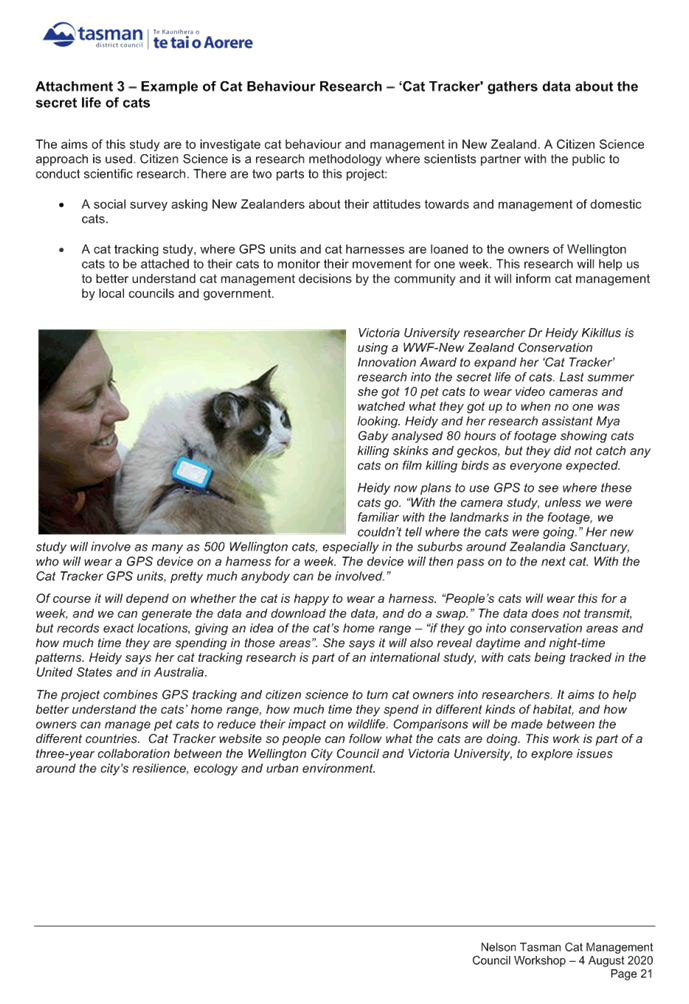
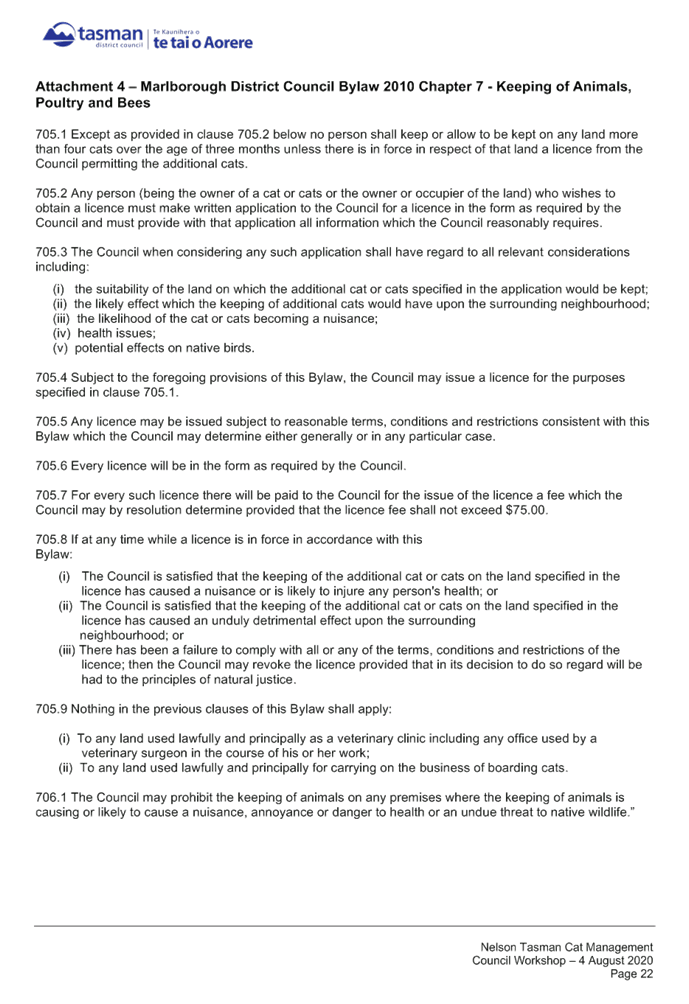
Attachment 1 Council Workshop cat Managment
|
12
|
|
2.
|
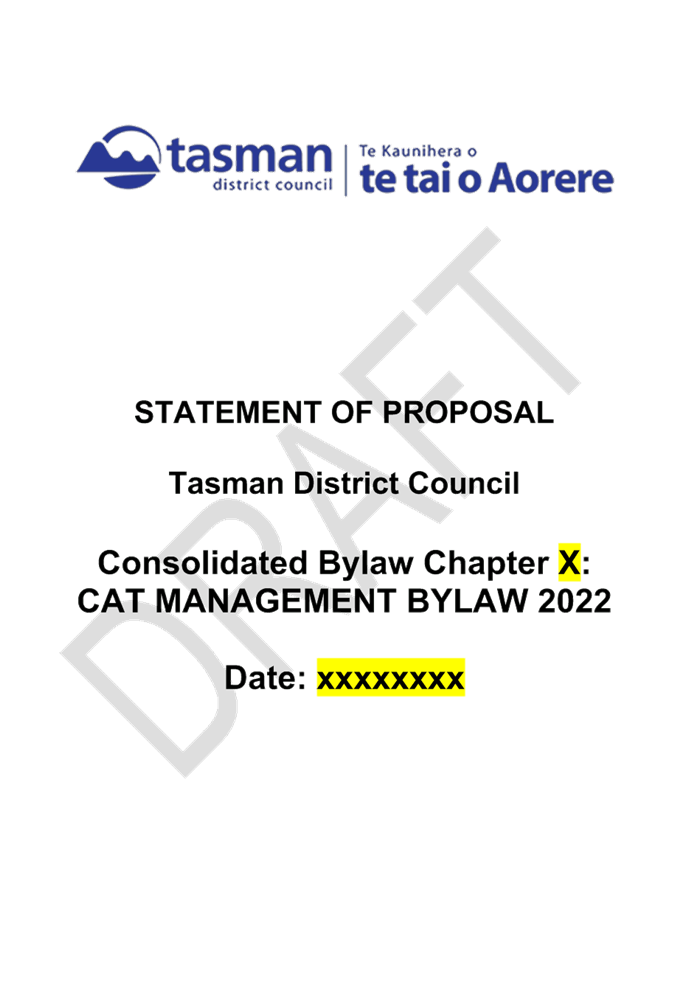
Attachment 2 Statement of Proposal Cat Managment
|
34
|
|
3.
|
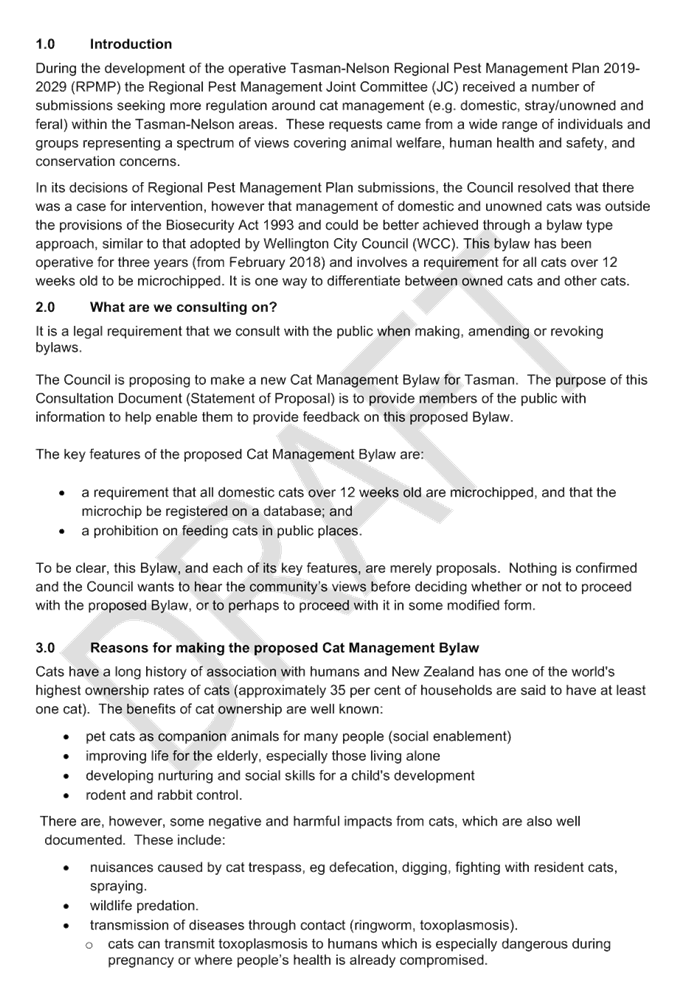
Attachment 3 Summary of Information Cat Managment
|
42
|
Tasman District Council
Regulatory Committee Agenda – 02 December 2021
Tasman District Council Regulatory Committee Agenda – 02
December 2021

Tasman District Council Regulatory Committee Agenda – 02
December 2021

Tasman District Council Regulatory Committee Agenda – 02
December 2021
8.2 Annual Biosecurity Report
Decision Required
|
Report To:
|
Regulatory Committee
|
|
Meeting Date:
|
2 December 2021
|
|
Report Author:
|
Guinevere Coleman, Team Leader
Biosecurity & Biodiversity
|
|
Report Number:
|
RRC21-12-2
|
1.1 The
Council is obliged under the Biosecurity Act to report annually on activities undertaken
under the Regional Pest Management Plan. The review of the 2020-21 Operational Plan
(Attachments 1 and 2) summarises and reviews the activities undertaken by
the Council in its role as the management agency during the previous financial year
and comments on relevant biosecurity monitoring and compliance issues.
1.2 The
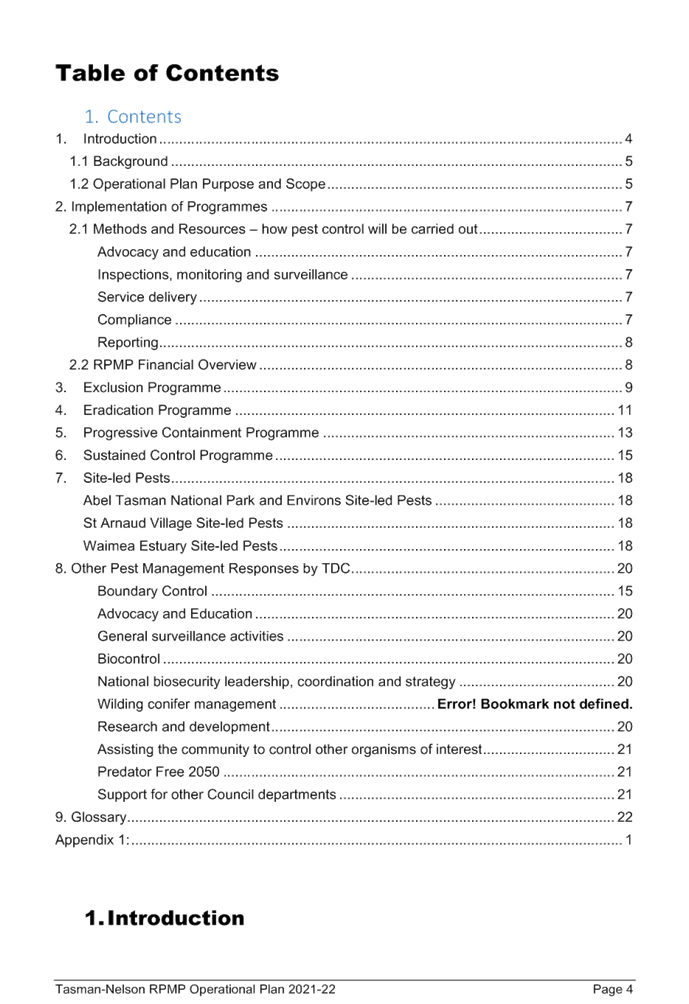
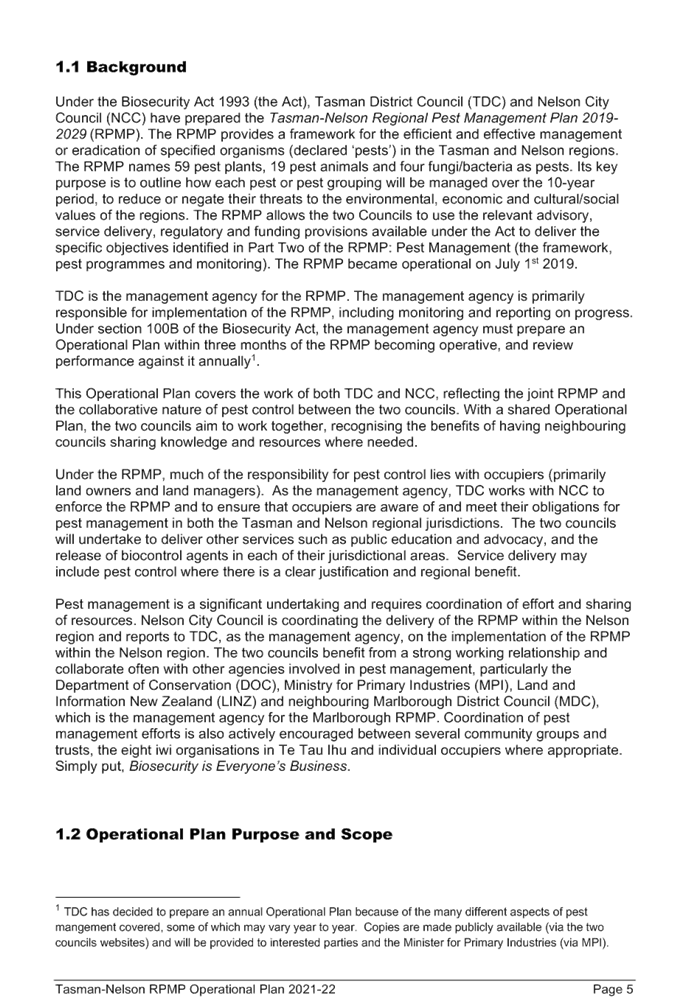
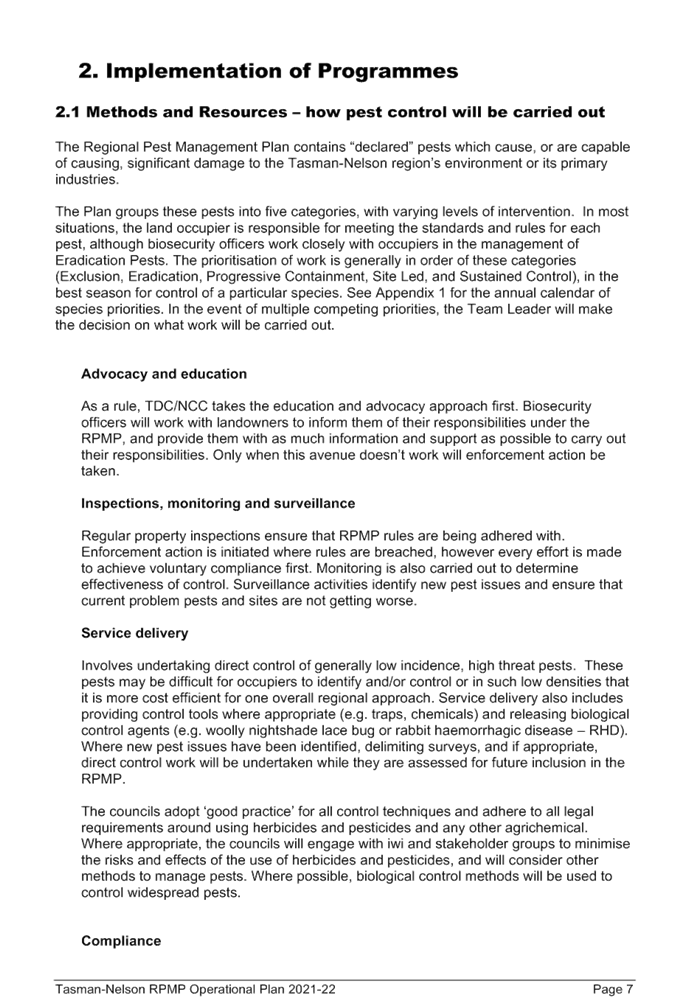
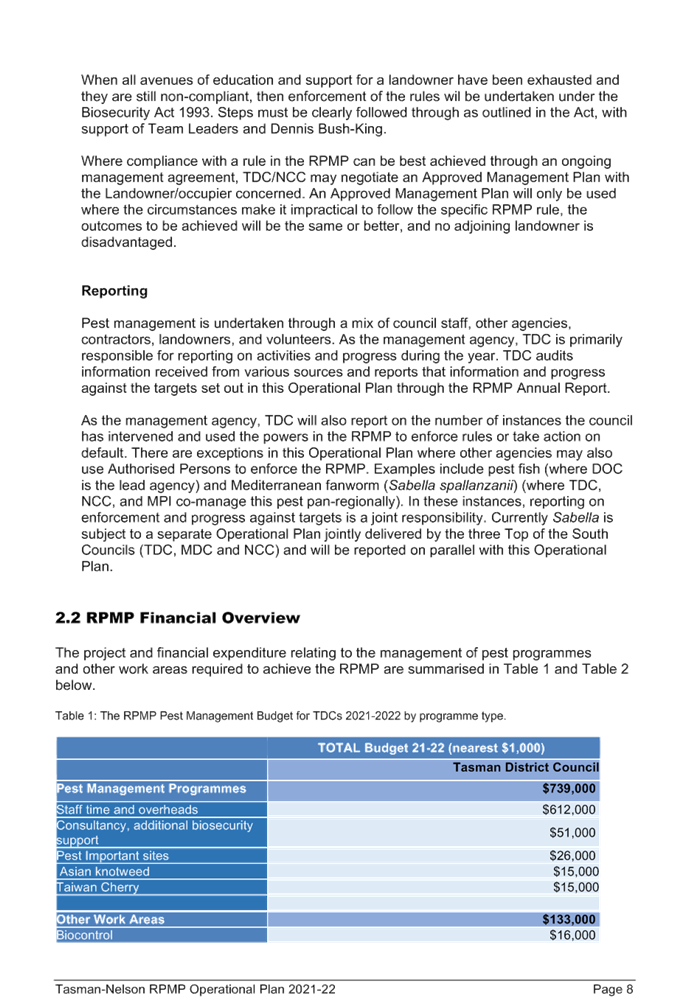
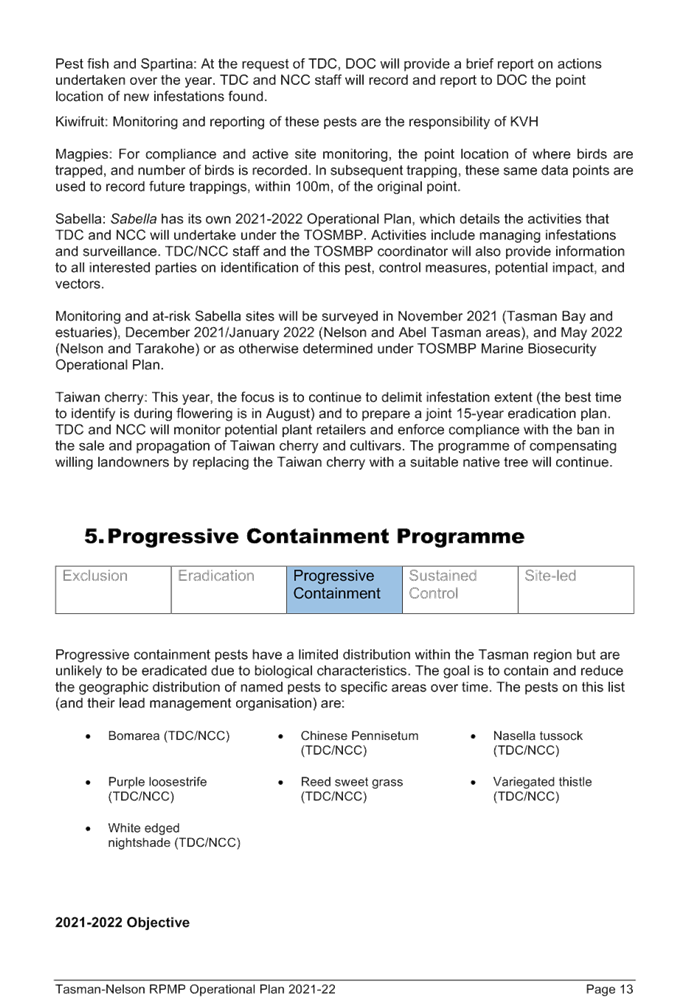
2021-22 Operational Plan (Attachment 3) outlines the objectives and activities
to be undertaken in implementing the 2019-2029 Tasman-Nelson Regional Pest Management
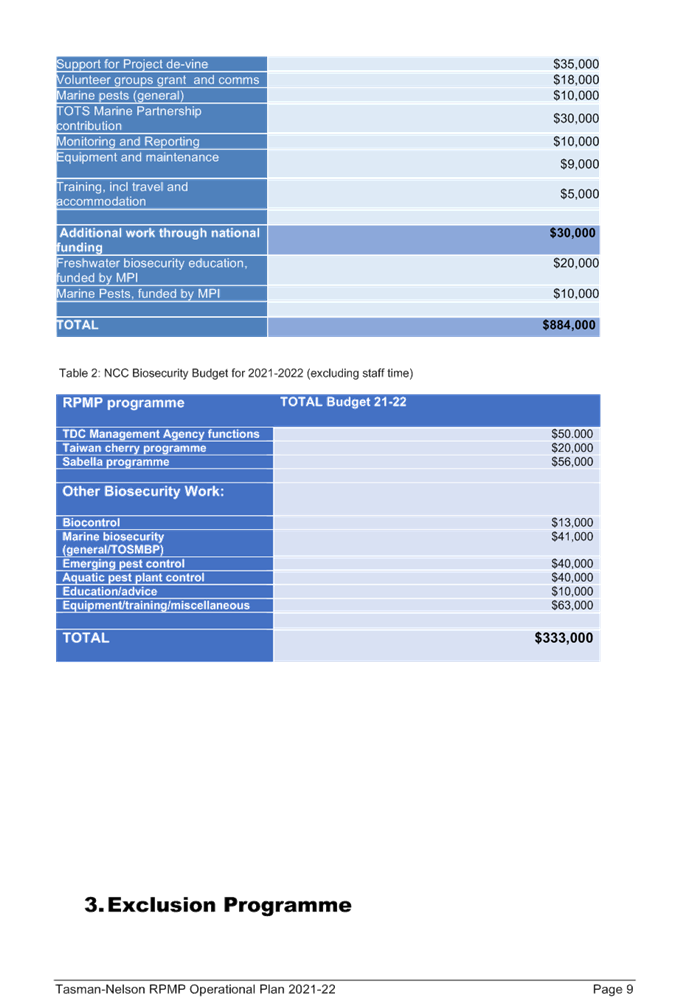
Strategy within the approved budget of $884,000.
1.3 These reports will also be conveyed to Nelson City Council as our joint
partner in biosecurity management.
That
the Regulatory Committee
1. receives
the Annual Biosecurity Report RRC21-12-2; and
2. receives
the Review of the 2019-2020 Operational Plan as Attachment 1 and Attachment 2; and
3. approves
the 2021-2022 Operational Plan for the Tasman-Nelson Region attached as Attachment
3.
3.1 The
purpose of this report is to present the Operational Plan for the 2021-22 Financial
Year and to summarise the achievements of the 2020-21 Operational Plan. This report
has been prepared for Tasman District Council and Nelson City Council as the Regional
Pest Management Strategy is a joint strategy, with an addendum which is specific
to Tasman District.
4 Background
and Discussion
4.1 This
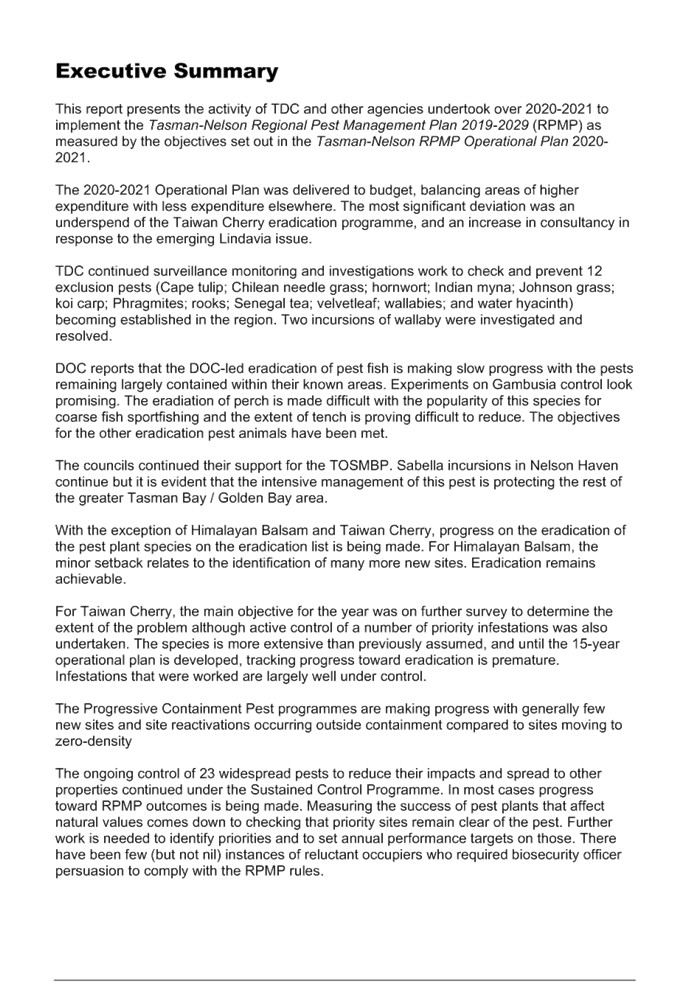
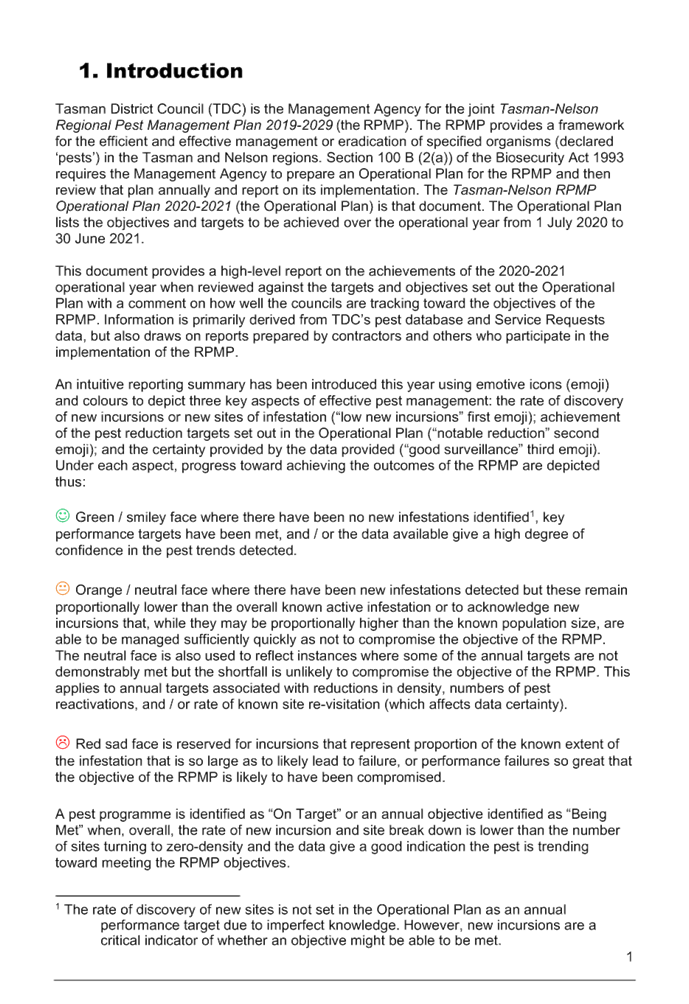
report presents the activity of Tasman District Council and other agencies undertaken
over 2020-2021 to implement the Tasman-Nelson Regional Pest Management Plan 2019-2029
(RPMP) as measured by the objectives set out in the Tasman-Nelson RPMP Operational
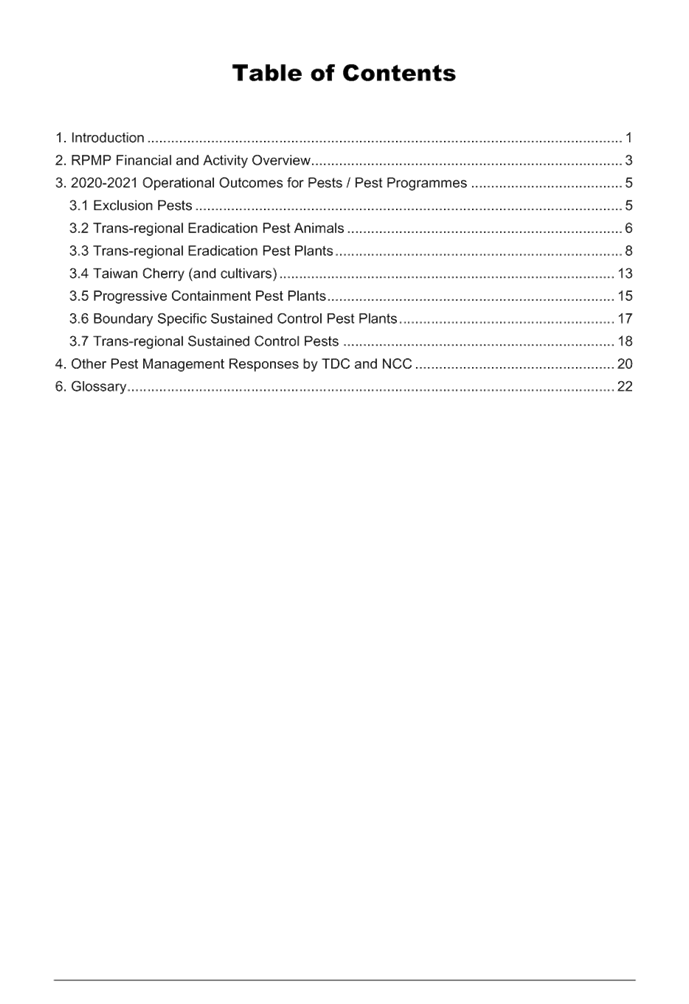
Plan 2020-2021 (both volumes). For additional detail and explanation, reference
should be made to the annual review reports attached as Attachment 1 and 2.
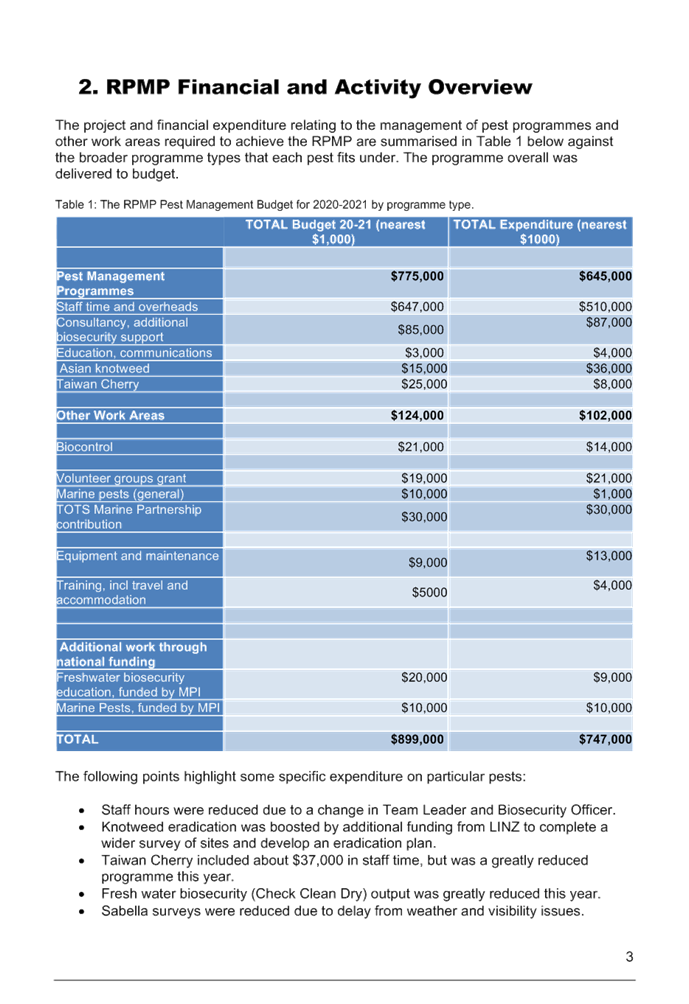
4.2 The
2020-2021 Operational Plan was delivered under budget, with the most significant
deviation being staff costs causing a $137,000 underspend in staff time and overheads.
Operational expenditure was on budget, balancing areas of higher expenditure with
less expenditure elsewhere. The most significant deviation was an underspend of
the Taiwan Cherry eradication programme, and an increase in consultancy in response
to the emerging Lindavia issue.
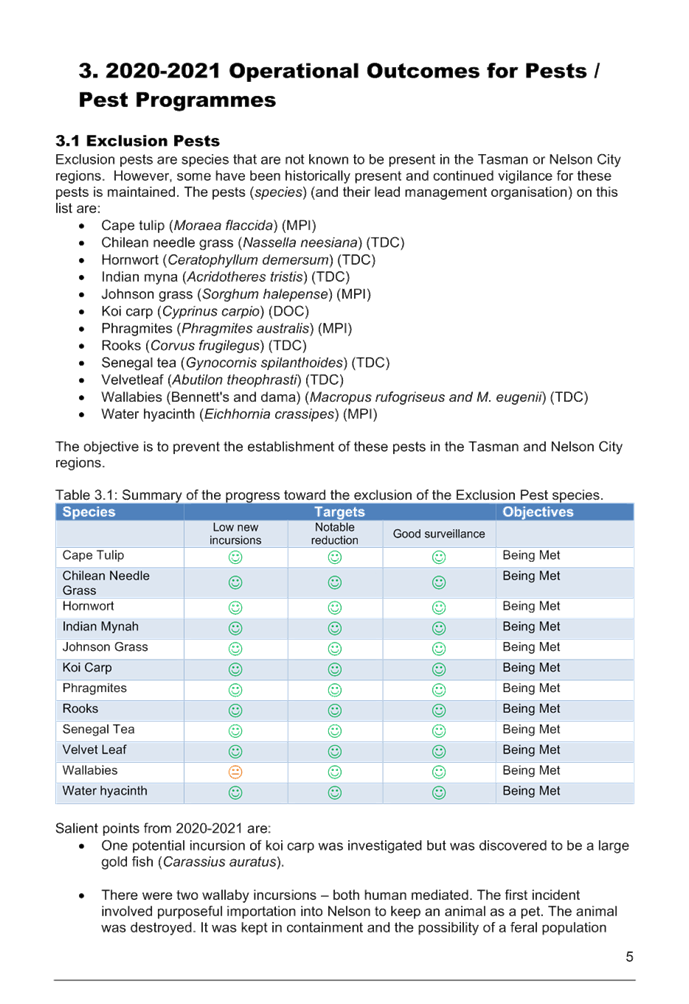
4.3 Tasman District Council continued surveillance monitoring
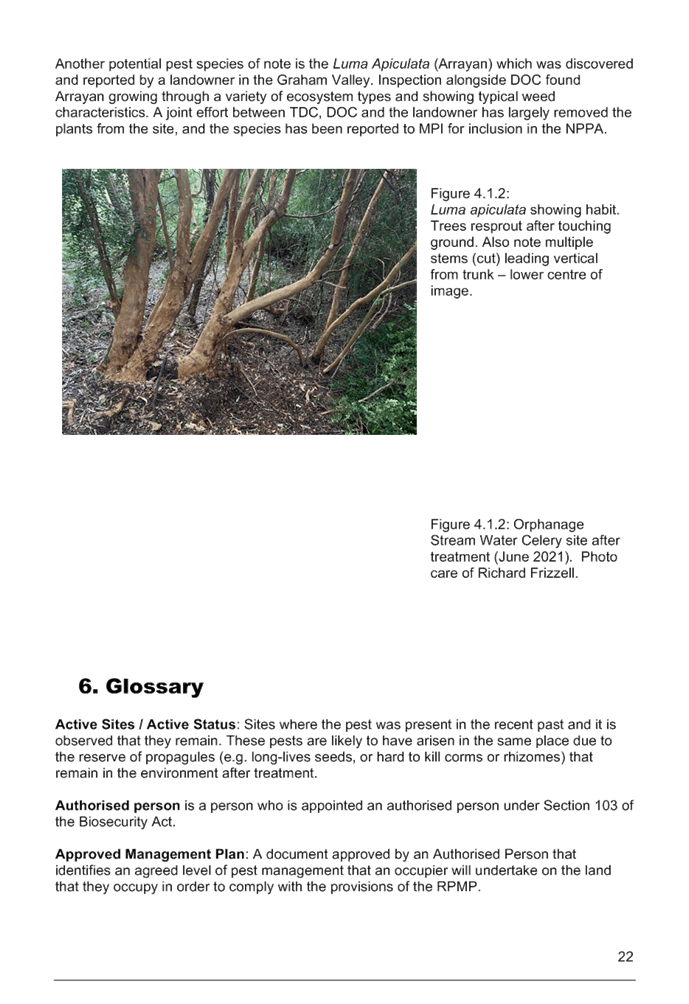
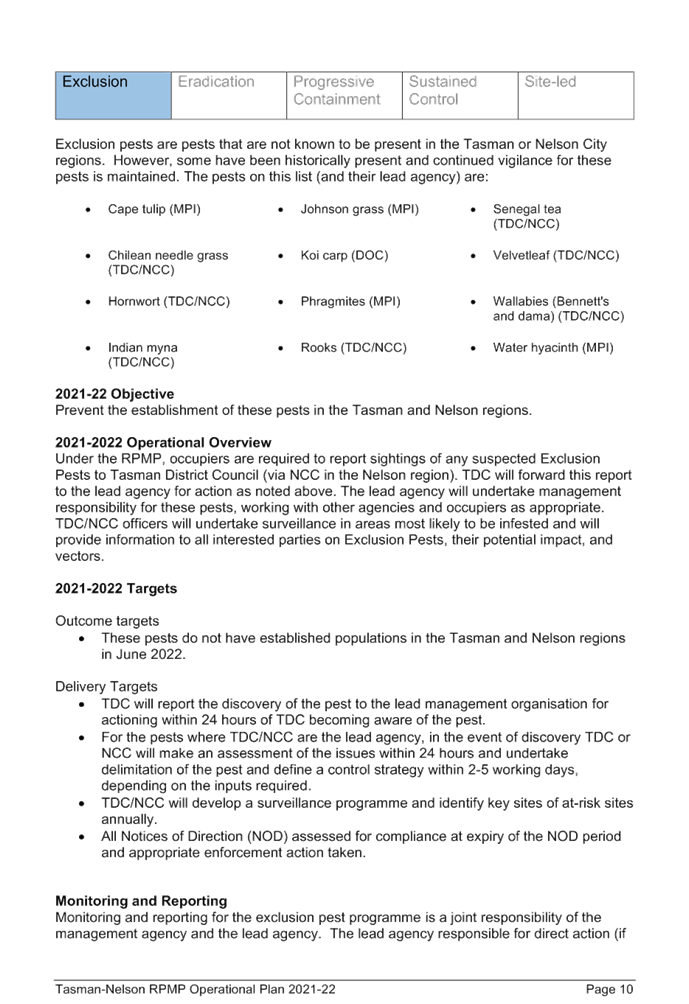
and investigations work to check and prevent 12 exclusion pests (Cape tulip; Chilean needle grass; hornwort; Indian
myna; Johnson grass; koi carp; Phragmites; rooks; Senegal tea; velvetleaf; wallabies; and water hyacinth) becoming established in the region. Two incursions
of wallaby were investigated and resolved.
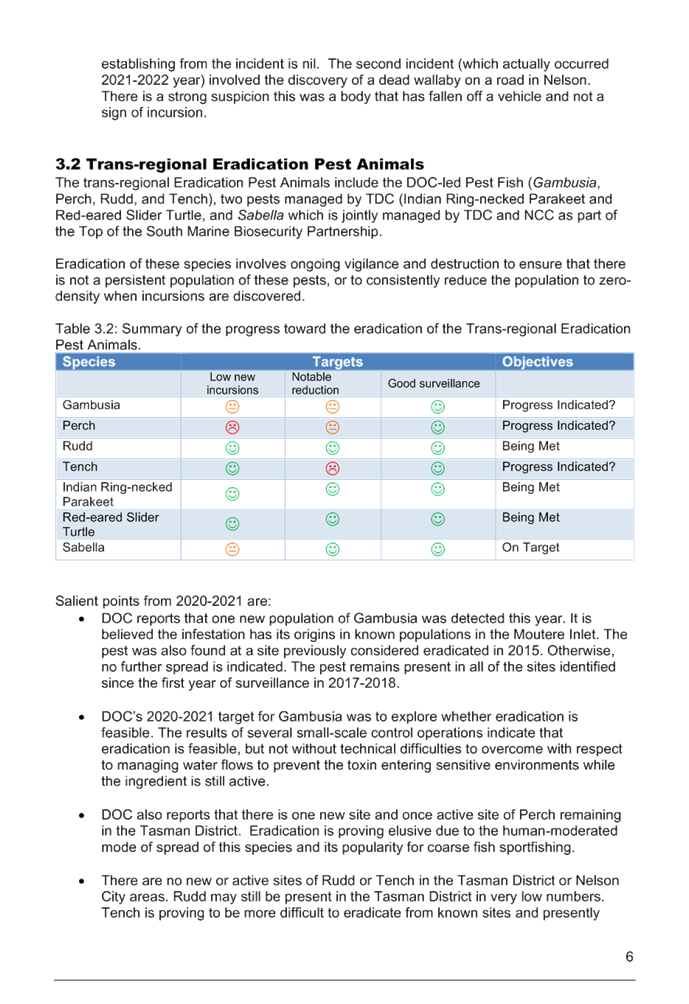
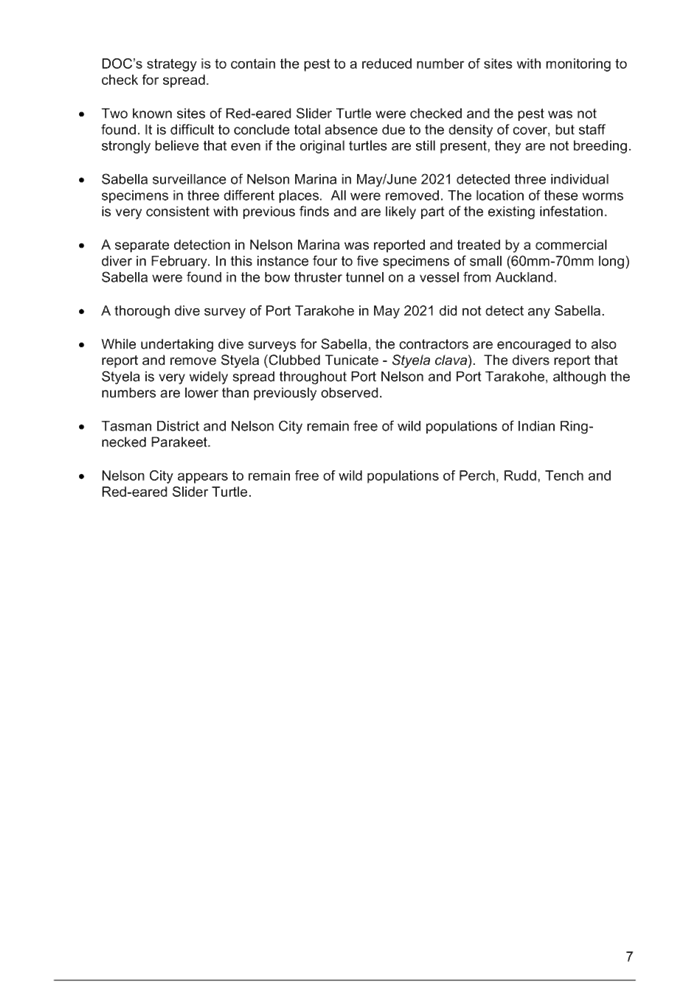
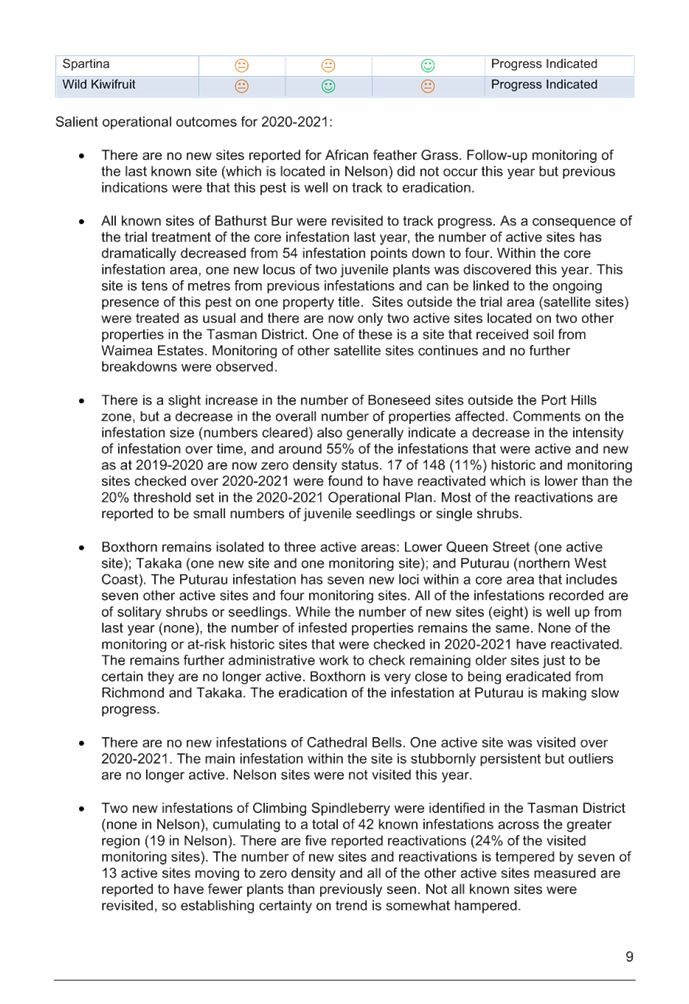
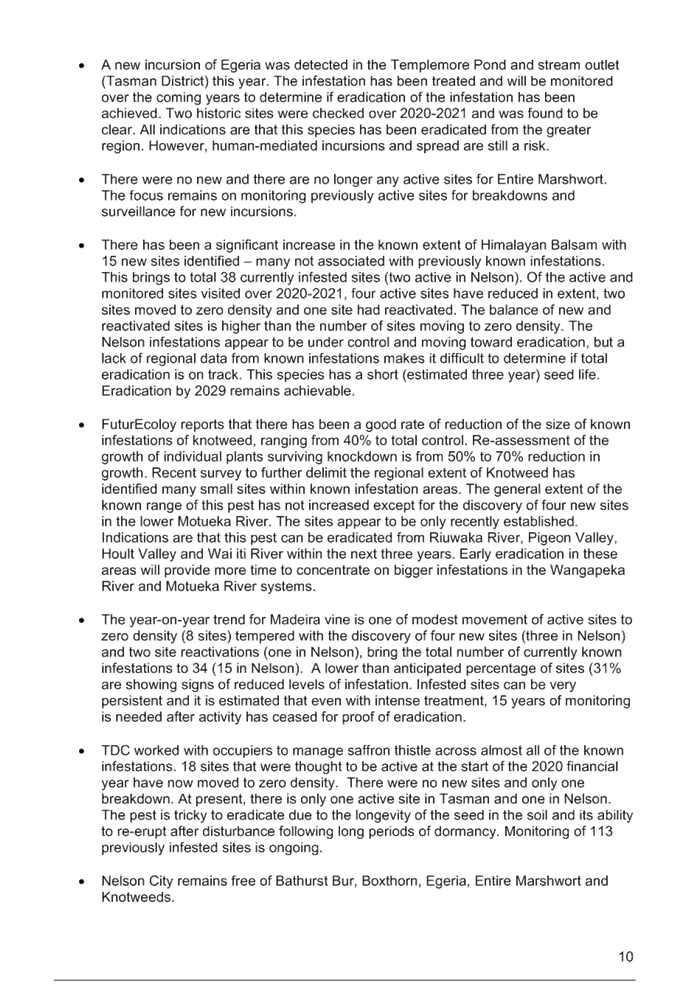
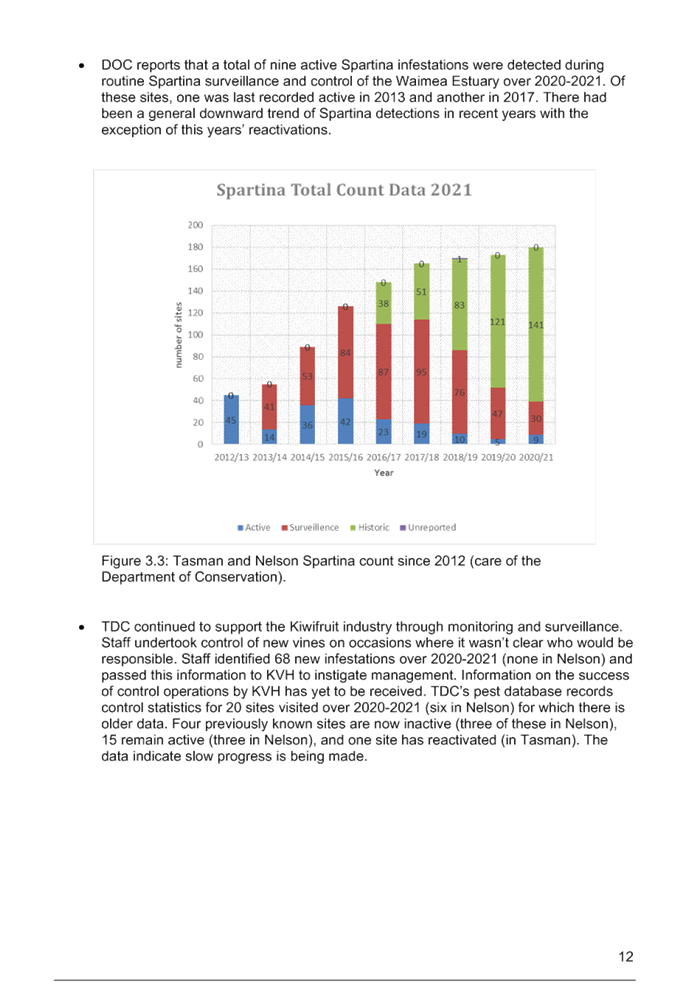
4.4 Department of Conservation (DOC) reports that the
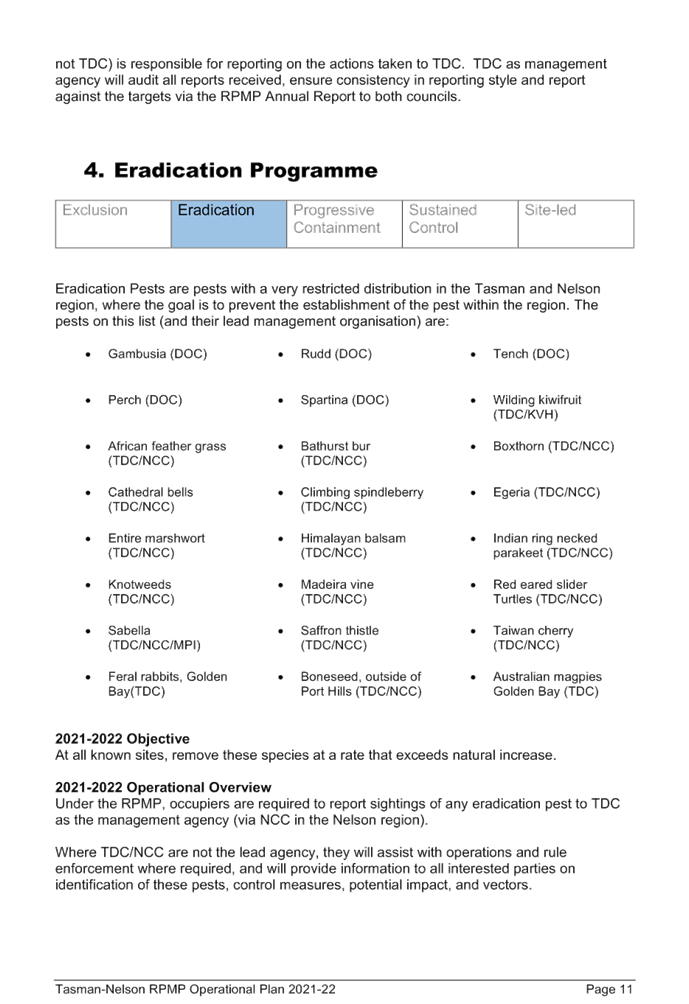
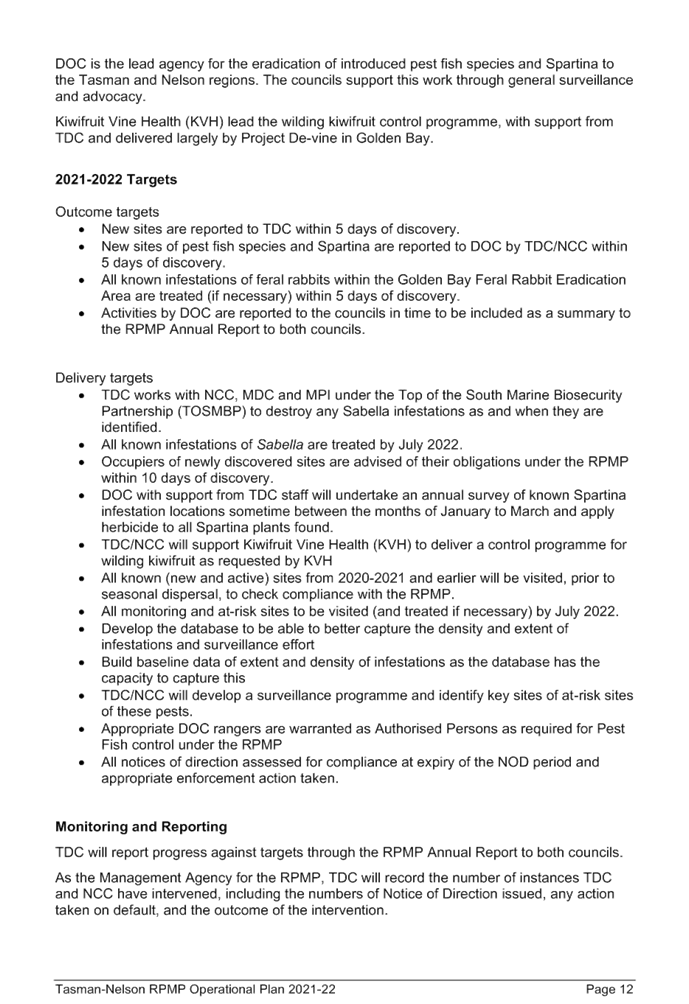
DOC-led eradication of pest fish is making slow progress, with the pests remaining
largely contained within their known areas. Experiments on Gambusia control look
promising. The eradication of perch is made difficult with the popularity of this
species for coarse fish sportfishing, and the extent of tench is proving difficult
to reduce. The objectives for the other eradication pest animals have been met.
4.5 The
councils continued their support for the Top of the South
Marine Biosecurity Partnership. Sabella incursions in Nelson Haven continue
but it is evident that the intensive management of this pest is protecting the rest
of the greater Tasman Bay/Golden Bay area.
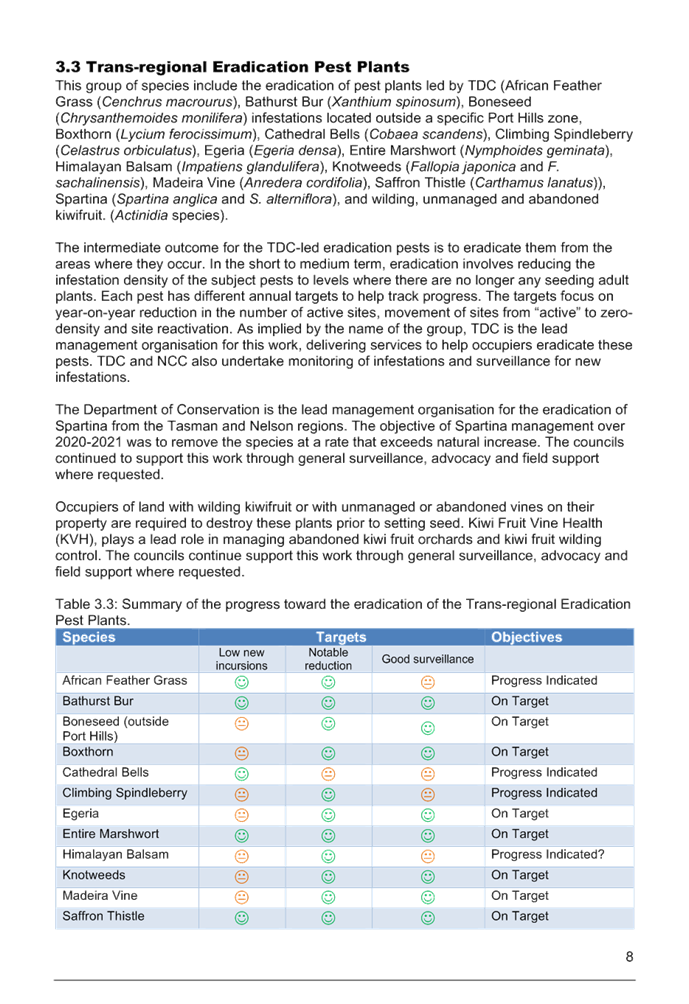
4.6 Except
for Himalayan Balsam and Taiwan Cherry, progress on the eradication of the pest
plant species on the eradication list is being made. For Himalayan Balsam, the minor
setback relates to the identification of many more new sites. Eradication remains
achievable.
4.7 For
Taiwan Cherry, the main objective for the year was further survey to determine the
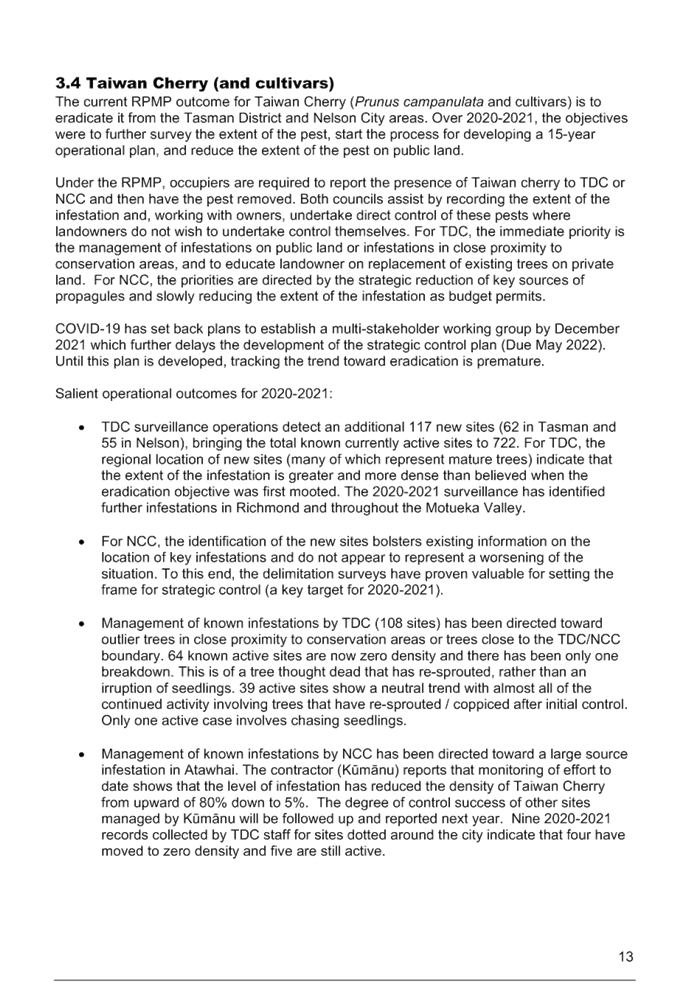
extent of the problem, although active control of several priority infestations
was also undertaken. The species is more extensive than previously assumed, and
until the 15-year operational plan is developed, tracking progress toward eradication
is premature. Infestations that were worked are largely well under control.
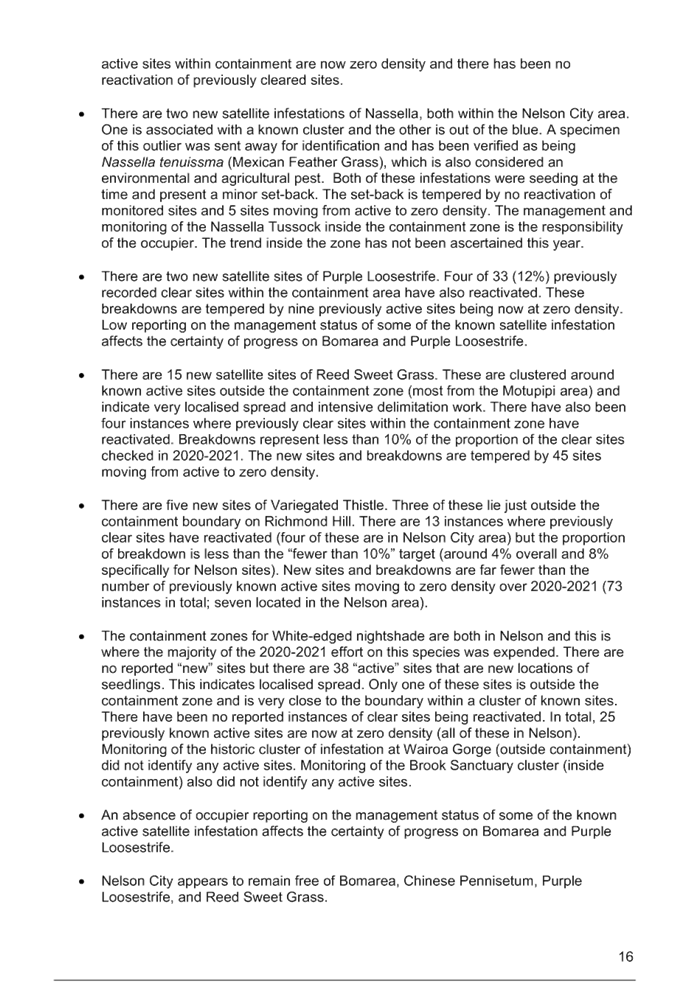
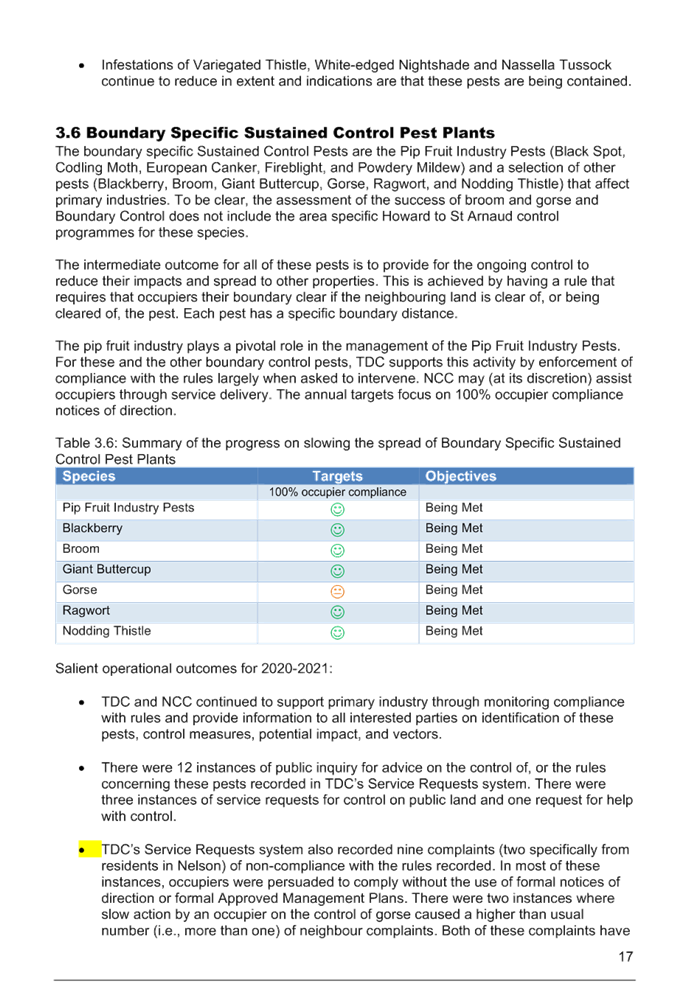
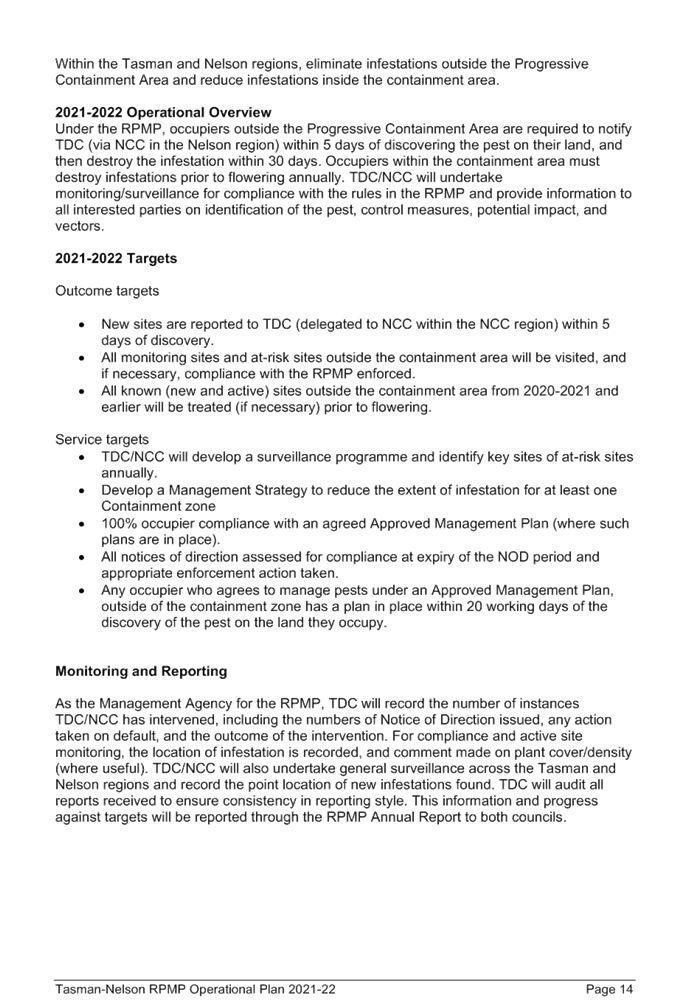
4.8 The
Progressive Containment Pest programmes are making progress with generally few new
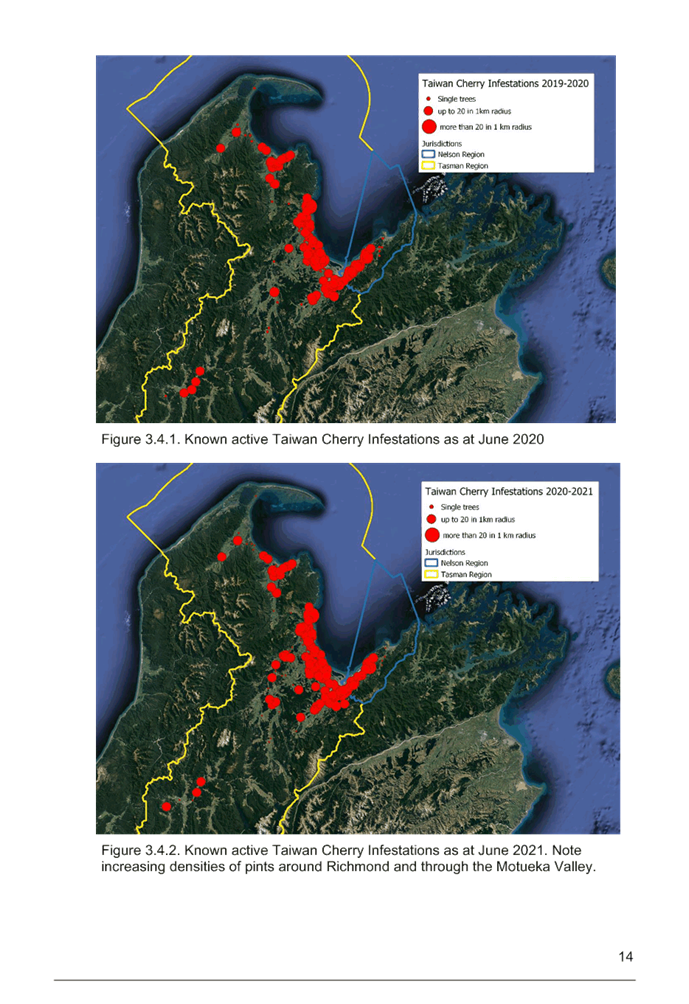
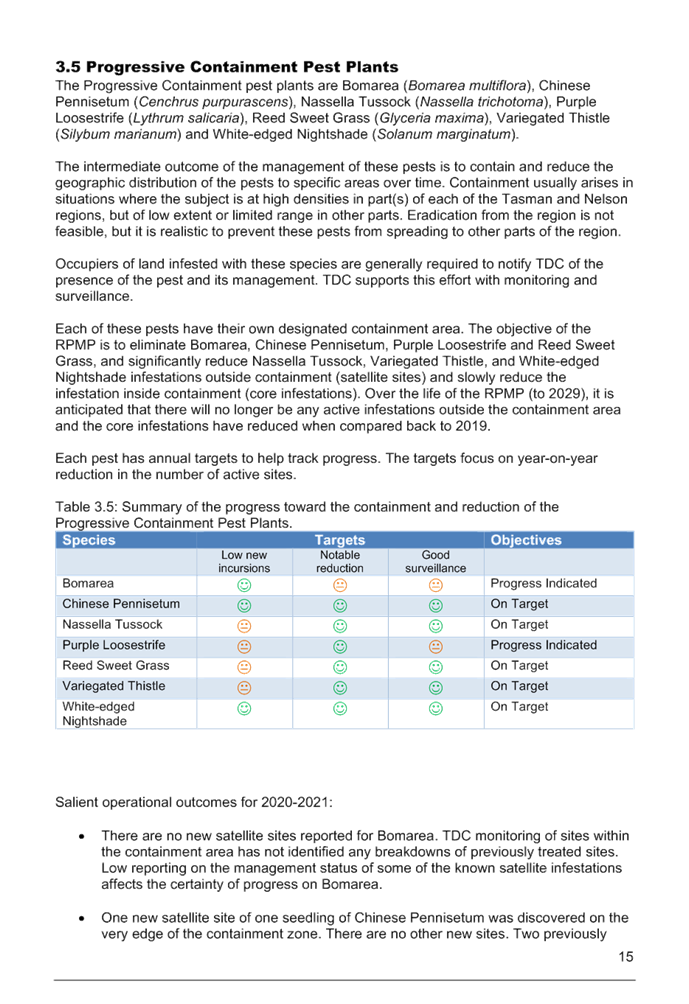
sites and site reactivations occurring outside containment, compared to sites moving
to zero-density.
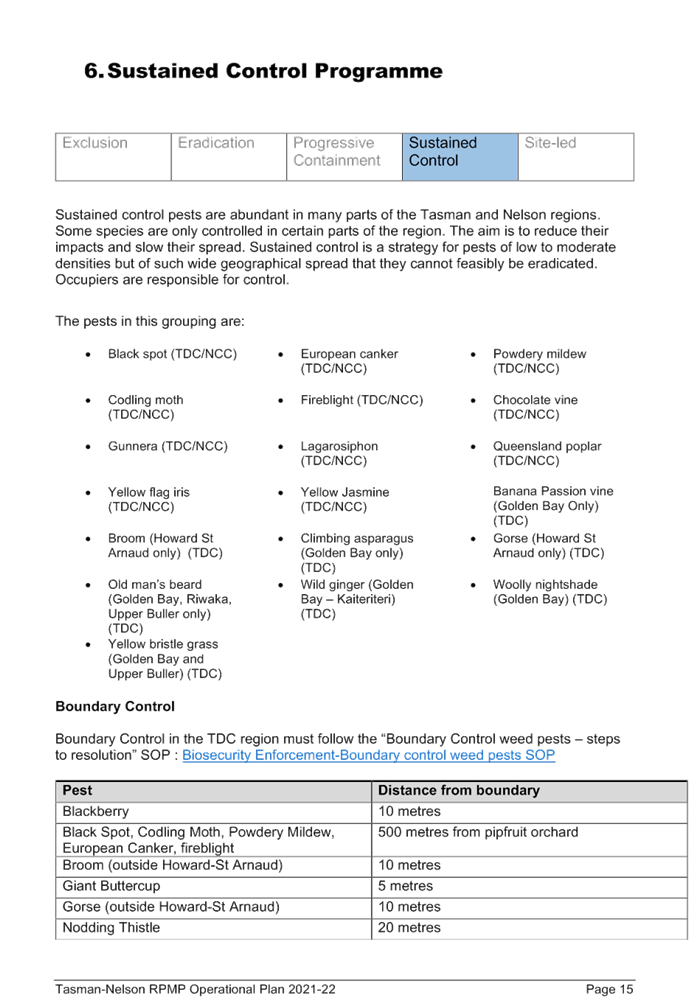
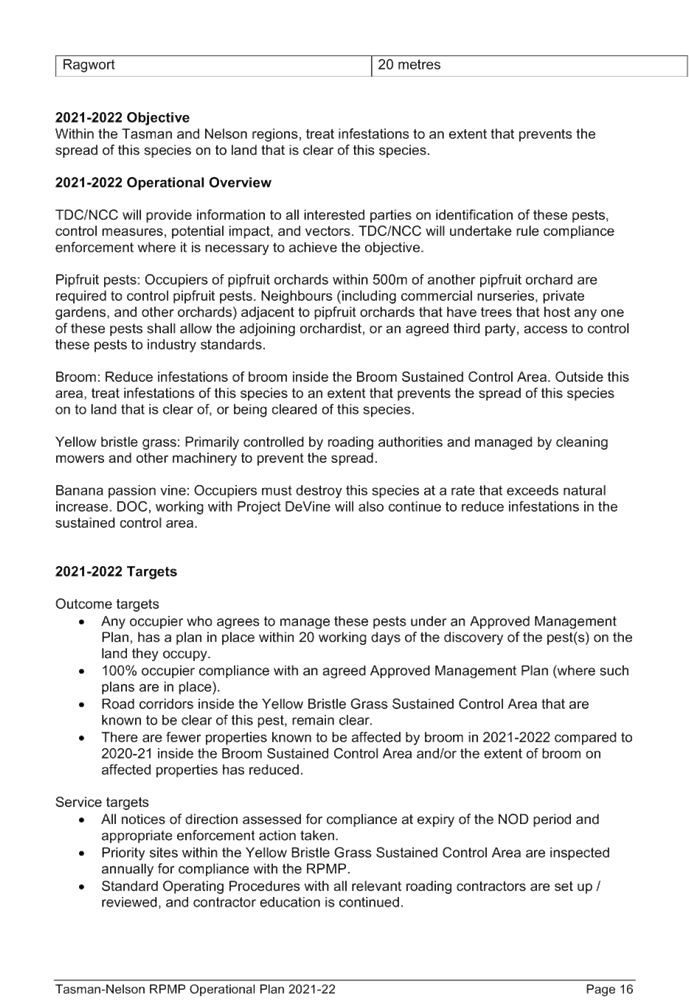
4.9 The
ongoing control of 23 widespread pests to reduce their impact and spread to other
properties continued under the Sustained Control Programme. In most cases progress
toward RPMP outcomes is being made. Measuring the success of pest plants that affect
natural values depends on checking that priority sites remain clear of the pest.
Further work is needed to identify priorities and to set annual performance targets
on those priorities. There have been few (but not nil) instances of reluctant occupiers
who required biosecurity officer persuasion to comply with the RPMP rules.
5.1 The options available to the Council are to accept the review or ask
that it be amended in some way. Staff are happy that the review meets the
best practice expectation and is a fair and reliable report of the work programme.
6.1 Implementation of the Regional Pest Management Strategy through the Operational
Plan aligns with the strategy vision of “Enhancing community wellbeing and
quality of life” by providing a framework for efficient and effective pest
management and making best use of the available resources. The risk of pest incursions
and the spread of species can present environmental and economic challenges for
the Tasman and Nelson community. These risks are appropriately and proportionately
managed through the work done by the Biosecurity staff.
7 Policy
/ Legal Requirements / Plan
7.1 Section 85(1) (b) of the Biosecurity Act 1993 requires the Management
Agency for every pest management strategy to annually review the Operational Plan
and report on its implementation.
8 Consideration
of Financial or Budgetary Implications
8.1 This
activity is already funded within the Council’s Long Term Plan (LTP) and no
additional funding is sought.
9 Significance
and Engagement
9.1 There
will be a low level of public interest in this annual report, as the activity is
only important for those people affected by pests. It will be released following
acceptance so will be available for public inspection.
|
|
Issue
|
Level of Significance
|
Explanation of Assessment
|
|
1.
|
Is there a high level of public interest, or is decision likely
to be controversial?
|
Low
|
The Annual
Report is a statement of accountability and while the activity affects a large
number of landowners, it is not contentious.
|
|
2.
|
Are there impacts on the social, economic, environmental or
cultural aspects of well-being of the community in the present or future?
|
Moderate
|
The delivery of the RPMP positively impacts the environmental
well-being of Tasman. The Operational
Plan identifies programmed work, which falls within budgeted limits. The activity
is important for those people directly concerned with pest weeds and animals.
|
|
3.
|
Is there a significant impact arising from duration of the
effects from the decision?
|
Low
|
This operational Plan is 1 year of the delivery of a 10 year
RPMP.
|
|
4.
|
Does this activity contribute or detract from one of the
goals in the Tasman Climate Action Plan 2019?
|
Goal 2: Tasman District becomes more resilient to the impacts
of climate change
|
Biosecurity activities directly respond to the changing climate,
identifying emerging pest plant and animal issues, and surveillance identifying
changes in our local environment.
|
|
5.
|
Does the decision relate to a strategic asset? (refer Significance
and Engagement Policy for list of strategic assets)
|
Low
|
|
|
6.
|
Does the decision create a substantial change in the level
of service provided by Council?
|
Low
|
This operational Plan is 1 year of the delivery of a 10 year
RPMP.
|
|
7.
|
Does the proposal, activity or decision substantially affect
debt, rates or Council finances in any one year or more of the LTP?
|
Low
|
The RPMP is already funded through the LTP
|
|
8.
|
Does the decision involve the sale of a substantial proportion
or controlling interest in a CCO or CCTO?
|
NA
|
|
|
9.
|
Does the proposal or decision involve entry into a private
sector partnership or contract to carry out the deliver on any Council group of
activities?
|
NA
|
|
|
10.
|
Does the proposal or decision involve Council exiting from
or entering into a group of activities?
|
Low
|
|
|
11.
|
Does the proposal require inclusion of Māori in the decision-making
process (consistent with s81 of the LGA)?
|
Low
|
|
10.1 The
2021-2022 Tasman–Nelson Regional Pest Management Operational Plan has been
reviewed from previous years to reflect the learnings from the first two years of
the new RPMP 2019-2029. The Operational Plans for both Tasman District Council and
Nelson City Council are now combined, and the structure simplified. Targets and
outcomes have been reviewed to include greater recording of surveillance sites and
developing techniques and technology to enable biosecurity officers to better record
and plan their work. This review and re-write included collaboration with Nelson
City Council which has taken more time to complete than originally expected.
10.2 Focus
this year will be on improving the Pest Inspection database, identifying at risk
sites for surveillance, and supporting the delivery of partner agencies (Nelson
City Council and DOC).
10.3 Metrics
in the 2021-2022 Operational Plan have been streamlined and simplified to better
reflect the information available to judge performance with the Plan.
11.1 Continue
to implement the Tasman–Nelson Regional Pest Management Plan Operational Plan
for the 2021-2022 year.
11.2 Consider
if changes to the RPMP related to Taiwan Cherry, wilding pine, and Sabella rules
should be initiated during this year or delayed until further information is available.
|
1.
|
Attachment 1 Report on Tasman-Nelson RPMP Operational Plan 2020-2021
Objectives and Targets
|
50
|
|
2.
|
Attachment 2 Report on Tasman-Nelson RPMP Operational Plan 2020-2021
Objectives and Targets Addendum 1
|
77
|
|
3.
|
Attachment 3 Tasman-Nelson RPMP Operational Plan 2021-2022
|
87
|
Tasman District Council
Regulatory Committee Agenda – 02 December 2021




Tasman District Council Regulatory Committee Agenda – 02
December 2021


Tasman District Council Regulatory Committee Agenda – 02
December 2021




Tasman District Council Regulatory Committee Agenda – 02
December 2021
8.3 Exchange of Unformed Road - 93 Richmond Road Pōhara
Decision Required
|
Report To:
|
Regulatory Committee
|
|
Meeting Date:
|
2 December 2021
|
|
Report Author:
|
Kevin O'Neil, Property
Officer; Robert Cant, Programme Leader - Land & Leases
|
|
Report Number:
|
RRC21-12-3
|
1.1 Kelso
Building Limited of 93 Richmond Road, Pōhara, approached Council staff regarding
three buildings that encroach onto legal road along an unformed southern section
of Richmond Road that runs through their property. Kelso Building Limited is proposing
to stop a section of the unformed road where the three buildings currently encroach
into the road corridor and exchange additional land to vest as road to not only
maintain access along this section of legal road, but to also form a road link to
Bay Vista Drive to the northeast.
1.2 This
proposal is based on an exchange of land for mutual benefit at no cost to the Council.
It will create an improved legal road corridor for the Council with more land vesting
as road than is being stopped. The landowner is planning to subdivide the property
once the road stopping and vesting has been completed.
1.3 The
plans (Plans A, B and C) are noted in Section 12 of this report.
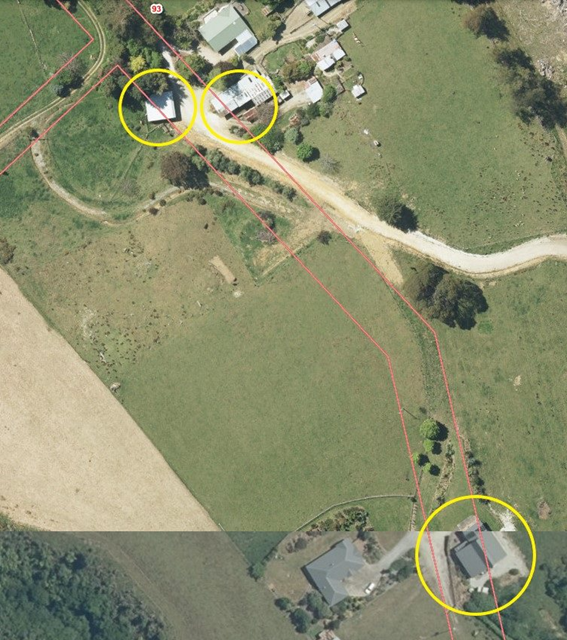
1.4 Plan
“A” shows the existing position of the legal road and the three encroachments
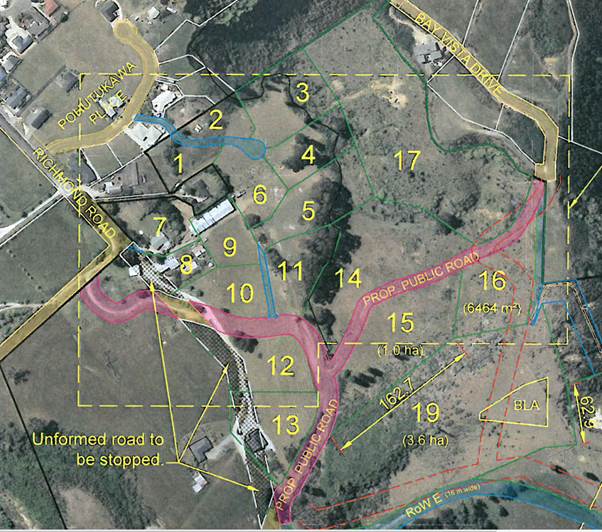
into the road corridor. Plan “B” shows the original proposal with the
road to be stopped bordered in white and hatched in black,
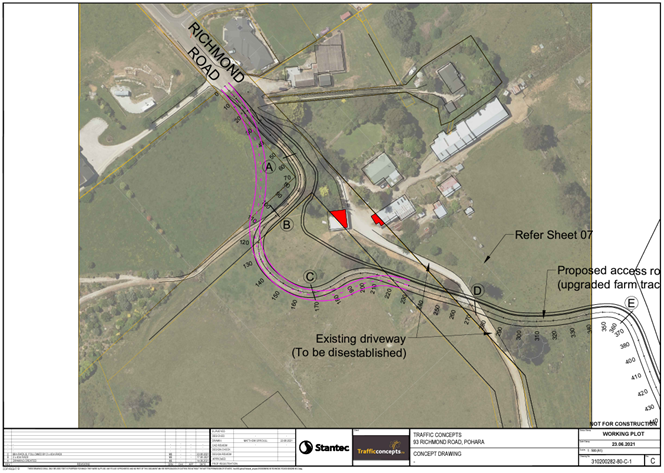
and the proposed land to be exchanged and vested as road shown coloured pink. Plan
“C” shows the most recent roading alignment that has been given approval
as to concept from the Council’s Transportation Manager. The Transportation
Manager was not satisfied with the original proposed roading formation as shown
in Plan “B”.
1.5 The
concept of the road exchange is a routine decision and staff recommend that the
Council approves this exchange. The final decision under the Public Works Act will
be subject to approval by Land Information New Zealand.
1.6 Given
that the fine details of precise locations for the road to vest are not yet finalised,
the Council is asked to delegate the ability to approve all details in relation
to this road exchange to the Transportation Manager.
That the Regulatory Committee:
1. receives
the Exchange of Unformed Road - 93 Richmond Road
Pōhara report RRC21-12-3; and
2. approves the road exchange in principle, and delegates final approval
of the road stopping/exchange proposal to the Transportation Manager once the landowner
has finalised all details regarding the new road to be constructed, subject to the
Minister for Land Information’s approval, of the land parcels shown in pink
on plans “B” and “C”, pursuant to Sections 17 and 114 of
the Public Works Act; and
3. consents under Section 116 of the Public Works Act 1981, subject to the
Minister for Land Information’s approval, to the stopping of the portions
of the legal road shown bordered in white and hatched in black on plan “B”;
and
4. delegates
to the Council’s Transportation Manager the power to undertake all processes,
including the authority to sign all relevant documentation necessary to give effect
to the decision to exchange road land for private land, including the powers in
Section 117 and Section 120 of the Public Works Act 1981 to deal with stopped roads
and complete registration.
3.1 To
gain the Council’s consent to the stopping of unformed legal road adjacent
to 93 Richmond Road, Pōhara under the Public Works Act 1981 and approve the
purchase of land for road from the adjacent landowner. This
is effectively an exchange of road land.
4 Background
and Discussion
4.1 The
concept is best explained with the aid of the plans in section 12 of this report.
On Plan “B” the black hatched area (bordered in white) shows the legal
road proposed to be stopped. The pink coloured areas show the land the developer
proposes to exchange and vest as road. On Plan “C” - the amended roading
plan, the alignment of the road now cuts through a second landowners’ property.
Kelso Building Limited is close to signing a deal to acquire this land so they can
exchange it so the road can be formed in a complying alignment.
4.2 A
significant motivation behind the road exchange is the fact three buildings have
been established outside the property boundary and a significant portion of the
buildings are on legal road. One of these buildings is a substantial one and relocation
or removal would have been an onerous requirement. The developers proposed a road
exchange to enable the buildings to be on private land, with the new road land established
elsewhere.
4.3 The
landowner’s initial new road alignment was not acceptable to the Council’s
Transportation Manager and a revised alignment was subsequently submitted and approved.
This involves a different landowner, which will add complexity to the exchange.
Due to the possibility this may need further modification, it is recommended that
the Council’s Transportation Manager have the delegation to approve the final
design and road exchange and the ability to sign all papers associated with the
exchange. This will avoid the need to bring the matter back to the Council if minor
changes are required.
4.4 All
costs in relation to this transaction will be met by the developer. The land area
of the road to be stopped is significantly less than the area of the land received
in exchange, however the landowner has offered that the road stopping and vesting
will just be a straight swap with no compensation required for the additional land
to be vested as road.
4.5 The
exchange will occur using the Public Works Act which allows the road exchange to
proceed without the need for public notification. The proposal was considered by
the Road Stopping Panel and the Transportation Manager. Staff have also consulted
with the New Zealand Walking Access Commission (NZWAC). NZWAC has confirmed it does
not oppose the road exchange as public access is being maintained. The developer
has liaised with Manawhenua ki Mohua and staff have received confirmation it does
not oppose the exchange.
4.6 The
road exchange has mutual advantage. The developer’s land will benefit from
no longer having three buildings that encroach onto the unformed legal road. The
developer will also have an improved roading link for the future subdivision development.
The Council will benefit from having access along the unformed section of Richmond
Road formed, and the formation of an additional link road from Richmond Road to
Bay Vista Drive. Public access will be enhanced if the exchange proceeds.
5.1 Option
1: Agree to the road exchange. (This is the recommended option).
Pros:
· This will see the unformed
section of Richmond Road formed along with a link road to Bay Vista Drive to the
northeast.
Cons:
· None identified.
5.2 Option
2: Not agree to the road exchange.
Pros:
· None identified.
Cons:
· There will still be three
buildings encroaching into the legal road and the opportunity to resolve this issue
at no cost to the Council will be lost.
6.1 This
is a routine low risk proposal. There is no cost to the Council for allowing the
road exchange to proceed.
7 Policy
/ Legal Requirements / Plan
.7.1 The
Council will acquire the land using the powers of the Public Works Act 1981. This
can be broken down into three key aspects:
7.1.1 Acquire
land for road: The Council has the power to enter into an agreement to acquire land
for public work (in this case road) under Section 17. The Minister for Land Information
may gazette land to be road under Section 114 of the Public Works Act 1981. The
Council must consent under Section 114. In effect, this involves the Council entering
into an agreement with the developer to acquire the land for road and then asking
the Minister to declare the land to be road. The agreement would be conditional
upon the relevant parcels of road being stopped and offered in exchange for the
developer’s land desired for road.
7.1.2 Consent
to road land being stopped: The Council has the power to consent to the stopping
of road under Sections 116 (Stopping Roads). The Minister for Land Information (LINZ)
has the final decision on whether or not to stop the parcels of legal road. In the
unlikely event the Minister declined to stop the road, the acquisition described
in 7.2 would not occur.
7.1.3 Completion
of title raising and subsequent transfer: If the Minister agrees to allow the road
to be stopped and the Council to acquire land for road, the Council will be able
to use Section 117 of the Public Works Act 1981 (dealing with stopped roads) and
Section 120 (registration) to complete the raising of title and subsequent legal
transfer of land ownership to the developer for amalgamation with the adjacent land.
7.2 The
final decision on whether or not to allow the road exchange lies with LINZ who administer
the Public Works Act 1981. It is considered a low risk that LINZ will refuse to
approve the exchange given the benefits from resolving an existing untidy situation
with the legal road.
7.3 This
proposal does not contravene any Council policy or plan.
8 Consideration
of Financial or Budgetary Implications
8.1 The
developer has agreed to cover all costs pertaining to this transaction, so there
are no financial or budgetary implications for the Council arising from this decision.
9 Significance
and Engagement
9.1 There is no requirement to undertake public notice if the Public Works
Act is used to do the road exchange. Given there will be no physical changes to
the road network, this proposal is considered of low significance and does not require
community engagement. It is worth noting that the physical changes to the road network
will occur as a result of the subdivision process, rather than this process.
|
|
Issue
|
Level of Significance
|
Explanation of Assessment
|
|
1.
|
Is there a high level
of public interest, or is decision likely to be controversial?
|
Low
|
The current road is
unformed, and unused. Public access will be improved when the new road land is
formed as part of the subdivision.
|
|
2.
|
Are there impacts
on the social, economic, environmental, or cultural aspects of well-being of the
community in the present or future?
|
Low
|
|
|
3.
|
Is there a significant
impact arising from duration of the effects from the decision?
|
No
|
|
|
4.
|
Does this activity
contribute or detract from one of the goals in the Tasman Climate Action Plan 2019?
|
No
|
The developer has
the right to form the existing road so providing a better alignment has mutual
benefit.
|
|
5.
|
Does the decision
relate to a strategic asset? (refer Significance and Engagement Policy for list
of strategic assets)
|
No
|
The entire road network
is a strategic asset. This proposal will improve the road network.
|
|
6.
|
Does the decision
create a substantial change in the level of service provided by Council?
|
No
|
|
|
7.
|
Does the proposal,
activity or decision substantially affect debt, rates, or Council finances in
any one year or more of the LTP?
|
No
|
The developer is meeting
all costs.
|
|
8.
|
Does the decision
involve the sale of a substantial proportion or controlling interest in a CCO
or CCTO?
|
No
|
|
|
9.
|
Does the proposal
or decision involve entry into a private sector partnership or contract to carry
out the deliver on any Council group of activities?
|
No
|
|
|
10.
|
Does the proposal
or decision involve Council exiting from or entering into a group of activities?
|
No
|
|
|
11.
|
Does the proposal
require inclusion of Māori in the decision-making process (consistent with
s81 of the LGA)?
|
No
|
The landowner consulted
with Manawhenua ki Mohua as there are known sites of cultural significance located
at the property address although Manawhenua ki Mohua confirmed via email that
they have no objection to the proposed road exchange.
|
10.1 The exchange is a technical land exchange, considered to be of mutual
benefit to both the developer and the Council. It allows the legal road to avoid
existing buildings and be more logically matched to the formation. It also allows
the developer’s land boundaries to relate to the physical road more logically.
11.1 If the Council
agrees to the proposal, within the next month staff will enter into a formal agreement
with the developer to proceed with the road exchange. The agreement notes that the
Council cannot guarantee LINZ will agree to allow the exchange.
11.2 After the
agreement is signed, LINZ will be asked to approve the exchange in principle. If
that is approved, the land will be formally surveyed, and LINZ asked to publish
a gazette notice that declares land to be road and stops road for amalgamation with
the developer’s title. This is likely to take several months to conclude.
12.1 93 Richmond Road - Plan A - Shows the
existing position of the legal road and the three encroachments into the road corridor.
12.2 93 Richmond
Road - Plan B - Shows the proposed road to be stopped bordered in white and
hatched in black, and the proposed land to be exchanged and vested as road shown
coloured pink.
12.3 93 Richmond Road - Plan C - Shows the
most recent amended roading alignment that has been given concept approval from
the Council’s Transportation Manager. The Transportation Manager was not satisfied
with the original proposed roading formation shown in Plan “B”.
“A” Aerial Photo Showing 3 Encroachments at 93 Richmond
Road, Pohara
“B” Original Subdivision
Plan Showing Road to Stop and Land to Vest as Road.
“C” Amended Roading Formation to Northern End of Property
– June 2021
Nil
Tasman District Council
Regulatory Committee Agenda – 02 December 2021
8.4 Exchange of Unformed Road - Moutere Highway - Merc
Developments Ltd
Decision Required
|
Report To:
|
Regulatory Committee
|
|
Meeting Date:
|
2 December 2021
|
|
Report Author:
|
Kevin O'Neil, Property
Officer; Robert Cant, Programme Leader - Land & Leases
|
|
Report Number:
|
RRC21-12-4
|
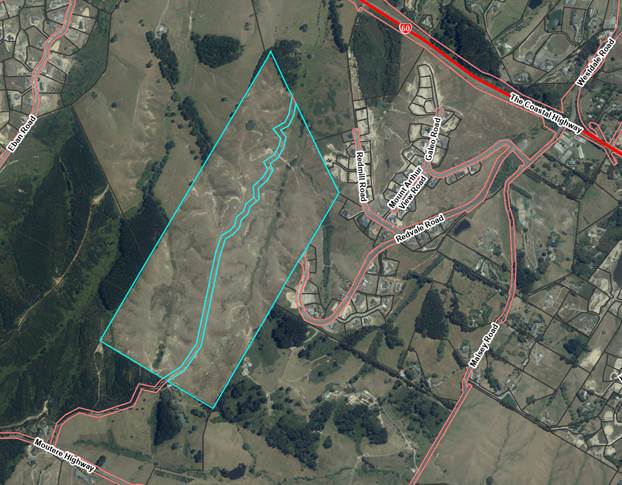
1.1 The
Council was approached by a lawyer acting on behalf of Merc Developments Limited
who are the owners of a 60.8850-hectare block of land located along the Moutere
Highway. Merc Developments Ltd are looking to subdivide their block of land
located between the Moutere Highway and the Coastal Highway in Moutere. There is
currently an unformed legal road that bisects this block and generally runs from
south to north through the property, terminating at the northern boundary of an
adjoining property owned by Tama Asset Holding Company Limited (Ngāti Tama
Ki Te Waipounamu).
1.2 The
landowners are proposing to stop the northern half of the existing legal road (approximately
1.4145ha), and in exchange, vest land for road of approximately 2.1508ha. This will
improve the location of the road corridor and allow for ease of access to the proposed
25 lots to be created by the subdivision. The proposed exchange and vesting of additional
land as road will not only maintain access in this area, but it will improve public
access with the main entry point to the subdivision, being from Redvale Road to
the east, and with the provision of access via a future road to the west. The single
lane gravel road access from the southern end of the block will not be used for
access to the future subdivision, and bollards will be installed so only cyclists
and pedestrians can access the subdivision from the south off Moutere Highway.
1.3 This
proposal is based on an exchange of land for mutual benefit at no cost to the Council.
It will create an improved legal road corridor for the Council with more land vesting
as road than is being stopped. The landowner is planning to subdivide the property
once the road stopping, and vesting has been approved.
1.4 The
plans (Plans A and B) are noted in Section 12 of this report.
1.5 Plan
“A” shows the property as it stands now with the unformed legal road
running through the property from the southern to northern boundaries.
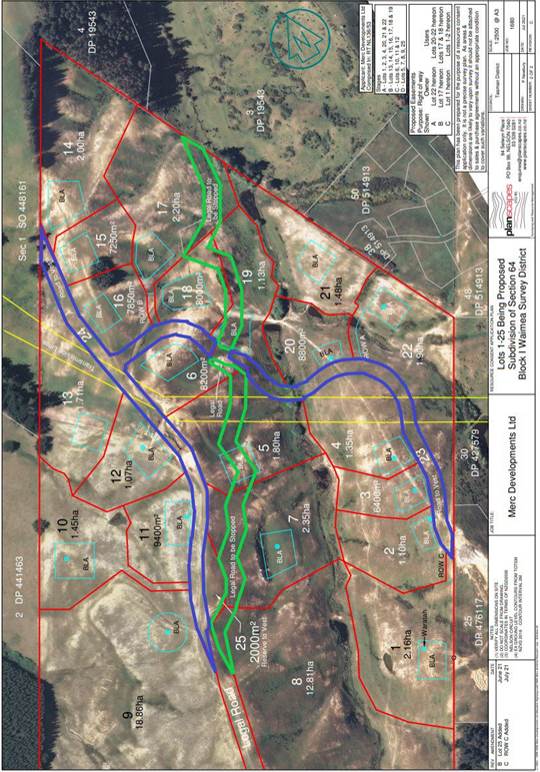
1.6 Plan
“B” is the subdivision plan that shows the location of the unformed
legal road proposed to be stopped (1.4145ha) bordered in green, and the proposed
land to be exchanged and vested as road (2.1508ha) shown bordered in blue.
1.7 This
is a routine decision and staff recommend that the Council approves this exchange,
which will be subject to final approval by Land Information New Zealand.
That the Regulatory Committee:
1. receives the Exchange of Unformed Road - Moutere Highway - Merc Developments Ltd Moutere Highway, Moutere report RRC21-12-4; and
2. approves the road exchange, subject to the Minister for
Land Information’s approval, of the land parcels shown bordered in blue on
plan “B”, pursuant to Sections 17 and 114 of the Public Works Act; and
3. consents under Section 116 of the Public Works Act 1981,
subject to the Minister for Land Information’s approval, to the stopping of
the portions of the legal road shown bordered in green on plan “B”;
and
4. delegates to
the Property Services Manager the power to undertake all processes, including the
authority to sign all relevant documentation necessary to give effect to the decision
to exchange road land for private land, including the powers in Section 117 and
Section 120 of the Public Works Act 1981 to deal with stopped roads and complete
registration.
3.1 To
gain the Council’s consent to the stopping of unformed legal road located
between the Moutere Highway and the Coastal Highway, Moutere under the Public Works
Act 1981, and approve the purchase of land for road. This is effectively an exchange
of road land.
4 Background
and Discussion
4.1 The
concept is best explained with the aid of the plans included in section 12 of this
report. The green bordered areas show the legal road proposed to be stopped. The
blue bordered areas show the land the developer proposes to exchange and vest as
road. All costs in relation to this transaction will be met by the developer.
4.2 The
land area of the road to be stopped is significantly less than the area of the land
received in exchange, however the road stopping and vesting will just be a straight
swap with no compensation required for the additional land to be vested as road.
4.3 The
exchange will occur using the Public Works Act which allows the road exchange to
proceed without the need for public notification. The proposal was considered by
the staff Road Stopping Panel and the Transportation Manager. Staff have also consulted
with the New Zealand Walking Access Commission (NZWAC). NZWAC has confirmed it does
not oppose the road exchange as public access is being maintained and improved.
4.4 The
road exchange has mutual advantage. The developer will have an improved and more
practical roading link for their future subdivision development. The Council will
benefit from having improved access by the new roading alignment that will connect
with future roads to the west and east, rather than have a road that terminates
in the middle of nowhere.
4.5 Ngāti
Tama was asked to comment. Ngāti Tama owns land the road stopping impacts,
as it technically loses road frontage. Ngāti Tama has confirmed that it does
not oppose the stopping of the unformed legal road that runs through Merc Developments
land, as they are confident that they have sufficient access options for their future
subdivision off Stringer Road.
4.6 A
neighbourhood group from the adjacent “Galeo Estates” (Galeo Estate
Residents Association – GERA) has lodged a petition with the Council, objecting
to the Resource Management Act (RMA) application for subdivision on the basis that
the use of Redvale Road being the vehicular route for landowners is inappropriate.
That question is appropriately considered in the RMA process and is not considered
relevant to this road exchange. While the exchange provides a new road linking to
Redvale Road, it does not necessarily lead to that being formed for vehicles. If
the vehicular route from the subdivision was to the Moutere Highway (as the GERA
advocates) the new road link to Redvale Road arising from this exchange would be
of potential benefit as a walking/cycling route.
5.1 Option
1: Agree to the road exchange. (This is the recommended option).
Pros:
· This will see the unformed section of road formed along with link roads
to the west and east (Redvale Road).
Cons:
· None identified.
5.2 Option
2: Not agree to the road exchange.
Pros:
· None identified.
Cons:
· A section of legal road that runs through the landowner’s block
remains unformed.
6.1 This
is a routine low risk proposal. There is no cost to the Council for allowing the
road exchange to proceed.
7 Policy
/ Legal Requirements / Plan
7.1 The Council will acquire the land using the powers in the Public Works
Act 1981. This can be broken down to three key aspects:
7.1.1 Acquire
land for road: The Council has the power to enter into an agreement to acquire land
for a public work (in this case road) under Section 17. The Minister for Land Information
may gazette land to be road under Section 114 of the Public Works Act 1981. The
Council must consent under Section 114. In effect, this involves the Council entering
into an agreement with the developer to acquire the land for road and then asking
the Minister to declare the land to be road. The agreement would be conditional
upon the relevant parcels of road being stopped and offered in exchange for the
developer’s land desired for road.
7.1.2 Consent
to road land being stopped: The Council has the power to consent to the stopping
of road under Sections 116 (Stopping Roads). The Minister for Land Information (LINZ)
has the final decision on whether or not to stop the parcels of legal road. In the
unlikely event the Minister declined to stop the road, the acquisition described
in 7.2 would not occur.
7.1.3 Completion
of title raising and subsequent transfer: If the Minister agrees to allow the road
to be stopped and the Council to acquire land for road, the Council will be able
to use Section 117 of the Public Works Act 1981(dealing with stopped roads) and
Section 120 (registration) to complete the raising of title and subsequent legal
transfer of land ownership to the developer for amalgamation with the adjacent land.
7.2 The
final decision on whether or not to allow the road exchange lies with LINZ, who
administer the Public Works Act 1981. It is considered a low risk that LINZ will
refuse to approve the exchange given the benefits from resolving an existing untidy
situation with the legal road.
7.3 This
proposal does not contravene any policy or plan.
8 Consideration
of Financial or Budgetary Implications
8.1 As mentioned earlier, the developer has agreed to cover all costs pertaining
to this transaction, so there are no financial or budgetary implications arising
from this decision.
9 Significance
and Engagement
9.1 There is no requirement to undertake public notice if the Public Works
Act is used to do the road exchange. Given there will be no physical changes to
the road network, this proposal is considered of low significance and does not require
community engagement. It is worth noting that the physical changes to the road network
will occur as a result of the subdivision process, rather than this process.
|
|
Issue
|
Level of Significance
|
Explanation of Assessment
|
|
1.
|
Is there a high level of public interest, or is decision likely
to be controversial?
|
Low
|
The adjoining established subdivision “Galeo Estate”
resident’s association (GERA) is unhappy that the main point of the entry
to the Merc Developments Limited subdivision will be through Redvale Road, and
they have lodged a petition with the Council as to why the main entry point is
not going to be off the Moutere Highway. While of significant interest to this
group, the wider public are unlikely to consider this a significant issue
|
|
2.
|
Are there impacts on the social, economic, environmental,
or cultural aspects of well-being of the community in the present or future?
|
No
|
|
|
3.
|
Is there a significant impact arising from duration of the
effects from the decision?
|
No
|
|
|
4.
|
Does this activity contribute or detract from one of the
goals in the Tasman Climate Action Plan 2019?
|
No.
|
The developer has the right to form the existing road, so
providing a better alignment has mutual benefit
|
|
5.
|
Does the decision relate to a strategic asset? (refer Significance
and Engagement Policy for list of strategic assets)
|
No
|
The entire road network is a strategic asset. This proposal
will improve the road network.
|
|
6.
|
Does the decision create a substantial change in the level
of service provided by Council?
|
No
|
|
|
7.
|
Does the proposal, activity or decision substantially affect
debt, rates, or Council finances in any one year or more of the LTP?
|
No
|
The developer is meeting all costs.
|
|
8.
|
Does the decision involve the sale of a substantial proportion
or controlling interest in a CCO or CCTO?
|
No
|
|
|
9.
|
Does the proposal or decision involve entry into a private
sector partnership or contract to carry out the deliver on any Council group of
activities?
|
No
|
|
|
10.
|
Does the proposal or decision involve Council exiting from
or entering into a group of activities?
|
No
|
|
|
11.
|
Does the proposal require inclusion of Māori in the decision-making
process (consistent with s81 of the LGA)?
|
No
|
Ngāti Tama confirmed that they are happy with the proposed
road exchange.
|
10.1 The exchange is a technical land exchange, considered to be of mutual
benefit to both the developer and the Council. It allows the legal road to be more
logically matched to the subdivision formation and provides additional access points
to the subdivision.
11.1 Within the next month or two the Council will enter into a formal agreement
with the developer to proceed with the road exchange. The agreement notes that the
Council cannot guarantee LINZ will agree to allow the exchange.
11.2 After the agreement is signed, LINZ will be asked to approve the exchange
in principle.
If that is approved, the land will be formally surveyed, and LINZ asked to publish
a gazette notice that declares land to be road and stops road for amalgamation with
the developer’s title. This is likely to take several months to conclude.
Moutere Highway - Plan
A – Existing block with unformed legal road shown.
Moutere Highway - Plan
B – Subdivision plan showing road to be stopped and land to exchange and
vest as road.
“A” Aerial photo showing existing block with unformed legal road
“B” Aerial photo showing subdivision plan with road to be stopped (bordered
in green) and land to exchange and vest as road (bordered in blue).
Nil
Tasman District Council
Regulatory Committee Agenda – 02 December 2021
8.5 Annual Air Quality Report
Information Only - No Decision Required
|
Report To:
|
Regulatory Committee
|
|
Meeting Date:
|
2 December 2021
|
|
Report Author:
|
Diana Worthy, Senior Policy Planner
|
|
Report Number:
|
RRC21-12-5
|
1.1 The
Annual Air Quality Report is appended to this report (Attachment 1).
It summarises the air quality work programme for the period 1 September 2020 to
31 August 2021, including our compliance with the National Environmental Standard
for Air Quality (NES-AQ).
A summary of the key information contained in the Annual Air Quality Report is set
out below.
1.2 The
Council has a permanent, fixed monitoring station in the Richmond Airshed, measuring
particulate matter (PM10 and PM2.5). The NES-AQ allows
one permissible exceedance per year for PM10 and any exceedance above
this is a breach of the regulations. Over the monitoring period, the Richmond Airshed
had four exceedances of the daily standard for PM10, all during winter
2021. The exceedances were primarily associated with the burning of wood for
home heating. Since 2012, daily PM10 concentrations have fluctuated with
no overall declining trend. Monitoring of PM2.5 also occurred during
the same period. The data shows the Airshed exceeded the 2021 World Health Organisation’s
(WHO) daily guideline value of 15 µg/m3 a total of 63 times.
1.3 The
Council has a winter-time air quality monitoring programme in Motueka and surrounds.
Monitoring of PM10 was undertaken in the Motueka township and no exceedances
were recorded of the PM10 daily standard over the winter period (May-August 2021).
The results of a commissioned air quality monitoring study in Riwaka and Brooklyn
are not yet available but will be reported in due course.
1.4 During
the six-month period from 1 April to 30 September 2021, the Council received 164
air quality related complaints. Of these, 28 complaints related to odour; five were
dust related; nine were discharge of pesticide/herbicide complaints; and 116 complaints
related to smoke.
1.5 The
Council has ongoing research and non-regulatory work programmes. In addition to
the Riwaka/Brooklyn monitoring, technical work this year included assessing the
influence of katabatic winds in the Richmond Airshed, and management options for
the Richmond Airshed. The Council continues to operate the Good Wood scheme alongside
Nelson City Council and provides education and advice through the Council’s
communications and publications. Funding was also provided to Warmer Healthier Homes
Te Tau Ihu Charitable Trust to enable retrofitting of insulation into qualifying
owner-occupied homes in the District. The Council’s
contribution of $20,000, along with other third-party funders, enabled the insulation
of 228 houses in the District over the 2020/2021 financial year.
1.6 Both
the national regulations and international guidance relating to the management of
air quality are going through a significant period of change. At this time
it is unclear how the current NES-AQ review (focusing on PM2.5 and mercury
emissions) will tie in with the wider Resource Management Act 1991 reforms. The
Ministry for the Environment (MfE) will also need to consider the updated 2021 World
Health Organisation guidelines as part of this review. These overall changes may
have significant implications for the management of Tasman’s air resource
going forward. In particular, the requirement to monitor and manage PM2.5 sources
could result in the establishment and targeted management of new airsheds. Additionally,
there will be implications for the management of the Richmond Airshed, particularly
given that it remains polluted under a PM10 monitoring regime.
1.7 The
development of the Aorere ki uta, Aorere ki tai – Tasman Environment Plan
(TEP), our second-generation resource management plan, is underway. Staff are currently
working on ‘issues and options’ for each planning topic. The emerging
national direction will influence the scope and requirements under the ‘discharges
to air’ section of the TEP. While timeframes for the national direction is
currently unclear, MfE is likely to continue to work with iwi, councils and stakeholders
next year. Staff will seek direction from the Council as further details become
known.
That
the Regulatory Committee receives the Annual Air Quality Report RRC-21-12-5.
3.1 This
report summarises the key information set out in the Annual Air Quality Report,
(Attachment 1). That report details the winter 2021 results for air quality
monitoring for particulate matter pollution in the Richmond Airshed and Motueka
township against compliance with the requirements of the Resource Management (National
Environmental Standards for Air Quality) Regulations 2004 (NES-AQ). It also includes
information on the wider air quality work programme undertaken this year including
complaints and enforcement, research, non-regulatory programmes, and ‘discharges
to air’ policy planning.
4 Background and Discussion
4.1 The
Annual Air Quality Report is attached to this report (Attachment 1).
The following paragraphs set out a high-level summary of the contents of that report.
Why is Air Quality Important?
4.2 Good
air quality is fundamental to our wellbeing and is a taonga to be protected, restored
or improved. The presence of contaminants in the air can have adverse health
and nuisance effects on people, property and the environment. Small particles
of pollution are known as particulate matter (PM). They consist of solid and
liquid particles suspended in the air and are usually measured in two sizes:
· PM10 refers
to particles that have a diameter of less than 10 microns (coarse component).
· PM2.5 refers
to particles that have a diameter of less than 2.5 microns (fine component) and
is a subset of PM10.
Legislative Framework
4.3 The National Environmental
Standards for Air Quality (Air Quality NES) are regulations made under the Resource
Management Act 1991 (RMA 1991) which aim to set a guaranteed minimum level of health
protection for all New Zealanders. The NES-AQ came into effect in 2004 and was amended
in 2011. It includes a standard for PM10 for outdoor air quality of 50
µg/m3 (micrograms per cubic metre) over a 24-hour average. The
Air Quality NES does not apply to indoor air quality. The NES-AQ has been under
review for the last couple of years and staff are actively engaging in that process.
4.4 While the NES-AQ
provides a level of health protection from air pollution, the 50 µg/m3
concentration limit for PM10 is not a ‘no-effect’ threshold.
The Council has a regulatory obligation to comply with this limit but achieving
even lower concentrations of particulate matter will ultimately result in improved
health outcomes for the community.
4.5 Several legislative
amendments (nationally and international commitments) are underway which will have
implications for management of discharges to air in our District. These are summarised
in the table below:
|
Legislative
Amendments/Guidelines
|
Summary
|
|
NES-AQ review
|
Focus of the review is on home heating and controlling mercury
emissions to help New Zealand meet its obligations under the Minamata Convention
on Mercury.
|
|
Resource
Management Amendment Act 2020
|
This amendment will enable councils to consider greenhouse gas
emissions when consenting discharges to air, and for councils to have regard to emissions reduction plans
and national adaptation plans when making and amending their resource management
plans.
|
|
Wider RMA 1991 reforms
|
Three new
pieces of legislation are proposed to replace the RMA 1991, including the proposed
Natural and Built Environments Act.
|
|
Maritime
Transport (MARPOL Annex VI) Amendment Bill 2021
|
This Bill
proposes to limit air pollution from ships around ports to align New Zealand’s
legislation with Annex VI of the International Convention for the Prevention of
Pollution from Ships (MARPOL)
|
|
World Health
Organisation’s air quality guidelines (September 2021)
|
After
a systematic review of the accumulated evidence of the significant health impacts
arising from poor air quality, WHO has adjusted almost all its air quality guideline
levels downwards, including those for particulate matter. The Ministry for
the Environment will need to consider these revised guidelines as part of the
Air Quality NES review.
|
Richmond
Airshed Monitoring Results and Analysis
4.6 The
Richmond Airshed is monitored continuously because it exceeds the standard for concentrations
of particulate matter during winter months. It is classified as a polluted
airshed under the NES-AQ and requires targeted management. The key source of pollution
in the airshed is biomass combustion (burning of wood) over the cooler winter months,
primarily associated with home heating.
4.7 The
NES-AQ allows one permissible exceedance per year for PM10 and any exceedance
above this is a breach of the regulations. Over the monitoring period for this report
(1 September 2020 – 31 August 2021), the Richmond Airshed had four exceedances
of the daily standard for PM10 over winter 2021. Figure 1 (over page)
illustrates the number of exceedances recorded per year in the Airshed for PM10
since records began in 2000, and the highest recorded exceedance per year. Since
2012, daily PM10 concentrations have fluctuated with no overall declining
trend.
4.8 Monitoring
of PM2.5 was also undertaken. The data shows the Airshed exceeded the
2021 World Health Organisation’s (WHO) daily guideline value of 15 µg/m3
a total of 63 times. For comparison, based on the 2005 WHO daily guideline
value of 25 µg/m3, the airshed had a total of 24 exceedances which
is consistent with previous years’ results.
Motueka, Riwaka and Brooklyn Air
Quality Monitoring Programme
4.9 The Council has
an air quality monitoring programme to better understand if there are air quality
issues in the Motueka, Riwaka and Brooklyn areas associated with home heating and/or
outdoor rural burning. Temporary monitoring of PM10 was undertaken in
the Motueka township (at Goodman Ledger Park) and no exceedances were recorded of
the PM10 daily standard over the winter period (May-August 2021). The
maximum PM10 recorded in Motueka was 32 µg/m3.
4.10 The Council also commissioned
Mote Ltd to undertake a PM2.5 monitoring programme at four sites in Riwaka
and Brooklyn over winter using ‘dustmote’ air quality monitoring sensors
which are suitable for research purposes. The results of the study are expected
in December, and a full review of the 2021 data for these areas will be completed
and reported following receipt of this work.
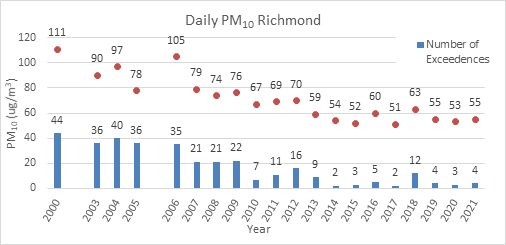
Figure 1: Number of Exceedances
of 24-Hour PM10 for Richmond (2000 to 2021)
Note:
PM10 has been measured in Richmond since 2000, with gaps in the data
for
2001/2002
and continuous monitoring using a BAM from 2006.
Complaints and Enforcement
4.11 During the six-month period
from 1 April to 30 September 2021, the Council received 164 air quality related
complaints. Of these, 28 complaints related to odour; five were dust related; nine
were discharge of pesticide/herbicide complaints; and 116 complaints related to
smoke. This total number of complaints is significantly down on previous years,
where the Council received 338 total air related complaints in 2020, and 208 complaints
in 2019.
4.12 Staff undertook the following
enforcement action during the year relating to non-compliant discharges to air:
five abatement notices, six infringement notices, and 11 warnings. Three outdoor
burns which resulted in serious breaches of the Tasman Resource Management Plan
(TRMP) rules are currently under further investigation.
4.13 Council staff are continuing
to update the home heating records for the Richmond Airshed to ensure compliance
with the TRMP rules. Staff will continue to target non-compliant properties to enable
the owners sufficient time to remediate their situation prior to the 2022 winter.
Research
4.14 The
Council has an ongoing air quality research work programme to help assist our understanding
and management of air quality in the Tasman District. The outputs of this work will
be used to inform the development of the discharges to air section of the Aorere
ki uta, Aorere ki tai – Tasman Environment Pan. Attachment 1 sets out
further details of the following research:
· The University of Canterbury
studied the influenced of ‘katabatic winds’ on dispersion of PM10
in the Richmond Airshed.
· Environet Ltd and the
University of Canterbury modelled a range of management options to reduce particulate
concentrations for the Richmond Airshed, including such as the status quo under
the TRMP rules, allowing the installation of ultra-low emission burners, phase out
of non-NES-AQ approved burners, and behaviour change initiatives.
Non-regulatory Programmes
4.15 Non-regulatory
programmes can play a key role in contributing to a reduction of winter-time air
pollution through a number of often simple actions undertaken by residents and land
managers in our District. Our non-regulatory work includes:
· The Council, working in partnership
with Nelson City Council, operates the voluntary Good Wood scheme which promotes
wood merchants who supply a trusted source of quality firewood.
· Fourteen (14) entries were
received for the ‘Do You Stack Up?’ firewood storage competition.
This is the third year the Council has run this competition and it provides an engaging
way to educate residents of correct firewood storage.
· Warmer Healthier Homes Te
Tau Ihu Charitable Trust (WHH) administers grants to enable retrofitting of insulation
into qualifying households. The Council’s contribution of $20,000, along with
other third-party funders, enabled the insulation of 228 houses in the District
over the 2020/2021 financial year. In May 2021 the Council resolved to provide a
further $60,000 to WHH to be spent over the following three-year period.
· This year staff targeted
improving our air quality social media presence, with a range of seasonal Facebook
posts to promote education and advice in relation to home heating and rural outdoor
burning activities. This was supplemented by Newsline articles and the Council’s
air quality website material, including best practice guides for home heating and
outdoor burning.
Discharges to Air Policy Planning
4.16 Work is underway to develop
the Aorere ki uta, Aorere ki tai – Tasman Environment Plan (TEP), which will
replace the TRMP. This year the Environmental Policy team has been working
on topic-specific ‘issues and options’ papers. The issues identified
for the ‘discharges to air’ topic include smoke from domestic home heating;
outdoor rural burning; agrichemicals; odour, dust and other nuisances; large scale
combustion; and greenhouse gas emissions. Over 2021/2022, staff are preparing these
papers to workshop with Councillors to seek comment on draft recommendations, which
in turn will be consulted on with iwi, stakeholders and the
wider community in 2022.
4.17 In general, the Council is
currently in a good position in relation to our TEP work programme and the wider
RMA 1991 reform. This is because our plan is in its early stages with the development
of background work relating to the identification of issues and options, and progressing
technical work/research, which will all be used to inform the TEP over the next
few years. However, staff recognise that the emerging national direction will influence
the scope and requirements under the ‘discharges to air’ section of
the TEP.
5.1 There
are no options considered as this is an information only report. However,
once the timeframe and contents of the NES=AQ review and wider RMA 1991 reform relative
to the development of the TEP is known, staff will bring options to the Council
to seek direction regarding review of the discharge to air rules.
6.1 The
Richmond Airshed continues to be polluted and is non-compliant with the NES-AQ in
relation to PM10. Both human behaviour in relation to burning and weather
conditions influence the levels of air pollutants and in a worse case year, the
targets are likely to continue to be exceeded.
6.2 There
are implications if the Council continues to exceed the NES-AQ. These may include
adverse reputational effects and the potential for legal challenge on any future
proposed TEP discharge to air rules by interested parties seeking more stringent
or relaxed control of air quality. Tasman also has an ageing population, so the
proportion of population at greatest risk from poor air quality is increasing.
6.3 In
addition, an investigation may be undertaken by MfE for non-complying councils and
an Airshed action plan and/or a progress report to monitor whether councils are
on track to meet the targets may be requested by the Minister for the Environment.
7 Policy / Legal Requirements / Plan
7.1 This
report provides the results of the air quality monitoring undertaken in Richmond
over the winter of 2021, as required by the NES-AQ and Section 35 of the Resource
Management Act. The Richmond Airshed is non-compliant with the Air Quality NES.
7.2 As
previously noted, staff have been implementing a work programme to develop an evidence
base through monitoring and research, which will ensure a robust review of the discharges
to air rules as part of development of the TEP.
7.3 These
national legislative changes and international guidelines have the potential to
have significant implications for the management of Tasman’s air resource.
The requirement to monitor and manage PM2.5 sources could result in the establishment
and targeted management of new Airsheds. Additionally, there will be implications
for the management of the Richmond Airshed, particularly given that it remains polluted
under a PM10 monitoring regime.
7.4 The development of the Aorere ki uta, Aorere ki tai –
Tasman Environment Plan (TEP), our second-generation resource management plan, is
underway. Staff are currently working on ‘issues and options’ for each
planning topic. The emerging national direction will influence the scope and
requirements under the ‘discharges to air’ section. While timeframes
for the national direction is currently unclear, it is expected that MfE will continue
to work with iwi, councils and stakeholders next year. Staff will seek direction
from the Council as further details become known.
8 Consideration of Financial or Budgetary Implications
8.1 Through
the 2021-2031 Long Term Plan there are budgets in place to enable a more proactive
and strategic air quality work programme. This funding will enable further research
and monitoring to meet our requirements under the NES-AQ in relation to PM10
over the next 10 years. Staff have also made best use of grants through MBIE’s
Envirolink funding programme to commission research work from the University of
Canterbury and Environet Ltd.
8.2 It
is likely that the outcome of the NES-AQ review will have implications on the air
quality budget if additional monitoring for PM2.5 is required for compliance
purposes. Budget could also be required to provide sufficient resources to
enable the implementation of a more targeted non-regulatory work programme to reduce
emissions.
9 Significance and Engagement
9.1 At
this stage while there is high public interest in air quality, the receipt of this
report is of low significance and no public consultation is required, although the
monitoring results are publicly available.
10.1 There
were four exceedances of the NES-AQ for daily PM10 of 50 µg/m3
for particulate matter over the winter of 2021. The Richmond Airshed is non-compliant
with the NES-AQ and is therefore classified as a ‘polluted’ airshed.
Since 2012, daily PM10 concentrations have fluctuated with no overall declining
trend. The implications of this is that no further discharge consents can be granted
that would make this situation worse.
10.2 There
have been approximately 164 air quality complaints for the winter of 2021, largely
relating to smoke complaints.
10.3 Staff
have also been implementing a work programme to develop an evidence base through
monitoring and research, which will ensure a robust review of the discharges to
air rules as part of development of the TEP. Our non-regulatory work programme is
ongoing to promote education and advice.
10.4 The
NES-AQ is currently under review and staff have been engaging in this process, along
with the wider RMA 1991 reforms. Staff will seek direction from the Council as further
details become known.
|
1.
|
Attachment 1 Annual Air Quality Report - 1 Sept 2020 to 31 Aug
2021
|
136
|
Tasman District Council
Regulatory Committee Agenda – 02 December 2021

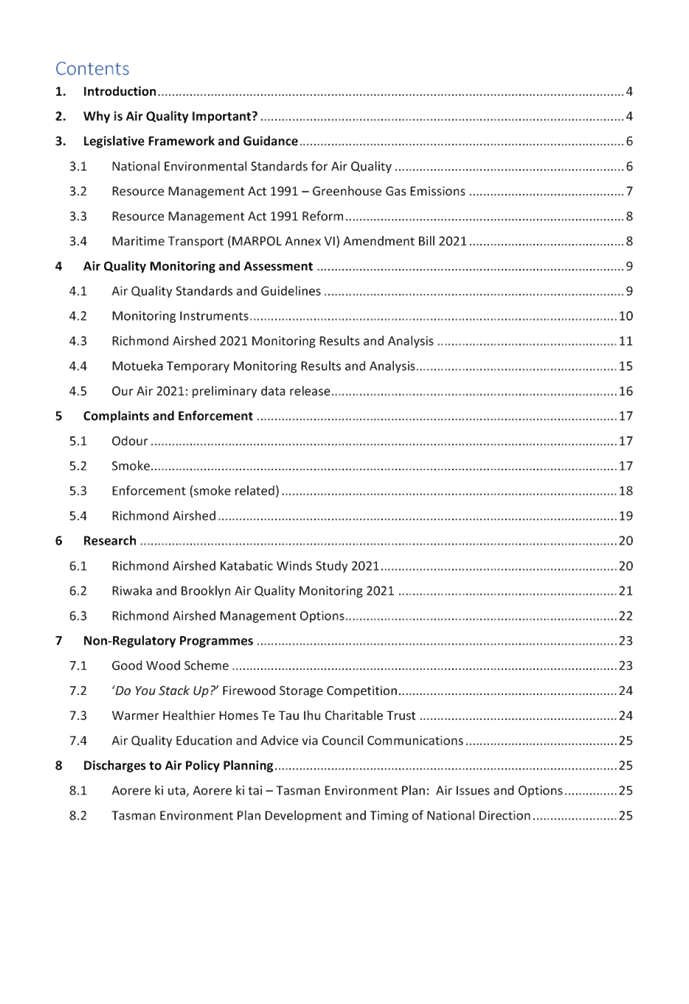
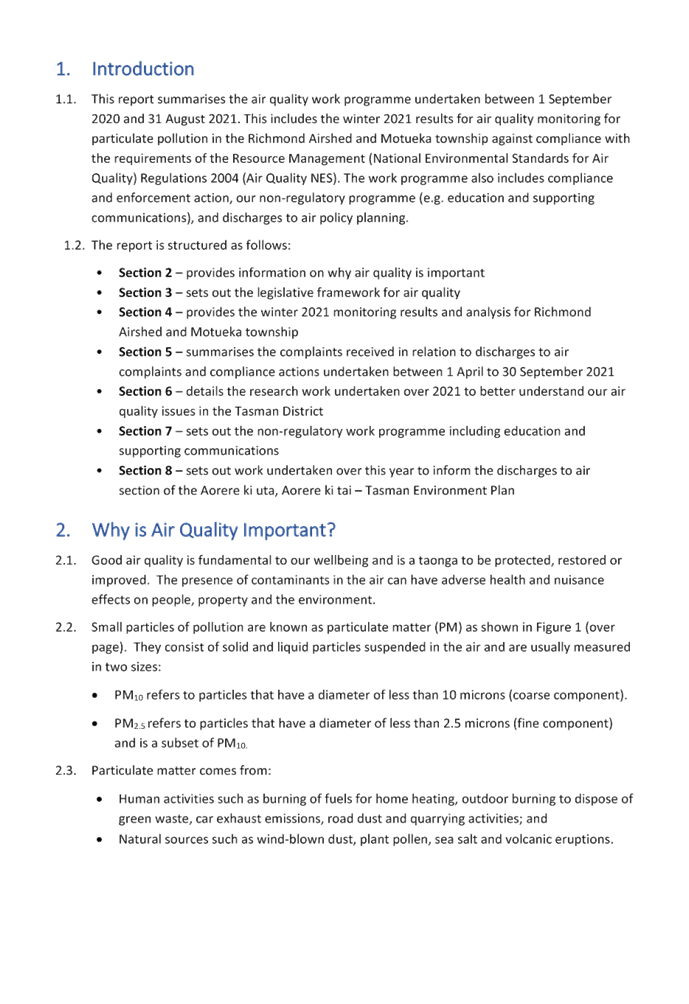
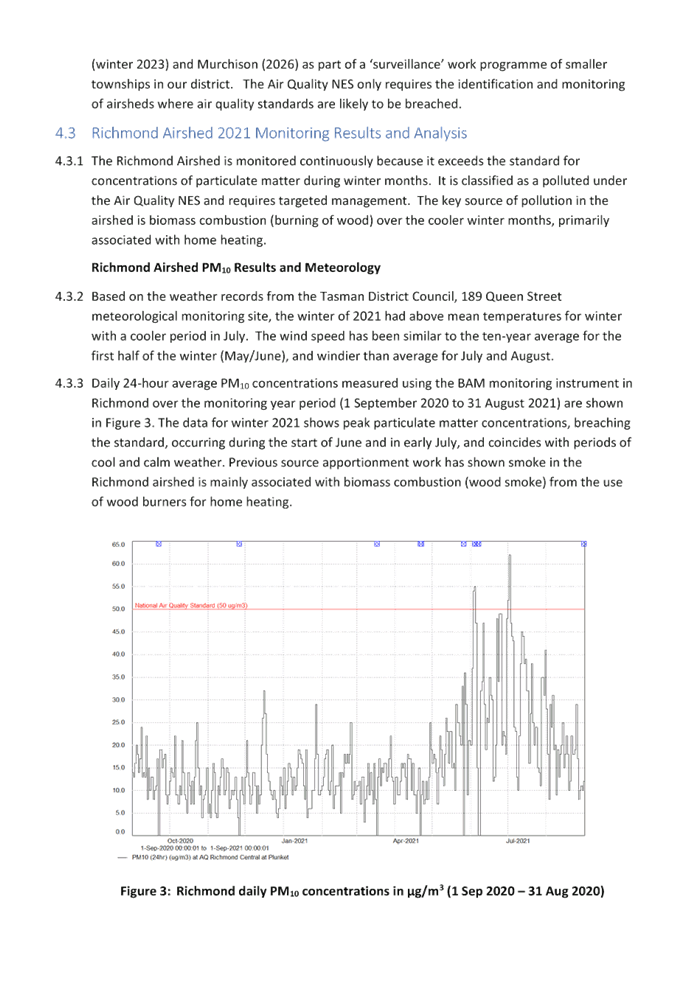
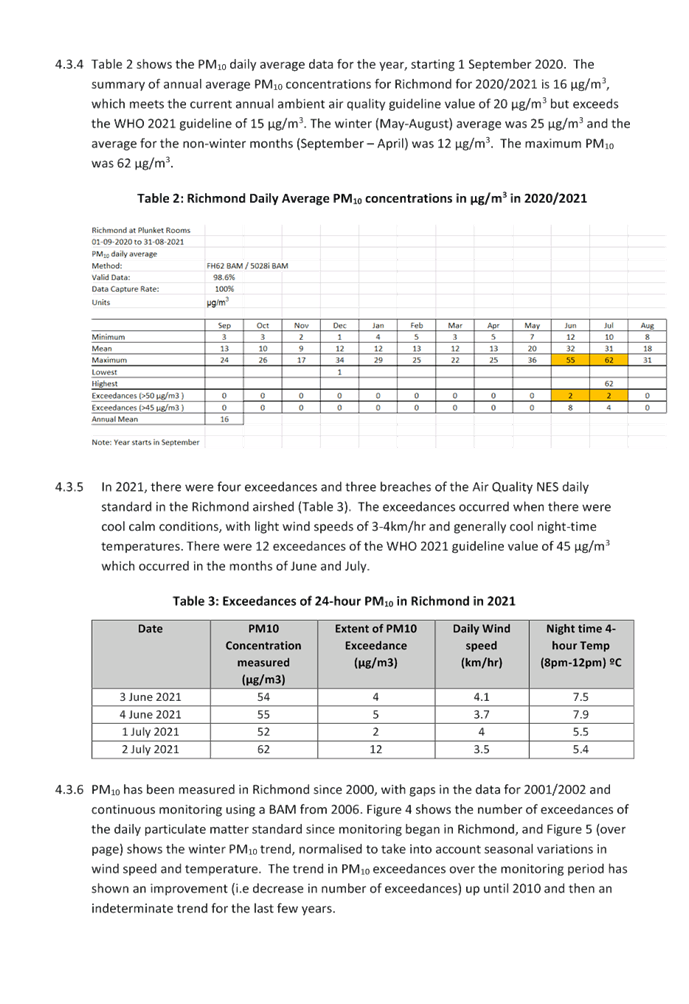
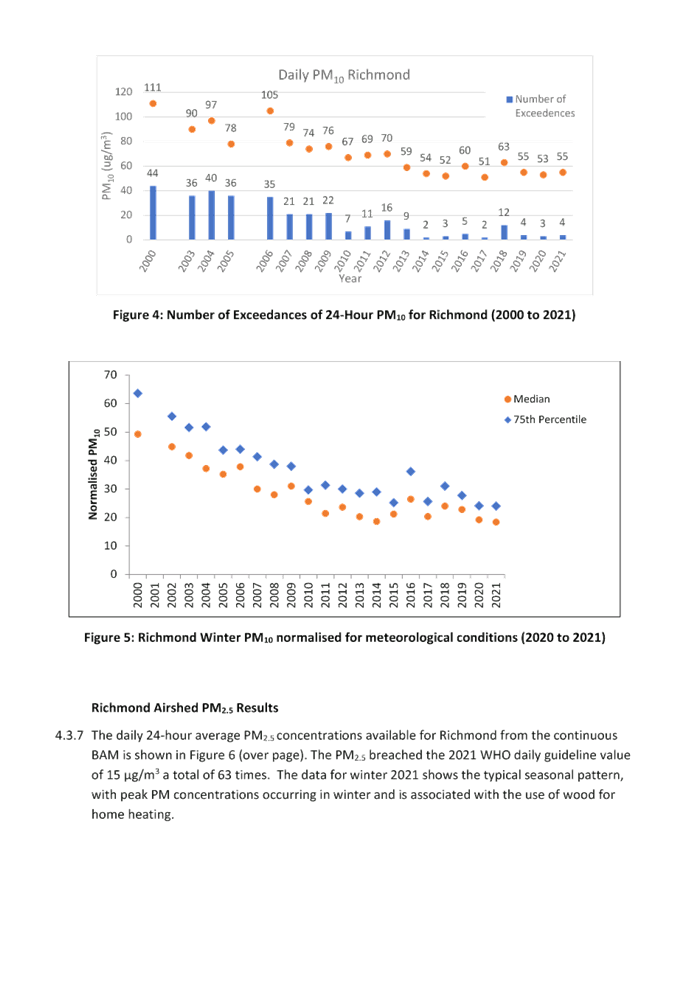
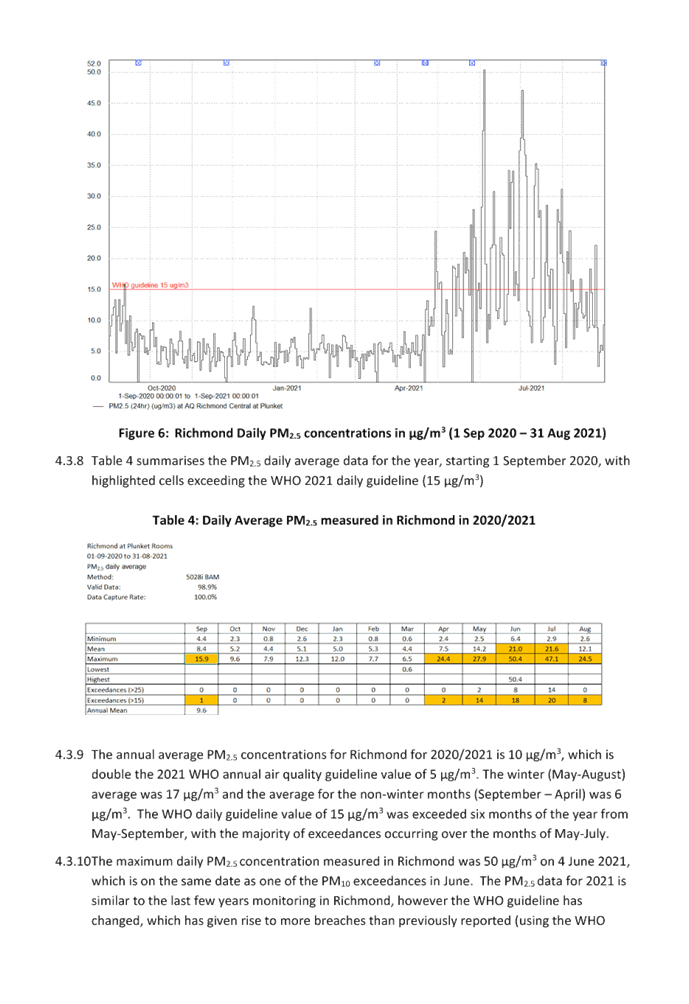
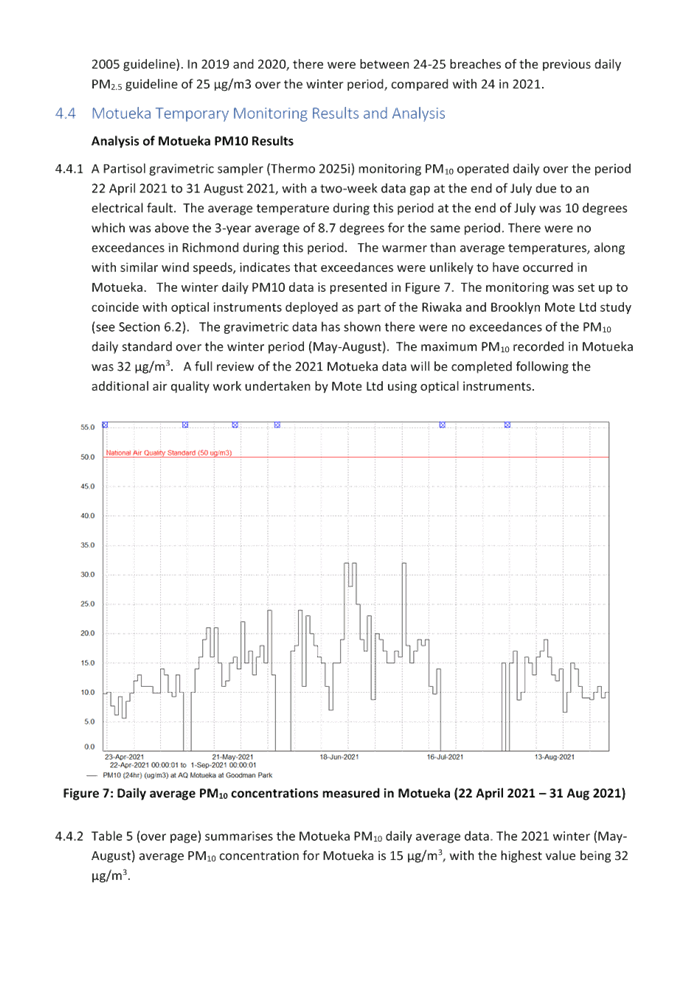
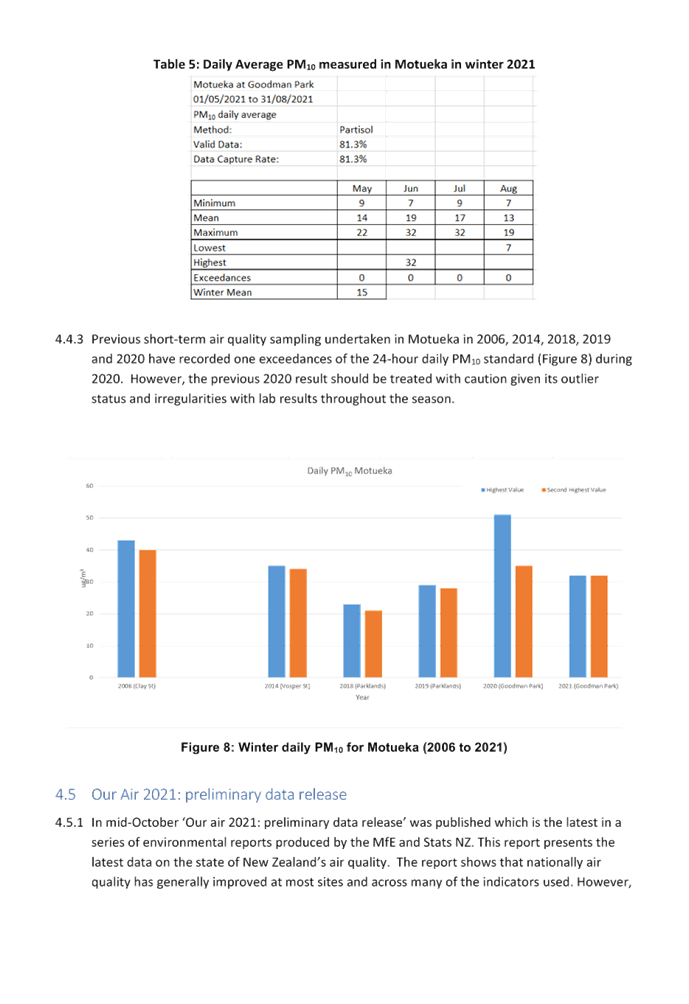
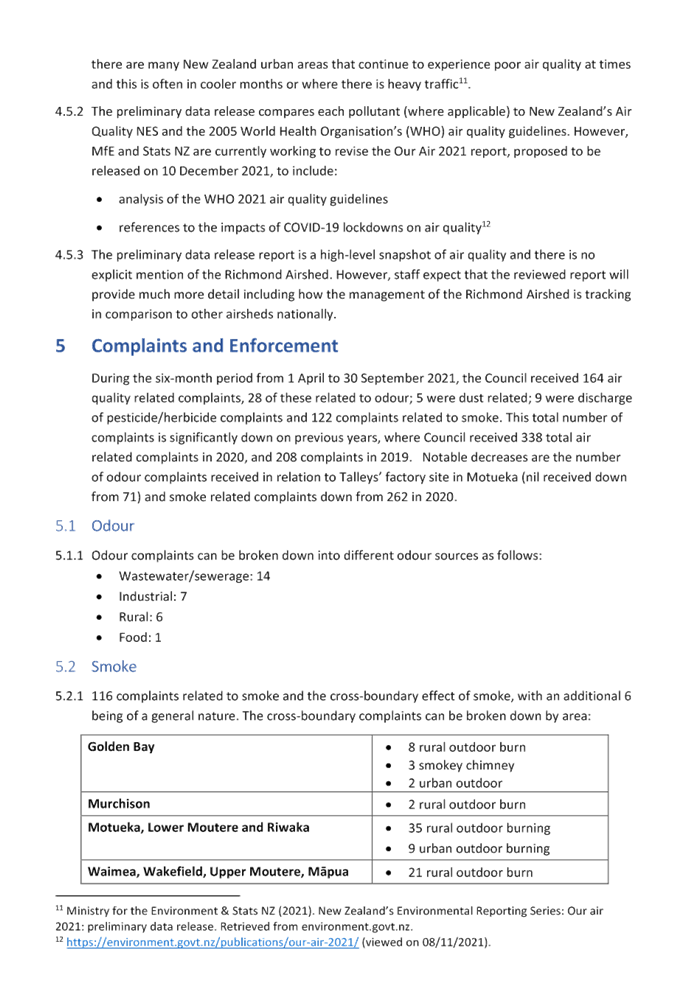
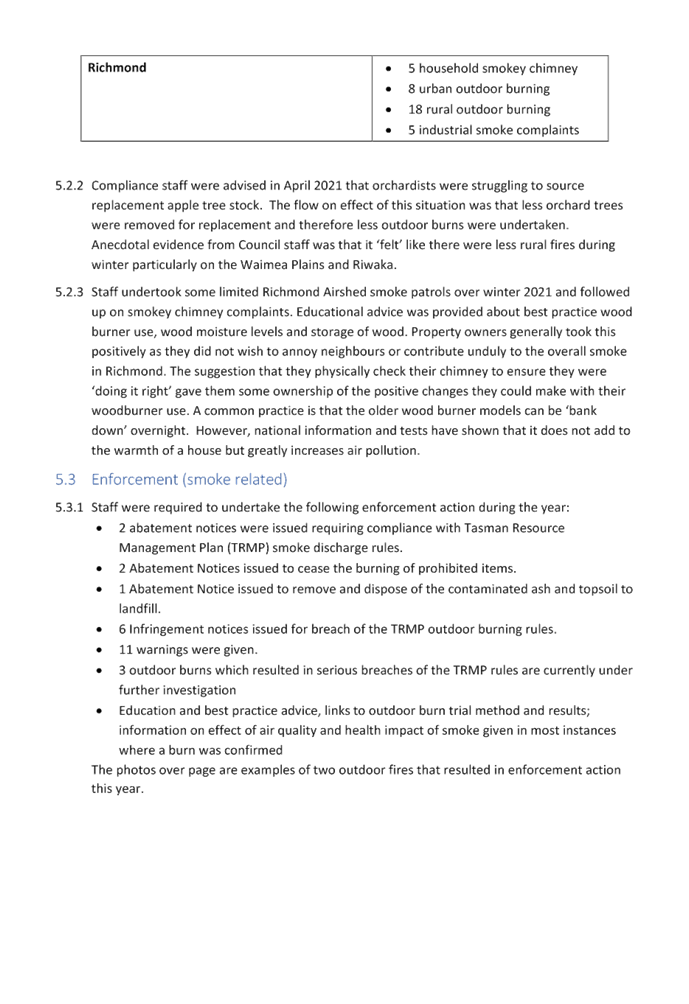
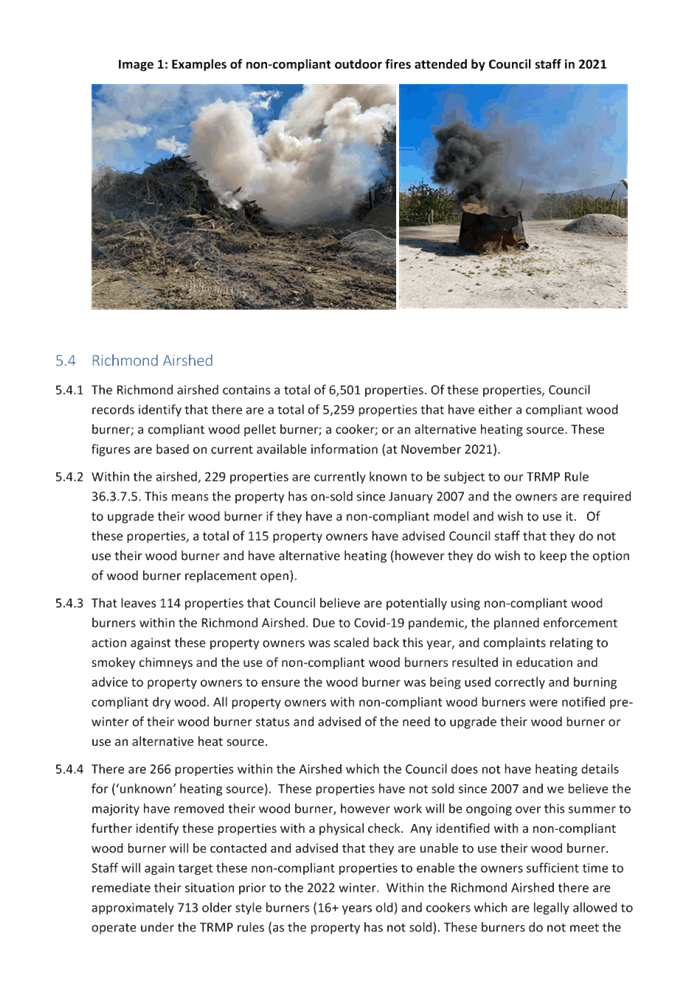
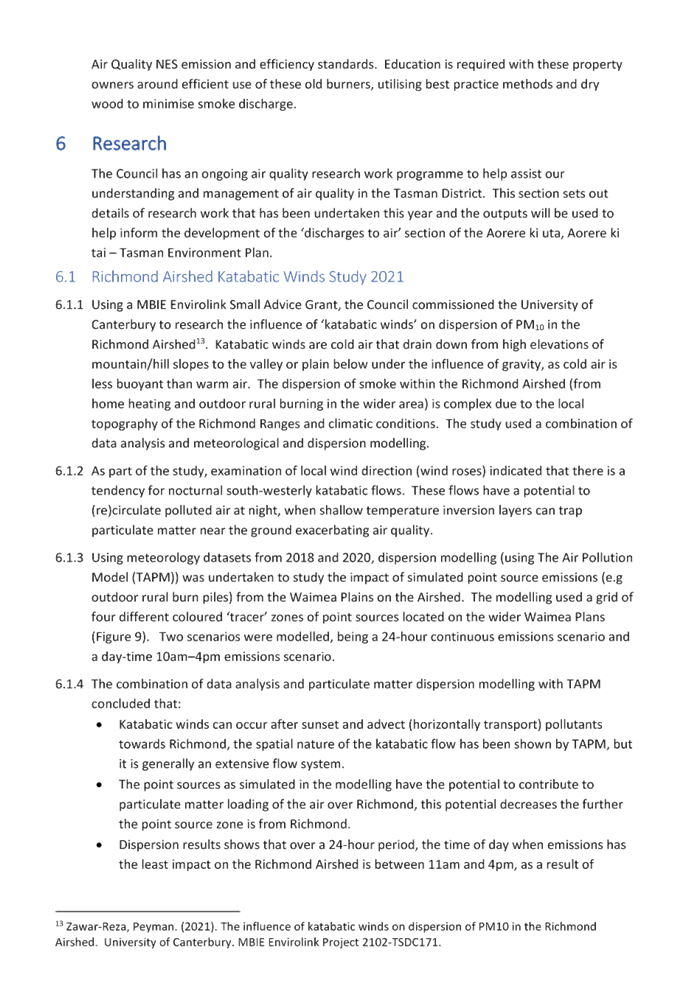
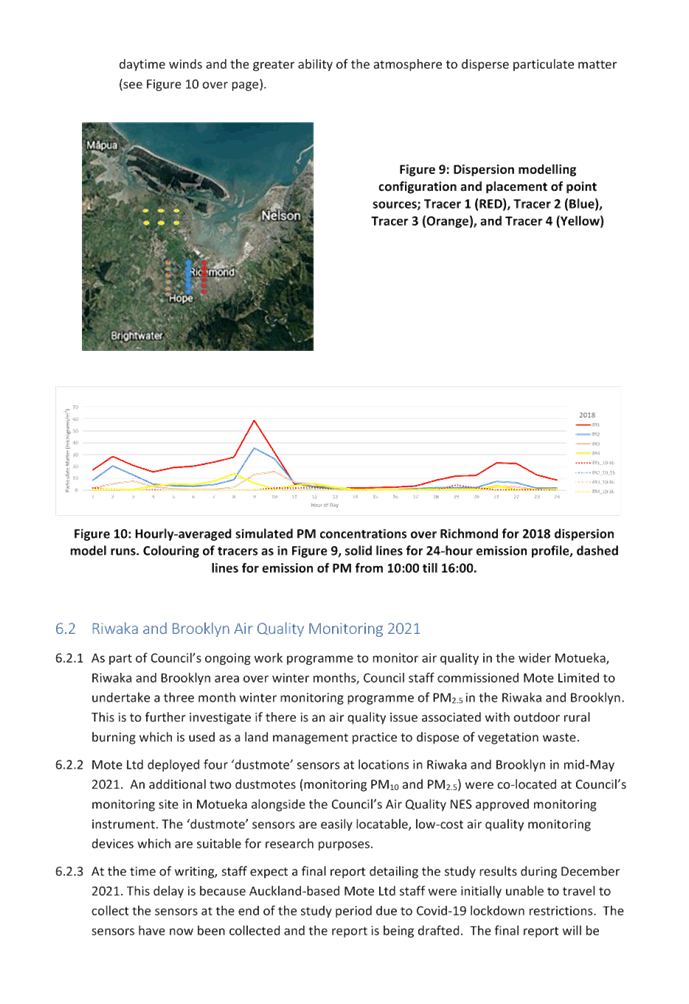
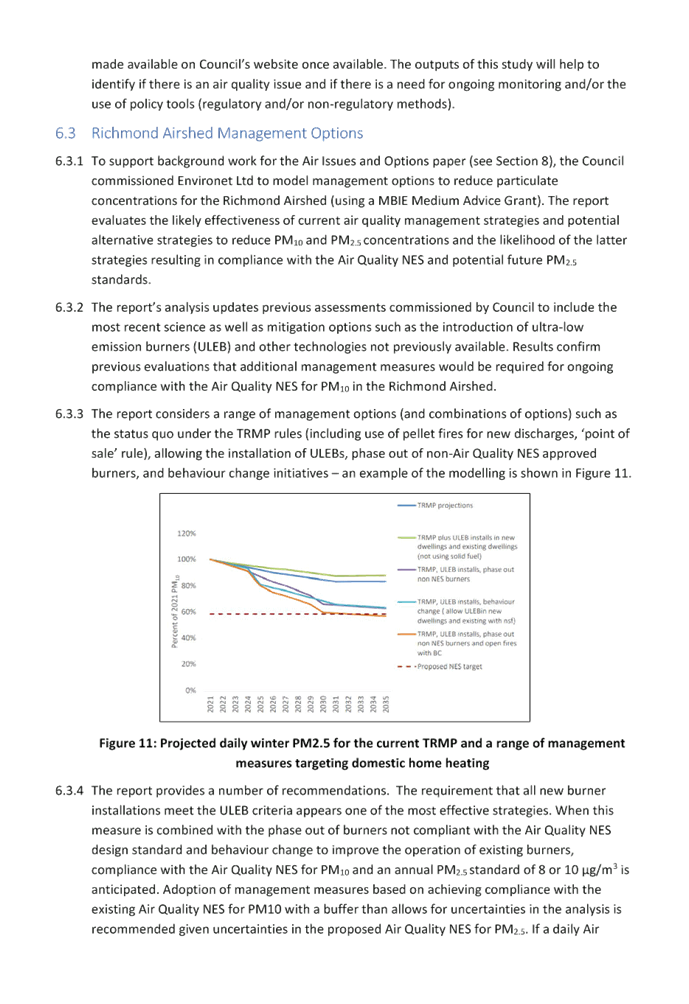
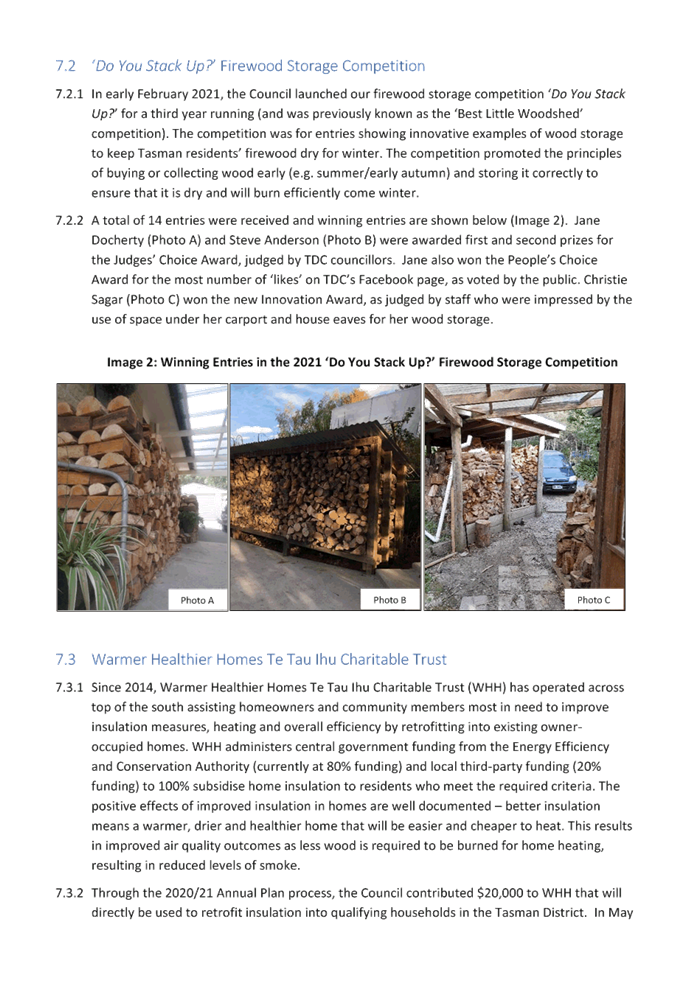
Tasman District Council Regulatory Committee Agenda – 02
December 2021
8.6 Building Assurance Manager's Report
Information Only - No Decision Required
|
Report To:
|
Regulatory Committee
|
|
Meeting Date:
|
2 December 2021
|
|
Report Author:
|
Ian McCauley, Building Assurance
Manager
|
|
Report Number:
|
RRC21-12-6
|
1.1 This
information report updates the Committee on activities of the Building Assurance
section over the six-month period since the last report issued 6 May 2021.
1.2 Tasman District Council is legally required under the Building Act 2004
to perform the functions of a Building Consent Authority and must maintain Accreditation
under the Building Regulations 2006. The IANZ Audit on the building consents team
in late October was a very good result with minor issues to resolve for re-accreditation.
1.3 The
last six months have not shown any slowdown in building consent applications, and
we are on track to meet or exceed our 12-month forecast. There have been significant
staff challenges particularly in the building support and consent processing teams
with the loss of experienced staff and constant renewed training demands for the
replacements to meet our service obligations. However, some staff within the team,
seeking career progression opportunities have successfully moved into technical
roles and this has been a positive change, although the backfilling has been particularly
demanding on the building support team.
1.4 In
March 2020 MBIE conducted an audit of the territorial authority functions under
the Building Act, focusing specifically on Pool inspection obligations and Building
Warrants of Fitness (BWOF’s). The audit highlighted some shortcomings and
required a detailed strategy to work toward better compliance. As Council is aware,
we have diverted resources to improve pool compliance. This has meant other
compliance workstreams have fallen behind. Progress reports to MBIE will continue
until we stabilise, and we are on track with the strategy to achieve this.
1.5 The
team is functioning well and although having suffered setbacks with resignations
of experienced officers meaning higher workload demands, the replacements are highly
motivated, and the team morale is good.
That
the Regulatory Committee receives the Building Assurance Manager's Report RRC-21-12-6.
3.1 This report informs the Council of the activities of the Building Assurance
Section since the last report issued on 6 May 2021.
4 Building
Control Functions and Delivery
Regulation 18 Diploma
4.1 The
building consent processors and inspectors undertaking the Diploma in Building Surveying
completed their last assignments this month with the overall results expected in
late December. They have all invested a significant amount of their own time to
complete the level-6 Diploma and this has been very demanding while carrying out
their processing and inspection duties. Their dedication, perseverance and assistance
given to each other during this demanding work has been commendable.
4.2 Service
delivery has been maintained at 99% within statutory timeframes both for building
consents and code compliance certificates, as well as achieving our Activity Management
Plan Performance measures. Details can be seen in the statistical summary in this
report.
4.3 A
multi-proof consent was issued for the Golden Bay affordable homes project with
the purpose to allow for more efficient processing of the same design. Two further
applications have been issued under this method of consenting. There is another
multi-proof application in the system, however, the progress for these have been
slower than we had hoped.
Stakeholder engagement
4.4 Interaction
with stakeholders, which includes regular face-to-face meetings, were postponed
due to lockdown. Meanwhile, our quarterly Building Assurance report informs our
key customers of important updates, legislation changes, and any other relevant
matters. These reports have been well commended and are valuable in keeping our
customers aligned with important process changes, expectations, and issues they
need to be aware of.
5 Compliance
Team Function and Service Delivery
5.1 The Compliance section of Building Assurance undertake all the territorial
authority responsibilities under the Building Act other than those functions of
the building consents team, and include the following:
· Inspections of Pool Fencing
· Processing Building Warrants
of Fitness (BWOF)
· Audits of BWOF’s
· Processing building consent
exemptions
· Processing Certificates
of Acceptance (COA’s)
· Complaints
· Compliance Investigation/
Enforcement
· Issuing Notices (NTF,
Dangerous and Insanitary, Infringement, CPU etc.)
Status and work of the Compliance Team
5.2 The
Committee may recall the Building Assurance report in May this year noting that
the compliance team positions became vacant after its staff moved into other roles
within Building Assurance, and the team leader had resigned.
5.3 This
meant that replacement staff required significant training for the various tasks.
However, our immediate urgency was and is, the backlog of pool fencing and BWoF’s
that were also highlighted in the MBIE T/A audit undertaken in May 2020.
5.4 The
strategy to regain a stable position on both these functions included the appointment
of a fixed term specialist administration officer.
5.5 We
have achieved good results and are on track to inspect all pools on our register
by the end of the year. The report chart below is generated weekly, monitored for
progress and any adjustments made to workflows as deemed necessary.
5.6 The
Committee will note that the report includes Building Warrant of Fitness data. It
was a requirement to amend compliance schedules to reflect some legal changes made
to these in 2013. Tasman District Council has approximately 600 BWoF’s and
we are halfway now to achieving the required amendments.
5.7 A
‘Specified System’ is the term used to describe a special feature (system)
required to be installed in buildings to ensure that the people who use buildings
can do so safely. This includes, escaping out of a building safely if it is on fire;
healthy air supply; drinking water supply protected. Mechanical air conditioning;
fire alarm systems; backflow prevention devices etc. are all part of what is called
a ‘Compliance Schedule.’
5.8 The
BWOF is the owners legal statement provided annually to the Council which confirms
that the systems contained on the ‘Compliance Schedule’ have been checked
and maintained during the previous 12 months.
5.9 The
compliance team is also required by MBIE to undertake BWOF audits within our district
commensurate with the risk/use of the building and safety systems installed.
5.10 Although
building consent exemptions and certificates of acceptance (COA) processing are
stable, we are looking forward to focusing attention across these and other compliance
tasks after we stabilise pool inspections and BWOF’s. The intention is to
audit and review these processes to gain the same level of efficiency that has been
successfully applied to pools and BWOF’s.
5.11 The chart
below shows the dedicated attention the compliance team are giving to pool fencing
and BWOF’s. Once we have caught up, we will organise the pool inspections
to be spaced out and maintained in a consistent and regular manner.
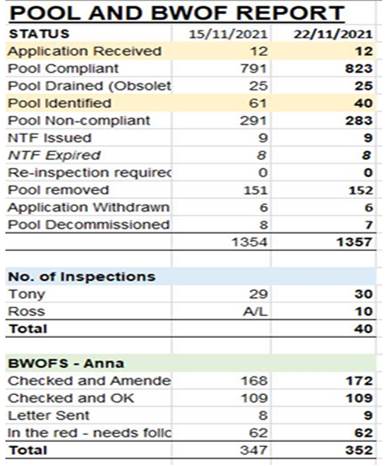
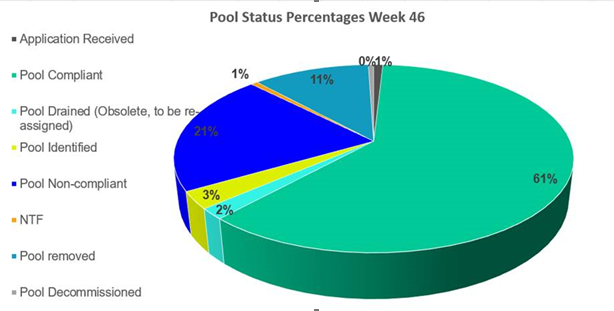
6 Determinations/
Practitioner Complaints
6.1 MBIE
Determinations. Determination applications to MBIE are prescribed in the Building
Act and intended to be a cost-effective way to help resolve disputes that occasionally
occur about Regulatory decisions we make. There is a 15-day opportunity to appeal
to the District Court if any party disagrees with a final Determination decision.
The decision of the district court appeal on the matter is final.
6.2 We
currently have six determinations most of which are long overdue for finalising
by MBIE.
6.3 Two
relate to pool fencing compliance, three to design issues and one to noncompliance
with the building consent.
6.4 A
Practitioner complaint was formally lodged with ENGNZ against two Chartered
Professional Engineers and accepted for independent expert technical review and
mediation. This is to be treated confidentially until resolved. We consider
we have a responsibility to the sector and the public to hold professional practitioners
to account and will do this when we consider it is required.
7.1 Comparative
statistics are shown by the following three columns in the table below.
The comparisons are three 12-month periods between 1 November to 31 October.
7.2 The numbers under ‘Building Consents Issued’ will
rise sharply before the end of year with over 100 subdivided lots at the Lower Queen
Street development ready for new dwellings. These were delayed in submitting due
to subdivision issues however, our stakeholders have advised that most of these
are now ready to lodge.
7.3 Seventy-five of these applications are starting to be submitted now at
Section 224 stage (prior to title) and we have developed a conditional process for
this work to manage the risk (pre-title) which we consider to be low. The difference
in the recent StatsNZ figure for new dwellings is due to the different 12-month
reporting period. We are tracking to again exceed our last year's new dwellings
figures for the same period.
7.4 The
BCA has maintained its statutory timeframes for both issuing building consents and
code compliance certificates among the highest in the country at 99%. The average
days for issuing these are also at 11 for consents and five for CCC’s, which
is also meeting our Activity Management Plan performance measures.
7.5 The
‘failed inspections’ at 67% are not a reflection of poor building work
but rather the document management tracking system which requires a ‘fail’
to record missing documentation. Inspection blocks are placed if any missing documentation
is necessary for a compliance decision. These figures show our building inspectors
are using the system as intended which ensures efficient and effective management
toward code compliance certificate. Our key customers understand this procedure
well and are content because we have met with them and explained the reasons.
|
Building Assurance Results
|
1 November 2018 - 31 October 2019
|
1 November 2019 - 31 October 2020
|
1 November 2020- 31 October 2021
|
|
Building Consents Issued
|
1407
|
1453
|
1429
|
|
New Dwelling Consents Issued
(excluding Amendments)
|
480
|
567
|
515
|
|
Average Processing Days
|
12
|
12
|
11
|
|
Building Consents Processed
within time %
|
96%
|
97%
|
99%
|
|
CCC Applications
|
1176
|
1048
|
1267
|
|
CCC Issued
|
1046
|
1105
|
1255
|
|
CCC Issued within time %
|
99%
|
99%
|
99%
|
|
CCC Average Processing days
|
0.9
|
3
|
5
|
|
Inspections
|
7518
|
7615
|
8255
|
|
Failed Inspections %
|
40%
|
53%
|
67%
|
8 Resourcing
Considerations
8.1 During
2021, and within the last six months, the BCA unfortunately lost some experienced
technical processors. This put significant constraints on the team because they
were fully competent, productive processors. While we are very pleased to have filled
these positions, the training and supervision requirements before the new staff
begin to be productive is intensive and demanding for between 6-12 months.
8.2 We
are meanwhile pleased to have reliable contracts in place to assist as required
until we build up our internal capacity again.
8.3 Although
the constraints are significant due to the new processing staff, the team is managing
well and despite their regular assignments for their Building Surveyor Diploma throughout
the year, we maintained good performance statistics. The inspections team is fully
resourced and stable.
9.1 Building
assurance risks have been assessed and added to the Council’s risk register.
Consequences and controls have been listed and categorised. Building Assurance’s
main risk mitigation continues to be ensuring that all technical staff are competent
to assess building consent applications and issue only when compliance with the
building code is demonstrated. Inspectors must in turn only issue Code Compliance
certificates when the building work is completed in accordance with the building
consent.
9.2 IANZ
accreditation helps provide the Council with a level of assurance that our Quality
Management System (QMS) is working. This QMS includes training toward competence,
evidence of effectiveness of training, internal audits and continuous improvement
which all assist in mitigating risk to the Council. The IANZ audit result completed
earlier this month has confirmed in the report that the building consent authority
functions continue to present a low risk to the Council.
10 Tasman
District Council BCA Accreditation Audit
10.1 International
Accreditation NZ (IANZ) undertook its biannual audit which ran over a five-day period
concluding on Tuesday, 2 November. This Audit is required to measure the performance
and compliance of the BCA functions against the Building Regulations 2006.
10.2 The
Auditors were generally complimentary of the work of the BCA and particularly commented
that our statutory timeframes were amongst the best in the country. They recognised
this was achieved despite considerable constraints imposed such as eight technical
staff undergoing Diploma training, loss of some key staff and consistently high
consent application numbers.
10.3 The
summary below is taken from the IANZ report.
RISK ASSESSMENT
‘The BCA’s risk, both to the Territorial Authority,
as a BCA and also as an organisation accredited by IANZ was assessed. The BCA was
considered to pose a Low Risk. The main reasons for considering this risk category
were:
· A relatively low number of GNCs were raised
during the assessment.
· The GNCs raised were generally minor in nature.
· There were no major concerns regarding the BCA’s
technical output.
· The BCA had been generally compliant with accreditation
requirements since the last assessment.
· The BCA appeared to have a stable management
team.’
10.4 Of
the 14 ‘General Noncompliance’ (GNC’s) received:
· Four (4) were cleared on site.
The remaining 10 GNC’s were as follows:
· Three (3) related to external
contracts.
· Three (3) to Compliance schedules.
· Two (2) related to our training
process.
· Two (2) minor process additions.
10.5 We
developed a clearance plan for all of these GNC items which has been submitted for
review by IANZ.
11 Building
Act/ Code changes
11.1 The Building Assurance report
in May 2021 provided information on the Building Amendment Bill 2021, This bill
was passed into law by Royal assent on 7 June 2021 and provided for Modular Components Manufacturing (MCM), Building Products Information
Requirements (BPIR), and Product Certification improvements.
11.2 The
various and significant supporting regulations that are currently being drafted
will underpin these changes to the Building Act.
12 Earthquake
Prone Buildings
Progress
12.1 Motueka,
Takaka, Collingwood and Richmond remain to be completed for Earthquake Prone Buildings
(EQPB) assessment and in that order. We decided to leave Richmond last due to the
volume and public engagement work that may be generated.
12.2 Motueka
is expected to have all assessments completed by the end of this year.
12.3 On
20 July 2021, we held a workshop with the Motueka Community Board in preparation
for the earthquake prone building assessments that were next to be done in Motueka,
beginning with the strategic routes.
12.4 Motueka
is in a medium seismic zone with associated timeframes below:
· EQPB
assessment by the Council within 10 years (priority buildings 5 years)
· Strengthening
work completed within 25 years (priority buildings 12.5 years)
12.5 The
streetscape assessment on the buildings located on the strategic routes has been
completed, and a detailed desktop review is underway.
12.6 Contact
lists were prepared in anticipation for the intended public engagement, however,
due to Covid-19 lockdowns and the subsequent social distancing, this has not been
attainable to date, therefore we are amending the comms strategy to a combination
of mailouts, website information, and FAQ’s. Any further enquiries that follow
can be addressed on a case-by-case basis.
System improvements
12.7 Concerted
effort has gone into setting up a system that will allow for more simplified reporting
and information retrieval for those buildings which have either been identified
as ‘potentially’ or confirmed earthquake prone. The reporting
is considered paramount, not only to supply information for MBIE requirements, it
also usefully enables the monitoring of dates and deadlines. The earthquake
prone status of a building, where relevant to a specific property, will now be simply
presented on LIMS.
13.1 MBIE
expect that councils will actively identify pools in their districts which are not
registered. After we stabilise pool inspections that are on our register, we will
be using various initiatives in our district to this end which will include:
· Active engagement with pool suppliers
Communication strategies
and potential ‘amnesty’ periods
Aerial GIS
Nil
Tasman District Council
Regulatory Committee Agenda – 02 December 2021
8.7 Regulatory Managers Six Monthly Report
1 March to 30 September 2021
Information Only - No Decision Required
|
Report To:
|
Regulatory Committee
|
|
Meeting Date:
|
2 December 2021
|
|
Report Author:
|
Adrian Humphries, Regulatory
Services Manager
|
|
Report Number:
|
RRC21-12-7
|
1.1 This
is a six-monthly status report on activities within the Regulatory Section (the
last report was RC20-11-5). Compliance activity will be reported separately on a
bi-annual basis.
1.2 Two
staff have left us and three have joined over the period. The Harbourmaster team
also received an international award.
1.3 Issues
with a backlog of food premise verifications caused by COVID 19 access limitations
have been cleared, in part by using s food contractor. Enforcement action was instigated
against an insanitary food supplier with a successful outcome.
1.4 An
application for an Off-Licence in Motueka caused angst for many of the community
but was withdrawn by the applicant. Alcohol license applications were up by over
10% on the same period last year.
1.5 Health
licensing saw a slight increase on last year, this is most likely due to lockdown
rebound and the increase in demand.
1.6 Dog
numbers have increased by 4% to 11.897 registered dogs.
1.7 Parking
has been busy, however, some restrictions still exist on issuing tickets for out-of-date
registrations and warrants.
1.8 Freedom
camping has been quiet over winter. Proposed legislative changes have been put on
hold by Central Government.
1.9 The
grounding of the FV Mistral caused some excitement and lots of frustration due to
its location.
1.10 Development
Contributions continue to be collected to support the ongoing expansion in council
infrastructure.
That
the Regulatory Committee receives the Regulatory Managers Six Monthly Report
1 March to 30 September 2021 report RRC-21-12-7
3.1 This
report informs the Council of the activities of the Regulatory Section over the
period 1 April 2021 to 30 September 2021. The Compliance and Monitoring team, although
part of the Regulatory Section, report to the Council separately on a biannual basis.
4 Regulatory
Section Activity Report
Staff
4.1 Graham
Caradus retired in April after 50+ years in the Civil Service. He was last seen
enjoying his yacht in the Marlborough Sounds! We were very fortunate to have a high
calibre of applicants to replace him and managed to secure the services of Daniel
Winter.
4.2 We
have also recruited two Compliance officers, Kathy Richardson and David Francis.
Kathy has an enforcement background with Police and other government agencies. She
has taken over the air discharges portfolio vacated by Jane Stuart when she moved
to the freshwater compliance role. David is in a general compliance role and has
a great deal of variety to cope with. He was previously employed in a similar role
in Nelson City Council.
4.3 Jimmy
Mackay (Deputy Harbourmaster) left us and we were fortunate enough to recruit Paul
Appleby in his stead. Paul is a very experienced mariner and had worked for Council
as a part time contractor last summer.
Search and Rescue Award: After previously receiving a Certificate of Achievement from New Zealand
Search and Rescue, the Harbourmaster team involved with the rescue of the Ocean
Jem were winners of an International Maritime Rescue Federation (IMRF) Award. The
award category was Outstanding Team Contribution to Marine SAR Operations. The award
was jointly shared by Nelson Coastguard, RCCNZ, Police SAR, and the Tasman Harbourmaster.
Without the involvement of the team a serious situation would have become much worse.
Food Safety
4.4 COVID-19
left us with a backlog in food verifications which had to be cleared. To assist
in this we employed a contractor who carried out some of the necessary visits. We
have been fully up to speed for over 4 months and are able to incorporate new National
Programmes into our audit schedule.
4.5 Late
last year council EHOs carried out enforcement inspections on an unregistered butcher
in Hope. The Ministry of Primary Industries prosecuted the owner in September, and
this resulted in the judge imposing a $24,000 fine against the butcher. As they
had no means to pay, this was changed to 240 Hours Community Work. The importance
of this conviction should be seen in context – over 240 transactions including
selling to cafes, and the hygiene standards in the butchery were very poor. Action
by our EHOs removed a serious risk to public health.
4.6 Work
on the food safety Quality Management System (QMS) is progressing. Once successfully
audited this will allow our team to include National Programmes on its verification
list.
Sale of Alcohol
4.7 An
application in October 2020 for an Off-Licence in Motueka caused angst for many
of the community. In total 266 objections were made against granting the licence,
mostly from local residents. The application was opposed by the Police, Medical
Officer of Health and the Licensing Inspector. The applicants decided to withdraw
their application shortly before the matter was due to be heard by the District
Licensing committee.
4.8 No
Controlled Purchase Operations have been carried out over the period due to COVID.
4.9 Alcohol licenses
issued over the period are shown below:
|
Table 1: Alcohol Licences issued over the
period 1 April to 30 September 2021
|
|
Type
|
2020
|
2021
|
|
Club Licence
|
12
|
14
|
|
Off Licence
|
28
|
23
|
|
On Licence
|
45
|
29
|
|
Special Licence
|
11
|
26
|
|
Managers Certificate
|
133
|
164
|
|
Temporary Authority
|
8
|
8
|
|
Totals
|
237
|
264
|
Health Licences
4.10 These are issued under the
Health Act:
|
Table 2: Total Health Licences held as of 30 September 2021
|
|
Camping Grounds
|
45
|
|
Food Control Plans/
National Programmes (including Mobile Shops)
|
495
(363 verified by the Council)
|
|
Hairdressers
|
48
|
|
Funeral Directors
|
5
|
|
Offensive Trades
|
11
|
Noise Complaints
4.11 People seem to have been
partying more and working less this year!
|
Table 3: Noise Complaints over period 1 April
to 30 September 2020 and 2021
|
|
Type
|
2020
|
2021
|
|
Music/Party
|
236
|
264
|
|
Machinery
|
76
|
66
|
|
Animal
|
2
|
1
|
|
Other
|
30
|
26
|
|
Total
|
344
|
357
|
Dog Control
4.12 Registrations
– compared to last year, 446 more dogs have been registered in the District,
this represents about a four percent increase. More targeted enforcement has led
to fewer unregistered dogs. The number of menacing dogs has also decreased as the
numbers of dogs classified purely because of their breed has dropped.
|
Table 4: Dog numbers as of 30 September 2021
|
|
|
2020
|
2021
|
|
Dogs Registered
|
11,451
|
11,897
|
|
Dogs Unregistered
|
34
|
14
|
|
Total
|
11,485
|
11,911
|
|
Classified
Dogs
|
|
|
Dangerous Dogs
|
24
|
23
|
|
Menacing Dogs
|
87
|
78
|
4.13 Prosecutions – One
dog attack is still before the Court.
4.14 Infringements
- We have issued infringement notices for a range of
offences under the Act. It should be noted that before issuing an infringement notice
for failure to register a dog, we have attempted to contact the dog owner at least
three times. Contact methods include letters, emails, and phone calls where we have
the appropriate details.
|
Table 5: Summary
of Dog Infringements –
1 April 2020 – 30 September
2021 and same period in 2020
|
|
Infringement
|
Issued
|
|
2020
|
2021
|
|
Failing to register
dog
|
180
|
67
|
|
Failing to keep controlled
|
11
|
10
|
|
Failure to comply
with classification
|
2
|
2
|
|
Willful obstruction
of an officer
|
2
|
0
|
|
Failure to comply
with barking abatement
|
2
|
2
|
|
Failure/refusal to
supply correct information
|
1
|
0
|
|
Failure to implant
microchip transponder
|
0
|
1
|
|
Total
|
198
|
82
|
Stock Control
4.15 Wandering
stock incidents are much the same as for previous years. Control Services Tasman
Ltd (CSTL) have good relationships with farmers throughout the District who will
often assist with resolving such issues.
Litter and Illegal
Dumping
4.16 In
collaboration with the Engineering Services Department, we have been cracking down
on illegal dumping. The use of covert cameras at several locations has enabled us
to identify offenders and take action against them. Over the period, ten $400 infringement
notices were issued. The cameras are moved to new and potential hotspots as required.
4.17 A litter
strategy team has been set up in council to investigate ways of addressing ongoing
issues.
Parking
4.18 During the pandemic lockdown,
a moratorium was put on issuing infringement notices for expired warrants and registrations.
This, combined with severe restrictions on movements, resulted in reduced income
for several months and will be seen more with reduced Court returns over the next
few periods.
|
Table 6: Summary of Parking Infringements
1 April to 30 September 2019 and 2020
|
|
Period
|
Issued
|
Paid
|
Cancelled
|
To Court
|
Total $ Anticipated
|
|
2020
|
1,543
|
1,040
|
164
|
260
|
$69,760
|
|
2021
|
2,786
|
1,700
|
439
|
655
|
$106,506
|
|
Actual Income
|
|
2020
|
$80,213.16*
|
|
2021
|
$122,896.44*
|
*Includes income from
the Courts for historical fine payments
Freedom Camping
4.19 During the
winter, freedom camping continues, but at a much lower level. The re-emergence
of Covid-19 meant that once again complaints received related to a lack of appropriate
social distancing by campers. Few other issues were
raised. A defendant for an infringement notice issued in February
requested a hearing and the matter was dealt with in the Nelson District Court.
The Court found against Council accepting that the defendant had been merely resting
as opposed to camping. This decision will have wider national ramifications, as
in the future Council will have to gather significantly more evidence to prove a
person is “camping” and not “Resting” as defined by
the Freedom Camping Act. The matter has been raised with the Department of Internal
Affairs who have recently postponed their review of the Freedom Camping Act until
at least next year.
|
Table 7: Summary of Complaints and Infringements
for Freedom Camping
1 April to 30 September 2020 and 2021
|
|
Period
|
Infringements Issued
|
Complaints Received
|
|
2020
|
7
|
63
|
|
2021
|
1
|
17
|
4.21 There will be no Responsible Camping
Fund support from Government this year.
Harbourmaster
4.22 Commercial
Operators: Commercial operators who specialize in local tourism are still doing
well, but the larger water taxi and kayak companies are still substantially down
on tourist numbers due to Covid. The school holidays are still seeing good numbers
in the National Park, but during the intervening times the operators are gearing
back to using only the smallest of their passenger carrying vessels etc. The kayak
companies in particular are well down in numbers, as without the international tourists
the numbers of guided kayak trips are ~70% down. Despite offering a 50% reduction
in fees during the 2020 21 year we are now back to charging full fees for the operator’s
commercial vessel licencing, these fees were set just before the second lockdown
and were due 31 October.
4.23 Harbourmaster
Vessel: Sentinel is now over 5 years old and has done ~2200 engine hours. Sentinel
recently had its end of term (5 year) survey, and it passed with no issues, this
included an inspection of the fuel tank and a complete structural integrity inspection
of the hull. The motors are still performing well, however, running an outboard
for 2200 hours is roughly equivalent to the wear seen in 250,000 km car. They are
due replacement in the next financial year.
4.24 Whale Rock navigation marker: This is a Maritime
NZ marker situated near Bark Bay in the Abel Tasman and it was lost during the storm
on 6 July. The mark is important as it identifies a submerged rock ~200 meters offshore
that puts boats in danger as they transit the area. The Tasman Harbourmaster put
out a temporary marker buoy and then worked with Maritime NZ to reinstate the aid
to Navigation.
4.25 Seasonal
buoys: The 180 seasonal buoys (marking navigational hazards, ski lanes and swim
areas etc) were put out in September and October. It takes ~4 weeks to prepare the
navigation aids for deployment as we need to maintain the weights, chains, and buoys
seasonally. We used to pay a contractor to do the in-water deployment of the seasonal
buoys but this year we again used our own barge (towed by Sentinel) to do this work,
and this results in savings for Council.
4.26 Community engagement and education: Due to
Covid we are finding many of the regions scheduled Maritime events have been cancelled.
Of the six pre-Christmas Maritime events that are usually held we have only held
two so far. Hopefully the ten events that are usually held post-Christmas will still
be able to go ahead. Cancellations have so far included the Clued-up Kids program,
the Kaiteriteri Waka Ama, and the Santa Parade.
4.27 TDC Boating and Water Sports Brochure: 4000
copies of the summer 2021-2022 Boating and Water Sports Brochure are currently being
printed, and this is a great way for us to get important safety information across to our locals and visiting boaties.
We also have six months of tide tables in the brochure, and this encourages boaties
to seek out this booklet from the local boat ramps.
4.28 Maritime
New Zealand (MNZ) funding: This year the Harbourmaster put in two bids for funding
from Maritime NZ. One was towards funding our Harbourmaster/regulatory summer student.
This was approved and we have now had funding for this position rolled over for
the last 5 years. The second bid was an initiative to have an Education and Enforcement
Officer shared across the three top of the south Harbourmaster offices (Marlborough/
Nelson/ Tasman) but was not approved due to cost. We will also be undertaking “No
Excuses days” this year where MNZ officers come on board the Harbourmaster
boat for ~five days over the summer period.
4.29 Derelict boats: Two derelict boats have been
removed under Harbourmaster powers over the last 6 months, one was from Grossi Point,
Mapua, and the other was from Trewavas Street, Motueka.
4.30 Marine farming: On 18 July storm seas of
~8 meters height were experienced in Tasman and Golden Bays. This storm action resulted
in millions of dollars of storm related damage to local marine farms. The storm
resulted in huge crop loss and also hazards to navigation from drifting marine farming
equipment, including several entire marine farm lines. It has taken months for the
owners to reinstate the marine farms and lessons learnt from the storm damage are
that larger anchoring systems need to be put in place. We are also now seeing faster
adoption of the new clamp float mussel float technology; this is reducing the amount
of plastic in the ocean by reducing the number of adrift mussel floats and also
reducing the need for plastic mussel lashing to tie on the floats. In response to
the storm damage the Harbourmaster put out hazards to navigation notification associated
with the adrift equipment, and also assisted by helping to clean-up the debris.
Over the period we have done one nighttime compliance check on the mussel farm lights.
4.31 Signage:
Various navigation safety signage has been updated and added to in response to either
issues raised by the community or the Harbourmaster team. This includes more signage
at designated Ski areas so that the public knows that these areas are for water
ski purposes only, and not for general high-speed use. We want to avoid the situation
where high speed craft such as jet skis are in the same limited area as water skiers
who have fallen off their skis; this has been the cause of fatalities in other districts.
4.32 Motueka
Channel Local Knowledge Channel Guide: The Motueka channel guide is now on Version
38. The channel markers have needed to be shifted seven times in the last six months
in response to the sand spit having changed shape. Copies of the channel guide are
continually being put out at the Motueka ramp, and the guide is also published on
the Tasman District Council website. Marking the channel is a very important task
in order to prevent local boats from running aground. A particular risk is boats
hitting the sand bar at speed, coming to a sudden stop and subsequently causing
de-acceleration injuries to the occupants. We are also now standardizing the use
of highly visible green plastic mussel floats to mark the channel. These now have
radar reflectors, reflective tape and top lights to make night operations safer.
4.33 Launch wardens: We currently have six honorary
launch wardens; these are in strategic locations i.e. Mapua, Tapu Bay, Torrent Bay
and Port Tarakohe.
4.34 Shipping: We continue to build infrastructure
around providing navigation safety services for shipping. We have been coordinating
with the Marlborough and Nelson Harbourmasters and will recommend to Council that
we will charge the same as Port Marlborough for the provision of navigation safety
services to ships. One of the issues we have with coordinating shipping, is that
we do not have the staffing to provide a 24-hour, 7 day a week response capability
to direct shipping. We are currently in discussions with Port Nelson around using
their 24-hour manning and associated VHF channel to assist with this task. Initial
discussions are positive as Port Nelson have limited space in their waters to anchor
shipping and are keen to work with TDC. Once all of the issues have been addressed
a report will be submitted to Council for consideration.
4.35 Moorings:
The new plan change has been adopted and we will be able to bring our moorings areas
into the new system in the New Year. A report to Council recommending the adoption
of the associated Mooring Bylaw will be presented early in the New Year. It is proposed
that we have a staged approach to this starting with Mapua, and moving through ten
other moorings areas. Moorings licences for new moorings will be issued on
a first in first served basis, existing moorings that are resource consented or
permitted will be bought into the licensing system according to their existing legal
status. As part of this process, we will need to remove all unauthorised mooring
structures and we expect this to be controversial as many boaties are used to having
free use of these unconsented structures.
Regional Oil Spill
Response
4.36 We
are required under the Maritime Transport Act (MTA) to have an oil spill response
capability to deal with any oil spills in our region. Together with Nelson City
Council and Port Nelson we have a team of approximately 20 personnel (who are trained
by Maritime NZ) to achieve this.
4.37 Tier
2 Plan – There is a requirement in the MTA for us to produce a Regional
Oil Spill Contingency Plan and review it annually. Every five years we must review
all elements in depth, this is a significant undertaking. The review was carried
out by the Regional On Scene Commanders and signed off by Maritime NZ (MNZ) in April
2021.
4.38 FV
Mistral – Council is aware of the protracted response to grounding of
the fishing vessel Mistral. MNZ were very happy with our efforts and have asked
for a presentation to the national oil spill community on the actions taken as a
learning opportunity.
Development Contributions
4.39 Income
from DCs is shown in Table 9 below:
|
Table 8: Development Contribution Invoices
1 April to 30 September 2021
|
|
DCs
|
Apr-21
|
May-21
|
Jun-21
|
Jul-21
|
Aug-21
|
Sep-21
|
Totals
|
|
Roading
|
13,959
|
80,157
|
22,034
|
88,212
|
144,790
|
197,790
|
546,943
|
|
Stormwater
|
95,057
|
166,771
|
22,235
|
203,894
|
651,242
|
596,790
|
1,735,989
|
|
Water
|
166,804
|
355,408
|
37,998
|
162,694
|
724,792
|
403,665
|
1,851,362
|
|
Wastewater
|
219,174
|
455,821
|
7,650
|
192,233
|
868,470
|
743,918
|
2,487,265
|
|
|
|
|
|
|
|
|
|
|
Totals
|
494,995
|
1,058,158
|
89,917
|
647,034
|
2,389,294
|
1,942,162
|
6,621,560
|
5.1 Another
busy six months for the team. Covid-19 did not see a reduction in workload but did
see some ongoing challenges such as working remotely. We are experiencing more negativity
from some members of the community in many areas of our work. This may be due to
COVID fatigue or changes in the make-up of the people in the district amongst other
things. Despite this, staff continue to offer service at a level which is exceptional
i.e. In the Customer Survey conducted by Research First, they recorded levels of
satisfaction at 85% (environmental health) and 95%(dogs).
|
Table 9: Annual Communitraktm Survey
|
|
|
Score - showing
proportion of respondents who agree or strongly agree
|
|
Question
|
Dogs
|
Environmental
Health
|
|
Staff were helpful
and courteous
|
80.0
(90.0)
|
96.0
(90.0)
|
|
Costs were reasonable
|
87.0
(94.0)
|
60.0
(80.0)
|
|
Time taken was reasonable
|
93.0
(94.0)
|
87.0
(84.0)
|
|
Overall level of satisfaction with Council service
|
95.0
(96.0)
|
85.0
(92.0)
|
Figures in brackets refer to the 2020 survey.
5.2 We look forward to continuing to serve our community as best as we can
Nil
Tasman District Council
Regulatory Committee Agenda – 02 December 2021
8.8 Road Naming Policy
Decision Required
|
Report To:
|
Regulatory Committee
|
|
Meeting Date:
|
2 December 2021
|
|
Report Author:
|
Dennis Bush-King, Group Manager
- Environmental Assurance
|
|
Report Number:
|
RRC21-12-8
|
1.1 The
Council is responsible for the naming and renaming of roads. Since 2012, the Council
has had a Road Naming Policy which provides guidance to developers and staff. This
report recommends that the Committee adopt an updated Policy.
1.2 The
new version has made a number of changes including:
1.2.1 Merging
of processes for roads and private rights of ways, including an updated application
form
1.2.2 Provision
for iwi/Māori to be notified of name changes
1.2.3 Updating
and technical edits.
1.3 However,
the Policy retains its overall structure in compliance with AS/NZS 4819:2011 Rural
and Urban Addressing.
1.4 The
naming of roads is delegated to the Community Boards and where there is no community
board, to the Group Manager, Environmental Assurance. Both Community Boards are
happy with the draft policy and we received some feedback from iwi and additions
were made.
1.5 Place names are
an important part to confirming and maintaining identity and iwi feedback on the
Policy asked that provision be made for an iwi representative to be around the table
when road naming decisions are made. Until wider
representation matters are considered, and in addition to the provisions of the
policy, provision could be made for iwi participation in the decision-making process
if the Council wishes to do this without necessarily changing the delegations already
in place. Staff recommend that the Council seizes this opportunity for increased
participation as it addresses iwi feedback and algins with the principles of Te
Tiriti o Waitangi
1.6 This
report recommends the Committee adopt the policy as included in Attachment 1
to this report.
That
the Regulatory Committee:
1. receives
the Road Naming Policy report RRC21-12-8; and
2. adopts the Road Naming Policy dated 3 December attached
as Attachment 1 to Report RC21-12-8; and
3. notes that staff will liaise with the Community Boards
over inviting an iwi representative when considering road naming proposal and that
for staff delegated decisions, they will be informed by consultation with a nominated
iwi representative.
3.1 This
report seeks the Council’s approval to an updated Road Naming Policy included
in Attachment 1 to this report.
4 Background
and Discussion
4.1 The
Council has had a Road Naming Policy which has provided guidance to developers and
staff since 2012. When land is subdivided and new roads created, the Council has
the power to name roads and developers are encouraged to provide suggestions. The
policy outlines the matters to be considered. Names can reflect geographical, cultural,
or historical associations with the place where the road is situated.
4.2 The
new version (see Attachment 1) has made several changes including:
4.2.1 merging
of processes for roads and private rights of ways, including an updated application
form
4.2.2 provision
for iwi/Māori to be notified of name changes
4.2.3 updating
and technical edits.
4.3 However,
the policy retains its overall structure in compliance with AS/NZS 4819:2011 Rural
and Urban Addressing, which is the national standard that the New Zealand Geographic
Board expects local authorities to follow.
4.4 The
naming of roads is delegated to the Community Boards and where there is no community
board, to the Group Manager, Environmental Assurance. Both Community Boards are
happy with the draft policy and we received some feedback from iwi and additions
were made.
4.5 Place
names are an important part to confirming and maintaining identity. Iwi feedback
on the Policy asked that provision be made for an iwi representative to be around
the table when road naming decisions are made This would require a change to the
delegations register, including to the composition of the Community Boards in relation
to road naming decisions. Until wider representation matters are considered,
and in addition to the provisions of the policy, the Mayor could ask for iwi to
nominate a person to participate in the decision-making process to provide a Te
Ao Māori
perspective, even though the decision would
rest with the Council delegate. Staff can approach the Community Boards if
this change is supported. Staff recommend that we explore this opportunity
without changing the Delegations.
4.6 This
report recommends that the Committee adopt the Policy as included in Attachment
1 to this report.
5.1 The
Committee has the option of adopting the Road Naming Policy as recommended, or with
amendments. The option of not adopting an updated policy means the current outdated
version will continue to apply. It is recommended an updated version is adopted.
6.1 The
naming of roads, and especially the renaming of existing roads, which the policy
also covers, can at times be a source of controversy and emotion. The policy discourages
the naming of roads after living people unless recognising a significant community
contribution and family names must have an historic or cultural association. Some
people are unhappy with these constraints, but staff are generally able to manage
these expectations.
7 Policy
/ Legal Requirements / Plan
.7.1 Section 319 of the Local Government Act 1974 provides
the mandate to the Council for road naming and numbering. There is no obligation
for the Council to have a policy to guide the use of these legal powers, but it
is appropriate that there is a policy in place for guidance to developers and staff.
8 Consideration
of Financial or Budgetary Implications
8.1 There
are no financial implications arising from adopting this policy which are not already
covered within any operational budgets.
9 Significance
and Engagement
9.1 Having
a Road Naming Policy is optional. Because it is an operational policy, it is considered
to be of low significance. Targeted consultation has taken place with iwi and the
Motueka and Golden Bay Community Boards. It is not considered necessary that any
wider consultation or engagement with the wider public is needed either prior to,
or subsequent to the Committee considering this report.
|
|
Issue
|
Level of Significance
|
Explanation of Assessment
|
|
1.
|
Is there a high level of public interest, or is decision likely
to be controversial?
|
Low
|
|
|
2.
|
Are there impacts on the social, economic, environmental or
cultural aspects of well-being of the community in the present or future?
|
Low
|
|
|
3.
|
Is there a significant impact arising from duration of the
effects from the decision?
|
Low
|
|
|
4.
|
Does this activity contribute or detract from one of the
goals in the Tasman Climate Action Plan 2019?
|
Not applicable
|
|
|
5.
|
Does the decision relate to a strategic asset? (refer Significance
and Engagement Policy for list of strategic assets)
|
Yes
|
Roads are a significant Council asset but their naming is
not of high strategic importance
|
|
6.
|
Does the decision create a substantial change in the level
of service provided by Council?
|
No
|
|
|
7.
|
Does the proposal, activity or decision substantially affect
debt, rates or Council finances in any one year or more of the LTP?
|
No
|
|
|
8.
|
Does the decision involve the sale of a substantial proportion
or controlling interest in a CCO or CCTO?
|
No
|
|
|
9.
|
Does the proposal or decision involve entry into a private
sector partnership or contract to carry out the deliver on any Council group of
activities?
|
Mo
|
|
|
10.
|
Does the proposal or decision involve Council exiting from
or entering into a group of activities?
|
No
|
|
|
11.
|
Does the proposal require inclusion of Māori in the decision-making
process (consistent with s81 of the LGA)?
|
Yes
|
Provision made within the Policy for iwi participation
|
10.1 The
current Road Naming Policy is outdated and merits revision. It is recommended that
the Committee adopts the version included as Attachment 1 to this report.
11.1 Following
adoption, the new policy will be uploaded to the Council’s website and applied.
We will let developers and others know through either email and/or Newsline.
|
1.
|
Road Naming Policy
|
184
|
Tasman District Council
Regulatory Committee Agenda – 02 December 2021
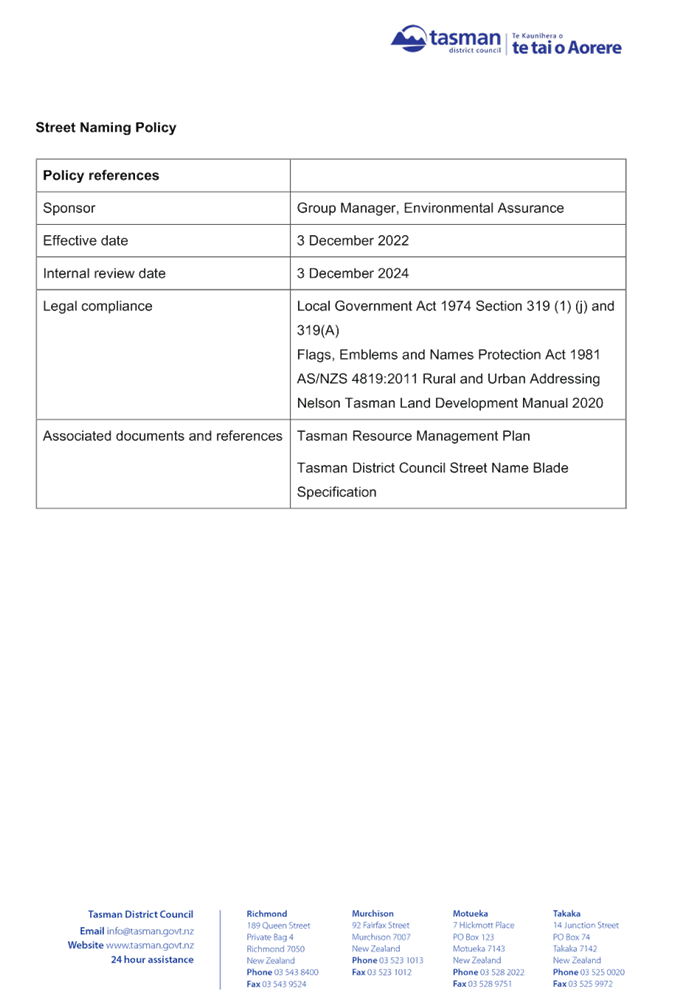
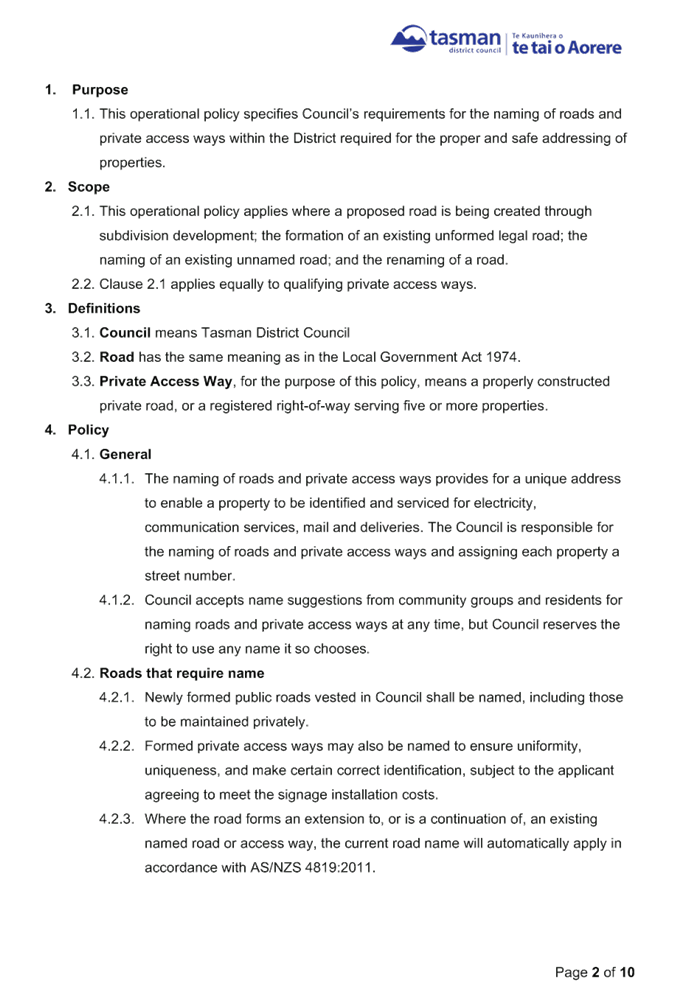
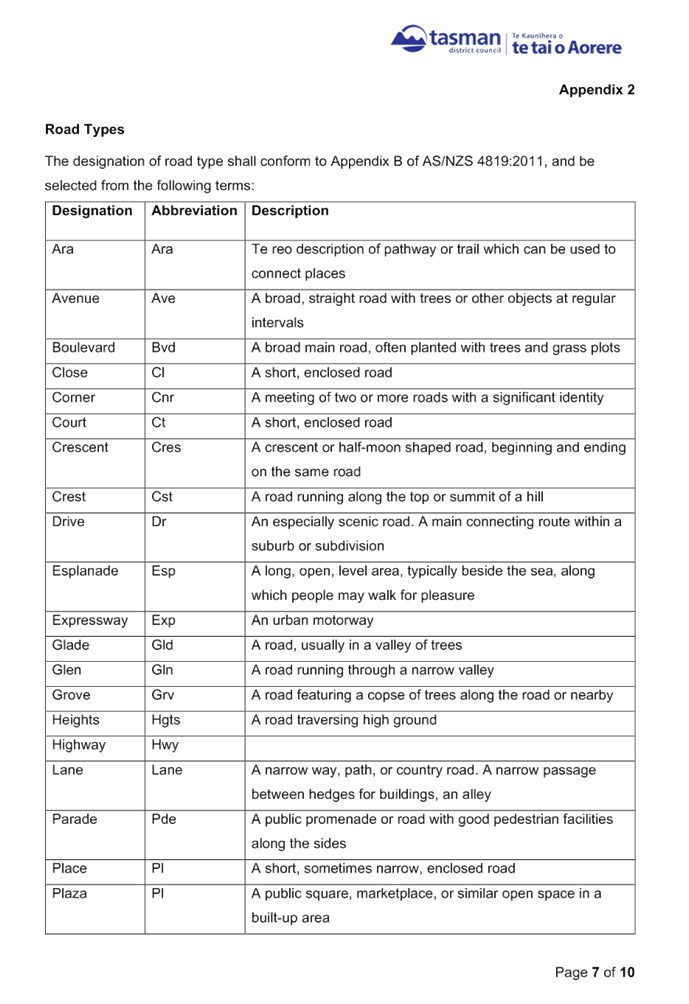
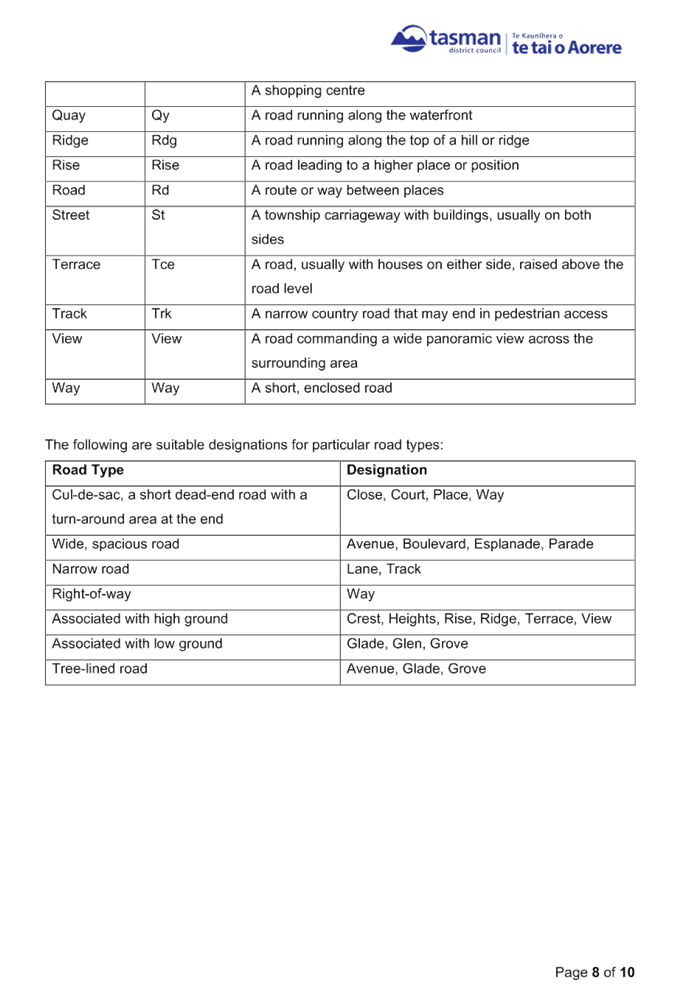
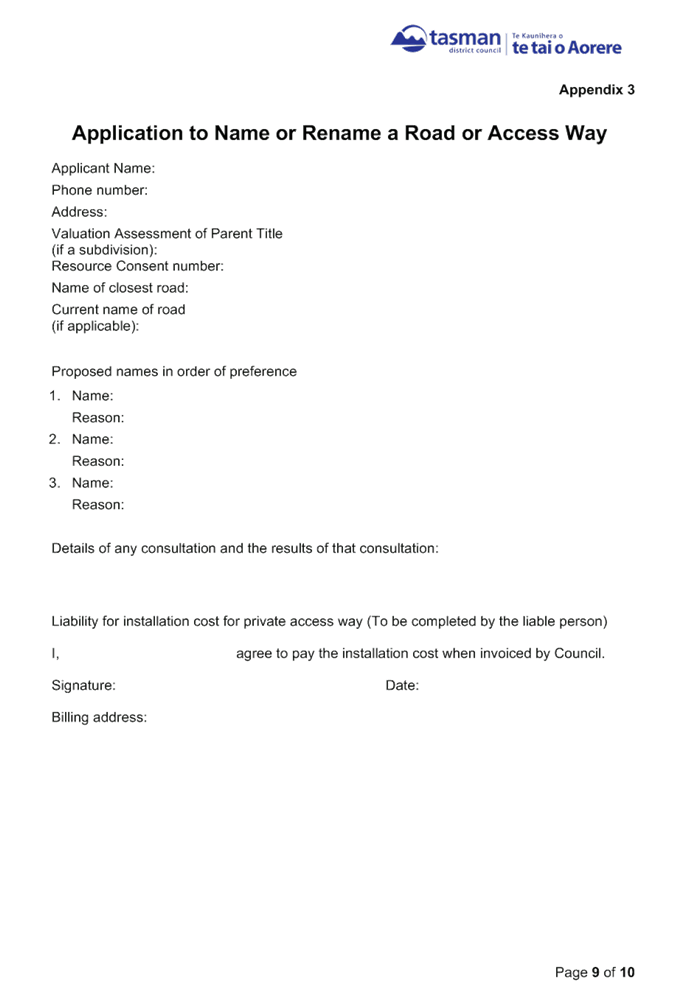

Tasman District Council Regulatory Committee Agenda – 02
December 2021
8.9 Chair's Report
Information Only - No Decision Required
|
Report To:
|
Regulatory Committee
|
|
Meeting Date:
|
2 December 2021
|
|
Report Author:
|
Dana Wensley, Chair - Regulatory
Committee
|
|
Report Number:
|
RRC21-12-9
|
1.1 Welcome
to the final Regulatory Committee meeting of 2021. When I wrote
my first Chair’s report for 2021 it was exactly one year ago to the day that
Prime Minister Ardern had announced that New Zealand was heading into its first
lockdown. At the beginning of this year, we had a feeling that as a region, we had
come out of the COVID-19 pandemic reasonably well. Little did we know that 2021
would bring a new set of challenges with the Delta variant, and that the fight with
COVID-19 was far from over.
1.2 Reflecting
on all that has happened and all the challenges we still face,
I want to take the opportunity to wish you all a happy and safe holiday season.
I also want to thank you for your hard work and commitment to this committee.
That
the Regulatory Committee receives the Chair's Report RRC-21-12-9.
3 Monitoring
and Compliance
3.1 We
are the committee that has the hard task of monitoring and enforcement
across a range of activities in this region. If we did not undertake this task,
environmental standards would be of little use because, (simply put) without monitoring
little enforcement can take place.
3.2 It
is sometimes a thankless task and a difficult area of the Council
to operate in, and I want to acknowledge the hard work and dedication of the team
of staff involved across multiple areas of the Council in these roles.
3.3 We
have in front of us today the air quality report by Diana Worthy,
Senior Policy Planner. It notes four exceedances in the last year. Her report records
that since 2012, daily PM10 concentrations have shown no overall
declining trend. Additionally, data demonstrates that the Airshed exceeded the 2021
World Health Organization’s daily guideline value of 15 ug/m3 a
total of 63 times.
3.4 This
is sobering news. I have received complaints about the air quality
in the Richmond airshed. Richmond’s urban centre is close to rural zones and
it is inevitable that this brings with it challenges with air quality. I received
one email from a ratepayer in the area questioning the number of permits we issue
each year to burn off green waste, and whether we were doing enough at the Council
to protect our airshed. Of particular concern seems to be the area around the new
subdivisions edging on to rural land. I note that Diana’s report states that
164 air quality related complaints were received in the last year, 116 of which
related to smoke.
4 Challenges and
Changes Ahead
4.1 There
are a staggering number of changes coming at us. Our role is to
represent our community and the people that live in this region. Sometimes, that
means advocating for them in the face of opposition from central government. I consider
it our job to ask the hard questions to ensure we get the best outcome for our ratepayers.
That does not mean that we have a negative attitude to change and reform, it merely
means that we may sometimes seem hesitant to do so without having full and robust
information upon which to make our decisions.
4.2 As a Council we have shown this year that we can consider and respond
to new challenges, whether it is COVID-19, the Resource Management Act or Three
Water reforms. We can be proud of our track record and the quality of the submissions
we provide that feedback our views to central government.
4.3 On
Monday 22 November I made oral submissions to the Environment Committee
on the Resource Management Housing Supply Bill. I undertook this (via zoom)
with Dennis Bush-King on behalf of Mayor King. I want to thank Dennis for his work
and guidance throughout the year and his commitment to this Committee. The Committee
acknowledged our submission. We followed Waimakariri District Council and
while they are a Tier 1 authority, there were many similarities in our submissions.
Nil.
Tasman District Council Regulatory Committee Agenda – 02
December 2021
2.3 Environmental Assurance Manager's Report
Information
Only - No Decision Required
|
Report To:
|
Regulatory
Committee
|
|
Meeting Date:
|
2 December
2021
|
|
Report Author:
|
Dennis Bush-King,
Group Manager - Environmental Assurance
|
|
Report Number:
|
RRC21-12-10
|
1.1 This report covers several general matters concerning the regulatory
activities of the Council since meeting of the Regulatory Committee on 21 October
2021.
|
That the Regulatory Committee:
1. receives
the Environmental Assurance Manager's Report RC21-12-10; and
2. endorses
the submissions made in respect of the Resource Management (Housing Supply and
Other Matters) Amendment Bill (Attachment 1), and the Discussion Paper on Wetland
Management (Attachment 2) contain in Report RC21-12-10; and
3. endorses the Enforcement
Policy attached as Attachment 5 to Rep RC 21-12-10 as a guide to staff in exercising
enforcement obligations on behalf of the Council; and
4. notes the Enforcement
Policy will be uploaded on to the Council website as information to the public
on how we meet our enforcement obligations following a style review by Communications
staff.
|
3.1
3.1 The
Select Committee considering the Government’s early exposure draft of the
Natural and Built Environments
Bill (NBEB) has reported back to Parliament.
3.2 The
majority of the Committee considered that the development of the NBEB should proceed,
and that the full Bill be introduced to the House of Representatives. Some of the
provisions in the exposure draft should be redrafted to better reflect the reform
objectives. Recommendations were reached by majority, and the report should be read
in this way. There are 37 specific recommendations which support most of Tasman
District Council’s submission. Not supported by Tasman District Council is
the recommendation that there be an option for environmental limits to be expressed
as a permitted maximum amount of harm or stress.
3.3 The
report recommends further work on:
· Te Tiriti O Waitangi principles
· Resolving conflicts between outcomes
· Regulations that need to be articulated in the National Planning Framework
(NPF)
· Planning committees, their role,representation, and secretariat functions
· Implementation principles.
3.4 The
Committee agreed there needed to be a substantial role for local authorities in
place-based planning, even though it supported having one plan per region. The Committee
noted the strong submissions from Tasman District Council, Nelson City Council and
Marlborough District Council about the different environmental character and issues
in our regions, and opposition to requiring a combined plan for all three councils
across Te Tau Ihu (the top of the South Island). Some Committee members agreed with
these concerns.
3.5 Local
government concerns raised about the NBEB plan process and the need for close engagement
with the sector were acknowledged and accepted. The Committee agreed that it is
important there is strong local democratic input in the making of NBEA plans. It
was accepted that local authorities have experience with consenting and broader
regulatory aspects, and it is important that local councils continue to play a substantial
role within the NBEB’s proposed plan-making framework. The Committee confirmed
that Māori had a critical role in plan making, including having advisers as
part of any secretariat, to advise on mātauranga Māori. Also flagged was
an ill-defined role for central government in assisting planning committees to achieve
as much consistency as possible when developing NBE plans.
3.5 Treaty settlements have established co-governance and co-management arrangements
regarding specific taonga which need to be upheld. Submissions from Māori set
out two approaches to partnership that could be incorporated within the NBEB. One
approach was to set up national and regional co-governance bodies, comprising iwi/hapū
appointees and local and central government appointees. Another approach included
the establishment of “mana whakahaere councils” and regional executive
committees which would comprise iwi, hapū, and Māori landowners.
3.6 The
Committee has reshaped the clauses on environmental limits and environmental outcomes,
shifting them out of the Purpose part of the Bill and created a new concept of Transitional
Limits which will be set in the NPF. Environmental targets may also emerge
as something to work within. There is still much uncertainty over how these
will apply and how internal conflicts will be reconciled.
3.7 The Committee suggested the carryover of all relevant definitions already
defined under the Resource Management Act 1991 (RMA) unless policy intent changes
were involved. It was noted that further direction on how principles of Te Tiriti
o Waitangi are to be given effect to is needed, including, but not limited to, local
government’s role in Treaty partnership.
3.8 The
Minister has established a steering group with local government Mayors and Chief
Executives to engage on the details of the reform proposals going forward.
4 Government Policy Statement
on Housing and Urban Development (GPS-HUD)
4.1 The
Government has published its Policy Statement
on Housing and Urban Development (GPS-HUD), a follow-up to its more specific National Policy
Statement on Urban Development (NPS-UD) from last year directing councils
to consider densifying their inner city suburbs. This latest GPS HUD was required
by October 1 under the Kāinga Ora – Homes and Communities Act 2019 and
must be reviewed every three years.
4.2 The GPS-HUD outlines the Government’s vision for housing and urban
development, informed by four aspirational outcomes and six focus areas. These priorities
outline the actions needed to take over the short to medium term to transform housing
and urban outcomes. The GPS-HUD signals Government’s commitment to adopting
new ways of working and partnering with individuals and organisations across the
housing and urban development system to deliver change, including expectations of
local government.
4.3 The
Tasman Region, despite having high unaffordability indices, is not listed as a housing
and urban development focus area.
5 Resource Management
(Enabling Housing Supply and Other Matters) Amendment Bill
5.1 Councillors
had a workshop on the proposed legislation that could allow up to three buildings,
three stories high on qualifying residential allotments. A submission was
prepared and is tabled for retrospective endorsement as the closing date was 16
November 2021 – see Attachment 1.
Changes to Wetland Rules
6.1 The
Government has proposed changes to the National Environmental
Standards as they affect activities involving the disturbance or destruction of
wetlands. The intent behind the changes is to be commended, which is to clarify
the application of the standards on such activities as quarrying, landfills, and
urban development; improve the definition of a natural wetland as it applies to
farms in pasture, along with other minor changes. A submission was circulated
for review prior to the closing date and is enclosed for endorsement
(Attachment 2).
Intensive Winter Grazing
(IWG)
6.2 The
Regional Sector has recently submitted its second quarterly report to the Minister
for the Environment on what is happening nationally, so it is timely that we update
Council on the Tasman experience.
6.3 Staff
undertook flyovers of Golden Bay and Murchison areas in
July to identify properties which were at risk of breaching the proposed IWG regulations.
Site visits were undertaken on these farms in early August and the visits proved
to be very beneficial allowing staff to assess IWG following the extreme weather
events experienced in Golden Bay during July. Pugging was seen to be a major
issue especially for those properties grazing on swedes as they were obviously disadvantaged
with the proposed pugging rules. No discharge of sediment or effluent to freshwater
was identified. Discussions and education focused on the sowing of critical source
areas and grazing of grass/crop buffer at the end of the IWG cycle. Concern was
expressed at the proposed dates for resowing, with a number of farmers indicating
they will not be undertaking IWG in the future. The proposed changes to the IWG
regulations have negated a lot of the concerns expressed by the farmers around pugging
and resowing dates. Educational site visits will continue and focus on critical
source areas, well established buffers and demonstrating good management practice.
6.4 Five community engagement meetings were undertaken within the Tasman
Region during October in conjunction with the Rural Support Trust and these covered
the entire suite of Freshwater related regulations including IWG. Some informative
discussions were had, and staff have a number of questions to follow up on. Farmers
spoken to are generally well informed and aware of the pending regulations, the
majority have engaged with one of the many groups providing guidance and support
on IWG practice. There has been strong collaboration between primary sector organisations,
farming groups and Council to ensure farmers are onboard and proactively thinking
about the 2022 IWG season. Staff have indicated that the upcoming 2022 winter will
be a ‘trial run’ for the new regulations, which are now expected to
come into force on 1 November 2022.
7 Waste Management Legislative Review
7.1 The
Ministry for the Environment is consulting on a reform of the waste management,
including a review of the Litter Act. Te kawe i
te haepapa para | Taking responsibility for our waste: Proposals for a new waste
strategy, the Government is dramatically changing the
approach to what it calls a circular economy approach and proposing a new legislative
framework. A workshop was held to brief Councillors on 17 November and submissions
close 10 December 2021 (extended from 26 November).
7.2 Any
new legislation is planned for 2023. The Government’s intention behind
the review is to:
7.2.1 ensure
the data, regulations and strategy are in place for transformational change
7.2.2 get
resource recovery and recycling systems working well
7.2.3 reduce
emissions from organic waste
7.2.4 stimulate
innovation and redesign for long-term change
7.2.5 understand
the scale and best approach for remediating past damage, and
7.2.6 establish
long-term information and education programmes.
7.3 At
the same time, but with a closing date of 16 December 2021, consultation is also
proceeding on new regulations controlling the collection, reuse and renewal of tyres
and large batteries!
8.1 The annual report
of regional council’s compliance monitoring and enforcement work has been
released. A copy of the National Summary and the figures for Tasman are reported
in Attachment 3. The full report can be made available on request.
8.2 There was some
media commentary on the fact that Tasman seemingly only monitored 57% of its 4,941
regional consents which required monitoring and that this was the lowest rating
(although Auckland and Waikato did not provide figures). The number of consents
requiring monitoring for Tasman (and remember our district consents are on top of
this figure) was second highest to that of Southland Regional Council, so we are
not sure how to interpret the percentage number. Environment Canterbury only reported
1,314 consents requiring monitoring which seems strange given they have a larger
number of water permits than most other Councils put together. Staff will seek clarification
prior to the next survey.
8.3 However, we accept
that we have not been able to get around to monitoring all the consents that should
technically be monitored by an on-site visit or assessed by other means. Staff
have to allocate their time to dealing with complaints and permitted activity monitoring
as well as consent monitoring and take a risk-based approach. While I cannot definitively
reassure the Committee, I would say that those consents that are not monitored annually
would be in the lower risk category.
9.1 The Parliamentary
Commissioner for the Environment, Hon Simon Upton, has released a report
on weeds in the environment and the threat they pose to native ecosystems. A summary
of key messages is to be found in Attachment 4 to this report.
9.2 The regional
pest management plan procedures come in for some fair criticism as being complicated,
inconsistent, and not very responsive to pest incursions. Other observations
from the report are that the ‘good neighbour’ rule has been ineffective,
the cost benefit obligations have not worked and focused on the wrong things, an
inference that pests targeted for control reflect public and political pressure,
and effort goes into monitoring actions and not outcomes. The Ministry for Primary
Industries, as lead agency is criticized as often missing-in-action, and that roles
and responsibilities across the sector are generally confusing. The passion and
commitment from individuals and community groups was acknowledged and Project De
Vine was a case study.
9.3 The
recommendations are largely targeted on the Government although one recommendation
does implicate regional councils and that suggests more effort is needed to scan
for, and respond to, emerging weeds of interest.
10.1 The Ministry
for the Environment is reviewing the Making Good Decisions
Programme, looking at the content, delivery, and effectiveness in light of the resource
management reforms. Making Good Decisions is the approved accreditation for
commissioners who sit on council hearing panels and make decisions under the RMA.
10.2 I am not sure if any members participated in the independent survey,
but the report has found the programme is largely meeting the needs of course participants
but there are opportunities for improvement including:
10.2.1 review the
structure of the programme to improve it for participants with varying levels of
knowledge and experience
10.2.2 include more
practical ‘on the ground’ training
10.2.3 help councils
identify and contact potential commissioners
10.2.4 greater use
of tikanga-based learning and encourage greater adoption of the programme
with Treaty partners
10.2.5 always use
appropriately experienced trainers to lead te ao Māori elements
10.2.6 more practical
training for chairs (e.g., managing conflicts of interest, obtaining specialist
advice and helping those with less understanding of hearings processes)
10.2.7 review the
training needs of experienced commissioners and how they can support the next generation
10.2.8 improve administration
of the course to handle complaints
10.2.9 develop tools
for continuous professional development, mentoring, regular practice knowledge updates,
and keep commissioners engaged through their career
10.2.10 improve access to content
to help lay witnesses with hearings processes.
10.3 The Ministry for the Environment (MfE) is looking at developing an online
platform for accredited persons to enable further professional development and training.
11 Tower Insurance Changes Flood Risk
Pricing
11.1 Tower Insurance have recently announced changes to the way they will
assess flood hazards from waterways and rainfall, and the associated risks to property
such hazards present. Tower has undertaken its own flood hazard assessment
for residential addresses across New Zealand, assigning them a risk rating.
Policy holders are able to download an app to access the data. Tower’s insurance
premiums will now reflect these risk ratings, with an increase for higher risk properties
and a decrease for lower risk properties. Tower’s risk assessment does
not presently include coastal inundation and erosion hazards.
11.2 Tower’s press release notes that their risk assessment uses data
obtained from New Zealand organisations and institutions, including the National
Institute of Water and Atmospheric Research (NIWA), Land Information New Zealand
(LINZ), territorial and regional councils and the Insurance Council of New Zealand.
Tower have reportedly included all publicly available flood defence and mitigation
measures into their risk assessment. Council staff have not been involved in the
risk assessment undertaken by Tower and are not privy to the results of this assessment.
11.3 The Council has provided hazard information, including Light Detection and
Ranging (LiDAR) derived elevation data, to the insurance industry over recent years
when requested. This is public information and there is no reason for Council
to withhold such information, nor is it Council practice to do so. The interpretation
of this data, the determining the risk such hazards present, and its application
to insurance premiums is solely Tower’s.
11.4 The Council currently provides natural hazard information upon request to
landowners and the wider public, including through the issuing of Land Information
Memorandum (LIMs). It is possible that the information Council holds on individual
properties, particularly any site-specific information, may differ from Tower’s
hazard and risk assessment. Council staff ensure that any hazard information provided
to ratepayers and the wider public is both accurate and current. Should an insurance
policy holder wish to challenge Tower’s risk assessment, it will be a matter
between them and Tower. Without knowing what Tower’s hazard and risk assessment
looks like across the Tasman region, it is not possible to comment further at this
time.
12.1 The Committee
asked staff to report back on whether the Council should move bore owners across
to telemetered water meters especially given the new Regulations in force.
MfE has accepted our interpretation that the regulations
do not make telemetry compulsory for all water meters and that weekly readings,
as are currently required, are sufficient.
12.2 If higher resolution data was collected, i.e., 15-minute volumes, our
water compliance monitoring database would still only be able to accept weekly volumes.
The weekly volumes are what compliance is based on for the majority of consented
takes. An upgrade of the database is not feasible at the present time.
12.3 Telemetry would likely cut down on the amount of weekly missing readings
and the staff effort associated with this. However, the data supplied may still
not be 100% accurate, with technical issues more predominant with such technology
and our experience suggests that third party suppliers are not as responsive as
they could be on behalf of their clients. To prove the accuracy of the data,
site visits are often required, requiring more staff time in visiting the meter
and auditing the readings.
12.4 There are cost implications for the water user and Council if telemetry
were made compulsory. For the user there would be the cost of the equipment and
installation along with ongoing data host costs. This may draw the ire of the majority
of water users who comply with Council’s requirement for weekly reporting.
There would be a cost to Council, as we would likely need to increase or redeploy
the staff resource if all 1478 or so metered bores were to be telemetered. We currently
manage 103 using this method.
12.5 Managing the data produced at scale would be yet another responsibility
to impose on the Council’s information system. The option of dealing with
a third-party data host for such a large number of users could become a complicated,
time consuming issue around the legality of who is responsible for any missing readings,
the consent owner or the data host.
12.6 There are some areas of the District that would have communication issues,
which would inhibit telemetry or force a large cost on the consent holder. An alternative
such as the current system would be needed in these situations.
12.7 While real time monitoring would avoid the missing return issue, we have
option of taking enforcement action against persistent offenders such as an Infringement
Fine or an Abatement Notice. An Infringement Fine for breaching Resource Consent
conditions (Weekly Readings required) is $500. An Abatement Notice is not designed
as punitive but a means to gain compliance. It carries a $750 fine if not complied
with and the prospect of prosecution. One would hope that if we employed these measures,
they would act to deter others. A further option could be to enforce telemetry
on repeat offenders, and this is contemplated in the consents.
12.8 The regulations require a pulse capable meter to be installed to allow
future datalogging. Tasman District Council has allowed existing meters that are not pulse capable to be ‘grandfathered’
if they are verified as accurate. As we are not requiring datalogging/telemetry,
there is no reason to enforce an extra cost on the consent holder to replace an
accurate meter if they were not requiring the use of the pulse capable functionality.
12.9 On balance, the staff view is not to enforce compulsory telemetry. It
would seem fairer to take a more robust line with individual offenders for missing
readings that are required by regulation, rather than penalise all for something
that is not compulsorily required by regulation.
13.1 The Council last adopted its Enforcement Policy in November 2016 (Resolution
EP16/11/03 refers). The Policy describes the approach taken, and options available,
in ensuring compliance with the many and varied rules and regulations the Council
has to enforce. It is an operational policy for staff, but it does reside
on the Council website as an outward-facing document to explain to readers our approach
to meeting our obligations. The 2016 Policy was held up as one of two examples
of a good Enforcement Policy in the Ministry for the Environment’s Guidelines
for Compliance Monitoring and Enforcement. However, the opportunity
has been taken following a recent review to refresh the Policy.
13.2 The main
changes made in the update in Attachment 5 include:
· An edit to trim down the size, including removal of all the legislation
administered but the essential structure has been retained
· A rewritten introduction
· Inserting a section on managing potential conflicts of interest
· Updating the section on who can make decisions
· Updating the policy to identify the triaging process which reflects,
and is proportional to, the nature of any breach or issue.
13.3 It is recommended that the Committee endorses the updated Enforcement
Policy. Subject to approval of the text, Comms staff will assist in improving
the format prior to uploading on the website.
14 Stewardship Land Consultation
14.1 The Department
of Conservation has released a discussion paper Stewardship
land reclassification - law reform which looks at the classification and disposal
process for stewardship land in New Zealand.
Submissions close 8 March 2022. It is unclear whether local authorities have
a role to play, and some of the land may be used for Treaty of Waitangi redress
so discussion will be held with iwi. However, it looks like there are about
246,262 hectares of land in Tasman District. The actual amount is unclear
as the dataset we have used picks up areas such as the Rainbow Conservation Area,
the St James Conservation Area, and Lyell Range. A lot of small areas involving
roads and streams e.g. Fern Flat Road, Dry Weather Road, Gravel Pit, St Arnaud,
Alexander Bluff Road are covered.
15.1 Attachment
6 is the Action Sheet which updates Councillors on action
items from previous Committee meetings relevant to the Regulatory portfolio.
|
1.
|
Resource Management (Housing Supply and Ohter Matters) Amendment
Bill
|
206
|
|
2.
|
Submission on Changes to Regulations Affecting Wetlands
|
212
|
|
3.
|
CME Metrics Report 2020-2021
|
220
|
|
4.
|
Down in The Weeds
|
222
|
|
5.
|
Enforcement Policy
|
226
|
|
6.
|
Action Sheet
|
236
|
Tasman District Council
Regulatory Committee Agenda – 02 December 2021
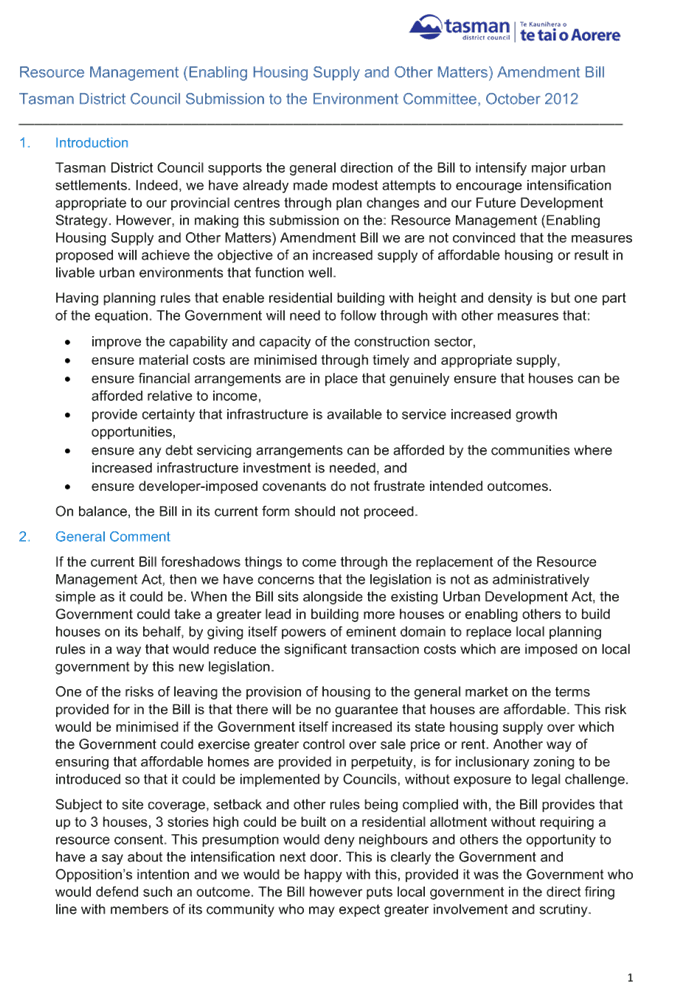
Tasman District Council Regulatory Committee Agenda – 02
December 2021
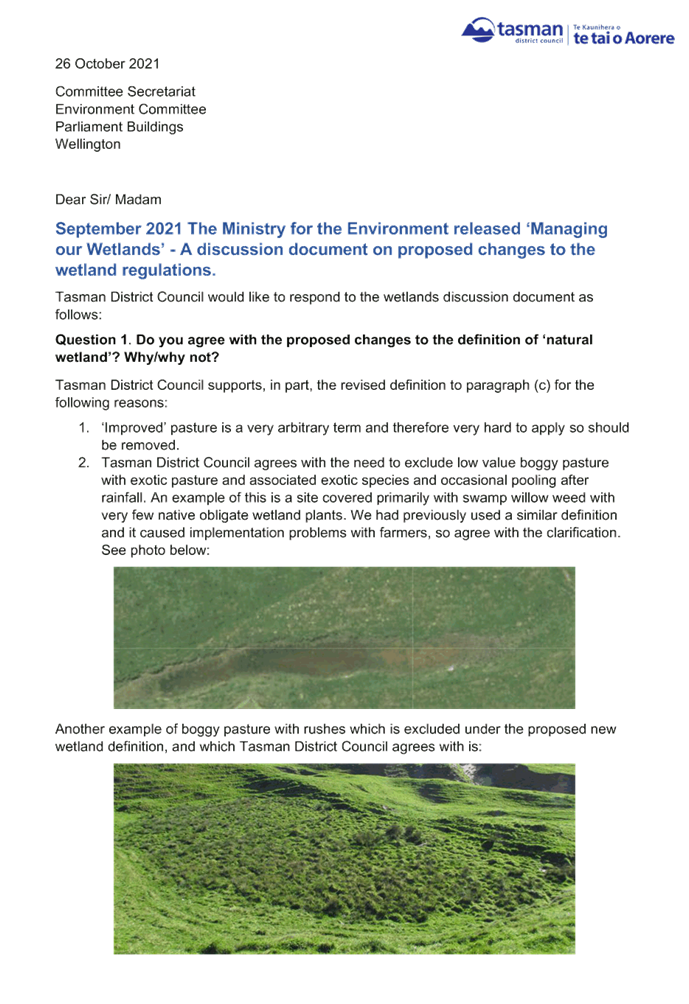
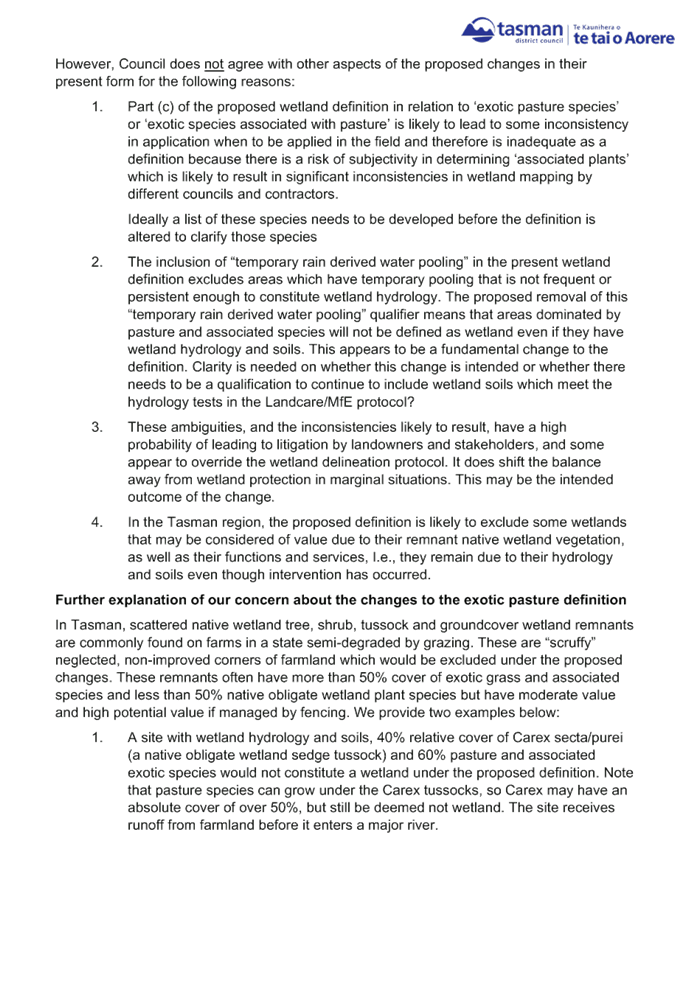
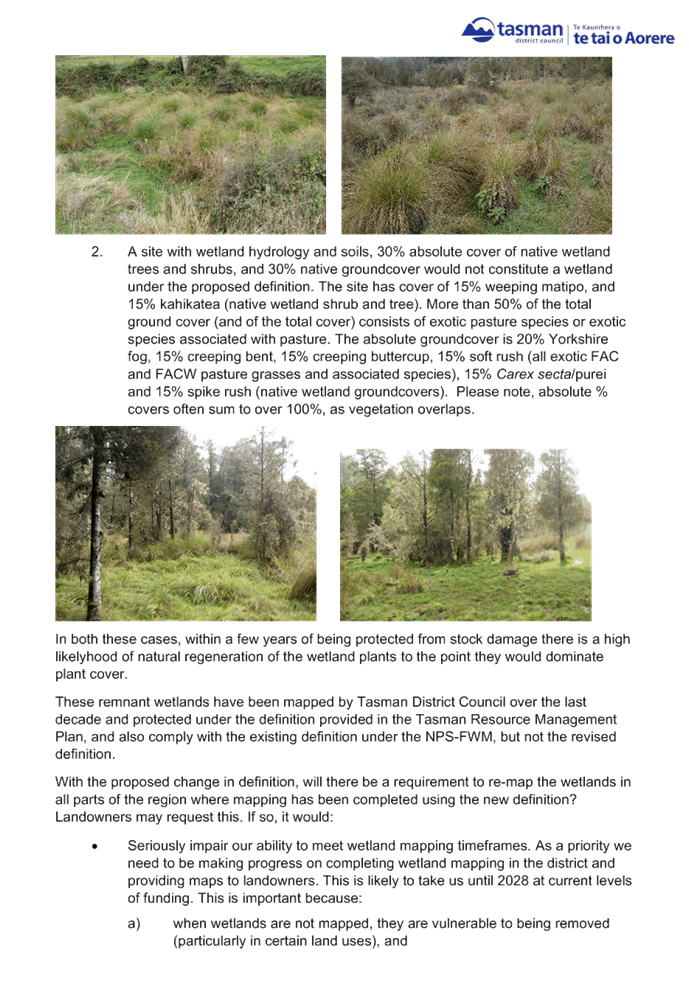

Tasman District Council Regulatory Committee Agenda – 02
December 2021
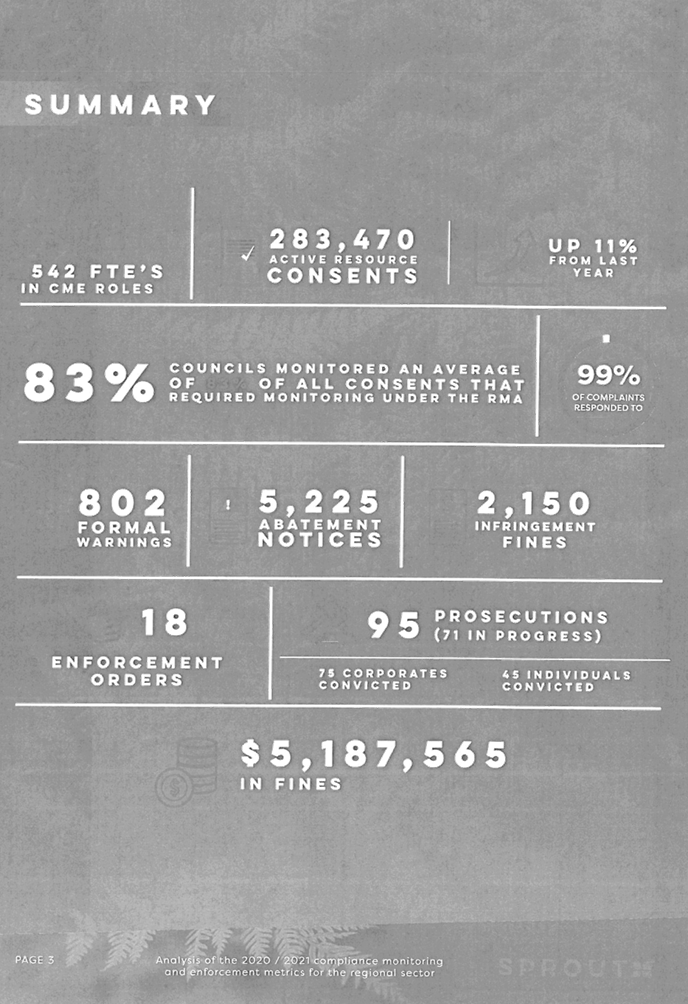
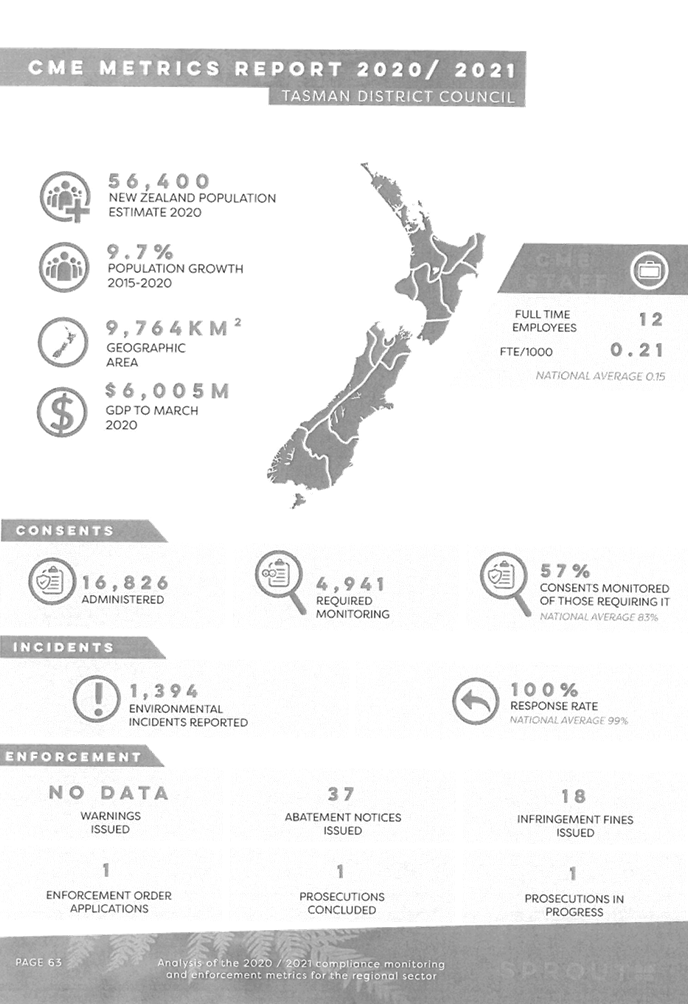
Tasman District Council Regulatory Committee Agenda – 02
December 2021
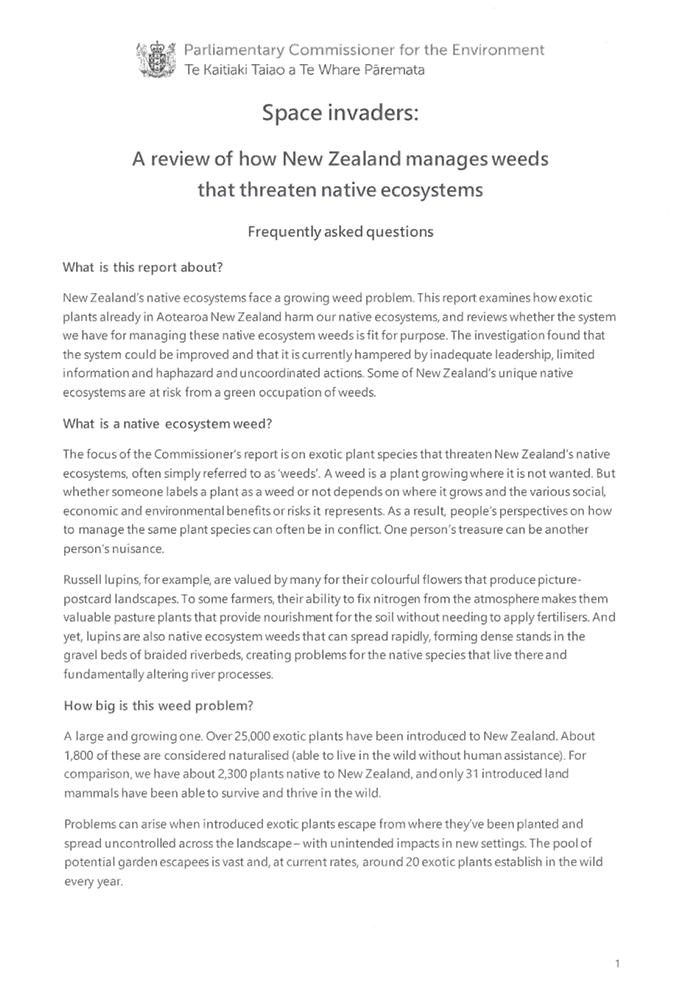
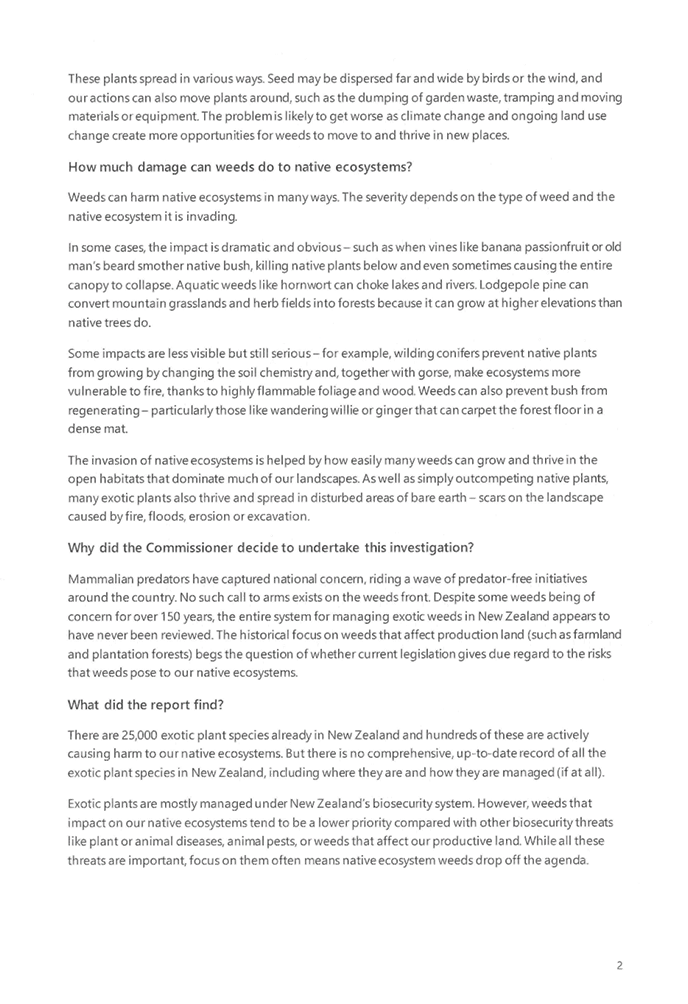
Tasman District Council Regulatory Committee Agenda – 02
December 2021
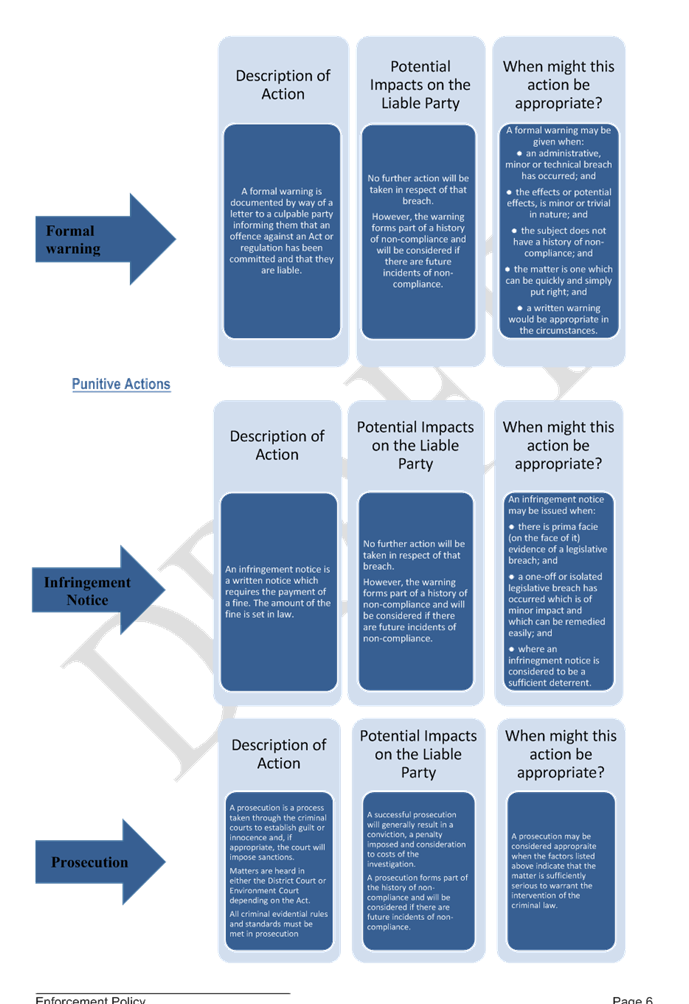
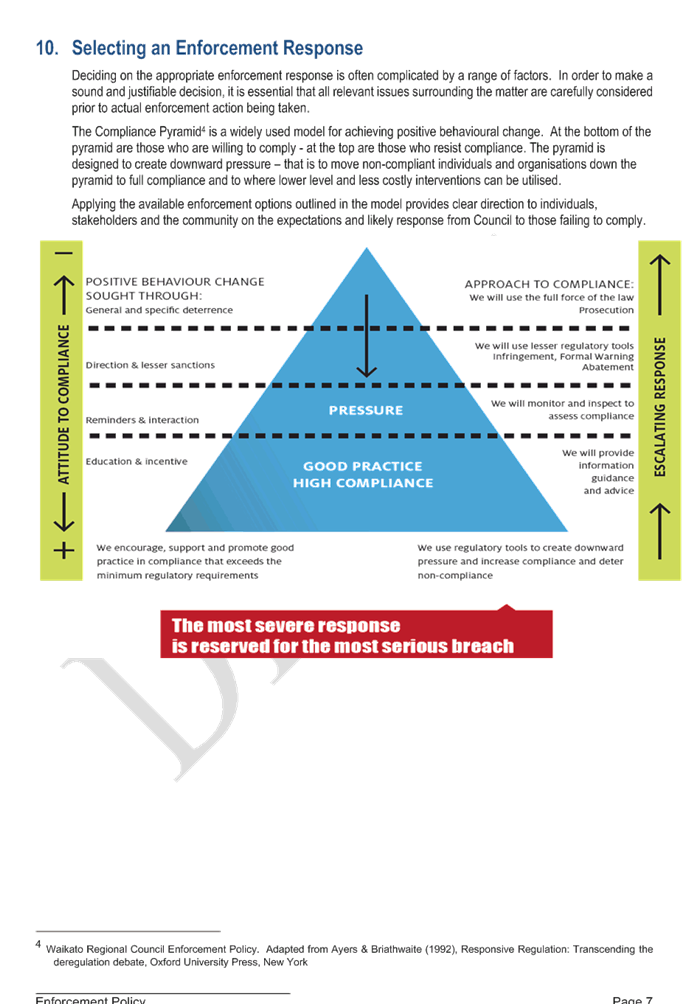
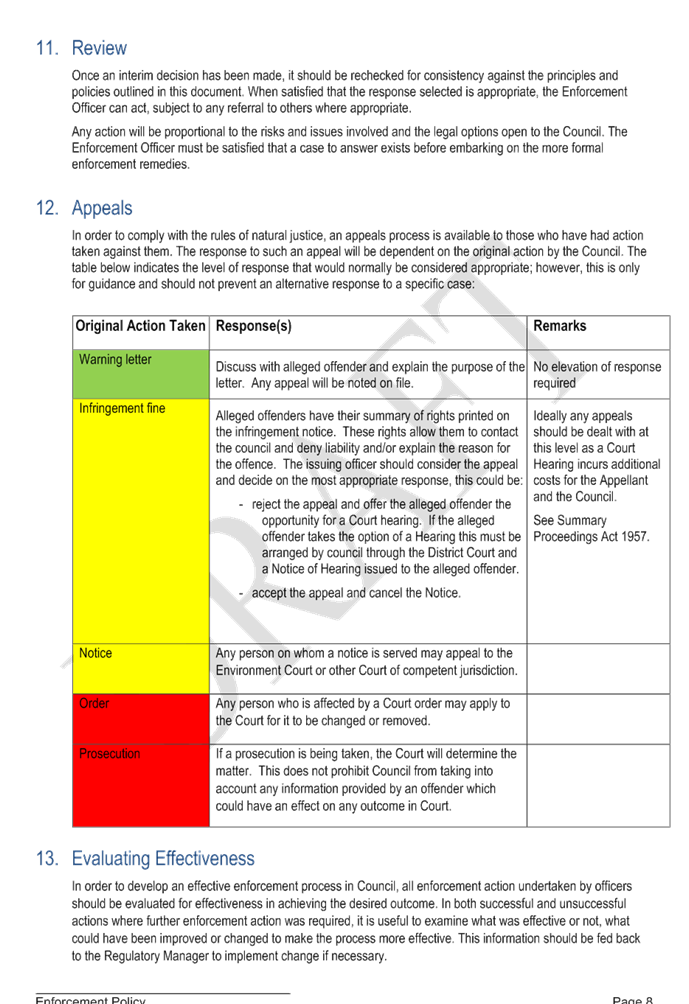
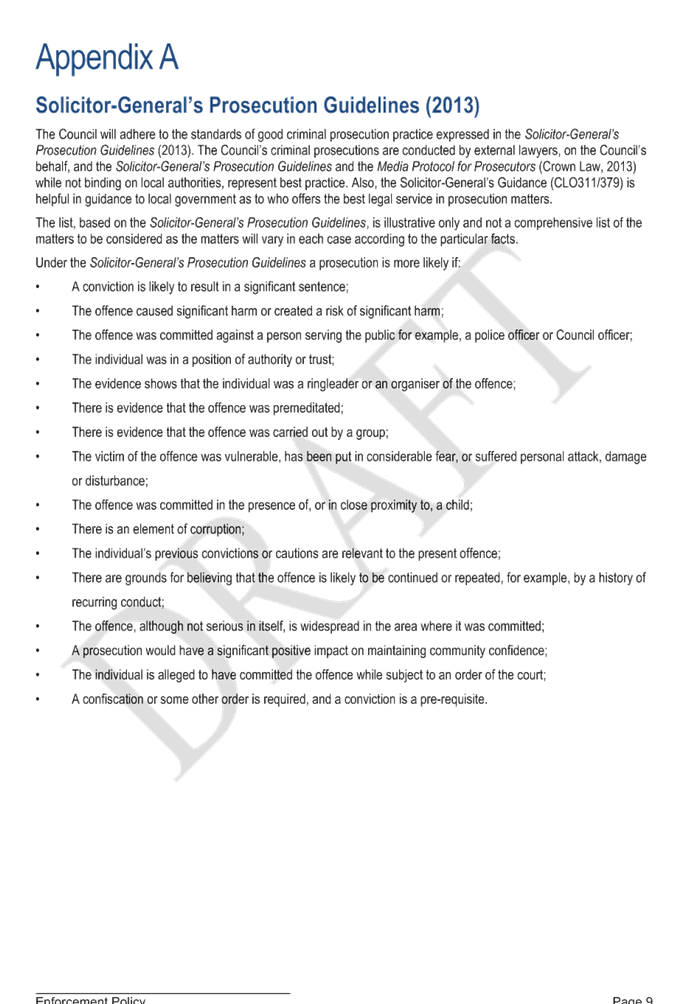
Tasman District Council Regulatory Committee Agenda – 02
December 2021


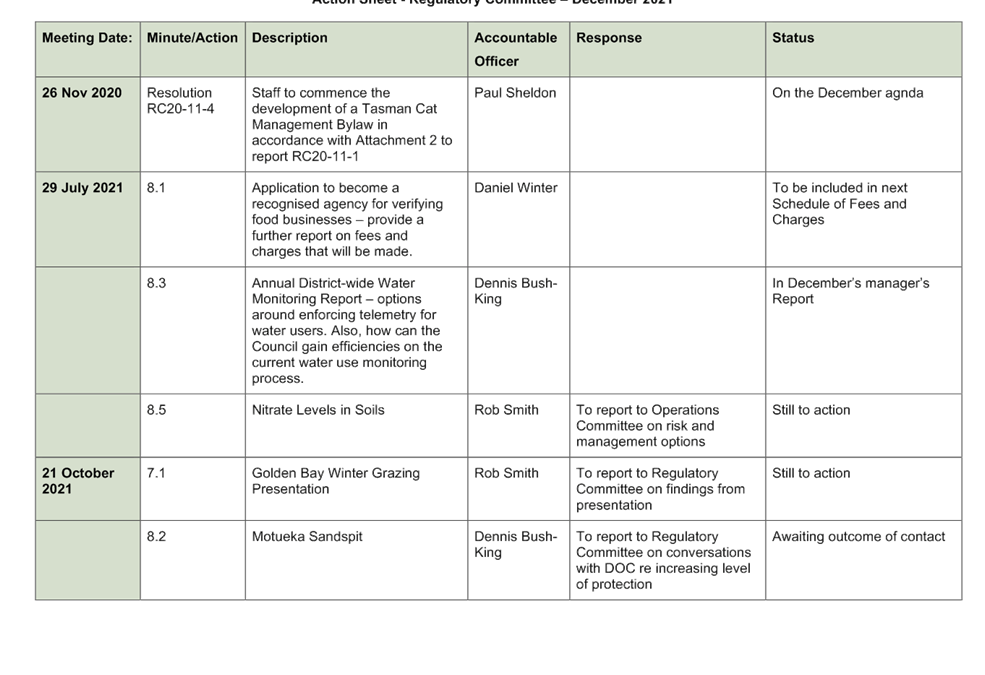
9.1 Procedural
motion to exclude the public
The following motion is
submitted for consideration:
That the
public be excluded from the following part(s) of the proceedings of this
meeting. The general subject of each matter to be considered while the public
is excluded, the reason for passing this resolution in relation to each matter,
and the specific grounds under section 48(1) of the Local Government Official
Information and Meetings Act 1987 for the passing of this resolution follows.
This
resolution is made in reliance on section 48(1)(a) of the Local Government
Official Information and Meetings Act 1987 and the particular interest or
interests protected by section 6 or section 7 of that Act which would be
prejudiced by the holding of the whole or relevant part of the proceedings of
the meeting in public, as follows:
9.2 Manager's
Report - Legal Matters
|
Reason for passing this resolution in relation
to each matter
|
Particular interest(s) protected (where
applicable)
|
Ground(s) under section 48(1) for the passing
of this resolution
|
|
The public conduct of the part of the meeting
would be likely to result in the disclosure of information for which good
reason for withholding exists under section 7.
|
s7(2)(f)(ii) - The withholding of the
information is necessary to maintain the effective conduct of public affairs
through the protection of such members, officers, employees and persons from
improper pressure or harassment.
s7(2)(j) - The withholding of the information
is necessary to prevent the disclosure or use of official information for
improper gain or improper advantage.
|
s48(1)(a)
The public conduct of the part of the meeting
would be likely to result in the disclosure of information for which good
reason for withholding exists under section 7.
|